

Zeitro Self-Employment Income Calculator for Mortgage
Instantly calculate qualifying self-employed income for loan pros.
Introduction
Calculating qualifying income for a self-employed borrower is easily one of the most tedious parts of mortgage origination. As a loan officer, spending hours manually cross-referencing IRS tax transcripts and Schedule C forms is a massive time drain. That is why we built the Zeitro Self-Employment Income Calculator.
Designed specifically for loan officers and processors, this tool automates the entire cash flow analysis. With over 10,000 accurate calculations completed, this calculator saves an average of 30 minutes per file, allowing you to deliver faster pre-approvals while staying completely compliant with agency guidelines.
Highlights
How to Calculate Self-Employed Income for Mortgage?
Determining a self-employed borrower's income requires more than just looking at their gross receipts. Underwriting standards from Fannie Mae and Freddie Mac require a thorough cash flow analysis based on the specific business entity.
Here is how our engine calculates stable monthly income in three compliant steps:
- Analyze Tax Documents: We evaluate the past two years of personal tax returns (Form 1040) and business returns, checking for income continuity and consistency.
- Identify Business Structure: Calculations vary because different structures have different formulas:
- Schedule C: We use the net profit as a baseline, add back non-cash expenses, like depreciation or amortization, and subtract non-recurring income.
- Partnerships & S-Corps (K-1): For borrowers with a 25% or greater ownership interest, we evaluate business income and cash flow under self-employment guidelines, and we also review K-1 income under the applicable ownership rules.
- Corporations: We analyze company tax returns (Form 1120) to confirm positive sales and earnings trends before qualifying corporate income.
- Perform Monthly Averaging: Once the adjusted income for Year 1 and Year 2 is calculated, we apply the standard two-year averaging method.
Documents Required to Calculate Self-Employed Income
To ensure a seamless underwriting process, collecting complete tax packets upfront is critical. Here are the standard documents required based on the borrower's entity:
- Sole Proprietor (Schedule C)
Personal Tax Returns (Form 1040), Schedule C, IRS Tax Transcripts, and a YTD Profit and Loss Statement.
- Partnership (Form 1065)
Partnership Tax Returns, Schedule K-1 (Form 1065), and a signed YTD Profit and Loss Statement.
- S Corporation (Form 1120S)
S-Corp Tax Returns, Schedule K-1 (Form 1120S), and a current Balance Sheet.
- Corporation (Form 1120)
Corporate Tax Returns (Form 1120) and a Year-End Balance Sheet to verify business asset liquidity.
- Independent Contractor
Form 1040, Schedule C, 1099 Forms, and recent business bank statements to confirm consistent income continuation.
Benefits of Using an Online Self-Employed Income Calculator
Why should busy originators stop using manual spreadsheets? Here are four major benefits:
- 1Instant Auto-Calculation
Simply upload documents to analyze complex cash flow statements in seconds.
- 2Agency Guideline Compliance
Our calculation engine strictly matches current Fannie Mae and Freddie Mac rules.
- 3Bank-Grade Data Security
Advanced encryption keeps your borrower's sensitive tax documents completely protected.
- 4Accelerated Processing Speeds
Skip hours of manual calculations and deliver faster client pre-approvals.
Common Self-Employed Income Types
Self-employed income comes in many forms, and loan programs underwrite them based on the borrower's ownership percentage:
- Schedule C Income: Earned by sole proprietors and 1099 independent contractors, calculated directly from the net profit line.
- Schedule K-1 Income: Distributed to owners in Partnerships or S-Corporations. Borrowers with 25% or more ownership are analyzed under full business guidelines.
- S Corporation Income: Income from S-Corps is evaluated through business tax returns, cash flow analysis, and the business's ability to sustain distributions.
- Corporation Income: Standard corporate earnings verified via Form 1120.
- Rental Income: Supplemental rental revenue documented on personal tax returns under Schedule E, calculated using net income plus depreciation add-backs.
FAQs About Calculating Self-Employed Income
Q1. How many years of self-employed income are required?
Q2. Can I qualify with only one year of self-employment?
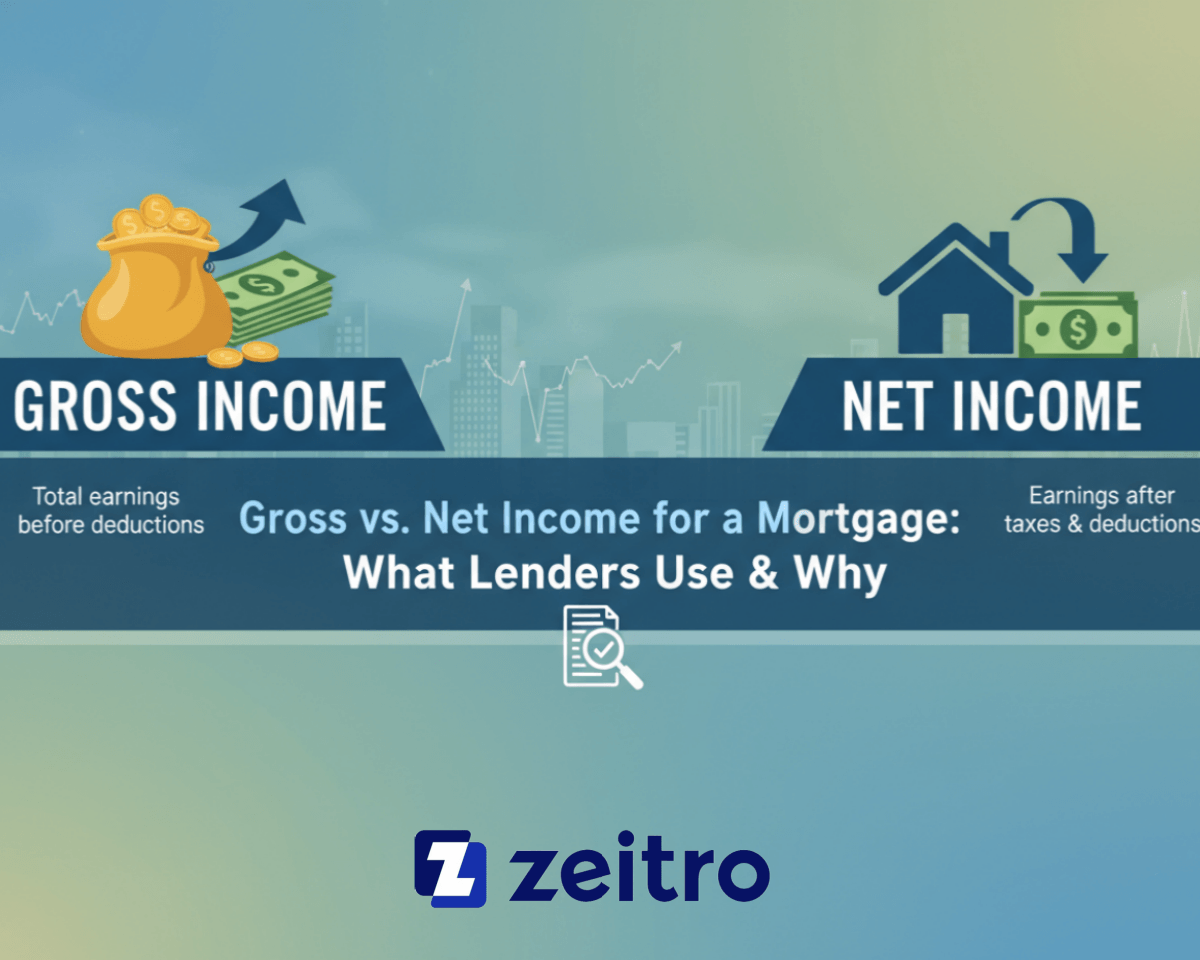
Q3. Do mortgage lenders use gross or net income?
Q4. Does depreciation count as income?
Q5. How is K-1 income calculated?
Q6. Can declining income affect mortgage approval?
Other Mortgage Tools to Consider
You Might Be Interested In

Calculate qualified self-employed income in seconds.
Calculate Now →Get started with
Zeitro Strata

Contact us
Let us know how we can help

+1 669-388-1928

contact@zeitro.com

10275 N De Anza Blvd Cupertino, CA 95014