Written by

Eric
Share this article

.svg)
Subscribe to updates
Last Checked and Updated on September, 2026
When I first started working in secondary marketing, rate volatility genuinely scared me. You lock in a borrower's rate today, and if the market shifts even a little before that loan closes, your entire profit margin can vanish. That's exactly the problem mortgage pipeline hedging solves. It's the defense mechanism lenders rely on to keep their bottom line intact no matter which way rates swing. Let's break down how it actually works.
Also Read:
- Mortgage Pipeline Management: Ultimate Guide & Best Practices
- Best Mortgage Pipeline Management Software: Streamline Workflow
Key Takeaways
- Pipeline hedging works like an insurance policy, shielding a lender's margin from rate swings between lock and sale.
- The goal is margin preservation, not chasing extra profit through market bets.
- Everything hinges on an accurate pull-through rate, the share of locked loans that actually make it to closing.
- TBA (To-Be-Announced) MBS trades remain the go-to hedging instrument for most originators, though forward sales and options both have their place.
- A separate but related discipline, MSR hedging, protects the value of servicing rights a lender already owns, and it's worth understanding the difference.
What is a Mortgage Pipeline?
Picture a mortgage pipeline as a conveyor belt that never stops moving. The moment a borrower locks an interest rate, their loan steps onto that belt. At the far end sits the closing table, and beyond that, the sale of the loan into the secondary market.
Every loan sitting on that belt right now, locked at a set rate but not yet closed or sold, makes up your pipeline. Here's the lesson that took me a while to fully absorb: this belt moves slower than most people expect, often 30 to 60 days from lock to funding. During that window, the lender is the one holding the risk. If the market moves before the loan reaches the finish line, the value of that asset moves with it. Industry veterans call this stretch of vulnerability your time exposure, and it's the entire reason hedging exists.
What Is Mortgage Pipeline Hedging?
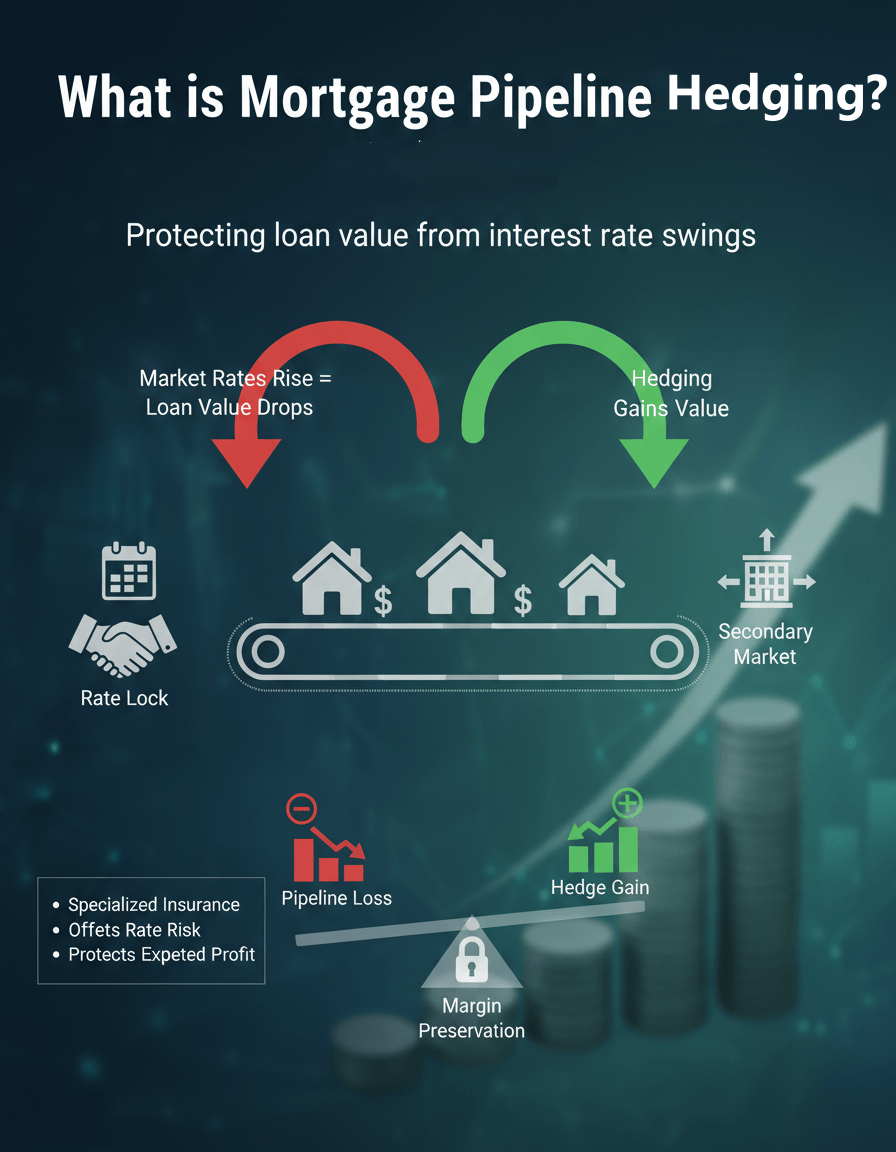
So how do you protect a conveyor belt full of exposed loans? Mortgage pipeline hedging is essentially a specialized insurance policy built for originators. When you lock a rate for a homebuyer, you're committing to a fixed price. If market rates climb before you sell that loan, the value of your borrower's now-below-market loan drops.
Hedging means taking a position that moves opposite to your locked loans. When the loan loses value, the hedge gains value, and vice versa. This isn't about speculating for extra upside; it's purely about margin preservation. By offsetting potential losses on the secondary market side, lenders can lock in the profit they originally underwrote, regardless of what the Federal Reserve does next.
Why Is Mortgage Pipeline Hedging Important in 2026?
You don't have to look far for proof of why this matters right now. In just the first two weeks of September 2026, the average 30-year fixed rate climbed from around 6.7% to nearly 7.1%, according to Optimal Blue's daily rate observations, its highest point in over a year. Freddie Mac's weekly survey told a similar story, with the 30-year average rising to 6.76% as of September 10, up from 6.35% the same week a year earlier. The trigger was a mix of renewed geopolitical tension in the Middle East, hotter-than-expected inflation data, and growing expectations that the Federal Reserve would raise rates for the first time since 2023.
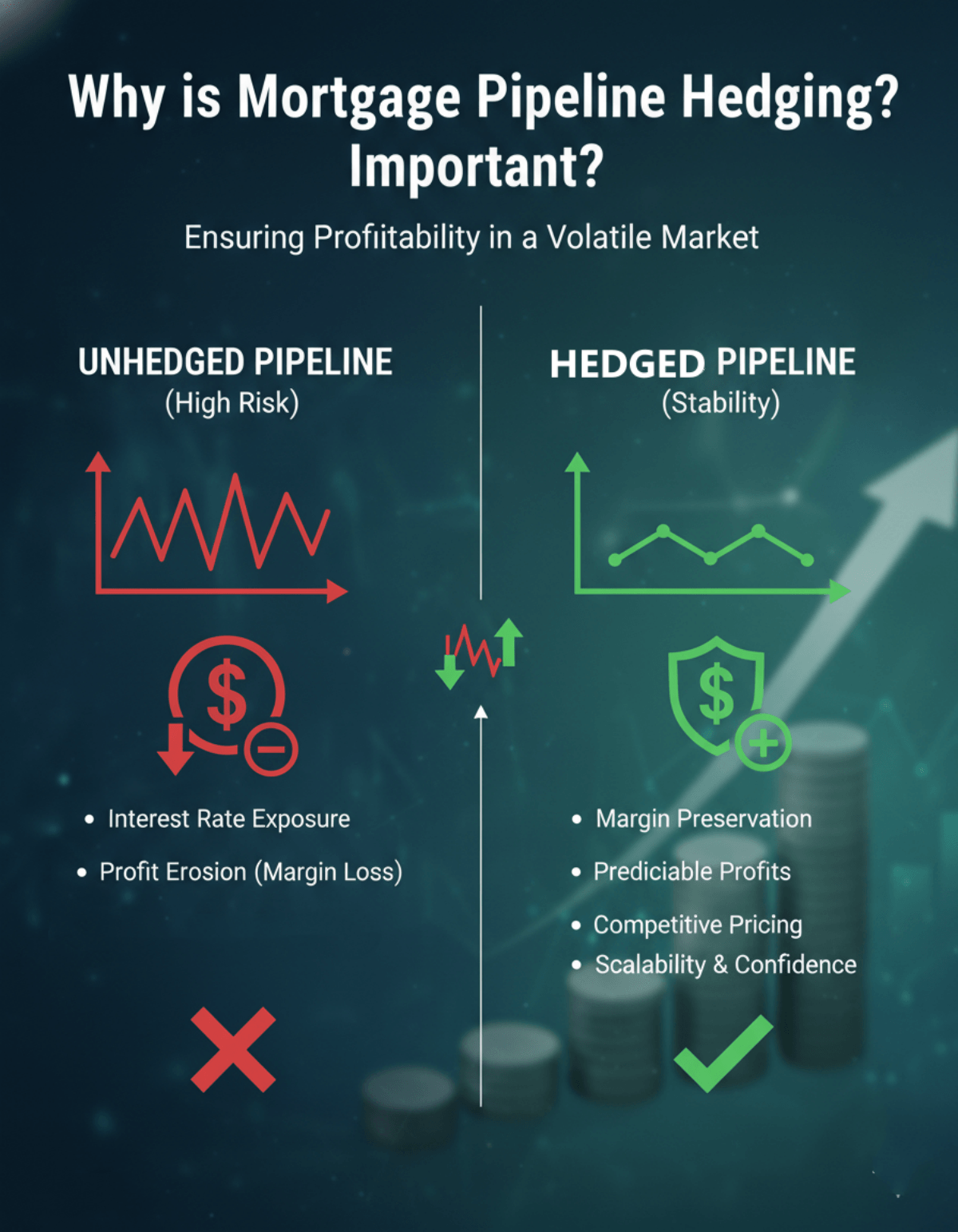
That kind of move is exactly what an unhedged pipeline can't survive. A sudden 50-basis-point jump in rates can wipe out most, if not all, of the origination margin baked into a lender's pricing. I've watched mid-sized shops transform their entire business simply by putting a proper hedge program in place. Done right, it lets you offer sharper pricing to borrowers, scale volume with confidence, and stop losing sleep every time bond markets get volatile.
Skip hedging altogether and you're accepting full, unmanaged exposure to whatever the market does next. In a year where rates have already swung by nearly a full percentage point, that's a bet few lenders can afford to make.
Mortgage Pipeline Hedging Example
Here's a real-world scenario. Say your institution just locked $10 million in borrower mortgages at 6.75%. A month later, inflation data comes in hot, geopolitical headlines rattle the bond market, and rates jump to 7.25%.
Suddenly, secondary market investors don't want your 6.75% loans anymore. They want fresh 7.25% paper instead. To move that $10 million batch, you'd have to sell it at a steep discount, and that discount comes straight out of your pocket.
But if you'd hedged, you would have shorted TBA securities the moment those loans were locked. As rates rose, the value of those TBA positions fell, and because you were short, that drop turned into a gain. That trading gain offsets the discount you had to eat on the physical loans, leaving your original margin essentially untouched.
How to Hedge Mortgage Pipeline Risk
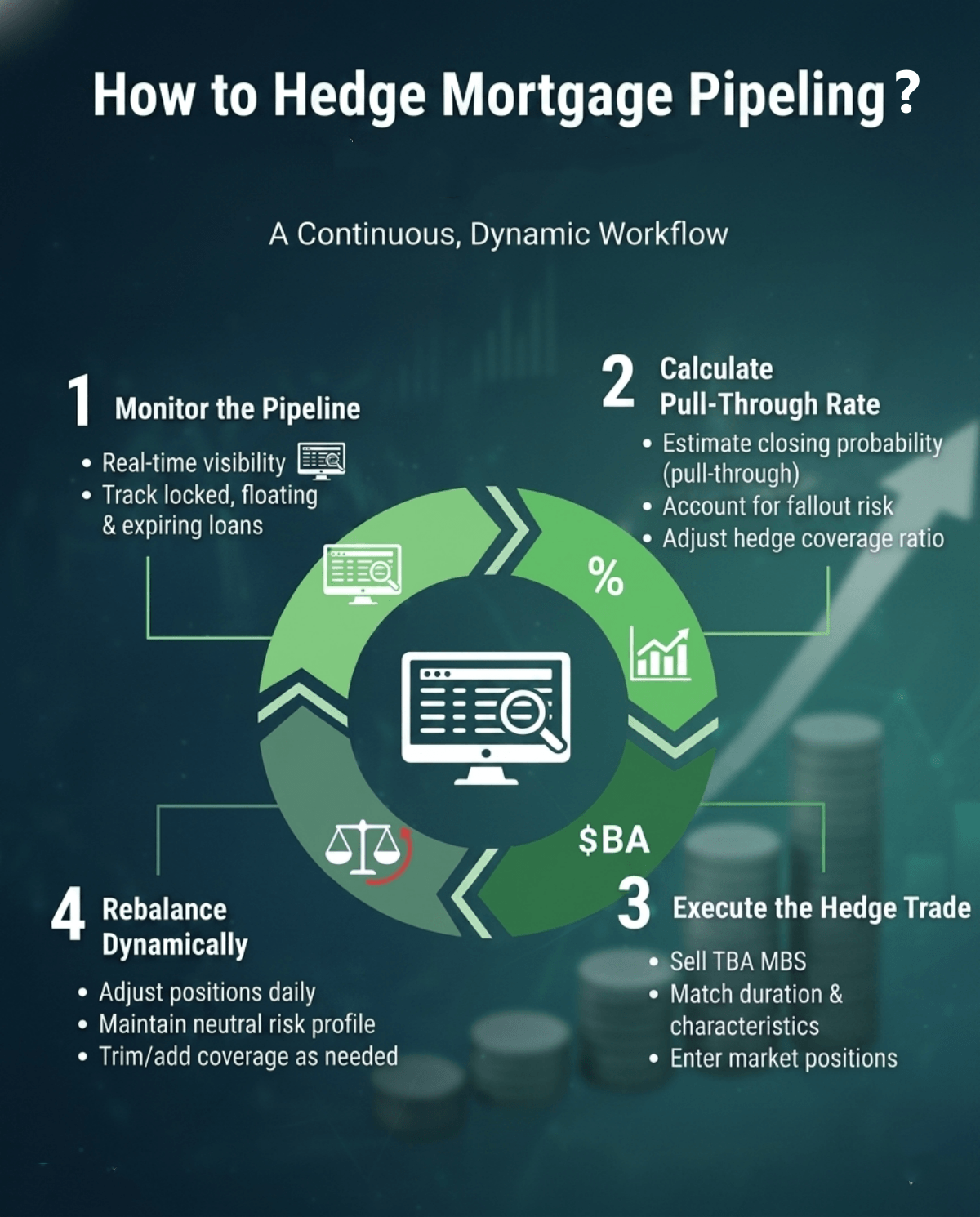
Building a dependable hedge program isn't a "set it and forget it" job. After years of trial and error, I've learned that effective hedging comes down to a tight, ongoing workflow.
- Monitor the Pipeline: You need real-time visibility into every application, so you always know what's locked, floating, or about to expire.
- Calculate Your Pull-Through Rate: This is arguably the most important step in the whole process. Not every locked loan actually closes; some borrowers walk away, a process finance professionals call fallout risk. MCT, a well-known mortgage hedge advisory firm, defines pull-through as the probability at a given moment that a specific rate lock will actually close and fund. That probability isn't static. It shifts based on the loan's origination channel, how far current market rates have moved from the locked rate, whether the loan is a purchase or a refinance, how far along it is in underwriting, and how much time is left before the lock expires. A freshly locked loan might carry a 70-75% pull-through assumption, while a loan that's already cleared underwriting and is heading to the closing table could be assumed at 90% or higher. Get this number wrong in either direction, and you'll either over-hedge and eat unnecessary trading losses, or under-hedge and leave real exposure on the table.
- Build a Rolling Forecast: Pull-through isn't a one-time calculation. Mortgage pipeline forecasting means continuously blending your historical closing data, current lock volume, and today's rate environment into a live estimate of how much of your pipeline will actually fund, and when.
- Execute the Hedge Trade: Once you know your true exposure, you enter the market, typically selling TBA mortgage-backed securities that match the duration and characteristics of your locked loans.
- Rebalance Constantly: Markets move daily, and so does borrower behavior. Positions need to be trimmed or added as loans fund, fall out, or as rates move, to keep your risk profile as close to neutral as possible.
Mortgage Pipeline Hedging Strategies
There's no single playbook here. Depending on an institution's size, liquidity, and appetite for risk, secondary marketing teams typically lean on a handful of core tools.
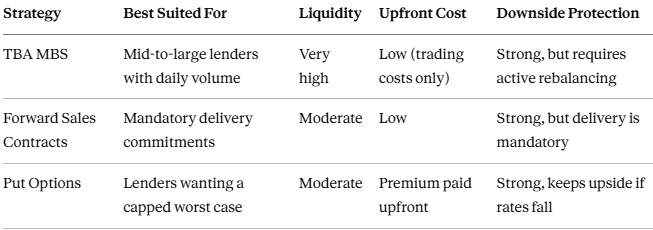
- TBA (To-Be-Announced) MBS Market: This is the industry standard for mid-to-large lenders, and for good reason. When you sell a TBA, you're agreeing on the issuer (Fannie Mae, Freddie Mac, or Ginnie Mae), coupon, term, price, and face amount up front, but the exact loan pool isn't identified until 48 hours before settlement, which is where the "to-be-announced" name comes from. That structure gives TBAs enormous liquidity, which makes it easy to enter and exit positions as your pipeline shifts day to day.
- Forward Sales Contracts: Common for mandatory delivery, this is an agreement to sell a set volume of loans to an investor at a locked-in price on a future date. It guarantees your margin, but it comes with strict delivery obligations.
- Options (Put Options): Some lenders buy put options on Treasury or MBS futures as a form of disaster insurance, paying a premium upfront. This caps your downside if rates spike while still letting you benefit if rates fall, though the upfront cost can add up.
It's worth being clear that none of this is directional trading in the speculative sense. A hedge desk isn't betting on where rates are headed; it's building a position that neutralizes exposure regardless of direction. That distinction matters, especially to auditors and boards who want to see risk management, not a proprietary trading operation.

TBA vs. Forward Sales vs. Options at a Glance
Convexity Hedging: Why MBS Hedging Is Back in the Headlines
Pipeline hedging isn't the only kind of mortgage hedging making news this year. In June 2026, Bloomberg reported that a phenomenon traders nicknamed the "beast" was making a comeback in the Treasury market: convexity hedging by MBS investors and servicers.
Here's the short version. When mortgage rates were near record lows, the MBS market held mostly low-coupon bonds trading well below par, so there was little incentive for anyone to hedge against further declines. That's changed. Barclays estimates that MBS carrying coupons of 5% or higher now total more than $2 trillion, roughly four times the amount from three years earlier. As those securities trade closer to par, their prices become far more sensitive to rate moves, which forces holders to actively hedge duration risk by trading Treasuries. Goldman Sachs estimated that last month's selloff alone pushed active MBS hedgers to take on interest rate exposure equivalent to buying an extra $40 billion of 10-year Treasuries.
This is a different animal from pipeline hedging. Pipeline hedging protects an originator's short-term exposure between a rate lock and a loan sale, typically a matter of weeks. Convexity hedging operates at the portfolio level, protecting investors and servicers who hold MBS or servicing rights for years and need to manage how prepayment speeds shift as rates move. The two aren't interchangeable, but they're connected: as rates get more volatile, both forms of hedging activity tend to increase at the same time, which is exactly what's playing out in the market right now.
Pipeline Hedging vs. MSR Hedging: What's the Difference?
It's easy to lump these together since both fall under the "mortgage hedging" umbrella, but they solve different problems.
Pipeline hedging protects the short window between when a borrower locks a rate and when that loan closes and sells, usually 30 to 60 days. The risk is that market rates move before the loan can be delivered.
MSR (mortgage servicing rights) hedging protects an asset a lender already owns outright: the right to service a loan over its life and collect the servicing fee. Servicing rights lose value when rates fall, because falling rates trigger more refinances and homeowners pay off their old loans early, cutting the income stream short. Hedging an MSR portfolio typically involves interest rate swaps, swaptions, or Treasury and agency MBS positions designed to move opposite to the servicing asset, and it's managed on a timeline of years rather than weeks.
If you're a smaller originator just getting your pipeline hedge program off the ground, MSR hedging probably isn't on your radar yet, and that's fine. But it's worth knowing the distinction so you're not confused when the two terms show up in the same conversation.
Best Efforts vs. Mandatory Delivery: A Closer Look
This choice sits right at the center of whether or not hedging even makes sense for your shop, so it deserves more than a passing mention.
Under best efforts delivery, you commit to selling a loan to an investor only if it actually closes. If the borrower walks away or the deal falls through, you owe nothing. That safety net comes at a cost: investors price best efforts loans lower because they're absorbing your fallout risk for you.
Under mandatory delivery, you commit to delivering a specific volume of loans, or paying a pair-off fee if you come up short. Because the investor isn't taking on fallout risk, mandatory pricing is consistently stronger. Historically, lenders moving from best efforts to mandatory delivery have picked up somewhere between 10 and 50 basis points in price improvement, with roughly 25 basis points being a reasonable average across market cycles.
There's a regulatory angle here too that a lot of lenders overlook. Under FDIC guidance, a mandatory delivery commitment is generally treated as a derivative, since the lender is on the hook to either deliver the loans or settle a pair-off fee, which counts as net settlement. That means it has to be carried at fair value on the balance sheet. Best efforts commitments, by contrast, usually aren't classified as derivatives before the underlying loan closes. In practice, this means a shift to mandatory delivery isn't just a pricing decision, it's an accounting one, and it's exactly why mandatory delivery and pipeline hedging tend to go hand in hand: once you've taken on that market risk, you need a real hedge program to manage it responsibly.
Should You Hedge In-House or Work With a Hedge Advisory Firm?
Once a lender decides to move to mandatory delivery, the next question is who actually runs the hedge desk. Larger institutions often build this in-house, hiring dedicated secondary marketing staff and licensing real-time pricing and trading tools. Smaller and mid-sized lenders more commonly outsource the job to a mortgage hedge advisory firm.
Firms like MCT (Mortgage Capital Trading) specialize in exactly this: they build the pull-through models, execute TBA trades on the lender's behalf, monitor positions throughout the day, and rebalance as loans fund or fall out of the pipeline. For a lender without the volume to justify a full trading desk, this outsourced model can deliver institutional-grade risk management without the overhead of building it from scratch.
To be clear, tools like Zeitro's Pricing Engine aren't a substitute for a hedge advisory relationship; they don't execute TBA trades or manage hedge positions. What Zeitro's Pricing Engine does is give your team accurate, up-to-the-minute rate sheets across conventional and Non-QM products in one place, which cuts down on manual pricing errors upstream. Cleaner pricing and lock data feeds directly into more reliable pull-through assumptions, which is exactly the input your hedge advisor needs to do their job well. Pairing solid pricing infrastructure with the right hedge partner is often what separates lenders who survive volatile years from those who get caught flat-footed.
FAQs About Mortgage Pipeline Hedging
Q1. Can I hedge my mortgage as an individual borrower?
No, individual borrowers don't hedge their own pipeline. This is strictly a business-to-business risk management strategy used by banks and loan originators. As a homebuyer, your closest equivalent is simply paying for a rate lock while your loan moves through underwriting to closing.
Q2. What are the main types of mortgage pipeline hedging?
The three most common approaches are TBA forward hedges, mandatory forward sales, and options on MBS or Treasury futures. TBA hedging involves trading mortgage-backed securities without naming a specific loan pool upfront, mandatory sales lock in a direct price with an investor, and options act as a protective floor against a sharp downturn.
Q3. What is the best hedging strategy for a mortgage lender?
There's no universal answer; it depends on your volume, staffing, and risk tolerance. That said, the TBA MBS market is widely considered the most practical option for most lenders because of its liquidity, relatively low trading costs, and flexibility for daily rebalancing.
Q4. What is fallout risk in a mortgage pipeline?
Fallout risk is the chance that a borrower locks a rate but never actually closes, whether because they found a better deal elsewhere, got denied in underwriting, or the purchase fell through. It's the single biggest variable behind your pull-through rate, and getting it wrong throws off your entire hedge coverage calculation.
Q5. What's the difference between mandatory and best efforts execution?
Best efforts means you face no penalty if a locked loan doesn't close, which is safer but comes with lower pricing. Mandatory execution typically pays more, but you're on the hook to deliver the loan or cover a pair-off fee, which is exactly why an active hedge program matters more once you make that switch.
Q6. What exactly is a TBA trade?
A TBA, or to-be-announced trade, is a forward contract for mortgage-backed securities where the buyer and seller agree on the issuer, coupon, term, price, and quantity at the time of the trade, but the specific pool of underlying loans isn't disclosed until 48 hours before settlement. That structure is what gives the TBA market its exceptional liquidity.
Q7. How is pull-through rate actually calculated?
There's no single universal formula, since it's a probability estimate built from historical loan performance data. Lenders typically start with a base assumption tied to how far along a loan is in the process (freshly locked versus already through underwriting), then adjust it up or down based on the loan's channel, purpose, and how the current market rate compares to the locked rate.
Q8. Is MSR hedging the same thing as pipeline hedging?
No. Pipeline hedging covers the short window between rate lock and loan sale, usually a month or two. MSR hedging protects the long-term value of servicing rights a lender already owns against the risk that falling rates trigger a wave of early payoffs. They're related disciplines, but they run on completely different timelines and tools.
Q9. Why does mortgage hedging matter more in 2026 than it did a few years ago?
Rate volatility has picked up noticeably this year, with 30-year rates swinging from the mid-6% range to nearly 7% within a matter of weeks. At the same time, the pool of higher-coupon MBS trading close to par has grown substantially, making the broader mortgage market more sensitive to rate moves than it was when most outstanding loans carried deeply below-market rates. Both trends push pipeline and portfolio-level hedging further up the priority list for lenders of every size.
Final Word
Managing interest rate risk isn't an advanced, optional tactic anymore. It's the baseline requirement for surviving in today's lending environment. I've watched unprotected margins evaporate during a single volatile Fed announcement, and it's not an experience I'd wish on anyone running a secondary marketing desk.
Mortgage pipeline hedging takes a process that's inherently unpredictable and turns it into something closer to a stable, repeatable revenue stream. If your institution is still leaning on best efforts delivery purely to avoid the complexity of hedging, you're leaving real money on the table. Moving to mandatory delivery, backed by a disciplined hedge program or a trusted advisory partner, is the most reliable path to scaling profitably.
There's a learning curve, no question. But between accurate pull-through modeling, the right execution strategy, and tools like Zeitro Strata AI and the Zeitro Pricing Engine that keep your underlying loan data and pricing clean, protecting the profit you've already earned is worth every bit of the effort.

![[Tips for Loan Officers] How Can I Lower Borrower DTI?](https://cdn.prod.website-files.com/6731bc6e813a541b54c30b10/6aa3b89e281a639e7a5c6fca_lower-debt-to-income-ratio-banner.jpg)