![[Tips for Loan Officers] How Can I Lower Borrower DTI?](https://cdn.prod.website-files.com/6731bc6e813a541b54c30b10/6aa3b89e281a639e7a5c6fca_lower-debt-to-income-ratio-banner.jpg)
Written by

Eric
Share this article

.svg)
Subscribe to updates
We have all sat across from a great applicant with steady paystubs and solid reserves, only to watch Desktop Underwriter spit out a "Refer/Ineligible" because their back-end DTI sits at 50.4%.
Losing a deal over a few percentage points is brutal. Luckily, DTI is not static. When we structure a file with the right agency rules, we can pull that ratio down and get our borrower approved.
Key Takeaways
- Installment paydown thresholds: You can exclude installment debts with ten or fewer remaining payments under agency rules, but watch out for strict lender overlays that require full payoffs.
- Revolving debt realities: Under agency guidelines, the monthly obligation used in DTI is the minimum payment reported on the credit report. If no minimum is reported, lenders typically use 5% of the outstanding balance. Partial paydowns only lower DTI once the credit report reflects a reduced minimum payment, which often requires waiting for the next billing cycle. Paying the balance to $0 before closing is the most reliable way to remove the obligation from DTI.
- Third-party relief: If an outside party (who is not an interested party to the transaction) has made all payments on a non-mortgage debt for the most recent 12 consecutive months with no delinquencies, agency guidelines allow the lender to exclude that monthly payment from the borrower's DTI. This does not legally remove the borrower's liability. It only excludes the payment from qualifying ratios when properly documented.
- Income-side solutions: When debt cannot be cut, add qualifying income using tools like Mortgage Credit Certificates or leverage compensating factors to raise the allowable DTI cap.
- Timing and re-underwrite risks: If additional debt is discovered or income decreases after the underwriting decision, the loan must be re-underwritten when the new DTI exceeds Fannie Mae's allowed tolerances. For DU casefiles, this means resubmitting to DU. For manually underwritten loans, a comprehensive risk assessment is required. Always source payoff funds early and obtain an updated credit supplement before closing to avoid delays.
Factors That Affect Borrowers' DTI?
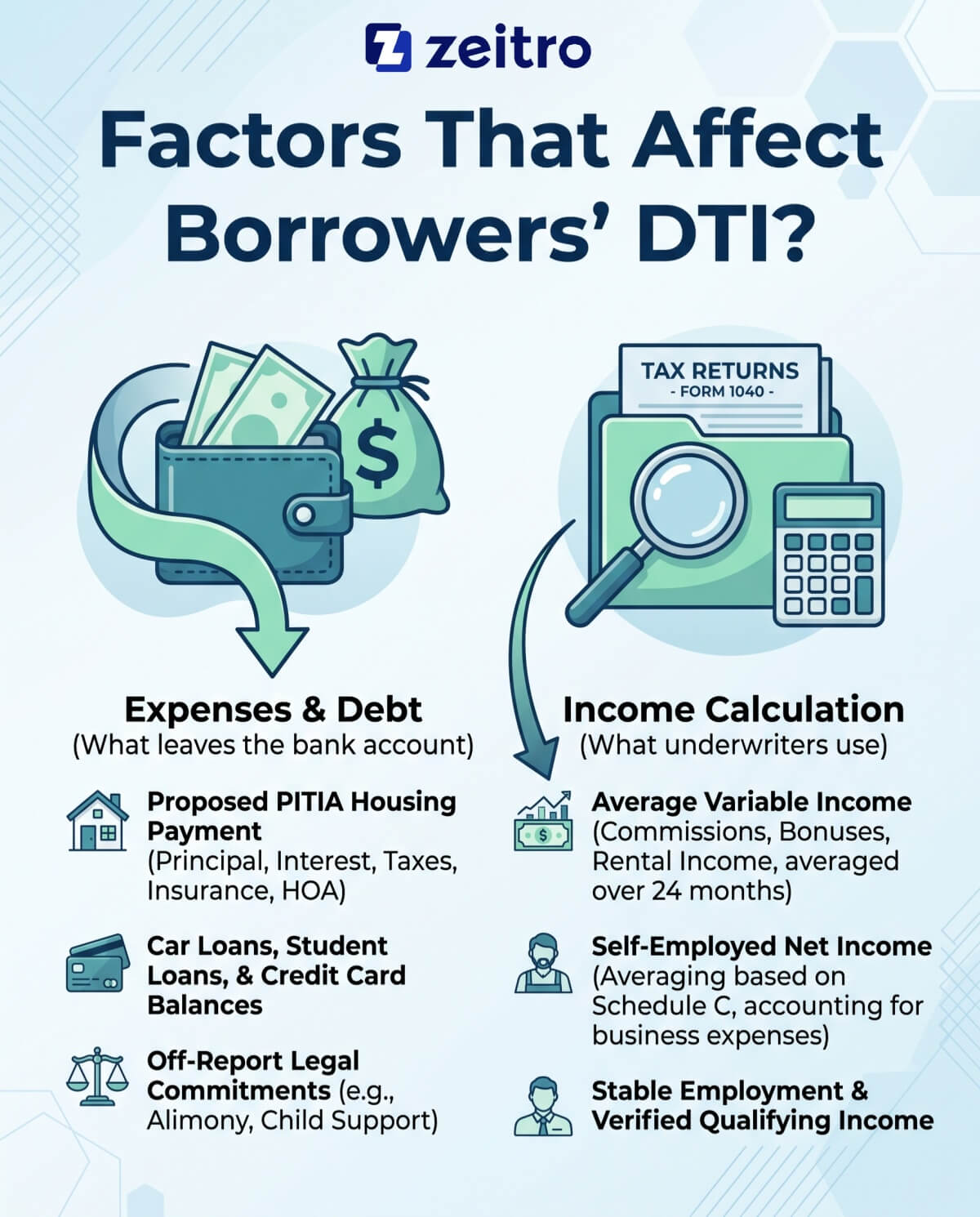
When I review a 1003 loan application, I break DTI into two moving parts: what leaves the borrower's bank account each month and how underwriters calculate their gross monthly earnings. Even minor shifts on either side can swing eligibility.
Here are the primary components that drive the final percentage:
- Front-end housing costs (PITIA): The full proposed monthly housing bill, covering principal, interest, real estate taxes, homeowners insurance, mortgage insurance, and mandatory HOA dues.
- Back-end recurring liabilities: Non-housing debt appearing on credit reports, such as car notes, student loans, and minimum revolving credit card balances.
- Off-report commitments: Legal obligations like alimony, child support, or IRS installment plans that do not show up on standard credit bureaus.
- Qualifying income adjustments: For self-employed borrowers or those with variable income (commissions, bonuses, rental income), underwriters often use tax returns to calculate a conservative monthly qualifying income, frequently averaging over 24 months and accounting for business expenses as reflected on Schedule C or other applicable forms.
How to Lower Debt-to-Income Ratio for Mortgage?
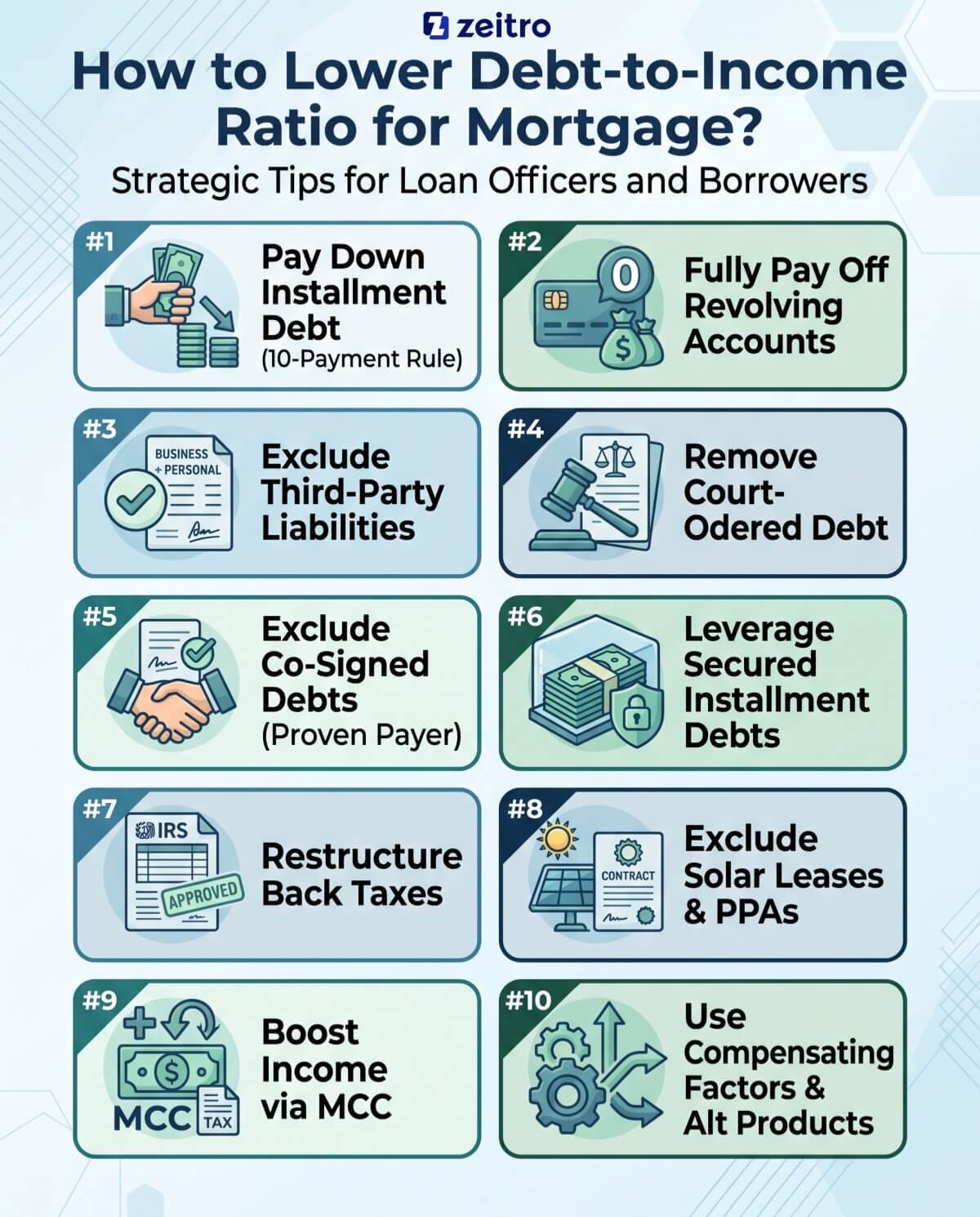
#1. Pay Down or Pay Off Installment Debts (The 10-Payment Rule)
Under Fannie Mae and Freddie Mac guidelines, an installment loan may be excluded from the borrower's monthly debt obligations if the credit report or loan file documentation verifies that ten or fewer monthly payments remain. However, the payment must still be included if it significantly affects the borrower's ability to meet credit obligations, and automated underwriting findings or lender overlays may require it to be counted.
If a buyer owes $4,000 on a truck with an $800 monthly obligation, putting down $1,600 to bring the balance to eight payments frees up substantial borrowing power.
However, never assume this applies across the board. In my experience, lender overlays often tighten this rule:
- Certain non-QM and portfolio programs prohibit paydowns entirely, requiring a full payoff to remove the payment.
- Other lenders only allow the 10-payment exclusion if the initial DTI is already below 40%.
- You must fully source and season the funds used for the paydown.
Always pull a fresh credit supplement confirming the updated remaining balance before submitting the file to the underwriter.
#2. Completely Pay Off Revolving Accounts Instead of Paying Them Down
A common misconception among rookie loan officers is advising clients to cut their credit card balances in half. Unfortunately, revolving debt rarely works that way in automated underwriting. Underwriters cannot guess what a credit card company's future minimum payment will be after a partial payment, so they rely solely on the minimum stated on the credit report.
To eliminate a revolving liability from DTI:
- Have the borrower pay off the entire balance prior to or directly at closing.
- The account does not need to be closed, protecting their average credit age and score.
- Order a credit supplement or show the payoff line item clearly on the Closing Disclosure.
I always warn borrowers to pay through verified liquid accounts. If they use an unverified gift or unseasoned cash, the underwriter will reject the payoff proof.
#3. Exclude Liabilities Paid by Third Parties or Businesses
Borrowers often carry debts that someone else actually pays, such as an auto loan handled by parents or an equipment loan paid by their company. Both Fannie Mae and Freddie Mac permit excluding these debts from the borrower's ratio under strict conditions:
- Debts paid by others: You must collect twelve consecutive months of canceled checks or bank statements proving an outside party made every payment. The paying individual cannot be an interested party in the real estate deal.
- Business-paid debts: If an entrepreneur carries a personal loan for business purposes, provide twelve months of business bank statements confirming direct payment, backed by corporate tax returns showing the expense deduction.
A single late payment in that twelve-month window invalidates the exclusion immediately, so verify every statement before pitching this strategy.
#4. Remove Court-Assigned and Divorce-Related Liabilities
Divorce files can be challenging, but they also offer clear opportunities to clean up liabilities. When a court assigns a joint debt, such as a joint mortgage or vehicle lease, to an ex-spouse, that obligation can be legally excluded from your applicant's DTI.
Under both Fannie Mae and Freddie Mac guidelines, when a court order (such as a divorce decree or separation agreement) assigns a joint debt to an ex-spouse, that obligation may be excluded from the borrower's monthly debt obligations even if the creditor has not formally released the borrower from liability, provided the court order is documented in the file. Here is what I make sure to put in the loan package:
- A certified copy of the final divorce decree or legal separation agreement detailing debt allocation.
- Recorded deeds or title transfer documentation showing the applicant no longer owns the encumbered property.
- Verification that no missed payments occurred prior to the transfer.
This allows your client to move forward without being penalized for debts they no longer manage.
#5. Exclude Co-Signed Debts with Proven Primary Payer History
Many well-meaning parents cosign car loans or student debt for their adult children, only to discover it blocks their own home purchase years later. Fortunately, cosigned contingent liabilities can often be scrubbed from the ratio if you can prove the primary borrower is handling it alone.
Agency guidelines and several non-QM programs allow you to exclude the cosigned account if you document that the primary obligor has made all payments on time. To clear this condition smoothly:
- Gather 12 consecutive months of canceled checks or bank statements directly from the primary debtor, showing that all payments were made on time with no 30-day (or worse) delinquencies during that period.
- Confirm the payment source account belongs exclusively to the primary borrower, with zero contributions from your applicant.
- Verify there are zero 30-day delinquencies across the past year.
This simple paper trail can erase hundreds of dollars in ghost payments from your applicant's file.
#6. Leverage Installment Debts Secured by Liquid Financial Assets
When working with affluent borrowers who prefer liquidity over cash purchases, you might encounter personal loans secured by investment portfolios or certificates of deposit. Rather than telling them to liquidate assets to pay these off, tap into Freddie Mac's financial asset exclusion rule.
Under this provision, monthly payments on installment debts pledged against verifiable financial assets can be omitted from DTI entirely, regardless of payment size or remaining term. Keep these criteria in mind:
- The loan must be held by a regulated financial institution.
- Eligible collateral typically includes stocks, bonds, mutual funds, or certificates of deposit held at a regulated financial institution. Cryptocurrency and other non-traditional assets are generally not accepted as eligible collateral under agency guidelines.
- The pledged asset cannot do double duty. You cannot count those same funds toward required down payment or closing reserves.
This guideline keeps high-net-worth deals moving without forcing unwanted asset liquidations or tax events.
#7. Restructure Back Taxes into Approved IRS Installment Agreements
Discovering past-due federal taxes on a client's transcript often causes panic, but it does not have to be a deal-breaker. You do not always need to force a borrower to drain their liquid reserves to pay off a $25,000 tax balance in full.
Both agency and wholesale lender guidelines allow including an IRS installment payment in DTI instead of mandating full payoff, provided you meet these terms:
- The borrower must produce a formal, approved IRS installment agreement notice.
- At least one scheduled monthly payment must be documented as completed before closing.
- The borrower must provide a formal, approved IRS installment agreement, and at least one scheduled monthly payment should be documented as completed before closing. The lender must also verify whether a Notice of Federal Tax Lien has been filed (via IRS transcripts and applicable public records) and ensure any lien is resolved, discharged, or subordinated prior to closing.
Trading a massive five-figure cash drain for a manageable $200 monthly line item saves closing funds while keeping DTI compliant.
#8. Exclude Qualified Solar Panel Leases and PPAs
Solar contracts are increasingly common on property appraisal reports, and their monthly lease payments can easily push an otherwise solid loan over the DTI limit. When an underwriter conditions for an unexpected $180 monthly solar payment, I look directly at the underlying contract terms.
Under Freddie Mac rules, solar panel lease payments and power purchase agreements (PPAs) can be excluded from DTI under specific scenarios:
- The lease terms include an explicit energy production guarantee that offsets traditional home utility bills.
- The PPA payment structure charges only for actual power generated, operating like a utility replacement rather than a personal debt obligation.
- The solar company handles all system repairs and ongoing maintenance.
Request the full solar agreement upfront. If it meets these standards, you can keep that payment out of the back-end calculation.
#9. Boost Qualifying Income via Mortgage Credit Certificates (MCC)
When every debt on the credit report is legitimate and cannot be paid down, switch your focus from reducing debt to expanding qualifying income. For first-time and moderate-income home buyers, a Mortgage Credit Certificate (MCC) issued by a local housing finance agency is a powerful underwriting lever.
Instead of simply acting as an annual tax refund, underwriters can convert this federal tax credit into immediate monthly qualifying income using this formula:
Calculate the monthly MCC income as: (Mortgage Amount × Note Rate × MCC certificate rate) ÷ 12, and add that amount to the borrower's gross monthly qualifying income. Note that the MCC certificate rate is set by the housing finance agency. For IRS purposes, credits with a rate above 20% are generally capped at $2,000 annually, but underwriting follows the agency's MCC income calculation.
For example, increasing qualifying income by the monthly MCC amount directly reduces the DTI ratio without changing the borrower's reported liabilities.
#10. Pivot to Compensating Factors and Alternative Loan Products
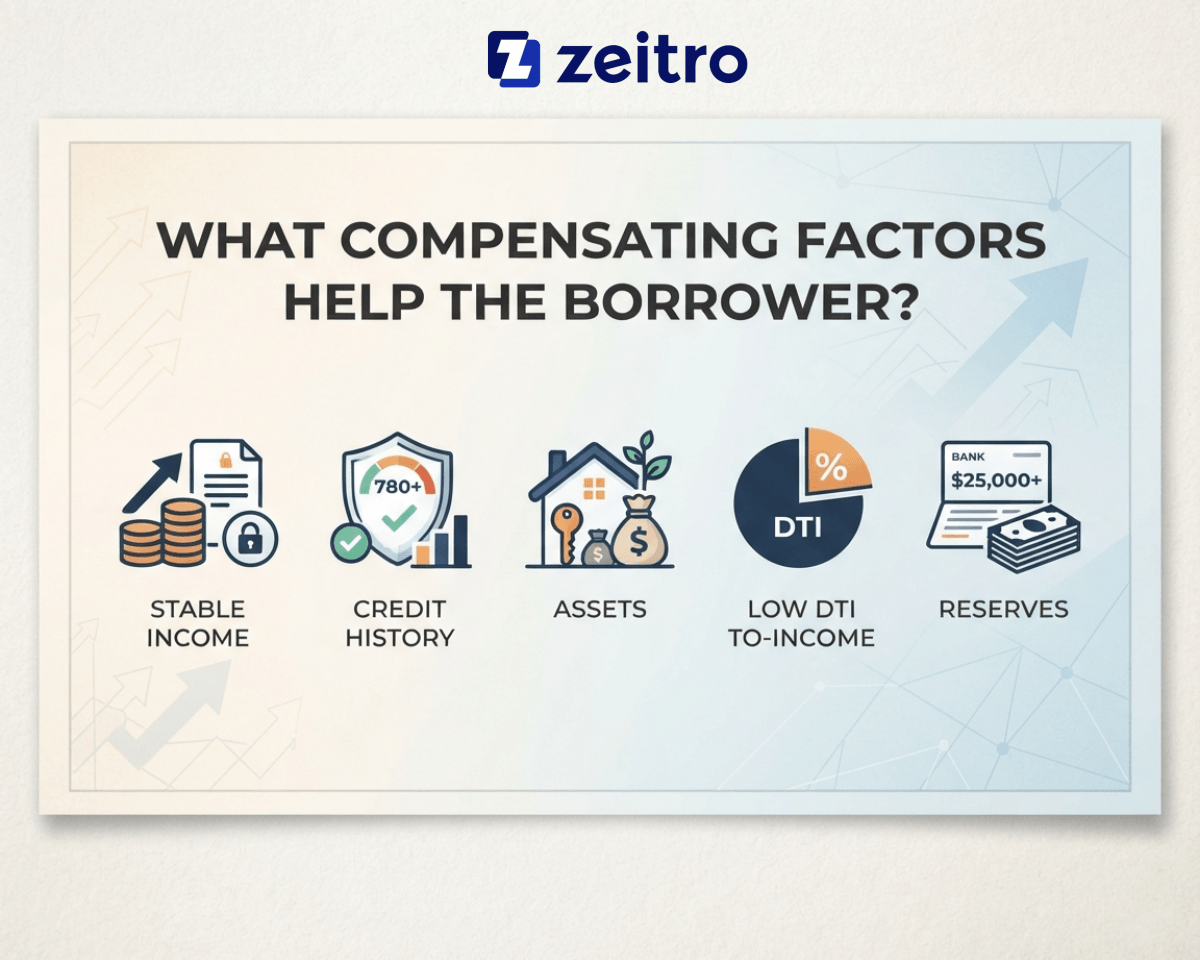
If you have exhausted debt exclusions and income adjustments, your final move is expanding the acceptable DTI ceiling through compensating factors or alternative loan products. Automated underwriting engines like DU and LPA can approve ratios up to 50% when offset by robust risk factors.
Consider these strategic pivots:
- FHA compensating factors: FHA guidelines allow back-end ratios to stretch to 47% or 50% if the borrower shows three to six months of verified reserves, substantial residual income, or minimal housing payment increase.
- Manual underwriting cushions: Document strong credit profiles (740+ FICO) or significant equity contributions to justify manual approvals above standard limits.
- Non-QM options: Transition self-employed borrowers to twelve-month bank statement programs or asset depletion loans, where qualifying income calculations are often significantly higher than tax-return adjusted numbers.
What is a Good Debt-to-Income Ratio?
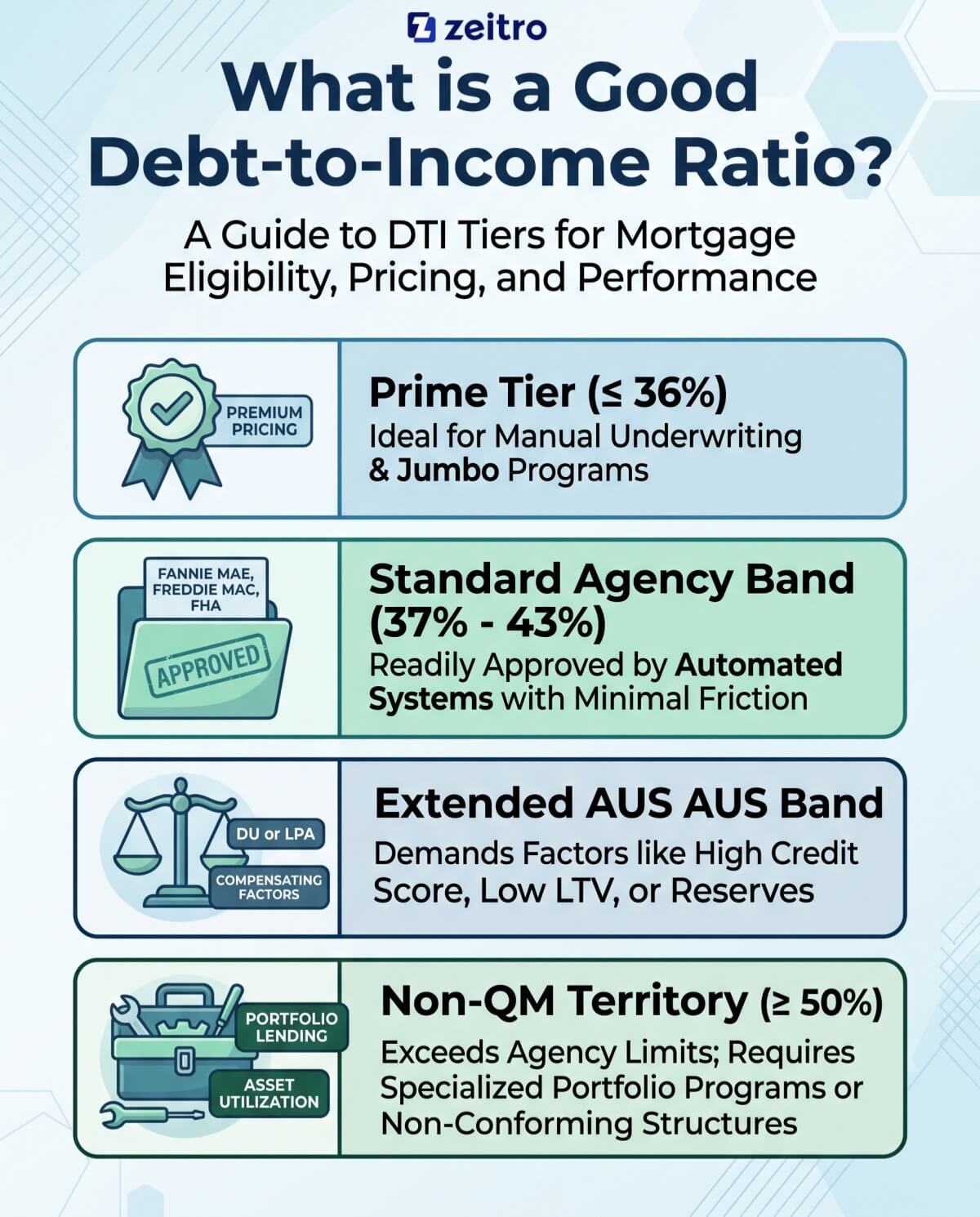
In the mortgage industry, what qualifies as a "good" DTI depends on whether you are looking through the lens of program eligibility, investor pricing, or long-term loan performance. While higher ratios can get approved, keeping clients within conservative bands provides safety margins against unexpected closing adjustments.
Here is how underwriters view DTI tiers across conventional and government channels:
- Prime Tier (36% or below): The ideal benchmark for manual underwriting, jumbo programs, and premium interest rate pricing.
- Standard Agency Band (37% to 43%): Readily approved by automated underwriting systems across Fannie Mae, Freddie Mac, and FHA with minimal documentation friction.
- Extended AUS Band (44% to 50%): Achievable through DU or LPA, but demands compensating factors like high credit scores, low LTV, or liquid reserves.
- Non-QM Territory (50% and above): Exceeds agency limits. Requires specialized portfolio lending, asset utilization programs, or higher-rate non-conforming debt structures.
FAQs About Lowering DTI
Q1. How to Calculate Debt-to-Income Ratio?
To calculate back-end DTI, add the borrower's proposed monthly housing cost (PITIA) to all recurring monthly debt payments, then divide by their verifiable gross monthly income before taxes. Multiply by 100 to find the percentage.
Include minimum credit card obligations, auto loans, student payments, and child support. Exclude ordinary living expenses such as food, utility bills, cellphone plans, and medical insurance premiums. A borrower with $3,000 in total monthly debt payments and $7,500 in gross monthly earnings has a back-end DTI of exactly 40%.
Also Read: [Guide] How to Calculate DTI Ratio for Mortgage?
Q2. What is the Max DTI by Loan Types?
Maximum DTI caps vary significantly depending on the loan program and whether the file is evaluated by an automated engine or manual underwriting:
- Conventional Loans: Manual underwriting is capped at 36% to 45%, but Desktop Underwriter and Loan Product Advisor regularly issue approvals up to 50% with strong compensating factors.
- FHA Loans: Standard benchmarks are 31/43%, yet automated approvals frequently clear at 46.9/56.9% for well-qualified applicants.
- VA Loans: The VA establishes a soft benchmark of 41%, but has no hard cap. Approvals rely primarily on passing regional residual income tests.
- Non-QM Loans: Portfolio guidelines often accommodate DTIs up to 50% or 55%, depending on liquid asset reserves.
Q3. Can Paying Off Debt Before Closing Trigger a Re-Underwrite or Delay?
Yes, uncoordinated debt payoffs can derail your closing timeline. Under Fannie Mae standards, if additional debt is discovered or income decreases after the underwriting decision and the resulting DTI exceeds the allowed tolerances, the loan must be re-underwritten. For DU casefiles, this requires resubmission to DU. For manually underwritten loans, a comprehensive risk assessment is required.
Furthermore, making last-minute lump-sum payments right before closing raises red flags during final credit refreshes and undisclosed debt monitoring. Underwriters will halt loan docs to demand proof of the transaction and source of funds to verify that no new unapproved credit or borrowed cash was used. Always structure payoffs early, document fund sources, and obtain a clean credit supplement before resubmitting.
Q4. Why Can't Borrowers Simply Pay Down Credit Cards by Half to Qualify?
Revolving accounts determine required monthly obligations based on variable formulas tied to fluctuating statement balances. Underwriters cannot guess what a credit issuer will demand next month if a client pays off only half the balance today. Unless an account is settled to a zero balance, guidelines require using the minimum payment listed on the current credit report.
To reflect a lower minimum payment, the credit report must show the updated amount, which typically requires waiting until the card issuer reports the new balance and minimum payment in the next billing cycle. Lenders then re-pull credit. This timeline often conflicts with closing deadlines.
Final Word
Lowering a borrower's DTI is not about finding loopholes. It is about knowing underwriting guidelines better than anyone else in the room. When an automated engine flags an ineligible ratio, walk through liabilities methodically before walking away from the deal.
Check for third-party payers, explore installment paydown thresholds, and verify investor overlays. Structuring files cleanly upfront turns borderline applications into closed loans and builds real trust with your real estate partners.
People Also Read
- [Solved] What Debt-to-Income Ratio is Needed for a Mortgage?
- Mortgage Guidelines: What They Are & How to Verify Fast
- How to Determine Mortgage Eligibility? Verify Guidelines Fast

![[Solved] What Red Flags Would a Mortgage Underwriter See?](https://cdn.prod.website-files.com/6731bc6e813a541b54c30b10/6aa24ca70b95e62dd7bbeefd_red-flags-mortgage-underwriting-banner.png)