Written by

Eric
Share this article

.svg)
Subscribe to updates
As a veteran loan officer, I frequently meet borrowers who do not earn a standard salary. Calculating qualifying income for clients with fluctuating paychecks can be a major hurdle during underwriting. If you want to successfully close more loans and avoid sudden pre-approval denials, mastering how to accurately average variable income is an absolute must-have skill in your daily mortgage toolkit.
Key Takeaways
- Distinct Streams: Never lump bonuses, commissions, or overtime together. Evaluate each stream separately.
- History Matters: Underwriters usually require a solid 12-to-24-month track record of receiving variable earnings.
- Trend Analysis: Income must be stable or increasing to qualify. Declining trends trigger conservative calculations.
- Automated Tools: Using a professional income calculator minimizes manual entry errors and speeds up processing.
What is an Example of Variable Income?
Consider a client of mine, Sarah, who works as a medical equipment sales representative. Sarah receives a modest base salary of $3,500 every month. However, her true earning power comes from her monthly sales commissions, which swing wildly between $1,500 and $6,000 depending on hospital buying cycles.
Because her commission checks fluctuate drastically, we cannot simply look at her latest paystub to determine her mortgage qualifying capacity. This fluctuating portion is the textbook definition of variable income. To satisfy strict underwriting standards, we must look backward over a defined historical period to find a stable, predictable monthly average rather than using her peak earning months.
Can Variable Income Be Used on a Mortgage?
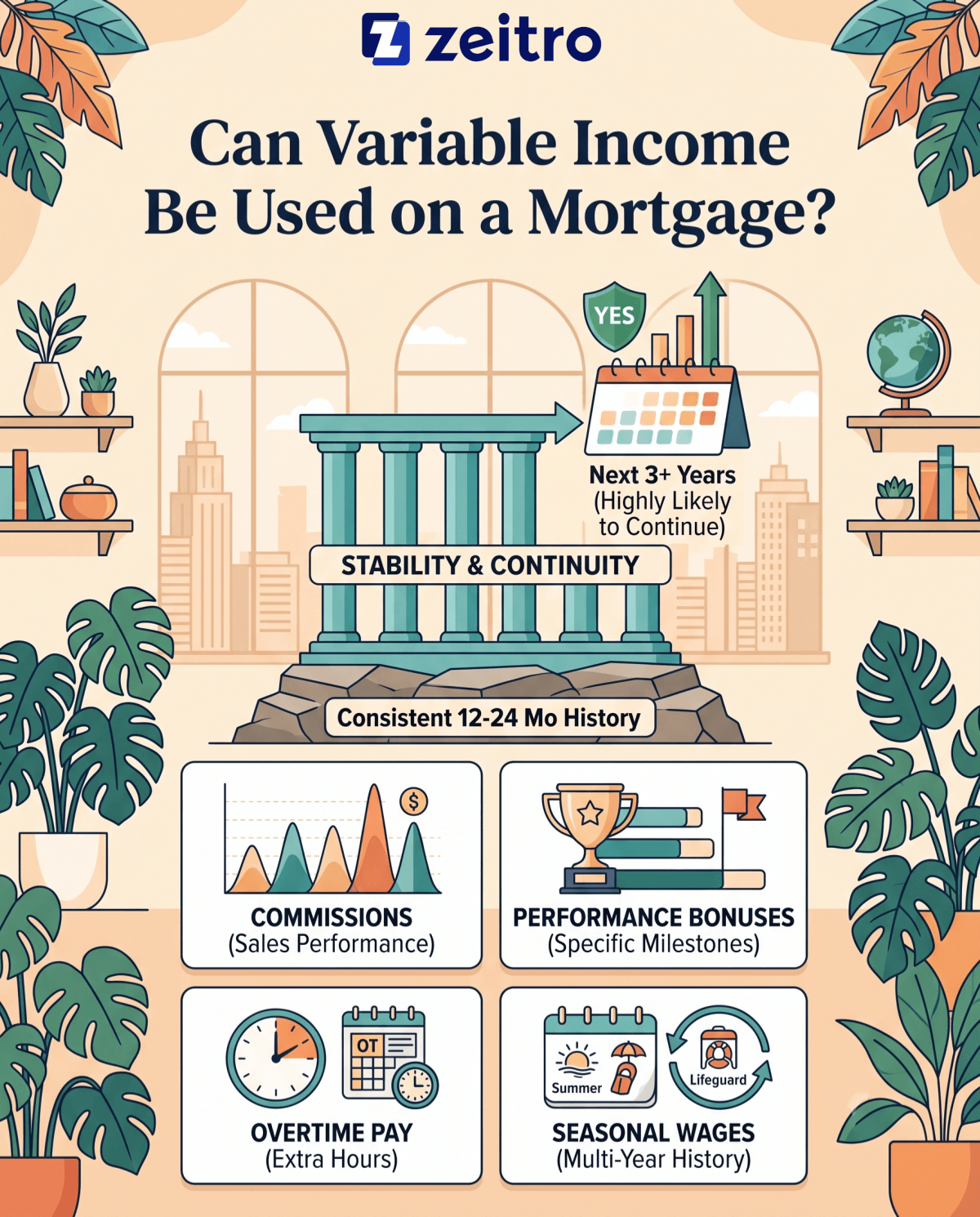
Yes, variable income can absolutely be used to qualify for a mortgage, provided it meets strict guidelines for stability and continuity. According to conventional agency guidelines, lenders typically look for a consistent history of receipt, usually spanning 12 to 24 months. More importantly, we must verify that this income is highly likely to continue for at least the next three years.
To qualify a borrower, we can consider several types of fluctuating earnings:
- Commissions: Fluctuating compensation based on sales performance.
- Performance Bonuses: Periodic payouts from an employer for meeting specific milestones.
- Overtime Pay: Extra compensation for working beyond standard weekly hours.
- Seasonal Wages: Income earned during specific parts of the year, provided there is a multi-year history in the same line of work.
Also Read:
- How to Calculate Commission Income for Mortgage?
- How to Calculate Overtime Income for a Mortgage?
- How Do I Calculate Bonus Income for a Mortgage?
- What Income Can Be Used for Qualification? Learn Now
How to Calculate Average Monthly Variable Income for a Mortgage?
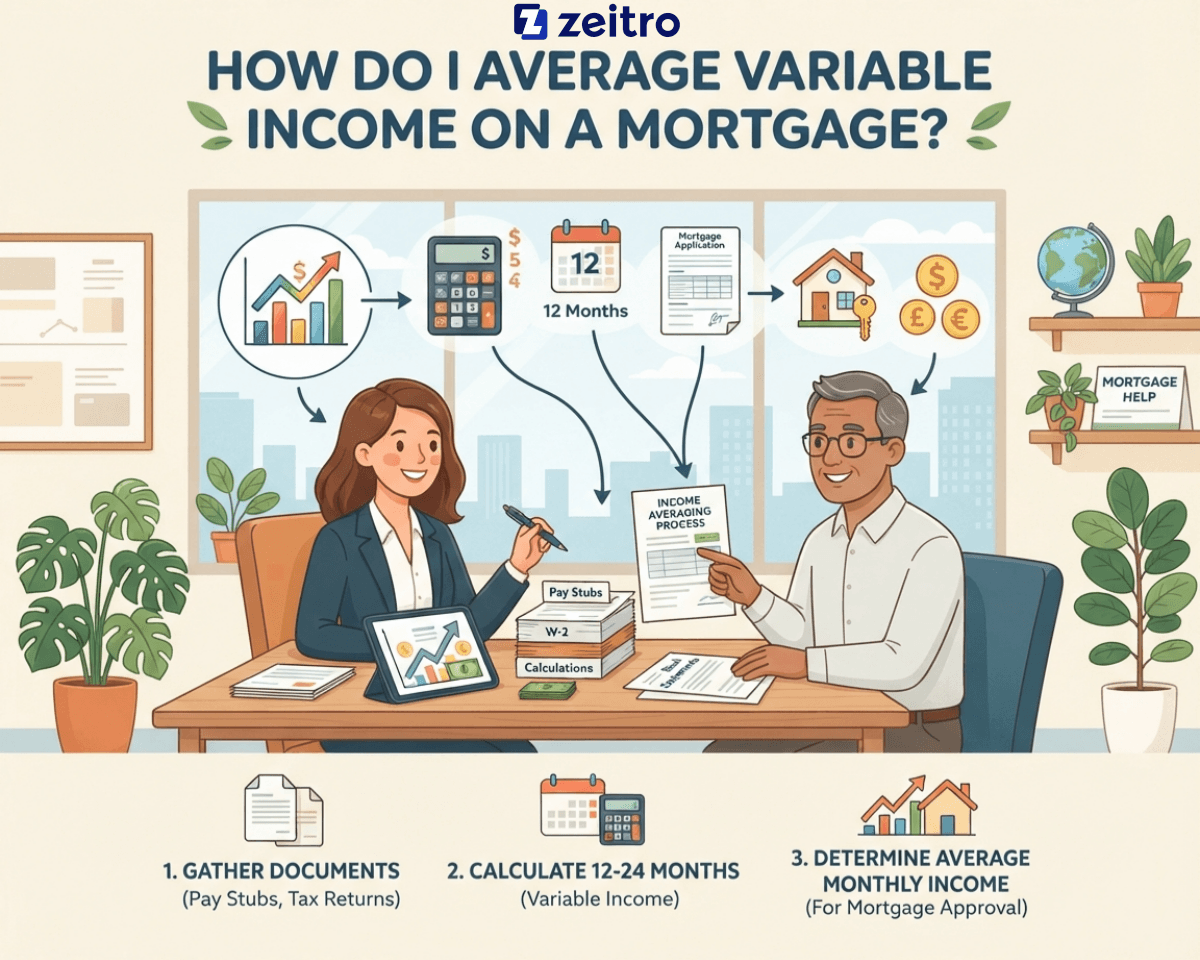
To calculate qualifying income, I follow a strict process. First, never combine different pay categories. Calculate the monthly averages for base salary, overtime, and bonuses separately before summing them up.
For the variable portion, compare the borrower's income over the most recent two years using W-2s or tax returns. If income is stable or increasing, use the two-year average. If income has declined, use only the most recent year's figures. Year-to-date (YTD) earnings are reviewed to confirm ongoing trends but are not typically averaged with prior-year data for qualification.
If the income is declining or volatile, underwriting guidelines dictate that we must utilize the lowest of these averages to be safe. For instance, if a borrower's monthly bonus average over 24 months is $1,500, but their YTD average is only $1,000, we must qualify them using the lower $1,000 figure.
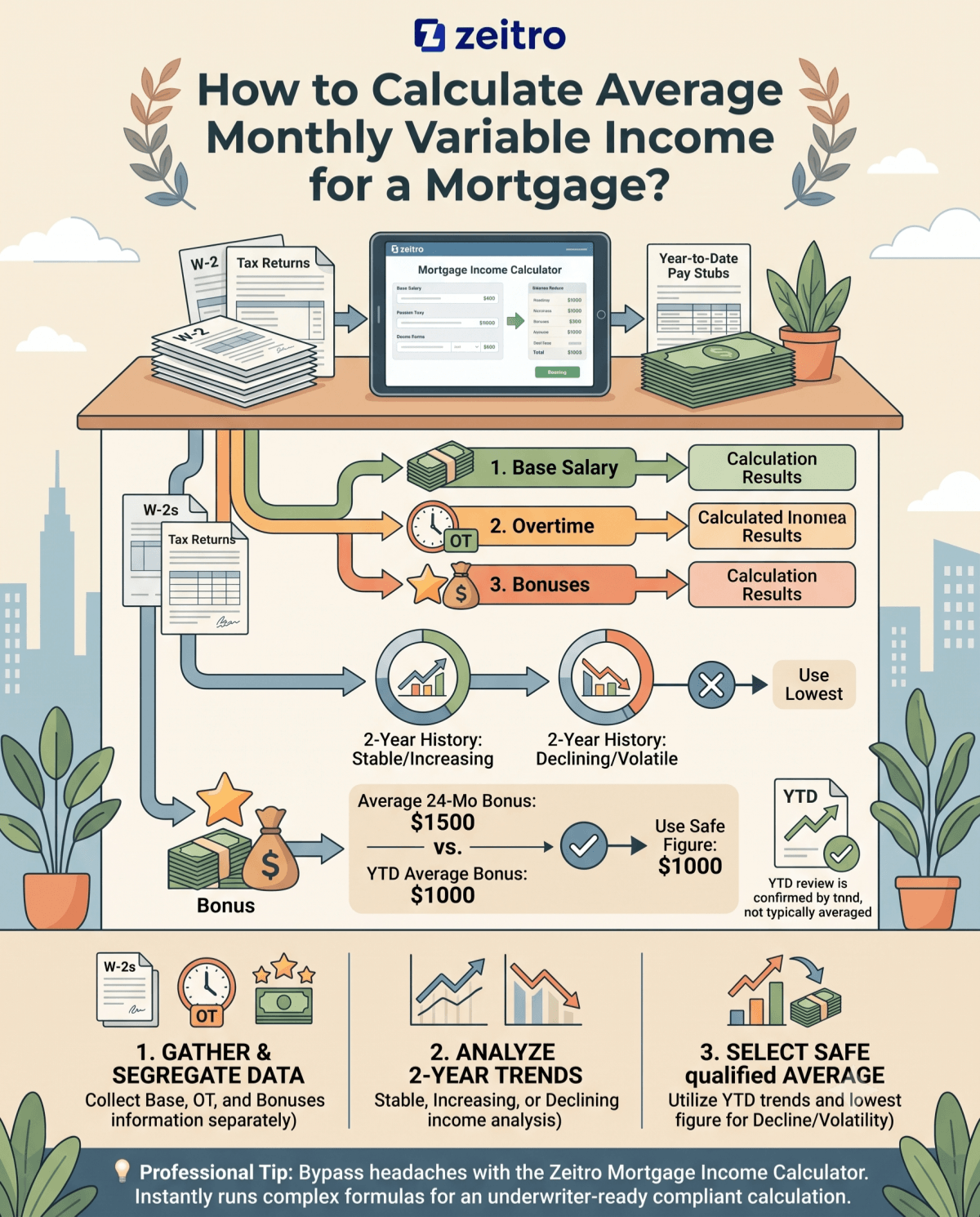
💡 Professional Tip: To bypass the headache of manual math, tax transcript analysis, and compliance checks, I recommend using the Zeitro Mortgage Income Calculator. You can easily upload your borrower's financial documents, and the system automatically runs these complex averaging formulas for you, instantly giving you an underwriter-ready, compliant calculation.
Tips When Calculating Average Variable Income
Over the years, I have gathered a few insider tips to help keep your loan files on track:
- Hourly Raises: When hourly employees receive a permanent raise, qualifying income can be based on the new, higher rate—provided the increase is documented and verified as non-temporary. Temporary or probationary raises may not be fully counted until sustained over time.
- Self-Employment Rules: If a borrower owns a business, utilize a self-employment calculator. For self-employed borrowers, underwriters typically analyze the net taxable income from Schedule C, adding back non-cash expenses like depreciation and subtracting deductible business expenses. Qualifying income is generally based on the average of the last two years' tax returns, but may be adjusted if there are significant year-over-year changes or unusual deductions.
- Watch Declining Income: If a borrower's variable income declines year-over-year, you must analyze the file with caution. Severe drops might disqualify the income entirely unless you can provide strong proof of stabilization.
FAQs About Average Variable Income
Q1. How long do I need to receive variable income to count it toward a mortgage?
Lenders typically prefer a 12-to-24-month history of receiving variable income in the same line of work. However, exceptions may be made if the borrower has a strong, related professional background or if alternative documentation loan programs are used. A shorter history may occasionally qualify if the borrower has a strong, related professional background.
Q2. What happens if my commission or bonus income has decreased year-over-year?
A downward trend is a major underwriting red flag. In such cases, lenders may either calculate the average over the most recent 12 months rather than 24, or exclude the variable income completely if stability cannot be proven.
Q3. Can I combine base pay, overtime, and bonuses into one single monthly average?
No. Underwriting guidelines require you to calculate each component's monthly average separately first. Combining them beforehand often leads to calculation errors and loan file rejection during audit checks.
Q4. How is a recent hourly raise handled differently from variable commission?
An hourly raise applies immediately to your qualifying income using the new rate. However, a commission increase cannot be used immediately and must be averaged over a 12-to-24-month period to prove continuity.
Q5. Do tax write-offs affect self-employed variable income calculations?
Yes. Underwriters use your adjusted net taxable income after business write-offs (from your Schedule C), not your gross revenue, to calculate your qualifying average monthly income.
Conclusion
Accurately averaging variable income is the difference between a smooth mortgage closing and a stressful loan denial. By strictly separating income streams and analyzing historical trends, you can protect your clients from late-stage underwriting surprises.
To streamline this process and completely eliminate manual math errors on your next file, try using the Zeitro Mortgage Income Calculator to calculate variable earnings with absolute speed and precision.
People Also Read
- How to Calculate Employment Income for a Mortgage?
- How to Calculate Self-Employed Income for a Mortgage?
- How to Average Self-Employed Income Over Two Years?
- How to Calculate Rental Income? Loan Officer's Guide


![[Tips for Loan Officers] How Can I Lower Borrower DTI?](https://cdn.prod.website-files.com/6731bc6e813a541b54c30b10/6aa3b89e281a639e7a5c6fca_lower-debt-to-income-ratio-banner.jpg)