Written by

Eric
Share this article

.svg)
Subscribe to updates
When I started originating home loans, I was stunned by how often borrowers panicked over bank records. Many asked me why great credit scores and solid paystubs weren't enough on their own. The truth is simple: lenders trust numbers, but they verify liquidity. Let's walk through exactly when underwriters demand your records, what red flags stop approvals, and how to prepare smoothly.
Key Takeaways
- Standard Rule: Conventional W-2 applicants typically provide the most recent two full calendar months of statements for every account supplying funds.
- Self-Employed Pathways: Business owners using non-QM bank statement programs must produce 12 to 24 months of activity to calculate qualifying income.
- Critical Scrutiny: Underwriters inspect entries for non-payroll cash deposits, overdraft fees, and undisclosed private loan payments.
- Pre-Closing Audits: Financial stability must hold until signing day, as lenders refresh account balances right before funding.
What are Bank Statements?
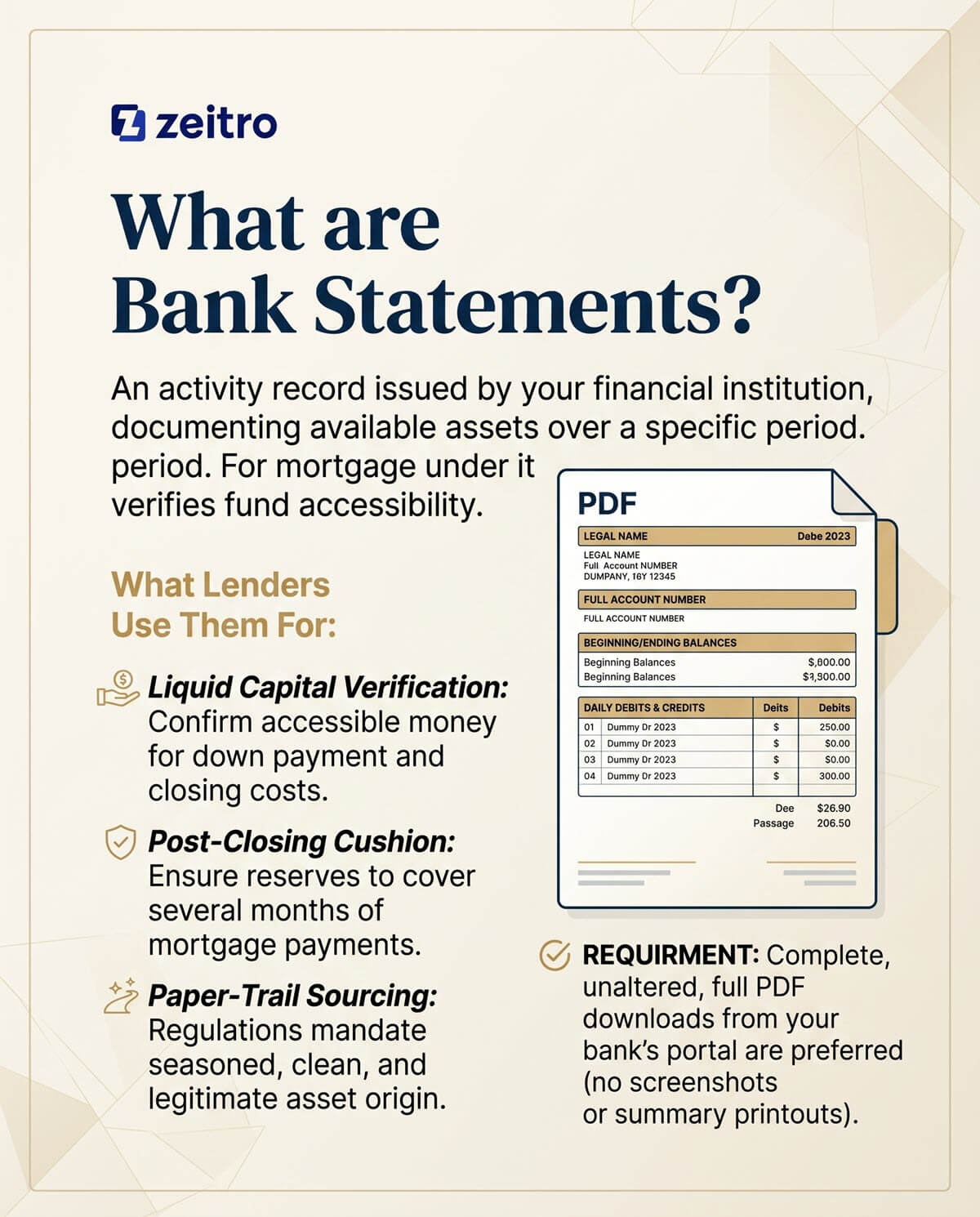
A bank statement is an account activity record issued by your financial institution. For mortgage underwriting, it is used as documentation of your available assets over a specific statement period. A valid statement clearly displays your complete legal name, full account number, beginning and ending balances, itemized daily debits and credits, plus institutional contact details.
Underwriters generally require complete, unaltered bank statements. In most cases, you should provide full PDF downloads from your bank's portal rather than screenshots or summary printouts, since lenders often need all pages to verify balances and transactions.
What are Bank Statements for?
When an underwriter reviews your file, they are not snooping on daily living costs. They are analyzing your balance sheets against strict secondary mortgage market regulations to mitigate loan default risks.
- Liquid Capital Verification: They confirm you possess readily accessible money to pay your down payment and closing costs at settlement without liquidating restricted accounts.
- Post-Closing Cushion: Lenders check your remaining reserves to ensure you can cover several monthly mortgage installments should an unexpected financial emergency arise.
- Paper-Trail Sourcing: Regulations mandate that your assets are properly seasoned and originate from clean, legitimate sources, ensuring funds are not unrecorded credit card cash advances or illegal gifts.
Do Mortgages Require Bank Statements?
Yes, most purchase mortgages require bank statements to verify assets, but there are exceptions. For conventional, FHA, VA, or jumbo purchase loans, lenders must verify your ability to repay, and asset documentation is commonly required, though some lenders may use digital asset verification or waive certain documents in specific refinance scenarios.
However, you might reduce paperwork through digital asset verification. Systems such as Fannie Mae's Day 1 Certainty allow lenders to electronically verify certain account data with your financial institution, though some lenders may still request PDF statements depending on their policies.
Furthermore, some streamline refinance programs, such as FHA Streamline and VA IRRRL, may not require asset documentation in certain cases, especially when closing costs are financed and reserves are not required by the lender.
When are Bank Statements Needed in a Mortgage?
The exact timeframe and quantity of records you must submit depend on your employment structure and mortgage financing category. While conventional applicants face brief review periods, non-traditional borrowers encounter more extensive documentation rules across the following standard loan scenarios.
Standard Loan Requirements
For standard agency purchases, mortgage underwriters operate within well-defined guidelines to assess traditional W-2 earners and prime portfolio clients:
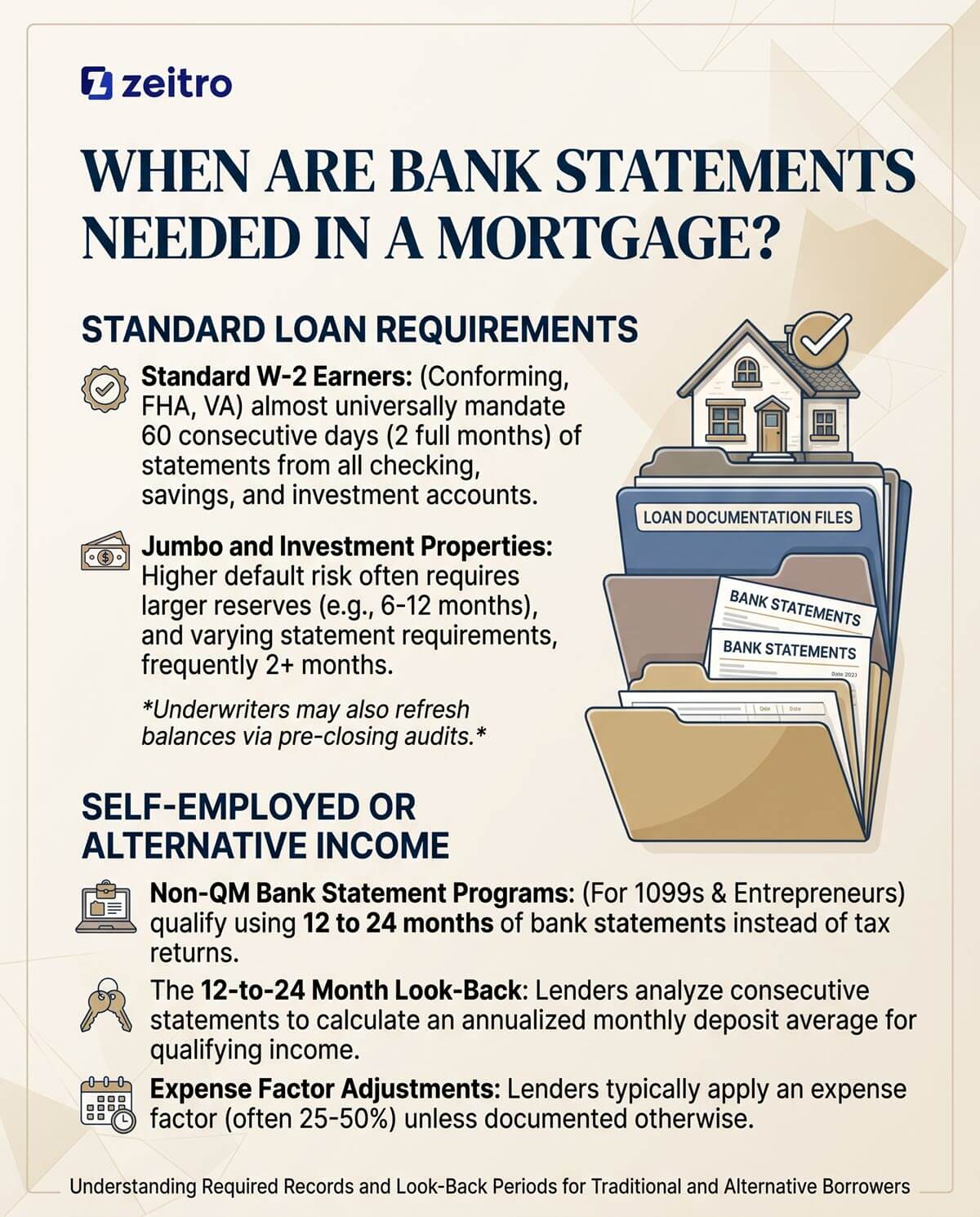
- Standard W-2 Applications: Conventional conforming, FHA, and VA loans almost universally mandate sixty consecutive days (two full calendar months) of statements from all checking, savings, and investment accounts involved in the transaction.
- Jumbo and Investment Properties: Because non-conforming jumbo mortgages and rental real estate carry elevated default risks, lenders often require larger reserves (commonly six to twelve months) and may request additional documentation. Statement requirements vary by lender but are frequently two months, sometimes more.
- Pre-Closing Quality Audits: Agency guidelines focus on using recent statements (typically the two most recent full months). Near closing, lenders often refresh balances via an automated verification of deposit to confirm funds remain available.
Self-Employed or Alternative Income
Entrepreneurs, 1099 independent contractors, and small-business owners frequently write off substantial business expenses to minimize federal taxable earnings. While beneficial at tax season, this practice limits qualification under standard debt-to-income models, paving the way for alternative documentation:
- Non-QM Bank Statement Programs: Specialized portfolio mortgages often qualify self-employed borrowers using 12 to 24 months of bank statements instead of tax returns. Underwriters analyze eligible deposits to estimate qualifying income.
- The 12-to-24 Month Look-Back: Lenders analyze twelve to twenty-four consecutive months of business or personal account statements, calculating an annualized monthly deposit average to establish qualifying income.
- Expense Factor Adjustments: For business accounts, lenders typically apply an expense factor (often between 25% and 50%) unless a CPA letter or other documentation supports a different ratio.
What Lenders Look for in Bank Statements?
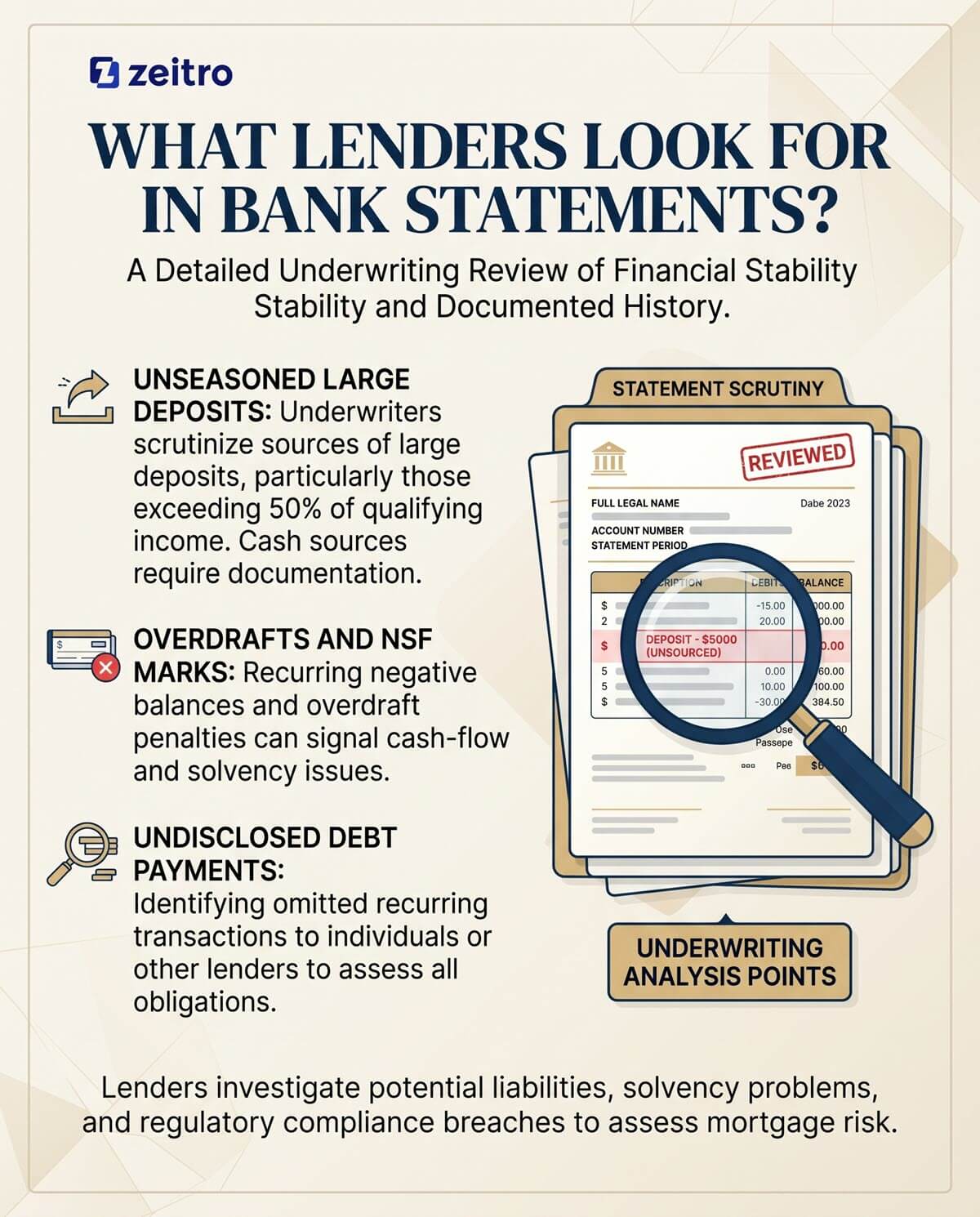
Underwriters examine bank statements through a forensic lens, searching for hidden liabilities, solvency problems, and regulatory compliance breaches:
- Unseasoned Large Deposits: Any single deposit exceeding 50% of your total qualifying monthly income on conventional mortgages triggers sourcing scrutiny. Cash deposits are harder to verify and may be excluded unless you can provide clear documentation of the source.
- Overdraft Penalties and NSF Marks: Recurring overdrafts or negative balances can signal cash-flow issues and may trigger manual review. A single recent overdraft does not automatically stop approval, but lenders may request an explanation.
- Omitted Debt Payments: Regular outbound debits to peer-to-peer lenders, individuals, or buy-now-pay-later platforms may prompt questions. Underwriters compare these transactions with your credit report to identify any undisclosed monthly obligations.
Conclusion
Preparing bank records early prevents major underwriting delays when buying a home. Keep your balances steady, avoid unverified cash deposits, and always download full PDF files directly from your banking portal. Your records should showcase stability, not sudden chaos.
Have you encountered unexpected hurdles or large deposit questions while gathering paperwork for your mortgage? Drop your questions below, and let's discuss how to clear conditions with your lender.
People Also Read
- Bank Statement Mortgage Guidelines: Full Requirements
- When are Profit and Loss Statements Required for a Mortgage?
- Checklist: What Tax Returns are Required for a Mortgage?
- What Income Documents are Needed for Underwriting? Learn Here
- What Documents Do I Need for a Self-Employed Borrower?

![[Tips for Loan Officers] How Can I Lower Borrower DTI?](https://cdn.prod.website-files.com/6731bc6e813a541b54c30b10/6aa3b89e281a639e7a5c6fca_lower-debt-to-income-ratio-banner.jpg)