
Written by

Eric
Author from Zeitro

Share this article

Subscribe to updates

Thank you! Your submission has been received!
Oops! Something went wrong while submitting the form.

As a loan officer, I know firsthand the daily headaches of navigating Non-QM lending. You get a solid self-employed borrower, and suddenly you are drowning in a sea of bank statement mortgage guidelines that change drastically from one lender to the next. Spending hours searching through hundreds of pages of PDF matrices just to find the right income calculation is exhausting.

But what if you could just ask an AI? That's where Zeitro's Scenario AI comes into play. You can now verify different lenders' complex guidelines through a simple, natural chat interface, instantly taking your workflow efficiency to the next level.

What is a Bank Statement Loan?

A bank statement loan is a highly popular Non-QM (Non-Qualified Mortgage) product designed specifically for self-employed borrowers, freelancers, gig economy workers, and business owners.

Since these clients lack traditional W-2s or regular pay stubs, standard income verification simply doesn't work for them. Instead of relying on tax returns, which usually show heavy write-offs and lower taxable income, lenders evaluate 12 to 24 months of consistent bank deposits to calculate their true earning capacity.

I've seen countless successful entrepreneurs get denied by traditional banks, only to secure their dream homes through this alternative documentation route. It's an absolute lifesaver for business owners who have strong cash flow but don't fit into the conventional lending box.

What Are Bank Statement Mortgage Guidelines?

Because these are Non-QM products, they are not backed by Fannie Mae or Freddie Mac. As a result, there is a massive lack of standardization across the industry.

Bank statement mortgage guidelines are the specific, internal underwriting rules created by individual lenders. When I review these matrices, I have to look closely at several unique dimensions. This includes maximum Loan-to-Value (LTV) limits, minimum FICO score requirements. Lenders have strict NSF/overdraft limits (e.g., no more than 2-5 per period), as they indicate unstable cash flow.

Furthermore, lenders apply an "expense factor" to business accounts to estimate operating costs. Lenders typically apply a 50% expense factor to business deposits, but may reduce it to 10-40% with a CPA letter specifying expenses (e.g., 10% for solo service businesses, 50% for larger ones). Because every lender writes their own playbook, placing a file correctly relies entirely on knowing these fractured, ever-changing guidelines.

What Are Bank Statement Mortgage Guidelines?

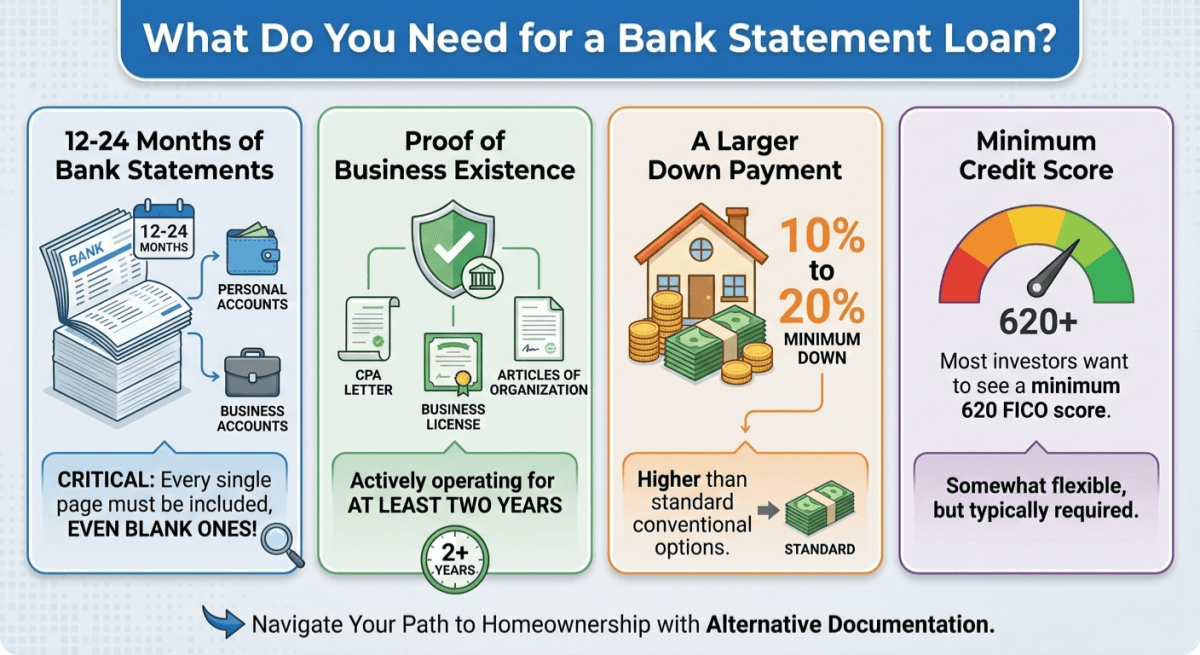
What Do You Need for a Bank Statement Loan?

Gathering the right documentation upfront saves everyone from a massive underwriting headache later. While traditional mortgages focus on tax transcripts, here is what you typically need to collect for a bank statement file:

  • 12 to 24 months of bank statements: This can be personal or business accounts. Make sure every single page is included, even the blank ones!
  • Proof of business existence: Lenders usually want a CPA letter, business license, or Articles of Organization proving the business has been actively operating for at least two years.
  • A larger down payment: These loans typically require a minimum of 10% to 20% down, which is higher than standard conventional options.
  • Minimum credit score: While somewhat flexible, most investors want to see a minimum 620 FICO score.

Disclaimer: Please note that exact requirements, especially expense factor calculations, vary significantly from lender to lender.

What Do You Need for a Bank Statement Loan?

Why Do You Need to Check Bank Statement Mortgage Guidelines?

Because of the disclaimer I just mentioned above, flying blind is a terrible idea. Here is why I always verify the exact guidelines before submitting my borrower's file:

  • Avoid Loan Rejections: Nothing ruins your pipeline faster than a denial that could have been avoided just by reading the fine print on overdraft limits.
  • Find the Best LTV and Rates: Matching your client with the lender that views their specific income profile most favorably means securing better terms.
  • Stay Updated: Lender matrices update constantly. The program that worked perfectly for your client last month might be suspended today.
  • Let's be real: manually flipping through dozens of 200-page PDFs is soul-crushing and prone to human error. You need a smarter approach.

Best Way to Quickly Verify Bank Statement Mortgage Guidelines

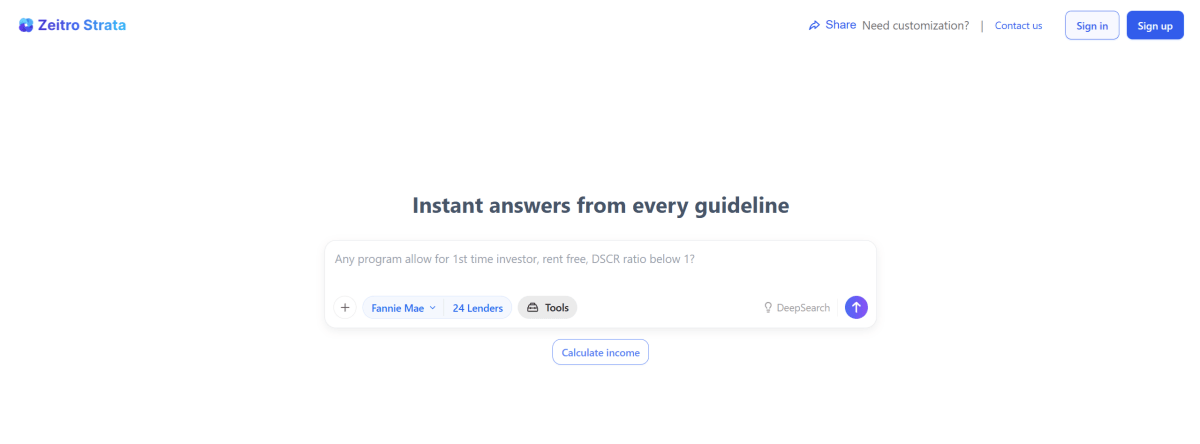
This is where my daily workflow completely transformed. I started using Zeitro's Scenario AI, an AI-Powered Mortgage Guideline Assistant that basically acts like a veteran underwriter sitting right next to you.

It covers over 300 guidelines, including more than 85 specific Bank Statement programs from top-tier lenders like AAA Lending, AD Mortgage, and CMG Financial, and it's constantly updating. Instead of downloading clunky matrices, you just type your borrower's scenario into the chat.

Best Way to Quickly Verify Bank Statement Mortgage Guidelines

Here are the standout features that make it a game-changer for Loan Officers, Brokers, and Processors:

  • High Accuracy with Citations: This is my absolute favorite part. The AI doesn't just guess. It provides specific citations and source links so you can verify the exact guideline yourself.
  • Lightning-Fast Responses: It scans vast amounts of data instantly, giving you precise answers in seconds. You no longer have to put clients on hold while you hunt for a rule.
  • Custom Data Scope (DeepSearch): You can check a single lender or cross-reference multiple lenders simultaneously to see who offers the most flexible terms.
  • Handles All Scenarios: Whether you ask a broad "What is it?" or a highly detailed eligibility question, it understands the context perfectly.
  • Explain Feature: If an answer seems confusing, the AI can further break down the details based on your selected data scope.
  • Unbeatable Value: You get 3 free queries every single day, and the paid version starts at an incredibly low $8/month. The ROI on time saved is immediate.

FAQs About Bank Statement Mortgage Guidelines

Q1. Do you need 3 or 6 months bank statements for a mortgage?

For traditional conventional or FHA loans, you usually only need 2 months to verify your assets and down payment. However, for a Non-QM Bank Statement Loan, lenders use the deposits to calculate your actual income, so you will need to provide 12 to 24 months of consecutive statements.

Q2. Does FHA require 1 or 2 months bank statements?

Standard FHA guidelines generally require two months of complete bank statements. The underwriter reviews these to ensure your down payment funds are properly seasoned and not coming from an undisclosed loan.

Q3. Can I use both personal and business bank statements?

Yes, but it depends heavily on the lender. Most prefer one or the other. If you submit business statements, the lender will apply an "expense factor" (often ranging from 10% to 50%) to deduct your estimated operating costs from the gross deposits.

Q4. Are interest rates higher on bank statement loans?

Honestly, yes. Because lenders consider these loans slightly higher risk without standard tax documentation, interest rates are typically 1% to 3% higher than conventional mortgages.

Q5. Is a bank statement loan considered a Non-QM loan?

Yes. Because it uses alternative documentation instead of standard W-2s or tax returns to verify your income, it falls outside the Consumer Financial Protection Bureau's (CFPB) standard "Qualified Mortgage" definition.

Final Word

In the mortgage industry, time is literally money. Bank statement loans are an incredible tool to help self-employed borrowers achieve homeownership, but the complex, unstructured guidelines are a massive hurdle. You simply cannot afford to lose deals or delay closings because of a misread PDF matrix or an outdated lender requirement.

That's exactly why I highly recommend adopting technology to do the heavy lifting for you. Take advantage of Zeitro's Scenario AI. With 3 free queries a day and premium plans starting at just $8/month, you can stop searching and start closing. Try typing your next tricky Non-QM scenario into the chat and experience the efficiency firsthand!

People Also Read

Keep reading

Mortgage Application Form 1003 (URLA): Everything You Need to Know

Blog

5 min read
Arrow icon on dark background
Mortgage Application Form 1003 (URLA): Everything You Need to Know
Everything you need to know about the Uniform Residential Loan Application (URLA). Get a clear breakdown of Form 1003 sections, a document checklist, and top FAQs.

Buying a home is incredibly exciting, but let's be honest: the mountain of paperwork can quickly kill that joy. I still remember staring at my very first Mortgage Application Form 1003, completely overwhelmed by the acronyms and endless boxes.

But here is the good news—it's not as intimidating as it looks. The 1003 form, also known as the URLA, is just a tool to tell your financial story. In this guide, I'll break down exactly what this document is and how to tackle it without the stress.

Key Takeaways

  • The Foundation: The 1003 form is the standard application used for nearly all U.S. residential mortgages.
  • The Purpose: Lenders use it to evaluate your financial health, determine loan eligibility, and calculate your debt-to-income (DTI) ratio.
  • Accuracy is Crucial: Almost all key information on the application must be supported by documentation, and guessing can delay your closing or even lead to a denial.

What is the 1003 Form? Uniform Residential Loan Application (URLA)

If you are applying for a home loan in the United States, you will cross paths with this document. Form 1003 is officially called the Uniform Residential Loan Application (URLA).

Created and standardized by government-sponsored enterprises (GSEs) Fannie Mae (who calls it Form 1003) and Freddie Mac (who refers to it as Form 65), it's the universal language of the mortgage industry. Whether you are applying for a Conventional, FHA, VA, or USDA loan, your lender will typically use this same standard application template as the starting point.

Back in 2021, when the redesigned URLA became the standard, with a mandatory effective date in early 2021, Fannie Mae and Freddie Mac modernized the layout, enlarged the fonts, and removed a lot of confusing jargon to make it more consumer‑friendly. Think of it as a comprehensive snapshot of who you are, what you earn, and what you owe.

What is the 1003 Form? Uniform Residential Loan Application (URLA)

What is Form 1003 Used For?

You might wonder why lenders need such a detailed breakdown of your life. Ultimately, the 1003 form serves a few critical purposes behind the scenes:

  • Risk Assessment: Lenders need to know if lending you hundreds of thousands of dollars is a safe bet. This form highlights your ability to repay.
  • Determine Eligibility: The data directly dictates how much money you actually qualify to borrow.
  • Set Interest Rates: Your credit profile and financial stability, as outlined here, help underwriters decide your specific loan terms and interest rates.
  • Legal Documentation: This isn't just a casual worksheet. It acts as a legally binding document. Signing it means you swear the information is truthful under penalty of fraud.
What is Form 1003 Used For?

How Does the 1003 Form Work?

The URLA isn't just something you fill out once and forget. It travels with you throughout the entire homebuying journey. Here is how the typical process flows:

  • Initiation: You'll complete the initial draft either online or sitting down with your loan officer. It gives them the baseline data to issue a pre-approval.
  • Verification: Once you submit the form, your lender pulls your credit report. They will ask you for supporting documents, like pay stubs, to prove every claim made on the application.
  • Underwriting: A human underwriter, or an automated system, reviews the verified 1003 alongside your credit history to make the final approval decision.
  • Closing: At the closing table, you will see this form one last time. You'll be asked to sign the final, updated version to confirm your financial situation hasn't drastically changed since you first applied.

Key Sections of Form 1003 Application (2021 Redesign Breakdown)

The 2021 redesign split the application into specific, logical sections. As someone who has reviewed countless files, I can tell you this new layout makes things so much easier to digest. Here is a breakdown of the core sections.

Section 1: Borrower Information

This is the "get to know you" phase. You will need to provide your basic personal details: legal name, Social Security Number, date of birth, and contact info. But it goes deeper than that. You'll generally be asked to document your living situation for the past two full years, and to map out about a continuous two-year employment and income history, explaining any gaps along the way. If there are gaps in your job history, don't panic. You'll just need to provide a brief explanation.

Section 2 & 3: Financial Information (Assets and Liabilities)

Here is where we dive into the numbers. Section 2 covers your assets. Basically, the cash and equivalents you have access to for the down payment and closing costs. You'll list checking and savings accounts, retirement funds, and stock investments. Section 3 flips the script and looks at your liabilities, which are your active debts. Think outstanding credit card balances, auto loans, student debt, and child support obligations.

Lenders use the balance between your gross income and your required monthly liabilities to calculate your Debt-to-Income (DTI) ratio. In my experience, this DTI calculation is often the make-or-break metric for loan approval, so being precise about your exact minimum monthly payments is vital.

Section 4: Real Estate Owned

If you are a first-time homebuyer, you get to skip this part entirely! But if you currently own a home, an investment property, or a vacation cabin, it all goes here. You need to list the current estimated market value of each property, along with the details of any mortgages tied to them.

Lenders need to know how much equity you hold and what your monthly obligations are on these existing properties, including taxes, insurance, and HOA dues. A quick tip: keep your most recent mortgage statements for these properties handy, as you'll need to reference the exact principal balances.

Section 5: Declarations & Acknowledgments

This section feels like taking a legal polygraph. It consists of a series of "Yes or No" questions regarding your past and intentions. For example, are you buying this house to live in, or is it an investment? Have you declared bankruptcy or had a property foreclosed on in the last seven years? Are you currently a party to a lawsuit?

Honesty is the only policy here. Trying to hide a past financial hiccup is never a good idea, as background checks and credit pulls will uncover it anyway. Answer truthfully, and if you have a complex history, work with your loan officer to write a letter of explanation.

Key Sections of Form 1003 Application (2021 Redesign Breakdown)

Document Checklist: What Information is Needed for Form 1003?

While the application asks for a lot of data, I always tell my clients that gathering your paperwork before you sit down to fill it out makes the process a breeze. Instead of frantically digging through drawers, build a folder with this document checklist:

  • Identification: A valid government-issued ID (like a driver's license or passport) and your Social Security card.
  • Income Proof: Your W-2 forms and 1099s from the past two years, plus your most recent 30 days of pay stubs. If you are self-employed, expect to provide two years of full tax returns.
  • Asset Verification: The last two to three months of statements for all your bank, retirement, and brokerage accounts. Make sure these include all pages, even the blank ones!
  • Debt Records: Recent statements for your auto loans, student loans, and credit cards.

Having these documents ready will save you hours of frustration and ensure your 1003 form is perfectly accurate from day one.

Document Checklist: What Information is Needed for Form 1003?

FAQs About Mortgage Application Form 1003

Q1. How many years of employment should you document on the 1003 for each borrower?

You generally need to document about a two-year (24‑month) employment and income history for each borrower, and your lender may ask for explanations or additional documentation if there are gaps. If you recently graduated from college, your transcripts may sometimes help satisfy this history requirement, depending on the lender and loan program, especially when combined with a solid job offer.

However, if you are an independent contractor or self-employed, the lender will likely scrutinize those two years of history much more closely with tax transcripts.

Q2. What is another name for the Form 1003?

The most common alternative name is the URLA, which stands for Uniform Residential Loan Application. Additionally, while Fannie Mae officially brands it as Form 1003, their counterpart, Freddie Mac, refers to the exact same standardized document as Form 65. Don't get confused. They are entirely interchangeable in the mortgage lending world.

Q3. Where to get a 1003 form?

You don't usually need to hunt this down yourself. Your mortgage broker or lender will provide you with a digital portal or paper copy to complete. If you just want to preview it, you can easily download a blank PDF template directly from the official Fannie Mae or Freddie Mac websites.

Q4. How to generate a 1003 form efficiently?

If you are a loan officer, you know that manually processing the URLA is incredibly tedious and prone to human error. That's where modern tools step in. Loan officers can use platforms like Zeitro to automate and generate the 1003 form. It dramatically reduces manual data entry, speeds up underwriting approvals, and provides a remarkably seamless digital experience for your borrowers.

Q5. Can I fill out the 1003 form online?

Yes, absolutely. The days of hand-writing your application are mostly behind us. Today, the vast majority of lenders utilize secure, encrypted online portals. This digital URLA experience is much faster, automatically skips sections that don't apply to you, and allows you to securely link your bank accounts for instant asset verification.

Q6. Do both spouses need to fill out a 1003 form?

If you and your spouse are applying as co‑borrowers and using both incomes to qualify, you'll complete a joint URLA (plus an Additional Borrower form, if needed), provide both sets of financial details, and both of you must sign. If only one spouse is applying for the loan, the other generally doesn't need to fill it out.

Conclusion

Navigating the mortgage process can feel like learning a foreign language, but the 1003 form is really just the starting line of your homebuying journey. At its core, the URLA is simply a detailed biography of your financial life. The biggest takeaway I can offer? Honesty and accuracy are your best friends here.

  • For borrowers, take the time to gather your checklist documents early, and never hesitate to ask your loan officer questions if a section confuses you.
  • For the mortgage professionals and brokers out there looking to scale their business, stop letting paperwork slow you down. By leveraging automated application solutions like Zeitro, you can drastically cut down on processing times and deliver the frictionless experience today's homebuyers expect.

People Also Read

Best Non-Warrantable Condo Lenders Near Me in 2026

Blog

5 min read
Arrow icon on dark background
Best Non-Warrantable Condo Lenders Near Me in 2026
Struggling to finance a condo? We review the top non-warrantable condo lenders of 2026. Find flexible Non-QM loans and use Bluerate for smart, local loan matching.

I know the sinking feeling. You finally found the perfect condo, made an offer, and then your loan officer calls: "It's non-warrantable." Traditional banks won't touch it. Suddenly, you're scrambling. But trust me, it's not a dead end. The truth is, there are plenty of excellent portfolio lenders who specialize in exactly this situation. You just need to find the right one.

Instead of losing sleep searching blindly, you can use Bluerate. Their smart matching system pairs you instantly with a top-tier, local loan officer for a free consultation. Let's look at the best non-warrantable condo lenders near you this year.

Key Takeaways

  • Traditional lenders reject non-warrantable condos because they don't meet Fannie Mae or Freddie Mac guidelines.
  • You'll need specialized portfolio or Non-QM lenders to finance these unique properties.
  • Expect slightly higher down payments and interest rates compared to standard mortgages.
  • Finding a local expert is crucial. Use Bluerate AI Agent's smart matching to quickly connect with top-rated loan officers near you.

What is a Non-Warrantable Condo Lender?

When a condo building doesn't check all the boxes for Fannie Mae or Freddie Mac (the government-backed agencies that buy most mortgages), it's classified as non-warrantable. A non-warrantable condo lender is simply a financial institution that offers Non-QM (Non-Qualified Mortgage) or portfolio loans.

Because they keep these mortgages on their own books rather than selling them to the government, they have the flexibility to make their own rules. So, don't panic. Millions of buyers finance these units every year. You just need an institution willing to hold the paper.

Typical Non-Warrantable Loan Requirements

Since these institutions are taking on more risk, their borrowing standards look a bit different from conventional loans. From what I've seen in the market, if you want to secure this type of financing, here is what you generally need to prepare:

  • Higher Down Payment: You'll rarely get away with 3% down. Most require 10% to 20%, and sometimes up to 25% if it's an investment property.
  • Strong Credit Score: A healthy FICO score (usually 680 or above) proves you are a reliable borrower despite the property's quirky status.
  • Larger Cash Reserves: Lenders often want to see several months of mortgage payments sitting in your savings account to buffer against any sudden HOA assessments.
  • Slightly Higher Rates: Expect your interest rate to be a bit steeper to offset the lender's risk.
Typical Non-Warrantable Loan Requirements

6 Best Non-Warrantable Condo Lenders Near Me

While the companies below are fantastic national players, having a local loan officer who understands your specific building's HOA quirks is a game changer.

Angel Oak Mortgage Solutions

Suitable for: Best for real estate investors and self-employed buyers seeking flexible Non-QM options.NMLS: #1160240

Angel Oak is a true heavyweight in the alternative lending space. Over the years, they've built a stellar reputation by focusing almost entirely on Non-QM loans, meaning they aren't scared off by unconventional borrower profiles or tricky property types. Whether you're a freelancer or an investor, they have a solution.

Their dedicated non-warrantable condo loan program is a lifesaver. Because they manage a massive portfolio of these specialized mortgages, their underwriters are highly skilled at navigating complex HOA documents, pending litigations, and high rental concentrations that make traditional banks run away.

Angel Oak Mortgage Solutions

Pros:

  • Very fast underwriting times tailored specifically to non-warrantable projects.
  • Gladly accepts buildings with high investor or rental unit ratios.
  • Flexible income verification, including bank statement loans for freelancers.
  • Primary residence down payments can sometimes be as low as 10%.
  • Excellent customer support with a broad network of local representatives.

Cons:

  • Interest rates can be noticeably higher than standard conventional options.
  • Stricter cash reserve requirements, especially if buying an investment property.

Deephaven Mortgage

Suitable for: Best for borrowers needing innovative portfolio products and Expanded-Prime loans.NMLS: #958425

Deephaven Mortgage was founded with a clear mission: to rebuild the non-government mortgage market. They are pioneers in the Non-QM sector, offering common-sense underwriting that looks at the big picture rather than just checking rigid boxes.

When it comes to non-warrantable condos, their Expanded-Prime program truly shines. I love how they evaluate the actual risk of the building instead of immediately denying the file over a technicality like single-entity ownership. They are heavily focused on serving the underserved, making them a fantastic ally.

Deephaven Mortgage

Pros:

  • Outstanding Expanded-Prime product for borrowers who barely miss traditional guidelines.
  • Very friendly toward real estate investors utilizing DSCR (Debt Service Coverage Ratio) loans.
  • Smooth digital portal makes the application process much less stressful.
  • Offers stand-alone second liens, allowing you to tap equity later.
  • Strong appetite for complex and unique property scenarios.

Cons:

  • Minimum credit score requirements can be rigid depending on the specific program.
  • Not directly available in every single state.

First National Bank of America (FNBA)

Suitable for: Best for buyers with past credit events or those utilizing ITINs.NMLS: #413209

Since 1955, First National Bank of America has been doing business differently. They started as a local Michigan bank and grew into a nationwide force by refusing to conform to the standard banking mold. FNBA prides itself on providing alternative mortgage financing to folks who don't fit the typical cookie-cutter profile.

Their non-warrantable condo financing is robust because they are a true portfolio lender. They literally hold the loans they originate. This gives them the ultimate final say, allowing them to finance unique properties and work with buyers who might have past credit hiccups, bankruptcies, or who use an ITIN.

First National Bank of America (FNBA)

Pros:

  • True portfolio lender, meaning decisions stay entirely in-house.
  • Extremely forgiving with past credit events or thin credit histories.
  • Open to ITIN borrowers, which is incredibly rare in the condo space.
  • Finances other unique properties like condotels and mobile homes.
  • Operates securely across all 50 states.

Cons:

  • Can carry hefty origination fees depending on your risk profile.
  • You might need a much larger down payment if your credit score is heavily bruised.

PrimeLending

Suitable for: Best for buyers seeking a streamlined, highly digital application experience with an established national bank.NMLS: #13649

PrimeLending, a PlainsCapital Company, is a massive nationwide lender with nearly four decades of experience. While they offer standard government-backed loans, their robust portfolio division allows them to fund deals that traditional lenders turn away.

What makes PrimeLending stand out in the non-warrantable space is their incredible technology and efficiency. They boast a 97% overall customer satisfaction rating because they utilize advanced validation tools to speed up underwriting. If your condo building has minor HOA compliance issues, their experienced local loan officers usually know how to push the file across the finish line smoothly.

PrimeLending

Pros:

  • Extremely fast processing and underwriting thanks to top-tier digital tools.
  • Massive network of highly rated loan officers accessible locally.
  • 97% overall borrower satisfaction rating in recent industry surveys.
  • Wide variety of loan options, including renovation financing for older condos.
  • Seamless communication from application all the way to closing.

Cons:

  • They might be more conservative with severe non-warrantable issues, like active litigation.
  • Rates may not be as competitive as specialized purely Non-QM lenders.

The Federal Savings Bank

Suitable for: Best for veterans, first-time homebuyers, and buyers wanting a true federally chartered bank experience.NMLS: #411500

The Federal Savings Bank is the privately held, veteran-owned and operated federally chartered bank in America. They focus heavily on educating their clients and controlling the entire lending timeline, from processing to writing the final check at the closing table.

As a federally chartered bank, they can originate loans nationwide, subject to state licensing. This gives them immense power to fund non-warrantable condo purchases quickly. They are deeply experienced with complex condo questionnaires and are exceptionally good at helping veterans navigate non-traditional property types.

The Federal Savings Bank

Pros:

  • Veteran-owned with a deep understanding of VA lending and unique property overlaps.
  • Complete in-house control over underwriting and closing means fewer delays.
  • Federally chartered, allowing originations in all 50 states seamlessly.
  • Very responsive loan officers who prioritize borrower education.
  • Strong secondary investor relationships offer diverse loan options.

Cons:

  • Large corporate structure can sometimes feel less personalized.
  • Not every loan officer specializes exclusively in non-warrantable properties, so matching is key.

Hurst Lending

Suitable for: Best for buyers who need aggressive, short-term solutions like bridge loans or cash offers to win a bidding war.NMLS: #267051

Based in Dallas, Texas, Hurst Lending is a family-managed business with deep roots in real estate investing. They are completely dedicated to reinventing the home loan process by offering innovative products that solve real-world buyer problems.

If you're eyeing a non-warrantable condo in a competitive market, their "Dominate with a Cash Offer" program is a secret weapon. They can provide short-term portfolio funds to help you secure the property quickly, even if the HOA is a mess. You can then stabilize the investment or refinance later. It's perfect for aggressive investors or desperate homebuyers.

Hurst Lending

Pros:

  • Incredible short-term bridge loans and cash-offer programs.
  • Investor-friendly mindset created by founders who invest themselves.
  • Fast, common-sense underwriting that ignores traditional red tape.
  • Great for buying a non-warrantable unit before selling your current home.
  • Highly personalized, family-business customer service feel.

Cons:

  • Only licensed in a handful of states (mostly TX, CO, FL, GA, etc.).
  • Short-term portfolio solutions carry higher interest rates and origination costs.

Common Reasons for Non-Warrantable Status

Why did your dream condo get slapped with this label? Based on my time navigating the real estate market, it usually boils down to the building's HOA structure. Here are the most frequent culprits:

  • Investor-Heavy Complexes: If over 50% of units are rented out rather than owner-occupied, it's deemed too risky.
  • Concentrated Ownership: When a single person or investment group owns more than 20% of the units.
  • Condotels & Short-Term Rentals: Buildings operating like hotels, with front desks or heavy Airbnb activity, are strictly prohibited.
  • Excessive Commercial Space: If ground-floor shops or offices take up more than 35% of the total square footage, traditional banks walk away.
  • Pending HOA Litigation: If the building is involved in litigation related to safety, structural soundness, habitability, or functional use, conventional lenders will typically reject it.

Also Read:

FAQs About Non-Warrantable Condo Loans

Q1. How to finance a non-warrantable condo?

The best way to finance this type of property is to bypass big-box traditional banks and find a Non-QM or portfolio lender. These institutions use their own money, so they don't have to follow strict government-backed rules.

To secure a non-warrantable condo loan, you should:

  • Save up for a larger down payment (usually 10-20%).
  • Keep your credit score in solid shape.
  • Gather the complete HOA condo questionnaire early.
  • Work with a specialized mortgage broker or use a matching platform to find a local expert.

Q2. Is a non-warrantable condo a bad investment?

Not necessarily. In fact, many real estate investors specifically hunt for these properties because they face less buyer competition and often carry a lower purchase price.

However, keep in mind:

  • Your initial financing costs will be slightly higher.
  • Reselling the property can take longer since your future buyer will also face financing hurdles.
  • Rental yields are often fantastic, compensating for the lack of liquidity.

Q3. What is the minimum down payment for a non-warrantable condo?

While conventional loans might let you squeak by with 3% to 5% down, you should expect a higher barrier to entry here. Because the lender cannot sell the loan on the secondary market, they need you to have more skin in the game.

Typically, you will need:

  • 10% to 20% down for a primary residence.
  • 20% to 25% down for an investment property.
  • Proof of cash reserves in the bank to cover several months of expenses.

Q4. Are interest rates higher for non-warrantable condos?

Yes, you should expect to pay a premium on your interest rate. Lenders price their loans based on risk. Since non-warrantable properties carry higher default risks and cannot be sold to Fannie Mae or Freddie Mac, the lender absorbs that burden.

Generally, you will see rates that are:

  • About 0.5% to 1.5% higher than standard conventional rates.
  • Sometimes offered as Adjustable-Rate Mortgages (ARMs) rather than 30-year fixed terms.

Q5. Can a non-warrantable condo become warrantable?

Absolutely. A building's status isn't permanent. It changes as the financial and physical realities of the complex evolve. I've seen many buyers purchase a unit under Non-QM terms and refinance into a cheaper conventional loan a few years later.

A building can become warrantable if:

  • The HOA settles its active legal disputes.
  • The ratio of owner-occupied units rises above 50%.
  • A single investor sells off units so they own less than 20% of the building.

Conclusion

Finding out your dream home is non-warrantable feels like a gut punch, but it is absolutely not the end of the world. As long as you partner with the right portfolio lender, you can close the deal and get your keys.

Here are the top lenders I highly recommend exploring: Angel Oak Mortgage Solutions, Deephaven Mortgage, First National Bank of America, PrimeLending, The Federal Savings Bank, and Hurst Lending.

Finding the institution that perfectly aligns with your building's quirky HOA can be exhausting. That's why I strongly suggest letting technology do the heavy lifting. Head over to Bluerate to use their free smart matching tool. Within minutes, you'll be connected to an experienced, local loan officer near you who knows exactly how to get your loan approved. Click the link and start your matching process today!

People Also Read

Blog

5 min read
Arrow icon on dark background
[Explained] What is a Warrantable Condo for Homebuyers?
Don't lose your mortgage! Discover what makes a condo warrantable, how to spot non-warrantable red flags, and steps to verify HOA financials before you buy.

I still remember a client who finally found their dream downtown apartment, only to have their heart broken weeks later. The mortgage application fell through because the building was labeled "non-warrantable." It was a devastating, expensive lesson.

From a homebuyer's perspective, whether a condo is warrantable or not essentially decides one crucial thing: can you get a standard mortgage to buy it? If you are house hunting right now, understanding this concept is vital. In this guide, I will walk you through exactly what a warrantable condo is, why it matters, and how to protect yourself from financing traps before you sign any contracts.

Also Read:

Key Takeaways

  • The definition: It is a condo that meets the strict lending guidelines of major government-sponsored enterprises like Fannie Mae or Freddie Mac.
  • The main benefit: Warrantability is the key to securing your mortgage. It allows you to get traditional financing with lower interest rates.
  • The biggest red flags: Avoid "condotels," properties where one single entity owns too many units, or homeowner's associations (HOAs) facing active legal battles.

What is a Warrantable Condo?

In simple terms, a warrantable condo is a property that meets the financial and structural requirements set by Government-Sponsored Enterprises (GSEs) like Fannie Mae and Freddie Mac.

Why do we even use this specific term? It all comes down to financial risk. When you take out a conventional mortgage, your local bank usually doesn't keep that loan forever. They sell it to these massive institutions to free up capital. However, Fannie Mae will only buy the loan if the entire condo building, not just your individual unit, is deemed a safe investment. This is not a judgment on your kitchen's granite countertops. It is strictly a judgment on financial risk. If a building is warrantable, lenders feel secure giving you money.

What is a Warrantable Condo?

Features of a Warrantable Condo

So, what specific boxes must a building check to get this golden stamp of approval? The guidelines are rigid, but they exist to ensure the community is financially healthy.

Based on the current rules, here are the standard features a condo community must have to be considered warrantable:

  • High owner-occupancy: For investment property purchases, at least 50% of units must be owner-occupied (primary residences or second homes). No minimum for primary residence buyers.
  • No monopolies: No single entity or investor can own more than 10% of the units in a project with 21 or more units (Fannie Mae guideline).
  • Healthy reserves: Healthy reserves: The HOA must allocate at least 15% of its annual budget to a replacement reserve fund, or follow a recent fully funded reserve study.
  • Low delinquency rates: No more than 15% of the condo owners can be over 60 days late on paying their HOA dues.
  • Limited commercial space: The building's commercial space, like ground-floor restaurants, cannot exceed 35% of the total square footage.
Features of a Warrantable Condo

Why Warrantability Matters When Buying a Condo

You might wonder why you should care about the HOA's overall budget if you just want a nice place to live. The truth is, buying a warrantable condo directly impacts your wallet.

Here is why it matters so much:

  • More Financing Options: You unlock the ability to use conventional loans and FHA loans, which make up the vast majority of the mortgage market.
  • Lower Interest Rates: Because the risk to the bank is lower, you are rewarded with better interest rates and much friendlier down payment requirements.
  • Higher Resale Value: Think about the future. When it is time for you to move, a warrantable unit is much easier to sell. Liquidity is high because your future buyer will not struggle to get a loan either, keeping the resale value strong.

What Makes a Condo Non-Warrantable?

If a property fails to meet the criteria mentioned above, it falls into the non-warrantable category. While you can still buy these units, you will likely need to find a specialized portfolio lender, put down 20% to 30% in cash, and accept a much higher interest rate.

Watch out for these common red flags:

  • Property type issues: Avoid condotels (condos operating like hotels with daily rentals) or timeshares. Banks hate short-term rental models.
  • Pending Litigation: If the HOA is involved in a lawsuit regarding structural safety, habitability, or massive financial damages, lenders will hit the brakes immediately.
  • Poor financials: A building flooded with investors, or an HOA lacking sufficient reserve funds, signals a high risk of bankruptcy.
What Makes a Condo Non-Warrantable?

How to Verify Whether It Is a Warrantable Condo?

As a buyer, you cannot tell if a building is warrantable just by touring the beautiful lobby. You need cold, hard paperwork.

Here is my step-by-step approach to verifying a property:

  1. Ask your real estate agent early: Before touring, ask them to check the MLS notes or call the listing agent to see if previous buyers successfully used conventional financing.
  2. Rely on the Condo Questionnaire: This is the ultimate deciding factor. Once you apply for a loan, your lender will send a highly detailed Condo Questionnaire to the HOA. Their answers will make or break your approval.
  3. Check official databases: If you plan to use an FHA loan, search the HUD website for their FHA-Approved Condo List (add external link here). It is a quick way to see if the building has already been vetted.

FAQs About a Warrantable Condo

Q1. Can I get a mortgage on a non-warrantable condo?

Yes, but you cannot use a standard Fannie Mae or FHA loan. You will need to find a specialized portfolio lender or utilize Non-QM loans. These alternative options usually require a steep 20% to 30% down payment and come with higher interest rates.

Q2. Do warrantable condos hold their value better?

Absolutely. Because they are easier to finance, the pool of potential buyers is much larger. This steady market demand helps maintain stable property values and ensures you won't be stuck with an unsellable asset in the future.

Q3. What is a condo questionnaire?

It is a comprehensive financial and operational survey that your mortgage lender sends to the condo's HOA. It asks detailed questions about the building's reserve funds, renter-to-owner ratio, commercial space, and legal history to determine warrantability.

Q4. How do pending lawsuits affect a condo's warrantability?

If the HOA is facing a lawsuit related to structural integrity, safety, or significant financial penalties, lenders will immediately flag the building as non-warrantable. They will not approve traditional loans until the legal issues are fully resolved.

Q5. Is it hard to sell a non-warrantable condo?

It is relatively difficult. Your buyer pool shrinks drastically because most people rely on conventional financing. You will mainly have to target all-cash buyers or those wealthy enough to afford high down payments, which often prolongs the selling process.

Conclusion

Ultimately, warrantability is a safety net. It protects both the bank and you, the buyer, from sinking money into a poorly managed or financially unstable building.

Based on my years of observing the real estate market, my strongest piece of advice is this: never assume a beautiful building is financially sound. Before you hand over your earnest money, always ensure your purchase contract includes a Financing Contingency. This crucial clause guarantees that if your lender discovers hidden HOA issues and deems the condo non-warrantable, you can walk away from the deal and get your deposit back without any penalties. Taking this one simple step will save you from sleepless nights and potential financial ruin.

People Also Read

Try Zeitro today and transform your loan origination workflow!

Get started free