Written by

Eric
Share this article

.svg)
Subscribe to updates
Last Checked and Updated on September, 2026
If you've spent any time working as a loan officer or underwriter, you know the drill. A borrower wants to finance a vacation property, and suddenly you're buried in PDF matrices trying to figure out if their scenario fits the current second home mortgage guidelines. Sorting through varying lender rules for LTVs, reserves, and occupancy proof eats up a shocking amount of your week.
I used to lose entire afternoons cross-referencing these details across different lender portals. Now I rely on Zeitro Strata AI, a chat-based guideline assistant that verifies rules across dozens of lenders in seconds, with citations you can actually trace back to the source. Let's walk through what a second home mortgage actually requires in 2026, clear up a few myths along the way, and see how this tool has changed my day-to-day pipeline.
What Are the Second Home Mortgage Guidelines?
Second home mortgage guidelines are the underwriting rules lenders use to qualify a borrower who's buying a property they plan to occupy for part of the year, not full-time. Pricing and risk for these loans sit between primary residences and pure rental properties.
The distinction comes down to intent and control. A primary residence is where you live most of the year. An investment property is bought strictly to generate rental income. A second home falls in between: you have to occupy it for some portion of the year, and you can't hand it over to a rental pool or a management company that dictates when you're allowed to use it. Fannie Mae spells this out directly in its Selling Guide, and understanding those exact terms before you take an application saves everyone a headache later.

Fannie Mae's Actual Second Home Requirements (Not the Internet Myth)
Here's something worth clearing up, because it trips up even experienced originators: Fannie Mae's Selling Guide does not name a specific mileage requirement for second homes. That "50 to 100 miles from your primary residence" figure you'll see repeated across the web is an industry rule of thumb, not something written in the actual guide.
What Fannie Mae requires, in plain terms, is that the property:
- Is occupied by the borrower for some part of the year
- Is a one-unit dwelling
- Is suitable for year-round occupancy (no seasonal cabins without heat, for example)
- Stays under the borrower's exclusive control
- Is never treated as rental property or a timeshare
- Isn't tied to any agreement that gives a management company control over who uses it
Freddie Mac's wording is similarly open-ended: the property must simply be able to "function reasonably" as a second home. Neither agency hands underwriters a ruler. Instead, distance becomes a practical signal. A condo 20 minutes from your primary home in the same metro area is a hard sell as a genuine vacation property, while a lake house three hours away or a beachfront unit in a resort market makes intuitive sense. Many lenders still apply their own 50-to-100-mile overlay simply to avoid disputes, but that's a lender policy layered on top of the agency rule, not the rule itself. If your file gets flagged, the real fix is showing the underwriter that occupancy and control make sense, not just measuring miles on a map.
Key Requirements for Second Home Mortgage Guidelines
Qualifying a borrower for a vacation property takes more scrutiny than a straightforward primary residence purchase. Conventional (QM) standards through Fannie Mae set the baseline, but Non-QM lenders layer their own overlays on top. Here's what to verify on every file:
- Down Payment (LTV limits): Expect a 10% minimum down payment on conventional loans. For better pricing, or when using Non-QM products like Bank Statement loans, 15% to 20% down is common.
- Credit Score: The agency floor is generally 620, though most lenders want 680 or higher to offer competitive pricing on a second property.
- Debt-to-Income (DTI) Ratio: Most underwriters cap DTI around 45%, counting the full PITI of both the primary residence and the new second home together.
- Reserves: This is where deals often stall. Lenders typically want 2 to 6 months of PITI in reserves, sometimes more if credit or DTI is on the edge.
- Loan Limits: For 2026, the conforming loan limit is $832,750 in most counties and up to $1,249,125 in high-cost areas. Anything above that pushes the file into Jumbo territory, which comes with its own reserve and credit overlays.
Keep in mind these numbers shift by lender, so treat them as a starting point rather than a guarantee.
What Is a Second Home Rider, and Why Does It Matter?
Buried in the closing package for nearly every second home loan is a document called the Second Home Rider. It's a short addendum to the security instrument where the borrower formally agrees, in writing, to keep the property for personal use, avoid renting it out full-time, and never sign it over to a rental management arrangement. Underwriters use it to convert Fannie Mae's occupancy language into a binding promise the borrower actually signs. If a borrower later starts renting the home short-term without disclosing it, this rider is often what a lender points back to.
Documentation You'll Need for a Second Home Loan
Beyond the standard income and asset paperwork, expect a few extras specific to second home files:
- Proof of insurance and property tax figures for both homes, so the underwriter can calculate combined PITI accurately
- A signed occupancy affidavit or explanation letter describing intended personal use
- Utility bills or similar evidence if the property is already owned and being refinanced
- For Non-QM borrowers, alternative documentation such as bank statements in place of tax returns
Having these ready before you submit the file cuts down on the back-and-forth that tends to delay second home closings.
Second Home vs. Investment Property: Know the Difference
Borrowers frequently confuse the two, and the wrong classification can sink a loan. Here's the quick comparison:
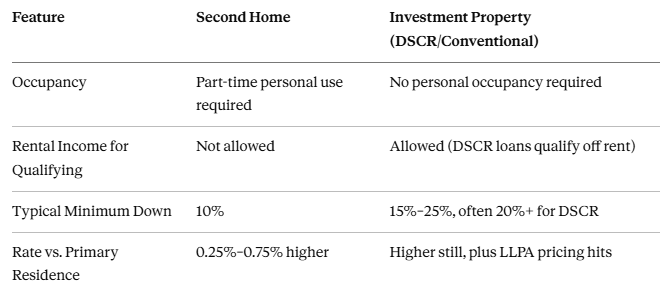
If a borrower's real goal is generating rental income, steering them toward a DSCR loan from the start is usually smarter than trying to stretch second home guidelines to fit.
Considerations for Second Home Mortgages
Beyond the numbers, underwriters look at whether the loan "makes sense" as a story. A few things to keep in mind:
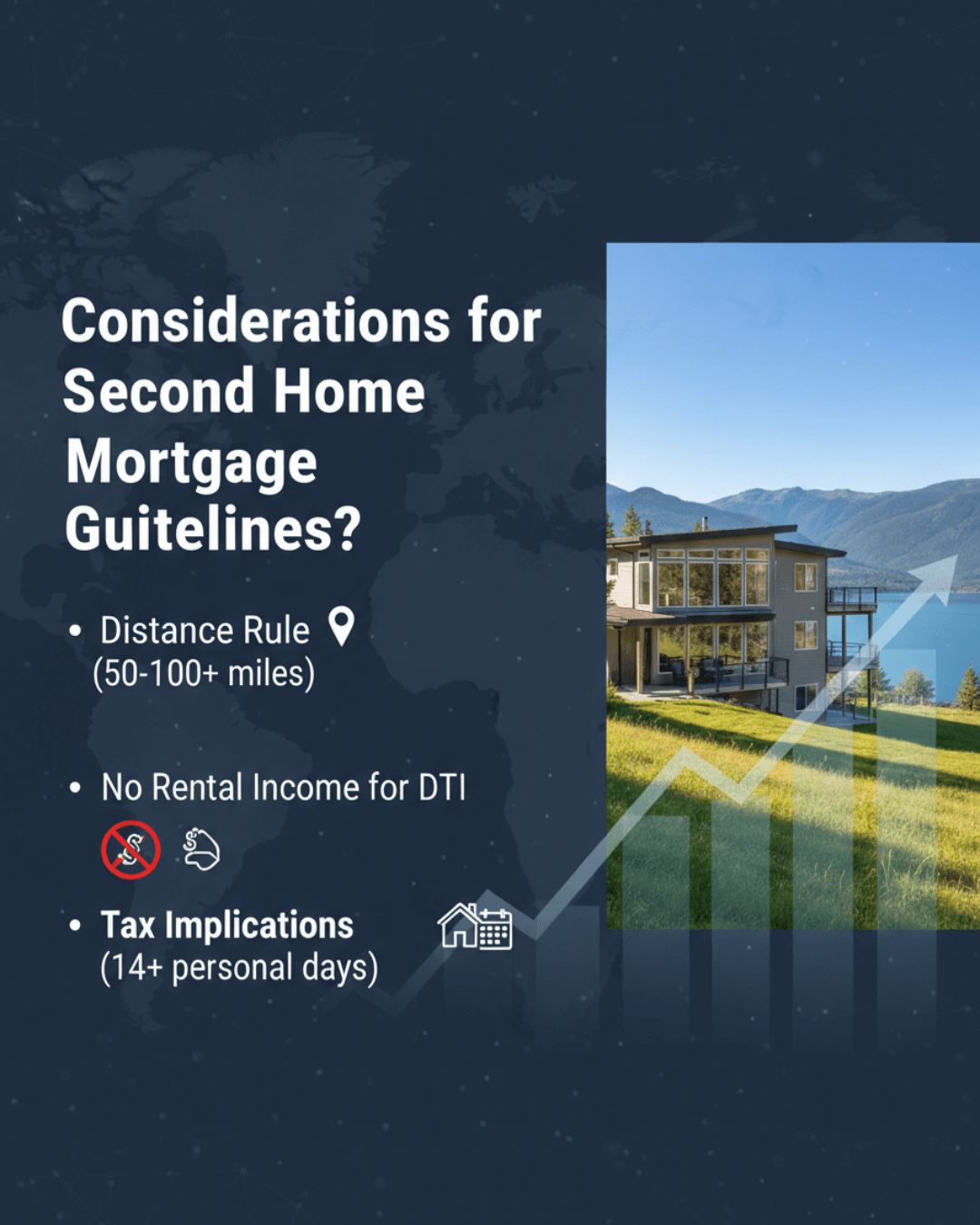
- No Rental Income for Qualifying: You can't use projected Airbnb or VRBO income to offset DTI on a second home. The borrower has to carry both housing payments on their own standard income.
- Higher-Priced Mortgage Loan (HPML) Rules: A common question I get is whether HPML protections apply to second homes. They don't. HPML rules under Regulation Z apply only to primary residences, so second homes are exempt. That said, second home loans can still qualify as a Higher-Priced Covered Transaction (HPCT) under a related APR test, so it's not entirely off the compliance radar.
- Tax Implications: I'm not a CPA, and borrowers should always confirm with one, but it's worth flagging that using the home for more than 14 days a year (or more than 10% of the days it's rented out) changes how the IRS classifies it.
Why You Should Check Second Home Mortgage Guidelines First
Nothing damages a referral relationship faster than issuing a pre-approval, only to have underwriting deny the file two weeks later over a hidden reserve overlay or an occupancy question nobody flagged early. I always verify the specific guideline set before collecting an application fee.
Checking lender matrices upfront prevents late-stage denials, saves your processor a headache, and keeps the borrower's experience smooth. The problem is that doing this manually, across dozens of lenders whose overlays change monthly, is close to impossible today.
How to Quickly Check Second Home Mortgage Guidelines?
This is exactly why Zeitro Strata AI has become part of my daily workflow. It's an AI-powered mortgage guideline assistant built for loan officers, account executives, and underwriters, and it now covers over 1,000 guidelines across more than 100 investors, spanning both QM and the notoriously fragmented Non-QM landscape, including multiple dedicated second home matrices.
Instead of hitting Ctrl+F in a 200-page PDF, you just ask.
A few reasons it's stuck in my rotation:
- Citations You Can Trust: Zeitro Strata AI pulls exact data and links back to the source document, so there's no guessing whether an answer is accurate.
- Speed on Vague or Specific Questions: Whether it's a broad eligibility question or a highly specific prequalification scenario, it searches the full guideline database and answers in seconds.
- The "Explain" Function: If a reserve requirement or occupancy rule reads as confusing, Explain runs a follow-up deep-dive on that exact scope for a clearer breakdown.
- Built for ROI: By plugging into your existing workflow, it cuts manual research time and speeds up your loan cycle.
- Genuinely Affordable: You get 3 free queries every day to test it out, and paid plans start at just $8 a month.

FAQs About Second Home Mortgage Guidelines
Can I use rental income to qualify for a second home mortgage?
Typically, no. This is the primary distinction between a second home and an investment property. The borrower must qualify for the loan using their own standard income streams, without relying on projected short-term or long-term rental income.
What is the distance requirement for a second home?
Historically, lenders looked for a 50 to 100-mile distance from the primary residence. Today, it's more about "logical sense." If it's a waterfront property or in a resort town, the distance rule can sometimes be waived, but it remains a key underwriting focus.
Are Non-QM loans available for second homes?
Absolutely. Many borrowers use Non-QM products like Bank Statement loans or Asset Utilization to finance vacation homes. Tools like Scenario AI can instantly show you which wholesale lenders offer the best terms for secondary properties.
How accurate is AI when checking mortgage guidelines?
Extremely accurate, provided you use an industry-specific tool. Scenario AI, for instance, provides direct citations and source links for every answer, ensuring your pre-approvals are based on verifiable, up-to-date lender data.
Can I try Zeitro Strata AI for free?
Yes. The Explorer plan includes free queries a day, enough to test it against a real second home scenario before deciding whether to upgrade.
Final Word
Structuring a second home mortgage takes precision. Between LTV limits, reserve requirements, and occupancy rules that sound simple but trip up plenty of experienced originators, there's little room for guesswork.
As mortgage professionals, our time is better spent building relationships and originating loans than acting as human search engines for hundreds of shifting lender PDFs. If you haven't already, I'd genuinely recommend heading to Zeitro to set up a free account. Take your 3 daily queries on Zeitro Strata AI for a spin today; your pipeline will notice the difference.
People Also Read
- Mortgage Guidelines 2026: What Are They? How to Verify?
- Conventional Mortgage Guidelines: What and How to Check Quickly?
- Jumbo Mortgage Guidelines: Check Eligibility Quickly and Accurately
- VA Mortgage Guidelines: What Are They and How to Check Them Quickly?
- What Are FHA Mortgage Guidelines? How to Verify FHA & Overlays Quickly?

![[Tips for Loan Officers] How Can I Lower Borrower DTI?](https://cdn.prod.website-files.com/6731bc6e813a541b54c30b10/6aa3b89e281a639e7a5c6fca_lower-debt-to-income-ratio-banner.jpg)