Written by

Eric
Share this article

.svg)
Subscribe to updates
Last Checked and Updated on September, 2026
In the Non-QM world, ITIN loans are one of the biggest opportunities out there — but they're also one of the messiest to process. Unlike government-backed programs that follow one rulebook, most ITIN loans are written by individual lenders who each set their own risk appetite.
I learned this the hard way early in my career. I once spent an entire afternoon flipping through a 40-page guideline PDF just to answer one client's question about reserve requirements. Multiply that by a dozen files a week, and you start to understand why loan officers dread ITIN scenarios.
That's the exact problem Zeitro Strata AI was built to solve. It's a chat-based guideline assistant that lets you check lender-specific ITIN rules in seconds instead of digging through PDFs, and it's become part of my daily workflow.
What are ITIN Mortgage Guidelines?
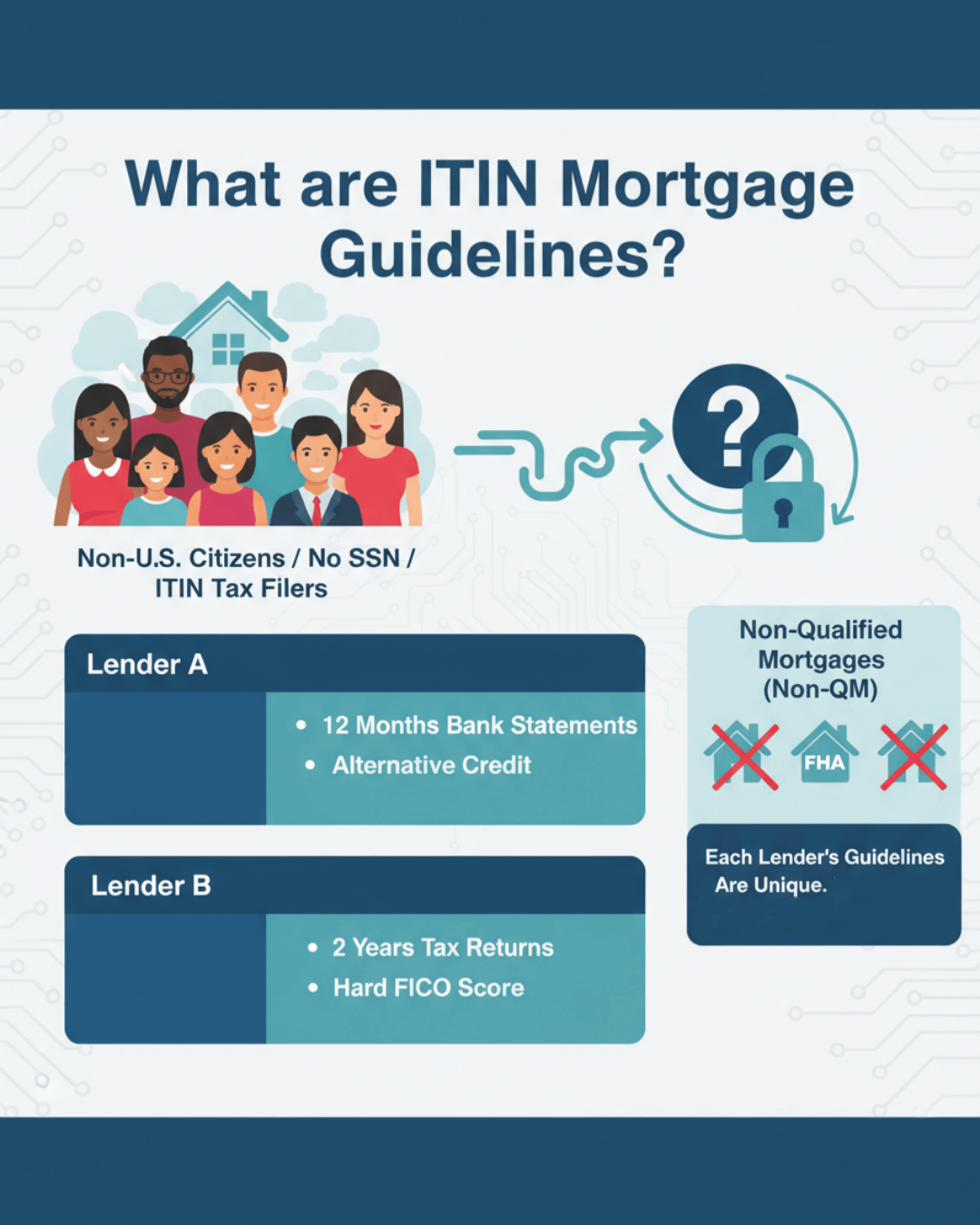
ITIN mortgage guidelines are the eligibility rules lenders apply to borrowers who file U.S. taxes with an Individual Taxpayer Identification Number instead of a Social Security number. This group usually includes recent immigrants, foreign-born workers, and long-term visa holders who are building a life — and a tax record — in the United States.
Most ITIN loans fall under the Non-Qualified Mortgage (Non-QM) category, meaning they aren't purchased by Fannie Mae or Freddie Mac and aren't insured by FHA. Because there's no single rulebook, one lender might accept twelve months of bank statements while another insists on two full years of tax returns. That inconsistency is exactly why blind spots cost deals, and why checking the specific lender's guideline sheet matters more than memorizing a "standard" rule that doesn't really exist.
Does Fannie Mae Accept ITIN Borrowers?
This one trips up a lot of loan officers, so let's clear it up. Fannie Mae's Selling Guide technically allows a borrower to use either a Social Security number or an ITIN to establish identity. On paper, that sounds like ITIN holders have a straightforward path into conventional lending.
In practice, it's not that simple. Fannie Mae also requires borrowers to be "legally present" in the U.S., and lenders must document that residency status separately from the tax ID itself. Most borrowers who rely solely on an ITIN, without an accompanying visa or lawful residency document a lender can verify, won't clear Fannie Mae's automated underwriting.
So when brokers ask me whether Fannie Mae "does ITIN loans," my honest answer is: technically yes, functionally rarely. That's the real reason Non-QM lenders built dedicated ITIN programs in the first place — they fill the gap that agency guidelines leave open but hard to reach.
Can You Get an FHA Loan With an ITIN?
Short answer: no, and this changed fairly recently. FHA loans have always required a valid Social Security number, so an ITIN alone was never sufficient on its own. But there used to be a workaround — non-permanent resident aliens with an Employment Authorization Document could still qualify.
HUD closed that door in 2025. A mortgagee letter removed FHA eligibility for non-permanent residents, which means borrowers who previously leaned on an EAD to get an FHA loan can no longer use that path. If a client asks about an "FHA ITIN loan," it's worth explaining upfront that this combination simply doesn't exist under current rules, and steering them toward a Non-QM ITIN program instead saves everyone time.
Why Verifying Guidelines Actually Matters
I've watched too many files fall apart in underwriting because of one small detail someone assumed rather than confirmed. A few reasons this step is non-negotiable:
- Fewer denials. Catching a lender-specific quirk early keeps the file out of underwriting purgatory.
- Time you don't get back. Nobody wants to burn an hour searching a PDF for one DTI cap.
- Your commission depends on it. Faster, cleaner closes protect your pipeline and your paycheck.
- Accuracy protects the client. A borrower matched to the wrong program from day one rarely has a smooth experience.
Who Actually Needs to Check These Guidelines?
It's tempting to assume this is only an underwriter's headache, but everyone touching a Non-QM file benefits from quick, accurate answers.
- Loan Officers and Brokers need fast eligibility checks to pre-qualify clients without leaving them waiting on hold.
- Account Executives field odd scenario questions from brokers all day and need instant, correct answers to win the business.
- Loan Processors have to confirm every piece of alternative documentation actually matches what the target lender wants to see.
- Underwriters are the last line of defense, so a quick way to cross-check rules keeps the sign-off confident rather than guesswork.
ITIN Mortgage Requirements in 2026
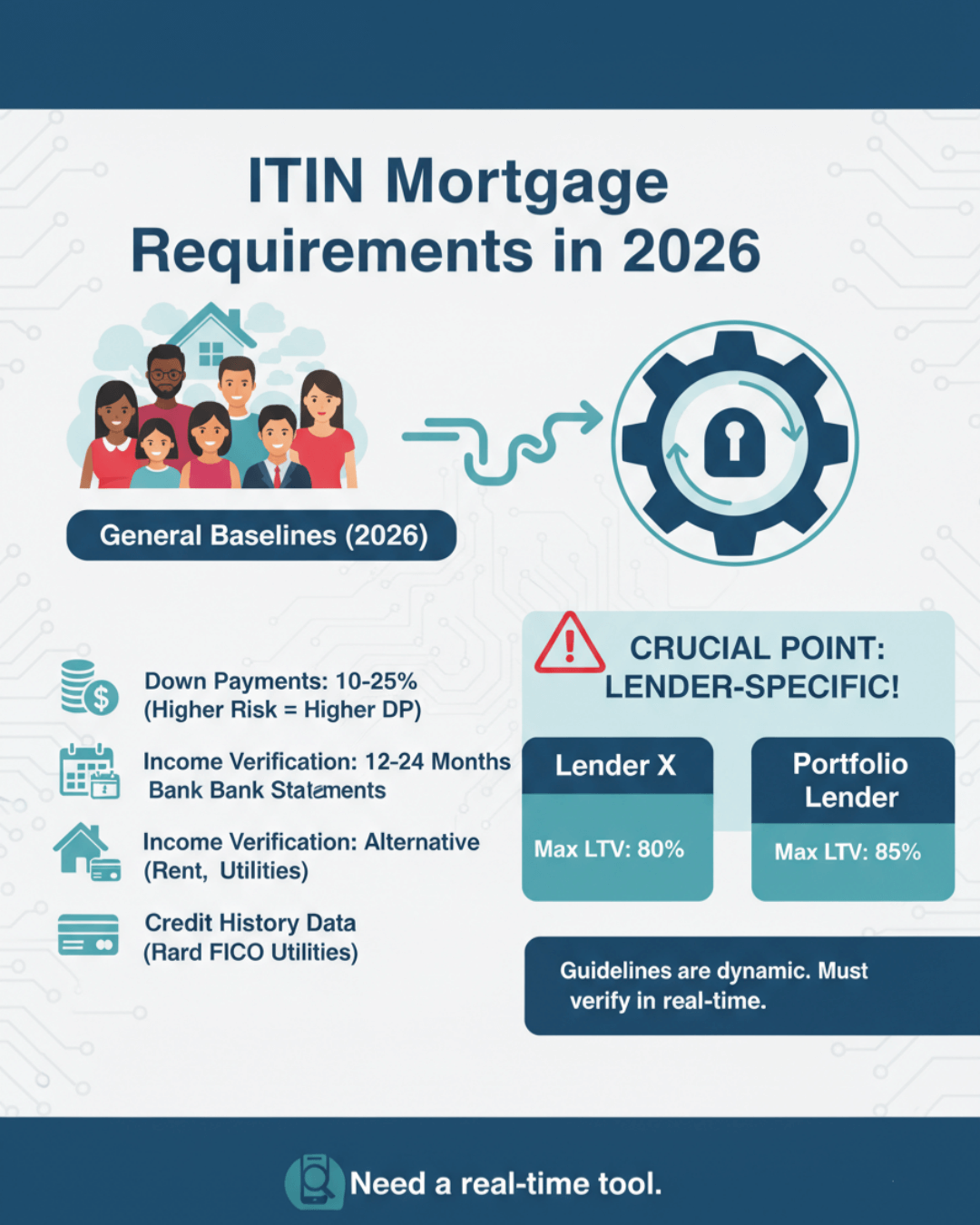
Heading into 2026, ITIN loans remain more accessible than most people expect, though the underwriting bar stays firm. Down payments generally sit between 10% and 20%, occasionally climbing toward 25% depending on how a lender scores overall risk.
Since most applicants don't have a traditional FICO score, lenders frequently build an alternative credit profile using twelve months of rent or utility payment history. For income, expect to submit 12 to 24 months of personal or business bank statements rather than W-2s. Most ITIN programs also cap debt-to-income around 45% to 50%, though that ceiling shifts based on reserves and how strong the rest of the file looks.
None of these numbers are fixed law — they're baselines that move depending on the lender and the borrower's overall risk picture. One lender might cap loan-to-value at 80%, while a portfolio lender stretches to 85% for a stronger file. That's exactly why relying on last year's cheat sheet, or a number a colleague mentioned once, is risky. You need something you can check in real time, deal by deal.
ITIN Loans in Florida: A Closer Look
Florida deserves its own mention here because it's one of the most active ITIN mortgage markets in the country. A large share of the state's workforce files taxes with an ITIN, and Non-QM lenders have responded by building out dedicated programs specifically for Florida buyers.
The documentation problems I see most often in Florida files aren't exotic — they're usually preventable. An ITIN that expired from inactivity and was never renewed with the IRS. A name that appears slightly differently across a passport, a lease, and a pay stub. Alternative credit history that's too thin because rent was paid in cash without a paper trail.
It's also worth separating two products people often confuse: an ITIN loan is for someone living in the U.S. and filing taxes here, while a foreign national loan serves buyers who live abroad and want to purchase Florida property. Foreign national programs typically demand a much larger down payment, often 30% to 40%, along with a foreign credit reference instead of a domestic score.
The ITIN Mortgage Pre-Approval Process
Once eligibility is confirmed, the actual pre-approval process runs fairly close to a conventional loan, just with a different documentation set behind it.
- Confirm the ITIN is active. If it's lapsed, the borrower needs to renew it with the IRS before anything else moves forward.
- Gather identity, income, and asset documents. Passport, bank statements, proof of residence, and any alternative credit evidence go here.
- Apply with a lender that supports ITIN programs online. Several digital-first lenders, including Griffin Funding, offer foreign national and ITIN products with a largely online application process, so it's worth comparing more than one before committing. Always check a lender's current reviews on Trustpilot or the BBB directly, since ratings and volume change over time.
- Receive a pre-approval letter. This gives the borrower a realistic price range before they start shopping.
Zeitro Strata AI: The Smart Way to Verify ITIN Mortgage Guidelines
Instead of wrestling with outdated PDFs, I lean on Zeitro Strata AI daily. It's an AI-powered guideline assistant purpose-built for Non-QM complexity — ITIN, DSCR, and bank statement programs included. The database currently spans 1,000+ guidelines pulled from 100+ investors, and it keeps expanding as new lenders publish updated overlays.
A few things make it genuinely useful rather than just another AI gimmick:
- Fast, specific answers. Ask something as broad as "what is an ITIN loan" or as narrow as a single eligibility scenario, and it searches the full guideline library in seconds.
- Citations you can actually check. Every answer links back to the source document, so you're not taking an AI's word for it — you can verify the exact page yourself.
- An Explain feature for follow-ups. If an answer is confusing, you can dig deeper into that same context without starting the search over.
- Affordable and multilingual. It supports several languages, which matters a lot when you're serving immigrant communities directly.
- LOS integration. Plugging into your Loan Origination System cuts out manual re-entry and speeds up the whole file.

FAQs About ITIN Mortgage Guidelines
Does Fannie Mae accept an ITIN as identification for a mortgage?
Technically, yes — Fannie Mae's guide allows either an SSN or an ITIN. But borrowers also need to document lawful residency separately, which is where most ITIN-only applicants run into trouble with agency underwriting.
Can I get an FHA loan with only an ITIN?
No. FHA has always required a Social Security number, and HUD's 2025 policy change also removed eligibility for non-permanent residents who previously used an EAD. Non-QM ITIN programs are the practical alternative.
What's the difference between an ITIN loan and a foreign national loan?
An ITIN loan is for someone living and filing taxes in the U.S. A foreign national loan is for a buyer living abroad, and it typically comes with a much larger down payment requirement.
Can a borrower qualify without a traditional credit score?
Yes, in most cases. Lenders often build an alternative credit profile from rent, utility, or phone payment history, though exact requirements still vary by lender.
Are ITIN loan requirements the same everywhere?
No. Because these are Non-QM products, every lender sets its own down payment, LTV, and DTI limits, and those numbers can differ significantly from one institution to the next.
Does Zeitro Strata AI only cover ITIN loans?
No — it covers 1,000+ guidelines across DSCR, bank statement, WVOE, conventional, FHA, and more.
Final Thoughts
Speed and accuracy are what separate closed deals from stalled ones in today's ITIN market. Non-QM products open the door to a genuinely underserved segment of buyers, but only if you can move through conflicting, constantly-updated guidelines without losing hours to PDF searches.
If you're ready to stop guessing and start verifying, give Zeitro Strata AI a try. It's built to help you structure complex ITIN scenarios with confidence, one guideline check at a time.
People Also Read
- 8 Best Non-QM Mortgage Lenders in 2026: Which to Choose?
- Foreign National Mortgage Guidelines: Verify Eligibility Fast
- DSCR Mortgage Guidelines Explained: What and How to Verify?
- 6 Best Loan Origination Software for LOs/Brokers

![[Tips for Loan Officers] How Can I Lower Borrower DTI?](https://cdn.prod.website-files.com/6731bc6e813a541b54c30b10/6aa3b89e281a639e7a5c6fca_lower-debt-to-income-ratio-banner.jpg)