Written by

Eric
Share this article

.svg)
Subscribe to updates
Last Checked and Updated on September, 2026
As a loan officer, I've watched more than one profitable deal stall for one simple reason: the guideline check took too long. Interest in foreign national mortgage guidelines keeps climbing as overseas buyers pour money into US real estate, but the rules are scattered across dozens of investor guides that rarely agree with each other. Nobody wants to burn an afternoon reading a 300-page PDF only to discover the borrower's visa situation doesn't fit that particular lender's box.
Speed matters here. In my own pipeline, I lean on Zeitro Strata AI to cross-reference lender guidelines in seconds instead of digging through PDFs one at a time. It's changed how fast I can say yes or no to a scenario.
People Also Read:
- What Are FHA Mortgage Guidelines? Verify FHA & Overlays Quickly
- Conventional Mortgage Guidelines: What and How to Check Quickly?
- Jumbo Mortgage Guidelines: Check Eligibility Quickly and Accurately
- VA Mortgage Guidelines: What Are They and How to Check Them Quickly?
- Mortgage Guidelines 2026: What Are They? How to Verify?
- Should Mortgage Lender and Broker Build In-House AI Tools?
What are Foreign National Mortgage Guidelines?
Foreign national mortgage guidelines are the underwriting rules lenders apply to borrowers who are not US citizens and don't live in the country permanently. Because there's no Fannie Mae or Freddie Mac backing behind these files, they almost always sit in the Non-QM (Non-Qualified Mortgage) space, where private investors set their own risk appetite.
That private-money structure is exactly why the rules swing so much from one lender to the next — allowable LTV, credit alternatives, reserve math, all of it. A file that gets declined at one shop might sail through at another simply because the investor's overlay is looser.
It also helps to separate three terms people mix up constantly:
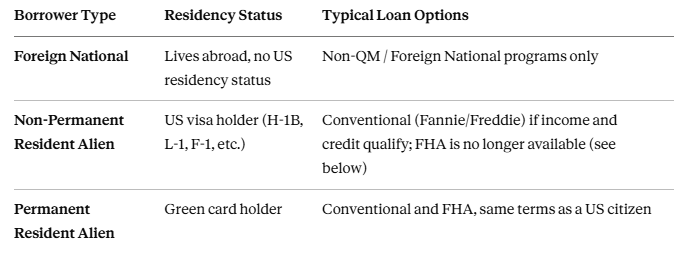
A true foreign national — someone with no US residency status at all — never had FHA access to begin with. But the middle category, visa holders, saw a real shift last year that's worth flagging for anyone searching this topic.
Why the FHA Landscape Changed for Visa Holders
Here's something a lot of guides on this topic still miss: in March 2025, HUD issued Mortgagee Letter 2025-09, and as of May 25, 2025, non-permanent residents — H-1B, L-1, F-1, and similar visa categories — are no longer eligible for FHA-insured financing. Only US citizens, green card holders, and citizens of the Federated States of Micronesia, the Marshall Islands, or Palau (under the Compact of Free Association) remain eligible for FHA loans today.
If you work with visa-holding clients who assumed FHA was still on the table, that conversation just got more important. Their remaining paths are conventional financing (if income, credit, and a valid Social Security number check out) or a Non-QM / foreign national program — which, frankly, is where a lot of these borrowers end up anyway once they see the paperwork FHA now demands to prove status.
Why Offer Foreign National Mortgages?
I get asked this a lot: why bother with loans that require extra documentation and more hand-holding? Because it's a large, underserved slice of the market, and originators who avoid it because "it's too complicated" are leaving commission on the table for the rest of us.
- Real Estate Investment Growth: Overseas investors treat US property as a stable store of value, and many are buying rentals that pair naturally with a DSCR (Debt Service Coverage Ratio) loan.
- Vacation and Second-Home Purchases: Buyers from Canada, Europe, and Asia regularly shop for second homes in Florida, California, and Texas.
- Diplomatic and Corporate Relocation: The DC metro area, including Northern Virginia, sees a steady stream of embassy staff and relocating executives who need financing before they've built US credit — and because home prices there routinely exceed conforming limits, a lot of these files also qualify as jumbo loans.
- Portfolio Diversification: When refinance volume dries up, foreign national and Non-QM business keeps your pipeline moving.
Key Foreign National Mortgage Requirements
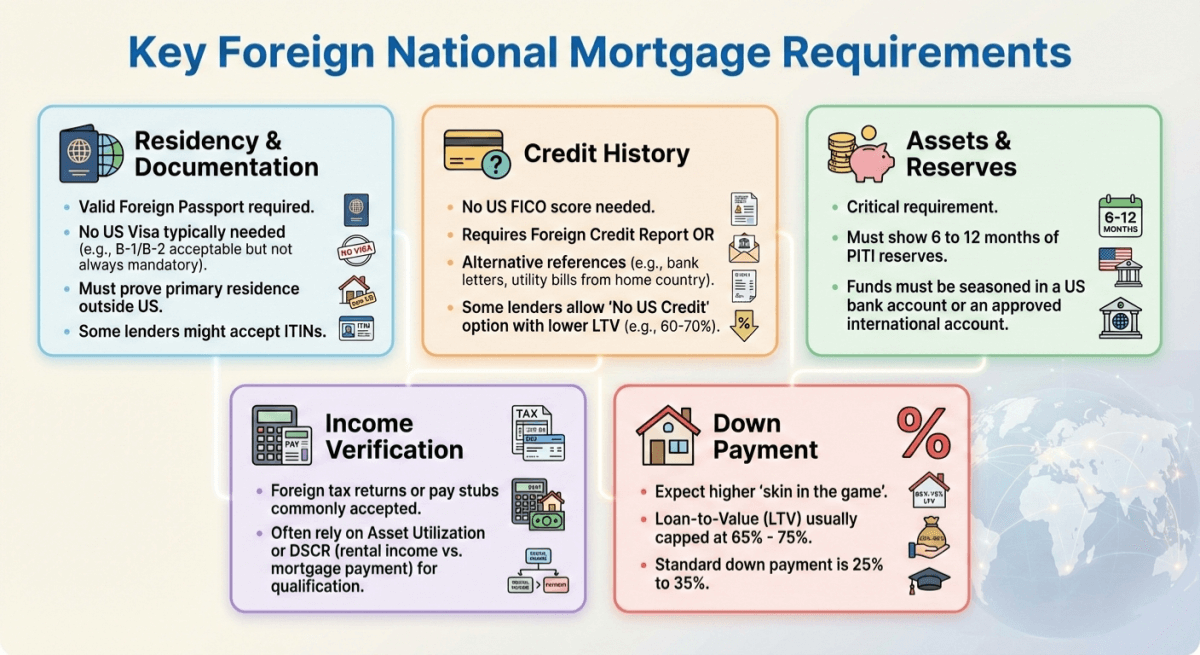
Every lender has its own flavor of guideline, but a handful of pillars show up almost everywhere. These are the things I check first before I even pull a scenario into Zeitro Strata AI.
- Residency and Documentation: A valid foreign passport is the baseline. Most programs don't require a US visa at all, though a few will accept B-1/B-2 or an ITIN if the borrower has one. What they do want is proof the borrower's primary residence is genuinely outside the US.
- Credit History: Without a US FICO score, lenders typically ask for an international credit report or reference letters from a bank or utility company back home. Some programs skip the credit check entirely when the LTV is low enough, often in the 60–70% range.
- Assets and Reserves: This is where files get held up if you're not careful. Lenders usually want reserves calculated on the full PITIA — principal, interest, taxes, insurance, and any HOA dues — not just principal and interest, so the number is often higher than borrowers expect. Six to twelve months is standard, though stocks and mutual funds are typically only counted at 70–80% of market value, and retirement accounts may be discounted further. On the flip side, some lenders will reduce or waive reserves entirely once the LTV drops below roughly 75%, so it's worth asking rather than assuming the worst case applies.
- Income Verification: Foreign tax returns and pay stubs work at many lenders, but Asset Utilization and DSCR are the two go-to paths when income documentation from abroad gets messy. DSCR in particular has become the default for foreign national investors because it qualifies the loan off the property's rental income rather than the borrower's paycheck — no US employment history required, and some programs don't pull a credit score at all.
- Down Payment: Expect to put more equity into the deal than a domestic borrower would. Down payments generally run 20% to 35% depending on the lender, property type, and loan amount, with LTV caps commonly landing between 65% and 80%.
Documents You'll Typically Need
Clients ask me for a checklist constantly, so here's the short version I hand them before we start:
- Valid, unexpired foreign passport
- Visa documentation, if applicable (not required by most programs)
- Two years of foreign income records — tax returns, pay stubs, or employer letters, translated into English
- Bank statements showing sourced and seasoned funds for the down payment and reserves
- Proof that overseas funds have been transferred into a US account, usually at least ten days before closing
- A US bank account set up for automatic mortgage payments
Pro Tip: Tool to Quickly Check Foreign National Mortgage Guidelines?
Nobody has time to skim 300-page guideline PDFs across fifteen different lenders every time a scenario lands on their desk. That's the exact problem Zeitro Strata AI was built to solve, and it's become a permanent part of my workflow.
It's an AI-powered guideline assistant built specifically for loan professionals. Instead of hunting through documents, I type something like "which lenders allow 75% LTV for a foreign national with no US credit?" and get an answer pulled straight from the source material.
What makes it worth the subscription:
- Broad Coverage: Strata AI cross-checks 100+ investors across more than 1,000 guideline documents, including a dedicated foreign national library from lenders such as AD Mortgage, Greenbox, and Lux — work that used to take 30 minutes now takes seconds.
- Deep Search by Lender: You can narrow the search to a handful of specific investors and ask the AI to compare their reserve requirements side by side.
- Citations You Can Trust: Every answer comes with a source link, so I can pull up the exact guideline page before I quote terms to a client. That's the feature that actually earns my confidence in the answer.
- Handles Vague Questions: You don't need perfect phrasing. Broad or narrow, the AI reads mortgage context either way.
- Affordable: Plans start at around $8 a month, which is nothing compared to one commission check on a foreign national deal.

FAQs About Foreign National Mortgage Guidelines
Q1. What is a foreign national mortgage loan?
It's a loan designed for non-US citizens who live outside the United States. These programs let foreign buyers purchase investment properties or second homes without a US credit history or Social Security number, usually through Non-QM lenders rather than conventional financing.
Q2. Can a foreign national get a mortgage in the US?
Yes. They won't qualify for conventional financing, but Non-QM lenders built entire product lines around this borrower profile. Expect a larger down payment, typically 20% to 35%, and qualification based on the property's cash flow (DSCR) or the borrower's liquid assets rather than US-based income.
Q3. Does Fannie Mae allow foreign nationals?
Not in the way most people mean when they say "foreign national." Fannie Mae purchases loans made to non-US citizens who are lawful permanent or non-permanent residents — green card holders or valid visa holders with a Social Security number — on the same terms as US citizens. A borrower who lives abroad full-time with no US residency status doesn't fit that box and needs a Non-QM foreign national program instead.
Q4. Does Fannie Mae accept foreign income?
It can, but only for borrowers who already qualify as lawful residents. If a resident borrower's income comes from an employer abroad, Fannie Mae requires two years of signed federal tax returns showing that foreign income, translated into English, with every figure converted to US dollars. This is a documentation issue, not an eligibility issue — it's a completely different scenario from a true foreign national with no US tax filings at all.
Q5. Are foreign national loans always DSCR loans?
Not always, but the two overlap constantly. DSCR is popular for foreign nationals because it sidesteps the need for US employment verification altogether, qualifying the loan against the subject property's rent instead. Some DSCR programs skip the credit score requirement entirely, which is a real advantage for a borrower with no US credit file.
Final Word
Foreign national mortgage guidelines don't have to feel like a guessing game, even with last year's FHA changes adding a new wrinkle for visa holders. The opportunity here is real for loan officers and brokers willing to learn the terrain, and the edge comes down to knowing which lender fits your client's exact situation before you submit the file.
If you're still digging through outdated PDFs to answer that question, give Zeitro Strata AI a try. It turns a chaotic corner of Non-QM lending into something you can search, verify, and quote with confidence in seconds rather than hours.

![[Tips for Loan Officers] How Can I Lower Borrower DTI?](https://cdn.prod.website-files.com/6731bc6e813a541b54c30b10/6aa3b89e281a639e7a5c6fca_lower-debt-to-income-ratio-banner.jpg)