
Written by

Eric
Author from Zeitro

Share this article

Subscribe to updates

Thank you! Your submission has been received!
Oops! Something went wrong while submitting the form.

Let's be real: the NMLS SAFE MLO exam is a beast. I've seen incredibly smart people, people with finance degrees, fail this test simply because they underestimated how tricky the questions are. With the national pass rate for first-timer. I've seen incredibly smart people, people with finance degrees, fail this test simply because they underestimated how tricky the questions are.

With the national pass rate for first-timers at 53%, relying solely on your mandatory 20-hour class is a massive gamble. You need a strategy to bridge the gap between "sitting in class" and "passing the exam." After digging through the noise, I've broken down the best prep courses for 2026 that actually teach you how to beat the test, not just memorize definitions.

People Also Read:

What are the NMLS Exam Requirements?

Before you drop money on a prep course, make sure you understand the rules. A lot of rookies confuse the Pre-Licensing Education (PE) with Exam Prep. They are not the same. You must take the 20-hour PE class to be legal. You should take an Exam Prep course to actually pass.

To qualify for the National Test with Uniform State Content (UST), here is the checklist you strictly need to follow:

  • Finish the PE: Complete your 20 hours of NMLS-approved education.
  • Get your NMLS ID: Create an account on the NMLS Resource Center.
  • Pay to Play: The exam fee is currently $110.
  • Sign the Agreement: You have to accept the Candidate Agreement before you can even look at a calendar.

6 Top-Rated NMLS Test Prep Course in 2026

I didn't just look for the cheapest options. I looked for courses that mimic the anxiety of the real test and offer tools to calm you down. Here is how the top players stack up this year.
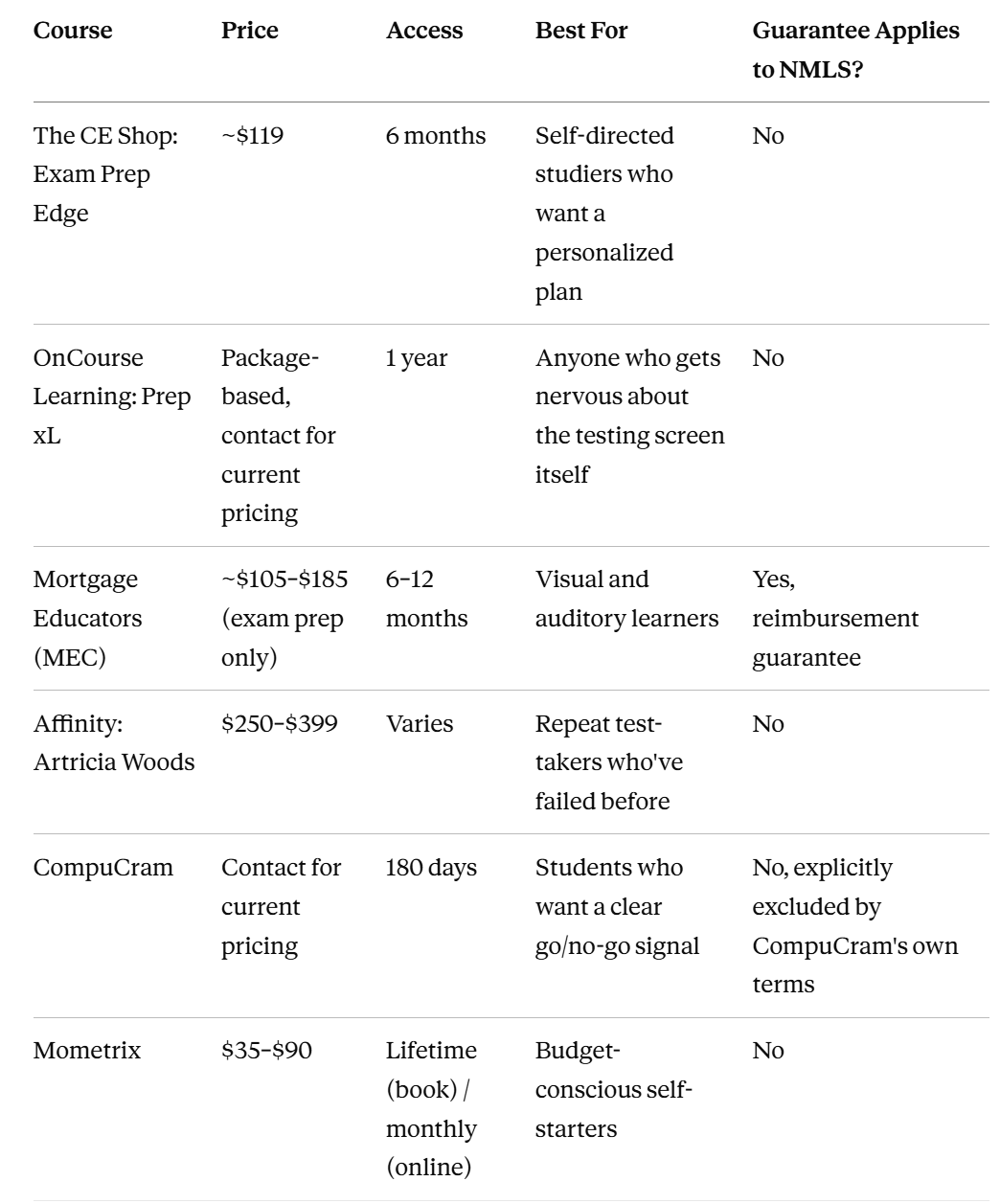
The CE Shop: Exam Prep Edge

Price: Around $119 (Look for promo codes)

Access Duration: 6 Months

Course Format: Adaptive online assessments, flashcards, dynamic dashboard.

Best for: Students who want a smart, customized study plan without fluff.

I've used a lot of learning platforms, and The CE Shop's "Exam Prep Edge" feels the most modern. The standout feature here is the initial assessment. It doesn't force you to waste time studying things you already know. If you are already a wizard at Ethics but suck at Federal Law, the system adapts and throws more law questions at you.

The dashboard is slick. It gives you a real-time competency score, so you know exactly when you are ready to take the real thing. It's fully optimized for mobile, so studying on the go is easy. Just note: it's very self-directed. If you need a teacher holding your hand, this might feel a bit too isolated. But for efficiency? It's hard to beat.

The CE Shop: Exam Prep Edge

OnCourse Learning: PrepXL

Price: $79 - $149 (Depends on the package)

Access Duration: 1 Year

Course Format: Heavy focus on exam simulation and flashcards.

Best for: People who get nervous about the test interface and want a realistic dry run.

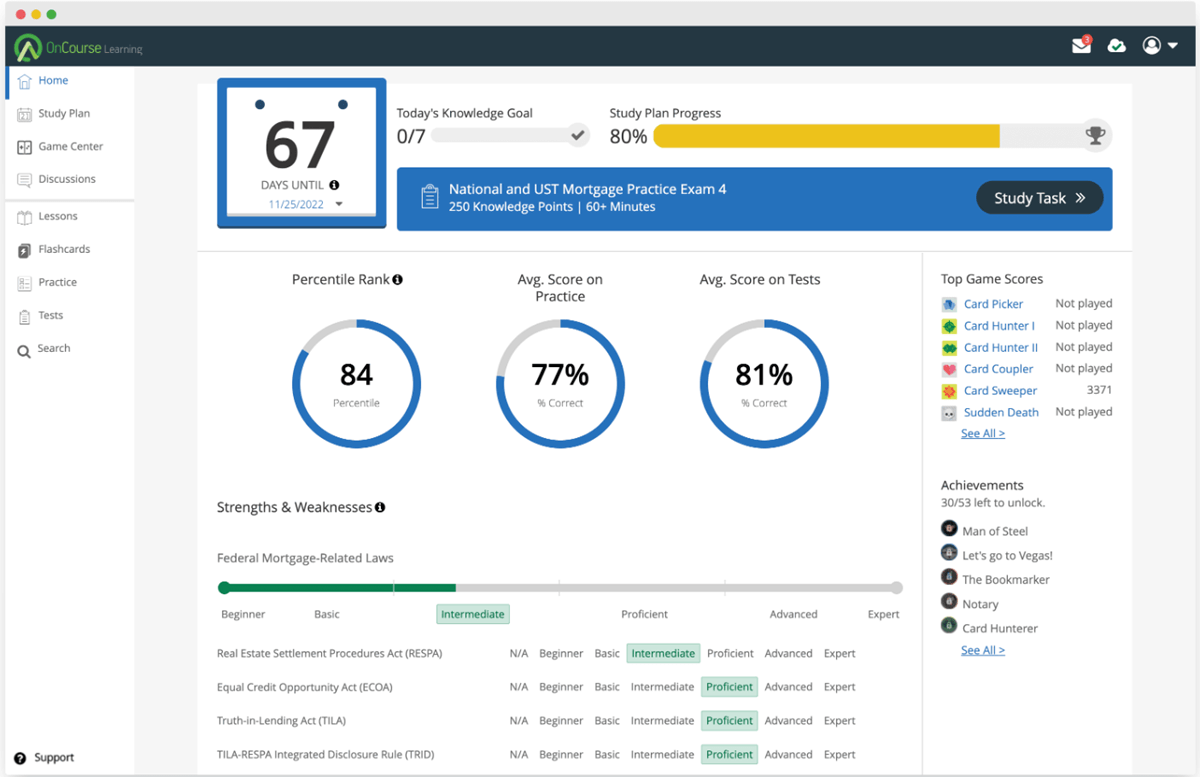
If you have test anxiety, OnCourse Learning's PrepXL is my top recommendation. Why? Because their simulator looks almost identical to the Pearson VUE interface you'll see on exam day. The fonts, the timer, the layout. It's all designed to make you feel comfortable when it counts.

I also appreciate their "explanations." When you get a question wrong, they don't just give you the right answer. They tell you exactly why your choice was wrong. That's where the real learning happens. It's less flashy than The CE Shop, but the bank of 1,000+ questions is rigorous. It's a workhorse of a course.
OnCourse Learning: PrepXL

Mortgage Educators (MEC)

Price: ~$100 - $150

Access Duration: 6 - 12 Months

Course Format: Engaging video lectures, PDF guides, practice quizzes.

Best for: Visual learners who can't stand reading walls of text.

Mortgage law is dry. There's no way around it. But MEC does a fantastic job of making it bearable, largely thanks to their lead instructor, David Luna. The guy is a legend in the industry. He uses humor, costumes, and stories to explain TRID and RESPA rules, which helps the info actually stick in your brain.

This course is perfect if you are an auditory or visual learner. Reading a textbook might put you to sleep, but watching David explains concepts keeps you engaged. The tech platform isn't the newest, but the content quality is top-tier. If you need a human element to keep you motivated, this is the one.
Mortgage Educators (MEC)

Affinity Mortgage Services: Artricia Woods

Price: $250 - $399 (Premium pricing)

Access Duration: Varies

Course Format: Live webinars, "The Owl" strategy, intensive coaching.

Best for: Retakers. If you've failed before, this is the fix.

I call Affinity the "Bootcamp" option. Artricia Woods is famous for getting people to pass after they've failed 2, 3, or even 4 times. This isn't just a generic question bank. She teaches you how to read the questions. The NMLS exam loves trick wording, and Artricia teaches you to spot the traps.

Her "MLO Exam Prep Master Course" is intense and expensive compared to others, but it works. She breaks down the complex legalese into plain English. If you are struggling and just want to get this over with, the extra cost is worth the investment.

Affinity Mortgage Services: Artricia Woods

CompuCram

Price: ~$109

Access Duration: 180 Days

Course Format: Vocabulary drills, practice testing, readiness meter.

Best for: Students who want a clear "Green Light" before scheduling.

I'm listing CompuCram here because their system is incredibly binary: Red means stop, Green means go. They have a "Readiness Indicator" on the dashboard that tracks your vocabulary and test scores. My advice? Don't schedule your exam until that bar hits the green zone.

They put a huge emphasis on vocabulary, which is smart because half the battle is just knowing what terms like "hypothecation" mean. The interface is simple and distraction-free. It's not as entertaining as MEC, but it's highly effective for rote memorization and speed drills.

CompuCram

Mometrix NMLS Test Prep Course

Price: $60 - $90 (Book or Monthly Sub)

Access Duration: Lifetime (Book) / Monthly (Online)

Course Format: Physical study guide, e-book, standard practice questions.

Best for: Self-starters on a tight budget.

Sometimes you just want a book. Mometrix is the old-school choice. You can grab their "Secret Study Guide" off Amazon or use their online portal. It's significantly cheaper than the full courses listed above.

It covers all the content, but be warned: it lacks the interactive "adaptive" features of The CE Shop or the realistic simulations of PrepXL. I see this as a great supplement, maybe buy the book to read offline, but pair it with a better digital question bank if you can afford it.

Mometrix NMLS Test Prep Course

How to Choose the Best NMLS Test Prep Course?

Don't just pick the cheapest one. You need to match the course to your brain. Here is what I tell people when they ask me for a recommendation:

  • Know Your Style: If you fall asleep reading, buy MEC for the videos. If you just want to grind questions until your eyes bleed, get CompuCram or PrepXL.
  • Check the Guarantee: Look for a "Pass Guarantee." Even if you don't use it, it shows the company backs their product. Just read the fine print. Some require you to score 90% on their practice tests first.
  • Mobile Matters: You'll likely be studying in 15-minute bursts on your lunch break. Make sure the site works on your phone.
  • Update Frequency: Laws change. Ensure the course explicitly mentions the 2026 UST update.

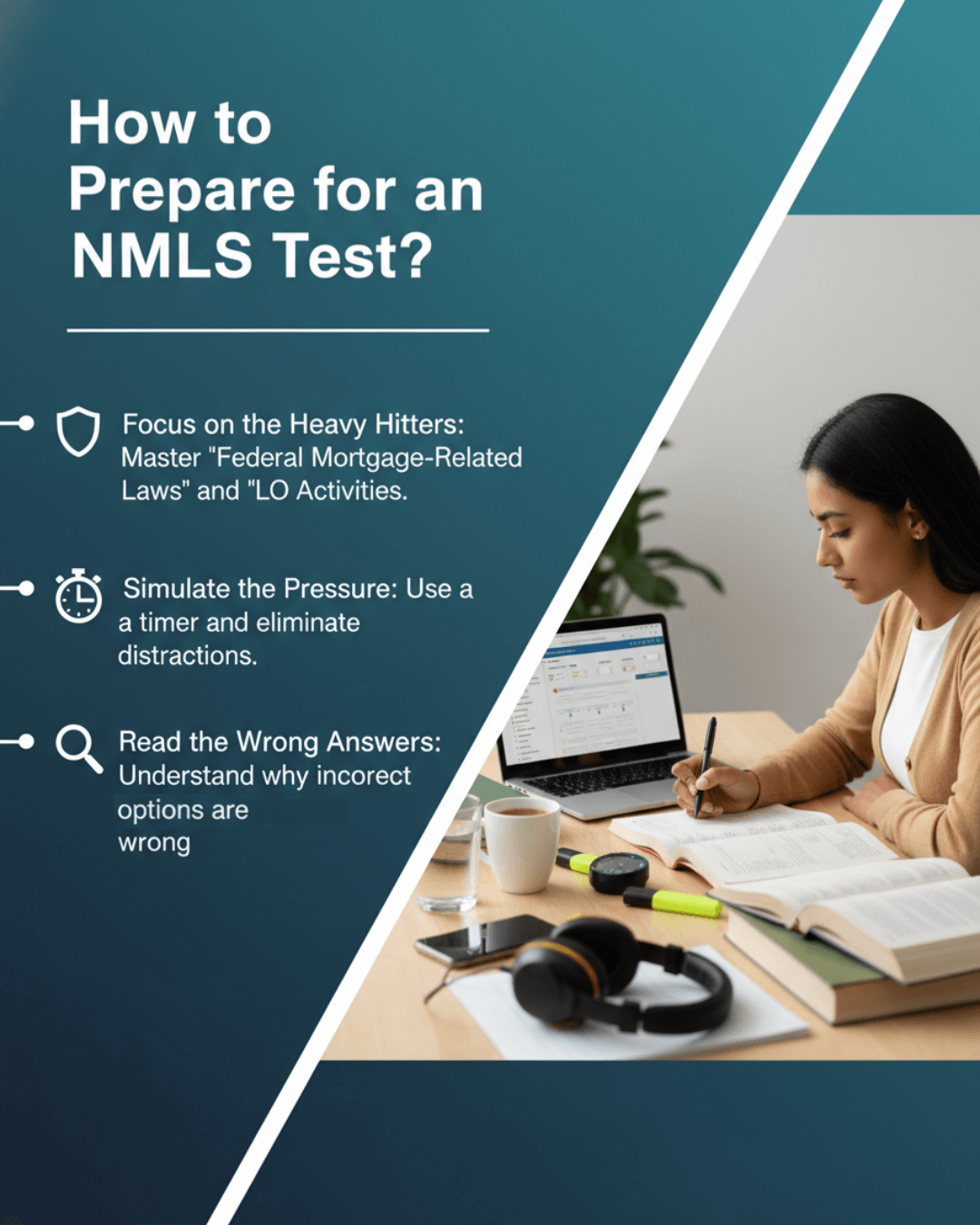
How to Prepare for an NMLS Test?

Buying the course is easy. Doing the work is hard. The biggest mistake I see? People memorize answers instead of learning concepts.

  • Focus on the Heavy Hitters: "Federal Mortgage-Related Laws" and "LO Activities" make up nearly 50% of the exam. Master those sections first.
  • Simulate the Pressure: When you take practice exams, turn off the TV, put your phone in another room, and use a timer. You need to get used to the stress.
  • Read the Wrong Answers: When you review your practice tests, study the wrong answers. Understanding why a distracter is incorrect is more valuable than knowing the right answer.
How to Schedule NMLS Test?

Once your practice scores are consistently hitting 80% or higher, stop procrastinating and book the test.

  1. Log into the NMLS Resource Center.
  2. Click the "Composite View" tab and manage your test enrollment.
  3. Pay the fee (it's non-refundable, so be ready).
  4. You will then be directed to the Prometric website to pick your seat.

Centers fill up fast. Book at least 2 weeks out to get a morning slot when your brain is fresh.

How Hard Is It to Pass the NMLS Test?

It's tough. I won't lie to you. The first-time pass rate sits around 53%.

The difficulty isn't just the material. It's the question design. You will see questions where two answers look "right," but one is "more right" based on federal law. It tests your ability to apply the law in a scenario, not just recite a definition.

How Many Hours to Study for NMLS?

Your 20-hour PE class is just the appetizer. To actually pass, you need to put in overtime.

I recommend an additional 20 to 40 hours of dedicated study time. Don't cram this into one weekend. Spread it out over 2 to 3 weeks, doing 2 hours a night. This gives your brain time to absorb the acronyms and regulations.

Conclusion

Getting your MLO license is a game-changer for your career, but you have to clear this hurdle first. Don't try to wing it.

  • If you want the best tech, go with The CE Shop.
  • If you need the most realistic practice, grab OnCourse Learning.
  • If you've failed before and need a rescue mission, hire Affinity.

Pick the tool that works for you, put in the hours, and go crush that exam. You've got this.

Keep reading

VA Mortgage Guidelines: What Are They and How to Check Them Quickly?

Blog

5 min read
Arrow icon on dark background
VA Mortgage Guidelines: What Are They and How to Check Them Quickly?
Stop searching PDFs. Learn key VA Mortgage Guidelines and use Zeitro Scenario AI to get accurate, cited answers from 15+ lenders instantly. Try it free!

As a Loan Officer or Broker, few things are as frustrating as navigating the labyrinth of government loan requirements. You think you know the rules, but then a specific lender's overlay throws a wrench in your deal. VA Mortgage Guidelines are the rulebook set by the Department of Veterans Affairs, detailing how we originate, process, and underwrite loans for our service members.

But here is the catch: knowing the "VA Handbook" isn't enough. You also need to know how each lender interprets it. How do you quickly verify if a borrower with a 580 FICO score qualifies with Lender A versus Lender B without reading endless PDFs?

In this guide, I'll break down the essentials of VA guidelines and share a workflow hack I've recently adopted: using Zeitro's Scenario AI. It's a chat-based tool that lets me verify guidelines across different lenders instantly, saving me hours of manual research.

People Also Read:

What Are VA Mortgage Guidelines?

At their core, VA Mortgage Guidelines are the standards outlined in the VA Lenders Handbook (Pamphlet 26-7). These rules dictate everything from income calculation to property safety. They exist to protect the government (which guarantees a portion of the loan) and the veteran.

However, from my experience in the trenches, there is a critical distinction between "VA Minimum Requirements" and "Lender Overlays."

While the VA technically doesn't set a minimum credit score, most investors do. While the VA allows for high Debt-to-Income (DTI) ratios if there is sufficient residual income, some lenders cap it at 45% or 50%. This is where the confusion often lies. The "Guidelines" generally refer to the baseline federal rules, but in practice, you are always dealing with a mix of federal mandates and specific investor risk layers. Understanding this difference is what separates an average LO from a top producer who can save a deal that others denied.

What Are VA Mortgage Guidelines?

Who Do VA Mortgage Guidelines Apply To?

These guidelines are not for everyone. They are strictly for eligible borrowers who have served our country. Before we even look at credit or income, we must establish eligibility through a Certificate of Eligibility (COE).

Generally, the guidelines apply to:

  • Veterans: Those who have served the required length of time and were discharged under conditions other than dishonorable.
  • Active-duty Service Members: Currently serving personnel, usually after 90 days of continuous service.
  • National Guard and Reserve Members: Typically require 6 years of service, though 90 days of active duty (Title 10 or 32) can also qualify them.
  • Surviving Spouses: Unremarried spouses of veterans who died in service or from a service-connected disability.

If your client doesn't fit one of these buckets, the VA guidelines and the zero down payment benefit won't apply.

Why Are VA Mortgage Guidelines Important?

You might ask, "Why can't we just wing it and ask the underwriter later?" As professionals, strictly adhering to these guidelines is non-negotiable for three massive reasons:

  • The VA Guaranty: The primary selling point of this loan is that the VA guarantees 25% of the loan amount against default. If we miss a guideline, say, we miscalculate Residual Income or ignore a Minimum Property Requirement (MPR), the VA can void that guaranty. That is a disaster for the lender.
  • Secondary Market Salability: Most lenders don't keep loans on their books. They bundle them into Ginnie Mae securities. If a loan doesn't meet the guidelines, it becomes "unsalable." This leads to forced buybacks, which can bankrupt smaller mortgage shops.
  • Veteran Protection: These guidelines are designed to stop predatory lending. Rules regarding fees (like the 1% origination cap) and strictly regulated closing costs ensure the veteran isn't being taken advantage of. Following the rules isn't just about compliance. It's about ethics.

VA Mortgage Eligibility Requirements 2026

As we move through 2026, the fundamental pillars of VA lending remain stable, but attention to detail is key. Here is what you need to focus on to get your files clear-to-close:

  • Residual Income (The "Secret Sauce"): Unlike Conventional or FHA loans that obsess over DTI, VA guidelines prioritize Residual Income (net income remaining for family expenses). Even with a high DTI (e.g., 60%), a borrower can qualify if their residual income exceeds the regional requirement by 20%.
  • Credit Score: Officially, the VA does not set a minimum credit score. However, in 2026, most lenders impose overlays typically in the 620–660 range. A few may approve 580–619 with compensating factors. Use tools or lender‑board overlays to identify banks that allow lower‑score files.
  • Property Standards (MPRs): The home must be "safe, structurally sound, and sanitary." This isn't just a cosmetic inspection. Issues like peeling paint (lead risk) or lack of a permanent heat source are deal-killers.
  • Occupancy: The borrower must intend to occupy the property as their primary residence within 60 days. Investment properties are a no-go unless it is an IRRRL (refinance).
  • Loan Limits: For borrowers with full entitlement, VA generally does not impose county‑level loan limits, so lenders can finance high loan amounts with zero‑down as long as the veteran qualifies on income, credit, and appraisal value. Many lenders will still apply internal or investor‑level ceilings (for example, clustered around $2M+), but those fall outside the VA guideline itself.
VA Mortgage Eligibility Requirements 2026

Pro Tip: How to Verify VA Mortgage Guidelines in Seconds with AI?

Here is the reality of our job: You have a client who is a borderline approval. You need to know, "Which lender allows a Chapter 13 bankruptcy buyout with 0x30 payment history?"

In the past, I would log into five different lender portals (Allregs), download massive PDFs, and Ctrl+F my way through hundreds of pages. It was exhausting and prone to human error.

Recently, I started using Zeitro's Scenario AI, and it has completely changed my workflow.

Zeitro is an AI-powered assistant specifically built for mortgage guidelines. It covers nearly 300 guidelines, including 22 specific VA Mortgage Guidelines from major lenders like Freedom Mortgage, AD Mortgage, CMG Financial, and HomeXpress.

More Amazing Features to Explore:

  • Deep Lender Coverage: It doesn't just give you generic VA rules. I can ask specific questions about specific lenders. For example, "Does Freedom Mortgage require a lower DTI than the standard VA guideline?"
  • Citations for Confidence: As an underwriter or LO, you can't just trust a chatbot. Zeitro provides citations (sources) for every answer. I can click the link and see the exact page in the guideline. This is crucial for E-E-A-T.
  • Handles Specific Scenarios: Whether it's a blurry eligibility question or a complex prequal scenario, the AI understands the context.
  • Incredible Speed: It scans hundreds of documents in seconds.
  • Cost-Effective: It starts at just $8/month. Considering one saved deal pays for a lifetime subscription, the ROI is a no-brainer.
  • Explain Feature: If a guideline is confusing (legalese is hard!), the "Explain" feature breaks it down into plain English for me.
 Zeitro's Scenario A

Instead of calling an Account Executive and waiting 4 hours for a call back, I get the answer in 10 seconds.

FAQs About VA Mortgage Guidelines

Q1. What disqualifies a house from a VA loan?

The house must meet Minimum Property Requirements (MPRs). Common disqualifiers include severe structural damage, a leaking roof, broken windows, lack of a permanent heating system, or peeling paint (due to lead risks in homes pre-1978). If it's not "safe, sound, and sanitary," it won't pass.

Q2. What is the VA 5-year rule?

The "5‑year rule" language is frequently used by originators, but it is not an official VA term for VA loan eligibility itself. In the context of surviving‑spouse benefits, VA's Dependency and Indemnity Compensation (DIC) criteria include situations where a veteran was rated totally disabled for at least 10 years before death, or since release from active duty and for at least 5 years immediately before death, under certain conditions.

For VA purchase‑loan underwriting, lenders apply their own lookbacks. For example, a foreclosure may require around 2 years seasoning, but VA itself does not publish one uniform "5‑year rule" applicable across all VA‑loan scenarios.

Q3. What is the VA 1% fee rule?

The VA's 1% rule caps a lender's origination fee at 1% of the loan amount. When lenders charge a flat 1% origination fee, they generally may not separately itemize lender‑overhead charges (processing, underwriting, document preparation, etc.) within the same fee bucket.

Many third‑party costs, for example, appraisal, title, recording, and certain administrative services, can still appear on the Closing Disclosure as separate, itemized charges, even when the 1% cap is used.

Q4. What is the downside of a VA loan?

The main downside is the VA Funding Fee, which can be as high as 3.3% for subsequent use (unless the veteran has a service-connected disability, which waives the fee). Additionally, strict property requirements make buying "fixer-uppers" difficult, and the loan is for primary residences only.

Final Word

Mastering VA Mortgage Guidelines is a superpower in this industry. It allows you to serve those who served us, often getting them into homes when other loan types fail. However, the sheer volume of lender overlays can be overwhelming.

Don't let manual research bottleneck your pipeline. Efficiency is the name of the game in 2026.

I highly recommend trying Zeitro's Scenario AI. Whether you are working on a tricky Non-QM deal or a standard VA file, it gives you accurate, cited answers from over 15 mainstream lenders in seconds. You can even try it for free (3 queries/day).

Stop guessing, stop searching, and start closing more loans with confidence.

Jumbo Mortgage Guidelines: Check Eligibility Quickly and Accurately

Blog

5 min read
Arrow icon on dark background
Jumbo Mortgage Guidelines: Check Eligibility Quickly and Accurately
Verify Jumbo Mortgage eligibility instantly. Zeitro's AI assistant checks 300+ guidelines to give you fast, cited answers. Save time and close more deals now!

I remember the sheer panic I used to feel when a potential borrower walked in asking for a $2 million loan on a luxury property. Why? Because I knew I was about to spend the next three hours digging through PDF matrices, trying to figure out which investor would actually take the deal. In the mortgage industry, time is literally money.

That's why finding a way to verify guidelines instantly has been a game-changer for my workflow. Today, tools like Zeitro's Scenario AI have revolutionized how we work. Instead of manual cross-referencing, I can now verify different lender's Jumbo Mortgage Guidelines through a simple chat interface. It turns a chaotic research process into a 10-second conversation, drastically improving efficiency and pre-qualification accuracy.

What is a Jumbo Mortgage?

Put simply, a Jumbo Mortgage (or non‑conforming loan) is a home loan that exceeds the dollar limits established by the Federal Housing Finance Agency (FHFA). In 2026, the conforming loan limit for a one‑unit property in most U.S. counties is $832,750. Any loan amount above that threshold becomes a jumbo loan.

Who is this for? In 2026, Jumbo loans are primarily designed for luxury home buyers, high-net-worth individuals, and real estate investors targeting properties in high-cost areas like Los Angeles, New York, or San Francisco. Because these loans often carry higher risk for lenders as they are typically held in portfolios or sold to private investors rather than guaranteed by Fannie Mae or Freddie Mac, they require a specialized approach to underwriting that differs significantly from your standard conventional loan.

What is a Jumbo Mortgage?

What are the Jumbo Mortgage Guidelines?

Unlike conventional loans, where the rulebook is fairly standardized by the GSEs, Jumbo Mortgage Guidelines are the Wild West. They are set entirely by individual lenders, banks, and private investors.

This means the rules vary—a lot. One lender might require 20% down, while another aggressive Non-QM investor might accept 10%. These guidelines dictate key parameters such as minimum credit score, maximum Debt‑to‑Income (DTI) ratio, required post‑closing reserves, and typical property‑type eligibility.

What you need to watch out for:

  • Source: Guidelines are proprietary. A "Jumbo" at Wells Fargo looks completely different from a "Jumbo" at AD Mortgage.
  • Overlays: Investors often add strict overlays.
  • Appraisals: Many require two full appraisals rather than one.

As a Loan Officer, you can't just memorize "Jumbo rules" because they don't exist in a vacuum. You have to know the specific guidelines of the investor you are selling to.

Why Are Jumbo Mortgage Guidelines Important?

It's not just about getting an approval. It's about structuring a deal that actually funds. Ignoring the nuances of these guidelines can lead to disastrous consequences, like a denial days before closing.

Here is why accurate guideline verification is non-negotiable:

  • Risk Management: Lenders are holding these loans in their portfolios or selling them to strict private investors. Adhering to guidelines mitigates the risk of default on these high-value assets.
  • Eligibility Assessment: You don't want to waste weeks processing a loan for a borrower who was never eligible in the first place due to a missed "reserve requirement."
  • Deal Structuring: Understanding the guidelines allows you to coach your borrower, perhaps paying down a small debt to fit a strict 43% DTI cap.
  • Secondary Marketability: For lenders, the loan must meet the guideline perfectly to be sold on the secondary market. A single foot-fault makes the loan unsellable.
Why Are Jumbo Mortgage Guidelines Important?

Jumbo Mortgage Requirements 2026

While every lender has their own "flavor," the market in 2026 has settled on some baseline expectations for Jumbo loans. These are stricter than what we saw a few years ago.

Here is what you typically need to prepare your client for:

  • Credit Score: The bar is high. Most lenders prefer a FICO of 700–720 or higher. While some Non‑QM Jumbo products may accept scores around 660–680, the pricing penalties are usually significant.
  • Down Payment: Expect to put down 10–20%, with many premium programs requiring closer to 20–25% for the most favorable pricing. The days of low-down-payment Jumbo loans are rare unless you have compensating factors.
  • DTI Ratio: Rigid adherence to 43% or lower in most QM programs. However, some Non‑QM or asset‑utilization Jumbo products may allow higher DTI with compensating factors. Unlike FHA, there is very little wiggle room here unless you are using an Asset Utilization program.
  • Reserves: Cash is king. Borrowers often need 6–12 months of PITI (Principal, Interest, Taxes, Insurance) in liquid assets after closing, though some programs may ask for more.
  • Documentation: Full‑documentation income verification is standard, though bank‑statement‑style Non‑QM income programs are a popular alternative for self‑employed Jumbo borrowers.
Jumbo Mortgage Requirements 2026

How to Quickly Check Jumbo Mortgage Guidelines?

In the past, checking these requirements meant logging into five different lender portals and reading the fine print. It was exhausting and prone to human error.

This is where Zeitro's Scenario AI comes in. It is an AI-Powered Mortgage Guideline Assistant specifically designed for us like Loan Officers, Processors, and Underwriters. It currently covers nearly 300 guidelines (and growing), including 34 specific Jumbo Mortgage Guidelines from major lenders like AD Mortgage, AmWest, CMG Financial.

Zeitro's Scenario AI

Here is why I use it to streamline my research:

  • Chat-Based Search: You don't need keywords. You can ask, "Does AD Mortgage allow a 680 FICO on a Jumbo loan with 15% down?" and get an answer in seconds. It handles both specific eligibility questions and vague "what if" scenarios.
  • Accuracy: This is the biggest selling point. The AI doesn't just guess. It provides Citations. It links back to the exact page in the guideline source. This gives me the confidence (Trust) to quote clients because the answer is evidence-based.
  • Comprehensive Coverage: It's not just for Jumbo. It covers QM and Non-QM, including DSCR, Bank Statement, ITIN, and Foreign National programs across 15+ mainstream lenders.
  • Explain Feature: If a guideline is confusing (legalese is tough), you can use the "Explain" function to get a breakdown of what that specific clause actually means for your borrower.
  • Cost-Effective: It starts at just $8/month. Considering it saves me hours of reading per week, the ROI is massive. Plus, you get 3 free queries a day to test it out.

FAQs About Jumbo Mortgage Guidelines

Q1. What are the rules for a jumbo mortgage?

The rules are defined by the specific investor but generally include: loan amounts exceeding FHFA limits, higher credit scores (typically 700+ on competitive programs), lower DTI ratios (usually max 43%), and significant post‑closing liquid reserves.

Q2. Do you have to put 20% down on a jumbo?

Not always. While 20% is the industry standard to secure the best rates and avoid mortgage insurance, many lenders offer Jumbo products with 10% or 15% down, usually requiring higher credit scores or slightly higher interest rates.

Q3. Are jumbo loans harder to get approved for?

In most cases, yes. Because they are typically not backed by Fannie Mae or Freddie Mac, Jumbo loans usually involve more manual underwriting, with lenders scrutinizing income stability, asset sourcing, and credit history more closely than on standard conforming loans.

Q4. What is Jumbo loan minimum?

The minimum is any amount that exceeds the FHFA‑set conforming loan limit for the county where the property is located. In 2026, that limit is $832,750 for one‑unit properties in most U.S. counties. Amount above that threshold generally triggers Jumbo guidelines.

Q5. Are Jumbo loan closing costs higher?

Generally, yes. Because the loan amount is higher, costs calculated as a percentage, like title insurance or origination fees will be higher. Additionally, you may pay for multiple appraisals.

Q6. Why avoid a jumbo loan?

Borrowers might avoid them because they typically come with stricter qualification requirements and often higher interest rates relative to conforming loans, though market spreads and competition can narrow this gap.

Final Word

Navigating the complex world of Jumbo Mortgages doesn't have to be a headache. Whether you are dealing with a picky underwriter or a complex borrower scenario, having accurate information at your fingertips is the key to closing more deals.

I highly recommend trying Zeitro's Scenario AI. It combines the speed of AI with the precision of actual lender guidelines, giving you a competitive edge. Stop guessing and start verifying with confidence. With a plan starting as low as $8/month and free daily queries, it is a tool that pays for itself on the very first deal you save.

Check your eligibility scenarios now at Zeitro.com.

People Also Read:

Conventional Mortgage Guidelines: What and How to Check Quickly?

Blog

5 min read
Arrow icon on dark background
Conventional Mortgage Guidelines: What and How to Check Quickly?
Struggling with lender overlays? Access the latest Conventional loan requirements and verify 300+ guidelines in seconds with Zeitro's Scenario AI. No more guesswork.

I've lost count of how many times a deal has stalled because of a minor guideline nuance I missed during pre-approval. In our industry, speed is currency, but accuracy is survival. As Loan Officers and processors, we juggle massive PDF guides from Fannie Mae and Freddie Mac, not to mention the specific overlays from every wholesaler we work with.

Scanning through thousands of pages to verify a DTI exception or a self-employment calculation is no longer efficient. This is where technology shifts the landscape. I've recently started utilizing Zeitro's Scenario AI, a specialized assistant that allows me to verify complex Conventional Mortgage Loan Guidelines via a simple chat interface. It streamlines the research process, ensuring I have the right answers before I even submit the file to underwriting.

What are the Guidelines for a Conventional Loan?

A "conventional loan" is simply any mortgage that is not insured or guaranteed by the federal government (unlike FHA, VA, or USDA loans). However, just because the government doesn't back them doesn't mean they lack rules.

The baseline standards are established by the two Government-Sponsored Enterprises (GSEs):

  • Fannie Mae (governed by its Selling Guide)
  • Freddie Mac (governed by its Seller/Servicer Guide)

These agencies set the floor for credit scores, down payments, and income requirements. However, here is where many newer LOs get tripped up: The Agency Guidelines vs. Lender Overlays.

While Fannie Mae might accept a 620 credit score, a specific lender might require a 640 to buy that loan. This is called an "overlay." Understanding conventional guidelines means understanding both the agency rulebook and the stricter rules your specific lender might impose to manage their risk.

What are the Guidelines for a Conventional Loan?

Who Do Conventional Mortgage Loan Guidelines Apply To?

These guidelines act as the rulebook for two distinct groups in the mortgage ecosystem.

The Borrowers

The rules shift dramatically based on occupancy and intent.

  • Primary Residence: Offers the most lenient terms (lowest down payment, best rates).
  • Second Home: Stricter reserves and down payment requirements.
  • Investment Property: The most scrutiny. Guidelines here demand higher credit scores and significant equity (often 15-25% down).

Lenders and Underwriters

For my colleagues in underwriting, following these guidelines isn't optional, it's mandatory for the loan's salability. If an underwriter approves a loan that deviates from agency rules without a proper waiver, that loan becomes "unsalable" on the secondary market. This creates "repurchase risk," where the lender is forced to buy the bad loan back. This is exactly why lenders apply overlays, to create a safety buffer above the minimum agency requirements.

Conventional Loan Requirements 2026

As we navigate the market in 2026, the fundamentals of conventional lending remain anchored in risk assessment, though we are seeing slight adjustments in loan limits and automated verifications.

Conventional Loan Requirements 2026

Credit Score Requirements

The minimum FICO score for most conventional loans is 620 (e.g., via DU Approve/Eligible for fixed-rate purchases), though manual underwriting and some products require 660+. However, purely hitting 620 doesn't guarantee a favorable approval.

Your borrower's credit score directly impacts the Loan-Level Price Adjustments (LLPAs), which determine the interest rate and the cost of Private Mortgage Insurance (PMI). While I have seen Desktop Underwriter (DU) approve scores slightly below 620 in rare cases with massive compensating factors, most lenders will not touch them due to overlays. For the best pricing and ease of underwriting, a score of 740+ is still the "gold standard" in 2026.

Debt-to-Income (DTI) Guidelines

The standard manual underwriting benchmark is 36% for housing ratios and 45% for total debt. However, in the real world, we rely heavily on the Automated Underwriting System (AUS).

If the rest of the file is strong, DU or LPA often return an "Approve/Eligible" finding with a DTI as high as 50%. To stretch to this upper limit, you usually need compensating factors. These are positive attributes that offset the risk of high debt, such as significant cash reserves (6+ months of payments), a long job history, or a large down payment. Without these, capping at 45% is the safe bet.

Down Payment Rules

One of the biggest myths I still bust daily is the "20% down" requirement. In 2026, the guidelines are quite flexible:

  • 3% Down: Available for first-time homebuyers or those qualifying for programs like HomeReady or Home Possible.
  • 5% Down: The standard minimum for most repeat buyers on primary residences.
  • 20% Down: Not required for approval, but required to avoid Private Mortgage Insurance (PMI).

For multi-unit properties (2-4 units), the minimum down payment jumps significantly (often 15-25%), so always double-check the specific matrix for those scenarios.

Income and Employment Verification

Consistency is king. Underwriters are looking for a two-year history of stable income.

  • W-2 Employees: Generally straightforward, requiring recent pay stubs and W-2s.
  • Self-Employed: This is where deals often die. Both agencies require two years of personal and business tax returns. One year is rarely accepted, even via LPA, without exceptional compensating factors.

The logic here is stability. If a borrower has a history of gaps in employment or declining income year-over-year, the guidelines require a deeper explanation or disqualification, regardless of how much money they made last month.

Property Eligibility Guidelines

Not every roof and four walls qualifies for a conventional mortgage.

  • Eligible: Single-family homes, PUDs, warrantable condos, and 2-4 unit properties.
  • Ineligible: Timeshares, houseboats, condo-hotels, or properties with major health and safety violations (e.g., mold, structural damage).

I always remind clients that the appraisal isn't just about value. It's about the property's condition. If a home is deemed "unsafe or unsound," conventional guidelines mandate that repairs be completed before closing.

Mortgage Insurance (PMI) Guidelines

If your borrower puts down less than 20%, they must carry Private Mortgage Insurance (PMI). This protects the lender, not the borrower.

The crucial advantage of Conventional loans over FHA is that PMI is temporary. Once the loan-to-value (LTV) ratio drops to 77.9% (automatically) or 80% (by borrower request with appraisal), PMI can be removed. In contrast, FHA MIP is cancelable after 11 years for most loans with LTV ≤90%, though upfront and annual premiums apply. This exit strategy makes conventional loans far more attractive for borrowers with good credit.

How to Verify Conventional Mortgage Guidelines Quickly?

In a perfect world, we would all have the Fannie Mae Selling Guide memorized. In reality, guidelines change, and referencing them manually is a massive time sink.

This is why I've integrated Zeitro's Scenario AI into my workflow. It is an AI-powered mortgage guideline assistant specifically designed for QM and Non-QM verifications. Rather than digging through PDF overlays from 15 different investors, I can simply ask the chat interface a specific question.

Why I find it indispensable:

  • Handling Complexity: I can ask vague questions like "Can I use rental income from a departing residence?" or specific ones about LTV limits.
  • Citations & Trust: As pros, we can't just trust a robot. Zeitro provides citations for its answers. It links back to the source material so I can verify the data myself. This is critical for E-E-A-T and compliance.
  • Coverage: It covers nearly 300 guidelines, including 57 Conventional guides and major lenders like Freedom Mortgage and AD Mortgage.
  • Speed: It scans these documents in seconds.
Scenario AI

If an answer is unclear, the Explain feature lets me dig deeper without starting over. For roughly $8 a month, it saves me hours of "ctrl+f" searching and reduces the human error of missing a recent overlay update.

FAQs About Conventional Mortgage Guidelines

Q1. What does a conventional mortgage mean?

It means the loan is funded by a private lender and sold to Fannie Mae or Freddie Mac, without government insurance (like FHA or VA).

Q2. Do all conventional mortgages require 20% down?

No. First-time buyers can put down as little as 3%, and repeat buyers can put down 5%. 20% is only required to avoid PMI.

Q3. What are the qualifications for a conventional mortgage?

Generally, you need a credit score of at least 620, a verifiable two-year income history, and a Debt-to-Income (DTI) ratio under 45% (sometimes up to 50% with AUS approval).

Q4. What disqualifies a home from a conventional loan?

Properties with significant structural issues, safety hazards, or "non-warrantable" condo features (like operating as a hotel) will be disqualified.

Q5. Are conventional mortgage guidelines the same for all lenders?

No. While the base rules are the same, lenders add "overlays." One lender might accept a 620 score, while another requires 640 for the same loan program.

Q6. Can conventional guidelines change year to year?

Yes. Loan limits (the maximum amount you can borrow) usually increase annually, and underwriting rules regarding credit or income calculation can change based on economic conditions.

Q7. How do lender overlays affect conventional loan approval?

Overlays make approval harder. Even if you meet Fannie Mae's minimums, you must also meet the stricter specific rules of the bank lending you the money.

Q8. What is the difference between FHA and conventional guidelines?

FHA is more lenient on credit scores (down to 580) and high DTI, but requires permanent mortgage insurance. Conventional requires better credit but offers lower costs and cancelable PMI.

Conclusion

Navigating conventional mortgage guidelines is not about memorizing every rule. It's about knowing where to find the right information fast. Remember, Guidelines ≠ Guaranteed Approval. A borrower might look good on paper but fail due to a specific lender overlay or a property issue.

To reduce the trial-and-error and prevent awkward denials days before closing, you need to verify rules upfront. I highly recommend trying Zeitro's Scenario AI. It allows you to check specific scenarios against hundreds of lender guidelines instantly. With free daily queries and a low entry cost, it's a high-ROI tool for any serious Loan Officer. Don't guess—verify.

People Also Read

Try Zeitro today and transform your loan origination workflow!

Get started free