
Written by

Eric
Author from Zeitro

Share this article

Subscribe to updates

Thank you! Your submission has been received!
Oops! Something went wrong while submitting the form.

When I first decided to become a Loan Officer, I thought I'd just pay a single application fee and get started. Boy, was I wrong. The NMLS website felt like a maze, and every time I turned a corner, there seemed to be another charge waiting for me. If you are eyeing a career change in 2026, you need to know what you are actually signing up for. It is not just one check. It is a whole stack of them. Here is the real cost breakdown so your bank account doesn't get a nasty surprise.

People Also Read:

Overview: NMLS License Cost Breakdown

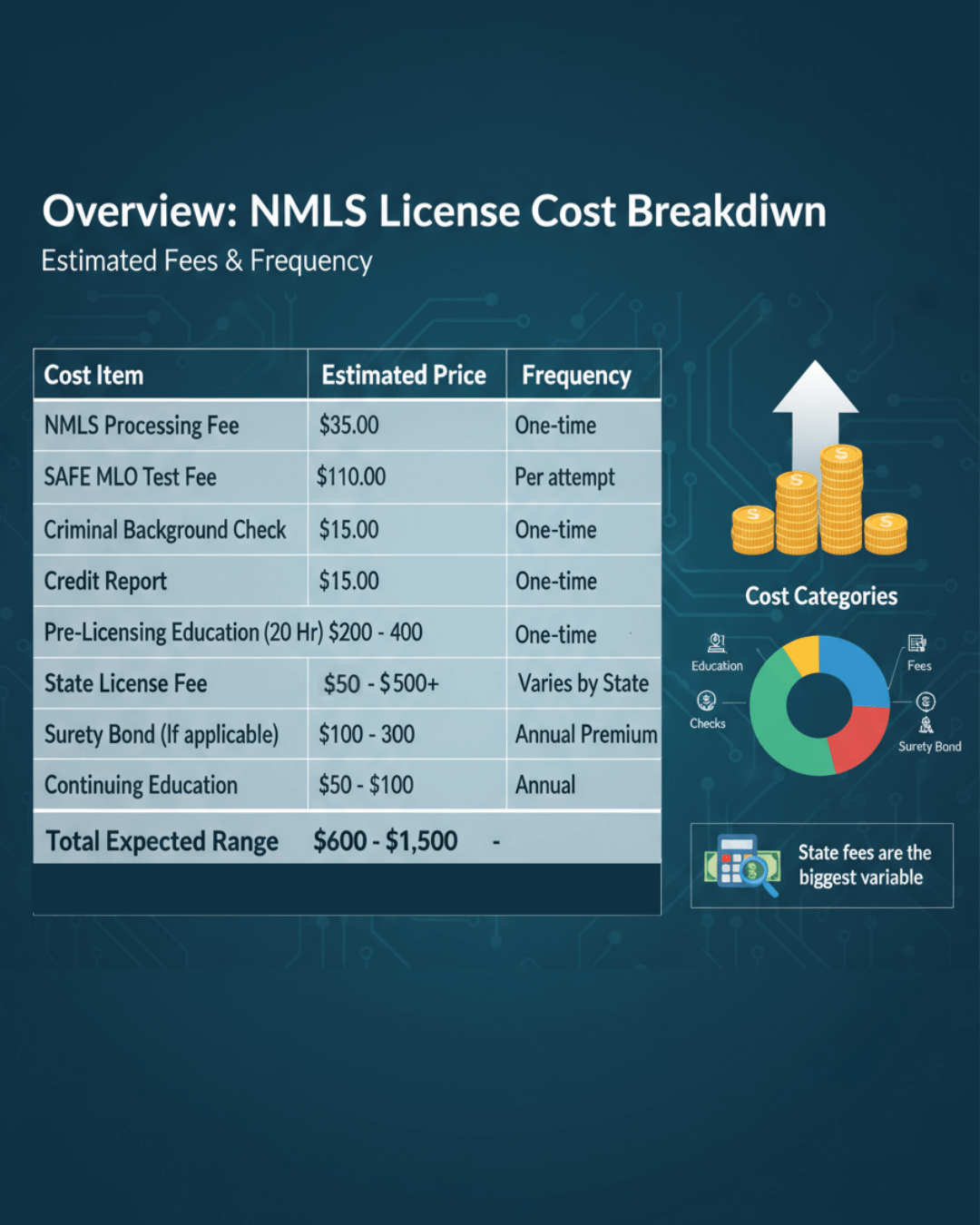
Let's cut to the chase. You need to have roughly $600 to $1,500 ready to go.

Why the big range? It depends entirely on which state you are in and whether you choose a "budget" online class or a premium one. Below is the cheat sheet of the fees I encountered (and you will too). These are the 2026 estimates based on the NMLS Resource Center.

  • NMLS Processing Fee: $35.00
  • SAFE MLO Test Fee: $110.00
  • Criminal Background Check: $36.25 - $39
  • Credit Report: $15.00
  • Pre-Licensing Education (20 Hr): $200 - $400
  • State License Fee: $50 - $500+
  • Surety Bond (If applicable): $100 - $300
  • Continuing Education: $50 - $100

Total Expected Range: $600 - $1,500
Overview: NMLS License Cost Breakdown

Introduction to Every NMLS License Cost

Now, let's look at the receipt line-by-line. It's important to understand that the NMLS collects money for two different people: themselves (for processing) and the state regulators.

NMLS Processing Fee

Think of this as the cover charge just to get into the club. You will pay a $35 initial set-up fee when you file your Form MU4. It's not much, but here is the kicker: even if your license gets denied later, the NMLS generally keeps this money. It is strictly a fee for using their software system.

SAFE MLO Test Fee

This one hurts the most if you aren't prepared. The National Test costs $110. The catch? You pay that every single time you take it. I know people who had to pay this three times because they underestimated the difficulty. Don't be that person. Study hard so you only have to pay this $110 once.

Criminal Background Check

You can't handle people's mortgage money without proving you are trustworthy. The NMLS FBI criminal background check fee is $36.25 for Live Scan (digital fingerprints). You will usually have to go to a third-party vendor (like Fieldprint) to get your fingerprints scanned digitally. Note that some states, like California, charge $39 via NMLS fingerprints, and third-party vendors may add fees. Sometimes those vendors tack on their own small service fee, so keep a credit card handy for that appointment.

Credit Report

The NMLS will pull your credit report for $15.00. Don't panic if your score isn't perfect. They aren't looking for an 800 FICO score. They are looking for "financial responsibility." Basically, as long as you don't have open fraud judgments or ignored government liens, you should be okay. It's about integrity, not wealth.

State-Specific License Fee

This is the wild card. Every state charges whatever they want. I've seen fees as low as $30 and some well over $500. Also, watch out for the double-dip: some states charge an "Application Fee" and a separate "License Fee." You absolutely have to check the state-specific page on the NMLS site to see what your local regulator charges.

Pre-Licensing Education (20 hours)

You cannot skip this. You need 20 hours of approved education, and it is the biggest ticket item, usually $200 to $400. The self-paced online slides are cheaper, but if you snooze through them, you will fail the exam. Personally? I'd spend a bit more on a course that actually teaches you, not just one that clicks "next" for you.

Surety Bond Costs

This is a hidden cost many guides forget. If you are an independent broker, you likely need a Surety Bond. You don't pay the full bond amount (e.g., $25,000). You pay a premium, usually $100-$300 a year based on your credit. However, if you work for a lender or bank, they typically cover this for you.

Annual Renewal Fee

The costs don't stop once you are licensed. Every year between November 1 and December 31, you must renew. The NMLS annual renewal processing fee for MLOs is $35 if between January-June or $65 if July-December for federal registration. For state licensure, it aligns with the $35 initial/annual processing fee. If you forget and miss the December 31st deadline, the reinstatement penalties are painful.

Continuing Education

To keep that license active, you need 8 hours of class every year. Budget about $50 to $100 for this. And no, you can't take the exact same course two years in a row. the "Successive Year Rule" stops that, so you'll be buying fresh content annually.

NMLS License Cost by State

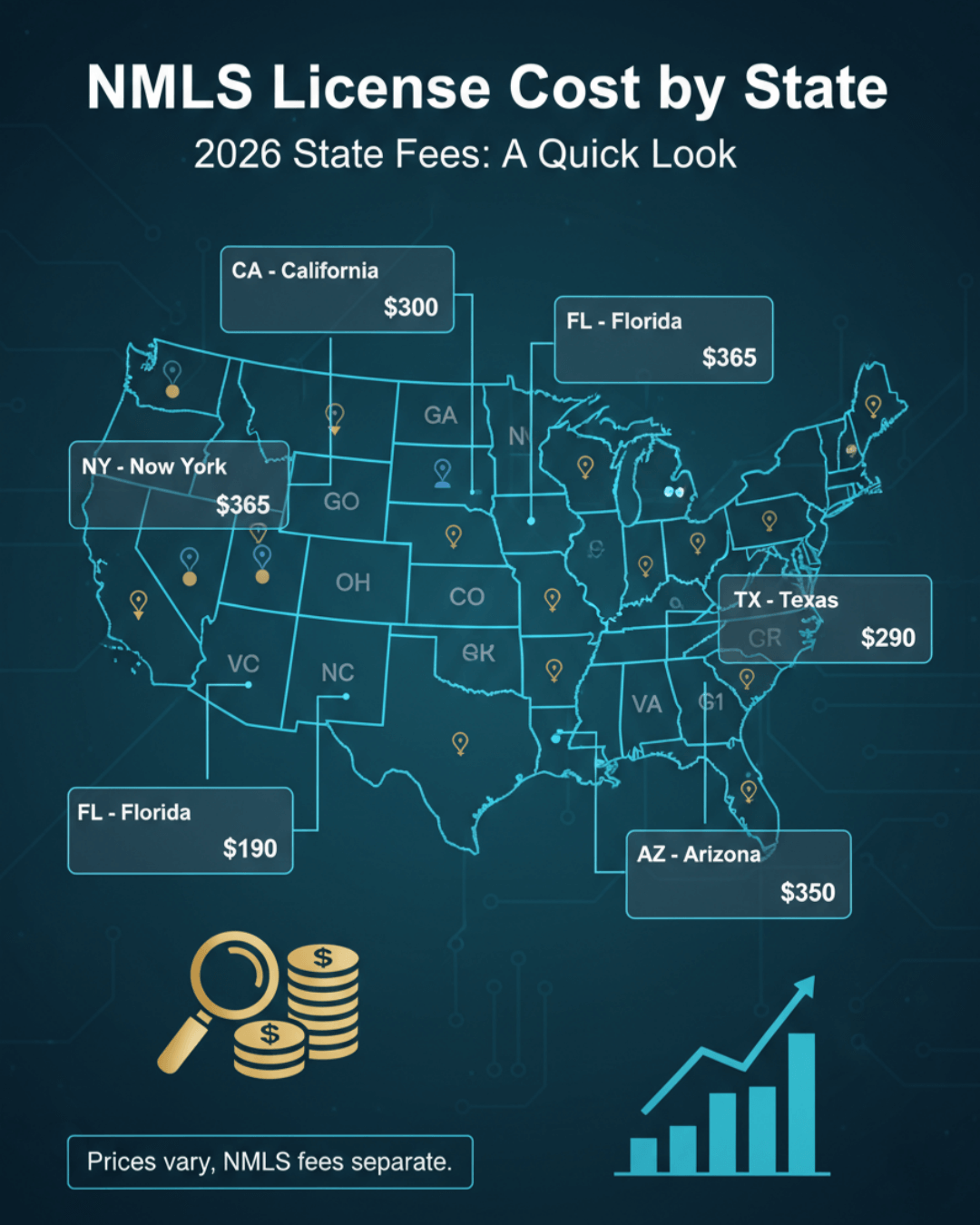
Since the state fee is the biggest variable, here is a quick look at the price tags for the most popular spots in 2026. Keep in mind, this is just what you pay the state. You still have to add the NMLS fees on top of these.

  • California (DFPI): Expect around $300 (Application + Investigation fees).
  • Florida: About $195 total for the license and guaranty fund.
  • Texas (SML): Roughly $190.
  • New York: One of the pricier ones at $365 (Investigation + License).
  • Georgia: A reasonable $100.
  • Illinois: Around $250.
  • Ohio: Approximately $150.
  • North Carolina: About $125.
  • Virginia: Around $130.
  • Arizona: On the higher end at $350.
NMLS License Cost by State

FAQs About NMLS License Cost

Q1. How much does the NMLS exam cost?

The test itself is $110. You pay this directly through the NMLS portal before you can schedule a date with Prometric. Just be careful. if you cancel or reschedule within 2 days of your slot, you might lose that money.

Q2. Is the NMLS license fee refundable?

Generally, no. Once the money leaves your account for background checks, credit reports, or processing fees, it is gone. Even if your state rejects your application, they rarely refund the application fees. Make sure you are eligible before you pay.

Q3. How much is the NMLS renewal fee?

It depends on your state, but the base NMLS processing fee is $30. Most states then add their own renewal fee, which is often the same as (or slightly less than) the initial license fee. Expect to pay this every single winter.

Q4. Does my employer pay for my NMLS license?

This is the industry norm for banks and direct lenders. Many companies will reimburse you for the test and classes once you pass. However, if you are going independent (working as a broker), you are usually on the hook for these costs yourself.

Conclusion

So, what is the final damage? Realistically, you should put aside $800 to $1,000 to be safe to get an NMLS license. It sounds like a lot upfront, but compared to the startup costs of opening a restaurant or a store, it is actually quite low.

Plus, in this industry, one decent commission check usually covers your entire startup cost. My best advice? Don't try to save $50 on a cheap education provider. Spend the money on good prep materials so you pass the test on the first try. That is the best way to save money in the long run. Good luck!

Keep reading

Mortgage Underwriter Salary: How Much Does a Home Loan Underwriter Make?

Blog

5 min read
Arrow icon on dark background
Mortgage Underwriter Salary: How Much Does a Home Loan Underwriter Make?
How much does a mortgage underwriter make in 2026? Discover average salaries, real bonus structures, and if this stable, high-paying career is right for you.

People usually think real estate finance is all about aggressive sales quotas. But if you want the financial upside of the housing market without cold-calling strangers, mortgage underwriting is the sweet spot. As of 2026, a home loan underwriter makes a highly competitive average salary, generally between $65,000 and $85,000 to start.

I've seen senior underwriters easily clear six figures once they get some experience under their belts. Forget the fluff. In this breakdown, we are looking at hard data from major job boards, how the compensation structure actually works legally, and whether this desk job is the right career move for you.

Mortgage Underwriter Salary Breakdown

A national average only tells part of the story. From what I've seen, talking to hiring managers, your actual paycheck swings wildly based on three main factors.

  • Experience & Government Certifications: This is your golden ticket. Entry-level folks start on the lower end, but the moment you pass the tests for your FHA Direct Endorsement (DE) or VA Staff Appraisal Reviewer (SAR) credentials, your market value practically doubles.
  • Where You Live: Location matters. A firm in New York or San Francisco will naturally offer a higher base to offset the insane cost of living compared to a mid-market lender in Ohio.
  • Retail Banks vs. Wholesale Lenders: Big retail banks usually offer better baseline benefits and a steady base. Independent wholesale shops? They often lean heavier on lucrative per-file bonuses during rate-drop booms.
Mortgage Underwriter Salary Breakdown

Average Mortgage Underwriter Salary

Every job board uses a slightly different formula to calculate pay. Some rely entirely on self-reported employee surveys (which often include bonuses), while others scrape base salaries straight from active job postings. To give you a realistic picture, I've averaged out the latest 2026 data from the four biggest platforms. Expect a middle-ground baseline hovering right around $65,000 to $85,000.

Indeed

Let's look at Indeed. Based on thousands of recently aggregated job postings as of early 2026, their data shows an average base salary of around $76,839 a year for U.S. underwriters. What I find interesting about Indeed's numbers is the spread. The bottom 10%, mostly total beginners, sit closer to $55,000. Meanwhile, the top end stretches well past $115,000, especially in major metro markets. Since this data pulls directly from employer listings rather than employee memories, it's a highly accurate reflection of what companies are currently willing to pay a mid-level hire.

Salary.com

If you literally have zero experience, Salary.com is the best benchmark. They specifically track the "Mortgage Underwriter I" title. Right now, in 2026, they peg the median base pay at roughly $65,000. The typical range sits tight between $58,000 and $75,000. I always tell newcomers to look at this tier first so they don't get unrealistic expectations. The good news? Salary.com also shows that once you hit the Level III or IV tier a few years later, jumping into the $95,000 to $110,000 bracket is the standard progression.

Glassdoor

Over on Glassdoor, things look a little different. Because workers self-report their total take-home pay here, the average sits higher, pushing close to $95,000 annually. Of that total, about $75,000 represents the fixed base salary, while the remaining $20,000 comes from cash bonuses and extra compensation. I completely trust this breakdown. Anyone who has survived a busy mortgage season knows that those monthly production bonuses significantly pad your W-2. Glassdoor essentially reveals the "hidden" upside that standard job listings rarely advertise upfront.

ZipRecruiter

Finally, ZipRecruiter shows extreme real-time wage fluctuations. For 2026, they report an entry-level national average of about $62,000. However, their data shows a massive spread. The 25th percentile is scraping by at $41,000, while the 75th percentile is already hitting $72,000 for the exact same job title. To me, this proves that negotiating your starting offer is crucial. The huge variance means some lenders are trying to lowball new talent, while others are aggressively paying up for smart, analytical candidates. Don't settle for the bottom of that barrel.

How Does a Mortgage Underwriter Get Paid?

I constantly hear people assume underwriters get a cut of the loan they approve. They don't. In fact, doing so is highly illegal. Thanks to the Dodd-Frank Act's Loan Originator Compensation Rule, an underwriter's pay cannot be tied to the loan's interest rate or its size. This prevents conflicts of interest.

Instead, your money comes from three legitimate buckets.

  • First is your Base Salary, which is your guaranteed W-2 income and the bulk of your earnings.
  • Second is the Production or Quality Bonus. If your monthly quota is 40 files, your company might pay you a flat cash bonus for every file you clear beyond that, provided your error rate stays low.
  • Third is straight-up Overtime Pay. When interest rates drop and the housing market catches fire, mandatory overtime is common, resulting in massive spikes in your paycheck.

Loan Officer VS Underwriter Salary

A lot of folks debate whether to go into sales as a Loan Officer (LO) or stay behind the scenes as a Mortgage Underwriter. The money structures are night and day. LOs eat what they kill, and they hunt for borrowers and live off commissions. Underwriters get paid just for doing the math, whether the loan closes or not.

Loan Officer VS Underwriter Salary

An LO might make $300,000 during a refinance boom and then struggle to pay rent when rates spike. An underwriter's income is much more insulated from those wild market swings.

Home Loan Underwriter or Officer: Which to Choose?

Choosing between these two paths shouldn't just be about who makes more on paper. It boils down to how your brain is wired.

  • Become a Mortgage Underwriter if: You are naturally analytical, love diving into complex tax returns, and genuinely care about the tiny details. If the idea of a stable, predictable income lets you sleep at night, and you hate the thought of networking or managing angry clients, stay at the underwriting desk.
  • Become a Loan Officer if: You have thick skin, serious hustle, and are highly extroverted. If you don't mind sacrificing your weekends to take calls from real estate agents, and you are perfectly fine with an unpredictable paycheck in exchange for uncapped earning potential, sales is where you belong.

FAQs About Home Loan Underwriter Salary

Q1. Do mortgage underwriters make good money?

Yes. The median pay easily beats the national average. A mid-level underwriter typically earns around $75,000, while seasoned pros with specialized government credentials like DE or SAR regularly clear $100,000 or more a year when factoring in their volume bonuses.

Q2. Is being a mortgage underwriter stressful?

Yes, especially at the end of the month. While you don't have the stress of finding clients, you are strictly graded on your speed and accuracy. Trying to clear a heavy pipeline of loans before rate locks expire can definitely raise your blood pressure.

Q3. Do mortgage underwriters get a commission?

No. Federal regulations completely ban underwriters from earning commission based on loan amounts or interest rates. You are paid to assess risk objectively. However, lenders can and do reward underwriters with flat cash bonuses based on the sheer volume of files completed accurately.

Q4. Can mortgage underwriters work from home?

Yes. Remote work is massive in this industry right now. Most major lenders currently offer hybrid schedules, and many allow 100% remote underwriting. Honestly, skipping the daily commute is a huge financial perk that effectively increases your real take-home pay.

Q5. Is there a high demand for mortgage underwriters?

Yes, though it fluctuates. When interest rates drop, the surge in refinancing creates a desperate shortage of underwriting talent. But even during slower, higher-rate markets, experienced underwriters holding specialized FHA or VA sign-off authority remain incredibly hard for companies to replace.

Conclusion

Ultimately, mortgage underwriting is one of the best-kept secrets in the finance world. It offers a rare mix: a highly respectable, stable salary without the brutal hustle of commissioned sales. You get paid to analyze data, mitigate risk, and help people buy homes. The math is pretty clear. If you put your head down, learn the guidelines, and aggressively pursue those advanced DE and SAR certifications, six figures is a very realistic target.

If this sounds like your kind of career, don't just take my word for it. Open up Indeed or ZipRecruiter today and search for entry-level underwriting roles in your state. Look at the real numbers they are offering right now. The opportunity is definitely out there if you're willing to do the work.

People Also Read

[NO Experience] How to Become a Mortgage Underwriter?

Blog

5 min read
Arrow icon on dark background
[NO Experience] How to Become a Mortgage Underwriter?
Want a high-paying career? Learn how to become a home loan underwriter with no experience. Follow our proven roadmap from entry-level roles to getting certified.

A few years back, I was stuck. I wanted a stable, well-paying career but had zero finance background. The title "mortgage underwriter" sounded like a job reserved for Wall Street elites, so I almost didn't look into it. If you're trying to figure out how to become a mortgage underwriter with no experience, I know exactly how intimidating it feels.

But here is the truth: it's entirely doable. You don't need a fancy degree to break into an entry-level underwriting career. In this guide, I'll walk you through the exact, step-by-step roadmap I used to get my foot in the door.

Who is a Mortgage Underwriter?

A mortgage underwriter is the final gatekeeper for a home loan. We are the people who actually decide if a borrower is too risky for a lender to approve.

My daily routine involves digging into credit histories to check past payment habits and tearing apart W-2s, tax returns, and bank statements to verify income. We carefully calculate Debt‑to‑Income (DTI) and Loan‑to‑Value (LTV) ratios for each file and check that they meet the lender's and its investors' guidelines, which are often based on agency rules, like Fannie Mae and Freddie Mac, and regulatory standards.

Also Read: Mortgage Underwriter Salary: How Much Does a Home Loan Underwriter Make?

Who is a Mortgage Underwriter?

How to Become a Home Loan Underwriter With No Experience?

Looking at a blank resume is scary. But the mortgage underwriting industry is remarkably open to newcomers if you take the right approach. Here are the six steps you need to follow to land your first job.

How to Become a Home Loan Underwriter With No Experience?

STEP 1. Meet the Basic Educational Requirements

When I first started job hunting, I thought my lack of a finance degree would get my resume tossed in the trash. That's actually a huge myth in this industry. Yes, a bachelor's degree in business or accounting helps.

Some U.S. lenders are open to hiring candidates with a high‑school diploma or an associate's degree, especially for processor or assistant roles, though many employers either prefer or require a bachelor's degree for more advanced underwriting positions.

What hiring managers actually care about is your comfort with numbers and your ability to spot inconsistencies. If you don't have a four-year degree, don't let it stop you. You just need to show them you have strong basic math skills, high numerical sensitivity, and the grit to learn the ropes.

STEP 2. Learn Mortgage Lending Basics

Since you don't have a track record, self-education is your best tool for standing out. You absolutely have to understand the different loan products out there. I spent my evenings reading up on Conventional loans versus government-backed stuff like FHA, VA, and USDA mortgages.

I also had to wrap my head around Fannie Mae and Freddie Mac, since they basically write the rulebook for most U.S. housing loans. You don't need to memorize the entire guideline manual, nobody does, but knowing the basic terminology shows interviewers you are serious. I used free online resources and YouTube to build my foundational knowledge. Also, when necessary, I use Zeitro Strata to verify mortgage eligibility as a double-check.

STEP 3. Develop Key Underwriting Skills

This role demands a very specific mix of technical and personal skills. On the hard skills side, you'll eventually need to read tax transcripts, decode financial statements, and use complex data software. But honestly? The soft skills matter more at the start.

The most critical trait is a borderline-obsessive attention to detail. Missing one decimal point on a bank statement can ruin a loan. You also need a thick skin to handle the pressure, especially at month-end when real estate agents are screaming about closing dates. Start training yourself to catch typos or math errors in your own daily paperwork.

STEP 4. Start in a "Stepping Stone" Role (Entry-Level)

Here is the reality check: no one gives you an underwriter title on day one. I certainly didn't get one. To build trust, you need to find a stepping-stone job. Look for titles like Loan Processor, Loan Officer Assistant, or Underwriting Trainee. I highly recommend aiming for a processing role.

As a processor, you are the person collecting the W-2s and pay stubs from the borrower before the file ever reaches the underwriter. It gives you a front-row seat to see exactly what gets a loan approved or rejected. Plus, managers love promoting their best processors into junior underwriting roles because they already know the system.

STEP 5. Earn Professional Certifications

When your work history doesn't scream "finance expert," a professional certificate does the talking for you. It proves to a hiring manager that you aren't just applying on a whim. These programs teach you the practical stuff: how to accurately calculate DTI, read an appraisal report, and flag potential mortgage fraud. Earning a credential helped me stand out in my own job search.

My callback rate noticeably improved after I listed it on my resume. For no‑experience candidates, a professional certification is a strong differentiator, but it is not the only way to get hired, some lenders will hire you into a processor or assistant role and then train you on the job.

STEP 6. Tailor Your Resume & Apply for Jobs

Now it's time to actually get out there. Stop worrying about the exact experience you lack, and start framing what you do have. Did you handle cash, audit inventory, or manage angry customers at your last job? Rebrand those as "analytical ability," "attention to detail," and "conflict resolution." Make sure any self-study courses or new certifications sit right at the top of the page.

I also aggressively networked on LinkedIn, connecting with local branch managers at credit unions and mid-sized lenders. Keep your eyes peeled for job postings with words like "Junior" or "Trainee," and apply even if you only check half the boxes.

Mortgage Underwriter Certification

A solid credential bridges the gap between being a total newbie and a viable candidate. Here are the ones that actually carry weight in the industry:

NAMU (National Association of Mortgage Underwriters): This is one respected organization in the U.S. mortgage industry. Earning a credential such as their Certified Mortgage Underwriter (CMU) or Certified Residential Underwriter (CRU) designation can show employers that you have studied formal underwriting guidelines, though it is not the only path to becoming a strong candidate.

FHA Direct Endorsement (DE)/VA SAR: These are advanced, specialized credentials for government‑backed loans. You won't be eligible right away, but pursuing them later in your career can help position you for higher‑level roles that often pay six‑figure salaries, depending on market, lender, and experience.

How Much Does It Cost to Become a Mortgage Underwriter?

Let's be completely transparent about the money. You will have to spend a little out of pocket to get started, but the return on investment is huge.

  • Training Courses: Good online boot camps or self-paced classes usually run anywhere from $300 to $1,000.
  • NAMU Exams: Depending on the specific tier you go for, expect the testing and study materials to cost between $600 and $1,500.
  • Background Checks: Sometimes you pay for this yourself initially. Plan for about $50 to $100.

Altogether, you might spend $1,000 to $2,000. Considering entry-level U.S. underwriters easily make around $55,000 to $65,000 their first year, it's a tiny price to pay for a lucrative career shift.

How Much Does It Cost to Become a Mortgage Underwriter?

Tips for New Home Loan Underwriters

Once you finally get a desk, the real stress tests begin. Here are three things that saved me during my first year:

  • Tip 1: Stay Updated on Guidelines: Fannie Mae changes their rules constantly. Make a habit of reading agency bulletins on Friday afternoons so you don't approve something using last month's rules.
  • Tip 2: Ask Questions: If a self-employed borrower's tax return looks like a mess, swallow your pride and ask a senior underwriter. Guessing will get you fired.
  • Tip 3: Embrace AI and Automation Technology: The industry isn't just paper anymore. I highly recommend familiarizing yourself with an AI-powered LOS (Loan Origination System) like Zeitro. Modern underwriters who use automated workflows to catch errors and speed up closing times are the ones who get promoted fastest.
Tips for New Home Loan Underwriters

FAQs About Becoming a Mortgage Underwriter

Q1. How hard is it to become a Mortgage Underwriter?

It isn't rocket science, but it demands extreme attention to detail and patience. Starting from scratch is tough, but if you take a transitional role like a loan processor first, the learning curve becomes much more manageable. You just have to be willing to study the guidelines.

Q2. How do I start a career as an underwriter?

The most realistic way in is to get hired as a Loan Processor or Underwriting Assistant. While working that job, study lending guidelines on your own time and earn a professional credential from NAMU to show managers you are ready to move up.

Q3. How long does it take to become a certified underwriter?

With consistent part‑time effort, many candidates can complete foundational training and pass their NAMU certification exams within roughly two to six months, though this will vary depending on prior background and study pace.

However, getting enough on-the-job experience to become an independent, fully authorized underwriter usually takes about one to two full years.

Q4. Do underwriters make a lot of money?

In many U.S. markets, entry‑level residential underwriters commonly start in roughly the $55,000 to $65,000 range, though this can be higher or lower depending on location and lender. With a few years of experience, total compensation often moves into the $70,000–90,000 band, and senior underwriters or those with advanced credentials (like FHA Direct Endorsement) can reach six‑figure salaries in stronger markets or high‑volume shops.

Q5. Is underwriting a hard career?

It can be highly stressful, especially when real estate volume spikes in the spring. You carry the burden of risk decisions and handle massive amounts of paperwork. But if you enjoy analyzing data and working in a structured, desk‑based environment, while also being comfortable with occasional high‑pressure deadlines and team coordination, it can be a very fulfilling career.

Conclusion

Looking back, deciding to step into the mortgage industry without a finance background was terrifying, but it was the best career move I ever made. Becoming a mortgage underwriter with zero experience is entirely within your reach.

You just need to follow the roadmap: learn the basic guidelines, grab a respected certification to beef up your resume, and get your hands dirty in an entry-level processor role. It's also vital to stay adaptable and learn modern tools, like an AI-powered LOS, to keep yourself competitive.

Don't wait until you feel "ready" because you never will. Start researching basic loan types today, look into modern platforms like Zeitro, and take that first step.

People Also Read

What is a Mortgage Underwriter? Responsibilities and Salary

Blog

5 min read
Arrow icon on dark background
What is a Mortgage Underwriter? Responsibilities and Salary
What does a mortgage underwriter do? Discover their key responsibilities, average 2026 salaries, and how to start your career in this complete home loan guide.

Let's be honest: waiting for a mortgage approval is stressful. You submit your paperwork, and then... silence. Behind that silence sits the mortgage underwriter, the person who actually decides if your loan gets funded. In this guide, I'm breaking down what this job really looks like, from daily tasks to salary data.

Having spent time around the lending space, I know manual underwriting drags on forever and frustrates everyone. That's why smart lenders now use highly cost-effective LOS platforms like Zeitro to speed up loan underwriting significantly. Let's look at who these decision-makers are.

What is a Home Loan Underwriter?

Think of a home loan underwriter as a professional risk detective for a financial institution. Their main goal isn't to reject people. It's to protect the lender from handing out money that won't come back. They comb through your financial life to see if you actually fit the lender's risk profile.

Most of these folks work directly for retail banks, credit unions, or mortgage brokers. I often get asked if you need a special license to do this. Usually, no individual license is required for mortgage underwriters employed by a licensed lender, as the company's license covers them.

However, independent contract underwriters or those performing loan origination activities must obtain a state license under the SAFE Act, involving education, exam, and background checks depending on the state.

What is a Home Loan Underwriter?

What Does an Underwriter Do for a Home Loan?

Once a loan application lands on their desk, underwriters start a deep dive into the borrower's financial reality. They hold the power to issue a "clear to close," suspend the file for more info, or flat-out deny it.

Here is what they actually spend their day doing:

  • Verify income and employment: Making sure the borrower has a steady paycheck to cover the mortgage.
  • Review credit history & DTI: Checking past payment habits and calculating the Debt-to-Income ratio to see if they are over-leveraged.
  • Assess the property appraisal: Confirming the house is actually worth the purchase price and the Loan-to-Value (LTV) ratio makes sense.
  • Ensure strict compliance: Double-checking that the whole package meets rigid mortgage guidelines from entities like Fannie Mae or the FHA.
What Does an Underwriter Do for a Home Loan?

Also Read: What is Mortgage Eligibility Checker? Best Tool to Verify Guidelines

Average Mortgage Underwriter Salary

Let's talk money. Based on the latest 2026 data from Indeed, the average salary for a mortgage underwriter in the U.S. is approximately $76,800 per year. Salary.com reports a similar average of about $74,600 as of early 2025, with ranges typically between $65,000 and $86,000.

But that's just the middle ground. Your actual paycheck swings wildly based on a few things.

  • First, experience matters a lot. Entry-level staff might pull in $55,000, while seasoned pros easily clear six figures.
  • Second is location, if you're underwriting in New York or California, expect a higher base to offset the crazy living costs.
  • Finally, there's the bonus structure. A lot of lenders offer a base salary plus per-file bonuses tied to the volume of loans you clear.

How to Become an Underwriter for a Home Loan?

You don't need a specific college major to get into this field, which is something I love about the mortgage industry. It's really about on-the-job grit and an obsession with details. If you're looking to break in as a mortgage underwriter, here is the most realistic path:

  • Start with the basics: A high school diploma works, though a bachelor's in finance or accounting gives you a nice head start.
  • Get your hands dirty: Nobody walks in off the street to become an underwriter. You almost always have to work as a Loan Processor or Mortgage Assistant first to learn how loan files actually move.
  • Grab a certification: Getting a credential from the Mortgage Educators and Compliance Technologies (MCT) proves you know your stuff and makes your resume pop.
  • Keep learning: The rulebook never stops changing. You'll spend a lot of time keeping up with fresh Fannie Mae and FHA guidelines.

Mortgage Underwriter vs Loan Officer

I see people mix these two up all the time. While both need each other to close a deal, their daily lives couldn't be more different. The Loan Officer is out there shaking hands, selling, and bringing the borrower in. The Underwriter sits in the back office, analyzing the math, and deciding if the deal is actually safe.

Here's a quick breakdown of how they compare:

Mortgage Underwriter vs Loan Officer

Also Read: Must Read: What are the Duties and Responsibilities of Loan Officers

FAQs About Home Loan Underwriters

Q1. What are the 3 C's of mortgage underwriting?

They stand for Capacity, Credit, and Collateral. Capacity means your income and DTI show you can handle the payments. Credit looks at your borrowing history. Collateral ensures the home's appraisal value is high enough to back up the loan amount.

Q2. Is it hard to become a mortgage underwriter?

It's challenging but very doable. The hard part isn't advanced math. It's memorizing hundreds of strict, ever-changing lending guidelines. You need a sharp eye for detail, strong logic skills, and the ability to handle high-pressure volume during busy housing seasons.

Q3. Can you work remotely as an underwriter?

Yes, absolutely. Since you're primarily reviewing digital documents and using cloud-based systems all day, it's a very remote-friendly job. Thanks to modern LOS software, many professionals now work entirely from home while securely accessing files and issuing their loan decisions.

Q4. How long does the mortgage underwriting process take?

An initial review usually takes about 3 to 10 business days. However, this timeline shifts constantly depending on how complicated your taxes are, the lender's current file backlog, and whether they use modern automated tools to speed up the workflow.

Conclusion

At the end of the day, the mortgage underwriter is the person keeping the housing market stable. They carefully balance risk for the banks while helping regular folks finally get the keys to their new homes. If you love digging into details and want a solid career, it's a great space to be in.

Now, if you're a mortgage broker or lender reading this, you know firsthand that sluggish back-office operations ruin the client experience. If you want to cut operational costs and give your team the tools they need, take a look at Zeitro. As a highly cost-effective LOS, it's specifically built to speed home loan underwriting up. Your staff gets a better workflow, and your borrowers get their homes faster. Win-win.

People Also Read

Try Zeitro today and transform your loan origination workflow!

Get started free