Written by

Eric
Share this article

.svg)
Subscribe to updates
Last Checked and Updated on August, 2026.
If you think being a loan officer is just about checking credit scores and filling out forms, you're missing most of the job. After years in this industry, I can tell you a loan officer, or LO, wears three hats on any given day: part financial detective, part sales expert, and part therapist for stressed-out borrowers. We sit right in the middle, between a family's dream of owning a home and the maze of paperwork and rules that stand between them and the keys.
LO is simply short for Loan Officer, sometimes called a Mortgage Loan Originator, or MLO, once they're licensed. Whether you're a first-time homebuyer wondering what this person actually does for you, or someone eyeing the career path, understanding the full scope of loan officer duties and responsibilities will save you from a lot of confusion later. This isn't just a sales job. It's the art of structuring deals that actually make it to the closing table.
People Also Read:
- What Does a Loan Officer Do? Duties, Pros, Cons, and Outlook
- Best Mortgage Loan Officer Training: Which to Pick?
- Best CRM for Loan Officers: Which One Suits You Most?
- Best Mortgage Companies for New Loan Officers
- Beginner's Guide: How to Get Leads for Mortgage Loans?
- 11 Best Loan Officer Schools for Newbies: Online & Local
What are the Duties of a Loan Officer?
A loan officer's job cycle runs from the first phone call to the final signature. It blends relationship building, financial analysis, and regulatory compliance into one role. Here's what mortgage loan officer duties actually look like once you're past the job title.

1. Evaluate Borrowers
This is where it all begins. When a client comes to me, my first job is to determine if they are "creditworthy." But I don't just look at a FICO score and call it a day. I have to analyze their entire financial picture. This means digging into debt-to-income (DTI) ratios, reviewing employment history, and understanding the source of their down payment.
For standard W-2 employees, this is straightforward. But for self-employed borrowers or those with complex income streams, it requires a forensic approach. I have to calculate qualified income accurately because if I overestimate their income now, the loan will get denied weeks later by the underwriter—and that is a nightmare scenario I work hard to avoid.
2. Match Borrowers to the Right Loan
Once I understand a borrower's full picture, my job shifts to matchmaking. Mortgages aren't one-size-fits-all. Depending on the borrower, I might steer them toward an FHA loan, a VA loan, a conventional mortgage, or a Non-QM (Non-Qualified Mortgage) product if their income doesn't fit a traditional mold.
This step is trickier than it sounds. Every loan program comes with its own guideline book, and individual lenders stack extra rules, known as overlays, on top. A borrower might sail through FHA approval with one lender and get rejected by another because of a single overlay. Knowing those differences cold is part of the job, so I don't send a client chasing a loan they were never going to get.
3. Collect and Verify Paperwork
If you dislike paperwork, this role will test you. A big chunk of my day goes into chasing pay stubs, W-2s, tax returns, and bank statements. But gathering documents is only half the work; verifying them is the other half.
I'm scanning for the same red flags an underwriter will catch later: an unexplained large deposit, a business loss on a tax return that quietly drags down qualifying income. Spotting these early lets me fix the file or rework the deal before it's ever submitted. It's tedious, but this is exactly what separates a seasoned LO from someone still learning the ropes.
4. Submit and Manage the Loan File
Once the data is gathered, it goes into the Loan Origination System (LOS) to build the 1003, the Uniform Residential Loan Application. This becomes the official record the lender works from, so accuracy matters enormously. A wrong digit in a Social Security number or a mismatched employment date can trigger conditions that stall everything.
After submission, the job doesn't pause. I track the file as it moves through processing and underwriting, making sure it never sits idle in a queue. In a lot of ways, an LO acts as the project manager for a borrower's entire file.
5. Communicate Throughout the Process
I often say that 50% of this job is psychology. Buying a home is stressful. Borrowers are anxious. Real estate agents want their commission. It is my duty to keep everyone in the loop.
I provide weekly updates at minimum to the borrower and the agents. If a problem comes up—say, an appraisal comes in low—I have to break the news and immediately offer a solution. Ghosting a client during a tough moment is the fastest way to ruin your reputation. You have to be available and responsive.
6. Stay Compliant With Federal and State Law
Mortgage lending is one of the most regulated corners of finance, and for good reason. Every file has to comply with laws like RESPA (Real Estate Settlement Procedures Act) and TILA (Truth in Lending Act).
Loan Estimates need to go out on schedule, and fair lending rules can't be bent. Ignorance isn't a defense here. A single compliance slip can bring hefty fines for the company, or even put an individual license at risk.
7. Close the Loan
This is the finish line. When we get the "Clear to Close" (CTC), my duty is to review the Closing Disclosure (CD) with the client. I walk them through the final numbers—cash to close, interest rate, and monthly payment—to make sure it matches what I promised them at the beginning.
I coordinate with the title company to set the signing appointment. My goal is "zero surprises" at the closing table. If the borrower sits down to sign and the numbers look wrong, I haven't done my job.
8. Build and Maintain Relationships
Finally, unless you work in a call center, you are responsible for generating your own business. Lenders don't just hand you files. You have to hunt for them.
My duty includes networking with realtors, builders, and past clients to keep the referrals flowing. I have to market myself as a trusted expert. This is the "business development" side of the role. If I stop building relationships, my pipeline dries up, and so does my income.
What is the Main Responsibility of a Loan Officer?
While the duties list is long, if you asked me to boil it down to one core responsibility, it would be Risk Management and Problem Solving.
At the end of the day, I serve two masters: the borrower and the lender. For the lender, my responsibility is to ensure the loan is a safe investment—that the borrower can actually repay it. For the borrower, my responsibility is to solve the puzzle of their finances to get them the keys to their home. You are the filter. You protect the bank from bad loans, and you protect the borrower from bad financial decisions.
What Does a Senior Loan Officer Do Differently?
The core duties don't change much with seniority, but the scope does. A senior loan officer typically manages a larger loan volume, handles more complex files (jumbo loans, Non-QM, self-employed borrowers), and often mentors newer LOs or reviews their files before submission. Some eventually move into producing branch manager roles while still originating their own loans.
What Are a Borrower's Responsibilities in the Process?
It's worth a quick mention here, since the process runs both directions. Borrowers are responsible for providing accurate, complete documentation, responding to requests promptly, and disclosing anything that affects their finances, like a new debt or a job change, before closing. A loan officer can only work with the information a borrower actually gives them.
Sample Loan Officer Job Description
If you're hiring, or you're an aspiring LO trying to picture the role before applying, here's a simple template that reflects the duties covered above.
Job Title: Mortgage Loan Officer / Loan Originator (MLO)Reports To: Branch Manager or Sales ManagerLicense Required: Active NMLS license (SAFE MLO Test passed)
Key Responsibilities:
- Evaluate borrower creditworthiness, income, and debt-to-income ratio
- Recommend appropriate loan products based on borrower profile
- Collect, review, and verify borrower documentation
- Submit and manage loan files through the LOS
- Communicate updates to borrowers, agents, and processing staff
- Ensure every file complies with RESPA, TILA, and state lending law
- Complete annual NMLS continuing education and license renewal
- Generate new business through referral relationships
Requirements: Bachelor's degree preferred (not always required), active NMLS license, strong math and communication skills, working knowledge of underwriting guidelines.
Common Loan Officer Interview Questions
Breaking into this field, or switching companies, means being ready for more than technical questions. Hiring managers want to see how you handle pressure. Here are a few you're likely to hear:
- "How do you handle a loan denial with a client?"Tip: Show empathy alongside problem-solving. Don't just say you deliver the bad news; explain how you help the client build a plan to qualify in the future.
- "How do you stay current with changing guidelines?"Tip: This question comes up constantly. Mention that you follow agency updates, read industry publications, or use AI-powered research tools to keep pace with guideline changes in real time.
- "Tell me about a difficult file you saved."Tip: Have a real story ready, structured simply: what was the obstacle (a low appraisal, a last-minute income issue), what did you do, and what was the outcome?
Loan Officer vs. Lender vs. Loan Originator: What's the Difference?
These three terms get mixed up constantly, so it's worth clearing up.
A lender is the institution, bank, credit union, or mortgage company, that actually funds the loan and holds the risk. A loan officer (or loan originator, the terms are used interchangeably once someone is NMLS-licensed) is the individual professional who works for or with that lender, guiding a specific borrower through the process. In short: the lender is the "who," and the loan officer is the "how."
As for what does a lender do beyond funding: they set the guidelines, underwrite the risk, and hold or sell the loan after closing. The LO's job is translating those guidelines into a real approval for a real person.
Tip: Zeitro - Best Mortgage AI Agent for Loan Officer
Throughout this piece, I've mentioned how hard it is to keep up with shifting guidelines while also generating new business. Honestly, trying to do both manually in 2026 is a fast track to burnout. That's exactly the gap Zeitro was built to close.
Zeitro is an AI mortgage platform built specifically for U.S. loan officers and brokers. It works like a research assistant and a lead-generation engine rolled into one.
A few things I find genuinely useful:
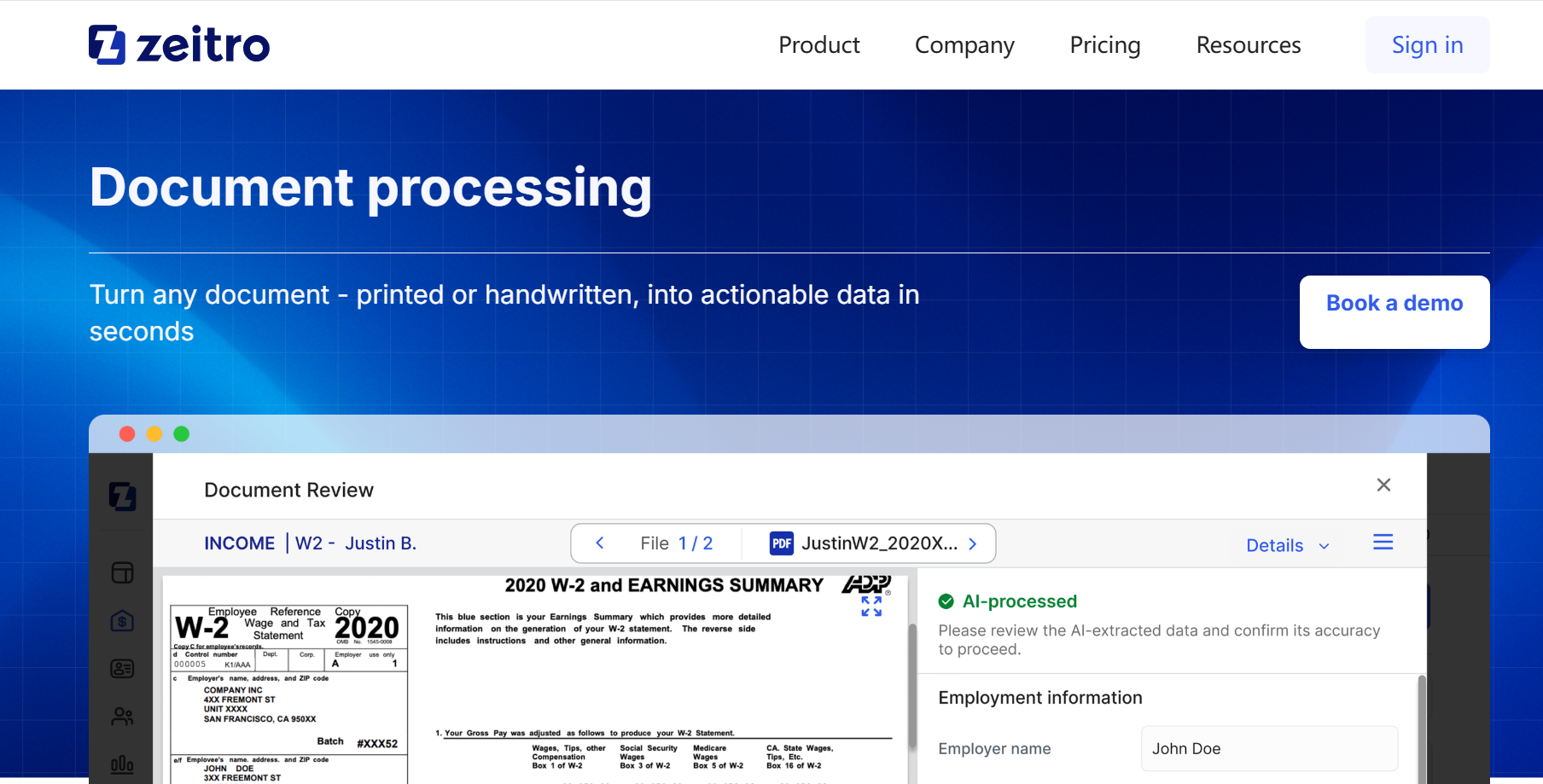
- Zeitro Strata AI (guideline research, minus the guesswork): Instead of digging through PDFs to check whether a borrower qualifies for a niche Non-QM program, you can ask Strata AI directly. It runs a DeepSearch across guidelines from 100+ investors and lenders, covering more than 1,000 guideline sets across Conventional, FHA, VA, DSCR, Bank Statement, Asset Utilization, ITIN, and Non-QM programs, and returns an answer backed by citations in seconds instead of the 30 minutes a manual lookup usually takes. New users get 10 free queries a day to try it out.
- Faster file prep: Strata AI can also read uploaded documents to calculate qualifying income and check it against program eligibility, plus match borrowers to state-specific Down Payment Assistance programs and look up AMI limits, tasks that used to eat up a good chunk of an LO's morning.
- Bluerate (a marketplace, not a lead list): Zeitro also built Bluerate, where borrowers search for loan officers based on location and live rate data. It's a different way to generate business than cold outreach alone.
- Built-in pricing and application tools: Between the pricing engine and the digital 1003 application, Zeitro reports users reach 90%+ application completion rates and cut pre-qualification time significantly compared to manual processes.
If you're spending your weekends on manual guideline research instead of closing files, it's worth a look. Zeitro's free tier is a low-friction way to test it out.
FAQs About the Duties and Responsibilities of a Loan Officer
Q1. What is the average salary of loan officers?
According to BLS data (May 2024), the median annual wage for loan officers in the US is $74,180. Starting salaries are often around $32,000–$40,000, rising to well over $150,000 or even $300,000+ for top producers through commissions.
According to the Bureau of Labor Statistics' most recent wage data (May 2025), the median annual wage for loan officers in the U.S. is $74,148 in 2024, with average total pay climbing to roughly $87,790 when you factor in the full range of the occupation. That figure blends salaried and commissioned roles across the industry, so it's a helpful benchmark rather than a hard ceiling. Entry-level LOs often start closer to $32,000–$40,000 in base pay, while experienced originators regularly clear $150,000, and top producers can pass $300,000 through commission alone.
Also Read: Mortgage Loan Officer Salary: How Much Do Loan Officers Make?
Q2. How to become a loan officer?
If you want to become a loan officer, you typically need a bachelor's degree in finance or business (though not strictly required). The non-negotiable step is getting MLO licensed. You must complete 20 hours of pre-licensure education, pass the SAFE MLO Test with a score of 75% or better, and pass a background check to get your NMLS ID.
Q3. What career paths open up for a loan officer?
Starting as a loan officer leads in several directions. You can work as a mortgage broker running your own book of business, a retail loan officer inside a bank or credit union, or move into operations as a loan processor or underwriter. Experienced LOs sometimes transition into account executive roles at wholesale lenders, working with brokers instead of borrowers directly.
Q4. What skills do loan officers need?
You need a unique mix of hard and soft skills. On the hard side: math proficiency, understanding of financial regulations, and tech-savviness (using CRM and LOS). On the soft side: excellent communication, sales negotiation, and resilience. You have to be able to hear "no" and keep going.
Conclusion
Being a loan officer isn't a role for anyone looking for an easy paycheck. It demands attention to detail, a genuine appetite for sales, and the patience to walk people through one of the biggest purchases of their lives. But watching a family pick up the keys to a home you helped them qualify for makes the long hours worth it.
If you're stepping into this field, or trying to scale what you're already doing, don't try to carry every part of it manually. Tools like Zeitro exist to handle the guideline research and lead generation, freeing you up to focus on what actually moves the needle: relationships, and getting deals across the finish line.

![[Tips for Loan Officers] How Can I Lower Borrower DTI?](https://cdn.prod.website-files.com/6731bc6e813a541b54c30b10/6aa3b89e281a639e7a5c6fca_lower-debt-to-income-ratio-banner.jpg)