
Written by

Eric
Author from Zeitro

Share this article

Subscribe to updates

Thank you! Your submission has been received!
Oops! Something went wrong while submitting the form.

If you are anything like me, your desk or your desktop is often a battlefield. I remember the panic of staring at a stack of 1003s, realizing I'd forgotten to call a hot lead back because I was too busy digging through a 500-page FHA guideline PDF for a different client.

It's a sinking feeling. In this industry, organization isn't just about being tidy. It's about survival. You cannot scale a loan business in 2026 using sticky notes and Excel spreadsheets. I've tested the s, felt the frustrations, and found the solutions. Here is how to find the digital partner that will actually help you close more some of the best CRM for loan officers, felt the frustrations, and found the solutions. Here is how to find the digital partner that will actually help you close more deals.

People Also Read

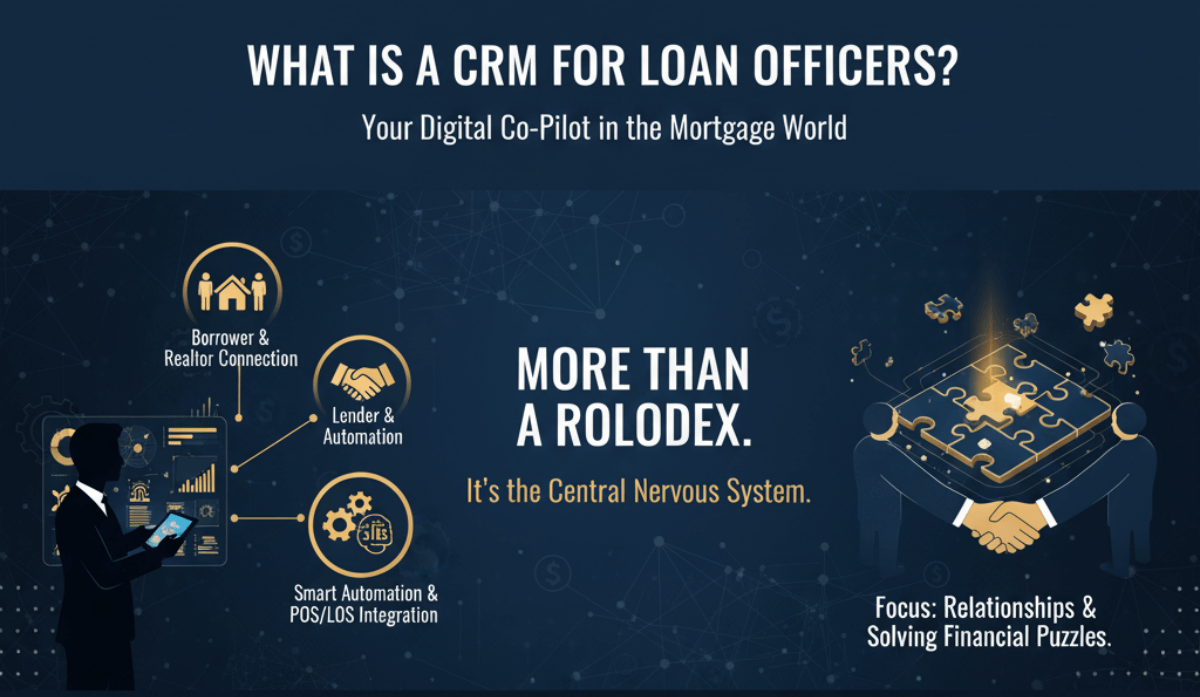
What is a CRM for Loan Officers?

In the mortgage world, "CRM" (Customer Relationship Management) has evolved. It is no longer just a digital Rolodex to store names and phone numbers. Today, the best platforms act as your digital co-pilot. They blur the lines between a CRM, a Point-of-Sale (POS), and a Loan Origination System (LOS).

For us Loan Officers, whether you are an independent broker or part of a large retail bank, these tools are the central nervous system of your business. They connect the borrower, the realtor, and the lender, automating the "busy work" so you can focus on what actually pays the bills: building relationships and solving complex financial puzzles.
Benefits of Using the Best CRM for Loan Officers

Why should you invest your hard-earned commission into sophisticated software? Simply put, manual processes are the enemy of growth. Here is why upgrading your tech stack is non-negotiable this year:

  • Automated Lead Nurturing: You stop losing leads to the cracks. Automated drip campaigns keep you top-of-mind without you lifting a finger.
  • Faster Loan Processing: By streamlining data collection, you can significantly shorten the "application-to-clear-to-close" timeline.
  • AI-Powered Efficiency: This is the big one for 2026. Tools like Zeitro allow you to calculate income and check guidelines instantly, removing human error.
  • Enhanced Compliance: With regulations like TCPA and RESPA constantly looming, a good system automatically logs communications and ensures you stay compliant.
  • Better Borrower Experience: Clients expect a seamless, Amazon-like digital experience. A modern CRM/POS delivers that, boosting your referral rates.
  • Centralized Data: Stop chasing emails. All documents and conversations live in one secure place.
Benefits of Using the Best CRM for Loan Officers

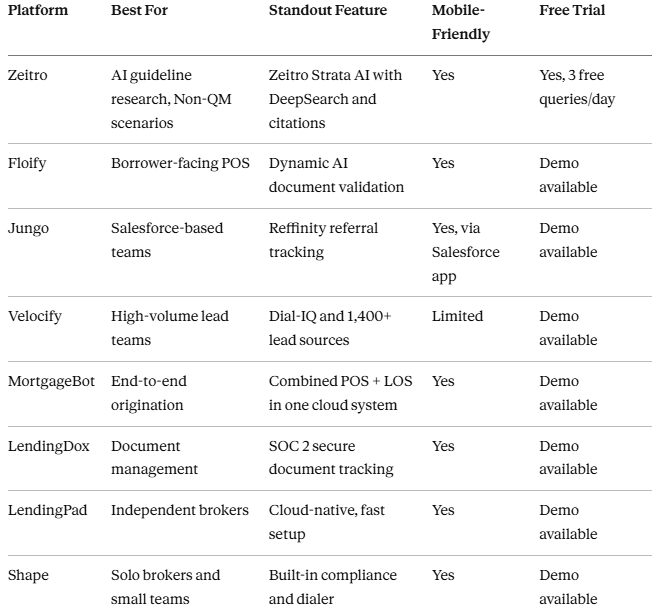
8 Best CRM for Loan Officers in 2026

The market is flooded with software, but only a few are truly worth your time. Let's dive into the best mortgage CRM that are reshaping the mortgage industry this year.

#1 Zeitro

Best for: AI-Powered Workflow & Complex Scenarios

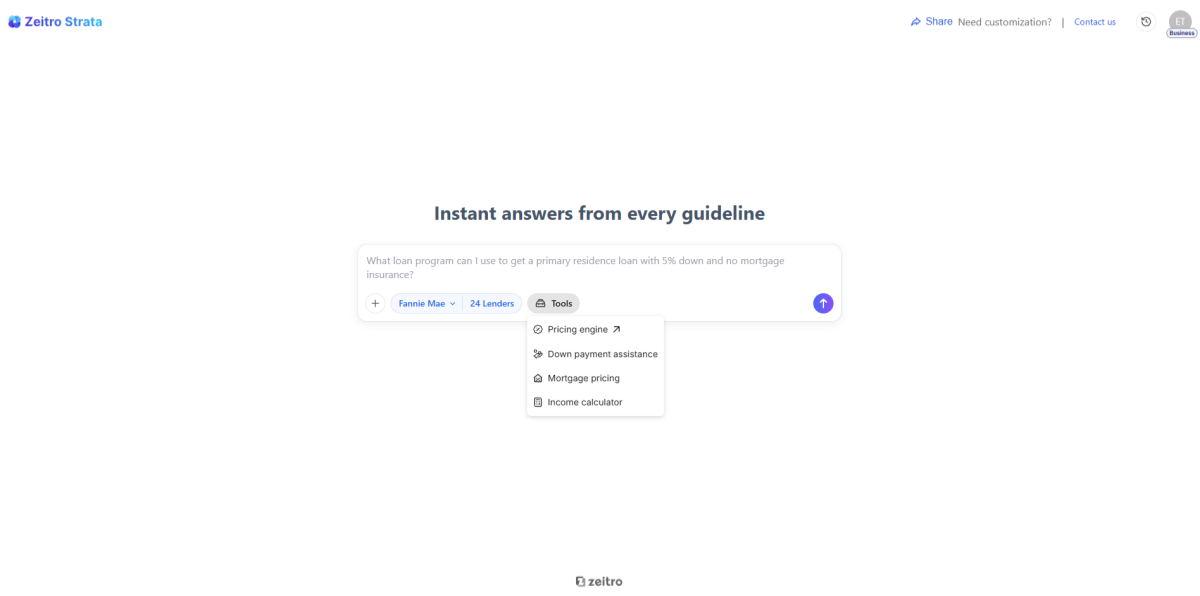
Zeitro is not just a CRM. It is arguably the smartest AI SaaS platform specifically engineered for US Loan Officers and Brokers. While most CRMs focus on managing contacts, Zeitro focuses on doing the work. I've found that the biggest bottleneck in our day is often researching guidelines and calculating income. Zeitro tackles this head-on.

Highlights:

  • Scenario AI & DeepSearch: This is a game-changer. You can ask complex lending questions (FHA, VA, Non-QM) in plain English. The "DeepSearch" mode cuts through thousands of guideline pages to give you instant, source-backed answers, eliminating hours of manual research.
  • Massive Time Savings: Data shows it can save professionals 7+ hours per loan file. Imagine what you could do with an extra 7 hours per deal.
  • Speed to Lead: It is designed to deliver 2.5x faster pre-qualifications, which is critical when a borrower is making an offer in a competitive market.
  • AI Tools Suite: It achieves 85%+ accuracy in AI-powered income calculation and automates document review and condition collection.
  • Pricing Engine: A built-in engine covers all loan types (Conventional, Jumbo, DSCR, Hard Money), allowing you to quote fast.
  • Conversion Boost: By reducing friction, users see a 90%+ application completion rate and close 30% more loans.

#2 Floify

Best for: A Superior Point-of-Sale (POS) Experience

If your main pain point is chasing borrowers for documents or dealing with clunky applications, Floify is the industry standard for a reason. It is a digital mortgage automation solution that makes you look incredibly professional to your clients.

Highlights:

  • Streamlined 1003: They utilize an "interview-style" application that guides borrowers through the 1003 form painlessly, reducing incomplete apps.
  • Dual AUS Integration: You can run Fannie Mae's Desktop Originator® (DO®) and Freddie Mac's Loan Product Advisor® (LPA℠) side-by-side to compare findings instantly.
  • Dynamic Apps: You can customize the loan application flow based on the specific loan scenario, so borrowers aren't asked irrelevant questions.
  • Automated Document Needs: The system automatically requests, collects, and organizes documents, sending reminders so you don't have to be the "bad guy."
  • Massive Integrations: It connects seamlessly with over 50 platforms, including major credit reporting agencies, pricing engines, and other LOS.

#3 Jungo

Best for: Salesforce Power Users

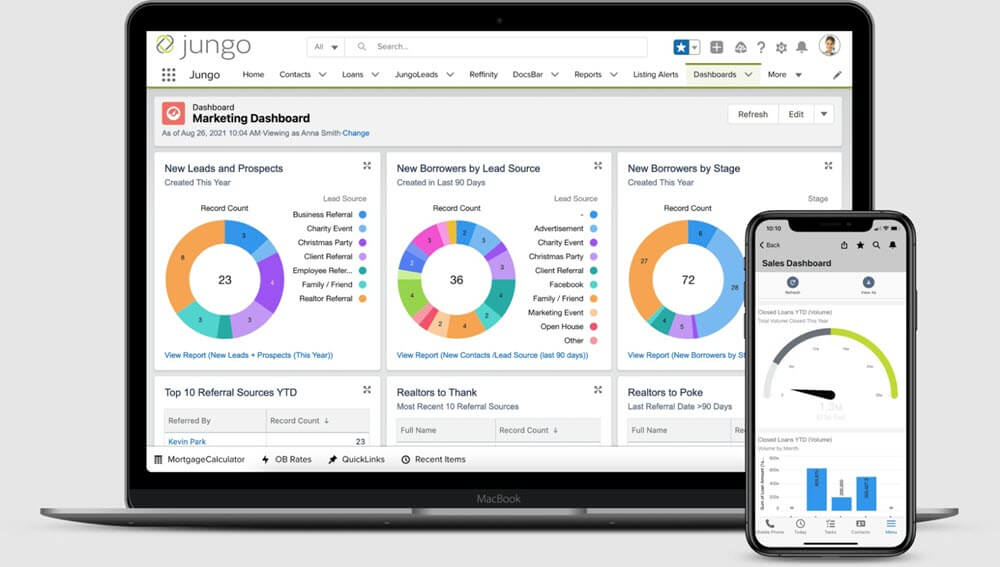
If you believe in the power of Salesforce but hate the headache of customizing it, Jungo is your answer. It is a mortgage-specific layer built on top of the Salesforce ecosystem.

Highlights:

  • The Salesforce Engine: You get the enterprise-grade security and data management of Salesforce, pre-configured for mortgage workflows.
  • Reffinity (Referral Management): This feature is brilliant for keeping your Realtors happy. It tracks referrals and automates pipeline reports sent back to your partners.
  • Concierge Program: It automates post-closing gifts and cards. This "set it and forget it" feature is amazing for long-term client retention.
  • PrintPub Marketing: You can create co-branded flyers and postcards directly within the CRM, which is a huge value-add for your real estate agents.
  • Multi-Channel Reach: It integrates SMS and video messaging (like BombBomb) directly into the contact record for higher engagement.

#4 Velocify

Best for: High-Volume Lead Management

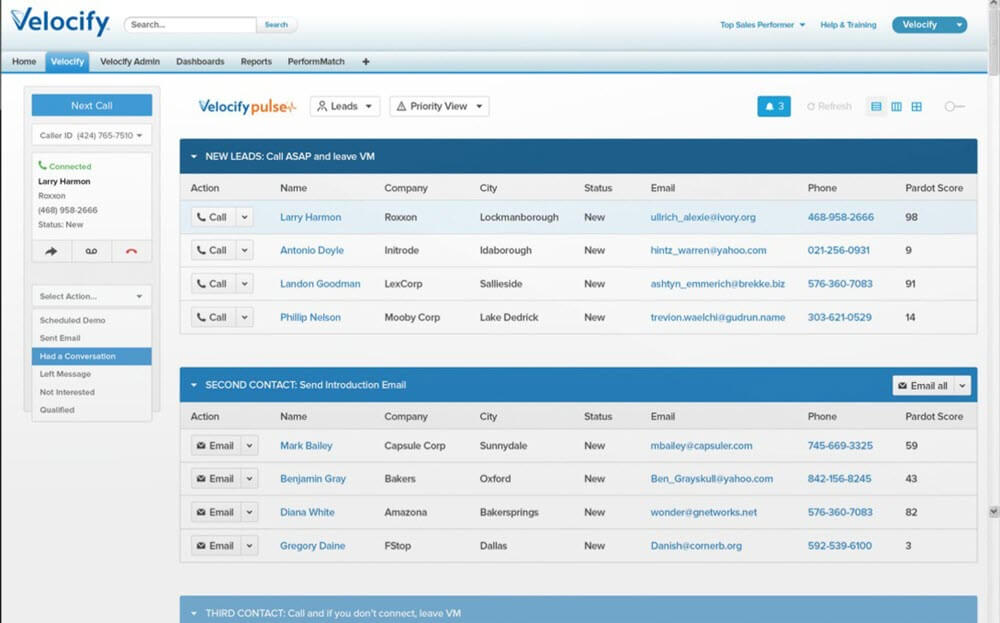
Now part of ICE Mortgage Technology, Velocify is all about speed and volume. If you are running a shop that buys internet leads or handles a massive inflow of inquiries, this is the tool to enforce discipline.

Highlights:

  • Sales Process Enforcement: It ensures every LO follows the exact same contact strategy, so no lead is ever "cherry-picked" or ignored.
  • Dial-IQ: This integrated dialer helps LOs power through call lists, aimed at driving actionable conversations rather than just voicemails.
  • High Conversion: Their methodology claims to increase lead conversion rates by up to 400% by optimizing exactly when and how you follow up.
  • Encompass Integration: Since it is owned by ICE, the data flow into the Encompass LOS is tighter than almost any other third-party CRM.
  • Lead Distribution: It automatically routes leads to the most available or qualified LO instantly, ensuring "speed to lead."

#5 MortgageBot

Best for: End-to-End Origination

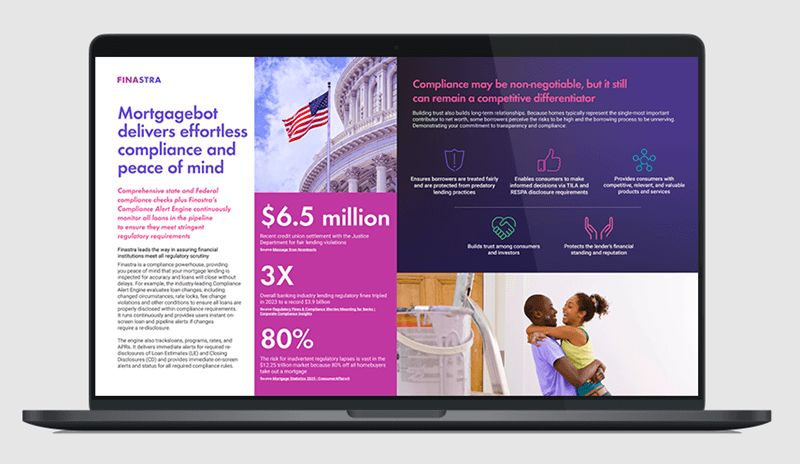
Finastra's MortgageBot is a powerhouse for those who want an all-in-one solution. It combines the consumer-facing application with the back-office processing in a unified cloud environment.

Highlights:

  • Cloud-Native Platform: Being fully web-based means you can access the entire origination system from anywhere, without clunky VPNs.
  • Direct Integration: Because the POS (Originate) and LOS are one system, there is zero data loss or syncing delay between the borrower and the back office.
  • Efficiency Gains: Users report up to a 40% faster application process compared to manual methods.
  • Compliance Tools: It has robust, built-in compliance checks for State and Federal regulations, which provides significant peace of mind.
  • Broad Support: It handles Retail, Wholesale, and Correspondent lending equally well, making it versatile for different business models.

#6 LendingDox

Best for: Secure Document Management

Often integrated with Shape Software, LendingDox focuses heavily on the document handling aspect of the business. If your current system is a mess of Google Drive folders and email attachments, look here.

Highlights:

  • Centralized Storage: It provides a single, secure location for originating, managing, and storing all loan documents.
  • Top-Tier Security: Built with SOC 2 compliance and GDPR standards, it ensures your sensitive borrower data is locked down tight.
  • Real-Time Tracking: You can monitor the status of every document in real-time, receiving notifications the moment a client uploads a paystub.
  • Shape Integration: It works hand-in-glove with Shape CRM, creating a seamless flow from lead intake to document collection.
  • Cost-Effective: Their pricing model (often per user/month with no installation fees) is transparent and friendly for growing teams.

#7 LendingPad

Best for: Cloud-Based Flexibility & Brokers

LendingPad has gained a cult following among brokers and independent mortgage banks. It is lightweight, fast, and completely modern.

Highlights:

  • Anywhere Access: It is a true cloud-native LOS. You can run your pipeline from a tablet in a coffee shop just as easily as from your office.
  • Broker Edition: They have a version specifically tailored for brokers that simplifies the interface and workflow, stripping away unnecessary bank-level complexity.
  • Fast Implementation: Unlike legacy systems that take months to set up, LendingPad gets teams up and running very quickly.
  • Wholesale Integration: It has direct integrations with major wholesalers, making the submission process incredibly smooth.
  • Collaboration: It supports multi-user editing, meaning a processor and an LO can work on the same file simultaneously without locking each other out.
LendingPad

#8 Backbase

Best for: Engagement Banking & Customer Journey

Backbase takes a different approach. They focus on "Engagement Banking." They are less about just processing a loan and more about the entire digital lifecycle of the customer.

Highlights:

  • Frictionless Journey: They excel at allowing a borrower to start an application on a phone, pause, and finish it on a laptop without missing a beat.
  • Unified Platform: It consolidates retail, SME, and commercial lending onto one platform, which is great for institutions offering diverse products.
  • Customer-Centric: The system leverages data to offer personalized experiences, much like modern apps such as Uber or Netflix.
  • Composable Banking: Their modular architecture allows you to "plug and play" new features without overhauling your entire legacy system.
  • Employee Efficiency: It gives your back-office team a unified view of the customer, empowering them to provide faster, better support.
Backbase

How to Choose Your Loan Officer CRM?

With so many options, how do you pick? In my experience, there is no "perfect" CRM, but there is one that fits your business model.

  • First, define your Business Model. If you are a Broker, flexibility and speed (like LendingPad or Zeitro) are key. If you are a large lender with a sales floor, you need the discipline of Velocify.
  • Second, consider your Tech Stack. Do you already use Encompass? Or are you a Salesforce shop? If the latter, Jungo is the logical choice.
  • Third, assess your AI Needs. Do you spend hours fighting with guidelines? If yes, Zeitro is currently unmatched in this specific area.
  • Finally, look at Ease of Use. You don't want a tool that requires a PhD to operate. Ask for a demo and see if the interface feels intuitive to you.

Conclusion

The mortgage industry in 2026 is unforgiving to those who refuse to adapt. Technology is your only leverage against margin compression and time constraints. While Salesforce-based tools like Jungo offer immense power for customization, and Floify dominates the borrower POS experience, the landscape is shifting towards AI.

If you want to truly future-proof your workflow, I highly recommend looking at Zeitro. The ability to save 7+ hours per loan and use AI to navigate complex guidelines is not just a "nice to have", it is a competitive advantage. It's like hiring a genius processor who works 24/7 for a fraction of the cost.

Don't just take my word for it. Most of these platforms offer trials. I suggest starting with Zeitro's Explorer Free plan to see the "Scenario AI" in action. Your future self (and your weekends) will thank you.

Keep reading

Best Non-QM Mortgage Lenders in 2026

Blog

5 min read
Arrow icon on dark background
8 Best Non-QM Mortgage Lenders in 2026: Which to Choose?
Bank said no? Explore the top Non-QM lenders of 2026. Perfect for self-employed, investors, and unique income situations. Get approved with our expert guide.

I still remember the frustration sitting across from my loan officer a few years ago. I had the cash flow, I had the savings, but because I wrote off significant business expenses on my tax returns, the conventional bank simply said, "No".

It's a scenario that happens way too often. As we head into 2026, the gig economy and self-employment are booming, yet traditional lending guidelines haven't fully caught up. That's where Non-QM (Non-Qualified Mortgage) comes in. These aren't the "subprime" loans of the past. They are smart solutions for borrowers with unique financial DNA. If you're self-employed, an investor, or recovering from a credit event, this guide is my personal take on the best non-QM lenders who can actually say "Yes" to your situation.

8 Top Non-QM Mortgage Lenders

Navigating the mortgage landscape in 2026 requires knowing who specializes in what. I've learned the hard way that not all Non-QM lenders are created equal. Some are fantastic for real estate investors using rental income to qualify, while others are better suited for someone needing a "second chance" after a bankruptcy.

Below, I've curated a list of the top 8 players. I've looked at them through the lens of product variety, customer service, and their willingness to perform manual underwriting. These aren't just faceless banks. They are the institutions bridging the gap for modern borrowers.

#1 New American Funding

Best For: Manual Underwriting & Self-Employed Flexibility

When I dig into New American Funding, what stands out is their philosophy that a borrower is more than just a FICO score. They are one of the few large lenders that have truly mastered the art of "manual underwriting". This means a human being, not just an algorithm, reviews your file.

Their proprietary "Non-QM" suite (often referred to as their "SmartSelf" or similar portfolio products) is designed specifically for entrepreneurs. If you are a business owner who minimizes net income for tax purposes, New American Funding allows you to use bank statements to prove your real cash flow.

Pros:

  • The "I CAN" Mortgage: They are willing to look at the whole picture, making them ideal for borrowers with complex income streams.
  • Latino Focus: They are a leader in serving Hispanic communities with bilingual support and culturally competent underwriting.
  • Flexibility: They often accept lower credit scores if other compensating factors (like a large down payment) are present.

Cons:

  • Rates: Like most Non-QM options, expect rates to be higher than a standard Fannie Mae loan.
  • Fees: Be sure to check their origination fees, as manual underwriting is labor-intensive and can cost more.

#2 Carrington Mortgage Services

Best For: Credit Challenges & Second Chances

If your credit report looks a bit bruised, perhaps due to a past foreclosure or bankruptcy, Carrington Mortgage Services is likely your best ally. In my research, Carrington consistently positions itself as the lender for the "underserved" market. They don't shy away from borrowers with credit scores that would make other banks run for the hills.

Carrington is particularly strong if your FICO score is in the 500s. While most lenders in 2026 cap their risk at 620 or 640, Carrington has programs that can go down to 500-550, provided you have "skin in the game" (a decent down payment). They understand that life events happen.

Pros:

  • Accessibility: One of the most forgiving underwriting departments in the industry.
  • Recent Events: They can often approve loans sooner after a negative credit event (like Chapter 13 bankruptcy) than traditional guidelines allow.
  • FHA Expertise: Alongside Non-QM, they are experts in manual FHA underwriting.

Cons:

  • Cost: You pay for the risk. Expect significantly higher interest rates and potentially higher closing costs compared to prime lenders.
  • Scrutiny: Because they take on high risk, they will scrutinize your ability to repay very strictly.
Carrington Mortgage Services

#3 Angel Oak Mortgage Solutions

Best For: The "Gold Standard" of Non-QM Variety

In the mortgage broker world, Angel Oak is practically synonymous with Non-QM. They were one of the first to rebuild this market after the 2008 crash, doing it responsibly. I view them as the "specialist" in the room. While big banks dabble in Non-QM, Angel Oak lives and breathes it.

Their standout product is the Bank Statement Loan for self-employed borrowers, allowing you to qualify using 12 or 24 months of personal or business bank statements, no tax returns required. They also dominate the "Investor Cash Flow" space, where qualification is based solely on the property's rental income (DSCR).

Pros:

  • Speed: Since they specialize in this, their underwriters understand complex files faster than a generalist bank would.
  • Loan Limits: They offer "Non-QM Jumbo" loans, allowing you to borrow amounts far exceeding standard county limits (often up to $3M).
  • Stability: As a veteran in the space, they are less likely to pull funding at the last minute.

Cons:

  • Wholesale Focus: They primarily work through mortgage brokers. You often cannot walk into a retail branch. you need a loan officer who is partnered with them.
  • Strict Guidelines: Because they securitize their loans, they stick rigidly to their own rules.

#4 Rate.com

Best For: Technology & Digital Experience

If you are like me and prefer uploading documents to a secure portal rather than faxing or mailing paperwork, Rate.com (formerly Guaranteed Rate) is a breath of fresh air. In 2026, their digital mortgage platform remains one of the best in the industry.

While they are massive in the conventional space, they have aggressively expanded their Non-QM offerings. Their "FlashClose" technology helps speed up the signing process, which is rare for Non-QM loans that usually drown you in paper. They offer solid 1099-only programs for gig workers and freelancers who might not have traditional paystubs.

Pros:

  • User Experience: The interface is intuitive, transparent, and fast. You can track your loan status in real-time.
  • Variety: Because they are a huge retail lender, they have access to multiple capital sources, offering a wide menu of products.
  • Convenience: Great for tech-savvy borrowers who want a streamlined process.

Cons:

  • The "Big Box" Feel: If your file is extremely messy, you might get lost in the shuffle compared to a boutique lender.
  • Overlays: They might have slightly higher credit score requirements than a specialist like Carrington to fit their automated models.

#5 Northpointe Bank

Best For: Portfolio Lending & Medical Professionals

Northpointe Bank operates differently than many others on this list because they are a strong "portfolio lender". This means they often keep the loans they originate on their own books rather than selling them to investors immediately. This gives them the power to make common-sense exceptions.

I've found them to be an excellent choice for high-net-worth individuals and medical professionals. They have specific programs that allow doctors or residents to exclude student loan debt from their debt-to-income (DTI) calculations. Furthermore, if you have complex assets but low taxable income, Northpointe is creative in how they calculate your buying power.

Pros:

  • Customization: They can tailor a loan to fit a borrower's specific financial picture better than a lender bound by secondary market rules.
  • High LTV: They have been known to offer higher Loan-to-Value ratios for qualified professionals (meaning lower down payments).
  • Rates: For high-credit borrowers, their Non-QM rates are often very competitive.

Cons:

  • Geography: They lend nationally, but specific program availability can vary by state.
  • Credit Standards: They generally prefer borrowers with good credit (680+) who just happen to have unique income, rather than "bad credit" borrowers.

#6 Change Wholesale

Best For: No Income Documentation (CDFI)

Change Wholesale (part of The Change Company) is a unique beast in the mortgage jungle. They are a CDFI (Community Development Financial Institution). This certification from the U.S. Treasury allows them regulatory exemptions that standard banks don't get, specifically to serve underbanked communities.

Their flagship "Community Mortgage" often requires zero income documentation, no tax returns, no P&L, sometimes not even employment verification, provided the borrower has a strong down payment and decent credit. It is as close to the old-school "No Doc" loans as you can legally get in 2026, focusing on equity rather than income.

Pros:

  • Ease of Qualification: If you fit their target demographic or geographic area, the paperwork is incredibly minimal.
  • Social Mission: They focus on Black, Latino, and low-income borrowers who have been historically shut out.
  • True No-Ratio: Qualification is often based primarily on the collateral and credit history.

Cons:

  • Broker Required: As the name implies, they are "Wholesale". You must find a mortgage broker to access their products.
  • Niche: You have to ensure the property or borrower fits their specific CDFI criteria.

#7 Guild Mortgage

Best For: Relationship & Long-Term Servicing

Guild Mortgage feels less like a transactional bank and more like a partner. They have been around for decades and have built a reputation for retaining the "servicing" of their loans. This means when you make your monthly payment, you're likely still paying Guild, not some random third-party company you've never heard of.

For Non-QM, Guild offers flexible programs for self-employed borrowers and those with significant assets. I appreciate their "Complete Rate" approach, which tries to verify income upfront to give you a solid pre-approval rather than a flimsy pre-qualification.

Pros:

  • Customer Service: They consistently rank high in customer satisfaction studies (like J.D. Power).
  • Local Presence: They have many physical branches, which is great if you prefer sitting down with someone face-to-face.
  • Reliability: A very stable lender that doesn't tend to change guidelines mid-process.

Cons:

  • Tech: While functional, their digital tools might feel a step behind Rate.com.
  • Conservative: They may be less adventurous with credit scores than Carrington or Angel Oak.

#8 AD Mortgage

Best For: Real Estate Investors & Foreign Nationals

If you are looking to build a rental portfolio in 2026, AD Mortgage should be on your radar. They have aggressively targeted the DSCR (Debt Service Coverage Ratio) market. This means they qualify the loan based on the cash flow of the property (Rent vs. Mortgage Payment) rather than your personal income.

They are also a top choice for Foreign Nationals (non-US citizens) looking to buy US real estate. What interests me about AD Mortgage is their innovation. in recent years, they have been open to using cryptocurrency holdings for reserve requirements, which is a game-changer for modern investors.

Pros:

  • Investor Friendly: Fast closings for investment properties with minimal personal document requirements.
  • Innovation: Willing to accept crypto assets for reserves and utilize 1099 income creatively.
  • Loan Limits: High loan amounts available for luxury investment properties.

Cons:

  • Volatility: Their rates and guidelines can shift quickly with market conditions.
  • Broker Dependent: Like Angel Oak, they do a massive amount of business through wholesale channels, so finding a broker who knows their system is key.

How to Choose the Top Non-QM Lenders?

Choosing the "best" lender isn't about looking for the lowest advertised rate, because in the Non-QM world, rates depend entirely on your specific risk factors. Here is my personal checklist for selecting the right partner:

  • Identify Your Primary Hurdle: Are you rejected because of credit (look at Carrington) or income documentation (look at Angel Oak or NAF)?
  • Ask About "Points": Non-QM loans often come with "discount points" (upfront fees to lower the rate). Make sure you compare the APR, not just the interest rate, to see the true cost.
  • Check Turnaround Times: Non-QM loans are manually underwritten and take longer. If you have a strict 30-day closing deadline, ask the lender explicitly if they can meet it.
  • Exit Strategy: Remember, Non-QM is often a temporary solution. Ask the lender about "Pre-payment Penalties". You want the flexibility to refinance into a cheaper conventional loan once your financial situation improves.

FAQs About Best Non-QM Lenders

Q1. What credit score do you need for a non-QM loan?

There is no single answer, but generally, the floor is lower than conventional loans. While most lenders prefer a score of 620 to 680, specialists like Carrington Mortgage Services can go as low as 500 to 580. However, keep in mind: the lower your score, the larger the down payment required (often 20-30%) and the higher your interest rate will be.

Q2. Where to find the best non-QM mortgage lenders near me?

This is where things have changed in 2026. In the past, I would have told you to call random brokers from Google Maps. But the problem is, many local loan officers are "assigned" to you and may not have deep experience with Non-QM products.

I recently discovered Bluerate, and it's a game-changer. Instead of being stuck with whoever picks up the phone, Bluerate allows you to search for local non-QM loan officers who specifically list "Non-QM" or "Self-Employed" as their specialty. You can view their profiles, compare their expertise, and book a free consultation directly. It puts the power back in your hands to choose an expert who actually understands your niche.

Q3. Can you refinance out of a non-QM loan?

Absolutely, and you should plan to! I always advise treating a Non-QM loan as a "bridge". You use it to secure the house now. Then, after 12 to 24 months, when your tax returns show more income or your credit score has healed, you refinance into a Conventional or FHA loan to get a lower rate. Just watch out for those pre-payment penalties I mentioned earlier (usually effective for the first 1-3 years).

Q4. What is the 3-7-3 rule in mortgage?

This is a compliance rule meant to protect you, but it can delay your closing if you aren't careful.

3: You must receive your Loan Estimate within 3 business days of applying.

7: You must wait at least 7 business days after receiving that estimate before you can sign the final closing docs.

3: If the APR on your loan changes by more than 0.125% (which happens often in Non-QM if terms are tweaked), a new 3-day waiting period is triggered before you can close.

Conclusion

The mortgage market in 2026 is diverse, and a "No" from a big bank is not the end of your homeownership journey. Whether you are an entrepreneur utilizing New American Funding, an investor leveraging AD Mortgage, or someone rebuilding credit with Carrington, there is a pathway for you.

My final piece of advice? Don't navigate this alone. The Non-QM landscape is complex and varies by state. Use tools like Bluerate to find a dedicated advocate who can shop these lenders for you. Compare the terms, read the fine print on pre-payment penalties, and choose the lender that sees the value in you, not just your tax return.

People Also Read

Full Guide: What is a non-QM Loan? Everything to Learn

Blog

5 min read
Arrow icon on dark background
Full Guide: What is a non-QM Loan? Everything to Learn
Don't know about non-QM loans? Take a look here to check out what it is, along with types, requirements, pros & cons.

I have seen it happen too many times: a financially stable business owner walks into a big bank, ready to buy their dream home, only to be shown the door because their tax returns don't tell the full story. It's frustrating, isn't it? You know you can afford the mortgage, but the traditional "check-the-box" system says otherwise.

This is where a Non-QM loan (Non-Qualified Mortgage) becomes a game-changer. It isn't some shady workaround. It is a legitimate, flexible financing solution designed for the modern economy, gig workers, real estate investors, and self-employed professionals. In fact, data from 2024 shows that Non-QM loans now make up roughly 5% to 8% of the total mortgage market, a number that is steadily rising as more people leave the traditional 9-to-5 workforce.

In this guide, I will walk you through exactly what these loans are, the different types available, and how you can use them to secure a property when traditional banks say "no."

What Is a Non-QM Loan?

To understand a Non-QM loan, I first need to explain what a "QM" is. A Qualified Mortgage (QM) is a standard home loan that meets strict rules set by the federal government, specifically the Consumer Financial Protection Bureau. These rules require lenders to verify your ability to repay using very specific documents, usually W-2s and tax returns, and typically cap your Debt-to-Income (DTI) ratio at 43%.

A Non-QM loan is simply a mortgage that doesn't fit into that rigid box. It uses alternative methods to prove you can pay back the loan.

Let me be clear about one thing: Non-QM is not the "subprime" lending that caused the 2008 housing crash. Back then, people were getting loans with no proof of income or assets. Today, Non-QM lenders are required by law to verify your "Ability to Repay" (ATR). We just do it differently.

Here is a real-world example:Imagine you are a shopkeeper. You made $200,000 in revenue last year, but after deducting your home office, equipment, and travel expenses, your tax return shows a net income of only $40,000. A traditional bank looks at that $40,000 and denies you. A Non-QM lender, however, can look at your bank statements to see the actual cash flow of $200,000 and approve you based on that real liquidity.

Who is this suitable for?In my experience, Non-QM loans are perfect for:

  • Self-employed individuals: Business owners, freelancers, and gig workers who write off significant expenses.
  • Real Estate Investors: Those who want to qualify based on the property's rental income rather than personal income.
  • Foreign Nationals: Buyers who lack a US credit history or Social Security Number.
  • High Net Worth Individuals: Retirees or wealthy buyers with low monthly income but massive assets.
  • Borrowers with Credit Events: People who have had a bankruptcy or foreclosure recently (often as soon as one day out of foreclosure).

Types of Non-QM Loans

Because "Non-QM" is just a category, not a specific product, it comes in many different flavors. I often tell my clients that there is likely a specific tool for their unique financial situation.

Here are the most common types available in the current market

  • Bank Statement Loans: The most popular option for self-employed borrowers. Lenders review 12 to 24 months of personal or business bank statements to calculate your income, ignoring the net income on your tax returns.
  • DSCR Loans (Debt Service Coverage Ratio): Designed strictly for real estate investors. We don't check your personal income at all. If the rent the property generates covers the monthly mortgage payment, you qualify.
  • Asset Depletion Loans: Ideal for retirees or wealthy individuals. We take your total liquid assets (stocks, savings, retirement) and divide them by a set term (like 84 months) to create a "virtual" monthly income for qualification.
  • ITIN Loans: For borrowers living in the US who have an Individual Taxpayer Identification Number (ITIN) but no Social Security Number.
  • Jumbo Non-QM: For luxury properties that exceed federal loan limits, offering more flexible terms than traditional Jumbo loans.

Non-QM Loan Requirements

A common misconception I hear is that Non-QM loans are "easy" to get or require no documentation. That is false. These are "Alternative Doc" loans, not "No Doc" loans. Because the lender is taking on more risk by stepping outside the government safety net, they still need assurance that you are a safe bet.

While every lender has different "overlays" (internal rules), here is what you generally need to bring to the table:

  • Credit Score: The requirements are more relaxed, but standards still exist. Most lenders look for a FICO score of 600 to 620. However, if you want competitive rates, a score above 700 helps significantly.
  • Down Payment (LTV): You usually need more skin in the game. Expect to put down 10% to 20%. The maximum Loan-to-Value (LTV) ratio typically tops out at 80% or 90%.
  • Reserves: This is crucial. Lenders often want to see that you have 3 to 6 months of mortgage payments saved up in liquid cash after the closing.
  • Proof of Income (Alternative): Depending on the loan type, you must provide bank statements, 1099 forms, P&L statements prepared by a CPA, or lease agreements.

Pros and Cons of Non-QM Loans

I believe in total transparency. Non-QM loans are powerful tools, but they aren't the right fit for everyone. Before you commit, you need to weigh the benefits against the costs.

The Pros:

  • High Flexibility: This is the biggest selling point. You aren't held back by tax returns that don't reflect your real cash flow.
  • Faster Closing (Especially DSCR): Since we aren't waiting on the IRS to verify tax transcripts or analyzing complex employment histories, investment loans (DSCR) can often close faster than conventional loans.
  • Access to Unique Properties: Non-QM lenders are often more willing to finance "non-warrantable" condos (like condotels) that Fannie Mae and Freddie Mac won't touch.

The Cons:

  • Higher Interest Rates: Flexibility comes at a price. In the current 2024-2026 market, you can expect Non-QM rates to be roughly 1% to 2% higher than a standard conventional mortgage.
  • Larger Down Payment: You typically cannot buy with 3% or 5% down like you can with an FHA or conventional loan.
  • Fewer Lenders: You can't just walk into a local branch of a major bank (like Chase or Wells Fargo) for these. You almost always need to work through a specialized Mortgage Broker.

QM vs. Non-QM Mortgages: Key Differences

When clients ask me to compare these two, I break them down into four distinct categories to make it easy to digest.

Underwriting & Documentation

  • QM: Extremely standardized. It relies heavily on W-2s, tax returns, and automated underwriting systems. It fits "square peg" borrowers.
  • Non-QM: Manual and logical. Human underwriters review bank statements or assets to make a common-sense decision on your ability to pay.

Borrower Protection

  • QM: Offers lenders a "Safe Harbor," meaning they are legally protected if you default, provided they followed the rules.
  • Non-QM: Does not offer this Safe Harbor. This means the lender takes on higher legal risk, which is why they are very careful about verifying your reserves and credit history.

Credit & LTV Limits

  • QM: Strict debt-to-income (DTI) cap, usually at 43%.
  • Non-QM: Much more lenient on debt. I frequently see approvals for borrowers with a DTI up to 50% or even 55%, allowing you to qualify for a more expensive home.

Secondary Market

  • QM: These loans are almost always sold to government-sponsored entities like Fannie Mae or Freddie Mac.
  • Non-QM: These are held by the lender in their portfolio or sold to private investors (hedge funds) and insurance companies.

Non-QM Loan FAQs

If you have more questions about non-QM loans, check out the FAQs below.

Q1. What property types are eligible for non-QM lending?

Non-QM is incredibly versatile regarding property types. You can finance primary residences, second homes, and investment properties. This includes Single-family homes, Townhomes, Multi-unit properties (2-4 units), and even tricky properties like non-warrantable condos and Condotels (condo-hotels) that conventional loans usually reject.

Q2. What are examples of non-QM loans?

The most common examples I handle are Bank Statement Loans (using 12-24 months of deposits for income), DSCR Loans (using rental income to qualify investment properties), Asset Depletion (using liquid savings as income), and Foreign National Loans for non-US citizens investing in the States.

Q6. Is a bank statement loan considered non-QM?

Yes, absolutely. It is the quintessential Non-QM product. Because it does not use standard tax returns or W-2s to verify income, as required by the "Qualified Mortgage" definition, it falls squarely into the Non-QM category. It is the go-to solution for self-employed borrowers.

Q7. What is non-qualified financing?

"Non-qualified financing" is just a broader industry term for Non-QM loans. It refers to any mortgage lending process that operates outside the "Safe Harbor" guidelines established by the CFPB. It simply means the loan doesn't meet the government's strict criteria for resale to Fannie Mae or Freddie Mac.

Conclusion

Here is the bottom line: Being rejected by a traditional bank does not mean you cannot buy a home. It often just means your financial life is more complex than a standard W-2 employee, and that is okay. Non-QM loans exist specifically to fill this gap, helping business owners and investors turn their real cash flow into real estate equity.

While the interest rates and down payments are slightly higher, I often advise my clients to view a Non-QM loan as a strategic bridge. You can use it to secure the property now, and then refinance into a conventional loan later if your tax profile changes or rates drop.

Since these loans are complex and rules vary by lender, your best move is to consult with an experienced Mortgage Broker who specializes in Non-QM products. They can navigate the "overlays" and find the program that fits your unique story.

People Also Read

[Proven] How to Generate Mortgage Leads for Free? 6 Methods

Blog

5 min read
Arrow icon on dark background
[Proven] How to Generate Mortgage Leads for Free? 6 Methods
If you're looking for the best way to generate mortgage leads for free, learn 6 proven methods here and get more leads now!

Are you tired of burning through your marketing budget on paid ads or buying mortgage leads that just don't convert? You are not alone. Whether you are a loan officer, mortgage broker, wholesaler, or part of a small lending team, the pressure to find quality borrowers without spending a fortune is real. We've all been there, staring at a pipeline that needs filling while trying to keep costs low.

The good news? Some of the highest-converting mortgage leads won't cost you a dime, but just your time and expertise.

In this guide, I'm sharing 6 proven, free methods to generate mortgage leads. These aren't theoretical concepts. They are actionable steps you can start today. By the end of this article, you will have a clear roadmap to build a sustainable flow of clients, from leveraging AI platforms to mastering local networking.

Let's dive into how you can stop chasing leads and start attracting them.

People Also Read:

Method 1. A Website to Showcase Yourself

In the digital age, if you aren't online, you don't exist. However, I've seen too many loan officers get stuck in the trap of building a custom website. Honestly, it's a headache. It requires expensive hosting, endless maintenance, and worst of all, you have to fight tooth and nail for SEO just to get a single visitor.

There is a smarter, zero-cost alternative.

Instead of building a lonely island on the web, I highly recommend creating a free profile on an AI Mortgage Marketplace like Bluerate. Think of this as your professional storefront that comes pre-loaded with traffic. By joining a platform where borrowers are already searching for rates and lenders, you leverage their SEO and marketing efforts for your own benefit.

But Bluerate is more than just a digital business card. It's a powerhouse that integrates directly with the bets Loan Origination System (LOS). Here is why this is a game-changer for your workflow:

  • Total Transparency: From the initial Rate Quote to the final Close, everything is tracked in real-time.
  • AI Efficiency: The platform utilizes tools like GuidelineGPT and Scenario AI, which can reduce manual guideline research by 100%.
  • Speed Wins: With AI empowerment, professionals using Bluerate save 7+ hours per loan and see 20% faster loan closing speeds.

When you streamline the process, borrowers notice. In fact, the platform boasts a 90%+ application completion rate. You aren't just getting a lead. You're getting a borrower who experiences a seamless, transparent journey. That level of service helps you close 30% more loans naturally. Why pay for a website when you can join an ecosystem that actually helps you work?

Method 2. High-Quality Content Marketing

You might be thinking, "I'm a lender, not a writer." But here is the truth: content is the only asset that works for you while you sleep. High-quality content builds trust before you ever pick up the phone.

The secret isn't to write generic updates, and it's to solve specific problems. Focus on educational content that answers the exact questions your clients ask. You can write blog posts like "How to get pre-approved in [Your City]" or "FHA vs. Conventional: What's best for first-time buyers?" Share a monthly local market snapshot. Use data from authoritative sources (like the Fed or local realtor boards) to show trends in your specific county.

Don't let them read and leave. Always include a "Lead Magnet." For example, offer a free eBook like "The Ultimate Closing Cost Guide" in exchange for their email. Place a sticky contact widget on your page so they can book a call instantly.

By consistently posting, say, one solid article every two weeks, you build a library of answers. Over time, this organic traffic becomes your most reliable source of free leads.

Method 2. High-Quality Content Marketing

Method 3. Leverage the Power of Social Media

Social media is often misunderstood in our industry. It's not about broadcasting your daily rates to an empty room. It's about community and education. Each platform has a specific role in your lead generation strategy.

  • LinkedIn: This is your B2B powerhouse. Use it to connect with real estate agents and financial planners. Share case studies of tough deals you saved or professional insights on market shifts.
  • Facebook: Focus on hyper-local community groups. Don't spam, and be the helpful expert. When someone asks about housing in a local group, answer their question genuinely without a hard sell.
  • Instagram/TikTok YouTube: Video is king here. Create short, captioned videos explaining complex terms (e.g., "What is refinance?"). These "micro-lessons" build massive trust.

Consistency beats virality. Create a simple schedule: FAQs on Tuesday, Client Success Stories on Thursday, and Market Updates on Friday. Always include a clear Call to Action (CTA), such as "Link in bio to book a consultation."Show the human side. Share a photo of a closing day (with client permission) or a "behind-the-scenes" look at your underwriting process. This transparency proves you are a real person helping real families, not just a faceless bank.

Method 4. Word of Mouth with a Great Reputation

A referral is the "Holy Grail" of mortgage leads, because it's free, high-intent, and closes fast. But hoping for referrals isn't a strategy. You need a system to generate them.

Reputation management starts with the client experience. If you use tools like Bluerate mentioned above to speed up closing, your clients are already happier. Capitalize on that joy. Don't know how to get reviews? Check out the ideas below:

  • Timing is Key: Ask for the review right when the loan funds. That is the moment of peak happiness.
  • Make it Easy: Send a text or email with a direct link to your Google Business Profile. Don't make them search for you.
  • The "Referral Tree": Create a simple program. Send handwritten thank-you cards or host small community appreciation events.

Note that you should always check your local regulations and RESPA guidelines regarding referral rewards to ensure you remain compliant. When future prospects search your name and see 50 five-star reviews mentioning your transparency and speed, the sale is already half-made.

Method 4. Word of Mouth with a Great Reputation

Method 5. Network with Local Real Estate Agents

This is the bread and butter for most top producers. Real estate agents control the buyer relationship, and they are desperate for a lender who won't kill their deal.

Don't just email them asking for coffee. You need to offer value first. Target high-volume local realtors and buy-side agents. Here are some partnership ideas:

  • Co-Marketing: Offer to create co-branded open house flyers using your marketing templates.
  • Education: Host a "Lunch & Learn" specifically on new loan products that help them sell hard-to-move properties like renovation loans or buydowns.
  • Open House Support: Offer to sit at their open house to pre-qualify buyers on the spot.

Show them you have a system. "I use an AI-driven process that ensures I never miss a closing date, and I update you every Tuesday on file status." When you prove you can make their life easier and protect their commission, the referrals will flow naturally.

Method 6. Connect with Other Professionals

While everyone chases realtors, many overlook the "Other Professionals" who advise clients on major life financial decisions. These relationships can yield incredibly high-quality borrowers. Here are some professionals you can target:

  • CPAs: They know exactly who is buying a home for tax benefits or who has a self-employed income structure that needs a skilled lender.
  • Financial Planners: They handle clients looking to refinance for investment purposes or wealth management.
  • Divorce Attorneys: A niche, but these clients often need to refinance a spouse off a title or buy a new home quickly.

You can try to send a professional, personalized email. Focus on how you protect your client's interests. For example: "I specialize in helping self-employed clients navigate mortgage approvals without triggering audits. I'd love to be a resource for your tax clients."

Treat these partners with extreme professionalism. A referral from a CPA comes with a high level of trust transferred to you, and don't break it.

Conclusion

Generating free mortgage leads isn't about finding a "magic button". It's about building a presence where trust and value meet. Whether you are leveraging the AI power of Bluerate, creating educational content, or shaking hands with local realtors, the core principle is the same: Give value first.Don't try to do all six methods at once. First of all, you can create your free profile on Bluerate to handle your digital presence and streamline your workflow. Then, pick one distribution channel like Instagram or local Realtor networking, and commit to it for 90 days.

The leads are out there, and they are looking for a professional like you. Start building your pipeline today.

Try Zeitro today and transform your loan origination workflow!

Get started free