
Written by

Eric
Author from Zeitro

Share this article

Subscribe to updates

Thank you! Your submission has been received!
Oops! Something went wrong while submitting the form.

I remember the first time I looked closely at a loan officer's business card. Right next to their phone number was a mysterious code: NMLS #12345. At the time, I had no idea what it meant. Was it a tax ID? An internal employee code?

If you are a homebuyer looking to verify your lender, or an aspiring professional planning to enter the mortgage industry in 2026, you've likely asked the same question. That string of numbers isn't just random digits. It is the backbone of consumer protection in modern finance. Whether you need to check a license or earn one, this guide covers everything you need to know about the NMLS.

What is NMLS?

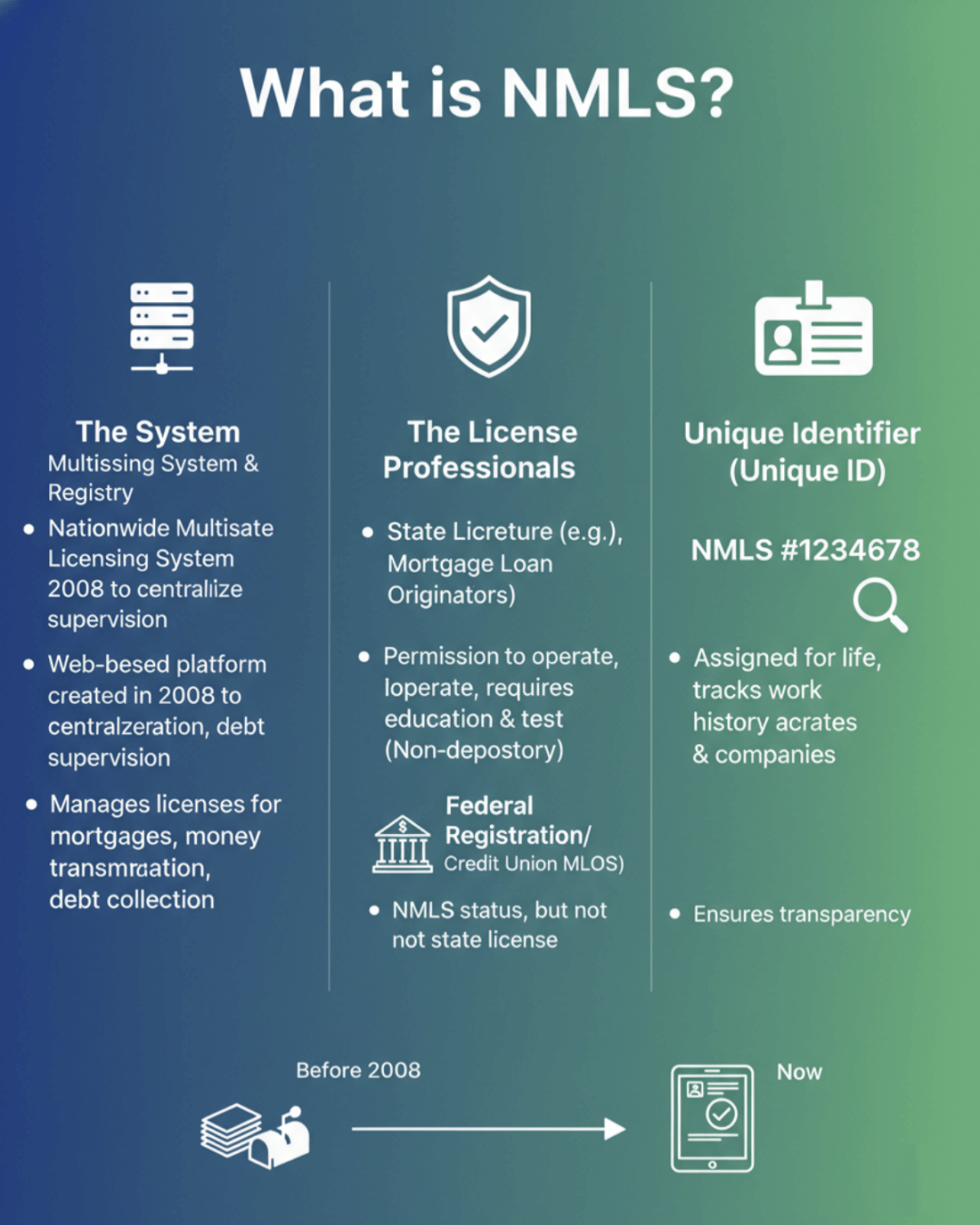
To be honest, the term "NMLS" can be a bit confusing because people use it as an umbrella term for three very different things. When you hear someone say, "I have my NMLS," they could be talking about the computer system itself, the professional license they hold, or the unique ID number assigned to them.

Before we dive deep, let's clear up the confusion. In the next few sections, I'll break down exactly what the acronym stands for, what the license actually permits, and why that specific number matters so much to you.

What is NMLS?

What Does NMLS Stand for?

Officially, NMLS stands for the Nationwide Multistate Licensing System and Registry.

You might hear some 'old school' veterans still call it the 'Nationwide Mortgage Licensing System' informally, but the official name has always been 'Nationwide Multistate Licensing System' to reflect its scope beyond just mortgages, including money transmission and debt collection. It tracks industries like money transmission and debt collection, too.

I like to think of the NMLS as the "central nervous system" of the financial services industry. Created by the Conference of State Bank Supervisors (CSBS) and the American Association of Residential Mortgage Regulators (AARMR), it started in 2008 following the housing market crash. The goal was simple but ambitious: create a single, unified database to improve supervision and bring transparency to a market that desperately needed it.

What is an NMLS License?

An NMLS license is essentially your "permission to operate." It is the credential issued by a state regulatory agency (facilitated through the NMLS system) that legally allows an individual to originate mortgages, typically required for non-depository institutions.

Here is a detail that trips up many beginners: Not everyone with an NMLS number has a "license."

  • State Licensure: If you work for a mortgage broker or independent lender, you must pass a difficult test and get a state license.
  • Federal Registration: If you work for a bank (like Wells Fargo or Chase) or a credit union, you are "federally registered." You have an NMLS status, but you don't hold the same state license.

If you are planning to become a Loan Officer, this license is proof that you have met strict education and testing requirements.

What is an NMLS Number?

Think of the NMLS Number as a Social Security Number for your career. It is a Unique Identifier (Unique ID) assigned to you when you first create an account, and it stays with you for life.

The beauty of this number is its portability. I've seen colleagues move from a bank in New York to a brokerage in Texas, and while their employer changed, their NMLS number remained exactly the same.

For regulators and consumers, this number is vital. It allows us to track a loan officer's entire work history across different companies and states. If a bad actor tries to hide past violations by moving to a new state or changing their name, the NMLS number exposes the truth immediately.

How Does NMLS Work?

So, how does this massive machine actually function? The NMLS acts as a secure, web-based hub that connects three groups: state regulators, financial companies, and individual professionals like Mortgage Loan Originators (MLOs).

From an operational standpoint, it simplifies what used to be a paperwork nightmare. Before 2008, if I wanted to work in five different states, I would have to mail five distinct paper applications to five different government offices. Now, everything is done through a single digital form called the MU4 Form.

The system records everything. It tracks your:

  • Pre-licensure education (PE) hours.
  • Credit report.
  • FBI background check results.
  • Annual continuing education.

It basically centralizes compliance, ensuring that every professional you deal with is monitored in real-time.
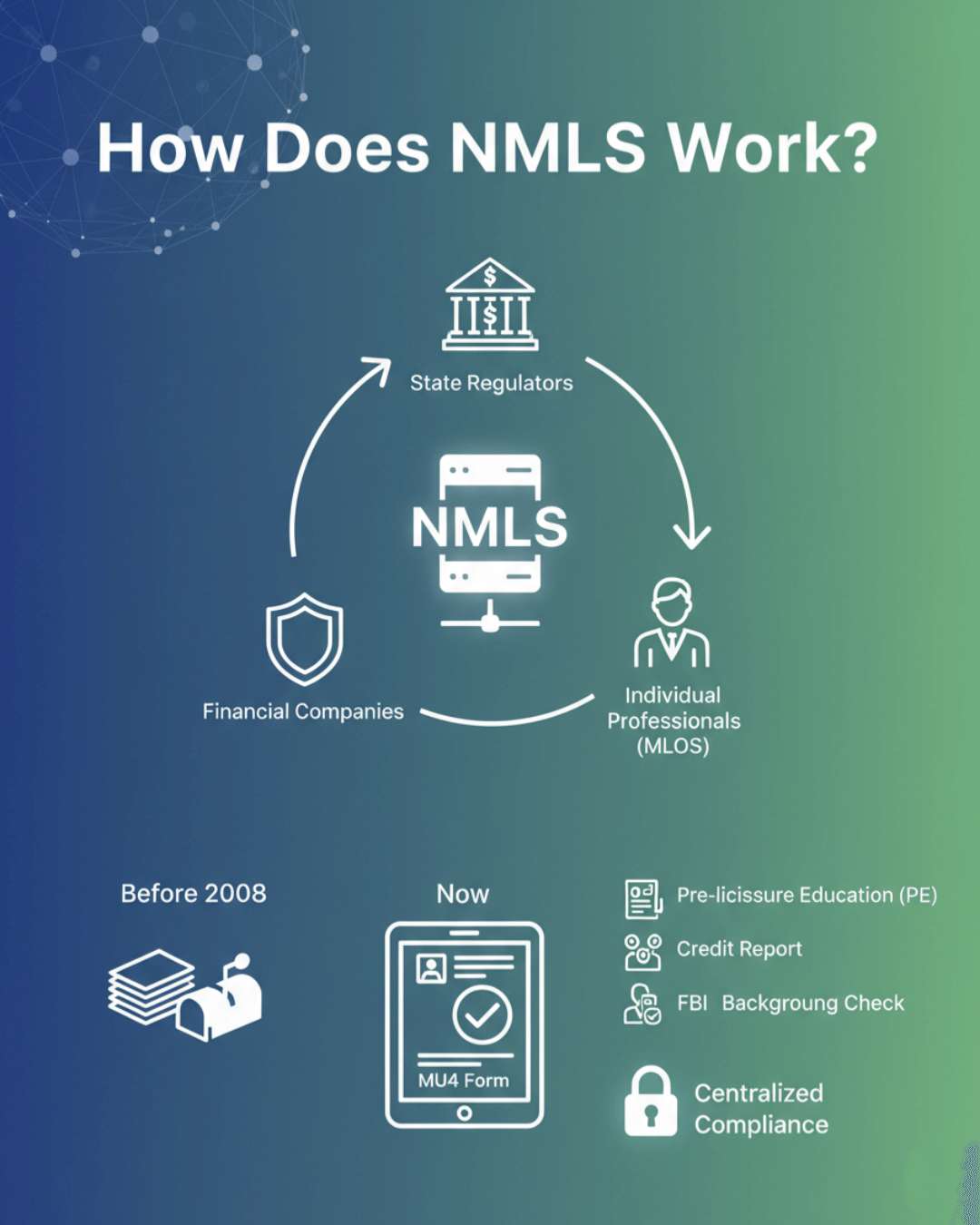
How Does NMLS Work?

Why is NMLS Important?

The importance of the NMLS cannot be overstated, especially when we look back at the 2008 financial crisis. The system was born out of the SAFE Act of 2008 (Secure and Fair Enforcement for Mortgage Licensing Act) to stop the "wild west" behavior that caused the market collapse.

Here is why it matters, specifically for you:

  • For Borrowers (Fraud Prevention): It is your shield. You can verify if your loan officer is legitimate or if they have a history of disciplinary actions. It creates accountability.
  • For the Industry: It levels the playing field. By enforcing uniform standards for testing and education, it weeds out unqualified individuals, raising the professional reputation of everyone else in the business.

Who is Required to Have an NMLS Number?

It's not just the person sitting across the desk from you who needs a number. The requirement covers a broad range of entities in the lending world.

Generally, the following must have an NMLS Unique ID:

  • Mortgage Loan Originators (MLOs): Anyone who takes a loan application or negotiates terms for compensation.
  • Mortgage Lenders and Brokers: The companies themselves must be licensed.
  • Branches: Even specific office locations often have their own branch NMLS numbers.
  • Independent Contractors: Contract underwriters or processors who work for multiple companies often need their own license number to operate legally.

How Do I Get an NMLS License?

If you are looking to join the industry, getting licensed is a structured process. While requirements vary slightly by state, the core steps are generally the same nationwide:

  1. Create an Account: Register on the NMLS Resource Center to get your Unique ID.
  2. Complete Education: Finish 20 hours of Pre-Licensure Education (PE).
  3. Pass the Test: Score a 75% or higher on the SAFE MLO Exam.
  4. Background Checks: Submit fingerprints for an FBI check and authorize a credit report.
  5. Apply: Submit the MU4 form and pay your fees.

For a more detailed breakdown of the study strategies and application costs, I recommend checking out this guide on how to get an NMLS license.
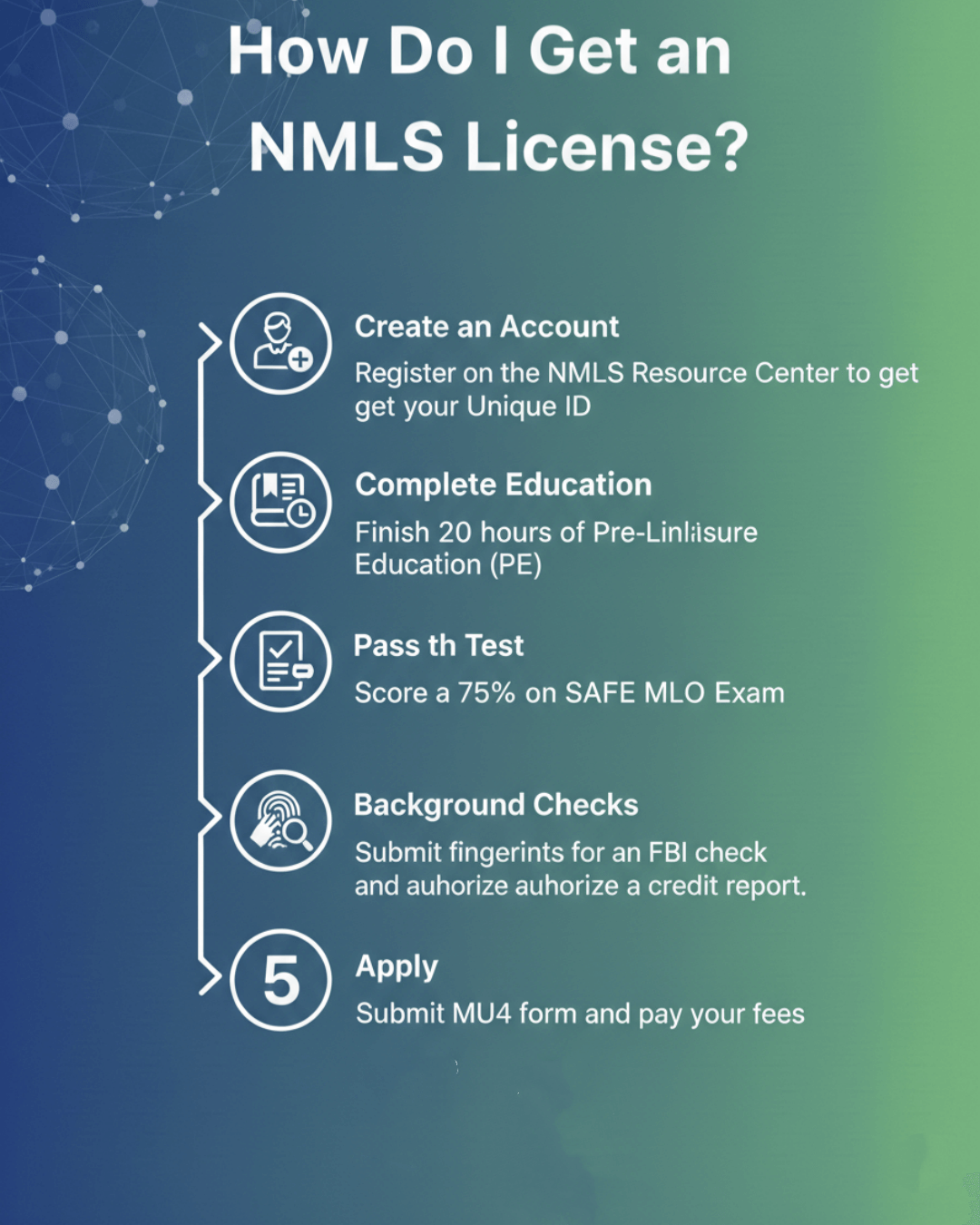
How Do I Get an NMLS License?

FAQs About NMLS Meaning

Q1. How to look up the NMLS number?

This is the most useful tool for consumers. You can verify any loan officer or company by visiting NMLS Consumer Access. It is a free, official website. Simply type in the name or number, and you will see their employment history, regulatory actions, and valid licenses. I always tell clients: "Trust, but verify."

Q2. Is the NMLS test hard?

I won't sugarcoat it—yes, it is difficult. The SAFE MLO Test typically has a first-time pass rate hovering around 54% to 65% (based on recent national averages), depending on the testing provider and year. It's not just a memory test. You need to understand how to apply federal laws to real-life scenarios. If you are preparing for it, study hard.

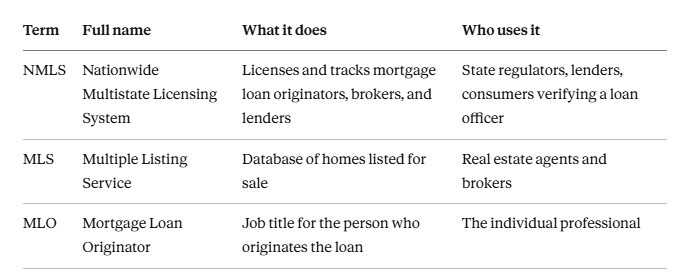
Q3. What is the difference between NMLS and MLO?

This is a common mix-up. NMLS is the database/system. MLO (Mortgage Loan Originator) is the job title of the person. You can think of it this way: The NMLS is the DMV (Department of Motor Vehicles), and the MLO is the driver.

Q4. Is an NMLS a professional license?

Technically, "NMLS" is the system, but when people ask this, they mean the credential. Yes, holding a state-issued license via the NMLS is a professional license. It requires ongoing education, credit checks, and adherence to federal law, similar to how CPAs or Realtors are licensed.

Conclusion

Whether you are navigating the exciting journey of buying a home or launching a new career in finance, understanding the NMLS is crucial.

  • For homebuyers, that unique number is your safety net. Always use Consumer Access to check who you are working with.
  • For aspiring professionals, your NMLS ID is a symbol of trust and competence. It proves you have put in the work, passed the background checks, and earned your place in the industry.

People Also Read

Keep reading

Must Read: What are the Duties and Responsibilities of Loan Officers

Blog

5 min read
Arrow icon on dark background
Must Read: What are the Duties and Responsibilities of Loan Officers?
Discover the key duties and responsibilities of loan officers. From evaluating borrowers and compliance to closing deals, get the full job breakdown here.

If you think being a loan officer (LO) is just about filling out forms and checking credit scores, think again. I've been in this industry long enough to know that we are part financial detective, part sales expert, and part therapist. We are the bridge between a borrower's dream of homeownership and the complex reality of financial lending.

The role is rewarding, but it's also demanding. You are the gatekeeper of the lender's money and the guide for the borrower's future. If you are curious about what we actually do day-to-day or if you're an aspiring LO looking to survive in this competitive market, you need to understand the full scope of the job. It's not just about sales. It's about structuring deals that actually cross the finish line.

People Also Read:

What are the Duties of a Loan Officer?

A loan officer's job cycle covers everything from the initial handshake to the final signature at the closing table. It's a mix of relationship building, technical analysis, and regulatory compliance. Here is a breakdown of the specific duties you will handle every single day.

What are the Duties of a Loan Officer?

1. Evaluate Borrowers

This is where it all begins. When a client comes to me, my first job is to determine if they are "creditworthy." But I don't just look at a FICO score and call it a day. I have to analyze their entire financial picture. This means digging into debt-to-income (DTI) ratios, reviewing employment history, and understanding the source of their down payment.

For standard W-2 employees, this is straightforward. But for self-employed borrowers or those with complex income streams, it requires a forensic approach. I have to calculate qualified income accurately because if I overestimate their income now, the loan will get denied weeks later by the underwriter—and that is a nightmare scenario I work hard to avoid.

2. Recommend the Right Loan Options

Once I understand the borrower's profile, I have to play matchmaker. There isn't a "one-size-fits-all" mortgage. I have to decide if a client is better suited for an FHA loan, a VA loan, a conventional mortgage, or perhaps a Non-QM (Non-Qualified Mortgage) product if they don't fit traditional molds.

This is tougher than it sounds. Each loan program has hundreds of pages of guidelines, and lenders often add their own "overlays" (extra rules). A borrower might qualify for an FHA loan with one lender but get rejected by another due to a specific overlay. My duty is to know these nuances so I don't waste the client's time applying for a loan they can't get.

3. Collect and Verify Documentation

If you hate paperwork, this job might be a struggle. A huge part of my day is spent chasing down documents: pay stubs, W-2s, tax returns, and bank statements. But collecting them isn't enough. I have to verify them.

I look for red flags that an underwriter will catch. Is there a large, unexplained deposit in the bank statement? Does the tax return show a business loss that lowers their qualifying income? Catching these issues early allows me to fix them or restructure the deal before submission. It's tedious, but thoroughness here is what separates the pros from the amateurs.

4. Submit and Manage Loan Applications

After gathering the data, I input everything into the Loan Origination System (LOS) to create the 1003 (Uniform Residential Loan Application). This is the official document that goes to the lender. Accuracy here is non-negotiable. A typo in the social security number or a mistake in the employment dates can trigger conditions that delay the whole process.

Once submitted, I don't just sit back. I manage the pipeline. I track the file as it moves to the processor and underwriter, ensuring it doesn't get stuck in a queue. I am essentially the project manager for the borrower's file.

5. Communicate Throughout the Process

I often say that 50% of this job is psychology. Buying a home is stressful. Borrowers are anxious. Real estate agents want their commission. It is my duty to keep everyone in the loop.

I provide weekly updates at minimum to the borrower and the agents. If a problem comes up—say, an appraisal comes in low—I have to break the news and immediately offer a solution. Ghosting a client during a tough moment is the fastest way to ruin your reputation. You have to be available and responsive.

6. Ensure Compliance

The mortgage industry is heavily regulated, and for good reason. I have to ensure every file complies with federal and state laws, such as RESPA (Real Estate Settlement Procedures Act) and TILA (Truth in Lending Act).

I need to make sure Loan Estimates (LE) go out on time and that we aren't violating any fair lending laws. Ignorance isn't a defense in this business. One compliance slip-up can lead to massive fines for the company or even the revocation of my license.

7. Close the Loan

This is the finish line. When we get the "Clear to Close" (CTC), my duty is to review the Closing Disclosure (CD) with the client. I walk them through the final numbers—cash to close, interest rate, and monthly payment—to make sure it matches what I promised them at the beginning.

I coordinate with the title company to set the signing appointment. My goal is "zero surprises" at the closing table. If the borrower sits down to sign and the numbers look wrong, I haven't done my job.

8. Build and Maintain Relationships

Finally, unless you work in a call center, you are responsible for generating your own business. Lenders don't just hand you files. You have to hunt for them.

My duty includes networking with realtors, builders, and past clients to keep the referrals flowing. I have to market myself as a trusted expert. This is the "business development" side of the role. If I stop building relationships, my pipeline dries up, and so does my income.

What is the Main Responsibility of a Loan Officer?

While the duties list is long, if you asked me to boil it down to one core responsibility, it would be Risk Management and Problem Solving.

At the end of the day, I serve two masters: the borrower and the lender. For the lender, my responsibility is to ensure the loan is a safe investment—that the borrower can actually repay it. For the borrower, my responsibility is to solve the puzzle of their finances to get them the keys to their home. You are the filter. You protect the bank from bad loans, and you protect the borrower from bad financial decisions.

What are Common Loan Officer Interview Questions?

If you are looking to break into the industry or switch companies, you need to be ready for more than just technical questions. Managers want to know how you handle pressure. Here are common questions I've seen:

  • "How do you handle a loan denial with a client?"
      Tip: They want to see empathy and problem-solving. Don't just say "I tell them no." Say you explain why and offer a plan to fix their credit for the future.
  • "How do you stay updated with changing guidelines?"
      Tip: This is huge. Mention you read industry news, study agency handbooks, or better yet, use advanced AI tools to keep track of updates.
  • "Tell me about a difficult file you saved."
      Tip: Have a "WAR" story ready. Structure it: What was the challenge (e.g., low appraisal)? What did you do? What was the result?

Tip: Zeitro - Best Mortgage AI Agent for Loan Officer

Throughout this article, I've mentioned how difficult it is to keep up with changing guidelines and find new business. Honestly, doing this manually in 2026 is a recipe for burnout. This is where I recommend looking into Zeitro.

Zeitro is an AI Mortgage Platform designed specifically for US loan officers and brokers. It essentially acts as a super-powered assistant that solves the two biggest headaches we face: complex research and lead generation.

Why I find it indispensable:

  • Scenario AI (Your 24/7 Expert): Instead of spending hours digging through PDFs to see if a borrower qualifies for a niche Non-QM loan, you can ask Scenario AI. It uses "DeepSearch" to scan thousands of guidelines (Fannie, Freddie, Non-QM, etc.) and gives you a precise answer with citations in seconds. It saves typical LOs 7+ hours per loan file.
  • Faster Processing: It has tools for AI Income Calculation and Document Review. It can spot issues in a file before you submit it, increasing your "pull-through" rate.
  • Bluerate (Automated Leads): This is a game-changer for the sales side. Zeitro built a marketplace called Bluerate where borrowers search for LOs based on location and real rates.
  • LOS Integrated: Deliver 2.5x faster pre-qualifications, and achieve 90%+ application completion rates, allowing borrowers to finish in 5 minutes.

If you want to close 30% more loans and stop working weekends doing manual research, you should check out their Explorer plan (which is free). It's the modern way to handle this job.

Zeitro

FAQs About the Duties and Responsibilities of a Loan Officer

Q1. What is the average salary of loan officers?

According to BLS data (May 2024), the median annual wage for loan officers in the US is $74,180. Starting salaries are often around $32,000–$40,000, rising to well over $150,000 or even $300,000+ for top producers through commissions.

Q2. How to become a loan officer?

If you want to become a loan officer, you typically need a bachelor's degree in finance or business (though not strictly required). The non-negotiable step is getting licensed. You must complete 20 hours of pre-licensure education, pass the SAFE MLO Test with a score of 75% or better, and pass a background check to get your NMLS ID.

Q3. What jobs can a loan officer do?

Starting as a Loan Officer opens many doors. You can work as a Mortgage Broker (independent), a Retail Loan Officer (for a bank), or transition into operations roles like Loan Processor or Underwriter. Some experienced LOs eventually become Account Executives for wholesale lenders.

Q4. What skills do loan officers need?

You need a unique mix of hard and soft skills. On the hard side: math proficiency, understanding of financial regulations, and tech-savviness (using CRM and LOS). On the soft side: excellent communication, sales negotiation, and resilience. You have to be able to hear "no" and keep going.

Conclusion

Being a loan officer is not for the faint of heart. It requires a relentless attention to detail, a hunger for sales, and the patience to guide people through the biggest purchase of their lives. But when you get to the closing table and see a family get the keys to their new home, it makes all the stress worth it.

If you are entering this field, or looking to level up, don't try to do it all alone. Leverage technology. Tools like Zeitro are there to handle the heavy lifting of guidelines and marketing, so you can focus on what matters most: building relationships and closing deals.

How to Get a DSCR Loan? Step-by-Step for Real Estate Investors

Blog

5 min read
Arrow icon on dark background
How to Get a DSCR Loan? Step-by-Step for Real Estate Investors
Want to invest but lack W-2 income? Here is the complete guide to qualifying for a DSCR loan in 2026. Learn how to calculate your ratio and find the best lenders.

I still remember the frustration of walking into a traditional bank, tax returns in hand, only to be told that my debt-to-income (DTI) ratio was "too high" for another investment property. My rental income was solid, and my credit was good, but on paper, I looked risky because of my self-employment deductions.

If you are a real estate investor in the U.S. facing similar roadblocks, or if you simply want to scale your portfolio without the paperwork nightmare, you are in the right place. The solution that changed the game for me, and thousands of other investors, is the DSCR loan.

In this guide, I will walk you through exactly how to get a DSCR loan in the current 2026 market. I'll break down the requirements, the math, and the "insider steps" to ensure your application flies through underwriting.

What is a DSCR Loan?

Put simply, a DSCR (Debt Service Coverage Ratio) loan is a type of Non-QM mortgage where the lender cares more about the property's income potential than your personal paycheck.

Instead of analyzing your W-2s or tax returns, the lender looks at the cash flow the property generates. If the rent covers the mortgage payment, you effectively qualify. This makes it the premier tool for experienced investors, self-employed individuals, and anyone looking to separate their personal finances from their business assets. It's a loan based on the asset's performance, not yours.

How is DSCR Calculated?

Before you talk to a lender, you need to know your numbers. The formula is straightforward, but accuracy is key.

The Formula: DSCR=Net Operating Income (or Monthly Rent)/Total Debt Service (PITIA)

  • Numerator: The lower of the actual rent (if leased) or the appraiser's market rent estimate.
  • Denominator: Principal, Interest, Taxes, Insurance, and HOA dues (PITIA).
  • Real-World Example:Let's say you are buying a rental home in Texas.
    • Monthly Rental Income: $2,500
    • Total Monthly Debt (PITIA): $2,000
    • DSCR= $2500/$2000=1.25

A ratio of 1.25 means the property generates 25% more cash than it costs to own. This is a green light for most lenders.

Who Qualifies for a DSCR Loan? Typical Lender requirements in 2026

While you don't need income verification, DSCR loans aren't a "free pass." Lenders in 2026 have specific risk appetites. Here is what you need of DSCR loans to aim for to get approved.

Typical DSCR Threshold Lenders Expect

Typical DSCR thresholds start at 1.0 (break-even) for many lenders, but 1.25+ remains the gold standard for optimal rates and terms.

  • 1.20 – 1.25+: This is the gold standard. If your ratio is here, you will unlock the best interest rates and lowest down payment options.
  • 1.00: This is the "break-even" point. The rent exactly covers the debt. Many lenders accept this, though the rate might be slightly higher.
  • Below 1.00: Yes, some lenders offer "no-ratio" or low-DSCR loans where the property loses money monthly (negative cash flow). However, expect to pay a premium in interest rates and put down a larger down payment (often 30-35%) to offset the lender's risk.

Common Credit Score, LTV, and Down-Payment Ranges

Unlike conventional Fannie Mae loans, DSCR requirements vary wildly between lenders. However, based on current 2026 market trends, here are the typical ranges:

  • Credit Score: Most lenders require a minimum FICO of 620. However, to get a competitive rate, you really want to be above 700-720.
  • Down Payment: Expect to put down 20% to 25%. It is rare to see 15% down payments unless you have stellar credit and a very high DSCR ratio.
  • Cash Reserves: Lenders want to see you can weather a storm. You typically need 3 to 6 months of mortgage payments sitting in your bank account (liquid cash) after closing costs.

Step-by-Step: How to Get a DSCR Loan?

Ready to move forward? I've broken this down into actionable steps based on my own experience closing these deals.

Step-by-Step: How to Get a DSCR Loan?

Step 1. Find experienced DSCR Lenders and Compare Terms

Avoid assuming big retail banks like Chase or Wells Fargo never originate these loans. Some offer DSCR products for investors, though specialized Non-QM lenders often provide more flexibility. Always verify with the specific bank.

Because rates and fees are not standardized like conventional loans, shopping around is critical. One lender might quote you 7.5% while another quotes 8.5% for the same deal.

  • What to ask: "Do you underwrite in-house?" and "What is your current turn time for appraisals?"

To save hours of phone calls, I recommend using Bluerate. They connect you with verified loan officers who specialize in DSCR loans. You can check rates online and get a clear picture of what's available in your area without the sales pressure.

Check rates here: Search for NonQM Loan Officers Nearby

Step 2. Calculate and Improve Your DSCR

Don't wait for the appraisal to see if you qualify. Run the math yourself first. If your ratio is tight (e.g., 0.95), try to improve it before applying.

  • Expense Reduction: Shop around for cheaper landlord insurance. Lowering your annual premium by $600 reduces your monthly debt by $50, which bumps up your DSCR.
  • Tax Protest: If it's a refinance, ensure you aren't overpaying on property taxes.
  • Rent Adjustments: If the unit is vacant, check if your projected rent aligns with the "1007 Rent Schedule" (the form appraisers use). If the market supports higher rent, provide comparables to your lender to justify a higher income figure.

Step 3. Prepare Required Documents

The beauty of DSCR loans is the "lite" documentation. You can say goodbye to digging up tax returns from two years ago. Here is the checklist I usually prepare:

  • Application (1003 Form): Standard loan application.
  • Credit Authorization: To pull your FICO scores.
  • Bank Statements: Usually the most recent 2 months. This proves you have the down payment and the required 3-6 months of reserves.
  • Property Docs: If it's a purchase, the purchase contract. If it's a refinance, your current mortgage statement and insurance.
  • Lease Agreements: If the property is currently rented.
  • Entity Docs: If you are closing in an LLC (which I highly recommend), you'll need your Articles of Organization and Operating Agreement.

Step 4. Decide Down Payment & Structure

At this stage, you need to make strategic decisions.

  • First, Vesting. Most investors prefer to close DSCR loans in an LLC name for liability protection. Unlike conventional loans, DSCR lenders are very LLC-friendly.
  • Second, Down Payment size. Ask your loan officer to run scenarios for 20% down versus 25% down. In my experience, bumping your down payment to 25% often unlocks a "pricing tier" that significantly lowers your interest rate. If you have the extra cash, that interest savings adds up massively over 30 years.

Step 5. Submit Application & What Underwriters Check

Once you submit, the process moves to underwriting. The Underwriter is the gatekeeper. Their main focus will be the Appraisal.

  • Valuation: Is the purchase price supported by the market?
  • Rent Schedule (Form 1007): This is crucial. The appraiser estimates the market rent. If this number comes in lower than you expected, it kills your DSCR ratio.
  • Habitability: The property must be "rent-ready." DSCR loans generally do not work for gut-renovation projects (fix-and-flips) because the property needs to be habitable to theoretically generate income immediately.

Step 6. Approval, Closing, and Post-Closing Checklist

DSCR loans can close fast, often in 2-3 weeks if you are organized. But before you sign the final closing disclosure, check one specific clause: the Prepayment Penalty (PPP).

Most DSCR loans come with a PPP, often structured as "3-2-1" (3% penalty if sold in year 1, 2% in year 2, etc.).

If you plan to hold the property long-term, a PPP is fine and gets you a lower rate. If you plan to sell or refinance in 12 months, negotiate to buy out the penalty. Do not let this surprise you at the closing table.

How to Improve Your Chance of Approval?

If you are worried about rejection, focusing on these factors will significantly strengthen your file:

  • Boost Credit Score: Even a 20-point jump can move you from a "Standard" to "Prime" borrower tier.
  • Increase Down Payment: Moving from 20% to 25% reduces the lender's risk (LTV), making them more lenient on other issues.
  • Show More Reserves: Lenders love liquidity. Showing 12 months of reserves instead of 3 makes you look incredibly safe.
  • Lease History: If refinancing, showing a stable, long-term tenant is better than a vacant unit.
  • Work with Specialists: I cannot stress this enough. A generalist broker who does FHA loans all day might mess up a DSCR file. Use a platform like Bluerate to find professionals who understand investment nuances.
How to Improve Your Chance of Approval?

FAQs About Getting a DSCR Loan

Q1. Can I get a DSCR loan with no tax returns?

Yes, absolutely. That is the defining feature of this loan. Lenders rely on the appraisal and credit report. I have closed multiple DSCR loans without ever showing a single page of my personal or business tax returns.

Q2. How much down payment do I need for a DSCR loan?

Typically, you need 20% to 25%. While some aggressive lenders might advertise 15% down, those programs are rare in 2026 and usually come with very high interest rates. If your credit is below 660, you might be asked for 30%.

Q3. Are DSCR loans good for short-term rentals?

Yes, but be careful. Short-term rentals (Airbnb/VRBO) earn more but are riskier. Make sure your lender allows AirDNA or short-term rental projections for the income calculation. Some conservative lenders will only use long-term rental comps, which might kill your deal if the long-term rent is low.

Conclusion

Getting a DSCR loan is one of the most powerful moves you can make as a real estate investor. It removes the friction of personal income verification and allows you to scale your portfolio based on the quality of your assets, not your W-2.

While the interest rates are slightly higher than conventional mortgages, the speed, flexibility, and ability to close in an LLC make it worth it. If you are ready to see what you qualify for, don't guess. Head over to find DSCR loan lenders to compare rates and connect with loan officers who know exactly how to structure these deals for success.

DSCR Loan Requirements (2026): Ratio, Credit Score, and More

Blog

5 min read
Arrow icon on dark background
DSCR Loan Requirements (2026): Ratio, Credit Score, and More
Learn 2026 DSCR loan requirements. No tax returns needed. Discover minimum credit scores, cash flow ratios, and down payment rules to qualify for your investment property.

I've been there. You find the perfect investment property, the numbers look incredible, but then your CPA reminds you that you wrote off so much income last year that you look “broke” on paper. It's the classic real estate investor's dilemma: smart tax planning often destroys your ability to qualify for a conventional mortgage.

That is exactly where a DSCR (Debt Service Coverage Ratio) loan saves the day. Unlike traditional financing, a DSCR loan doesn't care about your W-2s or tax returns. It cares about one thing: Does the property generate enough rent to pay for itself?

In 2026, lenders have tightened some guidelines while loosening others, particularly for short-term rentals. In this guide, I'm going to walk you through the exact requirements you need to hit this year to get approved, so you can stop worrying about DTI (Debt-to-Income) ratios and start scaling your portfolio.

Quick Summary: DSCR Loan Requirements at a Glance

If you are in a rush and just need the raw numbers to see if you qualify, here is the snapshot of the current lending landscape.

To qualify for a DSCR loan in 2026, lenders typically look for the following criteria:

  • DSCR Ratio: Lenders typically require a minimum DSCR of 1.00 or higher, with 1.25+ unlocking the lowest rates and maximum leverage.
  • Credit Score: Expect a minimum FICO of 640–660, with scores above 700 needed for optimal terms and higher LTV.
  • Down Payment: Expect to put down 20% to 25%. Unlike FHA loans, there is no 3.5% down option here.
  • Cash Reserves: Lenders typically require 6 months of PITIA payments in liquid reserves post-closing, though some accept 3 months or waive for cash-out refinances.
  • Loan Amount: Typically start at $100,000–$150,000 and reach up to $3–5 million for qualifying properties.
  • Experience: While "first-time investors" can qualify, having a track record of owning at least one other property often unlocks better rates.
Quick Summary: DSCR Loan Requirements at a Glance

Minimum DSCR Ratio Lenders Look For

The "Ratio" is the heart of this loan. If you understand this math, you understand how to get approved.

The formula lenders use is simple: DSCR = Gross Rental Income ÷ Total Monthly Debt (PITIA)

PITIA includes Principal, Interest, Taxes, Insurance, and HOA fees.

DSCR lenders price your loan based on risk tiers. Here is what I am seeing in the market right now:

  • The Safe Zone (> 1.25): If your rent is $2,500 and your mortgage is $2,000, your ratio is 1.25. This gets you the lowest interest rates and easiest underwriting.
  • The Break-Even Zone (1.00 – 1.24): The property pays for itself, but barely. You can still get funded, but the rate will be slightly higher.
  • The No-Ratio Zone (< 1.00): Yes, you can get a loan even if the property loses money monthly (often used for properties in high-appreciation areas like Austin or Miami). However, expect to put 30-35% down and pay a significantly higher rate.

If your ratio is tight (e.g., 0.95), consider buying down the interest rate with "points." Lowering the rate lowers the monthly payment, which mathematically raises your DSCR ratio back into the passing zone.

Credit Score & Borrower Qualifications for DSCR Loans

A common misconception I hear is, "Since they don't look at my income, my credit score doesn't matter." False. In fact, because they aren't looking at your income, your credit history is the primary way lenders judge your reliability.

While the technical minimum score is often 620, I wouldn't recommend applying with that score unless you have no other choice. Lenders use a tiered pricing matrix:

  • 740+ FICO: Unlocks the maximum LTV (up to 80%) and the lowest rates.
  • 700–739 FICO: Standard rates, usually 75% LTV max.
  • 620–679 FICO: You will likely be capped at 65% or 70% LTV, meaning you need a larger down payment, and your rate could be 1–2% higher than a top-tier borrower.

If you have had a bankruptcy or foreclosure, you typically need to wait 3 to 4 years before applying. This is much shorter than the 7-year wait for conventional loans, which is a huge advantage for investors recovering from a rough patch.

Also, I highly recommend closing these loans in an LLC (Limited Liability Company). Closing in an LLC is common and preferred by many lenders for asset protection, though personal guarantees may still apply.

Down Payment, LTV, and Reserve Requirements

Let's talk cash to close. DSCR loans are commercial-grade products, so they require "skin in the game."

In 2026, the standard down payment is 20% for a purchase. If you want a slightly better rate, 25% is the sweet spot.

  • Purchase: Max 80% LTV (Loan-to-Value).
  • Cash-Out Refinance: Max 70% – 75% LTV. Lenders are more conservative when you are pulling cash out.

This is where many beginners get denied. You cannot drain your bank account to zero at the closing table. Lenders require Reserves, liquid cash left over after the down payment.

  • Requirement: Usually 6 months of PITIA payments.
  • Example: If your mortgage is $2,000/month, you need $12,000 sitting in the bank after you pay the down payment.
  • Acceptable Sources: Business bank accounts, personal savings, and sometimes stocks/401k (though they may only count 70% of the vested value).
  • If you are short on cash, some lenders allow Gift Funds from a family member, but verify this early, not all DSCR lenders allow gifts.

Eligible Property Types & Loan Product Variations

One of the biggest shifts in 2026 is how lenders view Short-Term Rentals (STRs). A few years ago, financing an Airbnb with a DSCR loan was tough. Now, it's a standard product.

Eligible property types include the following.

  • Standard: Single-Family Homes (SFR), Condos, Townhomes.
  • Small Multi-Family: 2–4 Unit properties (Duplex, Triplex, Fourplex).
  • Large Multi-Family: 5+ units usually fall under commercial multifamily loans, not residential DSCR.

If you are buying a vacation rental, you don't have a long-term lease to show the lender. Lenders now accept data from AirDNA or a 1007 Rent Schedule marked for short-term usage. Lenders will often cut the projected AirDNA income by 10-20% to be safe. Ensure your numbers still work with that "haircut."

To maximize cash flow, many investors look for Interest-Only DSCR loans. You only pay interest for the first 10 years. This lowers your monthly obligation significantly, which boosts your DSCR ratio and puts more cash in your pocket today, though you aren't paying down principal.

Documentation Lenders Require: What to Prepare?

The beauty of this loan is the lack of paperwork. You can skip the call to your accountant. However, "Low-Doc" doesn't mean "No-Doc."

Here is the checklist you need to have ready:

  • Application: Standard 1003 loan application.
  • Credit Report: The lender will pull this (Tri-merge).
  • Bank Statements: Usually the most recent 2 months to prove you have the down payment and reserves.
  • Property Insurance: You need a policy ready before closing.
  • LLC Documents: Articles of Organization and Operating Agreement.
  • The Appraisal (The Big One): The appraiser fills out a Form 1007 (Rent Schedule). This document tells the lender what the "Market Rent" is. If the appraiser says the rent is $2,000, but you think it's $2,500, the lender uses the appraiser's number. This can kill your ratio. Meet the appraiser at the property with comps in hand to justify your rental numbers!
Documentation Lenders Require: What to Prepare?

How to Qualify: 6 Practical Steps to Improve Approval Odds

Navigating the Non-QM (Non-Qualified Mortgage) world can be tricky because every lender has different rules. Here is my proven workflow to get from application to funding.

  1. Check Your Credit: Ensure you are above 700 if possible. If you are at 660, pay down some credit card balances to boost your score before applying.
  2. Calculate Your Own DSCR: Don't guess. Take the expected rent and divide it by the new mortgage payment (including taxes/insurance). If you are under 1.15, you might need to put more money down.
  3. Organize Your Entity: Have your LLC registered and your EIN ready. Lenders hate waiting on state paperwork.
  4. Shop and Compare Rates (Critical Step): Here is the secret: DSCR rates are not standardized like conventional mortgages. Lender A might quote you 7.5% while Lender B quotes 8.5% for the exact same deal. That 1% difference kills your cash flow. I strongly recommend comparing quotes from multiple specialized loan officers. You can do this easily at Bluerate.
  5. Order the Appraisal: Once you pick a lender, they order the appraisal. Pray for a good rental valuation.
  6. Close: Sign the docs, wire the funds, and pick up the keys.
How to Qualify: 6 Practical Steps to Improve Approval Odds

Common DSCR Loan Requirements FAQs

Q1. Do DSCR loans typically require 20% down?

Yes. 20% is the industry standard minimum. While you might find a rare lender offering 15% down in a booming market, it usually requires an 800+ credit score and comes with a punishingly high interest rate.

Q2. Can equity be used for a DSCR down payment?

Yes. If you own another property with high equity, you can do a "Cash-Out Refinance" on that property first to generate the cash for the DSCR down payment. Some lenders also allow "Cross-Collateralization" loans, where you pledge two properties to secure one loan.

Q3. Is it difficult to qualify for a DSCR loan?

No, generally it is easier. Because there is no income verification or DTI calculation, the process is faster and less invasive than a conventional loan. If you have the cash for the down payment and a decent credit score, you will likely qualify.

Q4. What are the downsides of DSCR loans?

The main downsides are Rates and Prepayment Penalties. Expect an interest rate 1%–2% higher than a standard conventional loan. Also, most DSCR loans have a "Prepayment Penalty" (e.g., a 5-year step-down), meaning if you sell or refinance quickly, you pay a hefty fee.

Q5. How long are DSCR loan terms available for?

30 Years is standard. Most are 30-year fixed loans. However, 5/1 ARMs (Adjustable Rate Mortgages) and 40-year Interest-Only terms are also available if you need lower monthly payments to make the cash flow work.

Conclusion: Is a DSCR Loan Right for Your Investment?

In the 2026 real estate market, agility is everything. If you are a self-employed investor, or if you simply want to keep your personal debt-to-income ratio clean for a future primary home purchase, the DSCR loan is arguably the best tool in your arsenal.

Yes, the rate is slightly higher, and you need a solid down payment. But the ability to scale your portfolio without handing over your tax returns is a superpower.

If you are ready to see what numbers you can qualify for, don't just take the first offer you get. Compare live quotes. It's the smartest way to ensure your new investment starts profitable from day one.

People Also Read

Try Zeitro today and transform your loan origination workflow!

Get started free