Written by

Eric
Author from Zeitro

Share this article

Subscribe to updates

Thank you! Your submission has been received!
Oops! Something went wrong while submitting the form.

When I first looked into buying a house, I assumed I needed a massive pile of cash. Then I discovered the USDA loan, one of the best zero-down-payment options available for low-to-moderate-income families buying in rural and suburban areas.

But figuring out if you qualify can feel like solving a complex puzzle. From strict income caps to hyper-specific eligible locations, the rules are rigid. Luckily, you don't have to guess. You can use Zeitro Strata AI to instantly and accurately verify your mortgage eligibility. In this guide, I'll walk you through exactly what this program is, how it works, and how to get approved.

What Does USDA Stand for?

USDA stands for the United States Department of Agriculture. You might wonder why an agriculture department handles mortgages. It's simple: their core mission here is to boost economic growth and improve the quality of life in rural and suburban communities. By backing these mortgages, the government encourages people to settle outside of heavily populated, expensive urban centers.

What is a USDA Loan?

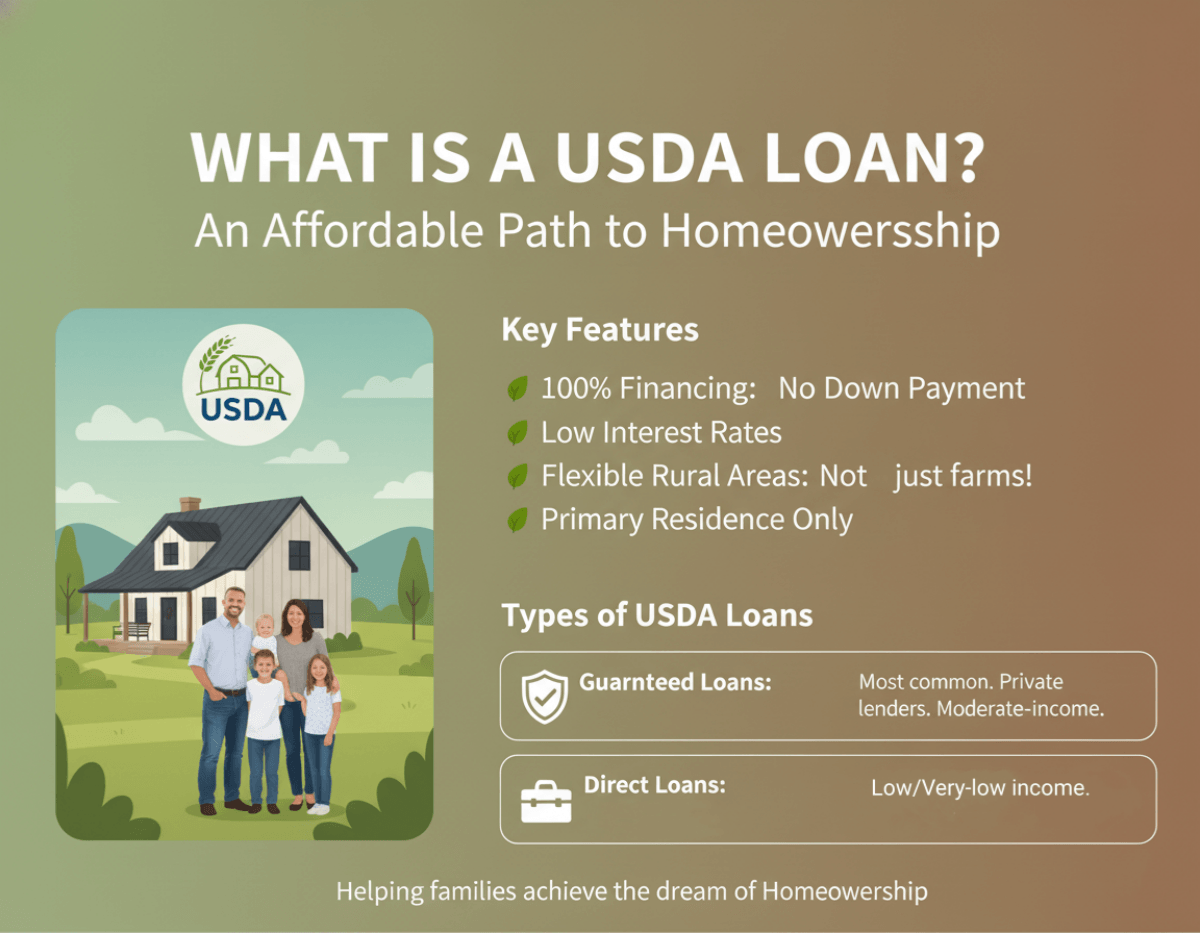
A USDA loan (often referred to as the Section 502 loan program) is a government-backed mortgage designed to help lower- and moderate-income Americans buy homes. Because the government insures a portion of the borrowed amount, private lenders feel completely safe offering 100% financing. That means you can buy a house without putting a single penny down.

When I talk to prospective buyers, their biggest misconception is thinking "rural" means buying a working farm or living miles from civilization. That's simply not true! Many quiet suburbs, small towns, and developments just outside major cities easily qualify. It's an incredible tool for ordinary families who want an affordable path to homeownership without draining their savings accounts.

What is a USDA Loan?

Types of USDA Loans

Not all of these mortgages are exactly the same. Depending on your financial situation, you'll typically look at three distinct options:

  • USDA Guaranteed Loans: This is the most common type. Private lenders issue the funds, and the government guarantees them. It's built for moderate-income buyers who want zero down payment.
  • USDA Direct Loans: Issued directly by the government rather than a bank. This version is strictly for low- and very-low-income applicants who cannot secure traditional financing anywhere else.
  • USDA Home Improvement Loans and Grants: Need a new roof or structural fixes? These funds help homeowners, especially elderly individuals, repair, upgrade, or modernize their existing properties to remove health and safety hazards.

Features of USDA Loans

What makes this mortgage so attractive? Here are the standout features I always highlight to homebuyers:

  • No Down Payment: You get true 100% financing, keeping your savings intact.
  • Competitive Interest Rates: Because of the government backing, lenders can offer slightly lower rates than conventional loans.
  • Upfront Guarantee Fees: 1% of the loan amount, which can be financed into the loan.
  • Annual Guarantee Fee: 0.35% of the remaining principal balance, paid monthly as part of the mortgage payment.
  • Primary Residence Only: You cannot use this program to buy a vacation cabin, a rental duplex, or an investment property. You must live in the house.

How Does a USDA Loan Work?

The way this system works is remarkably straightforward once you look under the hood. For the popular Guaranteed program, the government doesn't actually lend you the cash. Instead, the USDA provides a 90% loan note guarantee to approved lenders, covering up to 90% of the guaranteed portion of the loan in case of default.

Because the bank has this massive safety net, their risk drops dramatically. That reduced risk is exactly why they are willing to hand over a mortgage with zero down payment and a low interest rate to someone whose credit score might not be perfect. The USDA Loan lender provides the capital, the government provides the insurance, and you get the keys to your new home.

USDA Loan Requirements

To get approved for a USDA loan, you have to meet strict guidelines covering both your personal financial profile and the physical property.

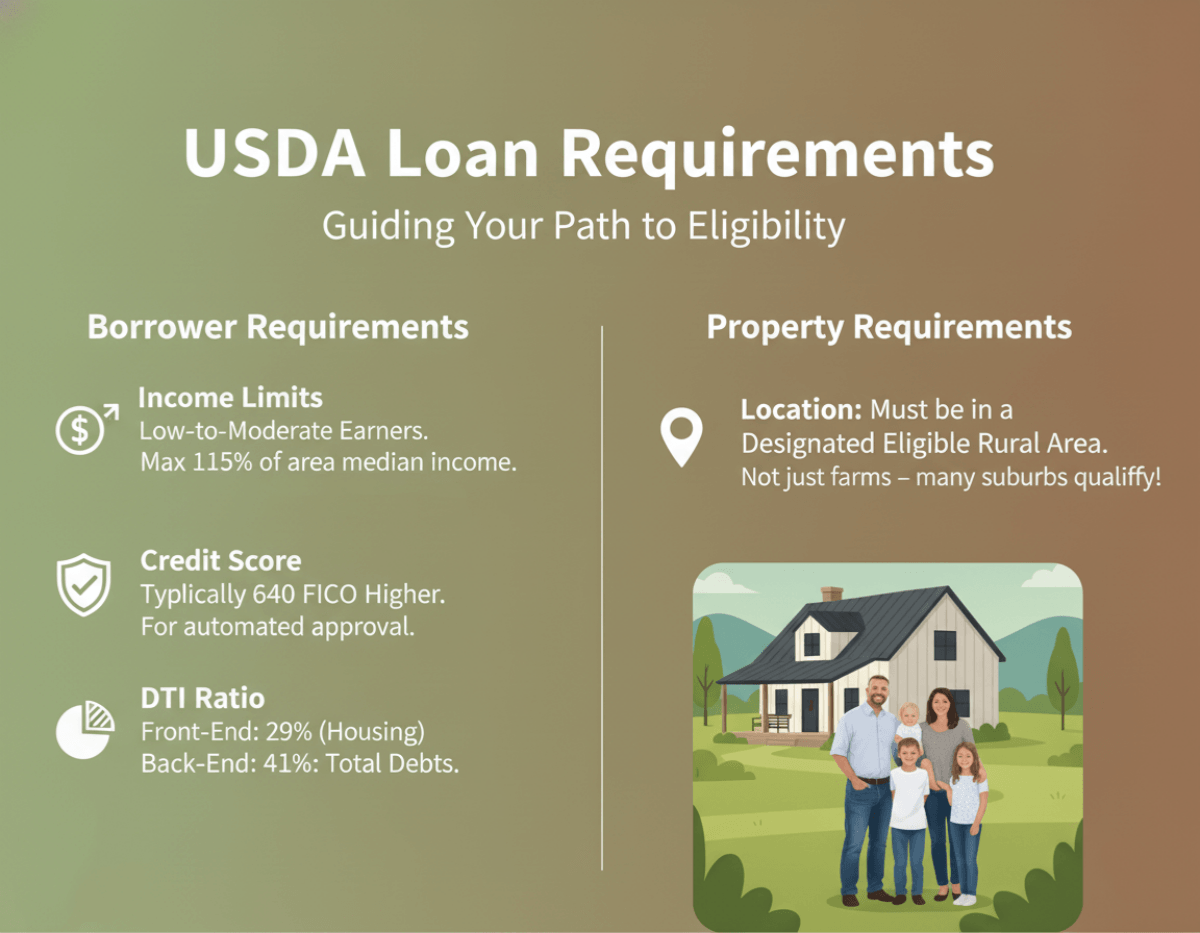
  • Income Limits: This program is strictly for low-to-moderate earners. Your total household income cannot exceed 115% of the area's median income. For 2026, standard limits generally sit at $119,850 for a family of 1-4, and $158,250 for 5-8 members. Keep in mind, this includes the income of everyone living in the house, even if they aren't on the actual mortgage application.
  • Credit Score: While the government doesn't set a hard minimum, most private lenders look for a 640 FICO score to run your file through automated approval systems.
  • DTI Ratio: USDA has no strict official DTI limits, but lenders typically prefer a front-end ratio of 29% (housing costs) and back-end ratio of 41% (total debts). Higher ratios may be approved with compensating factors. That means no more than 29% of your gross monthly income goes toward housing, and 41% toward total debts.
  • Location: The house must sit within a designated eligible rural or suburban zone.
USDA Loan Requirements

Pros and Cons of USDA Loans

Every mortgage product has trade-offs. To give you a realistic picture, here is an objective look at the advantages and disadvantages.

Pros

  • Zero Down Payment: Keep your cash in the bank for emergencies, moving costs, or new furniture.
  • Cheaper Mortgage Insurance: The 0.35% annual fee is usually much lower than standard FHA mortgage insurance or conventional PMI.
  • Competitive Rates: Enjoy lower interest rates thanks to federal backing.

Cons

  • Strict Income Caps: If you get a big promotion or raise, you might suddenly make too much money to qualify.
  • Geographic Restrictions: You absolutely cannot buy a house in major metropolitan centers.
  • Slower Closing Times: Because both the lender and the government have to sign off on the file, the underwriting process can occasionally take longer.

How to Get a USDA Loan?

Ready to move forward? The application process takes a little patience, but following these practical steps will keep you on track:

Step 1: Check your eligibility. Before falling in love with a house, confirm your income and target geography align with the rules. Again, plug your numbers into Zeitro Strata AI for a fast, accurate assessment.

Step 2: Find an approved lender. Not every bank offers these mortgages. Look for lenders who specialize in government-backed rural loans using Bluerate AI Agent so they can navigate the specific paperwork efficiently.

Step 3: Get pre-approved. Your lender will pull your credit, review your W-2s, and give you a pre-approval letter. This tells you your maximum purchase budget.

Step 4: Find a qualified property. Work with a real estate agent who understands the mapping restrictions to find a home that meets the safety and location standards.

Step 5: Apply and close. Once your offer is accepted, your lender finalizes the underwriting. After the federal office gives the final thumbs-up, you sign the papers and get the keys!

How to Get a USDA Loan?

USDA Loan VS FHA Loan

When trying to buy a house with minimal cash, most people weigh the USDA against the FHA program. The biggest difference is that FHA loans are available anywhere in the country but require a 3.5% down payment, whereas USDA loans offer zero down but limit where you can live and how much you can earn. I always tell buyers: if you want to live in a suburb and meet the income caps, the agricultural department's option is cheaper overall. If you want city life or have higher earnings, FHA is the way to go.

Here is a quick breakdown to help you compare:
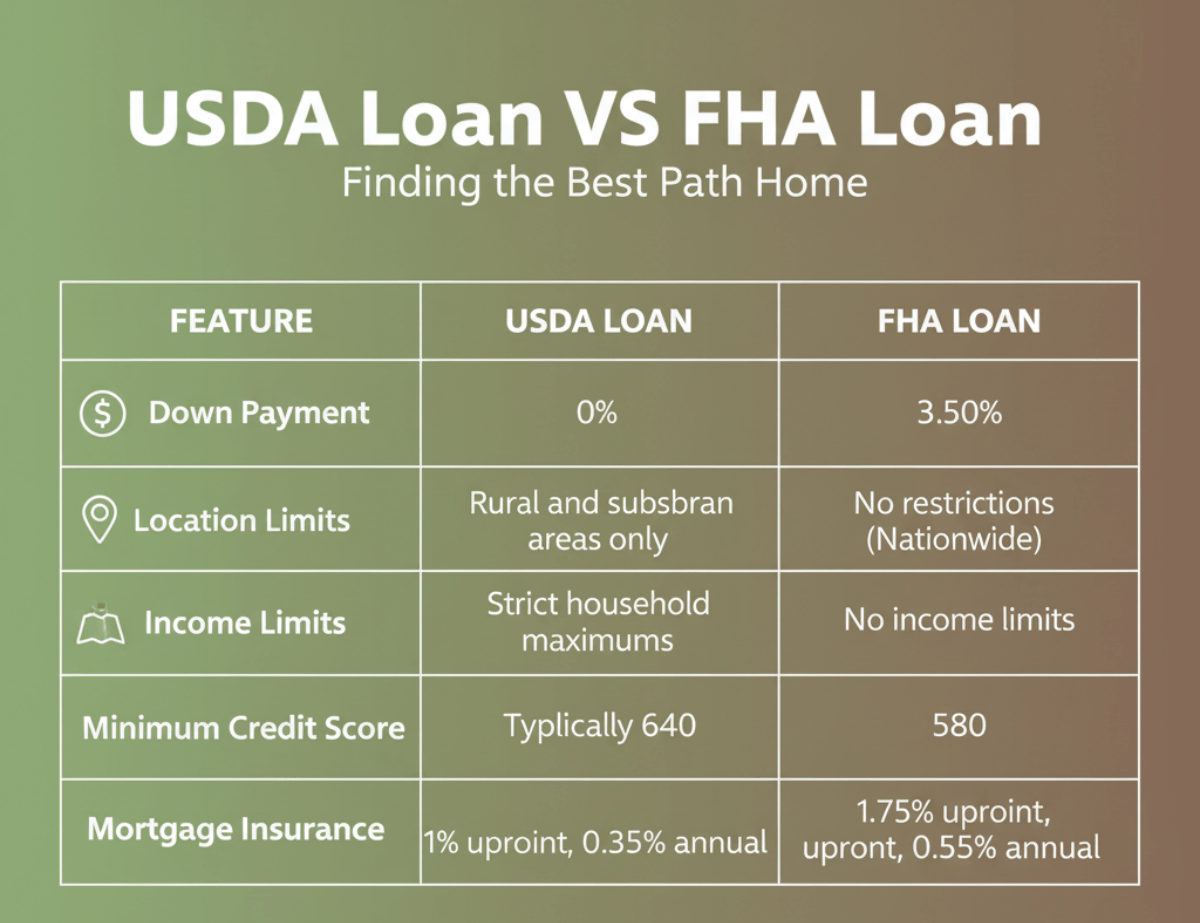
USDA Loan VS FHA Loan

FAQs About USDA Loans

Q1. Are USDA loans hard to qualify for?

No, they aren't inherently difficult to secure. However, they do have strict geographic boundaries and firm household income caps. As long as you meet those two unique hurdles, the actual credit score and debt-to-income requirements are quite reasonable. A 640 score usually ensures smooth sailing.

Q2. Is USDA better than FHA?

There is no absolute winner. It depends entirely on your situation. If you are buying in an eligible suburban area and want to save cash, the USDA is better because of the zero down payment and cheaper fees. However, if you earn a high salary or prefer city living, FHA is the clear choice.

Q3. What is the maximum income for a USDA loan?

The maximum limit usually cannot exceed 115% of your specific local area's median income. For 2026, standard regions cap out at $119,850 for households of up to four people, and $158,250 for larger families. High-cost counties will feature significantly higher thresholds to match local living expenses.

Q4. What disqualifies you from a USDA loan?

Making too much money is the most common reason for denial. Other disqualifications include trying to buy a home within a major urban center, having a credit score severely below 580, or intending to use the property as an investment rental rather than your primary residence.

Q5. What is the 20% rule for USDA?

A common real estate myth says you need 20% down to avoid mortgage insurance. USDA completely ignores this rule by allowing 0% down. However, instead of private mortgage insurance (PMI), you are required to pay government guarantee fees (1% upfront and 0.35% annually) regardless of your down payment size.

Q6. Who is eligible for a USDA direct loan?

This specific tier is reserved strictly for low-to-very-low-income households who currently lack safe, sanitary housing and are completely unable to secure financing from traditional banks. The government funds these directly, often providing payment assistance subsidies that can temporarily drop the effective interest rate to 1%.

Q7. What is the USDA eligibility map?

It is an interactive online tool maintained by the agricultural department. It highlights which addresses sit in approved rural or suburban zones. Because borders shift during census updates, a house that qualified last year might not today, making this map crucial during your home search.

Conclusion

Buying a house doesn't have to drain your life savings. In my experience, the USDA loan remains one of the most powerful, underutilized tools for middle-class Americans looking to achieve homeownership without a down payment. While navigating the income caps and geographic boundaries might seem intimidating at first, the financial payoff of 100% financing and reduced mortgage insurance is absolutely worth the effort.

People Also Read

Keep reading

Mortgage Pipeline Hedging 101: Complete Guide & Strategies

Blog

5 min read
Arrow icon on dark background
Mortgage Pipeline Hedging 101: Complete Guide & Strategies
What is mortgage pipeline hedging? Discover how lenders use TBA trades and calculate pull-through rates to offset market risk in this comprehensive 101 guide.

When I first started in secondary marketing, rate volatility terrified me. You lock in a borrower's interest rate, but if the market shifts before closing, your profit margins can completely evaporate. That's exactly where mortgage pipeline hedging comes in. It's the ultimate defense mechanism for lenders to protect their bottom line against unpredictable market swings. Let's dive into how it works.

Also Read:

Key Takeaways

  • Pipeline hedging acts as an insurance policy for lenders, protecting margins from interest rate volatility between rate lock and loan sale.
  • The primary goal is margin preservation, not market speculation.
  • Success relies heavily on accurately calculating your pull-through rate (the percentage of locked loans that actually close).、
  • TBA (To-Be‑Announced) MBS trades are the most widely used instrument in the industry to offset these risks.

What is a Mortgage Pipeline?

Think of a mortgage pipeline as a continuously moving conveyor belt. When a borrower signs an interest rate lock, they place their loan on this belt. At the other end of the belt is the actual loan closing and the subsequent sale of that loan into the secondary market.

The "pipeline" represents all those loans currently sitting on the belt. They are locked in at a specific rate but haven't been finalized or sold yet. Here's where my early experience taught me a hard lesson: this conveyor belt moves slowly, often taking 30 to 60 days. During that crucial time gap, the lender holds all the risk. If the economic environment shifts before the loan reaches the end of the line, the value of that asset changes. This specific period of vulnerability is what industry folks call your time exposure.

What is Mortgage Pipeline Hedging?

So, how do we protect that vulnerable conveyor belt? Mortgage pipeline hedging is essentially a specialized insurance mechanism for originators. When you lock a rate for a homebuyer, you commit to a set price. If overall market rates rise before you sell that mortgage in the secondary market, the value of your borrower's lower-rate loan drops.

Hedging involves taking a financial position that moves in the exact opposite direction of your locked loans. If your physical loan loses value, your hedge gains value, and vice versa. It's crucial to understand that we don't hedge to make a speculative profit. The entire goal is margin preservation. By intentionally offsetting potential secondary market losses, lenders can confidently lock in the expected baseline profit they calculated on day one, regardless of what the Federal Reserve does next.

What is Mortgage Pipeline Hedging?

Why is Mortgage Pipeline Hedging Important?

Let's look at the current U.S. market. In early 2026, we've seen mortgage rates hover around the low-to-mid 6% range, but geopolitical tensions and inflation data constantly trigger unpredictable daily rate swings. If you choose not to hedge, you are effectively accepting full exposure to interest rate risk, which can materially impact your company's profitability.

The biggest risk is profit erosion. A sudden 50‑basis‑point jump in rates can sharply erode, and in some cases nearly eliminate, the origination margin on an unhedged pipeline. Conversely, the primary benefit of hedging is absolute margin stability. I've seen mid-sized lenders completely transform their business just by implementing proper hedge strategies. It allows you to offer more competitive pricing to borrowers, scale your operations safely, and sleep peacefully at night knowing bond market volatility won't bankrupt your institution.

Why is Mortgage Pipeline Hedging Important?

Mortgage Pipeline Hedging Example

Let me give you a real-world scenario. Imagine your lending institution just locked in $10 million worth of borrower mortgages at a 6% interest rate. Over the next month, inflation spikes, and current market rates unexpectedly jump to 6.5%.

Suddenly, secondary market investors don't want your 6% loans. They want the new 6.5% ones. To sell your $10 million batch, you have to sell it at a steep discount, losing hundreds of thousands of dollars.

However, if you hedged, you simultaneously executed a short sale in the TBA market when you locked those loans. Because rates rose, the value of those TBA securities dropped. Since you shorted them, you actually made a profit on the trade. That trading gain perfectly offsets the discount you had to swallow on the physical loans, leaving your original profit margin completely intact.

How to Hedge Mortgage Pipeline Risk?

Building a reliable safety net isn't a "set it and forget it" task. Through years of trial and error, I've found that effective hedging requires a strict, continuous workflow. Here is the standard process:

  • Monitor the Pipeline: You must have real-time visibility into every loan application. Knowing exactly what is locked, floating, or expiring today is step one.
  • Calculate Pull-Through Rate: This is arguably the most critical step. Not every locked loan actually closes. Some borrowers walk away (fallout risk). If you hedge 100% of your $10 million pipeline, but only 70% closes, you are over‑hedged and may incur unnecessary losses. Calculating accurate pull‑through assumptions helps adjust your hedge coverage ratio.
  • Execute the Hedge Trade: Once you know your true exposure, you enter the market. Typically, this means selling TBA mortgage-backed securities to match the duration and characteristics of your locked loans.
  • Rebalance Dynamically: The market moves daily, and so does borrower behavior. You have to adjust your hedge positions constantly to maintain a neutral risk profile, trimming or adding coverage as loans fund or fall out.
How to Hedge Mortgage Pipeline Risk?

Mortgage Pipeline Hedging Strategies

There isn't just one way to protect your margins. Depending on an institution's size, liquidity, and risk appetite, secondary marketing teams generally rely on a few core tools to offset their exposure.

  • TBA (To-Be-Announced) MBS Market: This is the undisputed industry standard for mid-to-large lenders. By shorting TBA mortgage‑backed securities in the forward or futures market, you create a position that closely mirrors the interest rate risk of your pipeline. The beauty of TBAs is their massive liquidity, making it incredibly easy to enter and exit positions as your daily pipeline fluctuates.
  • Forward Sales Contracts: Often used for mandatory deliveries, this strategy involves an agreement to sell a specific volume of loans to an investor at a predetermined price on a future date. It guarantees your margin but requires strict delivery compliance.
  • Options (Put Options): Sometimes, lenders buy put options on Treasury or MBS futures contracts. Think of this as paying an upfront premium for disaster insurance. It caps your downside risk if rates skyrocket but allows you to capture extra profit if rates drop, though the upfront cost can be hefty.
Mortgage Pipeline Hedging Strategies

FAQs About Mortgage Pipeline Hedging

Q1. Can I hedge my mortgage as an individual borrower?

No, individual borrowers do not use pipeline hedging. This is strictly a B2B financial strategy used by banks and loan originators. As a homebuyer, your version of "hedging" is simply paying your lender to secure an interest rate lock while your home closes.

Q2. What are the three types of hedging in mortgages?

Common strategies include using TBA forward hedges, mandatory forward sales, and options on MBS or Treasury futures as part of an overall risk‑management program. TBA hedging involves trading mortgage-backed securities, mandatory sales lock in a direct investor price upfront, and options provide a protective floor against severe market downturns.

Q3. What is the best hedging strategy?

There is no single "best" strategy. It depends entirely on the lender's volume and risk tolerance. However, utilizing the TBA MBS market is widely considered the most effective method for most institutions because of its high liquidity, low transaction costs, and flexibility for daily rebalancing.

Q4. What is fallout risk in a mortgage pipeline?

Fallout risk is the probability that a borrower locks in an interest rate but ultimately fails to close the loan. This happens if they find a better rate elsewhere, get denied in underwriting, or the home purchase falls through, directly impacting how much hedge coverage the lender actually needs.

Q5. What is the difference between Mandatory and Best Efforts execution?

"Best Efforts" means a lender faces no financial penalty if a locked loan fails to close, making it safer but offering lower profit margins. "Mandatory" execution typically offers more attractive pricing from investors, but the lender must deliver the loan or pay a significant penalty, making hedging especially important.

Final Word

Ultimately, managing interest rate risk isn't just an advanced tactic. It's the absolute bedrock of survival in the modern lending landscape. I've witnessed firsthand how quickly unprotected margins can vanish during a volatile Fed announcement. Mortgage pipeline hedging transforms a risky, unpredictable origination process into a stable, reliable revenue stream.

If your institution is still relying on Best Efforts delivery out of fear of secondary market complexity, you are leaving substantial money on the table. Moving to a mandatory execution strategy supported by active hedging is the most reliable way to scale. I highly recommend partnering with an experienced capital markets advisor or investing in dedicated pipeline analytics software. The upfront learning curve is steep, but protecting your hard-earned origination profits makes it worth every single penny.

Best Mortgage Pipeline Management Software: Streamline Workflow

Blog

5 min read
Arrow icon on dark background
Best Mortgage Pipeline Management Software: Streamline Workflow
Find the best mortgage pipeline management software for brokers and lenders. Compare top AI, POS, and LOS tools to streamline workflows and close more loans today.

When I first started originating loans, my daily routine felt like a never-ending cycle of chasing down borrower documents, manually checking guidelines, and worrying about deals slipping through the cracks. If you are a loan professional handling a growing book of business, you know exactly what I mean.

Without the right system in place, the complex origination process quickly becomes exhausting. In this guide, we evaluate the best mortgage pipeline management software designed to automate your workflow, save hours of manual data entry, and ultimately help you close more loans. Let's dive in.

Key Takeaways

  • AI is the new standard: Modern tools are utilizing AI to slash guideline lookup and pre-qual times.
  • Choose based on scale: Individual LOs need flexible solutions, while enterprise banks rely on heavy-duty legacy systems.
  • Automation equals revenue: Seamless point-of-sale (POS) and CRM platforms significantly boost borrower application completion rates.

Benefits of Using Mortgage Pipeline Management Software

Upgrading your tech stack isn't just about having a flashy dashboard. It fundamentally changes how you manage your day. After helping several brokerages migrate their systems, we've seen the tangible upside firsthand. Here is what you gain:

  • Faster Pre-Qualifications: Automated income and DTI calculations mean you can deliver accurate quotes in minutes rather than days.
  • Higher Close Rates: Integrated CRMs stop leads from going cold by triggering automated follow-ups at the exact right moment.
  • Reduced Manual Errors: Letting software auto-fill the 1003 form and sync with your backend minimizes costly compliance mistakes.
  • Better Borrower Experience: Modern portals allow clients to upload sensitive documents securely from their phones, keeping them engaged throughout the financing journey.

6 Top-Rated Loan Pipeline Management Software

To find the right fit, we analyzed dozens of platforms based on their feature sets, integration capabilities, and real-world value for US lenders. Here are our top six picks to modernize your mortgage pipeline management.

#1 Zeitro - Best for SMBs and Individuals

Zeitro is a specialized AI mortgage agent built for US-based loan officers, brokers, and wholesale lenders. Serving over 10,000 users, it acts as a dedicated digital assistant to tackle the heavy lifting of the complex origination process.

Instead of spending hours reading lender manuals, Zeitro's AI verifies guidelines in seconds. It helps underwriters save over 18 hours a month, while LOs regain 20+ hours. By delivering pre-qualifications 2.5x faster, users often see a 30% increase in closed loans.

Zeitro
  • Zeitro Strata AI: A smart guideline assistant that answers Conventional and Non-QM queries instantly, pulling from verified sources so you can trust the data.
  • Digital 1003 (POS): Automates the borrower application, calculates DTI via AI, and exports seamlessly in the FNM 3.4 format.
  • Pricing Engine: Delivers competitive rate quotes for traditional and hard-to-place Non-QM products instantly.
  • GrowthHub: Provides a branded personal microsite to capture organic search traffic and easily manage new leads.

Why Choose: It is the absolute best choice for SMBs and individual LOs seeking powerful AI automation, especially since their Explorer tier is completely free.

#2 Floify - Best for Point-of-Sale (POS) Automation

Floify has earned its reputation as a powerhouse in the point-of-sale space. Backed by Porch Group, this platform is engineered to lubricate the entire front-end of the pipeline. If your team constantly struggles with chasing down bank statements and W-2s, this tool is a lifesaver.

We appreciate how it bridges the gap between the borrower and the loan team. By providing a highly secure, intuitive web portal, Floify dramatically reduces application abandonment rates. Borrowers log in, see exactly what they need to upload, and let the system guide them through financing.

  • Dynamic Apps: Tailors the 1003 questions based on the specific loan type, like a HELOC or Non-QM, stripping away irrelevant fields to speed up completion.
  • Automated Workflows: Sends automatic email and SMS nudges for missing documents.
  • Floify Verify: A built-in feature to verify income and employment (VOI/E) without needing a third-party vendor.
  • Seamless Integrations: Connects effortlessly with major loan origination systems (LOS) to push data securely.

Why Choose: Floify is perfect for teams that want to aggressively streamline their front-end document collection and elevate the borrower experience.

#3 Aidium - Best for Mortgage CRM and Lead Conversion

Aidium is a robust CRM platform designed strictly for the mortgage industry. Keeping your pipeline full requires constant lead nurturing, and that is exactly where this software excels. It takes the guesswork out of your daily sales routine.

Instead of wondering who to call next, Aidium organizes your contacts and prioritizes your highest-value prospects. It acts as an independent engagement hub, unifying marketing and compliance workflows so you can focus on building relationships with borrowers and real estate partners.

Aidium
  • Smart Lead Routing: Automatically captures new leads and routes them to the right loan officer based on custom rules.
  • Automated Campaigns: Offers pre-built email, SMS, and ringless voicemail drip sequences tailored to different loan stages.
  • Aidium Intelligence: Uses AI propensity modeling to predict when a past client might be ready to refinance or buy again.
  • Partner Tracking: Helps you monitor referral networks, ensuring you know exactly which Realtors are sending you the most business.

Why Choose: Aidium is the go-to solution for modern brokerages and mid-sized lenders deeply focused on marketing automation and lead conversion.

#4 Blend - Best for Enterprise Cloud Banking and Seamless Application

When we look at the enterprise sector, Blend is undeniably the infrastructure powering the future of banking. Used by 18 of the top 50 US originators, this cloud-based platform handles massive volumes, connecting the dots from initial application all the way to closing.

What makes Blend stand out is its frictionless, omnichannel borrower experience. It allows financial institutions to offer a totally digital, unified journey whether the client is applying for a traditional mortgage, a home equity line, or a new deposit account.

Blend
  • Omnichannel Application: Borrowers can start on their phone, pause, and finish seamlessly on a desktop or with a loan officer.
  • Instant Data Verification: Connects directly to payroll and banking institutions to instantly verify assets and income.
  • Blend Autopilot: Their newly introduced AI capabilities automate document detection and guideline validation with minimal human intervention.
  • Enterprise Scalability: Built to handle the heavy regulatory and volume demands of large-scale credit unions and national banks.

Why Choose: Blend is ideal for well-funded, enterprise-level banks that demand a highly sophisticated, multi-product digital banking environment.

#5 nCino Mortgage Suite - Best for Mobile-First Origination

Formerly beloved in the industry as SimpleNexus, the nCino Mortgage Suite brings the entire loan origination process straight to your smartphone. For loan officers who are constantly out in the field meeting Realtors or attending open houses, being tied to a desktop is a massive disadvantage.

nCino solves this by providing a top-tier mobile application. It unites loan officers, borrowers, and real estate agents in a single, collaborative digital space. This mobility not only speeds up the average cycle time but also vastly improves transparency across the board.

nCino Mortgage Suite
  • Co-Branded App: Allows LOs and Realtors to share a branded mobile app, keeping everyone in the loop on loan status.
  • Mobile Pre-Approvals: Originators can quickly run credit and issue pre-approval letters directly from their phones on the weekend.
  • Integrated eClose: Supports hybrid and fully digital closings, allowing borrowers to review and sign disclosures anywhere.
  • Incentive Compensation: Includes built-in tracking for LO commissions, eliminating messy payroll spreadsheets.

Why Choose: It is the perfect match for modern, mobile-heavy originators and teams that rely strongly on real estate agent partnerships.

#6 Encompass - Best for Comprehensive End-to-End LOS

It is impossible to talk about mortgage pipelines without discussing Encompass by ICE Mortgage Technology. Holding roughly 50% of the US market share, Encompass is the undisputed heavyweight champion of Loan Origination Systems. It acts as the central brain for your lending operation.

While known for being complex to configure, its sheer power is unmatched. From the moment an application is ingested to underwriting, closing, and secondary market delivery, Encompass keeps everything strictly compliant and organized under one roof.

Encompass
  • End-to-End Coverage: Manages processing, underwriting, and post-close delivery natively without needing to jump between systems.
  • Robust Compliance Engine: Automatically handles TRID timing, HMDA data collection, and state-specific disclosure generation to keep you out of trouble.
  • Massive Integration Ecosystem: It integrates with practically every major POS, CRM, and pricing engine available on the market.
  • Customizable Business Rules: Allows administrators to build incredibly specific internal workflows tailored to the lender's exact assembly line.

Why Choose: Encompass is the ultimate choice for mid-to-large independent mortgage banks (IMBs) requiring a heavy-duty, fully compliant backbone for their operations.

How to Choose Your Mortgage Pipeline Software?

Selecting the right tool can feel overwhelming, but keeping your specific operational bottlenecks in mind makes it easier. Before signing a long-term contract, we always recommend evaluating a few core pillars:

  • AI Capabilities: In today's market, AI-driven features are no longer optional. Look for tools that automate DTI calculations or instantly answer complex guideline questions, much like Zeitro does.
  • Integrations: Does the software play nicely with your existing tech stack? Your POS, CRM, and LOS need to sync seamlessly to prevent double data entry.
  • Budget & Scalability: Match the price tag to your size. A solo broker can thrive on a flexible freemium model, while a national bank needs to budget for an expensive enterprise solution.
  • Security & Compliance: Ensure the platform adheres to strict financial encryption standards to protect sensitive borrower data.

FAQs About Best Mortgage Pipeline Management Software

Q1. What is mortgage pipeline management software?

It is a digital platform used by lenders and brokers to track and manage loans. It handles the entire lifecycle, from the initial borrower application and document collection to underwriting, compliance checks, and final funding.

Q2. How much does a loan pipeline software usually cost?

Pricing varies wildly based on your scale. Solo originators can start with flexible subscriptions around $8 a month on platforms like Zeitro. Meanwhile, enterprise-grade systems for large banks can cost thousands of dollars monthly alongside hefty implementation fees.

Q3. Can AI improve my mortgage pipeline management?

Absolutely. AI significantly reduces manual "stare and compare" work. It can instantly calculate borrower income, extract data from W-2s, and quickly answer obscure Non-QM guideline questions, trimming hours off the standard approval process.

Q4. What is the difference between a Mortgage POS and an LOS?

A Point-of-Sale (POS) is the front-end interface where borrowers apply and upload documents. The Loan Origination System (LOS) is the backend engine where your team handles the heavy lifting like underwriting, compliance, and secondary market delivery.

Q5. Is it secure to use cloud-based mortgage software?

Yes. Top-tier mortgage platforms adhere to strict data security regulations. They utilize bank-level encryption and secure cloud infrastructure to ensure sensitive financial documents and personal borrower information remain completely protected from breaches.

Conclusion

Managing a healthy mortgage pipeline doesn't have to mean working endless nights and weekends. By implementing the right software, you can eliminate tedious manual data entry, stay compliant, and deliver a vastly superior experience to your borrowers. To recap:

  • Zeitro: Best for individuals and SMBs wanting powerful AI to handle guidelines and POS tasks.
  • Floify: The go-to for secure, front-end borrower document collection.
  • Aidium: Top choice for CRM, lead nurturing, and marketing automation.
  • Blend: Ideal for massive, enterprise-grade digital banking operations.
  • nCino: Perfect for originators who need a robust mobile app in the field.
  • Encompass: The ultimate, heavy-duty LOS for complete end-to-end management.

If you are unsure where to begin your tech upgrade, we highly recommend trying a risk-free option. Start with a flexible freemium tool like Zeitro to instantly see how AI can transform your daily workflow and help you scale your business.

People Also Read

Mortgage Pipeline Management: Ultimate Guide & Best Practices

Blog

5 min read
Arrow icon on dark background
Mortgage Pipeline Management: Ultimate Guide & Best Practices
What is mortgage pipeline management? Explore workflow standardization, risk hedging, and modern AI solutions to scale efficiently.

If you're a loan officer, broker, or wholesale lender, you know firsthand that the mortgage origination process can often feel like a maze. It's complex, labor-intensive, and frankly, exhausting. I've spent enough late nights staring at stalled applications to realize that without a healthy strategy, deals stall, and revenue slips away.

Mastering mortgage pipeline management isn't just a nice-to-have. It's business survival. In this ultimate guide, I'm walking you through exactly what a pipeline is, the core elements you need to track, and the modern AI-driven best practices to keep your deals closing smoothly.

Key Takeaways

  • What it is: A mortgage pipeline tracks your entire loan portfolio from initial origination straight through to the final closing table.
  • Core elements: Effective management balances operational efficiency, risk hedging, and strict regulatory compliance.
  • The AI Edge: Leveraging AI tools, like Zeitro, drastically changes the game by automating manual guidelines, speeding up pre-qualifications, and driving higher close rates.

What is a Mortgage Pipeline?

So, what exactly are we looking at here? In simple terms, a mortgage pipeline is the collection of loan applications your team is actively working on, spanning from the moment a borrower applies (origination) right down to when the funds are disbursed (closing), or when a file is ultimately withdrawn.

Why does maintaining this pipeline matter so much? Because leaving loans unmonitored leads to chaos. When I first started tracking my fallout rate (the percentage of loans that fail to close), I realized how quickly profitability evaporates when bottlenecks go unnoticed. Keeping a close eye on your active deals gives you a transparent, holistic view of your business health.

Here is exactly what an organized pipeline does for you:

  • Forecasting Revenue & Cash Flow: You know exactly what funds are coming in and when.
  • Tracking Loan Status & Identifying Bottlenecks: Pinpoint exactly where a file gets stuck, be it in processing or underwriting.
  • Managing Hedging & Interest Rate Risks: Protect your margins against sudden market rate fluctuations.
  • Resource Allocation: Prevent your underwriters and processors from burning out by distributing the workload evenly.
What is a Mortgage Pipeline?

Key Components of Mortgage Pipeline Management

Managing this constant flow of applications isn't just about moving folders from one desk to another. It requires a multi-dimensional approach. Over the years, I've found that the most successful lending teams focus heavily on a few non-negotiable pillars.

To keep everything running like a well-oiled machine, you need to consider the following key components:

  • Pipeline Definition & Tracking: Establish crystal-clear milestones for every loan stage so nothing falls through the cracks.
  • Risk Management (Hedging): Mitigate fallout risks and protect your bottom line against volatile interest rate swings.
  • Operational Efficiency: Cut down turnaround times and streamline approvals to keep clients happy.
  • Compliance & Regulations: Ensure every step adheres strictly to current credit laws to avoid crippling compliance fines and regulatory headaches.

Also Read: Best Mortgage Pipeline Management Software: Streamline Workflow

Key Components of Mortgage Pipeline Management

Best Practices: How to Manage Your Mortgage Pipeline Effectively?

Knowing the components is one thing, but executing them is another. Let me share the actionable best practices I rely on to turn a sluggish pipeline into a high-converting machine.

Leverage AI-Powered Pipeline Management Software

In 2026, relying on manual data entry and traditional spreadsheets is a fast track to losing borrowers. The modern lending environment demands speed, and quite frankly, we need AI to handle the heavy lifting. This is where I've found immense value in leveraging tools like Zeitro, a premier Mortgage AI Agent built specifically for U.S. mortgage professionals. Instead of drowning in paperwork, Zeitro allows teams to deliver pre-qualifications 2.5 times faster, close 30% more loans, and saves account executives and underwriters 18 to 20-plus hours per user every single month.

Here are the four core Zeitro tools that actually empower pipeline management:

  • Zeitro Strata AI: This AI-powered assistant is a lifesaver. It verifies both QM and Non-QM mortgage guidelines in seconds across multiple sources, eliminating most of the manual lookup work and reducing underwriter bottlenecks.
  • Digital 1003 (POS): A borrower application system that automates everything from accurate AI-driven Debt-to-Income (DTI) calculations to exporting FNM 3.4 formats. It boasts a 90%+ completion rate, letting borrowers finish the 1003 form in just 5 minutes and accelerating intake.
  • Pricing Engine: An intuitive rate quote tool granting instant access to up-to-the-minute conventional and Non-QM rates. You can deliver highly competitive pricing in seconds, which is crucial for early conversion.
  • GrowthHub: A customizable, SEO-optimized personal microsite on Bluerate for loan officers. It features instant rate quotes and pre-qualification forms, acting as a lead-generation magnet to keep your pipeline consistently full.
Zeitro

Standardize Workflows Across the Pipeline

You cannot scale chaos. One of the biggest lessons I've learned is that standardizing your Standard Operating Procedures (SOPs) is vital for a smooth pipeline. Every time a file moves from a loan officer to a processor, and then to an underwriter, there's a risk of friction or miscommunication.

By establishing clear, standardized milestones, you ensure that everyone on the team knows exactly what is required at each specific stage. This means standardized document checklists, uniform communication templates, and rigid handoff protocols. When expectations are crystal clear, you dramatically reduce the back-and-forth emails and missing document requests that typically delay closings. A standardized workflow keeps the momentum going and builds trust with your borrowers.

Implement Data-Driven Reporting & Analytics

If you aren't measuring your performance, you are simply guessing. I rely heavily on data-driven reporting to make informed decisions rather than going by gut feeling. Real-time analytics are the heartbeat of effective pipeline management.

You need to constantly monitor core metrics like your pull-through rates, fallout rates, and average turnaround times. For instance, if data shows a sudden spike in loans stalling during the processing phase, I immediately know where to investigate. Utilizing advanced reporting tools allows you to proactively spot trends, identify exactly which stage is causing delays, and adjust your strategies before those bottlenecks cost you deals. Let the numbers guide your daily operations.

Optimize Loan Volume & Capacity Planning

The mortgage industry is famously cyclical. Volume fluctuates wildly. Managing capacity is all about ensuring your team doesn't buckle under pressure during a boom or sit idle during a lull. I've seen underwriters get entirely overwhelmed when a sudden surge of applications hits the pipeline, leading to costly errors and missed deadlines.

To optimize capacity, you must anticipate these waves. When the pipeline swells, leveraging AI technology, like the assistants I mentioned earlier, can absorb the excess volume without requiring you to immediately hire more full-time staff. Properly balancing the workload prevents burnout and ensures that every loan, regardless of the overall volume, receives the prompt attention required to reach the closing table on time.

Separate Workflows by Loan Types

Treating every loan exactly the same is a rookie mistake. Qualified Mortgages (QM) and Non-QM loans have vastly different documentation requirements and risk profiles. Mixing them in the same processing queue usually slows down the simpler, straightforward files.

I strongly recommend segmenting your pipeline based on loan type. By separating these workflows, you can route the complex Non-QM scenarios to your most experienced processors or let specialized AI tools quickly handle those obscure guideline queries. This prevents a complicated bank statement loan from holding up a standard W-2 conventional application. Routing files to the right expertise instantly boosts overall review efficiency and improves your team's sanity.

FAQs About Mortgage Pipeline Management

Q1. What is a loan pipeline?

It is the total sum of all active, in-progress loan applications your business is handling before they are either fully funded or canceled.

Q2. What are the KPIs for pipeline management?

The core Key Performance Indicators (KPIs) include the pull-through rate, fallout rate, average cycle time (from origination to close), and the operational cost per loan.

Q3. What is mortgage pipeline hedging?

It is a financial risk management strategy where lenders use market instruments to protect themselves against the risk of interest rate changes after a borrower locks in their rate.

Q4. What is the difference between a mortgage pipeline and a portfolio?

A pipeline consists of active, unclosed loans still in the application process, while a portfolio refers to fully funded loans that a lender already holds as assets.

Q5. How can AI improve mortgage pipeline management?

AI transforms the process by automating mundane data entry, instantly verifying complex lending guidelines, and drastically accelerating underwriting decisions.

Q6. How do you calculate the mortgage pipeline fallout rate?

You divide the total number of loans that failed to close (before their rate lock expired) by the total number of locked applications during that same period.

Final Thoughts

Let's face it: the mortgage landscape is incredibly competitive right now, and the margin for error is constantly shrinking. Effective mortgage pipeline management isn't just a defensive tactic to avoid risks. It's an offensive strategy to increase your revenue and deliver an exceptional borrower experience.

By standardizing workflows, keeping an eye on your data, and embracing next-generation AI technology like Zeitro, you can completely automate the tedious daily tasks. This frees you up to focus on what truly matters: building strong relationships and closing more deals. If you are ready to stop fighting with clunky spreadsheets and start scaling your business efficiently, I highly recommend exploring Zeitro's free Explorer tier. It's time to let innovation drive your pipeline forward.

People Also Read

Try Zeitro today and transform your loan origination workflow!

Get started free