Written by

Eric
Share this article

.svg)
Subscribe to updates
Last Checked and Updated on September, 2026
A reverse mortgage lets homeowners 62 and older turn their home equity into spendable cash without selling the house or taking on a new monthly payment. I've sat across the table from dozens of retirees over the years, and the same worry always comes up first: fixed income, rising costs, and a paid-off house that isn't doing anything for them. The idea is simple. The 2026 rulebook, on the other hand, has gotten more detailed, especially around who actually qualifies.
This guide walks through exactly what lenders check in 2026, what can knock you out of the running, and a real dollar example so the math actually makes sense. For loan officers reading this, tools like Zeitro pull current guideline answers in seconds instead of hours, which matters a lot when a client is sitting across from you asking "do I qualify?"
What is a Reverse Mortgage?
Think of a traditional mortgage as you slowly buying your house from the bank. A reverse mortgage flips that script, the lender actually pays you based on the equity you've already built up. You skip the monthly principal and interest payments entirely.
This setup is exclusively for older homeowners. Whenever I sit down with clients, their first question is almost always, "Will the bank own my house?" Let me be crystal clear: you keep your title and ownership. You just live there like normal. The loan balance is only repaid when you permanently move out, sell the property, or pass away. It's simply a practical way to pad your retirement fund, cover unexpected medical bills, or afford basic home renovations without the heavy burden of a monthly payment hanging over your head.
Reverse Mortgage Example
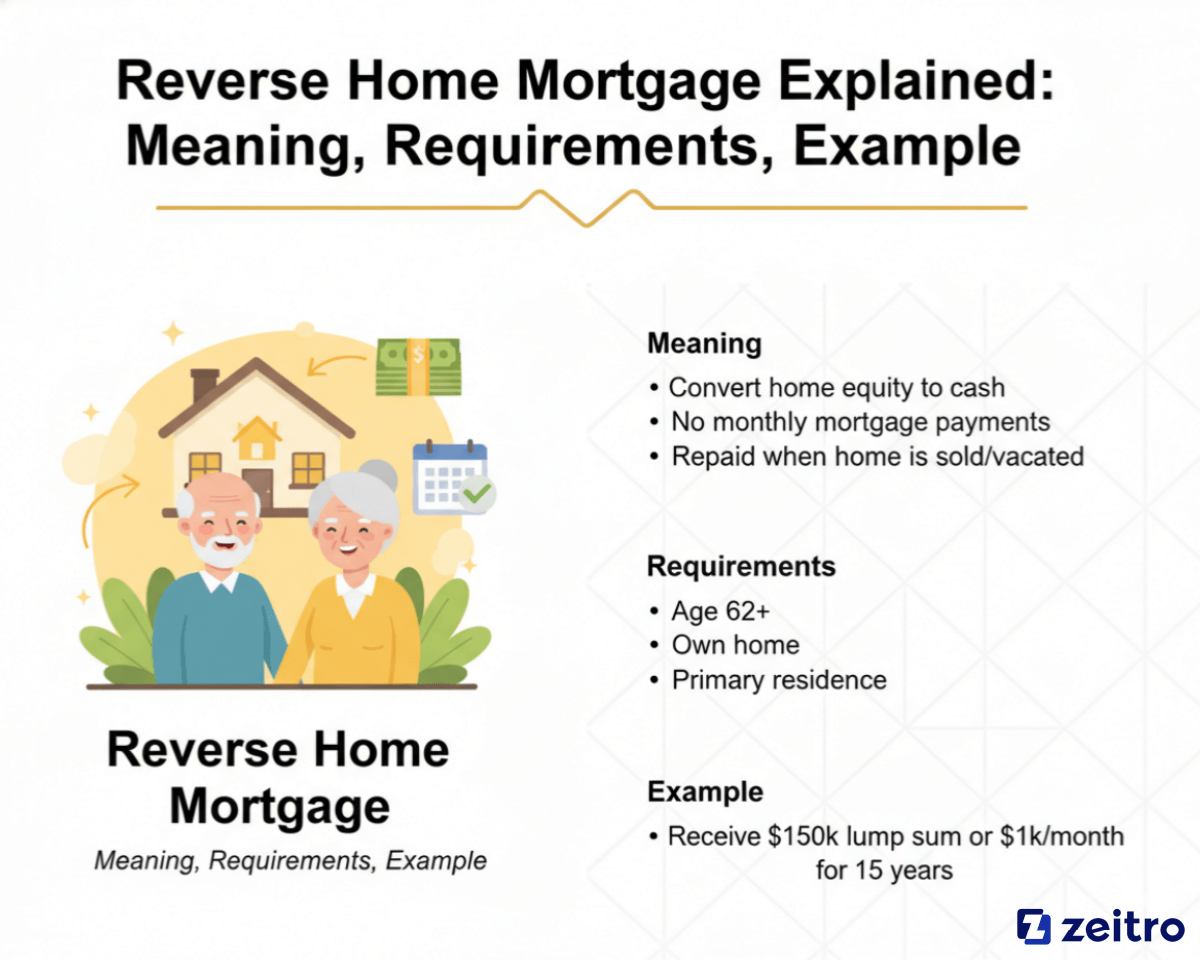
Let's look at a realistic scenario. Take John, a 65-year-old retiree whose house is worth $500,000. He finally paid off his original mortgage years ago, but his current pension barely covers groceries and utilities.
By taking out a reverse mortgage, John taps into that $500,000 value. Since he has full equity, he qualifies for a tax-free line of credit. Instead of taking a massive lump sum, he sets up a $1,000 monthly payout to make life easier. Every month, his loan balance slowly grows because interest is added to what he borrows. But John still owns his home, lives comfortably, and never has to write a check to a lender.
Pros and Cons of a Reverse Mortgage
No loan product fits everyone, and I always tell clients to weigh both sides before signing anything.
Pros:
- No monthly mortgage payment: principal and interest stop entirely.
- Tax-free proceeds: the IRS treats the money as loan proceeds, not income.
- You keep ownership: your name stays on the title for as long as you live there.
- Flexible payout: choose a lump sum, monthly checks, or a standby credit line.
Cons:
- Your balance grows: unpaid interest gets added on top each month.
- Smaller inheritance: heirs receive less home equity than they otherwise would.
- Upfront costs add up: origination fees, closing costs, and mortgage insurance aren't small.
- Ongoing obligations remain: property taxes and homeowners insurance still have to be paid, or the loan can go into default.
What are the 3 Types of Reverse Mortgages?
There are three main paths, and which one fits depends on your home's value and what you need the money for.
Home Equity Conversion Mortgages (HECMs)
HECMs are the standard option and the one most people mean when they say "reverse mortgage." Because the FHA insures them, you get real protections, including a guarantee that you'll never owe more than the home is worth when it's sold.
The FHA also caps how much home value counts. For 2026, that ceiling is $1,249,125, up from $1,209,750 in 2025. If your home is worth $2 million, the lender still bases your loan on the $1,249,125 figure, not the full appraised value. Every HECM applicant also has to sit through a counseling session with an independent, HUD-approved advisor before the loan can move forward. It's mandatory, and honestly, it's a good idea even where it isn't required.
Proprietary Reverse Mortgages
Also called jumbo reverse mortgages, these come from private lenders instead of the government and exist for borrowers with high-value homes who want to borrow past the FHA ceiling. Some programs, including offerings from national reverse lenders, now go up to $4 million for qualifying properties.
Note for loan officers: proprietary products come with lender-specific overlays that shift constantly, and digging through them used to eat up my afternoons. Zeitro Strata AI deep-searches over 100 investor guidelines at once, so a vague scenario question gets a precise, source-backed answer in seconds instead of a half-day of PDF hunting.
Single-Purpose Reverse Mortgages
These are the cheapest option, offered by state or local agencies and nonprofits, but the money comes with strings attached. The lender decides what it can be used for, typically urgent repairs or overdue property taxes, not a vacation or everyday groceries. Fees and rates are low, but availability varies a lot by state, so check with a local housing authority first.
How Does a Reverse Mortgage Work?
The mechanics of these loans often confuse people. Let me break down exactly what happens to the money once you are approved:
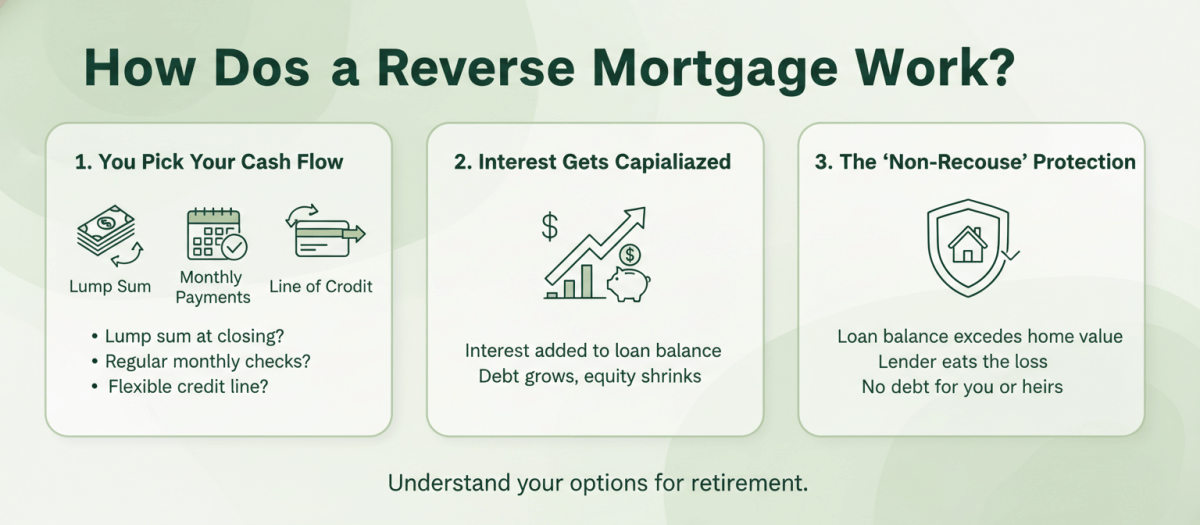
- You Pick Your Cash Flow: Do you want a lump sum right at closing? Regular monthly checks? Or a line of credit you can tap into whenever you want? You get to choose the structure.
- Interest Gets Capitalized: Since you aren't sending the bank a check every month, the lender just adds that month's interest directly to your loan balance. Slowly but surely, your debt grows while your remaining home equity shrinks.
- The "Non-Recourse" Protection: This is huge. These are strictly non-recourse loans. If the housing market crashes and your loan balance eventually grows larger than what your house is worth, the lender eats the loss. Neither you nor your kids will ever have to pay the difference out of your own pockets.
The 60% Rule, Explained With a Real Example
HUD limits how much of your available balance you can pull out during the first 12 months. You can access whichever is greater: 60% of your principal limit, or your mandatory obligations (like paying off an existing mortgage) plus an extra 10%.
Here's how that plays out. Say your principal limit is $200,000 and you have no existing mortgage to pay off. In year one, you're capped at $200,000 × 60% = $120,000. The remaining $80,000 stays untouched until month 13, at which point it becomes fully available. Now flip the scenario: if you owed $150,000 on an existing mortgage, that exceeds the 60% threshold, so the rule lets you draw enough to pay it off plus an additional 10% of the principal limit. The rule exists to keep borrowers from draining their equity too fast in the early years, and it applies no matter which payout option you pick.
Reverse Mortgage Requirements in 2026
Here's the full 2026 checklist. Miss any of these and the loan likely won't close. For a deeper walkthrough of each item, see our reverse mortgage eligibility guide.
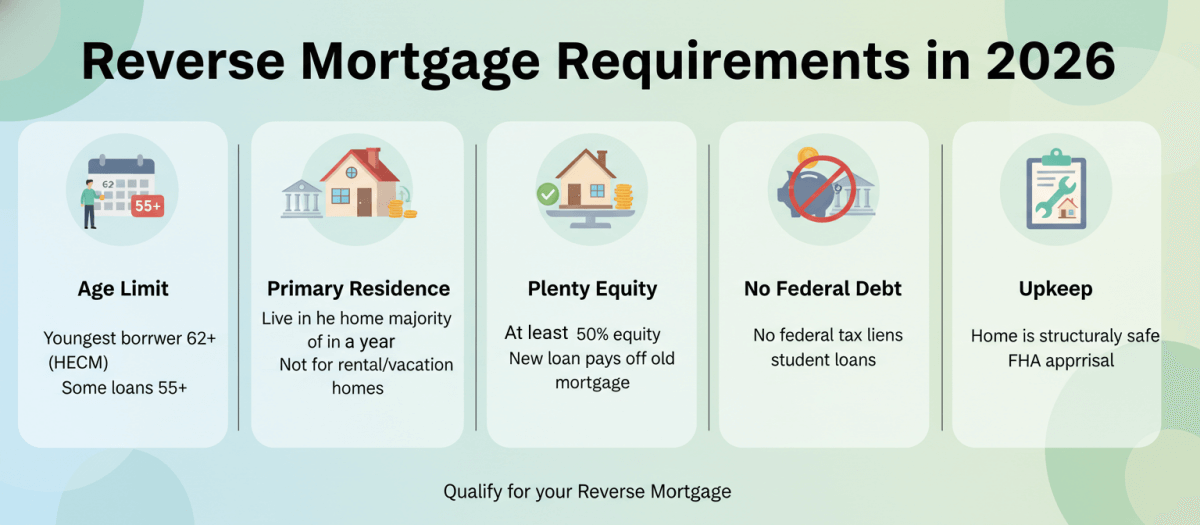
- Age: The youngest person on the title needs to be at least 62 for a standard HECM. A handful of proprietary jumbo programs allow 55, but that varies by lender.
- Citizenship or lawful residency: Since May 2025, HUD requires borrowers to be a U.S. citizen or a lawful permanent resident (green card holder) to qualify for an FHA-insured HECM. This was a real shift from the previous rules, and it's one lenders now check closely at intake.
- Primary residence: You need to actually live there most of the year. Vacation homes and rental properties don't qualify.
- Eligible property type: Single-family homes, 2-4 unit properties (as long as you occupy one unit), FHA-approved condos, and manufactured homes meeting HUD's construction and foundation standards all qualify. Most co-ops and second homes do not.
- Sufficient equity: A common benchmark is owning the home outright or having roughly 50% equity or more, since the new loan has to pay off any existing mortgage first.
- No unresolved federal debt: Defaulted federal student loans or unpaid IRS tax debt typically stand in the way of approval.
- Property condition: An FHA appraiser confirms the home meets basic safety and structural standards.
What Disqualifies You From a Reverse Mortgage?
Flip the checklist above around, and here's what typically knocks an application out:
- Being under 62 with no age-eligible co-borrower or qualifying spouse.
- Not being a U.S. citizen or lawful permanent resident under current HUD rules.
- Using the property as a second home or rental instead of your main residence.
- Not enough equity left to pay off the existing mortgage balance.
- Outstanding federal debt, like a defaulted student loan or unpaid federal taxes.
- A home that fails the FHA safety and structural inspection.
- Skipping the required HUD counseling session.
None of these are permanent roadblocks in every case. Paying down federal debt, adding equity, or bringing a spouse's age into the calculation can sometimes turn a "no" into a "yes" later on.
How Do You Qualify for a Reverse Mortgage?
Beyond the basic age and equity rules, lenders need to know you won't default on your basic homeowner duties. The approval process starts with that mandatory HUD counseling I mentioned earlier, just to prove you understand what you're signing up for.
Then comes the Financial Assessment. There is no minimum credit score requirement. Lenders assess your overall financial patterns to confirm ability to pay property taxes, insurance, and HOA fees. We have to verify you bring in enough cash every month to easily cover your property taxes, homeowners insurance, and HOA fees.
Chasing down borrower documents for this assessment is notoriously slow. Smart brokerages are moving to POS systems like Zeitro's Digital 1003. It lets borrowers self-pre-qualify online in minutes while AI instantly crunches the Debt-to-Income (DTI) ratios. It delivers pre-qualifications 2.5x faster and literally saves loan officers over 7 hours of manual data entry per file.
HELOC vs. Reverse Mortgage
"Should I just get a HELOC instead?" I hear this question constantly. While both let you turn your home's value into cash, they are entirely different animals. A Home Equity Line of Credit (HELOC) works like a massive credit card secured by your house, and it expects you to pay the money back right away. A reverse mortgage is built for long-term retirement survival.
Here is how they stack up against each other:
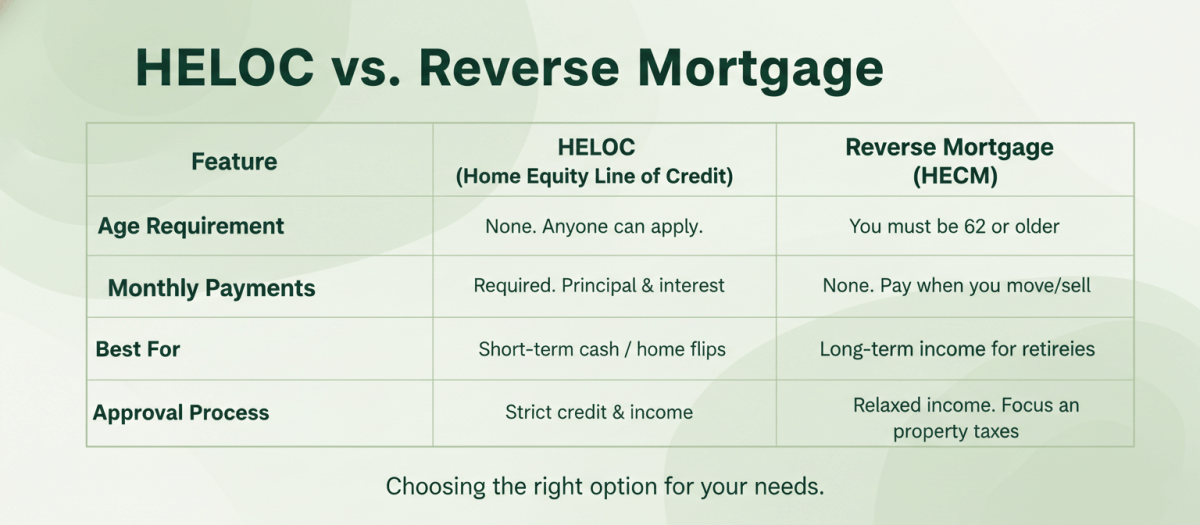
Basically, if you can afford another monthly bill, a HELOC is cheaper. If you need cash but cannot handle another payment, go with the reverse option.
FAQs About Reverse Home Mortgage
Q1. How to get out of a reverse mortgage?
By law, you get a three-day "Right of Rescission" to cancel the deal right after closing without any penalties. After that window closes, your only way out is to pay off the balance by selling the house or refinancing it into a traditional loan.
Q2. How do you pay back a reverse mortgage?
The debt typically comes due when the last borrower dies or permanently moves into a care facility. Heirs usually handle this by selling the house, paying off the lender, and keeping whatever profit is left over. Alternatively, they can use their own money to pay off the loan and keep the family home.
Q3. Is reverse mortgage interest deductible?
Not immediately. Because you aren't actually making monthly payments, you can't deduct the interest on your taxes every year. You only get to claim that mortgage interest deduction in the specific year the loan is entirely paid off.
Q4. How long does it take to get a reverse mortgage?
Expect the process to take roughly 30 to 45 days. It drags on a bit longer than a standard mortgage because you have to schedule the mandatory HUD counseling session and wait for a specialized FHA appraisal.
Q5. How much can I get from a reverse mortgage?
Your final number depends on your exact age, current interest rates, and the appraised value of your home. Generally, the older you are and the more your house is worth, the bigger your payout will be. You can pull personalized, instant rate quotes for clients using the Zeitro Pricing Engine, which grabs live pricing for both conventional and Non-QM products, so you can show borrowers real numbers in seconds.
Q6. How much equity do you need for a reverse mortgage?
Most lenders want to see that you own the home outright or have at least 50% equity. Since the new reverse loan has to pay off your old traditional mortgage first, you need a large cushion of equity to ensure you actually get cash in your pocket.
Q7. Can you get a reverse mortgage if you still have a mortgage?
Yes, and it's actually one of the most common reasons people apply. The reverse mortgage pays off your existing balance at closing, and whatever equity is left over becomes available to you. You just need enough equity for the new loan to fully cover the old one plus closing costs.
Q8. Can a reverse mortgage affect eligibility for programs like Medicaid or SSI?
Reverse mortgage proceeds themselves aren't counted as income, so Social Security and Medicare aren't affected. But needs-based programs like Medicaid or SSI look at your assets, so cash sitting in a bank account past the end of the month could count against you. It's worth checking with a benefits counselor before drawing a large lump sum if you rely on either program.
Q9. Can you get a reverse mortgage on a home held in a trust?
Usually, yes, as long as it's a revocable living trust that meets HUD's requirements. Title sometimes needs to move out of the trust briefly during underwriting and then back in after closing, so plan for a little extra paperwork.
Q10. Do both spouses need to be 62 to qualify?
No. If one spouse is under 62, they can be listed as an eligible non-borrowing spouse, which protects their right to stay in the home after the older spouse passes away, as long as they keep meeting occupancy and payment obligations. The tradeoff is a smaller loan amount, since the calculation uses the younger spouse's age.
Conclusion: Is a Reverse Mortgage a Good Idea?
After walking hundreds of families through this decision, I still land on the same answer: it's a genuinely useful tool when the situation fits. If you want to age in place, eliminate an existing mortgage payment, and free up breathing room in your monthly budget, it's worth serious consideration. If you're planning to move soon, or leaving a fully paid-off house to your kids matters more to you than extra cash now, it's probably not the right fit. Either way, talk it through with a financial advisor before signing anything.
For loan officers, staying on top of shifting eligibility rules like the 2025 citizenship update or the 60% disbursement rule is part of the job now. Bringing AI into the workflow, whether that's Zeitro for guideline lookups or GrowthHub for a branded landing page that answers client questions instantly, builds trust exactly when seniors need it most.
People Also Read
- Full Guide: What is a non-QM Loan? Everything to Learn
- 8 Best Non-QM Mortgage Lenders in 2026: Which to Choose?
- Refinance Meaning: What Refinancing a Mortgage Really Means
- Breakdown: How Much Does It Cost to Refinance a Mortgage?

![[Tips for Loan Officers] How Can I Lower Borrower DTI?](https://cdn.prod.website-files.com/6731bc6e813a541b54c30b10/6aa3b89e281a639e7a5c6fca_lower-debt-to-income-ratio-banner.jpg)