Written by

Eric
Share this article

.svg)
Subscribe to updates
Last Checked and Updated on August, 2026
I have watched this happen more times than I can count: a financially stable business owner walks into a big bank, ready to buy their dream home, and gets shown the door because their tax returns don't tell the full story. Frustrating, right? You know you can afford the mortgage, but the traditional "check-the-box" system says otherwise.
This is where a Non-QM loan (Non-Qualified Mortgage) becomes a game-changer. It isn't some shady workaround. It's a legitimate, flexible financing path built for the modern economy — gig workers, real estate investors, and self-employed professionals who don't fit the W-2 mold. Non-QM lending has grown fast in the last two years: recent industry data puts it at roughly 10% of all U.S. mortgage originations in 2025, up from around 5% just a year earlier, and several forecasters expect that share to climb even higher through 2026 as more Americans work for themselves.
In this guide, I'll walk you through what these loans actually are, the different types available, who they're built for, and how to use one to close on a property when a traditional bank says no.
Quick Answer: A Non-QM loan is a mortgage that qualifies you using income documentation outside the standard rules set for a Qualified Mortgage — think bank statements, business assets, or rental income, instead of W-2s and tax returns. It's not a "no-doc" loan and it's not subprime; it's simply a different, still fully verified path to approval.
What Is a Non-QM Loan?
To understand a Non-QM loan, I first need to explain what a "QM" is. A Qualified Mortgage (QM) is a standard home loan that meets strict rules set by the federal government, specifically the Consumer Financial Protection Bureau. These rules require lenders to verify your ability to repay using very specific documents, usually W-2s and tax returns, and typically cap your Debt-to-Income (DTI) ratio at 43%.
A Non-QM loan is simply a mortgage that doesn't fit into that rigid box. It uses alternative methods to prove you can pay back the loan.
Let me be clear about one thing: Non-QM is not the "subprime" lending that caused the 2008 housing crash. Back then, people were getting loans with no proof of income or assets. Today, Non-QM lenders are required by law to verify your "Ability to Repay" (ATR). We just do it differently.
Here is a real-world example:Imagine you are a shopkeeper. You made $200,000 in revenue last year, but after deducting your home office, equipment, and travel expenses, your tax return shows a net income of only $40,000. A traditional bank looks at that $40,000 and denies you. A Non-QM lender, however, can look at your bank statements to see the actual cash flow of $200,000 and approve you based on that real liquidity.
Who is this suitable for?In my experience, Non-QM loans are perfect for:
- Self-employed individuals: Business owners, freelancers, and gig workers who write off significant expenses.
- Real Estate Investors: Those who want to qualify based on the property's rental income rather than personal income.
- Foreign Nationals: Buyers who lack a US credit history or Social Security Number.
- High Net Worth Individuals: Retirees or wealthy buyers with low monthly income but massive assets.
- Borrowers with Credit Events: People who have had a bankruptcy or foreclosure recently (often as soon as one day out of foreclosure).

Types of Non-QM Loans
Because "Non-QM" is just a category, not a specific product, it comes in many different flavors. I often tell my clients that there is likely a specific tool for their unique financial situation.
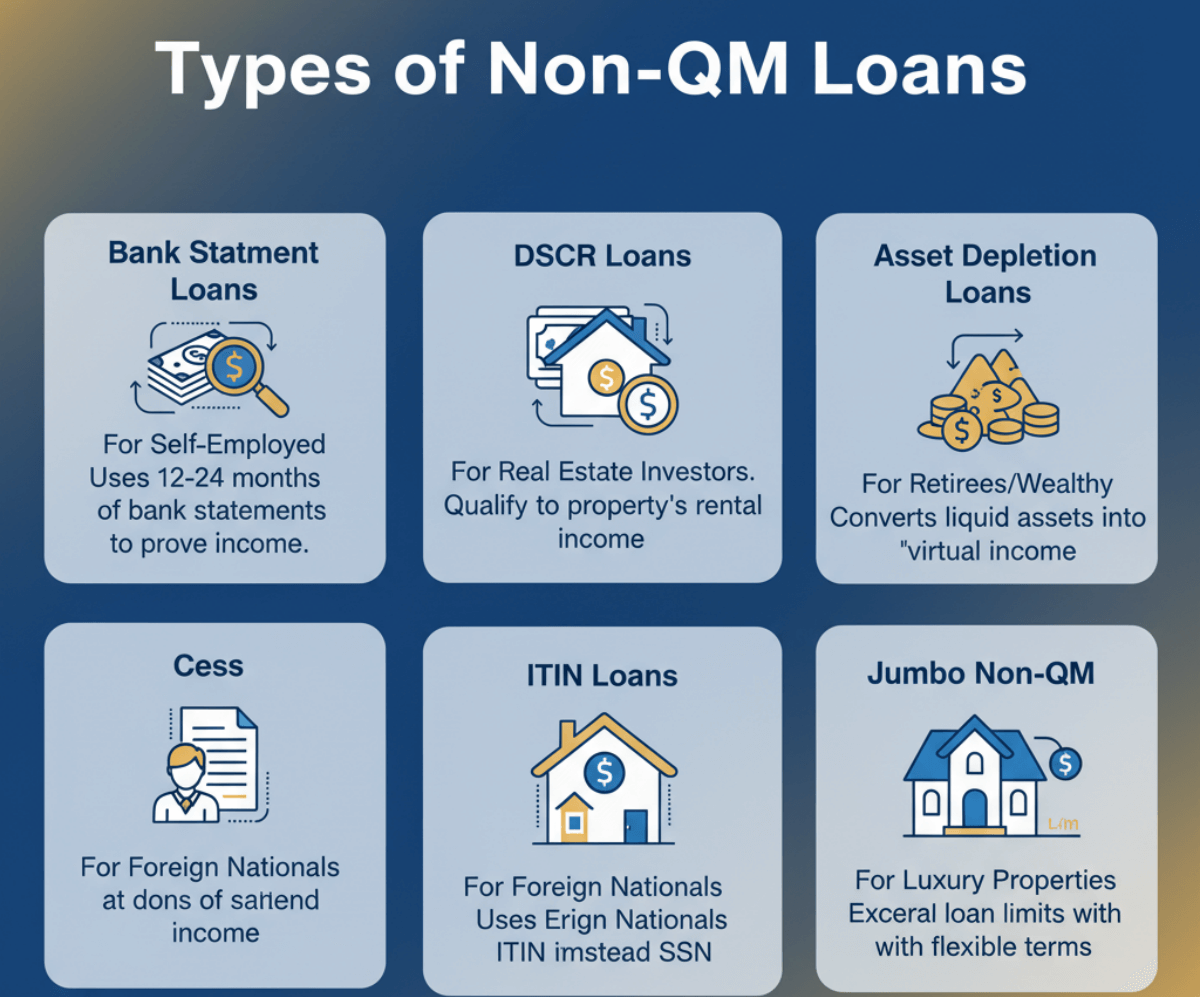
Here are the most common types available in the current market
- Bank Statement Loans: The most popular option for self-employed borrowers. Lenders review 12 to 24 months of personal or business bank statements to calculate your income, ignoring the net income on your tax returns.
- DSCR Loans (Debt Service Coverage Ratio): Designed strictly for real estate investors. We don't check your personal income at all. If the rent the property generates covers the monthly mortgage payment, you qualify.
- Asset Depletion Loans: Ideal for retirees or wealthy individuals. We take your total liquid assets (stocks, savings, retirement) and divide them by a set term (like 84 months) to create a "virtual" monthly income for qualification.
- Full Doc Non-QM: a type people often overlook. You may have complete W-2s and tax returns, but still land outside QM because of a high loan amount, a non-warrantable condo, or a recent credit event. Full Doc Non-QM lets you use your full paperwork through a more flexible underwriting path.
- ITIN Loans: For borrowers living in the US who have an Individual Taxpayer Identification Number (ITIN) but no Social Security Number.
- Jumbo Non-QM: For luxury properties that exceed federal loan limits, offering more flexible terms than traditional Jumbo loans.
- Non-QM Construction Loans: a niche but growing option for self-employed borrowers or investors who want to build rather than buy. These typically require a specialty lender and more reserves than a standard purchase loan.
Non-QM Loan Requirements
A common misconception I hear is that Non-QM loans are "easy" to get or require no documentation. That is false. These are "Alternative Doc" loans, not "No Doc" loans. Because the lender is taking on more risk by stepping outside the government safety net, they still need assurance that you are a safe bet.
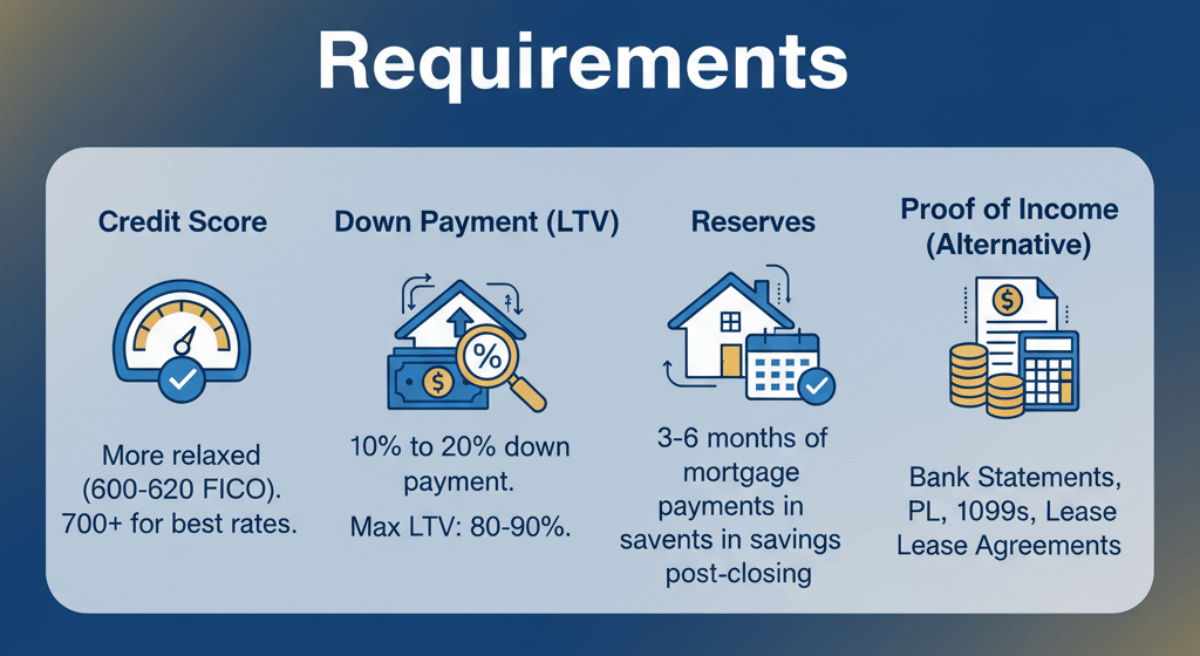
While every lender has different "overlays" (internal rules), here is what you generally need to bring to the table:
- Credit Score: The requirements are more relaxed, but standards still exist. Most lenders look for a FICO score of 600 to 620. However, if you want competitive rates, a score above 700 helps significantly.
- Down Payment (LTV): You usually need more skin in the game. Expect to put down 10% to 20%. The maximum Loan-to-Value (LTV) ratio typically tops out at 80% or 90%.
- Reserves: This is crucial. Lenders often want to see that you have 3 to 6 months of mortgage payments saved up in liquid cash after the closing.
- Proof of Income (Alternative): Depending on the loan type, you must provide bank statements, 1099 forms, P&L statements prepared by a CPA, or lease agreements.
Is a Non-QM Loan Safe? Understanding the Risks
I always tell clients: flexibility isn't free, and you should walk in with your eyes open. A few things worth weighing before you sign anything.
- Higher long-term cost. Between the rate premium and, on some programs, a prepayment penalty, a Non-QM loan can cost noticeably more over time than a conventional one — especially if you keep the loan for years instead of refinancing out of it.
- No Safe Harbor for the lender. Because Non-QM loans skip the QM's legal protection, lenders lean harder on your reserves, credit history, and documentation. That's good for you in one sense — someone is genuinely checking your ability to repay — but it also means underwriting can feel slower and more detail-driven than a standard loan.
- Thinner secondary market. Non-QM loans are usually held by the lender or sold to private investors rather than Fannie Mae or Freddie Mac. During periods of market stress, that can mean tighter guidelines or pricier terms industry-wide.
- Fewer lenders to shop. You won't find these at a typical bank branch, so comparing offers takes more legwork through brokers who specialize in the space.
None of this makes Non-QM "unsafe" in the way subprime lending was. It just means you should ask direct questions about your rate structure, any prepayment penalty, and total closing costs before you commit — the same due diligence I'd want for my own mortgage.
Pros and Cons of Non-QM Loans
I believe in total transparency. Non-QM loans are powerful tools, but they aren't the right fit for everyone. Before you commit, you need to weigh the benefits against the costs.
The Pros:
- High Flexibility: This is the biggest selling point. You aren't held back by tax returns that don't reflect your real cash flow.
- Faster Closing (Especially DSCR): Since we aren't waiting on the IRS to verify tax transcripts or analyzing complex employment histories, investment loans (DSCR) can often close faster than conventional loans.
- Access to Unique Properties: Non-QM lenders are often more willing to finance "non-warrantable" condos (like condotels) that Fannie Mae and Freddie Mac won't touch.
The Cons:
- Higher Interest Rates: Flexibility comes at a price. In the current 2024-2026 market, you can expect Non-QM rates to be roughly 1% to 2% higher than a standard conventional mortgage.
- Larger Down Payment: You typically cannot buy with 3% or 5% down like you can with an FHA or conventional loan.
- Fewer Lenders: You can't just walk into a local branch of a major bank (like Chase or Wells Fargo) for these. You almost always need to work through a specialized Mortgage Broker.
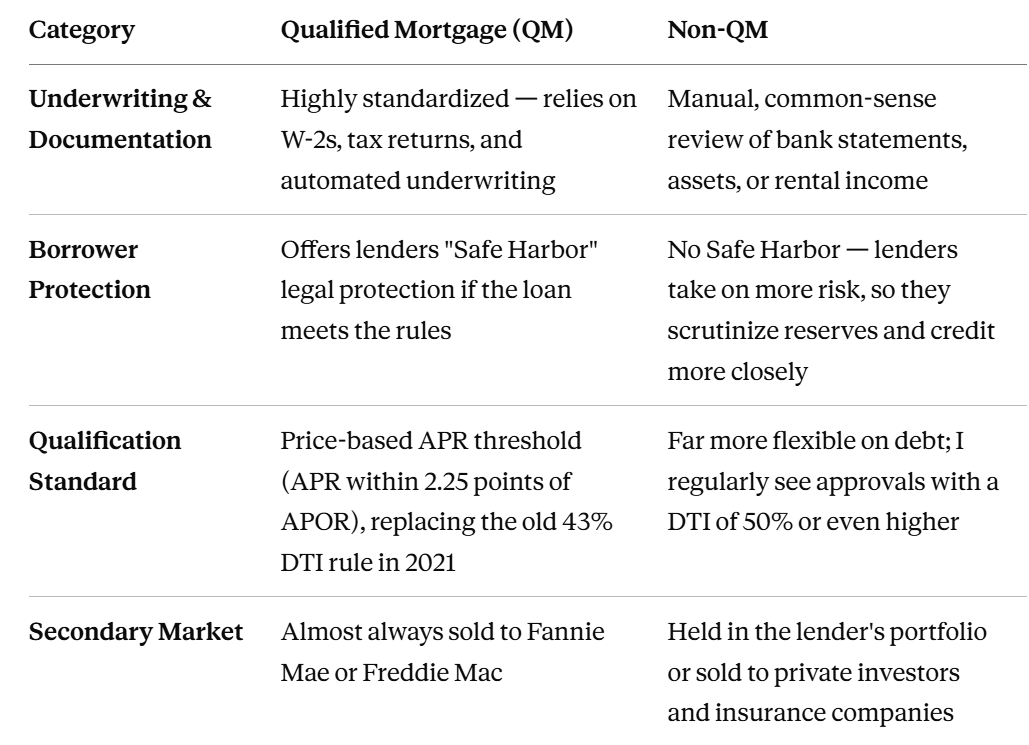
QM vs. Non-QM Mortgages: Key Differences
When clients ask me to compare these two, I break it down into four categories to make it easy to digest.
When Does a Non-QM Loan Make Sense?
This is probably the question I get asked most, so let me answer it directly with a few scenarios I see all the time:
- You're self-employed and your tax returns understate what you actually bring home.
- You're an investor buying a property purely on the strength of its rental income, not your paycheck.
- You're recently out of a bankruptcy or foreclosure and need a bridge until you're eligible for conventional financing again.
- You're retired with strong assets but limited monthly income on paper.
- You want to buy a non-warrantable condo or condotel that conventional lenders won't finance.
If more than one of these sounds like you, it's worth at least running the numbers on a Non-QM program before assuming a traditional bank is your only option.
Getting Started: The Non-QM Loan Process
Here's roughly how the process unfolds once you decide to move forward:
- Identify the right product. A broker who works in Non-QM daily can match your income situation — self-employed, investor, retired, or credit event — to the right program.
- Gather your documentation. Depending on the product, that's bank statements, a CPA letter, asset statements, or a lease agreement.
- Confirm your reserves and down payment. Know your LTV target early so there are no surprises at underwriting.
- Go through manual underwriting. Expect a human to actually read your file rather than an automated system checking boxes.
- Close. DSCR and asset-based files, in particular, tend to move faster than a traditional purchase since there's no tax transcript to wait on.
Non-QM Loan FAQs
If you have more questions about non-QM loans, check out the FAQs below.
Q1. What property types are eligible for non-QM lending?
Non-QM is incredibly versatile regarding property types. You can finance primary residences, second homes, and investment properties. This includes Single-family homes, Townhomes, Multi-unit properties (2-4 units), and even tricky properties like non-warrantable condos and Condotels (condo-hotels) that conventional loans usually reject.
Q2. What are examples of non-QM loans?
The most common examples I handle are Bank Statement Loans (using 12-24 months of deposits for income), DSCR Loans (using rental income to qualify investment properties), Asset Depletion (using liquid savings as income), and Foreign National Loans for non-US citizens investing in the States.
Q3. Is a bank statement loan considered non-QM?
Yes, absolutely. It is the quintessential Non-QM product. Because it does not use standard tax returns or W-2s to verify income, as required by the "Qualified Mortgage" definition, it falls squarely into the Non-QM category. It is the go-to solution for self-employed borrowers.
Q4. What is non-qualified financing?
"Non-qualified financing" is just a broader industry term for Non-QM loans. It refers to any mortgage lending process that operates outside the "Safe Harbor" guidelines established by the CFPB. It simply means the loan doesn't meet the government's strict criteria for resale to Fannie Mae or Freddie Mac.
Q5. What are the risks of a non-QM loan?
The main trade-offs are a higher interest rate, in some cases a prepayment penalty, and a smaller pool of lenders to shop against. Because these loans don't carry the QM's legal Safe Harbor, lenders also tend to require stronger reserves and documentation than a conventional loan. It's not risky in the subprime sense — your ability to repay is still fully verified — but it does cost more over time.
Q6. What documents do I need for a non-QM loan?
It depends entirely on the program. Bank Statement Loans typically need 12-24 months of statements; DSCR loans need a lease agreement or market rent estimate; Asset Depletion loans need statements showing your liquid assets; and Full Doc Non-QM uses standard W-2s and tax returns. In every case, expect to also show proof of reserves and a valid form of ID.
Q7. How do non-QM lenders evaluate borrowers without traditional income documents?
They lean on real financial behavior instead of paperwork: consistent bank deposits, a property's actual rental income, verified liquid assets, credit history, and cash reserves after closing. It's a more manual, judgment-based review than an automated conventional underwrite, which is exactly why it can approve borrowers a traditional system would reject outright.
Conclusion
Here is the bottom line: Being rejected by a traditional bank does not mean you cannot buy a home. It often just means your financial life is more complex than a standard W-2 employee, and that is okay. Non-QM loans exist specifically to fill this gap, helping business owners and investors turn their real cash flow into real estate equity.
While the interest rates and down payments are slightly higher, I often advise my clients to view a Non-QM loan as a strategic bridge. You can use it to secure the property now, and then refinance into a conventional loan later if your tax profile changes or rates drop.
Since these loans are complex and rules vary by lender, your best move is to consult with an experienced Mortgage Broker who specializes in Non-QM products. They can navigate the "overlays" and find the program that fits your unique story.Here's the bottom line: getting turned down by a traditional bank doesn't mean you can't buy a home. It usually just means your financial life is more complex than a standard W-2 employee's, and that's completely normal in today's economy. Non-QM loans exist specifically to close that gap, turning your real cash flow into real estate equity.
Yes, the rates and down payments run a bit higher. I often tell clients to think of a Non-QM loan as a strategic bridge — use it to secure the property now, then refinance into a conventional loan later if your tax profile changes or rates come down.
Because these loans are complex and overlays vary by lender, your best move is to work with an experienced mortgage broker who specializes in Non-QM products. They'll know how to navigate the fine print and match you with the program that actually fits your story.
People Also Read
- [Tips] Where to Buy Mortgage Leads? Warm Leads for LOs
- Detailed Guide: How to Become a Loan Officer with No Experience?
- 8 Best Mortgage Lead Generation Companies in 2026: Don't Miss

![[Tips for Loan Officers] How Can I Lower Borrower DTI?](https://cdn.prod.website-files.com/6731bc6e813a541b54c30b10/6aa3b89e281a639e7a5c6fca_lower-debt-to-income-ratio-banner.jpg)