Written by

Eric
Share this article

.svg)
Subscribe to updates
Last Checked and Updated on September, 2026
I've lost count of how many times a deal has stalled because of a minor guideline nuance I missed during pre-approval. In this business, speed is currency, but accuracy is what keeps you employed. As Loan Officers and processors, we juggle massive PDF guides from Fannie Mae and Freddie Mac, plus the specific overlays from every wholesaler we work with.
Scanning through thousands of pages just to verify a DTI exception or a self-employment calculation isn't realistic anymore. That's where technology actually earns its keep. I've been leaning on Zeitro Strata AI, a mortgage guideline assistant that lets me verify conventional loan requirements through a simple chat window instead of a PDF search bar. It's changed how fast I can move a file from application to submission.
What are the Guidelines for a Conventional Loan?
A conventional mortgage loan is any home loan that isn't insured or guaranteed by a federal agency, unlike FHA, VA, or USDA loans. That's the short version of the conventional mortgage loan definition, and it trips people up because "not government-backed" doesn't mean "no rules."
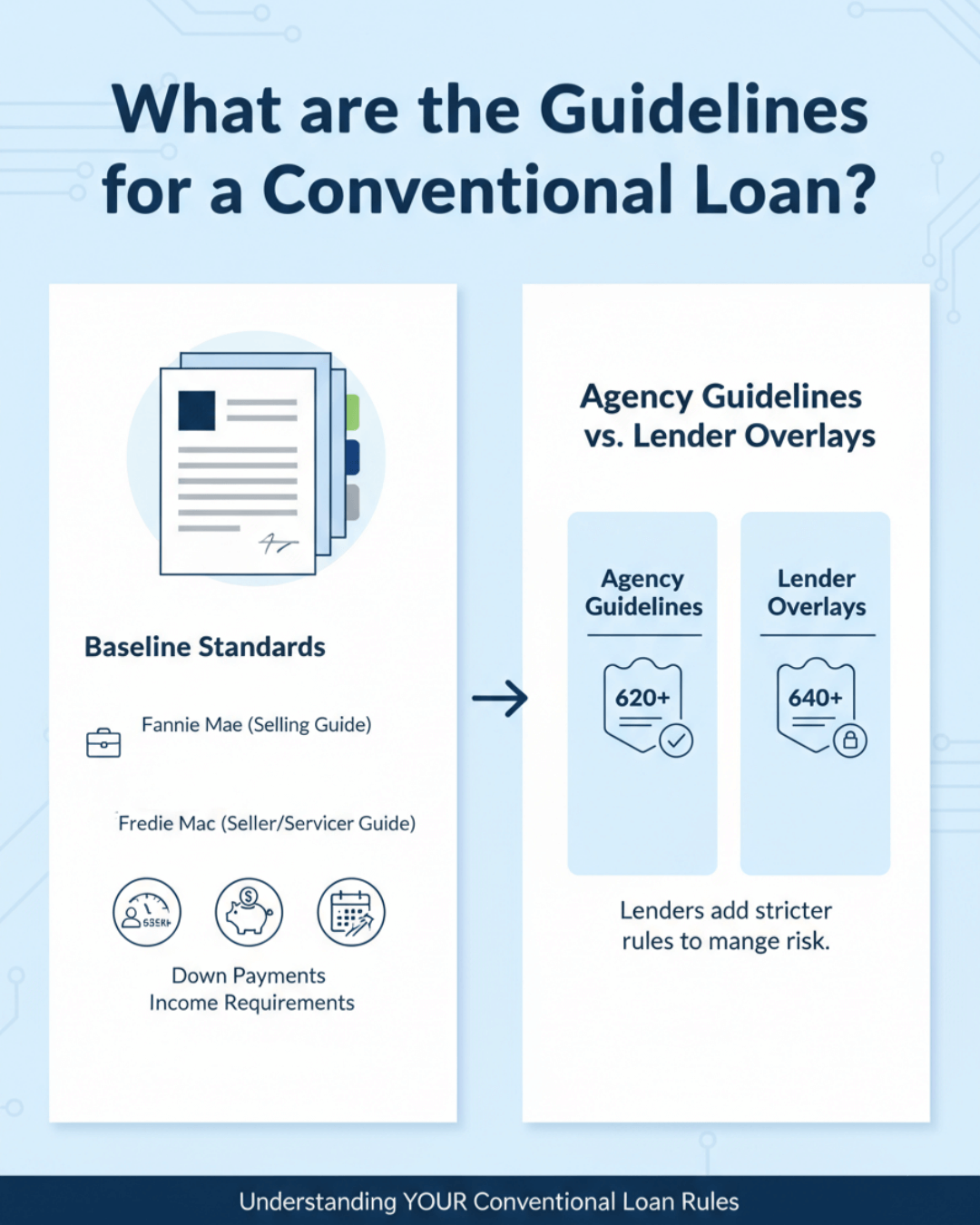
The baseline standards come from the two Government-Sponsored Enterprises, or GSEs:
- Fannie Mae, governed by its Selling Guide
- Freddie Mac, governed by its Seller/Servicer Guide
These two set the floor on credit scores, down payments, and income documentation. Here's where a lot of newer loan officers get tripped up, though: agency guidelines and lender overlays are not the same thing.
Fannie Mae might accept a 620 credit score on paper, but a specific lender might require 640 before they'll buy that loan. That extra layer is called an "overlay." Understanding conventional mortgage loan guidelines really means understanding two rulebooks at once: the agency minimums and whatever stricter version your lender layers on top to manage their own risk.
Who Do Conventional Mortgage Loan Guidelines Apply To?
These guidelines function as the rulebook for two very different audiences.
The Borrowers
The rules shift dramatically based on occupancy and intent.
- Primary Residence: Offers the most lenient terms (lowest down payment, best rates).
- Second Home: Stricter reserves and down payment requirements.
- Investment Property: The most scrutiny. Guidelines here demand higher credit scores and significant equity (often 15-25% down).
Lenders and Underwriters
For my colleagues in underwriting, following these guidelines isn't optional, it's mandatory for the loan's salability. If an underwriter approves a loan that deviates from agency rules without a proper waiver, that loan becomes "unsalable" on the secondary market. This creates "repurchase risk," where the lender is forced to buy the bad loan back. This is exactly why lenders apply overlays, to create a safety buffer above the minimum agency requirements.
Conventional Loan Requirements 2026
As of 2026, the fundamentals of conventional lending are still rooted in risk assessment, though loan limits and automated verification tools keep evolving year over year.
Credit Score Requirements
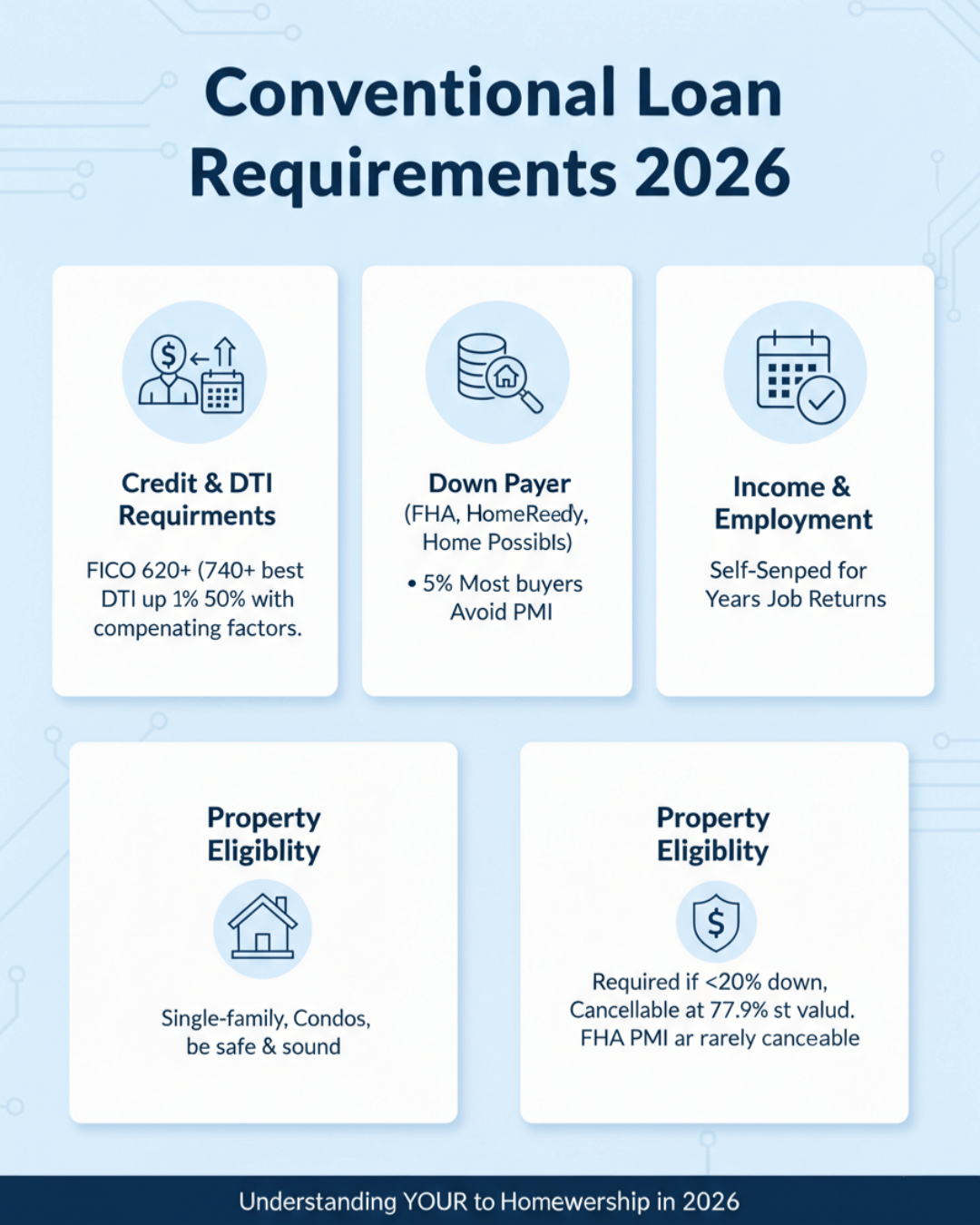
The minimum FICO score for most conventional loans sits at 620 through Desktop Underwriter or Loan Product Advisor's Approve/Eligible path, though manual underwriting or certain loan products can push that up to 660 or higher. Hitting 620, though, is rarely the whole story.
Your borrower's credit score for a conventional loan feeds directly into Loan-Level Price Adjustments, which shape both the interest rate and the Private Mortgage Insurance cost. I've watched Desktop Underwriter approve scores just under 620 in rare cases stacked with strong compensating factors, but most lenders won't touch those files because of their own overlays. For the smoothest pricing and underwriting experience in 2026, a score of 740 or above is still considered the gold standard.
Debt-to-Income (DTI) Guidelines
The textbook manual underwriting benchmark is 36% for housing costs and 45% for total debt. In practice, though, most files run through an Automated Underwriting System, and that changes the math.
If the rest of the file is strong, DU or LPA will often return an Approve/Eligible finding with a DTI as high as 50%. Stretching to that upper limit usually requires compensating factors — things like six-plus months of cash reserves, a long, stable job history, or a sizable down payment. Without those cushions, treating 45% as your practical ceiling is the safer play.
Down Payment Rules
One myth I still bust on nearly every call is the idea that conventional loans require 20% down. In 2026, the reality is a lot more flexible:
- 3% Down: Available through first-time buyer programs, or the broader "Conventional 97" path that many repeat buyers can also access depending on the product.
- 5% Down: Sometimes referred to informally as "Conventional 95," this is the standard minimum for most repeat buyers on a primary residence.
- 20% Down: Not a requirement for approval — it's only the threshold to skip Private Mortgage Insurance (PMI) entirely.
For multi-unit properties (2-4 units), the minimum down payment climbs significantly, often into the 15-25% range, so always run the exact matrix for that scenario rather than assuming standard terms apply.
If you're working with a lower-income or first-time borrower, it's worth knowing the differences between the three main low-down-payment programs, since they each have their own income limits and eligibility quirks:
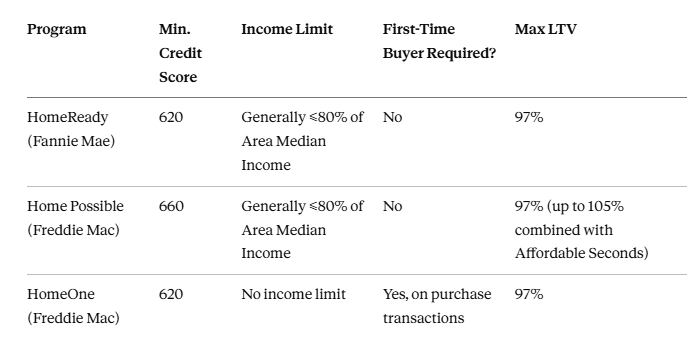
The Fannie Mae HomeReady matrix is a common point of confusion because agents and borrowers often assume it works exactly like Home Possible. It doesn't — the credit score floor and income documentation nuances differ enough that it's worth double-checking the specific program before quoting a rate.
Loan Limits in 2026
Conforming loan limits reset every year, and 2026 brought a real jump. The baseline conforming loan limit for a one-unit property is now $832,750, up from $806,500 in 2025 — a $26,250 increase driven by rising home values. In high-cost counties, the ceiling climbs to $1,249,125. Alaska, Hawaii, Guam, and the U.S. Virgin Islands share that same higher ceiling as their baseline.
Anything above these thresholds no longer qualifies as a conventional conforming loan and shifts into jumbo territory, which comes with its own credit, reserve, and documentation standards.
Income and Employment Verification
Consistency is everything here. Underwriters want to see a two-year history of stable income before they'll rely on it.
- W-2 Employees: Usually the easiest path — recent pay stubs and W-2s tell most of the story.
- Self-Employed: This is where files most often die on the table. Both agencies require two full years of personal and business tax returns, and one year rarely gets accepted, even through an AUS approval, without exceptional compensating factors.
A question I get constantly is whether a borrower can count rental income from a home they're moving out of, often called "departing residence" income. Fannie Mae does allow it under specific conditions, generally when there's documented equity in the departing property, a signed lease is in place, and the borrower can show they're not double-counting housing expenses in their DTI. It's a nuanced calculation, and it's exactly the kind of scenario-specific question I now run through Zeitro Strata AI before I trust my own memory of the guideline.
The underlying logic is always stability. If a borrower has gaps in employment or a declining income trend year over year, guidelines call for a deeper explanation, or disqualification, no matter how strong last month's paycheck looked.
Property Eligibility Guidelines
Not every roof and four walls qualifies for a conventional mortgage.
- Eligible: Single-family homes, PUDs, warrantable condos, and 2-4 unit properties.
- Ineligible: Timeshares, houseboats, condo-hotels, or properties with major health and safety violations like mold or structural damage.
Roof condition specifically comes up more than people expect. There's no single hard-coded "minimum years of life" rule the way FHA sometimes gets described, but appraisers will flag visible damage, active leaks, or deferred maintenance, and that can trigger a repair requirement before closing. I always tell clients: the appraisal isn't just checking value, it's checking whether the house is actually safe and sound to lend against.
Do Conventional Loans Require an Appraisal?
Not always, and this surprises a lot of first-time buyers. Fannie Mae's automated system, Desktop Underwriter, can issue what it now officially calls a Value Acceptance (the updated name for what used to be called an appraisal waiver or PIW). Freddie Mac's equivalent tool is Automated Collateral Evaluation (ACE), and there's also a newer inspection-based version, ACE+ PDR, that uses a trained data collector instead of a licensed appraiser.
Whether a file qualifies depends on the strength of the borrower's credit profile, the loan-to-value ratio, and how much reliable data exists on that specific property. When it works out, borrowers skip a $400-500 appraisal fee and shave roughly a week off the closing timeline. It's never guaranteed, though — the lender can still order a traditional appraisal even if the automated system says one isn't required.
Mortgage Insurance (PMI) Guidelines
If your borrower puts down less than 20%, PMI comes with the loan. It protects the lender, not the borrower, which is a distinction worth explaining clearly to first-timers.
The real advantage conventional loans hold over FHA is that PMI is temporary. Once the loan-to-value ratio drops to 78% based on the original amortization schedule, the lender is legally required to cancel it automatically under the Homeowners Protection Act, no request needed. Borrowers can also request cancellation earlier, once LTV hits 80%, provided they have a clean payment history and sometimes a fresh appraisal to confirm value. Compare that to FHA, where MIP only becomes cancelable after 11 years if the borrower put down at least 10% at closing; below that, it sticks around for the life of the loan.
One update worth knowing for 2026: PMI premiums are once again tax-deductible for borrowers who itemize, after that deduction had been phased out for several years. It's a small detail, but it's the kind of thing that can shift a borrower's math when they're deciding between waiting to hit 20% down or moving forward sooner with PMI attached.
Waiting Periods After Bankruptcy, Foreclosure, or Short Sale
This is one of the most common questions I field from borrowers who assume a past financial setback disqualifies them permanently. It doesn't — it just resets the clock.
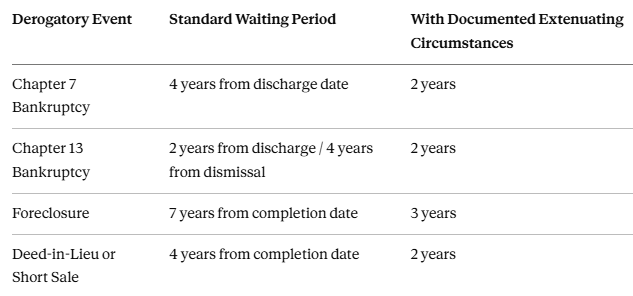
One detail that trips people up: the waiting period needs to be satisfied by the day the new loan actually funds, not the day the borrower applies. Since a purchase can easily take four to six weeks to close, I always tell borrowers sitting right at the edge of eligibility to build in a buffer rather than cutting it close.
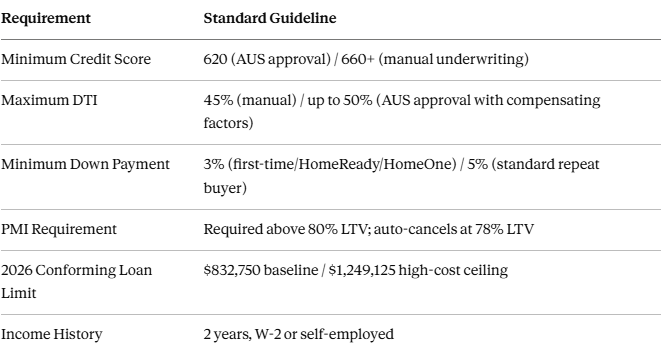
Conventional Loan Requirements at a Glance
If you just need the numbers without the backstory, here's the quick-reference matrix I keep pinned for myself:
How to Verify Conventional Mortgage Guidelines Quickly?
In an ideal world, we'd all have the Fannie Mae Selling Guide memorized cover to cover. Realistically, guidelines shift constantly, and manually cross-referencing them eats up hours you don't have.
That's why Zeitro Strata AI has become part of my daily workflow. It's an AI-powered mortgage guideline assistant built for both QM and Non-QM scenarios. Instead of digging through PDF overlays from a dozen different investors, I just type the question the way I'd ask a colleague.
Why it's stuck around in my toolkit:
- Handles nuance: I can ask something as specific as "can I use departing residence rental income here?" or as broad as general LTV limits, and it holds up either way.
- Citations you can actually check: Every answer comes with a source link back to the original guideline, which matters when you're the one signing off on a file. I don't just take an AI's word for it — I verify.
- Real coverage: It draws from over 1,000 guidelines and cross-checks more than 100 investors, cutting what used to be a 30-minute manual lookup down to a matter of seconds.
- Beyond Q&A: It'll also calculate income from uploaded documents, check income eligibility against area median income limits, surface matching down payment assistance programs, and pull current rate sheets for a quick pricing comparison.

If an answer isn't fully clear, the Explain feature lets me dig deeper on that specific point without starting the whole query over. You get free queries a day, which is usually enough to get through a typical scenario without hitting a wall, and the paid tier is priced low enough that it pays for itself the first time it saves you from missing an overlay update.
FAQs About Conventional Mortgage Guidelines
Q1. What does a conventional mortgage mean?
It means the loan is funded by a private lender and sold to Fannie Mae or Freddie Mac, without government insurance (like FHA or VA).
Q2. Do all conventional mortgages require 20% down?
No. First-time buyers can put down as little as 3%, and repeat buyers can put down 5%. 20% is only required to avoid PMI.
Q3. What are the qualifications for a conventional mortgage?
Generally, you need a credit score of at least 620, a verifiable two-year income history, and a Debt-to-Income (DTI) ratio under 45% (sometimes up to 50% with AUS approval).
Q4. What disqualifies a home from a conventional loan?
Properties with significant structural issues, safety hazards, or "non-warrantable" condo features (like operating as a hotel) will be disqualified.
Q5. Are conventional mortgage guidelines the same for all lenders?
No. While the base rules are the same, lenders add "overlays." One lender might accept a 620 score, while another requires 640 for the same loan program.
Q6. Can conventional guidelines change year to year?
Yes. Loan limits (the maximum amount you can borrow) usually increase annually, and underwriting rules regarding credit or income calculation can change based on economic conditions.
Q7. How do lender overlays affect conventional loan approval?
Overlays make approval harder. Even if you meet Fannie Mae's minimums, you must also meet the stricter specific rules of the bank lending you the money.
Q8. What is the difference between FHA and conventional guidelines?
FHA is more lenient on credit scores (down to 580) and high DTI, but requires permanent mortgage insurance. Conventional requires better credit but offers lower costs and cancelable PMI.
Conclusion
Navigating conventional mortgage guidelines isn't about memorizing every rule in the Selling Guide. It's about knowing where to find the right answer fast, before a small detail turns into a denial three days before closing. Guidelines don't equal guaranteed approval — a borrower can look great on paper and still trip over a lender overlay or a property issue nobody flagged early enough.
To cut down on that trial-and-error, I'd genuinely recommend giving Zeitro Strata AI a try. It lets you check specific scenarios against more than a thousand lender guidelines in seconds instead of hours. With free daily queries and a low-cost paid tier, it's a high-ROI addition for any loan officer who's tired of guessing. Verify first, submit second.
People Also Read
- What Are FHA Mortgage Guidelines? How to Verify FHA & Overlays Quickly?
- Jumbo Mortgage Guidelines: Check Eligibility Quickly and Accurately
- Best Mortgage Loan Officer Training in 2026: Which to Pick?
- 6 Best Mortgage CRM for Brokers, Lenders, MLOs
- Best NMLS Test Prep Course 2026: Which to Choose from?
- Should Mortgage Lender and Broker Build In-House AI Tools?
- Mortgage Guidelines 2026: What Are They? How to Verify?

![[Solved] What Red Flags Would a Mortgage Underwriter See?](https://cdn.prod.website-files.com/6731bc6e813a541b54c30b10/6aa24ca70b95e62dd7bbeefd_red-flags-mortgage-underwriting-banner.png)