
Written by

Eric
Author from Zeitro

Share this article

Subscribe to updates

Thank you! Your submission has been received!
Oops! Something went wrong while submitting the form.

As a loan officer in today's competitive mortgage landscape, securing quality leads remains your top business priority. Buying leads is one option, but the smarter play is to find warm, qualified prospects. Borrowers who are actively searching or already trusting a resource. This guide tells you where to find mortgage leads in 2026, how much they typically cost, which vendors to consider, and which channels deliver the best ROI. Let's dive in.

Where to Buy Mortgage Leads Zeitro

People Also Read: Detailed Guide: How to Become a Loan Officer with No Experience?

Learn Mortgage Lead Generation Statistics 2026

Before you spend a dollar, understand the marketplace and how different lead sources perform. Below, we cover: the overall market outlook for 2026, typical conversion rates by channel, and comparative ROI so you can judge which channels to prioritize for your production goals.

Mortgage Market Potential in 2026

Industry forecasts show origination volume recovering in 2026. The Mortgage Bankers Association (MBA) projects total single-family mortgage originations will increase in 2026 vs. 2025, with both purchase originations and refinance activity rebounding as rates stabilize. This recovery means a larger addressable market for originators who are ready to capture demand.

Conversion Rate of Mortgage Leads

Conversion varies widely by source and by how quickly you follow up:

  • Referral / agent-sourced leads typically convert highest, which is often reported in the high teens to 30%+ range) because of pre-existing trust.
  • Organic search (SEO) leads: Borrowers who find you via search or content. frequently outperform paid aggregator leads. The conservative industry ranges places organic lead conversion roughly in the 5–15% band, depending on local authority and funnel quality.
  • Aggregator / shared purchased leads: commonly convert lower. often in the 1–5% range. because these prospects are shopped around and receive multiple inbound calls.

Speed-to-lead matters enormously: multiple studies show that contacting inbound mortgage/financial leads within minutes rather than hours multiplies qualification and conversion rates. Historic research and industry replications put the uplift at many times higher for first responders by HBR. Prioritize automation and immediate acknowledgement to protect conversion.

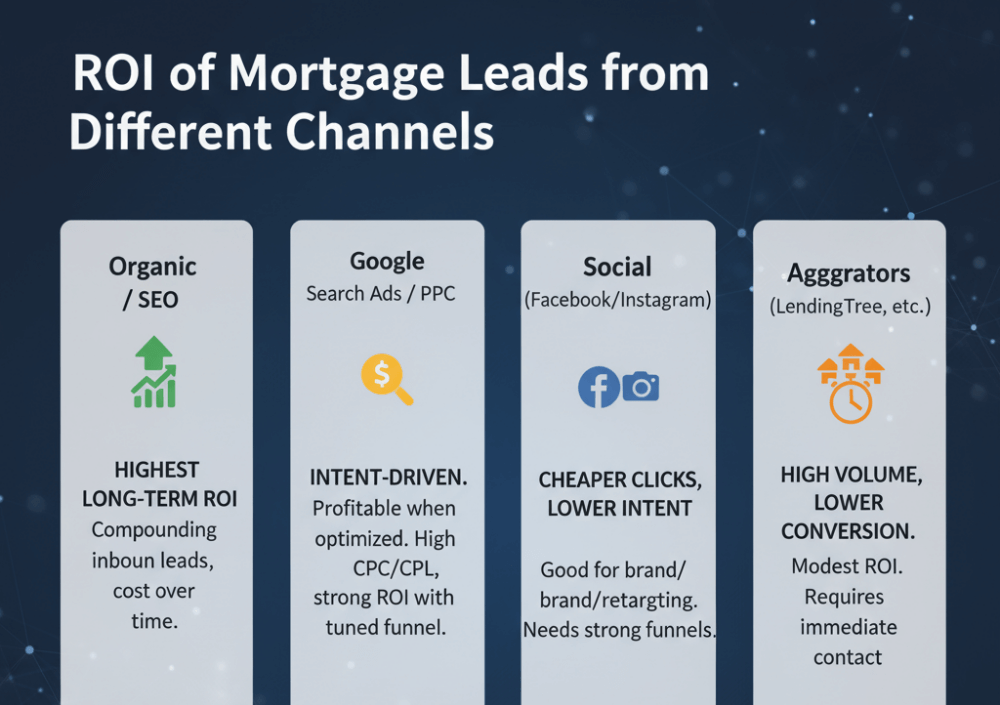
ROI of Mortgage Leads from Different Channels

ROI depends on your loan size, team efficiency, and conversion rates, but these patterns recur:

  • Organic / SEO: highest long-term ROI. Upfront time and content investment pay off with compounding inbound leads and lower per-lead marginal cost over time.
  • Google Search Ads / PPC: intent-driven. It can be profitable when optimized. Industry benchmarks show search CPCs and CPLs for mortgage keywords are relatively high, but optimized campaigns often return multiple dollars for every ad dollar when funnel and conversion are tuned.
  • Social (Facebook / Instagram): cheaper clicks but lower intent. It can work well for brand-building, retargeting, and first-time buyer audiences when combined with strong funnel flows.
  • Aggregators (LendingTree, Bankrate, Lendgo, etc.): high volume, but lower conversion and more competition. ROI can be modest if your contact processes aren't immediate and relentless.
ROI of Mortgage Leads from Channels

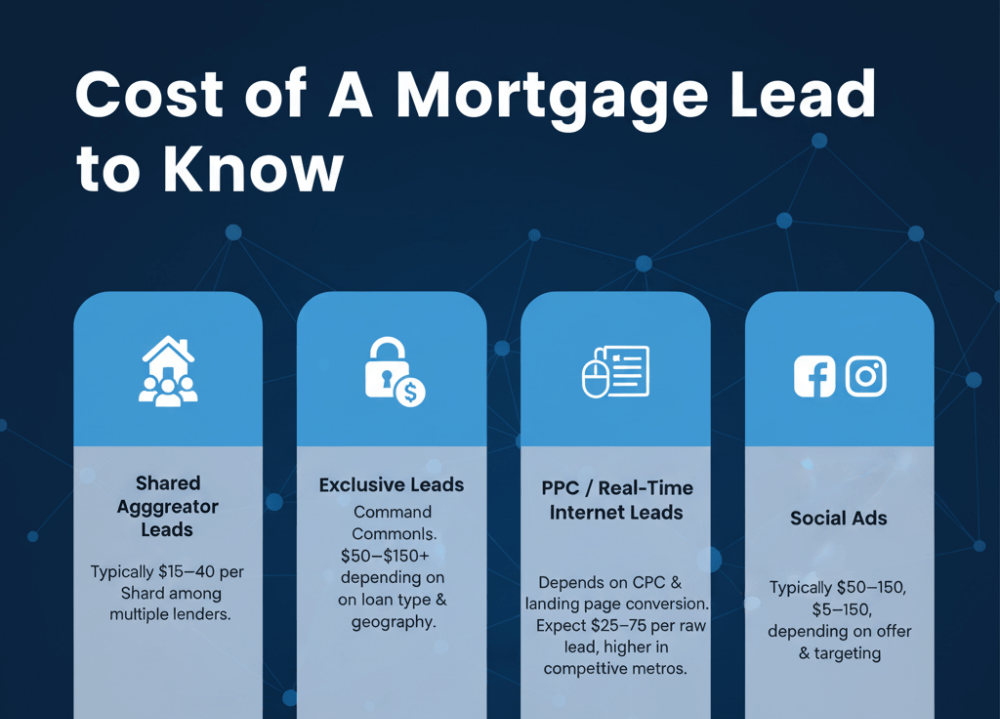
Cost of a Mortgage Lead to Know

Lead prices vary widely by exclusivity, intent, and channel:

  • Shared aggregator leads: typically $15–40 per lead in many markets and shared among multiple lenders.
  • Exclusive leads: command premiums. commonly $50–$150+, depending on loan type and geography.
  • PPC / real-time internet leads (landing page → form): costs depend on CPC and landing page conversion. expect $25–$75 per raw internet lead in many markets, with higher CPLs in competitive metro areas.
  • Social ads: typical CPLs range broadly from $50–$150, depending on offer and targeting.

How to evaluate price: calculate your acceptable Cost-Per-Funded-Loan:Max CPL = (Average Commission per Funded Loan) × (Targeted % of revenue you'll reinvest in acquisition) × (1 / Expected lead→fund conversion). If a lead source pushes your CPL below that threshold and the leads are real, scale up.
Cost of a Mortgage Lead

Best Mortgage Lead Generation Companies

Your first thought must be buying mortgage leads from generation companies. Here are five ones for you to consider.

#1 Zeitro

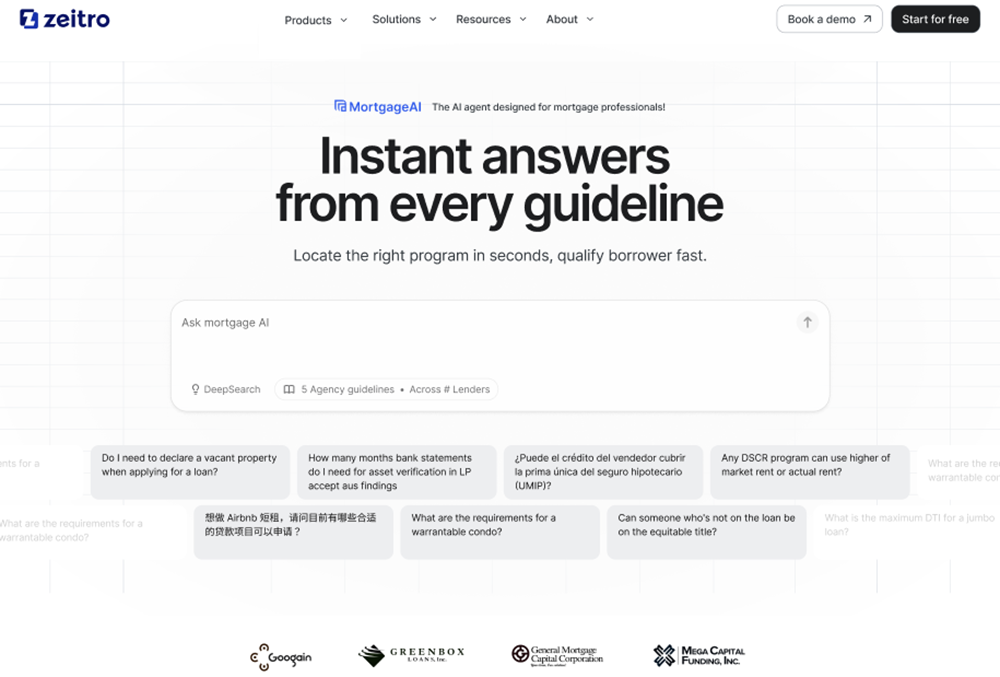
Zeitro is an industry-focused AI SaaS that helps loan officers create SEO-optimized personal microsites and speed up borrower qualification with AI tools. Zeitro's Growth Hub lets loan officers publish a branded microsite for free, embed rate quote tools and calculators, and surface content that attracts organic search traffic. Turning searchers into warm inbound leads. Zeitro also markets product features that streamline guideline lookups and borrower intake.

Key Features:

Personal branded microsite with SEO optimization for organic lead capture

Real-time rate quote engine covering conventional, Non-QM, and private lending

Affordability calculator that keeps prospects engaged on your site

GuidelineGPT for instant, accurate answers across multiple loan programs

AI-powered income calculation with 85%+ accuracy

Digital 1003 application with 90%+ completion rates in 5 minutes

Integration with leading lenders and wholesalers for comprehensive pricing

Open House Finder connecting you with real estate professionals

Zeitro Homepage

#2 LendingTree

LendingTree runs one of the largest online lending marketplaces in the U.S., matching borrowers to multiple lenders via a comparison funnel. Lenders buy those consumer requests as leads. Because multiple lenders often receive the same lead, speed and follow-up quality determine conversion success. LendingTree is strong for loan officers who can respond instantly and compete on pricing and service.

Key Features:

High-volume lead flow from established consumer brand

Pre-qualified borrowers who have expressed mortgage intent

Multiple loan types including purchase, refinance, and home equity

Detailed borrower information including credit score ranges and loan amount

Real-time lead delivery for immediate follow-up opportunity

Geographic and loan type filtering options

Mobile-optimized lead management interface

Integration capabilities with CRM systems

#3 LendingPad

LendingPad is primarily a modern cloud LOS that also offers borrower-facing point-of-sale tools and co-branded borrower portals. For LO teams that want an end-to-end digital loan flow (POS → LOS), LendingPad helps capture and convert borrowers coming from your own marketing or referral sources, effectively turning origination technology into a lead-capture channel.

Key Features:

Borrower-facing digital application portal for lead capture

Seamless online document upload and loan tracking functionality

Co-branding options to maintain your professional identity

Integration with wholesale lenders for expanded product offerings

Real-time collaboration tools for team-based lead management

Automated compliance and reporting to ensure regulatory adherence

Mobile accessibility for on-the-go lead response

API connectivity with marketing and CRM platforms

#4 Lendgo

Lendgo is a consumer mortgage marketplace that matches borrowers with lenders after they complete a request form. Lendgo emphasizes comparison shopping and matching borrower profiles with participating lenders, which can produce higher intent leads when borrowers are actively comparing offers.

Key Features:

Borrower matching based on loan type and qualification criteria

Real-time lead delivery notifications for fast response

Detailed borrower financial profiles including income and assets

Competitive marketplace with transparent pricing expectations

Lead quality filters to reduce unqualified prospect volume

Dashboard for tracking lead status and conversion metrics

Multi-channel lead sources including web, mobile, and partner sites

Flexible purchasing options including shared and exclusive leads

#5 Bankrate

Bankrate is a high-traffic personal finance publisher that generates leads via rate tables, calculators, and editorial content. Leads from Bankrate often come from shoppers who have researched extensively. That can mean better lead quality, although these leads are commonly sold to multiple lenders. Bankrate also offers advertising/rate table placements for lenders.

Key Features:

Access to highly trafficked financial comparison site

Educated borrowers who have researched options before submitting

Comprehensive borrower data including loan purpose and timeline

National coverage with geographic targeting capabilities

Multiple loan product types including conventional and government programs

Real-time rate integration for competitive positioning

Brand credibility that provides third-party validation

Performance analytics and lead source tracking tools

Best Ways to Buy Mortgage Leads Online

Below, I compare the main online channels and what you should expect.

Organic Traffic

Organic search. owned content, local SEO, and SEO-optimized microsites. produces the most consistent warm inbound leads over time. The advantage: compounding returns and usually higher conversion rates because searchers actively seek mortgage help. Zeitro's Growth Hub is an example of how a loan officer can build organic visibility without ongoing per-lead purchase costs. Invest in localized content (city + loan type), calculators, and clear CTAs for best results.

Google Search Ads

Google Search Ads target active searchers and therefore, can drive high-intent traffic quickly. Benchmarks (industry PPC reporting) show mortgage keywords are competitive. CPCs can be high, and CPLs depend heavily on landing page performance. With disciplined funnel optimization and good landing pages, Google Ads often deliver strong ROI. Use geo-targeting, tight keyword match types, and conversion-focused landing pages to control CPL.

Facebook/Instagram

Social advertising is powerful for reach, audience building, and retargeting. Costs per click are generally lower than search, but intent is lower too. expect lower raw conversion rates unless the campaign uses strong retargeting and educational content to warm prospects before asking for contact details. Video and webinar sign-ups perform particularly well for first-time buyer audiences.

LinkedIn

LinkedIn is more expensive per click but useful when you target high-income prospects (jumbos, physician loans, executive relocation) or when your product needs professional targeting. Expect higher CPLs but potentially larger loan sizes and LTVs that justify the spend in specialized niches. Recent benchmarks put LinkedIn CPCs higher than social platforms, but with higher lead quality for B2B/professional audiences.

Get Mortgage Leads Through Local Workshops and Webinars

Running local seminars and webinars is an often-underused channel that builds trust and captures warm leads. First-time homebuyer workshops typically attract 15–30 attendees. conversion from attendee → qualified lead can be high (industry estimates often show double-digit conversion rates for education attendees).

Costs are modest (local venue, refreshments, promotion), and webinars are even cheaper. Combine these events with a robust follow-up sequence and a dedicated post-event landing page to convert attendees into applicants. Recent industry pieces show strong ROI for educational events when events are co-hosted with agents or local partners.

Conclusion

Buying mortgage leads can speed pipeline growth, but the smartest originators balance purchased volume with owned channels. Organic search (SEO + personal microsites) and referral partnerships deliver the warmest leads and the best long-term ROI, while paid channels (search, social, aggregators) are powerful for targeted, short-term volume if you measure CPL and speed-to-lead closely.

Why Zeitro matters in this mix: Zeitro provides tools that help LOs build owned organic channels like branded microsites, calculators, and AI intake, so you rely less on expensive, shared leads and more on warm prospects you control. If you're buying leads now, pair that spend with an investment in a personal organic funnel. That's how most high-performing originators reduce acquisition costs over time.

Keep reading

Blog

5 min read
Arrow icon on dark background
What Does a Loan Officer Do? Duties, Pros, Cons, and Outlook
What does a loan officer do? Discover daily duties, average salary, pros & cons, and the 2026 career outlook in our complete guide. Is this job right for you?

Have you ever looked at a house, wondering how people afford it, or sat across from someone at a bank and thought, "What do you actually do all day?" I get that question a lot. When I tell people I'm a Loan Officer, they often imagine I just stamp "APPROVED" or "DENIED" on stacks of paper like a cartoon banker.

But the reality is far more dynamic. Being a loan officer isn't just about math. It's about being a detective, a therapist, and a project manager all rolled into one. Whether you are curious about the career or just looking for a new path in 2026, I'm going to pull back the curtain and show you exactly what this job entails, the good, the bad, and the paycheck.

What is a Loan Officer?

Simply put, I am the bridge between a borrower's dream and the bank's money. A Loan Officer (often called a Mortgage Loan Originator or MLO in the housing world) assists borrowers in applying for loans. We evaluate their financial history to determine if they qualify and for how much.

While you can find loan officers in commercial banking or consumer lending (think car loans), most of the buzz, and the money, is in mortgage lending. We work in commercial banks, credit unions, and independent mortgage companies.

Let's talk about the average salary of a loan officer, because that's probably why you're here. According to the U.S. Bureau of Labor Statistics (BLS) data from May 2024, the median annual wage for loan officers was $74,180. However, that number is misleading.

Why? Because this is a sales job. Top producers who work on commission easily clear $100,000 to $200,000+ a year, while those who treat it like a passive 9-to-5 might struggle. If you are a "people person" who loves crunching numbers and has a high tolerance for pressure, this might just be your calling.

What is a Loan Officer?

What Does a Loan Officer Do in Real Estate?

This is the core of the job. If you decide to join me in this industry, here is what your day-to-day life will actually look like. It's a cycle of five main duties:

Prospecting and "Hunting"

I don't just sit at my desk waiting for the phone to ring. A huge part of my week is spent building relationships. I meet with real estate agents, builders, and past clients to generate referrals. If I don't bring in business, I don't eat. In 2026, this also means maintaining a strong digital presence on social media.

The Initial Consultation

This is where the "therapist" part comes in. I sit down with clients or Zoom with them to discuss their goals. Do they want a lower monthly payment? Are they first-time buyers? I have to listen carefully to match them with the right product, whether that's a conventional loan, an FHA loan for lower credit scores, or a VA loan for veterans.

Financial Assessment & Qualification

Now, I put on my detective hat. I collect the "docs": W-2s, tax returns, and bank statements. I analyze their credit report and calculate their Debt-to-Income (DTI) ratio. This is critical. If I miscalculate income here, the loan will blow up weeks later, and everyone will be furious. My job is to "pre-qualify" them so they can shop for homes with confidence.

The Application (Form 1003) & Processing

Once they find a house, we fill out the Uniform Residential Loan Application (Form 1003). I gather every piece of paper required and submit the file to a "Processor." But my job isn't done. I have to oversee the process, answering questions from the Underwriter, the person who makes the final decision. If the Underwriter asks for a letter explaining a large bank deposit, I have to get it from the client immediately.

Closing the Deal

This is the best part. I coordinate with the title company to ensure the money is wired on time. When the client gets the keys, and I get that "Thank You" text (and my commission check), all the stress feels worth it.

Pros and Cons of Being a Loan Officer

Like any relationship, my relationship with this career has its ups and downs. Here is an honest look:

Pros:

  • Unlimited Earning Potential: There is no glass ceiling. If you close more loans, you make more money. It's that simple.
  • Helping People: There is a genuine emotional reward in helping a family buy their first home. You are part of a major life milestone.
  • Flexibility: I control my schedule. If I need to go to the dentist or pick up my kids, I can, as long as I am hitting my numbers.

Cons:

  • Income Instability: If interest rates spike, like they did a few years ago, or the market slows down, your income drops. You have to be good at saving money for rainy days.
  • High Stress: Deadlines are non-negotiable. If a loan doesn't close on Friday, a family might have nowhere to sleep. That pressure falls on you.
  • Long Hours: Real estate happens on weekends and evenings. You will likely be answering calls at 8 PM on a Tuesday or during Sunday brunch.
Pros and Cons of Being a Loan Officer

How to Become a Loan Officer?

If you are still reading and thinking, "I can do this," here is your roadmap. Unlike becoming a doctor or lawyer, you don't need years of grad school, but you do need a license.

  1. Meet Basic Requirements: You generally need to be 18 years old and have a high school diploma.
  2. Pre-Licensing Education: You must complete 20 hours of NMLS (Nationwide Multistate Licensing System) approved education. This covers federal law, ethics, and lending standards.
  3. Pass the SAFE MLO Exam: This is the big hurdle. It's a tough test with a national pass rate that often hovers around 50-60%. You need a score of 75% to pass.
  4. Find a Sponsor: You cannot hold an active license on your own. You must be hired or sponsored by a lender or mortgage broker to activate your license.

For a deeper dive into these steps, I recommend checking out this guide on how to become a loan officer.

What Skills Does a Loan Officer Need?

The license gets you in the door, but skills keep you in the room.

  • Communication: You must be able to explain complex financial terms like "amortization" or "escrow" in plain English.
  • Sales & Persuasion: You are selling yourself as much as the money. Why should they trust you over an online algorithm?
  • Attention to Detail: One wrong digit on a social security number can delay a closing by days.
  • Tech Savviness: This is non-negotiable now. In 2026, the old-school LOs are retiring. The new generation uses technology to speed up the boring stuff.

Efficiency is the name of the game. I use a CRM (Customer Relationship Management) system to track every lead so no one falls through the cracks. If you want to know what tools the pros are using to automate follow-ups and stay organized, take a look at the best CRM for loan officers. Using the right software is often the difference between closing 5 loans a month and closing 15.

Loan Officer Outlook in 2026

So, is it too late to join? Absolutely not, but the landscape has changed.

According to the BLS, employment for loan officers is projected to grow 2% from 2024 to 2034. While that sounds slow, it translates to about 20,300 job openings each year, mostly due to older officers retiring.

As we head into 2026, we are seeing a "rebound" market. After the high rates of 2023 and 2024, rates have stabilized, and pent-up demand from homebuyers is releasing. However, lenders are being pickier. They want LOs who are self-sufficient and tech-savvy. The days of being an "order taker" are over. The future belongs to the "expert advisor" who uses AI and automation to deliver a faster, smoother experience than the big banks can offer.

Loan Officer Outlook in 2026

Conclusion

Being a Loan Officer is one of the few careers where you can earn a CEO-level salary without a CEO-level degree, if you are willing to work for it. It requires hustle, thick skin, and a genuine desire to serve others.

If you are just starting out, my best advice is to embrace technology immediately. Don't drown in paperwork. Tools like Zeitro can help you automate the heavy lifting, keeping your clients happy and your pipeline full. In this business, your efficiency is your income. Good luck!

Mortgage Loan Officer Salary: How Much Do Loan Officers Make?

Blog

5 min read
Arrow icon on dark background
Mortgage Loan Officer Salary: How Much Do Loan Officers Make?
How much do mortgage loan officers earn? Explore average salary guides from BLS & Indeed, and learn the secret to maximizing your commission.

I've been in the industry long enough to know that when someone asks, "How much does a loan officer make?", the only honest answer is: it depends.

Are you looking at those flashy recruitment ads promising $200k in your first year? Or are you scrolling through Reddit threads where people vent about market cycles? I've seen both sides. The reality is that mortgage loan officer salaries have a massive variance. You aren't just getting a paycheck. You're hunting for one. Your income is directly tied to your hustle, your network, and honestly, how efficiently you can close deals without drowning in paperwork.

What is a Mortgage Loan Officer?

Simply put, we are the bridge between a borrower's dream home and the bank's money. A Mortgage Loan Officer (MLO) guides applicants through the complex approval process, ensuring they get the right loan product while protecting the lender's interest. It's equal parts sales, financial counseling, and problem-solving.

Duties and Responsibilities

If you think this job is just shaking hands and quoting rates, think again. Here is what the daily grind actually looks like:

  • Prospecting Leads: This is the lifeblood of the job. You need to constantly find new clients through realtors, builders, and past referrals.
  • Analyzing Financials: You'll spend hours digging through credit reports, tax returns, and bank statements to determine eligibility.
  • Navigating Guidelines: This is the tricky part. You must understand the ever-changing rules for Fannie Mae, FHA, VA, and Non-QM loans to structure deals that actually close.
  • Ensuring Compliance: One mistake here can kill a deal or cost you your license. You manage the file from the application to the closing table.

Payment Structure

This is where the magic (and the stress) happens. Most MLOs don't work for a flat salary.

  • Commission is King: We are typically paid in "basis points" (BPS). For example, if your commission is 100 bps on a $500,000 loan, you make $5,000.
  • Retail vs. Broker: Retail lenders often offer a small base salary plus lower commission (e.g., 50-80 bps) and provide some leads. Mortgage brokers usually offer zero base salary but much higher commission (e.g., 100-200+ bps) because you hunt your own food.
  • The "Draw": Some companies offer a "draw against commission," meaning they advance you a monthly paycheck, but you have to pay it back from your future commissions.
What is a Mortgage Loan Officer?

Average Loan Officer Salary and Income

Every platform gives you a different number because they average out the top producers with the part-timers. Context is everything. Geography also plays a massive role. Higher home prices mean bigger loan amounts and fatter commission checks.

According to recent data, the top 5 highest-paying states for loan officers in 2024-2025 often include high-cost areas like New York, California, Massachusetts, Washington, and Colorado.

Average Loan Officer Income

U.S. Bureau of Labor Statistics

The BLS tends to be the most conservative source. For May 2024, they reported a median annual wage of $74,180 for loan officers.

However, keep in mind that the BLS lumps "Mortgage Loan Officers" in with general "Loan Officers" who might work 9-to-5 at a local bank branch, handling auto loans. That drags the average down. Specialized MLOs who hustle often see numbers significantly higher than this median.

Indeed

Indeed's data is often more reflective of current job postings. For late 2025 in a high-volume market like California, the average base salary is reported to be around $69,414, but this is misleading without commission.

When you factor in commission-heavy roles, Indeed listings for "Top Loan Officers" or "Licensed MLOs" often show earning potential ranging from $88,000 to well over $120,000 annually, depending on volume.

Glassdoor

Glassdoor gives us a better look at "Total Pay." For a major metro area like Los Angeles, reports in late 2025 suggest an average total compensation of around $86,000, with a very wide range.

The "Additional Pay" (commission/bonuses) component is huge here. Glassdoor data indicates that while the base might be modest, the top earners (90th percentile) in these hubs are clearing $135,000+, proving that experience and a strong pipeline make all the difference.

AFCPE

The Association for Financial Counseling & Planning Education (AFCPE) provides a broader view of financial professionals. Their data for December 2025 suggests a national average for Mortgage Loan Officers around $55,800, with top earner scrossing $104,000.

Interestingly, they highlight a massive disparity by state. For example, their data shows Texas MLOs averaging higher than the national mean, while other regions lag, reinforcing that your zip code dictates your paycheck.

ZipRecruiter

ZipRecruiter is great for seeing the spread between "Entry Level" and "Pro." As of December 2025, they see a national average of roughly $79,825.

But look at the percentile spread: the 25th percentile (newbies) is around $52,000, while the 75th percentile is nearly $100,000. If you are in the top 10% of earners, you are looking at $125,500+. This gap proves that in this industry, you eat what you kill.

How Do Mortgage Loan Officers Get Paid?

Understanding how the money hits your account is as important as how much.

  • W-2 vs. 1099: Most retail MLOs are W-2 employees, meaning taxes are withheld, and you might get benefits like health insurance. Mortgage Brokers are often 1099 independent contractors. You get the gross check, but you pay your own taxes and health insurance.
  • The Lag Time: You don't get paid when you find a client. You get paid when the loan funds are received. This means you might work for 30-45 days on a deal before seeing a dime.
  • Clawbacks: If a borrower pays off their loan too early (usually within 6 months), the lender might take back your commission. It's painful, but it happens.

How to Become a Mortgage Loan Officer?

Getting into the industry is straightforward, but staying in is the hard part. Here's how to become a mortgage loan officer.

  • Meet the Criteria: You generally need to be 18+ and pass a background check (credit issues can be a blocker).
  • Pre-Licensure Education (PE): You must complete 20 hours of NMLS-approved education.
  • Pass the SAFE Exam: This is the big hurdle. It covers federal law, ethics, and non-traditional mortgage lending.
  • Find a Sponsor: You can't just hold a license. A lender or broker must employ (sponsor) you to activate it.

Is it hard to make it as a loan officer? Yes. The washout rate is high. Many new LOs quit in the first year because they underestimate the difficulty of building a referral network from scratch while surviving months without a commission check.

Is a Mortgage Loan Officer a Good Career?

If you ask me, absolutely, but only for a specific type of person.

It is not for those who crave safety and a guaranteed 9-to-5 paycheck. It is highly cyclical. When interest rates drop in 2026, you feast. When rates rise, you famine.

However, if you are a self-starter who loves solving puzzles and helping people achieve homeownership, the ceiling is non-existent. You can earn more than doctors without the student loan debt. It offers incredible flexibility and the chance to build a business within a business.

Tip: How to Improve Your Income As a Loan Officer?

Here is the secret top producers know: Income = Volume × Efficiency.

You can't manufacture more hours in the day. To break through the income ceiling, you have to stop doing manual grunt work and start using tools that multiply your effort. This is where leveraging platforms like Zeitro and Bluerate changed the game for me.

  • Stop "Pdf-Diving": I used to waste hours manually searching through Fannie Mae or Freddie Mac guidelines to see if a weird borrower scenario would fly. Now, I use Zeitro's Scenario AI. It lets me ask complex questions (even for Non-QM) and get instant, cited answers. This saves me 5+ hours a week that I can spend selling.
  • Speed Kills: In this market, speed is your differentiator. Zeitro's platform helps deliver 2.5x faster pre-qualifications. When a realtor knows you can get a solid pre-qual letter out in minutes, not hours, they send you the leads, not your competitor.
  • Accuracy is Cash: There is nothing worse than a loan dying in underwriting because you miscalculated income. Zeitro's AI Income Calculation tools increase accuracy to 85%+, helping you close 30% more loans.
  • Get More Leads Automatically: Finding borrowers is the hardest part. Bluerate is a marketplace designed to fix this. You can create a free personal profile that showcases your expertise. Unlike buying cold leads, Bluerate uses SEO to put you in front of borrowers actively searching for rates in your area.
  • Build Trust with Transparency: Borrowers today are skeptical. Bluerate allows you to offer real-time, personalized rate quotes (not fake teaser rates) and use an Affordability Calculator. This transparency builds trust before you even pick up the phone.
  • Focus on High-Value Work: By letting AI handle the document review and guideline checking (Zeitro) and letting the marketplace bring you warm leads (Bluerate), you focus 100% on closing. That is how you double your income.
Zeitro

Conclusion

So, how much do loan officers make? The answer is largely up to you. You can be the median earner making $70k, or you can be the top producer clearing $200k+.

The difference isn't usually talent. It's tenacity and technology. The market in 2026 rewards those who are efficient. If you are ready to embrace the grind and equip yourself with the right tools like Zeitro to streamline your workflow, this career can be life-changing. Don't just work hard, work smart.

People Also Read

Beginner's Guide: How to Get Leads for Mortgage Loans?

Blog

5 min read
Arrow icon on dark background
Beginner's Guide: How to Get Leads for Mortgage Loans?
Stop buying bad leads. Discover how to generate high-quality mortgage leads using referral partners, social media, and AI tools like Bluerate and Zeitro.

Let's be brutally honest for a minute. If you have spent any time scrolling through the r/loanoriginators subreddit lately, you know exactly what the atmosphere is like. You see the posts from exhausted newcomers: "I've made 500 calls this week and got zero apps," or "Is this industry even viable anymore?" The anxiety is palpable. As a new Loan Officer (LO), you are likely feeling the weight of the "feast or famine" cycle that defines our industry. You might be staring at a silent phone, wondering if you should max out your credit card on expensive leads that may never convert.

I have been exactly where you are. I know the feeling of needing a deal just to keep the lights on. But here is the good news: the "meat grinder" phase doesn't last forever if you build the right foundation. The top producers in 2026 aren't just working harder. They are working smarter by blending old-school relationship building with new-school technology. This guide isn't just theory. It's a breakdown of how to survive your first year and build a pipeline that feeds you for the next ten.

People Also Read:

Method 1. Build Your Referral Network

Despite the rise of AI and automation, the mortgage industry remains deeply human. People don't just want a loan. They want to trust the person handling the biggest debt of their lives. Building a referral network is about planting seeds. It takes longer than buying a lead, but the fruit is much sweeter and costs you nothing but time and effort.

Real Estate Agents

Real estate agents are the traditional gatekeepers of purchase business. However, most new LOs approach this completely wrong. They call agents and essentially beg for business: "Do you have any buyers I can pre-qualify?" That is a fast track to being ignored. Agents already have a lender. You need to give them a reason to switch to you.

To become their go-to partner, you must offer value before you ask for a single lead. Value means reliability. Agents are terrified of one thing: a deal falling apart at the closing table. Be the LO who guarantees a "Pre-Approval" is solid, not just a guess. Communicate proactively, update the agent every Tuesday on the status of the file so they never have to chase you. Furthermore, help them grow. Offer to co-host open houses or help design co-branded marketing flyers. Focus on building deep, reciprocal relationships with 5 to 10 producing agents who trust you implicitly, rather than spamming 100 agents who don't know your name.

Past Clients & Network

Your "Sphere of Influence" (SOI) and past clients are your lowest-hanging fruit, yet they are often the most neglected. It is easy to close a loan, shake hands, and never speak to that borrower again. This is a massive mistake. Your past clients have already trusted you with their finances. If you did a good job, they are your best evangelists. But here is the catch: they will not refer you if you don't ask.

You need a systematic approach. I use a specific script during the "Congratulations, you are clear to close!" call, which is when the client is happiest. I say: "It has been an honor helping you get this home. My business relies entirely on people like you. If you have a friend or family member looking to buy, would you feel comfortable introducing us?" Additionally, don't forget your personal network, your dentist, your kid's soccer coach, and your barista. If the people you see every week don't know you are a mortgage expert, you are leaving money on the table.

Other Professionals

While everyone chases realtors, smart LOs diversify. Partnering with professionals like CPAs and Financial Advisors can yield some of the highest-quality leads you will ever get. Why? Because when a financial advisor refers a client, that client usually has their financial house in order, good credit, documented assets, and a clear budget. These are "slam dunk" files compared to the messy leads you might get from the internet.

Don't overlook divorce attorneys or family law practitioners. It sounds grim, but divorce often necessitates a refinance (to buy out a spouse) or a new home purchase. Being the empathetic, efficient expert in those situations can secure you a steady stream of business. Similarly, local home builders need preferred lenders to qualify buyers for their new developments. If you can prove you understand new construction nuances, you can lock in an entire subdivision of loans.

Method 1. Build Your Referral Network

Method 2. Leverage Digital Marketing

In 2026, if you are not visible online, you do not exist. Referrals are great, but they are hard t, if you are not visible online, you do not exist. Referrals are great, but they are hard to scale. To truly grow, you need to capture the attention of the 90% of homebuyers who start their journey on the internet.

Website/Blog

Building a personal brand starts with a website, but let's be real: building a custom website is expensive, time-consuming, and incredibly hard to rank on Google. You could spend thousands on a WordPress site that no one ever sees. This is where I strongly recommend using Bluerate.

Bluerate is a marketplace designed specifically for connecting borrowers with Loan Officers. Instead of fighting an uphill battle with web design, you can create a free personal profile page on Bluerate. This isn't just a static biography. it's a functional microsite. It allows you to showcase your expertise, your photo, and your bio without needing to know a single line of code. More importantly, Bluerate invests heavily in SEO, meaning your profile has a much better chance of ranking in local searches (like "Loan Officer in [Your City]") than a personal site would. The platform drives warm leads to you, borrowers who are actively searching for rates and help, so you can focus on closing rather than coding.

Google Business Profile

If a borrower hears your name, the first thing they will do is Google you. If they see no profile, or worse, a profile with zero reviews, trust is lost instantly. You must claim your Google Business Profile. It is free and is the cornerstone of local SEO.

Fill out every section: your address, phone number, hours, and photos of yourself (not just stock photos of houses). But the real currency here is reviews. Social proof is powerful. A profile with fifteen 5-star reviews will consistently beat a veteran with 30 years of experience who has no digital footprint. Make it part of your process to send a direct link to your happy clients, asking for a review. Respond to every review, good or bad, to show that you are active and care about client feedback.

Social Media

You don't need to be an influencer with a million followers, but you do need to be present. LinkedIn is fantastic for B2B networking, connecting with realtors, CPAs, and recruiters. Share industry news, rate updates, and professional insights.

For reaching borrowers, Facebook and Instagram are key. Join local community groups (e.g., "Moms of Chicago," "First Time Buyers of Florida"). Do not spam these groups with "Call me for low rates!" Instead, watch for people asking questions. When someone posts, "Does anyone know a good lender?", reply with a helpful, non-salesy comment first, then DM them. Share content that educates: "3 Mistakes First Time Buyers Make" or "How to Buy a Home with Student Debt." Be the helpful neighbor, not the pushy salesperson.

Video Marketing

Video bridges the trust gap faster than any other medium. When a potential borrower sees your face and hears your voice, they feel like they already know you. You don't need a professional studio. Your smartphone is enough.

Focus on short-form content for TikTok and Reels. Answer the questions you get asked every day: "Rent vs. Buy," "What is DTI?", "How to improve your credit score." Explain complex topics in simple terms. This positions you as an authority. If you are camera shy, start by recording your screen and narrating over charts or rate sheets. The goal is to provide value. When people learn from you, they will eventually buy from you.

Email Marketing

Most of the leads you generate won't be ready to buy today. They might be 6 to 12 months away. If you don't stay in touch, they will forget you and use whoever is in front of them when they are ready. This is where email marketing shines.

Avoid generic, canned newsletters that just list interest rates. Send content that matters to their life stage. Send home maintenance tips, local market trends, or neighborhood news. Segment your list: renters need different emails than past clients who might want to refinance. Consistent, valuable communication keeps you "top of mind" so that when the trigger moment happens, you are the only LO they call.

Method 3. Buy Paid & Purchased Leads

This is often called the "fast lane" to leads, but be warned: it has potholes. If you have the budget, paid strategies can bring immediate volume, but they require a rigorous follow-up system to be profitable.

PPC Ads

Pay-Per-Click (PPC) ads allow you to target people who are actively searching for mortgages right now. However, dumping ad traffic onto a generic homepage is a waste of money. Borrowers want immediate answers.

This is another area where your Bluerate profile is a massive asset. When you run Facebook or Google ads, direct that traffic to your Bluerate personal page. Why? Because Bluerate features built-in tools like "Personalized Rates" and "Digital 1003" applications. When a user clicks your ad, they can instantly see real-time rates tailored to their scenario or start an application online. This interactivity significantly increases conversion rates compared to a static contact form. You own the lead, and the user gets a seamless, tech-forward experience.

Lead Services

Best Mortgage Lead Generation Companies like Zillow or LendingTree can provide a high volume of leads instantly. The problem is quality and competition. These leads are often sold to multiple lenders simultaneously.

Success here depends entirely on "Speed to Lead." If you do not call within the first 5 minutes, your chances of conversion drop by 400%. You also need a thick skin. Internet leads are colder and more price-sensitive. You might need to call 100 leads to get 2 or 3 closings. It is a numbers game. Use this method to fill the gaps in your pipeline, but do not rely on it as your only source of business, or you will be racing to the bottom on margins forever.

Strategies to Become a Successful Loan Professional

Getting the lead is only step one. Converting that lead into a closed loan, and doing it efficiently, is where the real money is made. Here are the strategies to master the craft.

Use CRM

You cannot manage a pipeline on sticky notes or Excel spreadsheets. You will lose leads, forget follow-ups, and drown in paperwork. You need a dedicated mortgage CRM. I highly recommend looking into Zeitro. Unlike generic CRMs, Zeitro is built specifically for the mortgage industry. It integrates document collection, organization, and communication. When a borrower sends you 50 disorganized PDF attachments, Zeitro's AI tools (Document Review) can automatically categorize and verify them. This keeps your pipeline organized and frees you up to sell, rather than acting as a glorified file clerk.

Community Involvement

To be a leader in your market, get offline and get involved. Host "First Time Home Buyer" seminars at your local library or community center. Sponsor a local Little League team. Volunteer at a food bank. When people see you giving back, they trust you. Being a familiar face in the community creates a "halo effect" around your business. You stop being just a salesperson and start being a neighbor who happens to do mortgages.

Be Responsive/Patient/Persistent

The mortgage process is stressful for borrowers. Your responsiveness is their emotional anchor. Reply to texts quickly, even if it's just to say, "I'm in a meeting, I'll call you in an hour." Be patient with their repetitive questions, this is likely the first time they are doing this. And be persistent with leads. A "no" today is often a "yes" in 6 months. Most LOs give up after one call. the money is made on the 5th, 6th, and 7th follow-up.

Be Client-Centric

Always put the borrower's financial health ahead of your commission check. If a refinance doesn't make sense for them because the break-even point is 10 years away, tell them. If they shouldn't stretch their budget for that bigger house, advise them against it. It might hurt to lose a deal today, but that level of honesty builds a reputation that is bulletproof. Clients can smell commission breath. They run to advisors who actually care.

Embrace Continuous Learning

The only constant in this industry is change. Guidelines, rates, and regulations shift weekly. You must be a student of the game. Join professional groups like the Association of Independent Mortgage Experts (AIME) or local broker associations. Seek mentorship from senior LOs who have survived previous market downturns. Attend webinars on new loan products. The more you know, the more scenarios you can save, and the more deals you will close.

Focus on Your Strengths

You don't have to be good at everything. If you are terrified of video but are a networking machine, double down on coffee meetings with realtors. If you are an introvert who loves data, focus on SEO and paid ads. Analyze where your best loans came from in the last 6 months and pour your energy into that channel. Don't try to copy someone else's blueprint if it doesn't fit your personality.

Provide Exceptional Value

Education is your greatest sales tool. A confused borrower doesn't sign papers. Take the time to explain the difference between FHA and Conventional, or why points might be worth paying. Use tools to create "Total Cost Analysis" comparisons. When you offer tailored advice rather than just pushing a product, you commoditize the competition. They might find a lower rate by 0.125%, but they will stick with you because you gave them clarity and peace of mind.

Master Your Craft

Here is the biggest hurdle for rookies: confidence. You get a complex lead, maybe a self-employed borrower with a 650 credit score, and you freeze. You don't know if they qualify, so you say, "I'll check and get back to you." That hesitation kills deals.

This is where Scenario AI is an absolute game-changer. It is an AI tool trained on thousands of guidelines (Fannie Mae, FHA, Non-QM, etc.). Instead of spending hours reading PDF handbooks or waiting for an Account Executive to call you back, you can ask Scenario AI complex questions like, "Can I use 12 months of bank statements for a borrower with a 650 score?" It gives you instant, citation-backed answers. This allows you to speak with expert authority instantly, saving you 20+ hours of research a month and preventing you from losing deals due to uncertainty.

Conclusion

Success in the mortgage industry is not a sprint. It is a marathon. There is no single "magic pill" that will fill your pipeline overnight. Instead, it requires a hybrid approach. You need the human element, building deep, trust-based relationships with partners and past clients. But you also need to embrace the digital shift. By building a strong personal brand on platforms like Bluerate to attract organic leads, and utilizing powerful AI tools like Zeitro and Scenario AI to handle the complexity of guidelines and processing, you can free up your time to focus on what matters most: the people. Stop chasing low-quality leads and start building a business that is professional, efficient, and built to last.

Try Zeitro today and transform your loan origination workflow!

Get started free