
Mortgage Loan Officer Salary: How Much Do Loan Officers Make?

Blog

Mortgage Loan Officer Salary: How Much Do Loan Officers Make?

How much do mortgage loan officers earn? Explore average salary guides from BLS & Indeed, and learn the secret to maximizing your commission.
January 25, 2026
·
5 min read

Written by

Eric
Author from Zeitro

Share this article

Subscribe to updates

Thank you! Your submission has been received!
Oops! Something went wrong while submitting the form.

I've been in the industry long enough to know that when someone asks, "How much does a loan officer make?", the only honest answer is: it depends.

Are you looking at those flashy recruitment ads promising $200k in your first year? Or are you scrolling through Reddit threads where people vent about market cycles? I've seen both sides. The reality is that mortgage loan officer salaries have a massive variance. You aren't just getting a paycheck. You're hunting for one. Your income is directly tied to your hustle, your network, and honestly, how efficiently you can close deals without drowning in paperwork.

What is a Mortgage Loan Officer?

Simply put, we are the bridge between a borrower's dream home and the bank's money. A Mortgage Loan Officer (MLO) guides applicants through the complex approval process, ensuring they get the right loan product while protecting the lender's interest. It's equal parts sales, financial counseling, and problem-solving.

Duties and Responsibilities

If you think this job is just shaking hands and quoting rates, think again. Here is what the daily grind actually looks like:

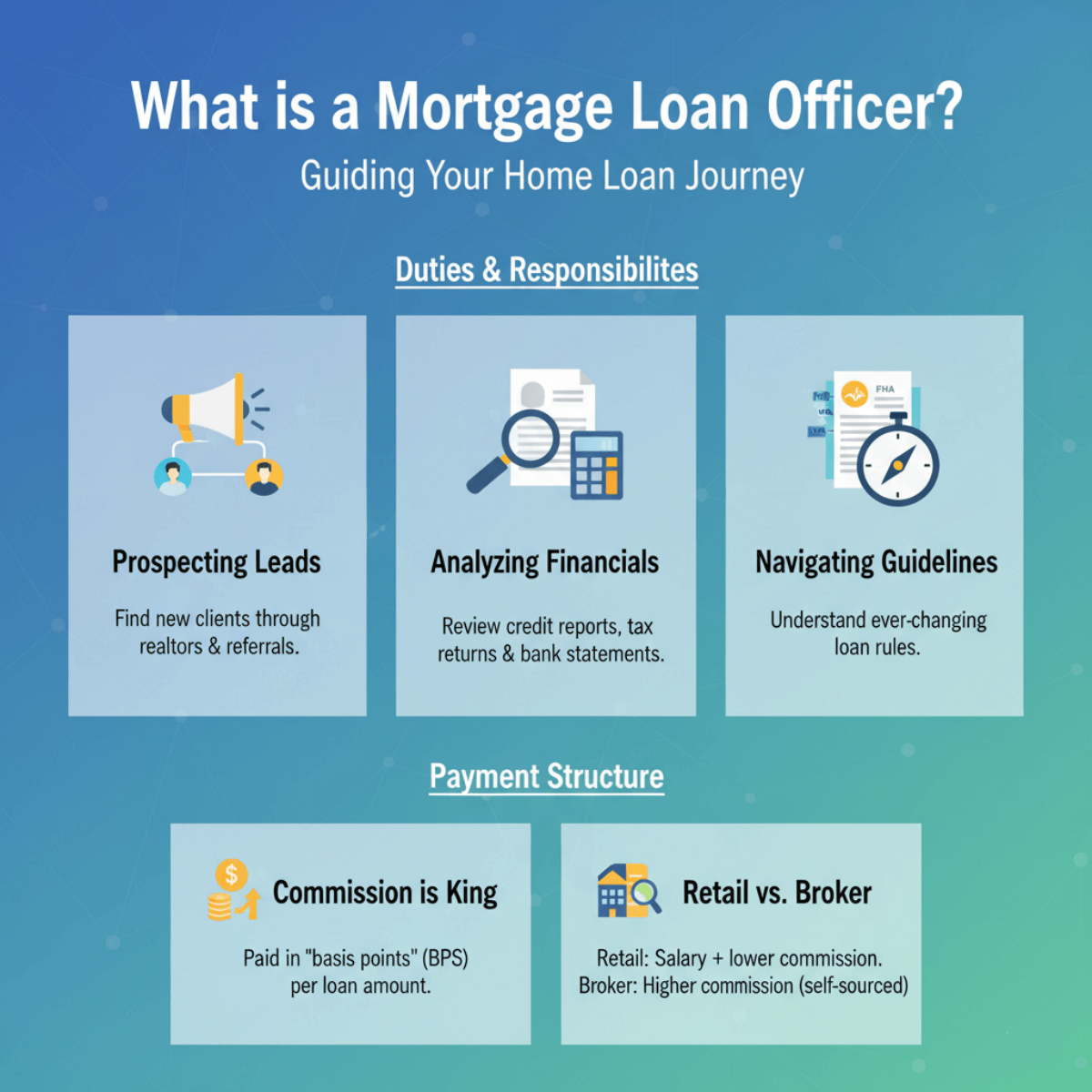
  • Prospecting Leads: This is the lifeblood of the job. You need to constantly find new clients through realtors, builders, and past referrals.
  • Analyzing Financials: You'll spend hours digging through credit reports, tax returns, and bank statements to determine eligibility.
  • Navigating Guidelines: This is the tricky part. You must understand the ever-changing rules for Fannie Mae, FHA, VA, and Non-QM loans to structure deals that actually close.
  • Ensuring Compliance: One mistake here can kill a deal or cost you your license. You manage the file from the application to the closing table.

Payment Structure

This is where the magic (and the stress) happens. Most MLOs don't work for a flat salary.

  • Commission is King: We are typically paid in "basis points" (BPS). For example, if your commission is 100 bps on a $500,000 loan, you make $5,000.
  • Retail vs. Broker: Retail lenders often offer a small base salary plus lower commission (e.g., 50-80 bps) and provide some leads. Mortgage brokers usually offer zero base salary but much higher commission (e.g., 100-200+ bps) because you hunt your own food.
  • The "Draw": Some companies offer a "draw against commission," meaning they advance you a monthly paycheck, but you have to pay it back from your future commissions.
What is a Mortgage Loan Officer?

Average Loan Officer Salary and Income

Every platform gives you a different number because they average out the top producers with the part-timers. Context is everything. Geography also plays a massive role. Higher home prices mean bigger loan amounts and fatter commission checks.

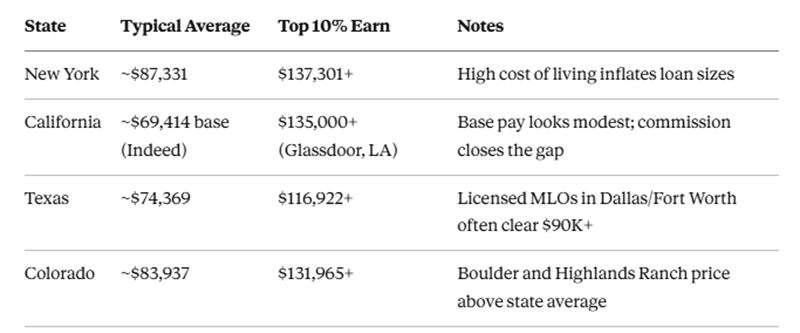
According to recent data, the top 5 highest-paying states for loan officers in 2024-2025 often include high-cost areas like New York, California, Massachusetts, Washington, and Colorado.
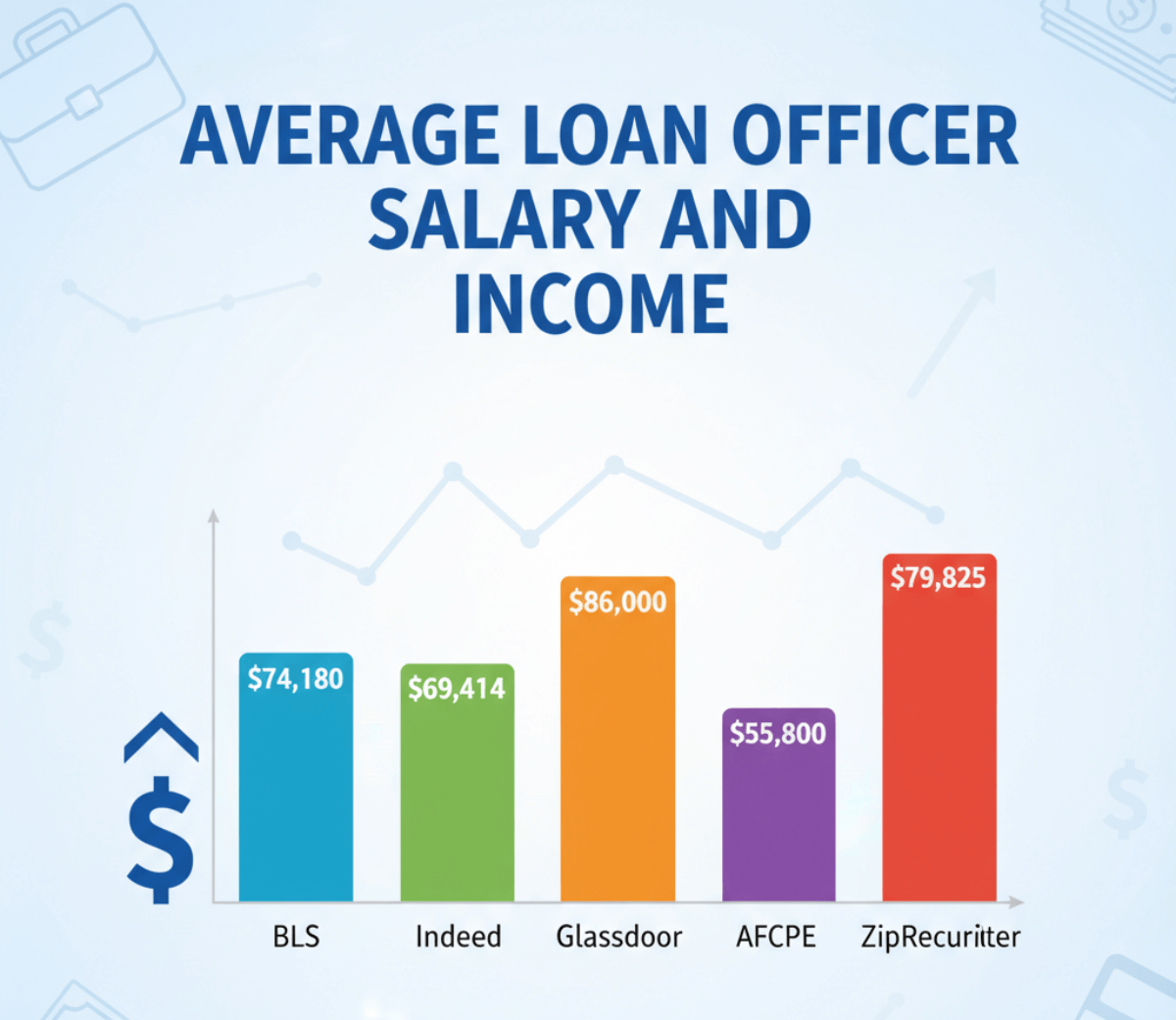
Average Loan Officer Income

U.S. Bureau of Labor Statistics

The BLS tends to be the most conservative source. For May 2024, they reported a median annual wage of $74,180 for loan officers.

However, keep in mind that the BLS lumps "Mortgage Loan Officers" in with general "Loan Officers" who might work 9-to-5 at a local bank branch, handling auto loans. That drags the average down. Specialized MLOs who hustle often see numbers significantly higher than this median.

Indeed

Indeed's data is often more reflective of current job postings. For late 2025 in a high-volume market like California, the average base salary is reported to be around $69,414, but this is misleading without commission.

When you factor in commission-heavy roles, Indeed listings for "Top Loan Officers" or "Licensed MLOs" often show earning potential ranging from $88,000 to well over $120,000 annually, depending on volume.

Glassdoor

Glassdoor gives us a better look at "Total Pay." For a major metro area like Los Angeles, reports in late 2025 suggest an average total compensation of around $86,000, with a very wide range.

The "Additional Pay" (commission/bonuses) component is huge here. Glassdoor data indicates that while the base might be modest, the top earners (90th percentile) in these hubs are clearing $135,000+, proving that experience and a strong pipeline make all the difference.

AFCPE

The Association for Financial Counseling & Planning Education (AFCPE) provides a broader view of financial professionals. Their data for December 2025 suggests a national average for Mortgage Loan Officers around $55,800, with top earner scrossing $104,000.

Interestingly, they highlight a massive disparity by state. For example, their data shows Texas MLOs averaging higher than the national mean, while other regions lag, reinforcing that your zip code dictates your paycheck.

ZipRecruiter

ZipRecruiter is great for seeing the spread between "Entry Level" and "Pro." As of December 2025, they see a national average of roughly $79,825.

But look at the percentile spread: the 25th percentile (newbies) is around $52,000, while the 75th percentile is nearly $100,000. If you are in the top 10% of earners, you are looking at $125,500+. This gap proves that in this industry, you eat what you kill.

How Do Mortgage Loan Officers Get Paid?

Understanding how the money hits your account is as important as how much.

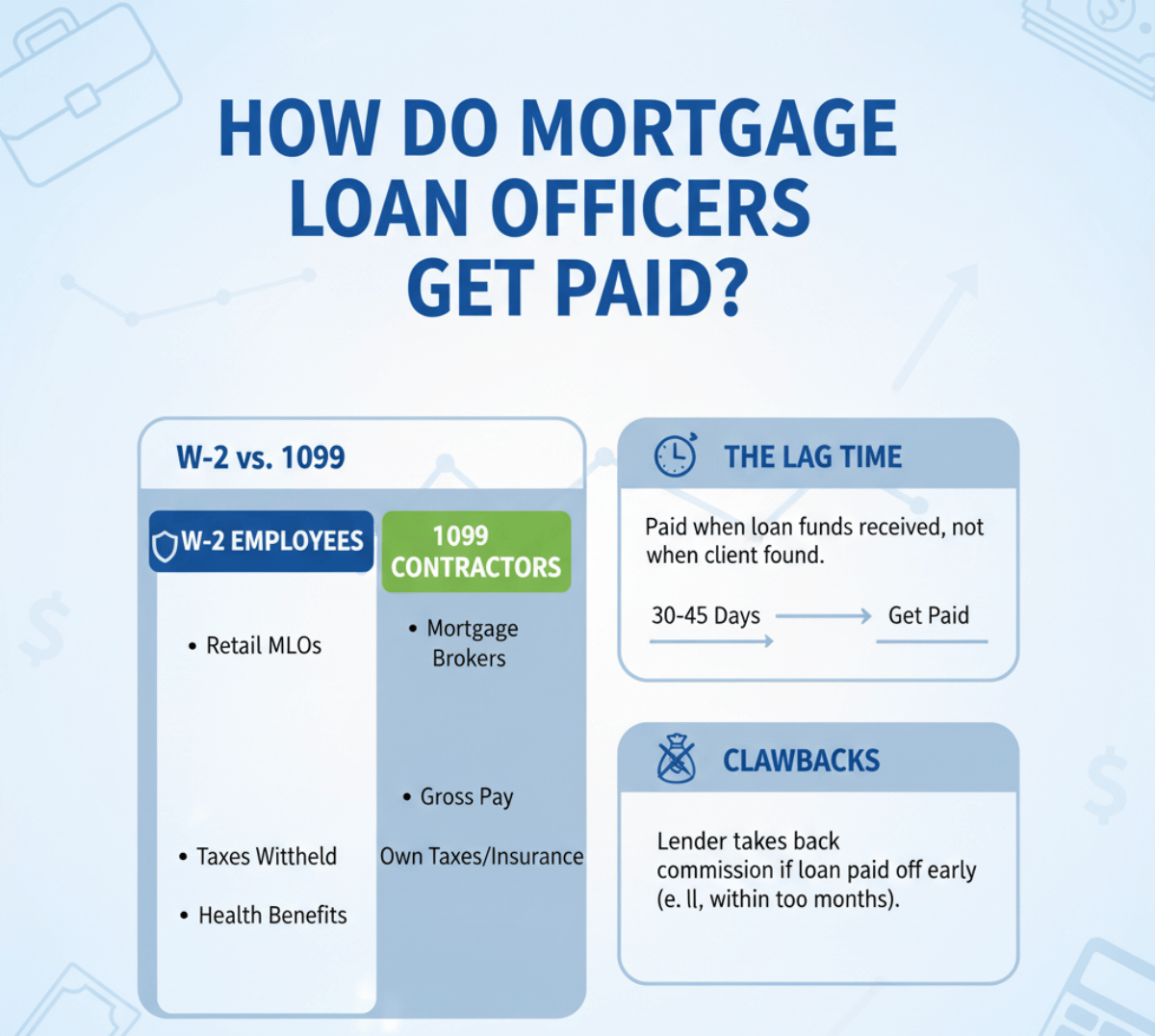
  • W-2 vs. 1099: Most retail MLOs are W-2 employees, meaning taxes are withheld, and you might get benefits like health insurance. Mortgage Brokers are often 1099 independent contractors. You get the gross check, but you pay your own taxes and health insurance.
  • The Lag Time: You don't get paid when you find a client. You get paid when the loan funds are received. This means you might work for 30-45 days on a deal before seeing a dime.
  • Clawbacks: If a borrower pays off their loan too early (usually within 6 months), the lender might take back your commission. It's painful, but it happens.
How to Become a Mortgage Loan Officer?

Getting into the industry is straightforward, but staying in is the hard part. Here's how to become a mortgage loan officer.

  • Meet the Criteria: You generally need to be 18+ and pass a background check (credit issues can be a blocker).
  • Pre-Licensure Education (PE): You must complete 20 hours of NMLS-approved education.
  • Pass the SAFE Exam: This is the big hurdle. It covers federal law, ethics, and non-traditional mortgage lending.
  • Find a Sponsor: You can't just hold a license. A lender or broker must employ (sponsor) you to activate it.

Is it hard to make it as a loan officer? Yes. The washout rate is high. Many new LOs quit in the first year because they underestimate the difficulty of building a referral network from scratch while surviving months without a commission check.

Is a Mortgage Loan Officer a Good Career?

If you ask me, absolutely, but only for a specific type of person.

It is not for those who crave safety and a guaranteed 9-to-5 paycheck. It is highly cyclical. When interest rates drop in 2026, you feast. When rates rise, you famine.

However, if you are a self-starter who loves solving puzzles and helping people achieve homeownership, the ceiling is non-existent. You can earn more than doctors without the student loan debt. It offers incredible flexibility and the chance to build a business within a business.

Tip: How to Improve Your Income As a Loan Officer?

Here is the secret top producers know: Income = Volume × Efficiency.

You can't manufacture more hours in the day. To break through the income ceiling, you have to stop doing manual grunt work and start using tools that multiply your effort. This is where leveraging platforms like Zeitro and Bluerate changed the game for me.

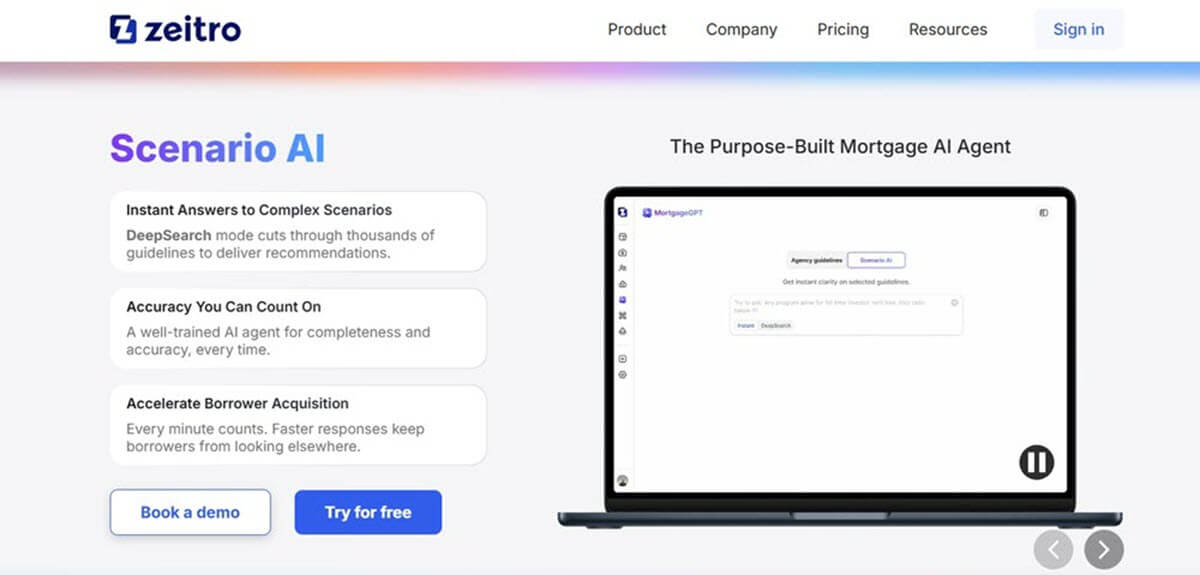
  • Stop "Pdf-Diving": I used to waste hours manually searching through Fannie Mae or Freddie Mac guidelines to see if a weird borrower scenario would fly. Now, I use Zeitro's Scenario AI. It lets me ask complex questions (even for Non-QM) and get instant, cited answers. This saves me 5+ hours a week that I can spend selling.
  • Speed Kills: In this market, speed is your differentiator. Zeitro's platform helps deliver 2.5x faster pre-qualifications. When a realtor knows you can get a solid pre-qual letter out in minutes, not hours, they send you the leads, not your competitor.
  • Accuracy is Cash: There is nothing worse than a loan dying in underwriting because you miscalculated income. Zeitro's AI Income Calculation tools increase accuracy to 85%+, helping you close 30% more loans.
  • Get More Leads Automatically: Finding borrowers is the hardest part. Bluerate is a marketplace designed to fix this. You can create a free personal profile that showcases your expertise. Unlike buying cold leads, Bluerate uses SEO to put you in front of borrowers actively searching for rates in your area.
  • Build Trust with Transparency: Borrowers today are skeptical. Bluerate allows you to offer real-time, personalized rate quotes (not fake teaser rates) and use an Affordability Calculator. This transparency builds trust before you even pick up the phone.
  • Focus on High-Value Work: By letting AI handle the document review and guideline checking (Zeitro) and letting the marketplace bring you warm leads (Bluerate), you focus 100% on closing. That is how you double your income.
Zeitro

Conclusion

So, how much do loan officers make? The answer is largely up to you. You can be the median earner making $70k, or you can be the top producer clearing $200k+.

The difference isn't usually talent. It's tenacity and technology. The market in 2026 rewards those who are efficient. If you are ready to embrace the grind and equip yourself with the right tools like Zeitro to streamline your workflow, this career can be life-changing. Don't just work hard, work smart.

People Also Read

Keep reading

Conventional Mortgage Guidelines: What and How to Check Quickly?

Blog

5 min read
Arrow icon on dark background
Conventional Mortgage Guidelines: What and How to Check Quickly?
Struggling with lender overlays? Access the latest Conventional loan requirements and verify 300+ guidelines in seconds with Zeitro's Scenario AI. No more guesswork.

I've lost count of how many times a deal has stalled because of a minor guideline nuance I missed during pre-approval. In our industry, speed is currency, but accuracy is survival. As Loan Officers and processors, we juggle massive PDF guides from Fannie Mae and Freddie Mac, not to mention the specific overlays from every wholesaler we work with.

Scanning through thousands of pages to verify a DTI exception or a self-employment calculation is no longer efficient. This is where technology shifts the landscape. I've recently started utilizing Zeitro's Scenario AI, a specialized assistant that allows me to verify complex Conventional Mortgage Loan Guidelines via a simple chat interface. It streamlines the research process, ensuring I have the right answers before I even submit the file to underwriting.

What are the Guidelines for a Conventional Loan?

A "conventional loan" is simply any mortgage that is not insured or guaranteed by the federal government (unlike FHA, VA, or USDA loans). However, just because the government doesn't back them doesn't mean they lack rules.

The baseline standards are established by the two Government-Sponsored Enterprises (GSEs):

  • Fannie Mae (governed by its Selling Guide)
  • Freddie Mac (governed by its Seller/Servicer Guide)

These agencies set the floor for credit scores, down payments, and income requirements. However, here is where many newer LOs get tripped up: The Agency Guidelines vs. Lender Overlays.

While Fannie Mae might accept a 620 credit score, a specific lender might require a 640 to buy that loan. This is called an "overlay." Understanding conventional guidelines means understanding both the agency rulebook and the stricter rules your specific lender might impose to manage their risk.

What are the Guidelines for a Conventional Loan?

Who Do Conventional Mortgage Loan Guidelines Apply To?

These guidelines act as the rulebook for two distinct groups in the mortgage ecosystem.

The Borrowers

The rules shift dramatically based on occupancy and intent.

  • Primary Residence: Offers the most lenient terms (lowest down payment, best rates).
  • Second Home: Stricter reserves and down payment requirements.
  • Investment Property: The most scrutiny. Guidelines here demand higher credit scores and significant equity (often 15-25% down).

Lenders and Underwriters

For my colleagues in underwriting, following these guidelines isn't optional, it's mandatory for the loan's salability. If an underwriter approves a loan that deviates from agency rules without a proper waiver, that loan becomes "unsalable" on the secondary market. This creates "repurchase risk," where the lender is forced to buy the bad loan back. This is exactly why lenders apply overlays, to create a safety buffer above the minimum agency requirements.

Conventional Loan Requirements 2026

As we navigate the market in 2026, the fundamentals of conventional lending remain anchored in risk assessment, though we are seeing slight adjustments in loan limits and automated verifications.

Conventional Loan Requirements 2026

Credit Score Requirements

The minimum FICO score for most conventional loans is 620 (e.g., via DU Approve/Eligible for fixed-rate purchases), though manual underwriting and some products require 660+. However, purely hitting 620 doesn't guarantee a favorable approval.

Your borrower's credit score directly impacts the Loan-Level Price Adjustments (LLPAs), which determine the interest rate and the cost of Private Mortgage Insurance (PMI). While I have seen Desktop Underwriter (DU) approve scores slightly below 620 in rare cases with massive compensating factors, most lenders will not touch them due to overlays. For the best pricing and ease of underwriting, a score of 740+ is still the "gold standard" in 2026.

Debt-to-Income (DTI) Guidelines

The standard manual underwriting benchmark is 36% for housing ratios and 45% for total debt. However, in the real world, we rely heavily on the Automated Underwriting System (AUS).

If the rest of the file is strong, DU or LPA often return an "Approve/Eligible" finding with a DTI as high as 50%. To stretch to this upper limit, you usually need compensating factors. These are positive attributes that offset the risk of high debt, such as significant cash reserves (6+ months of payments), a long job history, or a large down payment. Without these, capping at 45% is the safe bet.

Down Payment Rules

One of the biggest myths I still bust daily is the "20% down" requirement. In 2026, the guidelines are quite flexible:

  • 3% Down: Available for first-time homebuyers or those qualifying for programs like HomeReady or Home Possible.
  • 5% Down: The standard minimum for most repeat buyers on primary residences.
  • 20% Down: Not required for approval, but required to avoid Private Mortgage Insurance (PMI).

For multi-unit properties (2-4 units), the minimum down payment jumps significantly (often 15-25%), so always double-check the specific matrix for those scenarios.

Income and Employment Verification

Consistency is king. Underwriters are looking for a two-year history of stable income.

  • W-2 Employees: Generally straightforward, requiring recent pay stubs and W-2s.
  • Self-Employed: This is where deals often die. Both agencies require two years of personal and business tax returns. One year is rarely accepted, even via LPA, without exceptional compensating factors.

The logic here is stability. If a borrower has a history of gaps in employment or declining income year-over-year, the guidelines require a deeper explanation or disqualification, regardless of how much money they made last month.

Property Eligibility Guidelines

Not every roof and four walls qualifies for a conventional mortgage.

  • Eligible: Single-family homes, PUDs, warrantable condos, and 2-4 unit properties.
  • Ineligible: Timeshares, houseboats, condo-hotels, or properties with major health and safety violations (e.g., mold, structural damage).

I always remind clients that the appraisal isn't just about value. It's about the property's condition. If a home is deemed "unsafe or unsound," conventional guidelines mandate that repairs be completed before closing.

Mortgage Insurance (PMI) Guidelines

If your borrower puts down less than 20%, they must carry Private Mortgage Insurance (PMI). This protects the lender, not the borrower.

The crucial advantage of Conventional loans over FHA is that PMI is temporary. Once the loan-to-value (LTV) ratio drops to 77.9% (automatically) or 80% (by borrower request with appraisal), PMI can be removed. In contrast, FHA MIP is cancelable after 11 years for most loans with LTV ≤90%, though upfront and annual premiums apply. This exit strategy makes conventional loans far more attractive for borrowers with good credit.

How to Verify Conventional Mortgage Guidelines Quickly?

In a perfect world, we would all have the Fannie Mae Selling Guide memorized. In reality, guidelines change, and referencing them manually is a massive time sink.

This is why I've integrated Zeitro's Scenario AI into my workflow. It is an AI-powered mortgage guideline assistant specifically designed for QM and Non-QM verifications. Rather than digging through PDF overlays from 15 different investors, I can simply ask the chat interface a specific question.

Why I find it indispensable:

  • Handling Complexity: I can ask vague questions like "Can I use rental income from a departing residence?" or specific ones about LTV limits.
  • Citations & Trust: As pros, we can't just trust a robot. Zeitro provides citations for its answers. It links back to the source material so I can verify the data myself. This is critical for E-E-A-T and compliance.
  • Coverage: It covers nearly 300 guidelines, including 57 Conventional guides and major lenders like Freedom Mortgage and AD Mortgage.
  • Speed: It scans these documents in seconds.
Scenario AI

If an answer is unclear, the Explain feature lets me dig deeper without starting over. For roughly $8 a month, it saves me hours of "ctrl+f" searching and reduces the human error of missing a recent overlay update.

FAQs About Conventional Mortgage Guidelines

Q1. What does a conventional mortgage mean?

It means the loan is funded by a private lender and sold to Fannie Mae or Freddie Mac, without government insurance (like FHA or VA).

Q2. Do all conventional mortgages require 20% down?

No. First-time buyers can put down as little as 3%, and repeat buyers can put down 5%. 20% is only required to avoid PMI.

Q3. What are the qualifications for a conventional mortgage?

Generally, you need a credit score of at least 620, a verifiable two-year income history, and a Debt-to-Income (DTI) ratio under 45% (sometimes up to 50% with AUS approval).

Q4. What disqualifies a home from a conventional loan?

Properties with significant structural issues, safety hazards, or "non-warrantable" condo features (like operating as a hotel) will be disqualified.

Q5. Are conventional mortgage guidelines the same for all lenders?

No. While the base rules are the same, lenders add "overlays." One lender might accept a 620 score, while another requires 640 for the same loan program.

Q6. Can conventional guidelines change year to year?

Yes. Loan limits (the maximum amount you can borrow) usually increase annually, and underwriting rules regarding credit or income calculation can change based on economic conditions.

Q7. How do lender overlays affect conventional loan approval?

Overlays make approval harder. Even if you meet Fannie Mae's minimums, you must also meet the stricter specific rules of the bank lending you the money.

Q8. What is the difference between FHA and conventional guidelines?

FHA is more lenient on credit scores (down to 580) and high DTI, but requires permanent mortgage insurance. Conventional requires better credit but offers lower costs and cancelable PMI.

Conclusion

Navigating conventional mortgage guidelines is not about memorizing every rule. It's about knowing where to find the right information fast. Remember, Guidelines ≠ Guaranteed Approval. A borrower might look good on paper but fail due to a specific lender overlay or a property issue.

To reduce the trial-and-error and prevent awkward denials days before closing, you need to verify rules upfront. I highly recommend trying Zeitro's Scenario AI. It allows you to check specific scenarios against hundreds of lender guidelines instantly. With free daily queries and a low entry cost, it's a high-ROI tool for any serious Loan Officer. Don't guess—verify.

People Also Read

Should Mortgage Lender and Broker Build In-House AI Tools?

Blog

5 min read
Arrow icon on dark background
Should Mortgage Lender and Broker Build In-House AI Tools?
Build vs Buy Mortgage AI in 2026: Discover 6 critical risks here to see whether it's worth building in-house AI tools.

If you are reading this, you are likely a mortgage executive or brokerage owner facing a massive decision. You feel the pressure, the Fear Of Missing Out (FOMO), gnawing at you. You see competitors leveraging automation, and your instinct says, "We need to own this technology. We need to build our own AI".

I have sat in those boardrooms. I understand the allure of owning your intellectual property. But before you sign off on a multimillion-dollar R&D budget, we need to have a brutally honest conversation. For 99% of lenders and brokers, attempting to build a proprietary AI engine in-house is not just a headache. It is a strategic trap that leads to wasted capital and "zombie" projects.

The State of Mortgage AI in 2026: Efficiency & Speed

To understand why building is so risky, you first need to understand the standard that has already been set by specialized SaaS providers. In 2026, AI isn't just a chatbot on your website. It is the engine room of the loan origination process.

Take Zeitro as a prime example of the current market benchmark. This isn't a theoretical tool. It is a specialized AI SaaS platform built specifically for US Loan Officers (LOs) and brokers. The efficiency metrics they are delivering right now are staggering:

  • 2.5x faster pre-qualifications.
  • Elimination of 100% of manual guideline lookup work.
  • Saving 7+ hours per loan file.
  • Increasing loan closes by 30%.

Their flagship feature, Scenario AI, essentially functions as a super-underwriter. It supports both QM and Non-QM loans, allowing LOs to ask vague or complex questions and get instant, citation-backed answers from Fannie Mae, Freddie Mac, VA, and niche lender guidelines.

Scenario AI

Here is the reality check: Building a tool like Scenario AI took a dedicated team of experts over six months of rigorous development, data cleaning, and testing. It involved ingesting thousands of PDF pages and fine-tuning models to avoid hallucinations. Do you truly have the time to pause your business operations for half a year to replicate what already exists?

6 Strategic Risks of Building In-House Mortgage AI

If you are still tempted to hire a dev team and build your own "Proprietary Underwriting Bot," you need to consider the six major hurdles that kill most internal AI projects before they ever process a single loan.

  1. Insufficient AI Expertise and Production Readiness

There is a massive difference between building a prototype that works on a laptop and a scalable system that works for your entire branch network. Most lenders are experts in risk assessment, not MLOps (Machine Learning Operations).

The biggest silent killer of these projects is data quality. As a lender, you have data, but it is likely "messy", such as unstructured PDFs, email threads, and siloed CRM notes. According to recent industry observations and echoed by Gartner, a lack of "AI-ready data" is the primary reason AI projects fail. Without a team of data engineers to clean and structure this information 24/7, your expensive AI model will simply output garbage. You risk building a tool that gives your LOs wrong guideline advice—a compliance nightmare.

  1. High AI Talent Costs and Hiring Barriers

Let's talk numbers. You cannot build a competitive AI tool with just one "IT guy". To build something comparable to Zeitro, you would need a full squad: 2–5 Machine Learning Engineers, 1–3 Data Scientists, plus Backend Developers and a Product Manager.

In the US market, this talent is incredibly expensive. Data from platforms like Glassdoor and Levels.fyi shows that ML Engineers command salaries significantly higher than traditional software developers, often exceeding $600k per year per person. When you factor in benefits and overhead, a "Minimum Viable Product" (MVP) team could easily cost $1 million to $2 million annually. Compare that to the cost of a SaaS subscription, and the math starts to look terrifying.

  1. Weak ROI from Limited Scale and Ongoing Maintenance

This is a lesson in unit economics. A SaaS company like Zeitro spreads its development costs across thousands of users. If they spend $5 million on R&D, it costs you pennies. If you build in-house, 100% of that cost sits on your P&L.

Furthermore, AI is not a "set it and forget it" asset. Models suffer from "drift". They degrade over time as the world changes. You need a permanent team to monitor performance, retrain models, and fix bugs. This creates "Technical Debt". As noted in AWS MLOps frameworks, the initial code is just the tip of the iceberg. The massive bulk of the work is ongoing maintenance. For a mid-sized lender, the ROI simply isn't there because you don't have the user volume to justify the perpetual expense.

  1. High Talent Churn in a Competitive AI Market

Even if you have the budget to hire a genius AI Lead, can you keep them? In 2026, you aren't just competing with other lenders for talent. You are competing with Google, Meta, and high-frequency trading firms.

Reports from financial news outlets like FNLondon have highlighted that hedge funds and tech giants are offering astronomical packages to poach top AI engineers. If your lead engineer leaves six months into the project for a double-salary offer, your project dies. You are left with "zombie code" that no one at your company understands how to fix or update. This continuity risk is a danger most mortgage CEOs underestimate.

  1. Rapid AI Innovation and Model Obsolescence Risk

The speed of AI evolution is blinding. New Large Language Models (LLMs) and architectures are released every few months. Dedicated AI companies pivot instantly to integrate these advancements.

If you build in-house, your team will likely spend a year building on "last year's technology". By the time you launch, your tool is already obsolete compared to what's available on the open market. According to Gartner surveys on GenAI deployment, organizations that "buy" or partner are finding value much faster than those trying to build foundational models themselves. You don't want to be the company holding the bag on a legacy system that can't keep up with the latest Non-QM guideline updates.

  1. High Failure Rates from Pilot to Production

Finally, we must look at the statistics. The failure rate for taking AI projects from "Pilot" (testing) to "Production" (real-world use) is notoriously high. It takes an average time of 8.6 months to develop from prototype to production, but only 53% succeeds in mature organizations.

Many in-house tools get stuck in "Pilot Purgatory". They work great in a controlled demo, but when real LOs try to use them for complex, messy loan scenarios, the tool breaks or hallucinates. For a SaaS provider, a failed feature is a bad quarter. For a lender, a failed $2M internal project is a disaster that can cost executives their jobs.

When Does Building In-House Actually Make Sense?

To be fair, there is a 1% exception. Building in-house might be justified if you meet a very strict set of criteria:

  1. Massive Scale: You are a top 5 national lender processing volumes that justify a permanent, multi-million dollar R&D department.
  2. Proprietary Data Advantage: You possess unique, proprietary data that no competitor has, which gives you an edge beyond standard agency guidelines.
  3. Mature Governance: You already have a mature Data Governance and MLOps structure in place.

If you cannot check all three of these boxes, the building is vanity, not strategy.

Build vs. Buy: The Mortgage AI Cost-Benefit Analysis

Let's look at the direct comparison.

Build vs. Buy: The Mortgage AI Cost-Benefit Analysis

Conclusion

In the mortgage business, your competitive advantage comes from your relationships, your service speed, and your ability to close tough deals. It does not come from being a mediocre software development shop.

The risks of building in-house, like runaway costs, talent churn, and technical obsolescence, are simply too high. Instead of distracting your leadership team with software engineering problems, leverage specialized partners like Zeitro. They have absorbed the R&D risk, so you don't have to.

Smart lenders aren't the ones building the AI. They are the ones adopting it fastest. Save your capital, protect your margins, and let the experts handle the code while you handle the loans.

People Also Read

Blog

5 min read
Arrow icon on dark background
What Are FHA Mortgage Guidelines? How to Verify FHA & Overlays Quickly?
Need quick answers on FHA loans? Get instant, cited verifications for HUD rules and lender overlays with Zeitro. The ultimate tool for mortgage pros. Start for free.

We have all been there. You have a borrower who fits the FHA box on paper—580 credit score, steady job, ready to buy. But then you submit the file, and the underwriter kicks it back because of a specific "lender overlay" you missed in the fine print. It's frustrating, time-consuming, and frankly, it kills deals.

In 2026, the volume of guidelines we have to navigate is overwhelming. Between the massive HUD Handbook 4000.1 and the individual rulebooks of every wholesaler, manually verifying eligibility is becoming impossible. That is why I started using Zeitro's Scenario AI. It acts like a digital underwriting assistant, allowing me to verify FHA guidelines and specific lender overlays through a simple chat interface. It turns hours of PDF searching into seconds of verification.

What Are FHA Mortgage Guidelines?

To navigate this landscape, we first need to respect the source. FHA Mortgage Guidelines are the official rules set forth by the Department of Housing and Urban Development (HUD). These are the "Constitution" of FHA lending, primarily housed in the HUD Handbook 4000.1 (Single Family Housing Policy Handbook).

These guidelines dictate the minimum standards for a loan to be insured by the federal government. They cover everything from borrower creditworthiness to property safety standards (Minimum Property Standards or MPS).

The Critical Distinction: It is vital for us as professionals to distinguish between "FHA Guidelines" and "FHA Loan Requirements."

  • FHA Guidelines: The official, technical rules written by HUD for lenders (e.g., how to calculate effective income).
  • FHA Loan Requirements: The tangible targets a borrower sees (e.g., "I need a 3.5% down payment").

While consumers focus on the requirements, our job as Loan Officers (LOs) and Processors is to master the guidelines that dictate how those requirements are met.

What Are FHA Mortgage Guidelines?

Who Do FHA Guidelines Apply To?

Many clients assume these rules are just for them, but we know the reality is much broader. The guidelines create a chain of liability that affects every professional touching the file:

  • Lenders (Mortgagees): Specifically, Direct Endorsement (DE) lenders. They must ensure every file meets HUD standards to maintain their insurance endorsement. If they fail, they face indemnification requests.
  • Underwriters: They are the gatekeepers. They must sign off that the borrower's income, assets, and credit history align strictly with Handbook 4000.1.
  • Appraisers: They aren't just valuing the home. They are inspecting it for health and safety issues as defined by HUD.
  • Mortgage Brokers: We are the front line. We must structure the deal correctly from day one so it survives the underwriting scrub.

FHA Loan Requirements 2026

For 2026, the baseline requirements remain accessible, but we are seeing stricter scrutiny on income stability. Here is the current snapshot you need to know for your files:

Credit Score & Down Payment:

  • 580+ FICO: Eligible for maximum financing (3.5% down payment).
  • 500–579 FICO: Requires a 10% down payment (Harder to place due to overlays).

Debt-to-Income (DTI) Ratios: The standard manual underwriting benchmark is 31%/43% (front-end/back-end) with no compensating factors. Limits increase to 37%/47% (one factor) or 40%/50% (two+ factors). With AUS Approve/Eligible, total DTI can reach up to 56.99% even without manual comp factors.

Mortgage Insurance (MIP):

  • Upfront MIP: 1.75% of the loan amount (can be financed).
  • Annual MIP: Typically 0.55% for loans ≤ $726,200 with LTV >95% (>15-year term), but varies (e.g., 0.50% for 90.01-95% LTV, 0.15%-0.75% overall by LTV/term/amount), paid monthly.

Property Condition: The home must be safe, sound, and secure. Peeling paint (pre-1978) or safety hazards are deal-breakers until fixed.

FHA Loan Requirements 2026

Why FHA Guidelines Are Often Confusing?

If the HUD Handbook is the "Constitution," then Lender Overlays are the local laws that confuse everyone. This is the single biggest pain point in our industry.

HUD might say a 580 credit score is acceptable. However, Lender A might require a 620, while Lender B demands a 640. These are "overlays"—additional rules imposed by lenders to minimize their risk.

This creates a chaotic environment where a borrower is "FHA Eligible" per the government, but "Ineligible" per the specific investor you are trying to sell the loan to. You aren't just memorizing one rulebook. You are juggling the invisible rules of dozens of different investors.

How Professionals Verify FHA Guidelines Efficiently?

This is where technology has finally caught up to our needs. I used to spend hours Ctrl+F searching through PDFs to find which lender would accept a specific credit event. Now, I use Zeitro's Scenario AI.

Scenario AI is a specialized Mortgage Guideline Assistant built for LOs and Underwriters. It doesn't just search the web. It searches a curated database of nearly 300 guidelines (including 42 specific FHA guidelines and 256 total QM/Non-QM rulebooks).

Here is why it has become my daily driver:

  • Deep Lender Coverage: It covers guidelines from over 15 mainstream lenders like Freedom Mortgage, AD Mortgage, and Nations Direct. If I have a tricky FHA file, I can verify it against multiple investors simultaneously.
  • Accuracy with Citations: In our business, "I think so" isn't good enough. When I ask Scenario AI a question, it provides the answer and cites the specific source (e.g., "Page 42 of AD Mortgage FHA Matrix"). This gives me the confidence to quote guidelines to my processors.
  • Complex Scenario Analysis: I can ask vague questions like, "Can I use 12 months bank statements for income on an FHA loan with a 580 score?" or specific ones about DTI caps. The AI parses the logic and gives a precise answer in seconds.
  • The "Explain" Feature: Sometimes a guideline is technically "correct" but practically confusing. I use the Explain feature to get a secondary breakdown of the rule, ensuring I understand the why behind the no.

At roughly $8/month, the ROI is undeniable. It saves me at least 3-4 hours of research a week.

Scenario AI

FAQs About FHA Mortgage Guidelines

Q1. Can FHA guidelines change year to year?

Yes. HUD issues Mortgagee Letters throughout the year that update or supersede sections of the 4000.1 Handbook. For example, recent updates in 2025/2026 adjusted how we calculate self-employment income add-backs.

Q2. Are FHA guidelines the same for every lender?

No. As mentioned, lenders apply overlays. While the core FHA insurance rules are universal, the credit score, DTI, and property standards can vary significantly from one lender to the next.

Q3. Can I qualify for FHA with past bankruptcy?

Yes. The standard waiting period is 2 years after a Chapter 7 discharge date (1 year with extenuating circumstances). For Chapter 13, 1 year of successful payout performance with court/trustee approval, or 2 years from discharge. However, you must have re-established good credit and have a clean payment history since the event.

Q4. What disqualifies you from an FHA?

The most common disqualifiers are CAIVRS hits (delinquency on federal debt like student loans), recent foreclosures (under 3 years), or property conditions that fail the safety/sanitary check.

Q5. Is it hard to get approved for FHA?

Generally, no. FHA is often more forgiving than Conventional loans regarding credit events and DTI. The "difficulty" usually comes from the stricter property appraisal and the documentation required for income.

Final Thoughts

FHA loans remain the bedrock of the American housing market, but for us as originators, the complexity of verifying guidelines across different lenders is a constant hurdle. The difference between a funded loan and a denial often comes down to knowing which investor allows that one specific exception.

We need to move away from manual research and embrace tools that offer speed and precision. Zeitro's Scenario AI has bridged that gap for me, handling everything from standard FHA questions to complex Non-QM scenarios. If you want to stop guessing and start verifying with confidence, I highly recommend giving it a try. You can even test it out with 3 free queries per day to see how much time it saves you.

Work smarter, not harder.

People Also Read

Try Zeitro today and transform your loan origination workflow!

Get started free