
Written by

Eric
Share this article

.svg)
Subscribe to updates
Last Checked and Updated on August, 2026
We've all been there. A borrower fits the FHA box on paper — 580 credit score, steady job, ready to buy. Then the file lands on an underwriter's desk and gets kicked back over one specific lender overlay buried in the fine print. It's frustrating, it's slow, and it kills deals that should have closed.
By 2026, the sheer number of rulebooks we have to juggle has gotten out of hand. Between the massive HUD Handbook 4000.1 and every wholesaler's own overlay sheet, checking eligibility by hand just isn't realistic anymore. That's the exact problem that pushed me toward Zeitro Strata AI. It works like a digital underwriting assistant — I type a question about an FHA scenario or a specific lender's overlay, and it answers through a simple chat interface, cited and sourced. What used to take an hour of PDF searching now takes seconds.
What Are FHA Mortgage Guidelines?
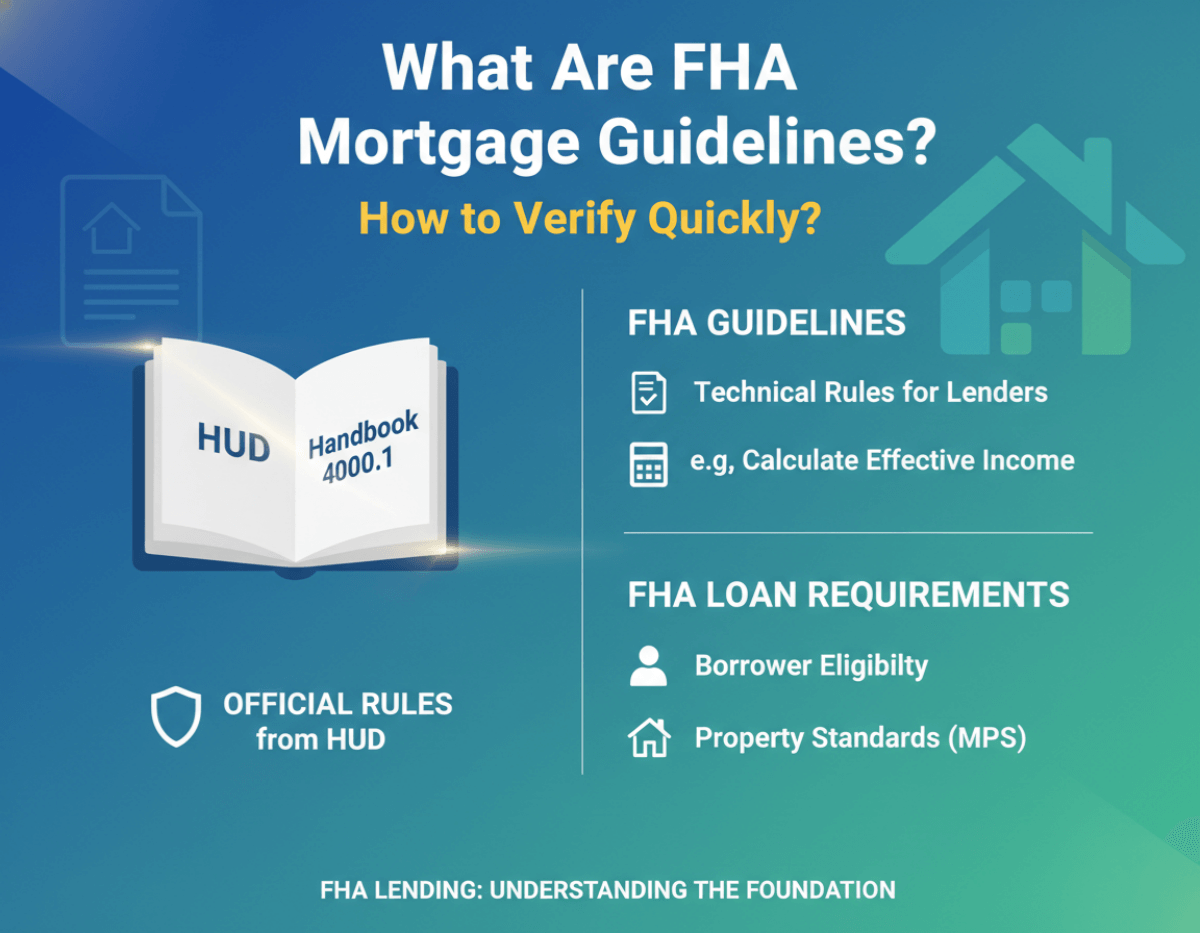
Let's start with the source. FHA Mortgage Guidelines are the official rules published by the Department of Housing and Urban Development (HUD). Think of them as the constitution of FHA lending, and they live mainly inside the HUD Handbook 4000.1 (Single Family Housing Policy Handbook).
These rules set the minimum standard a loan must meet before the federal government will insure it. That covers everything from how a borrower's credit gets evaluated to how safe the property has to be, which HUD calls Minimum Property Standards (MPS).
One distinction matters more than people realize: the difference between "FHA Guidelines" and "FHA Loan Requirements."
- FHA Guidelines are the technical instructions HUD writes for lenders — for example, exactly how to calculate a borrower's effective income.
- FHA Loan Requirements are what a borrower actually sees on the surface, like "I need 3.5% down."
Borrowers only care about the requirements. Our job as Loan Officers and processors is to understand the guidelines that sit underneath them, because that's where deals get won or lost.
Who Do FHA Guidelines Apply To?
Clients often assume these rules only affect them. In reality, the guidelines create a chain of responsibility that touches nearly everyone who works on the file:
- Lenders (Mortgagees): Direct Endorsement (DE) lenders in particular. They have to confirm every file meets HUD's standard to keep their insurance endorsement intact, or they risk an indemnification request down the road.
- Underwriters: The gatekeepers. They sign off that income, assets, and credit history all line up with Handbook 4000.1, no exceptions.
- Appraisers: They're not just pricing the home. They're checking it against HUD's health and safety standards too.
- Mortgage Brokers: We're the front line. If the deal isn't structured correctly from day one, it won't survive the underwriting review.
FHA Loan Requirements 2026
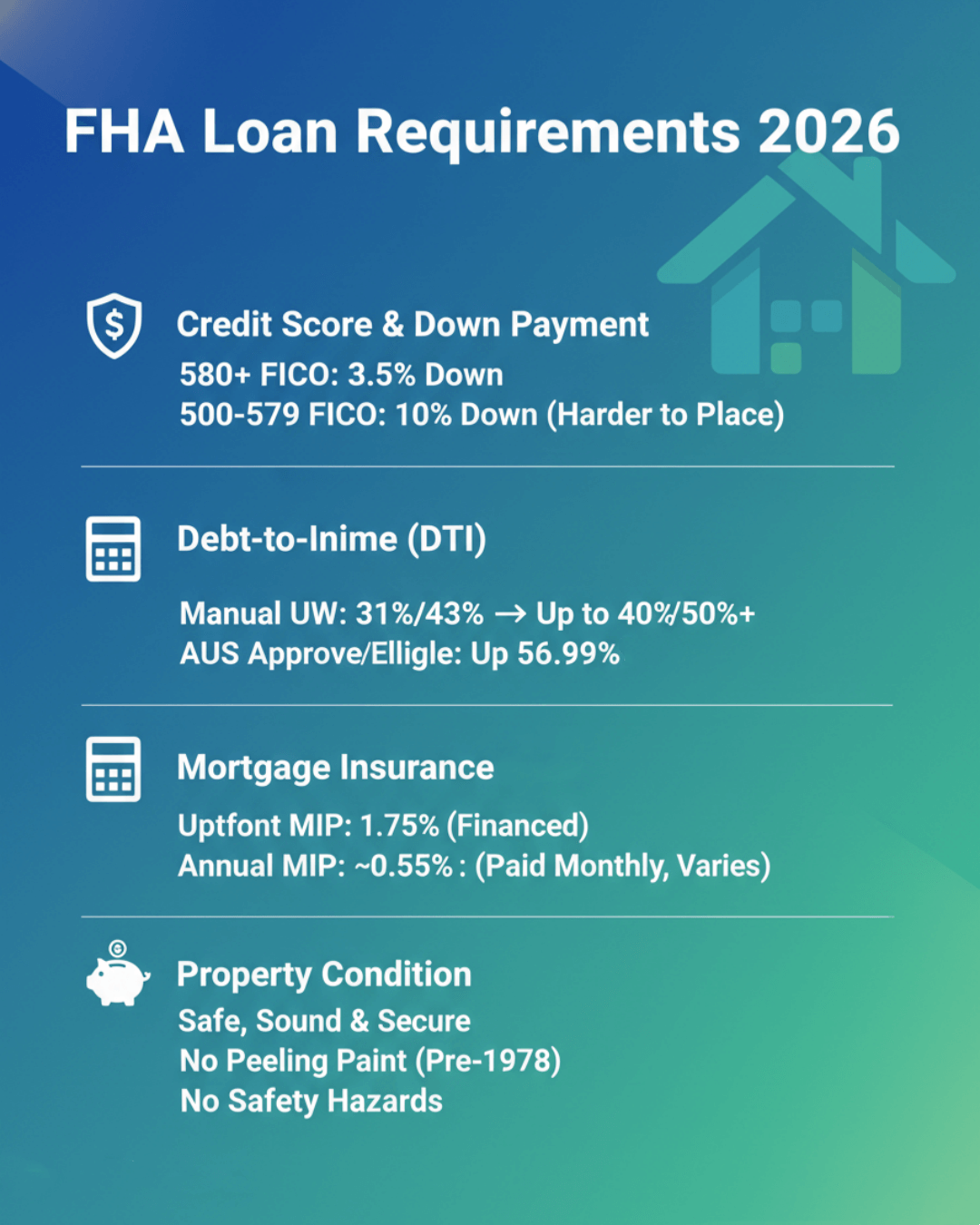
For 2026, the baseline requirements remain accessible, but we are seeing stricter scrutiny on income stability. Here is the current snapshot you need to know for your files:
Credit Score & Down Payment:
- 580+ FICO: Eligible for maximum financing (3.5% down payment).
- 500–579 FICO: Requires a 10% down payment (Harder to place due to overlays).
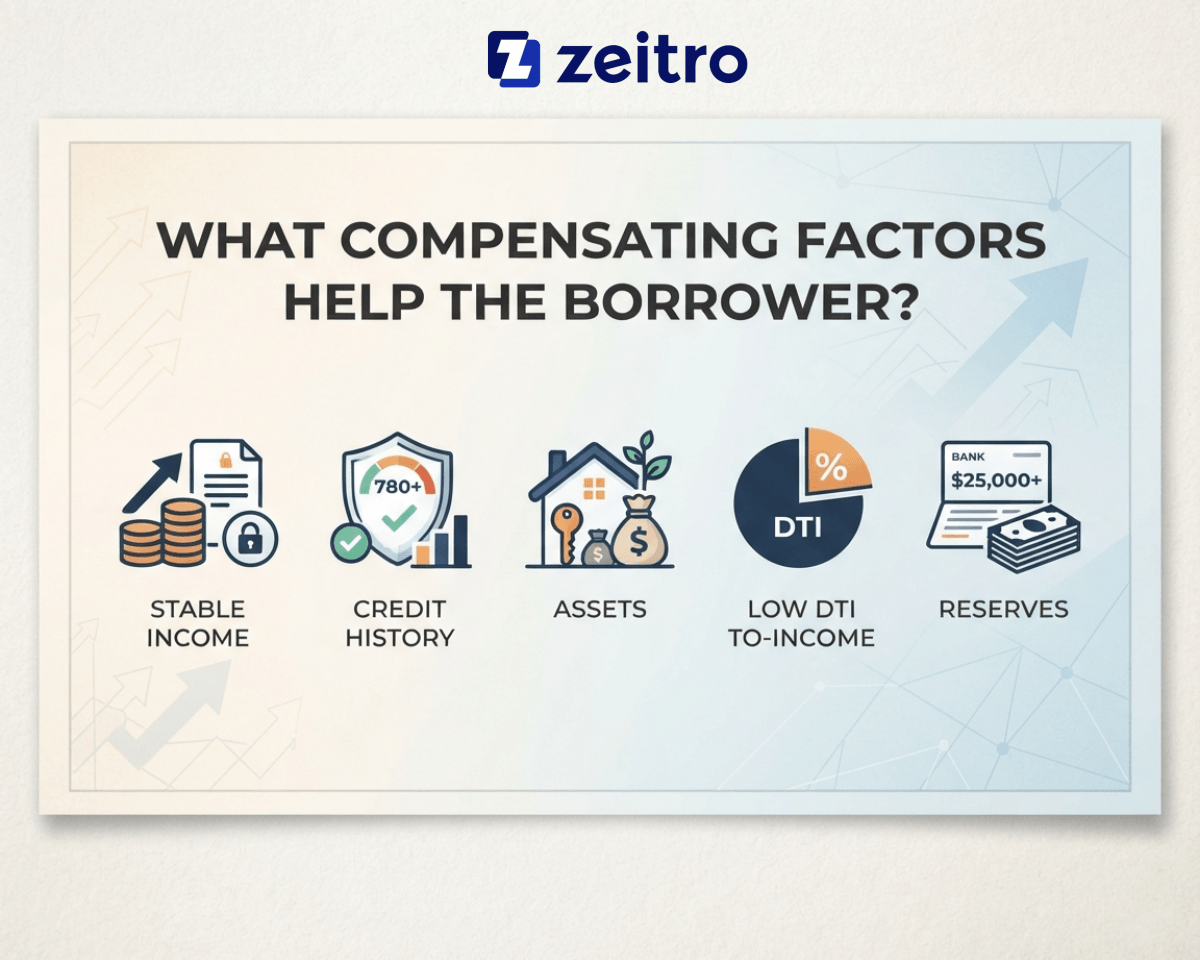
Debt-to-Income (DTI) Ratios: The standard manual underwriting benchmark is 31%/43% (front-end/back-end) with no compensating factors. Limits increase to 37%/47% (one factor) or 40%/50% (two+ factors). With AUS Approve/Eligible, total DTI can reach up to 56.99% even without manual comp factors.
Mortgage Insurance (MIP):
- Upfront MIP: 1.75% of the loan amount (can be financed).
- Annual MIP: Typically 0.55% for loans ≤ $726,200 with LTV >95% (>15-year term), but varies (e.g., 0.50% for 90.01-95% LTV, 0.15%-0.75% overall by LTV/term/amount), paid monthly.
Loan Limits: This is the piece a lot of guides skip. For 2026, FHA's national floor is $541,287 and the ceiling in high-cost areas is $1,249,125 for a one-unit property, both up roughly 3.26% from 2025. Multi-unit limits scale up from there. Because these figures are set county by county, I'd always run the borrower's specific county through HUD's lookup tool before quoting a number.
Property Condition: The home must be safe, sound, and secure. Peeling paint (pre-1978) or safety hazards are deal-breakers until fixed.
Also Read: How to Check Mortgage Eligibility? Quick and Accurate with Sources
What Credit Report and Score Model Does FHA Use?
This is a question I've fielded a lot more this year, and honestly, the answer is in the middle of changing. Historically, FHA has required a tri-merge credit report (all three bureaus) and scored borrowers using Classic FICO.
That started shifting in April 2026, when HUD confirmed that FHA will accept VantageScore 4.0 and FICO 10T as approved scoring models, alongside Classic FICO, following similar moves at Fannie Mae and Freddie Mac. The goal, according to HUD, is more competition in credit scoring and lower costs for borrowers over time.
Here's the part loan officers should actually remember: the tri-merge requirement isn't going away yet. HUD has said it will keep requiring all three bureau reports during this transition to protect consistent risk evaluation, with more detailed implementation guidance expected later in 2026. So if a borrower asks whether their FHA loan will suddenly be scored differently, the honest answer right now is "not yet, but watch this space."
FHA Student Loan Guidelines: What Actually Counts Toward DTI
This one trips up more first-time FHA borrowers than almost anything else I see, so it deserves its own section instead of a passing mention.
Since 2021, FHA has calculated student loan debt this way:
- If the credit report shows an actual monthly payment above $0, that documented payment is what counts toward DTI.
- If the credit report shows $0 (common for borrowers in deferment or an income-driven repayment plan), the lender counts 0.5% of the outstanding balance instead.
On a $60,000 balance with no reported payment, that works out to $300 a month counted against the borrower's DTI. It's a meaningful drop from the older 1% rule, but I still see loan officers quote the wrong number because they're working off outdated notes. If a borrower is parked in forbearance, it's worth double-checking their servicer statement rather than assuming the credit report is current.
Why FHA Guidelines Are Often Confusing?
If the HUD Handbook is the "Constitution," then Lender Overlays are the local laws that confuse everyone. This is the single biggest pain point in our industry.
HUD might say a 580 credit score is acceptable. However, Lender A might require a 620, while Lender B demands a 640. These are "overlays"—additional rules imposed by lenders to minimize their risk.
This creates a chaotic environment where a borrower is "FHA Eligible" per the government, but "Ineligible" per the specific investor you are trying to sell the loan to. You aren't just memorizing one rulebook. You are juggling the invisible rules of dozens of different investors.
Niche FHA Scenarios: When "Yes or No" Isn't Simple
Every loan officer eventually runs into an FHA question that isn't covered in the standard checklist. A few examples I get asked about regularly:
- Identity-of-interest transactions: When a sale happens between family members or existing business partners, FHA caps the loan-to-value at 85% on a principal residence, meaning a 15% down payment instead of 3.5%. There are exceptions, though. If the borrower is buying the principal residence of a family member, or has rented the property from that family member for at least six months before signing the contract, the restriction can be waived with proper documentation.
- New construction and builder warranty questions: These come with their own inspection and warranty documentation requirements that vary depending on how far along the build is at the time of the appraisal.
- Timeshares, solar panel liens (like PACE loans), and large or unusual deposits: Each of these has a specific documentation trail HUD expects to see, and it genuinely changes case by case.
I'll be honest: these are exactly the kind of scenarios where I don't trust my memory anymore. There are too many exceptions and too many lender-specific twists. This is where I actually open Zeitro Strata AI and ask the scenario directly instead of guessing or digging through a 900-page PDF.
How Professionals Verify FHA Guidelines Efficiently?
Technology has finally caught up with how much we actually need to track. I used to spend hours hitting Ctrl+F across PDFs trying to find which lender would accept a specific credit event. Now I use Zeitro Strata AI.
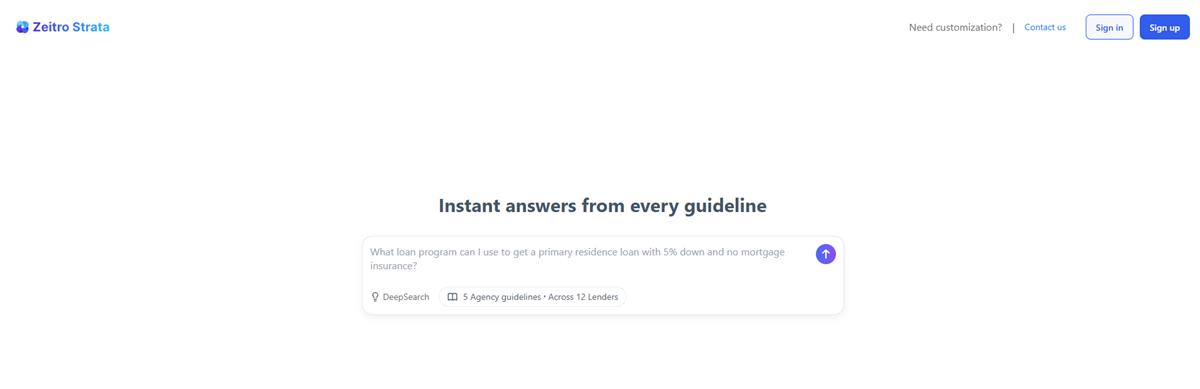
Zeitro Strata AI is a guideline assistant built specifically for loan officers and underwriters. It doesn't just crawl the open web. It searches a curated library of more than 1,000 guidelines pulled from mainstream and non-QM lenders like Freedom Mortgage, AD Mortgage, CMG Financial, and Nations Direct, covering FHA, VA, DSCR, bank statement, asset utilization, ITIN, jumbo, and several other loan categories.
Here's what's kept it in my daily rotation:
- Broad lender coverage: When I have a tricky FHA file, I can check it against more than a dozen investors at once instead of calling around.
- Citations, not guesses: Every answer comes with a source attached, down to the specific page or section it pulled from. That's the difference between telling a processor "I think this is right" and actually showing them where it says so.
- It handles vague questions too: I can type something as loose as "Can I use 12 months of bank statements for income on an FHA loan with a 580 score?" and it works through the logic instead of needing a perfectly worded query.
- The Explain feature: Sometimes a guideline is technically correct but still confusing in practice. Explain gives me a second, plainer breakdown so I understand the reasoning, not just the rule.
- Extras that save real time: It can calculate income from uploaded documents, match a borrower to state-specific Down Payment Assistance programs, check Area Median Income (AMI), and pull current rate sheets through its built-in pricing engine.
The free tier gives you free queries every day, which covers most day-to-day guideline checks without needing a paid plan. For anyone verifying FHA files regularly, it's easily saved me a few hours of research every week.
FAQs About FHA Mortgage Guidelines
Q1. Can FHA guidelines change year to year?
Yes. HUD issues Mortgagee Letters throughout the year that update or override sections of the 4000.1 Handbook. The Handbook itself was last revised in August 2026, and HUD has published multiple Mortgagee Letters this year alone covering property valuation review, disaster-area exceptions, and documentation requirements. If you're not checking for updates regularly, you're working off stale information.
Q2. Are FHA guidelines the same at every lender?
No. As covered above, lenders layer on overlays. The core FHA insurance rules apply everywhere, but credit score minimums, DTI caps, and property standards can vary quite a bit from one lender to the next.
Q3. What credit report does FHA use?
FHA currently requires a tri-merge credit report using Classic FICO. Starting in 2026, HUD is also allowing VantageScore 4.0 and FICO 10T as approved scoring models, though tri-merge reporting stays in place during the transition.
Q4. Can I qualify for FHA with a past bankruptcy?
Yes, under conditions. The standard waiting period is two years from a Chapter 7 discharge date, or one year with documented extenuating circumstances. For Chapter 13, it's one year of on-time payments with court or trustee approval, or two years from discharge. Either way, you'll need re-established credit and a clean payment history since the event.
Q5. What disqualifies a borrower from FHA financing?
The most common culprits are CAIVRS hits (delinquency on a federal debt, like a defaulted student loan), a foreclosure within the past three years, or property conditions that fail the safety and sanitation check.
Q6. Is it hard to get approved for FHA?
Generally, no. FHA tends to be more forgiving than conventional financing on credit events and DTI. Where borrowers usually struggle is the property appraisal and the amount of income documentation required, not the credit side.
Final Thoughts
FHA loans are still the backbone of the American housing market, but for those of us originating them, verifying guidelines across dozens of lenders never stops being a grind. The line between a funded loan and a denial usually comes down to knowing which one investor allows that single exception everyone else doesn't.
We can't keep doing this by memory and manual research. Zeitro Strata AI has closed that gap for me, from routine FHA questions to messier Non-QM scenarios. If you're tired of guessing and want to verify with actual confidence, it's worth trying. The free tier gives you 10 queries a day, which is plenty to see how much time it saves.
Work smarter, not harder.
People Also Read
- 8 Best Mortgage Lead Generation Companies: Don't Miss
- [Tips] Where to Buy Mortgage Leads? Warm Leads for LOs
- Best CRM for Loan Officers: Which One Suits You Most?
- Beginner's Guide: How to Get Leads for Mortgage Loans?
- Best Mortgage Companies for New Loan Officers
- Mortgage Guidelines 2026: What Are They? How to Verify?

![[Solved] What Red Flags Would a Mortgage Underwriter See?](https://cdn.prod.website-files.com/6731bc6e813a541b54c30b10/6aa24ca70b95e62dd7bbeefd_red-flags-mortgage-underwriting-banner.png)