
Written by

Eric
Author from Zeitro

Share this article

Subscribe to updates

Thank you! Your submission has been received!
Oops! Something went wrong while submitting the form.

I remember when I first decided to look into becoming a Mortgage Loan Originator (MLO). I searched Google for a simple roadmap, but 90% of the results were just ads trying to sell me a $300 course or confusing government jargon that didn't make sense. It was frustrating.

That is why I am writing this guide. I want to cut through the noise. This is the exact, no-nonsense roadmap to obtaining your NMLS license in 2026. Whether you are looking to work for a mortgage broker or a direct lender, the core process is federal, but the execution requires attention to detail. This guide is not selling you a course. It is designed to help you navigate the NMLS Resource Center, pass the "beast" of an exam, and actually get your license active so you can start your career.

People Also Read

What is an NMLS License?

First, let's clear up a common misconception. The NMLS (Nationwide Multistate Licensing System) is just the database, and it doesn't actually "issue" the license. Your specific state government, like the DRE or DFPI in California, or the DFS in New York, issues the license through this system.

If you want to originate loans for a non-bank lender like a mortgage broker, you are required by the federal SAFE Act to be state-licensed. This is different from working at a big bank like Chase or Wells Fargo, where you only need to be "registered."

When you start this process, you will be assigned an NMLS Unique Identifier (NMLS ID). Think of this like a "Social Security Number" for your mortgage career. It stays with you for life, regardless of which company you work for or which state you move to. It allows consumers to look you up and verify your history, which is a key part of maintaining public trust in our industry.

What is an NMLS License?

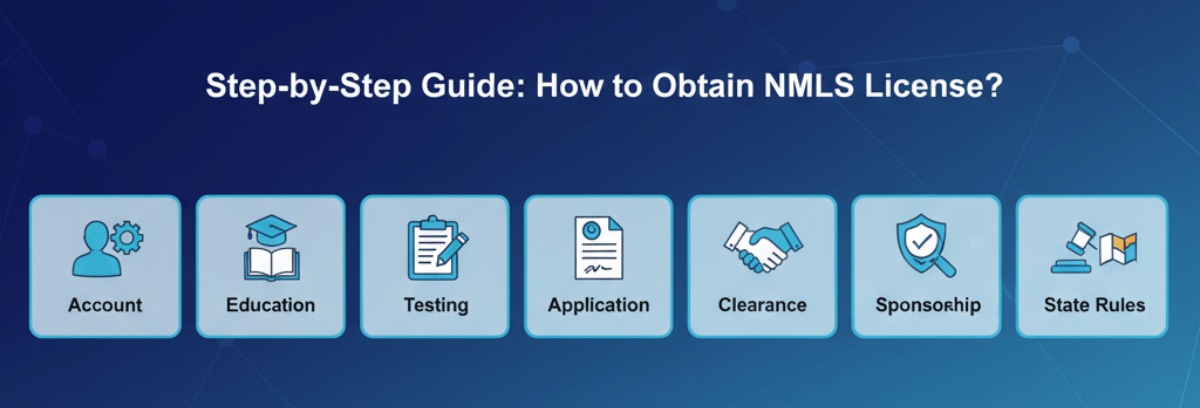
Step-by-Step Guide: How to Obtain NMLS License?

Getting licensed involves a mix of federal mandates and state-specific rules. It can feel overwhelming, so I have broken it down into a logical 7-step roadmap.

The Roadmap at a Glance:

  1. Account: Create NMLS Login & Get ID
  2. Education: Complete 20-Hour Pre-License Course
  3. Testing: Pass the SAFE MLO Exam
  4. Application: Submit Form MU4
  5. Clearance: Background Checks (Fingerprints/Credit)
  6. Sponsorship: Find an Employer
  7. State Rules: Complete specific state requirements
Step-by-Step Guide: How to Obtain NMLS License?

STEP 1. Create an NMLS Account & Get Your ID

Your journey begins at the NMLS Resource Center. You need to request an account to get into the system. When you visit the site, look for the "Log in to NMLS" button and select "Request an Account."

You will be filing as an Individual. The system will ask for your personal information to generate your account. Once you complete this, you will immediately receive your NMLS ID number. Write this number down. You will need it for everything: signing up for classes, scheduling your exam, and eventually printing it on your business cards.

During this setup, ensure your name matches your government ID exactly. If your driver's license says "Jonathan" but you register as "John," you will be turned away at the testing center later.

STEP 2. Complete Pre-License Education (PE)

Before you can even touch the exam, federal law requires you to complete 20 hours of Pre-Licensure Education (PE). You cannot just read a book. You must take a course from an NMLS-Approved Course Provider.

The 20 hours are strictly structured:

  • 3 Hours: Federal Law
  • 3 Hours: Ethics (Fraud, Consumer Protection)
  • 2 Hours: Non-Traditional Mortgage Lending
  • 12 Hours: Electives

Most people take this online. You can choose "Online Instructor-Led", similar to a Zoom class, or "Online Self-Study." Be warned: NMLS requires a security measure called BioSig ID. You will have to draw a password with your mouse every time you log in to prove it is really you taking the course. It's annoying, but mandatory for compliance.

STEP 3. Pass the SAFE MLO Exam

This is the biggest hurdle. The SAFE MLO Test with Uniform State Content (UST) is not easy. It consists of 125 multiple-choice questions (115 scored, 10 unscored experimental), and you are given 190 minutes to finish." You need a score of 75% to pass.

Do not underestimate this test. The questions are designed to be tricky, often using double negatives or asking for the "BEST" answer among four "correct" looking options. It covers federal laws (TILA, RESPA, ECOA), ethics, and general mortgage knowledge.

What if I fail? Don't panic. You can retake it after waiting 30 days for the first three attempts. After failing a third time, you must wait 180 days before a fourth attempt. Study hard so you don't get stuck in that 6-month penalty box.

STEP 4. Apply for Your License

Once you pass your exam, you need to formally ask the state for your license. This is done by filing Form MU4 (Individual Form) inside the NMLS portal.

Log in, go to the "Filing" tab, and pay the fees. The fees usually include an NMLS processing fee around $30, a credit report fee, and the specific application fee for your state. For example, if you are applying in California via the DRE or DFPI, the state fee will be added here.

Once you submit the MU4, your license status will likely show as "Pending-Incomplete" or "Pending-Review." This is normal. It just means the state regulators are now looking at your file.

STEP 5. Complete Background Checks

Technically, you often initiate this step while filing your MU4, but it is a distinct requirement. You must authorize a Criminal Background Check (CBC) and a Credit Report.

  • Fingerprints: You cannot just go to a local police station. You must schedule an appointment through the NMLS-approved vendor Fieldprint, which links directly to the NMLS system, to send your prints to the FBI.
  • Credit Report: Regulators aren't necessarily looking for a perfect 800 credit score. They are looking for "financial responsibility." If you have current tax liens, government debt, or recent foreclosures, you might have to provide a detailed letter of explanation.
  • Disqualifiers: A felony conviction involving fraud, dishonesty, or money laundering at any time is an automatic ban. Other felonies within the last 7 years are also usually disqualifiers.

STEP 6. Find an Employer

Here is the catch that trips up many new LOs: You can pass the test and pay the fees, but your license will not become "Active" until a licensed employer sponsors you.

Until you are hired, your status will sit as "Approved - Inactive." You need to interview with Mortgage Brokers or Lenders. Once you accept an offer, their compliance manager will log into NMLS and request "Sponsorship" of your license. Once the state approves that relationship, your license flips to "Active," and you can officially start originating loans.

Also Read: Best Mortgage Companies for New Loan Officers in 2026

STEP 7. Meet State-Specific Rules

While the "Uniform State Test" (UST) covers most states, some regulators have extra homework.

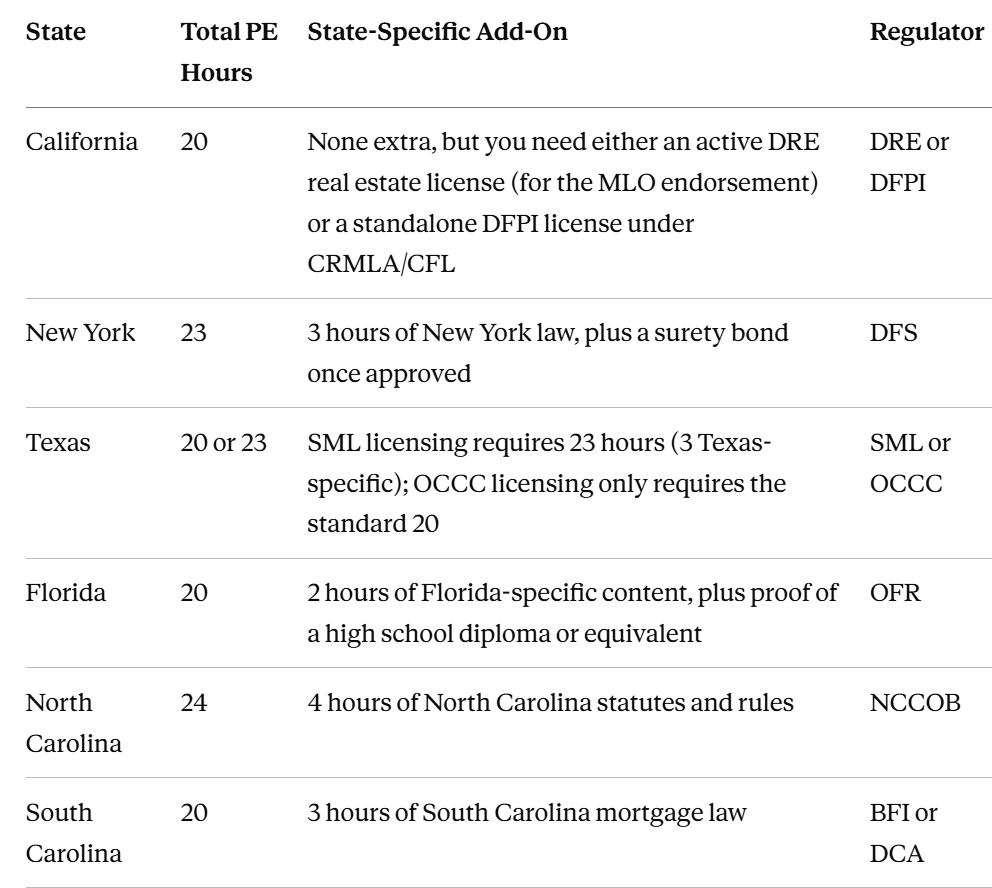
For instance, to obtain a DRE MLO endorsement in California, you must hold an active DRE real estate license. Under the DFPI for CRMLA or CFL, you obtain a separate individual MLO license without needing a real estate license, but you might need specific education. Other states like Texas or Florida may have their own specific education modules (e.g., a 2-hour state law course) that must be taken in addition to the standard 20-hour PE. Always check the State Licensing Requirements Checklist on the NMLS website for your specific target state.

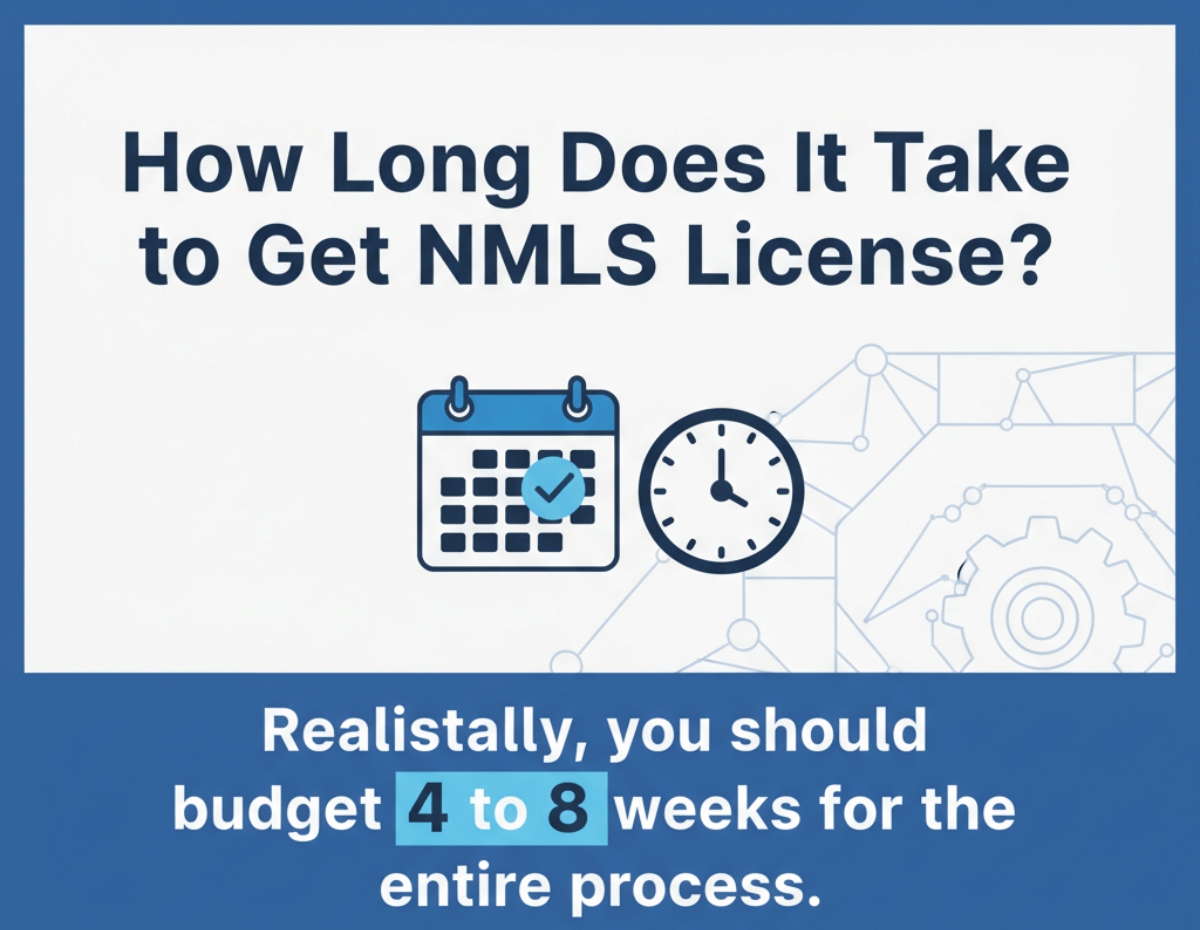
How Long Does It Take to Get NMLS License?

Realistically, you should budget 4 to 8 weeks for the entire process.The 20-hour course can be done in a week if you treat it like a full-time job. Studying for the exam typically takes another 2 weeks. Once you pass, the background check and state review can take anywhere from a few days to a month, depending on how backed up the FBI or state regulators are. If you have a "clean" history (no criminal hits, clear credit), the approval is usually faster.
How Long Does It Take to Get NMLS License?

How Hard Is It to Get NMLS?

I won't lie to you. The exam is difficult. The first-time pass rate for the SAFE MLO test is around 58%. It is generally considered harder than the Real Estate Agent exam because it is less about common sense and more about memorizing specific federal regulations and timelines (e.g., "How many days does a lender have to send a Loan Estimate?"). However, the process itself isn't "hard" technically. It's just bureaucratic. If you follow the steps and actually study for the test, it is 100% achievable.

FAQs About Getting an NMLS License

Q1. How much does it cost to take the NMLS?

National Exam fee (typically $110), NMLS processing fee ($30), Credit Report ($15), FBI Background Check (around $36.25), plus 20-hour course ($200–$400) and state fees. Total often $600–$1,000, depending on state.

Also Read: NMLS License Cost Breakdown 2026: Know Your Every Penny

Q2. How long does it take to study for NMLS?

Most successful candidates spend 2 to 4 weeks preparing. I recommend taking the exam immediately after your course while the laws are fresh in your mind.

Q3. Can I take a NMLS test online?

Yes. You can take the test online from home through the approved remote proctoring service, such as ProProctor by PSI, with strict security like room inspections via webcam. However, the security is intense. They will inspect your room via webcam, and you cannot have paper, pens, or even a watch near you.

Q4. What is the NMLS exam pass rate?

The national pass rate for first-time test takers is typically in the mid-50% range. It drops to the mid-40% range for subsequent attempts, which highlights the importance of studying correctly the first time.

Q5. Is getting a mortgage loan officer license worth it?

If you are self-driven, absolutely. The income potential is uncapped (commission-based), and with interest rates predicted to stabilize in 2026, demand for refinancing and purchases is expected to rise.

Q6. How many times can I take the NMLS test?

You can take it 3 times, with a 30-day wait between each attempt. If you fail the 3rd time, you must wait 180 days before you can book a 4th attempt.

Final Word

Obtaining your NMLS license is the barrier to entry for a lucrative career in financial services. It protects consumers and ensures you know the laws. My advice? Do not rush the education part. The laws you learn in that 20-hour course are the same ones that will keep you out of trouble when you start signing loans.

If you are ready to start, head over to the NMLS Resource Center today and create your account. The process might seem long, but ticking off that first box is the most important step you will take. Good luck!

Keep reading

Mortgage Guidelines 2026: What Are They? How to Verify?

Blog

5 min read
Arrow icon on dark background
Mortgage Guidelines 2026: What Are They? How to Verify?
What are mortgage guidelines? Stop reading long lender PDFs. Learn the key types and discover how to verify lender rules in seconds.

If you've been in the mortgage industry as long as I have, over 15 years now, you know that keeping up with lending rules is a full-time job. In 2026, the mortgage market is shifting faster than ever. Between the new conforming loan limit hitting $832,750 and the explosive growth of Non-QM products, manually digging through hundreds of PDF matrices is a surefire way to kill a deal.

Today, top-producing Loan Officers are ditching the old way. Instead, they are turning to tools like Zeitro's Scenario AI. By simply using a chat interface, you can instantly verify guidelines across different lenders, saving hours of research and rescuing dying deals.

What are Mortgage Guidelines?

Think of mortgage guidelines as the absolute "rulebook" or the DNA of a loan approval. In simple terms, these are the strict criteria established by government-sponsored enterprises (like Fannie Mae and Freddie Mac), government agencies (such as the FHA), and private investors in the secondary market.

These rules dictate the minimum standards a borrower must meet for a loan to be approved and ultimately funded. They cover everything from acceptable credit profiles and income verification methods to property types and reserve requirements.

When I train new Loan Processors, I always tell them: Guidelines aren't suggestions. They are boundaries. If a file doesn't fit the box perfectly, you need a documented exception, or the deal simply won't close. As the market evolves into 2026, understanding this foundational rulebook is the only way to determine whether you can actually get your client to the closing table.

What are Mortgage Guidelines?

Types of Mortgage Guidelines (QM vs. Non-QM & More)

The mortgage landscape isn't one-size-fits-all. Because we serve vastly different borrower profiles, the guidelines are broken down into specific categories. Generally, they are split between Qualified Mortgage (QM) and Non-Qualified Mortgage (Non-QM) loans. With Non-QM expected to capture a massive share of originations in 2026, it is vital to understand these diverse niches.

Here are the most common types of guidelines you'll encounter today:

  • Conventional: The gold standard backed by Fannie Mae and Freddie Mac. Great for W-2 borrowers with strong credit.
  • FHA (Federal Housing Administration): Perfect for first-time buyers or those with lower credit scores, offering low down payments.
  • VA (Veterans Affairs): Designed for eligible military members, focusing heavily on residual income rather than strict debt ratios.
  • Jumbo: For loan amounts exceeding the 2026 baseline limit of $832,750. These carry strict investor-specific rules.
  • Bank Statement (Non-QM): A lifesaver for self-employed borrowers, qualifying them based on 12 to 24 months of business deposits rather than tax returns.
  • DSCR (Debt Service Coverage Ratio): Specifically for real estate investors. Qualification is based on the property's rental cash flow rather than personal income.
  • Asset Utilization (Non-QM): Allows high-net-worth individuals to use their liquid assets to calculate a monthly income equivalent.
  • Foreign National (Non-QM): Tailored for non-U.S. citizens buying property here, requiring alternative credit verification.
  • ITIN (Non-QM): Designed for tax-paying immigrants without a standard Social Security Number.
  • WVOE (Written Verification of Employment): A niche option relying solely on an employer's written verification rather than traditional pay stubs.

Why are Mortgage Guidelines Important?

You might wonder why lenders are so obsessed with these rules. From a Loan Officer or Broker's perspective, strict adherence to guidelines is about protecting your pipeline and your paycheck. Here is why they matter:

  • Risk Mitigation: Guidelines ensure that the borrower actually has the ability to repay the loan, drastically lowering the risk of default.
  • Compliance & Legal Protection: Following the rules keeps originators compliant with federal regulations, avoiding hefty fines.
  • Marketability: Most lenders don't hold loans. They sell them. If a loan doesn't meet the investor's guidelines, it cannot be legally sold in the secondary market.
  • Preventing Buybacks: This is every lender's worst nightmare. If you close a loan that violates a guideline, the investor can force your company to buy the unsalable loan back.
Why are Mortgage Guidelines Important?

Key Mortgage Qualification Guidelines

No matter which loan type you are structuring, Underwriters will always scrutinize a few core qualification metrics. I like to call these the "Big Five."

  • Credit Score (FICO): The ultimate indicator of creditworthiness. While FHA might accept a 580, a Jumbo investor might demand a 700+.
  • LTV (Loan-to-Value Ratio): This measures how much equity is in the deal. Higher LTVs equal higher risk.
  • DTI (Debt-to-Income Ratio): Your borrower's monthly debt compared to their gross income. Conventional loans usually cap around 45-50%, while Non-QM loans might offer more flexibility.
  • Reserves: The liquid cash a borrower has left after closing. Essential for investment properties and Jumbo loans to cover months of mortgage payments if things go south.
  • Employment & Income History: Standard rules require a two-year history, but how it's calculated varies wildly between W-2 and self-employed files.

The tricky part? These baseline metrics look completely different depending on the specific lender and loan program.

How to Quickly Check & Verify Mortgage Guidelines in 2026?

Back in the day, when I had a tricky file, I would spend hours hitting "Control-F" on massive PDF matrices or waiting a full day for an Account Executive (AE) to reply to my email. With nearly 100 lenders updating their policies daily, that traditional method is completely dead in 2026.

To stay competitive, I now rely on Zeitro's Scenario AI, what I consider the ultimate AI-powered mortgage guideline assistant. It is built specifically for our industry and is an absolute game-changer, especially when navigating complex Non-QM scenarios.

Here is why top-producing originators are making the switch:

  • Comprehensive & Constantly Updated Coverage: It covers over 300 unique guidelines across major wholesale lenders, including powerhouses like AD Mortgage, Freedom Mortgage, and CMG Financial. Whether it's QM or Non-QM, the database is always current.
  • Instant Answers with Citations: You can ask vague questions like "What is DSCR?" or highly specific ones like "Eligibility for ITIN with 10% down." Within seconds, it delivers precise answers. Better yet, it provides direct citations linking back to the source document, giving you 100% confidence to quote your borrower.
  • Customizable DeepSearch & 'Explain' Feature: You can narrow your search to specific lenders. If you don't fully understand an underwriting caveat, you can use the "Explain" function to have the AI break down the jargon into plain English based on your selected parameters.
  • Cost-Effective Efficiency Booster: It drastically reduces the manual labor for Loan Officers and Processors. By accelerating the loan structuring process and minimizing human error, it directly boosts your ROI.
  • Unmatched Market Value: It integrates smoothly with LOS (Loan Origination Systems), supports multiple languages (you can type in English or Chinese), and operates at lightning speed. And the cost? It starts at a ridiculously low $8 per month.
Quickly Check & Verify Mortgage Guidelines

FAQs About Mortgage Guidelines

Q1: How often do mortgage guidelines change?

Guidelines change frequently, often driven by macroeconomic factors, interest rate fluctuations, and investor risk appetite. Fannie Mae and Freddie Mac release updates regularly, while private Non-QM investors might tweak their matrices weekly. Using an automated tool is essential to track these silent updates.

Q2: What is an underwriting exception?

An exception occurs when a borrower falls slightly short of a specific guideline (like being 1% over the DTI limit) but has strong "compensating factors," such as massive cash reserves. Understanding the underlying rules helps you successfully argue for an exception with your Underwriter.

Q3: Can AI accurately verify non-QM guidelines?

Yes. While early generic AI suffered from "hallucinations," purpose-built tools like Scenario AI pull directly from the lenders' primary source documents. Because they provide exact citations to the original matrices, the accuracy is exceptionally high, making them safe for real-world loan structuring.

Conclusion

In the highly competitive 2026 mortgage market, speed and accuracy are everything. The originators who can instantly digest and apply complex guidelines are the ones closing the most deals and earning the trust of their referral partners. You simply cannot afford to lose a borrower to a competitor just because you were stuck reading a 100-page PDF or waiting for an AE to call you back.

It's time to modernize your workflow. I highly recommend trying out Zeitro's Scenario AI today. You can experience the platform absolutely risk-free since they offer 3 free queries every single day. Test it on your hardest Non-QM file and watch it instantly pull the exact answer with a citation. Do yourself, and your processing team, a favor: share the link or send them an email about this tool. Embrace the AI advantage, protect your margins, and let's close more loans this year.

People Also Read

Blog

5 min read
Arrow icon on dark background
Foreign National Mortgage Guidelines: Verify Eligibility Fast
Find Foreign National Mortgage Guidelines fast. Use Zeitro Scenario AI to check eligibility, get cited answers, and close more Non-QM deals. Start today.

As a loan officer, I've lost count of how many times a lucrative deal stalled simply because checking the guidelines took too long. The demand for Foreign National Mortgage Guidelines is skyrocketing as international investors flock to the US real estate market. However, navigating the maze of differing requirements across lenders can be a nightmare. You don't want to spend hours reading PDFs only to find out your borrower's visa type isn't accepted.

To stay competitive, you need a way to verify eligibility instantly. In my workflow, I've started using tools like Zeitro Scenario AI, which allows me to chat with an AI to cross-reference different lenders' guidelines in seconds. It's a game-changer for efficiency.

People Also Read:

What are Foreign National Mortgage Guidelines?

Foreign National Mortgage Guidelines are the specific underwriting standards used by lenders to approve borrowers who are not US citizens and do not reside permanently in the United States. Unlike standard Conventional loans backed by Fannie Mae or Freddie Mac, these loans almost always fall under the Non-QM (Non-Qualified Mortgage) category.

Since there is no government backing, private investors and wholesale lenders set the rules. This means the guidelines, ranging from allowed LTVs (Loan-to-Value) to credit requirements, vary wildly from one lender to another. As brokers, we must understand that "Foreign National" is distinct from "Resident Alien." These guidelines are specifically designed for borrowers living abroad who want to purchase investment properties or vacation homes in the US. The key here is realizing that investor discretion plays a huge role. What gets denied by one wholesale lender might be a perfect fit for another.

What are Foreign National Mortgage Guidelines?

Why Offer Foreign National Mortgages?

You might be wondering, "Why should I complicate my pipeline with these complex loans?" The answer is simple: Information Gain. This is a massive, underserved market with high ROI. Many originators shy away from it because it's "too hard," leaving more commission on the table for those of us who know how to navigate it.

Here are the main reasons why mastering these guidelines is a must:

  • Real Estate Investment Growth: Foreign investors love US real estate for its stability. They are often looking for rental properties, which pairs perfectly with DSCR (Debt Service Coverage Ratio) loan programs.
  • Vacation Home Purchases: High-net-worth individuals from Canada, Europe, and Asia frequently buy vacation homes in states like Florida, California, and Texas.
  • Relocation Scenarios: Executives moving to the US often need to buy before their US credit is established.
  • Diversification: When the conventional refi market dries up, Non-QM foreign national loans keep your volume high.

Key Foreign National Mortgage Requirements

While I mentioned that every lender has their own "flavor" of guidelines, there are common denominators you need to look out for. When I'm pre-qualifying a client, these are the pillars I check first:

  • Residency & Documentation: The borrower typically needs a valid foreign passport. Importantly, no US visa is required. Many lenders accept borrowers with no US visa at all, while others may require specific types like B-1/B-2 for business/tourism or even ITINs. They must prove they live primarily outside the US.
  • Credit History: Since they lack a US FICO score, most guidelines require a Foreign Credit Report or alternative credit references (like letters from their home country's bank or utility company). Some lenders offered by Zeitro allow for "No US Credit" options if the LTV is lower (e.g., 60-70%).
  • Assets & Reserves: This is critical. Lenders typically require 6 to 12 months of reserves (PITI) seasoned in a US bank account or an approved international account.
  • Income Verification: Foreign tax returns or pay stubs are commonly accepted by many lenders, alongside Asset Utilization or DSCR. Instead, we rely on Asset Utilization or DSCR (rental income vs. mortgage payment) to qualify the loan.
  • Down Payment: Expect to ask for more skin in the game. LTVs are usually capped at 65% - 75%, meaning a 25% to 35% down payment is standard.
Key Foreign National Mortgage Requirements

Pro Tip: Tool to Quickly Check Foreign National Mortgage Guidelines?

Here is the reality of our job: skimming through 300-page PDF guides for 15 different lenders is inefficient. It kills your momentum. This is where Zeitro Scenario AI has become an essential part of my tech stack.

It is an AI-Powered Mortgage Guideline Assistant specifically designed for loan professionals. Instead of manually searching, I just type a query like, "Which lenders allow 75% LTV for a foreign national with no US credit?" and it gives me an answer based on actual data.

Why It Shines Through?

  • Massive Coverage: It covers nearly 300 guidelines, including 18 specific Foreign National guidelines from major lenders like AD Mortgage, Greenbox, and Lux.
  • Deep Search Capability: You can customize the search scope. I can select 5 specific lenders and ask the AI to compare their reserve requirements instantly.
  • Citations for Trust: This is the most important feature for me. It doesn't just give an answer. It provides citations (source links). I can click through to verify the exact page in the guideline, giving me the confidence to quote terms to my client.
  • Handle "Fuzzy" Scenarios: You don't need perfect phrasing. Whether asking a broad question or checking specific eligibility, the AI understands mortgage context.
  • Cost-Effective: It costs as little as $8/month. Considering the commission on one Foreign National deal, the ROI is unbeatable.

FAQs About Foreign National Mortgage Guidelines

Q1. What is a foreign national mortgage loan?

It is a mortgage loan designed for non-US citizens who reside outside of the United States. These loans allow foreign borrowers to purchase investment properties or second homes in the US without having a US credit history or Social Security Number.

Q2. Can a foreign national get a mortgage in the US?

Yes, absolutely. While they cannot typically use conventional financing, they can obtain loans through Non-QM lenders. hese loans usually require a larger down payment (typically 25-35%+, with LTVs capped at 65-75%) and use the property's cash flow (DSCR) or the borrower's assets to qualify, rather than US-based income.

Q3. Does Fannie Mae allow foreign nationals?

This is a common misconception. Fannie Mae allows loans for non-US citizens who are lawful residents (e.g., Green Card holders or those with valid work visas like H1B) and have US credit. However, for a true "Foreign National" who lives overseas and has no US credit history, Fannie Mae is generally not an option. You must look toward Non-QM products.

Final Word

Navigating Foreign National Mortgage Guidelines doesn't have to be a guessing game. The opportunity in this market is huge for us as Loan Officers and Brokers, provided we have the right information at our fingertips. The key to closing these deals is speed and accuracy, knowing exactly which lender accepts your client's unique scenario before you even submit the file.

Stop wasting hours digging through outdated PDFs. I highly recommend you try Zeitro Scenario AI. It brings clarity to the chaotic world of Non-QM guidelines and gives you the citations you need to underwrite with confidence. It's time to work smarter, not harder.

VA Mortgage Guidelines: What Are They and How to Check Them Quickly?

Blog

5 min read
Arrow icon on dark background
VA Mortgage Guidelines: What Are They and How to Check Them Quickly?
Stop searching PDFs. Learn key VA Mortgage Guidelines and use Zeitro Scenario AI to get accurate, cited answers from 15+ lenders instantly. Try it free!

As a Loan Officer or Broker, few things are as frustrating as navigating the labyrinth of government loan requirements. You think you know the rules, but then a specific lender's overlay throws a wrench in your deal. VA Mortgage Guidelines are the rulebook set by the Department of Veterans Affairs, detailing how we originate, process, and underwrite loans for our service members.

But here is the catch: knowing the "VA Handbook" isn't enough. You also need to know how each lender interprets it. How do you quickly verify if a borrower with a 580 FICO score qualifies with Lender A versus Lender B without reading endless PDFs?

In this guide, I'll break down the essentials of VA guidelines and share a workflow hack I've recently adopted: using Zeitro's Scenario AI. It's a chat-based tool that lets me verify guidelines across different lenders instantly, saving me hours of manual research.

People Also Read:

What Are VA Mortgage Guidelines?

At their core, VA Mortgage Guidelines are the standards outlined in the VA Lenders Handbook (Pamphlet 26-7). These rules dictate everything from income calculation to property safety. They exist to protect the government (which guarantees a portion of the loan) and the veteran.

However, from my experience in the trenches, there is a critical distinction between "VA Minimum Requirements" and "Lender Overlays."

While the VA technically doesn't set a minimum credit score, most investors do. While the VA allows for high Debt-to-Income (DTI) ratios if there is sufficient residual income, some lenders cap it at 45% or 50%. This is where the confusion often lies. The "Guidelines" generally refer to the baseline federal rules, but in practice, you are always dealing with a mix of federal mandates and specific investor risk layers. Understanding this difference is what separates an average LO from a top producer who can save a deal that others denied.

What Are VA Mortgage Guidelines?

Who Do VA Mortgage Guidelines Apply To?

These guidelines are not for everyone. They are strictly for eligible borrowers who have served our country. Before we even look at credit or income, we must establish eligibility through a Certificate of Eligibility (COE).

Generally, the guidelines apply to:

  • Veterans: Those who have served the required length of time and were discharged under conditions other than dishonorable.
  • Active-duty Service Members: Currently serving personnel, usually after 90 days of continuous service.
  • National Guard and Reserve Members: Typically require 6 years of service, though 90 days of active duty (Title 10 or 32) can also qualify them.
  • Surviving Spouses: Unremarried spouses of veterans who died in service or from a service-connected disability.

If your client doesn't fit one of these buckets, the VA guidelines and the zero down payment benefit won't apply.

Why Are VA Mortgage Guidelines Important?

You might ask, "Why can't we just wing it and ask the underwriter later?" As professionals, strictly adhering to these guidelines is non-negotiable for three massive reasons:

  • The VA Guaranty: The primary selling point of this loan is that the VA guarantees 25% of the loan amount against default. If we miss a guideline, say, we miscalculate Residual Income or ignore a Minimum Property Requirement (MPR), the VA can void that guaranty. That is a disaster for the lender.
  • Secondary Market Salability: Most lenders don't keep loans on their books. They bundle them into Ginnie Mae securities. If a loan doesn't meet the guidelines, it becomes "unsalable." This leads to forced buybacks, which can bankrupt smaller mortgage shops.
  • Veteran Protection: These guidelines are designed to stop predatory lending. Rules regarding fees (like the 1% origination cap) and strictly regulated closing costs ensure the veteran isn't being taken advantage of. Following the rules isn't just about compliance. It's about ethics.

VA Mortgage Eligibility Requirements 2026

As we move through 2026, the fundamental pillars of VA lending remain stable, but attention to detail is key. Here is what you need to focus on to get your files clear-to-close:

  • Residual Income (The "Secret Sauce"): Unlike Conventional or FHA loans that obsess over DTI, VA guidelines prioritize Residual Income (net income remaining for family expenses). Even with a high DTI (e.g., 60%), a borrower can qualify if their residual income exceeds the regional requirement by 20%.
  • Credit Score: Officially, the VA does not set a minimum credit score. However, in 2026, most lenders impose overlays typically in the 620–660 range. A few may approve 580–619 with compensating factors. Use tools or lender‑board overlays to identify banks that allow lower‑score files.
  • Property Standards (MPRs): The home must be "safe, structurally sound, and sanitary." This isn't just a cosmetic inspection. Issues like peeling paint (lead risk) or lack of a permanent heat source are deal-killers.
  • Occupancy: The borrower must intend to occupy the property as their primary residence within 60 days. Investment properties are a no-go unless it is an IRRRL (refinance).
  • Loan Limits: For borrowers with full entitlement, VA generally does not impose county‑level loan limits, so lenders can finance high loan amounts with zero‑down as long as the veteran qualifies on income, credit, and appraisal value. Many lenders will still apply internal or investor‑level ceilings (for example, clustered around $2M+), but those fall outside the VA guideline itself.
VA Mortgage Eligibility Requirements 2026

Pro Tip: How to Verify VA Mortgage Guidelines in Seconds with AI?

Here is the reality of our job: You have a client who is a borderline approval. You need to know, "Which lender allows a Chapter 13 bankruptcy buyout with 0x30 payment history?"

In the past, I would log into five different lender portals (Allregs), download massive PDFs, and Ctrl+F my way through hundreds of pages. It was exhausting and prone to human error.

Recently, I started using Zeitro's Scenario AI, and it has completely changed my workflow.

Zeitro is an AI-powered assistant specifically built for mortgage guidelines. It covers nearly 300 guidelines, including 22 specific VA Mortgage Guidelines from major lenders like Freedom Mortgage, AD Mortgage, CMG Financial, and HomeXpress.

More Amazing Features to Explore:

  • Deep Lender Coverage: It doesn't just give you generic VA rules. I can ask specific questions about specific lenders. For example, "Does Freedom Mortgage require a lower DTI than the standard VA guideline?"
  • Citations for Confidence: As an underwriter or LO, you can't just trust a chatbot. Zeitro provides citations (sources) for every answer. I can click the link and see the exact page in the guideline. This is crucial for E-E-A-T.
  • Handles Specific Scenarios: Whether it's a blurry eligibility question or a complex prequal scenario, the AI understands the context.
  • Incredible Speed: It scans hundreds of documents in seconds.
  • Cost-Effective: It starts at just $8/month. Considering one saved deal pays for a lifetime subscription, the ROI is a no-brainer.
  • Explain Feature: If a guideline is confusing (legalese is hard!), the "Explain" feature breaks it down into plain English for me.
 Zeitro's Scenario A

Instead of calling an Account Executive and waiting 4 hours for a call back, I get the answer in 10 seconds.

FAQs About VA Mortgage Guidelines

Q1. What disqualifies a house from a VA loan?

The house must meet Minimum Property Requirements (MPRs). Common disqualifiers include severe structural damage, a leaking roof, broken windows, lack of a permanent heating system, or peeling paint (due to lead risks in homes pre-1978). If it's not "safe, sound, and sanitary," it won't pass.

Q2. What is the VA 5-year rule?

The "5‑year rule" language is frequently used by originators, but it is not an official VA term for VA loan eligibility itself. In the context of surviving‑spouse benefits, VA's Dependency and Indemnity Compensation (DIC) criteria include situations where a veteran was rated totally disabled for at least 10 years before death, or since release from active duty and for at least 5 years immediately before death, under certain conditions.

For VA purchase‑loan underwriting, lenders apply their own lookbacks. For example, a foreclosure may require around 2 years seasoning, but VA itself does not publish one uniform "5‑year rule" applicable across all VA‑loan scenarios.

Q3. What is the VA 1% fee rule?

The VA's 1% rule caps a lender's origination fee at 1% of the loan amount. When lenders charge a flat 1% origination fee, they generally may not separately itemize lender‑overhead charges (processing, underwriting, document preparation, etc.) within the same fee bucket.

Many third‑party costs, for example, appraisal, title, recording, and certain administrative services, can still appear on the Closing Disclosure as separate, itemized charges, even when the 1% cap is used.

Q4. What is the downside of a VA loan?

The main downside is the VA Funding Fee, which can be as high as 3.3% for subsequent use (unless the veteran has a service-connected disability, which waives the fee). Additionally, strict property requirements make buying "fixer-uppers" difficult, and the loan is for primary residences only.

Final Word

Mastering VA Mortgage Guidelines is a superpower in this industry. It allows you to serve those who served us, often getting them into homes when other loan types fail. However, the sheer volume of lender overlays can be overwhelming.

Don't let manual research bottleneck your pipeline. Efficiency is the name of the game in 2026.

I highly recommend trying Zeitro's Scenario AI. Whether you are working on a tricky Non-QM deal or a standard VA file, it gives you accurate, cited answers from over 15 mainstream lenders in seconds. You can even try it for free (3 queries/day).

Stop guessing, stop searching, and start closing more loans with confidence.

Try Zeitro today and transform your loan origination workflow!

Get started free