Written by

Eric
Share this article

.svg)
Subscribe to updates
Last Checked and Updated on September, 2026
If you've been in the mortgage industry as long as I have, over 15 years now, you know that keeping up with lending rules is a full-time job. In 2026, the market keeps moving fast. The conforming loan limit just climbed to $832,750, and Non-QM products keep grabbing a bigger slice of originations. Manually digging through hundreds of PDF matrices is still a fast way to lose a good deal.
Top-producing loan officers have moved past that approach. Many now lean on tools like Zeitro Strata AI, a chat-based assistant that pulls guideline answers from across dozens of lenders in seconds instead of hours. Below, I'll walk through what these rules actually cover, why they matter, and how to check them without burning your whole afternoon.
What are Mortgage Guidelines?
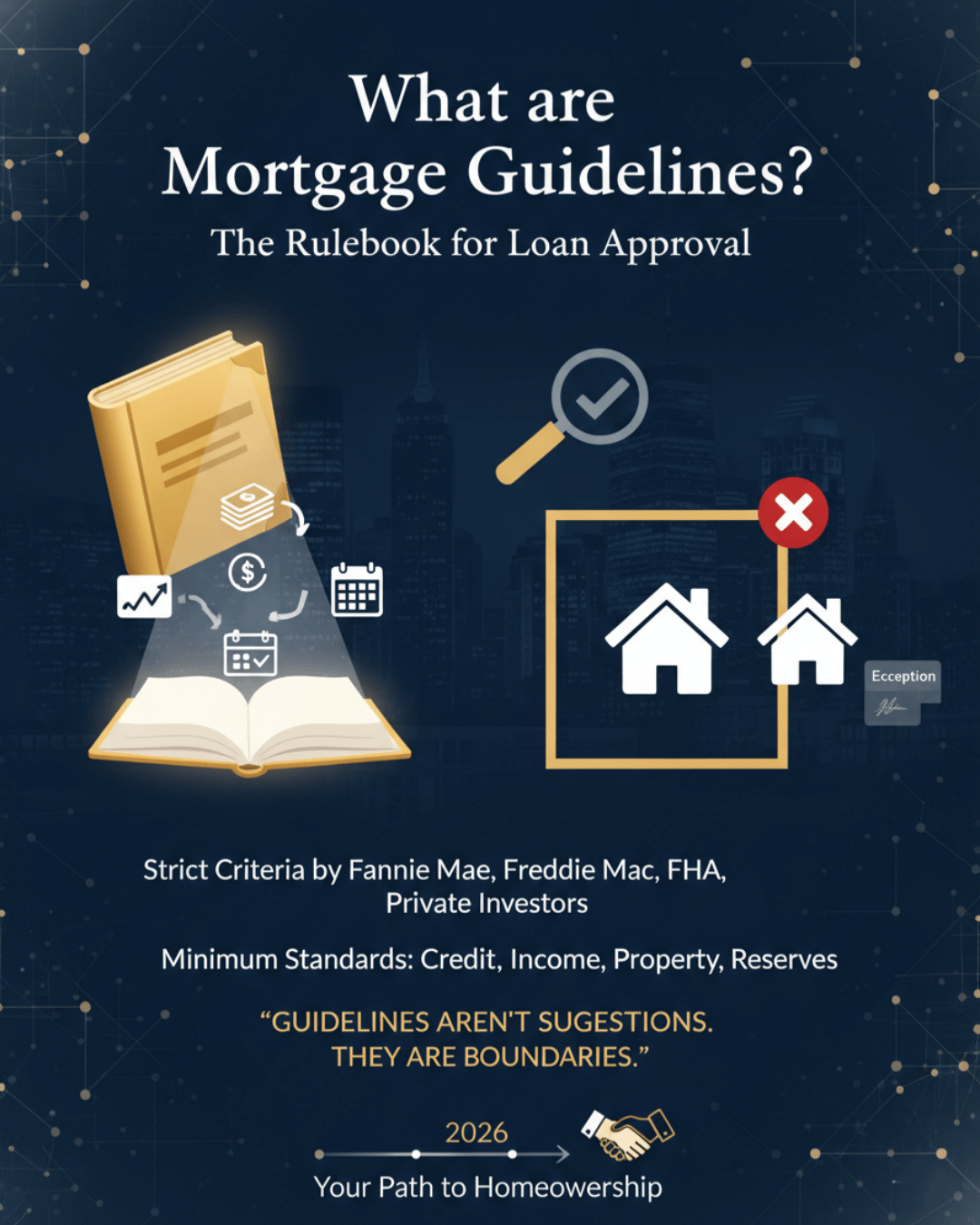
Think of mortgage guidelines as the rulebook behind every loan approval. They're the standards set by government-sponsored enterprises like Fannie Mae and Freddie Mac, federal agencies such as the FHA and VA, and private investors in the secondary market.
These rules spell out the minimum bar a borrower has to clear before a loan can fund. That covers credit history, how income gets verified, which property types qualify, and how much cash a borrower needs left over after closing.
When I train new loan processors, I tell them this: guidelines aren't suggestions, they're boundaries. If a file doesn't fit cleanly inside one, you need a documented exception, or the deal stalls. Heading into the rest of 2026, knowing this rulebook cold is still the fastest way to tell whether your borrower can actually reach the closing table.
Types of Mortgage Guidelines (QM vs. Non-QM & More)
Not every borrower fits the same box, so lenders split their rulebooks into distinct categories. The broadest split is between Qualified Mortgage (QM) loans and Non-Qualified Mortgage (Non-QM) loans. With Non-QM continuing to grow its market share this year, it pays to know these niches well.
Here are the loan categories you'll run into most:
- Conventional: Backed by Fannie Mae and Freddie Mac, and the go-to choice for W-2 borrowers with solid credit.
- FHA (Federal Housing Administration): Popular with first-time buyers and applicants with lower credit scores, thanks to smaller down payment requirements.
- VA (Veterans Affairs): Reserved for eligible service members, and it weighs residual income more heavily than a flat debt ratio.
- Jumbo: Covers loan amounts above the 2026 baseline of $832,750. Each investor sets its own overlay on top of the basics.
- Bank Statement (Non-QM): A practical path for self-employed borrowers, using 12 to 24 months of business deposits instead of tax returns to show income.
- DSCR (Debt Service Coverage Ratio): Built for real estate investors, qualifying the loan off the property's rental income rather than the borrower's paycheck.
- Asset Utilization (Non-QM): Lets high-net-worth borrowers convert liquid assets into a monthly income figure for qualifying purposes.
- Foreign National (Non-QM): Built for non-U.S. citizens purchasing property here, with alternative credit documentation in place of a U.S. credit file.
- ITIN (Non-QM): Serves taxpaying immigrants who file with an ITIN instead of a Social Security number.
- WVOE (Written Verification of Employment): A narrower option that relies on a signed employer letter rather than pay stubs.
Why are Mortgage Guidelines Important?
You might wonder why lenders obsess over these rules. From a loan officer or broker's seat, sticking to guidelines protects your pipeline and your paycheck. Here's the short version:
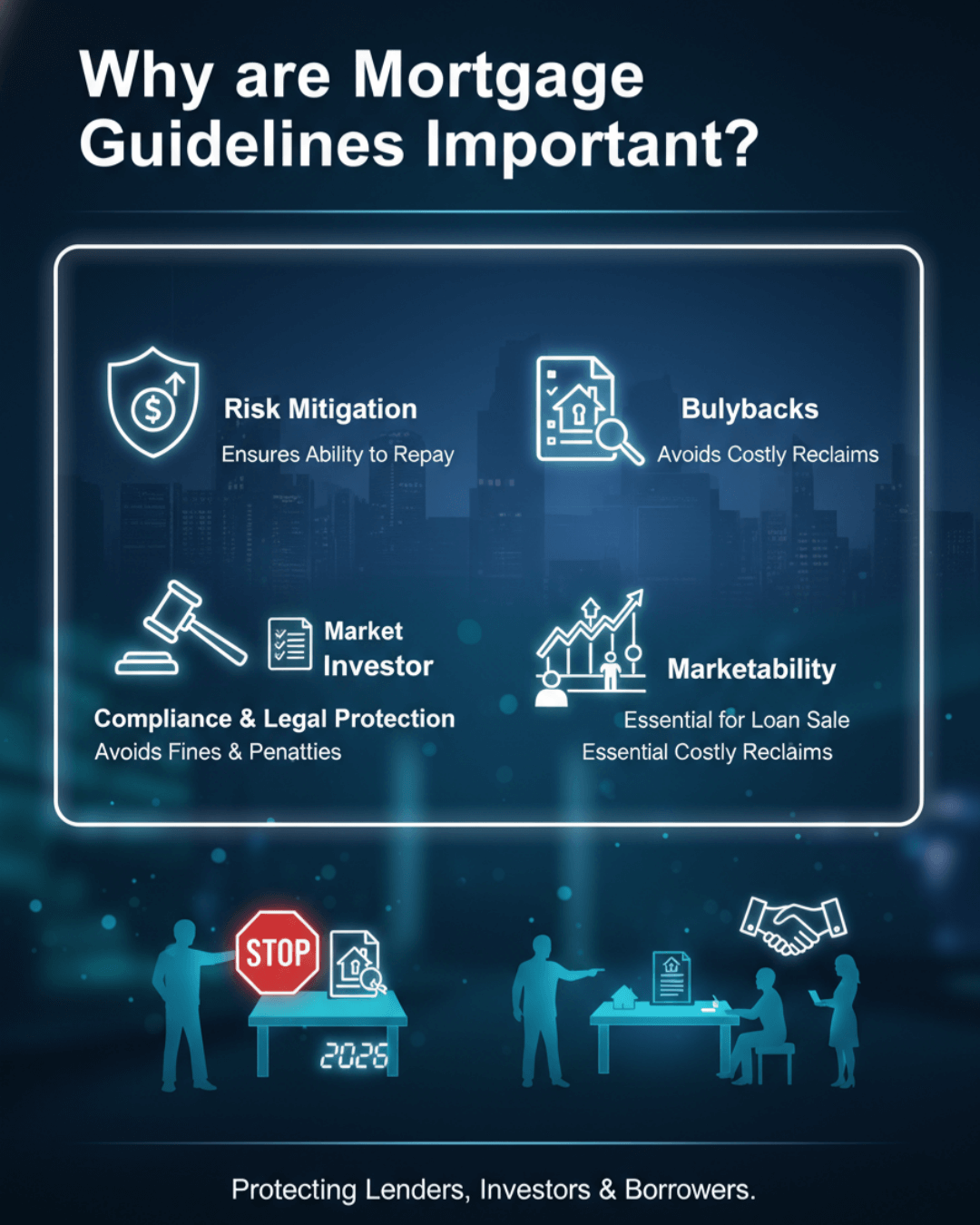
- Risk control: Guidelines confirm a borrower can genuinely afford the payment, which keeps default rates in check.
- Compliance: Following the rules keeps originators on the right side of federal regulations and away from costly fines.
- Marketability: Most lenders sell their loans rather than hold them. A loan that misses investor guidelines simply can't move through the secondary market.
- Buyback protection: This is the nightmare scenario. Close a loan that violates a guideline, and the investor can force your company to buy it back.
Key Mortgage Qualification Metrics
No matter which loan type you're structuring, underwriters keep coming back to the same core numbers. I call these the "Big Five":
- Credit Score (FICO): Still the clearest signal of creditworthiness. FHA might accept a 580, while a Jumbo investor could want 700 or higher.
- LTV (Loan-to-Value Ratio): Measures how much equity sits in the deal. A higher LTV means more risk for the lender.
- DTI (Debt-to-Income Ratio): Compares monthly debt to gross income, and the ceiling shifts depending on the loan program (full breakdown below).
- Reserves: Liquid cash left over after closing. Investment properties and Jumbo loans especially demand a cushion here.
- Employment & Income History: A two-year history is the standard ask, though how it gets documented differs sharply between W-2 employees and self-employed borrowers.
Current DTI Ratio Guidelines by Loan Type (2026)
DTI trips up more borrowers than any other number on this list, mostly because the ceiling isn't one fixed figure. It moves based on the loan program and how the file gets underwritten.
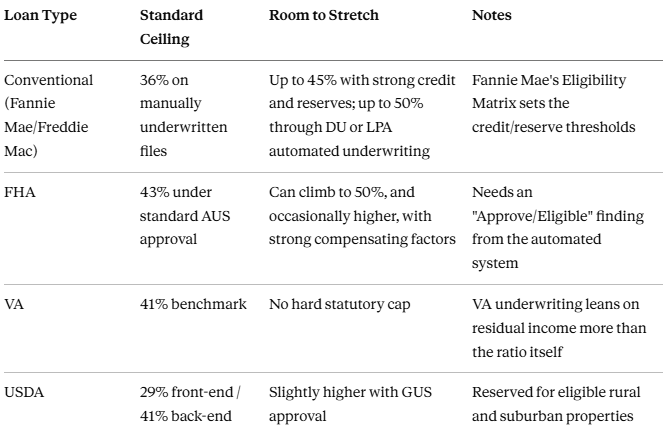
One detail that trips up even seasoned originators: the old idea that a Qualified Mortgage requires a flat 43% DTI is outdated. The CFPB's General QM rule replaced that hard cap with a price-based threshold, so DTI still matters, but it's no longer the single line in the sand it used to be. I still see loan files get flagged simply because someone applied the old 43% rule from memory instead of checking current guidance.
For a full, program-by-program breakdown, see our dedicated guide: Max DTI for Mortgage: Requirements By Loan Types.
How Do Lenders Verify Income and Assets?
This is where a lot of new processors get tripped up, because verification isn't one-size-fits-all. Lenders lean on three main methods to confirm income and employment:
- Written VOE: The employer fills out a standardized form, often Fannie Mae's Form 1005, confirming pay and job status.
- Verbal VOE: A quick call or fax to the employer, usually done right before closing, to confirm the borrower is still on payroll.
- Automated VOE: Instant, database-driven verification through third-party providers, pulling employment and income data directly from payroll systems.
Most shops now run what's called a verification waterfall: try the instant database first, and fall back to manual pay stubs or bank statements only when that data isn't available. It's faster for everyone, and it cuts down on the endless phone tag that used to eat up a processor's week.
Asset verification usually means two months of bank, retirement, or investment statements, though large or unusual deposits will draw questions no matter how clean the rest of the file looks. There's also a compliance detail worth knowing: lenders must re-confirm employment within 10 days of closing, so a borrower changing jobs mid-transaction can genuinely derail a deal at the last minute.
Self-employed and bank statement borrowers face a different playbook entirely, since there's no employer to call. Underwriters instead average deposits across 12 to 24 months or lean on a CPA-prepared profit and loss statement. If that's your borrower's situation, our guides on tax return requirements and profit and loss statements walk through the documentation piece in more depth.
This is also where an AI guideline assistant earns its keep. Instead of manually building an income worksheet, tools like Zeitro Strata AI can read uploaded documents and calculate qualifying income automatically, which saves real time on files that would otherwise sit in a processor's queue for days.
How to Quickly Check & Verify Mortgage Guidelines in 2026?
Back when I had a tricky file, I'd spend hours hitting Control-F on massive PDF matrices, or wait a full day for an account executive to reply to my email. With lenders updating policy language almost daily, that old workflow just doesn't hold up anymore.
These days, I rely on Zeitro Strata AI, an AI guideline assistant built specifically for our industry. It's become a genuine time-saver, particularly on complex Non-QM scenarios where one wrong assumption can cost you the deal.
Here's why so many originators have made the switch:
- Broad, current coverage: Strata AI's DeepSearch cross-checks more than 1,000 guidelines from over 100 investors, including names like AAA Lending, AD Mortgage, Freedom Mortgage, and CMG Financial. Whether the file is QM or Non-QM, the database stays current.
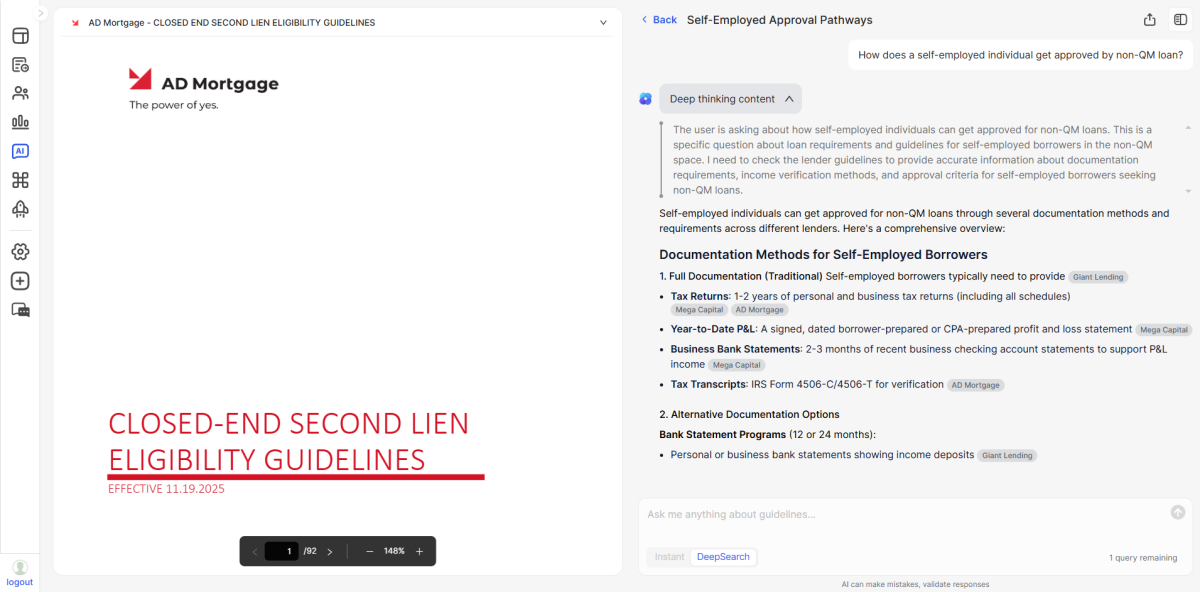
- Answers backed by citations: Ask something broad like "what is DSCR" or specific like "ITIN eligibility with 10% down," and you get a precise answer within seconds, plus a direct citation back to the source document.
- Customizable search and an Explain option: You can narrow results to a specific lender or loan type. If an answer needs more context, the Explain feature re-runs your query with added depth (note: this uses one query credit, since it's essentially a second search rather than a free follow-up).
- Real efficiency gains: Less manual lookup means fewer errors and faster file structuring, which shows up directly in your closing ratio.
- Practical extras: It integrates with common loan origination systems, accepts input in English or Chinese, and calculates qualifying income straight from uploaded borrower documents.
Pricing is refreshingly simple. The free Explorer plan includes free Strata AI queries a day, a personal microsite, and ten lifetime 1003 exports, enough to see whether the tool fits your workflow. Power users can upgrade to unlimited queries for $8 a month per seat, or $35 a month for a small team.
FAQs About Mortgage Guidelines
Q1: How often do mortgage guidelines change?
Fairly often. Fannie Mae and Freddie Mac issue updates on a regular cycle, and private Non-QM investors can revise their matrices weekly based on shifting risk appetite. Keeping a manual spreadsheet current is nearly impossible, which is exactly why automated tools have caught on so quickly.
Q2: What is an underwriting exception?
An exception happens when a file falls just short of a guideline, say, 1% over the DTI cap, but has strong compensating factors like sizable cash reserves or an unusually high credit score. Knowing the underlying rule well enough to argue for an exception is a skill that separates good processors from great ones.
Q3: What is the maximum DTI for a conventional loan in 2026?
Manually underwritten conventional loans cap at 36%, but that ceiling can stretch to 45% with strong credit and reserves, or up to 50% when the file runs through Fannie Mae's Desktop Underwriter or Freddie Mac's Loan Product Advisor.
Q4: How do lenders verify self-employed income?
Since there's no employer to call, underwriters typically average 12 to 24 months of bank statement deposits or review a CPA-prepared profit and loss statement alongside tax returns. Consistency matters more than the total figure, so wide swings between months tend to invite extra scrutiny.
Q5: Can AI accurately verify Non-QM guidelines?
Yes, provided the tool pulls from primary source documents rather than generating answers from general training data. Platforms like Zeitro Strata AI cite the exact matrix and page behind every answer, which keeps the accuracy high enough for real-world loan structuring.
Also read: Non-QM Loan Guidelines: How to Check and Verify with AI Accuracy
Conclusion
Speed and accuracy decide who wins deals in the 2026 mortgage market. The originators closing the most loans and earning repeat referrals are the ones who can pull up a precise guideline answer in seconds instead of losing a borrower to a competitor while stuck on hold with an account executive.
If you haven't tried an AI guideline assistant yet, Zeitro Strata AI is worth testing on your hardest Non-QM file this week. The free plan gives you three queries a day, so there's no real risk in seeing how it handles your toughest scenario. Share the link with your processing team, and let's get more files across the finish line this year.
People Also Read
- What Are FHA Mortgage Guidelines? How to Verify FHA & Overlays Quickly?
- Conventional Mortgage Guidelines: What and How to Check Quickly?
- VA Mortgage Guidelines: What Are They and How to Check Them Quickly?
- Jumbo Mortgage Guidelines: Check Eligibility Quickly and Accurately
- Foreign National Mortgage Guidelines: Verify Eligibility Fast
- How to Check Mortgage Eligibility? Quick and Accurate with Sources
- Max DTI for Mortgage: Requirements By Loan Types

![[Tips for Loan Officers] How Can I Lower Borrower DTI?](https://cdn.prod.website-files.com/6731bc6e813a541b54c30b10/6aa3b89e281a639e7a5c6fca_lower-debt-to-income-ratio-banner.jpg)