Written by

Eric
Share this article

.svg)
Subscribe to updates
Last Checked and Updated on August, 2026
I still remember the knot in my stomach the first time a client called about a $2 million loan on a lakefront property. I knew what came next: hours digging through PDF matrices, calling account executives, and hoping I hadn't missed a footnote buried on page 40 of some investor's guideline manual. In mortgage lending, that kind of delay isn't just annoying — it can cost you the deal.
That's the exact problem I've since solved with AI-powered guideline search. Instead of manually cross-referencing lender after lender, I can now pull up a Jumbo Mortgage guideline and get a sourced answer in under ten seconds using Zeitro Strata AI, Zeitro's AI mortgage guideline assistant (formerly known as Scenario AI). What used to eat up an entire afternoon now fits inside a coffee break.
What is a Jumbo Mortgage?
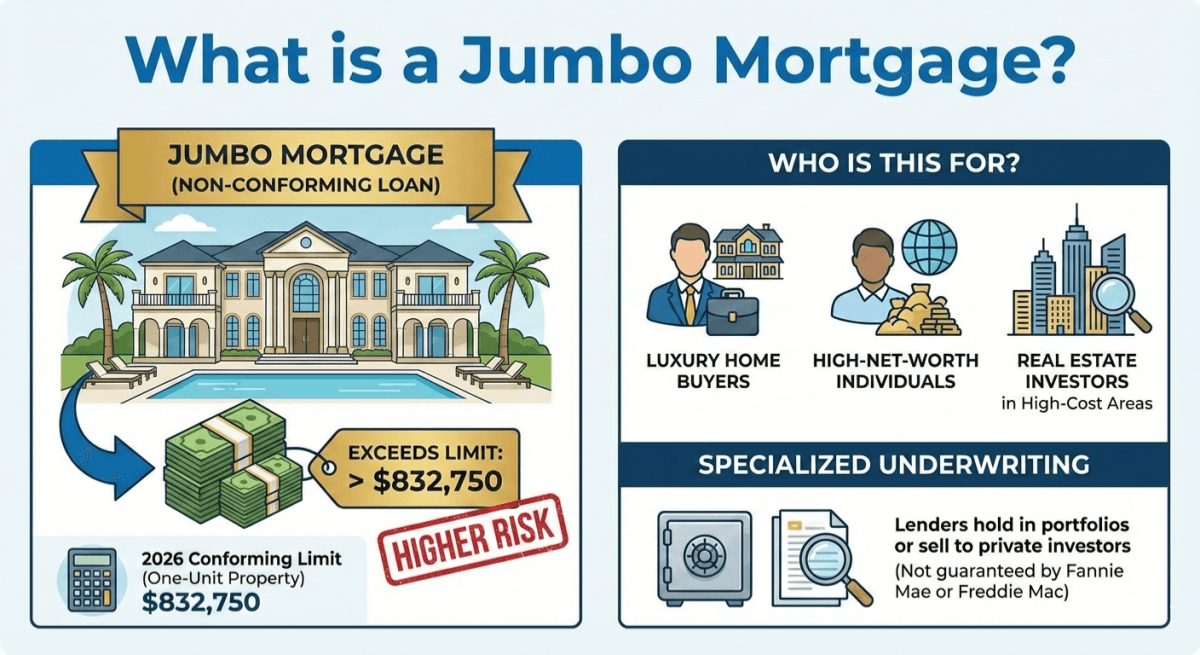
A jumbo mortgage, also called a non-conforming loan, is any home loan that exceeds the limit the Federal Housing Finance Agency (FHFA) sets for loans that Fannie Mae and Freddie Mac are allowed to purchase. For 2026, that baseline limit for a one-unit home is $832,750 across most U.S. counties, up from $806,500 the year before. Cross that line, and the loan automatically falls under jumbo underwriting rules instead of standard conforming guidelines.
The threshold isn't the same everywhere, though. In federally designated high-cost counties, the ceiling jumps to $1,249,125 for a single-unit property — 150% of the baseline. So a $1 million loan might be a straightforward conforming loan in one county and a full jumbo loan two counties over, depending entirely on local home values.
Jumbo loans mainly serve luxury buyers, high-net-worth borrowers, and investors purchasing in expensive metro markets. Because lenders usually keep these loans on their own books or sell them to private investors rather than to Fannie Mae or Freddie Mac, the underwriting is more hands-on, and the paperwork is heavier than what conforming borrowers typically deal with.
Jumbo Loan Limits in High-Cost Areas Like Northern Virginia
This is a piece a lot of guides skip, and it trips buyers up constantly. If you're shopping in Northern Virginia — Arlington, Fairfax, Loudoun, Prince William, Stafford, or Fauquier County — you're already in a federally recognized high-cost area for 2026, with the same $1,249,125 ceiling as San Francisco or Manhattan.
That distinction matters for your monthly budget. A $1.1 million purchase in Fairfax County could still qualify for a conventional loan with standard pricing and mortgage insurance options, while the same loan amount in a lower-cost Virginia county would trigger full jumbo underwriting: bigger down payment, tighter debt-to-income ratio, and larger cash reserves. Before you assume you need a jumbo loan, it's worth checking your specific county's limit, since guessing wrong can throw off your entire pre-approval.
What are the Jumbo Mortgage Guidelines?
Unlike conventional loans, where the rulebook is fairly standardized by the GSEs, Jumbo Mortgage Guidelines are the Wild West. They are set entirely by individual lenders, banks, and private investors.
This means the rules vary—a lot. One lender might require 20% down, while another aggressive Non-QM investor might accept 10%. These guidelines dictate key parameters such as minimum credit score, maximum Debt‑to‑Income (DTI) ratio, required post‑closing reserves, and typical property‑type eligibility.
What you need to watch out for:
- Source: Guidelines are proprietary. A "Jumbo" at Wells Fargo looks completely different from a "Jumbo" at AD Mortgage.
- Overlays: Investors often add strict overlays.
- Appraisals: Many require two full appraisals rather than one.
As a Loan Officer, you can't just memorize "Jumbo rules" because they don't exist in a vacuum. You have to know the specific guidelines of the investor you are selling to.
Why Accurate Jumbo Guideline Verification Matters
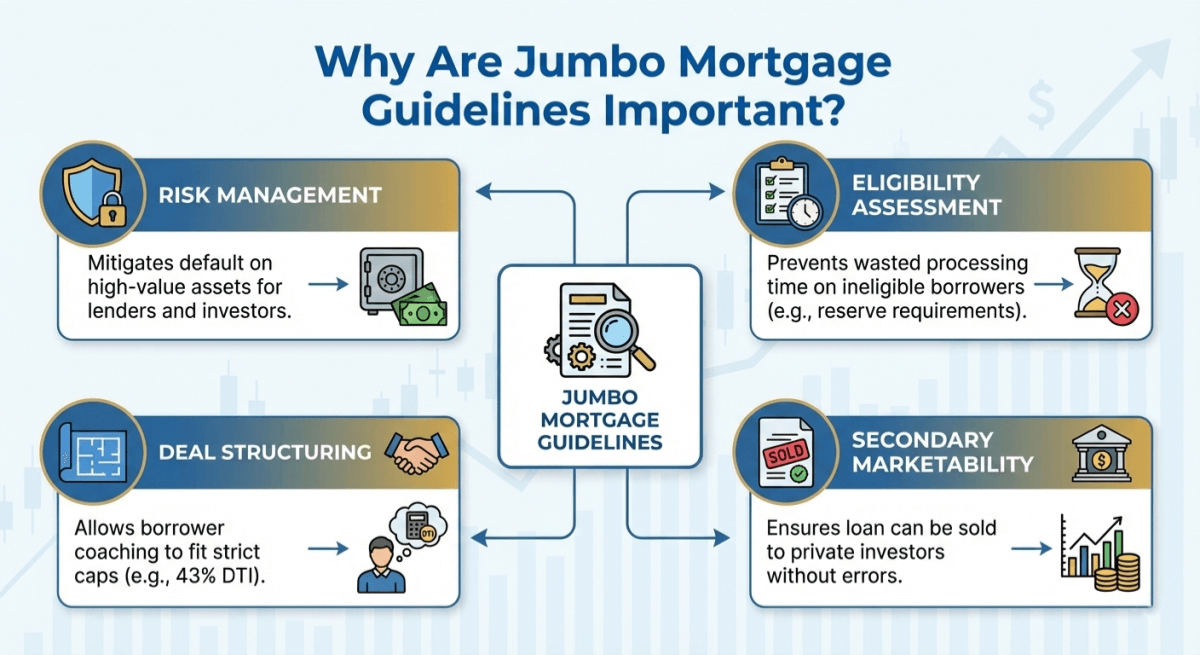
Getting a jumbo loan approved isn't the finish line — structuring it so it actually funds and closes is. Miss a nuance in the guidelines, and you risk a denial days before closing, which is about as painful as this business gets.
Here's why nailing the details up front is non-negotiable:
- Risk management. Since lenders hold these loans in portfolio or sell them to private investors, following the guidelines precisely limits default exposure on high-value assets.
- Eligibility screening. Nobody wants to spend weeks processing a file for a borrower who was never eligible because of a reserve requirement nobody caught early.
- Deal structuring. Knowing the exact guideline lets you coach a borrower proactively — maybe paying down one credit card to land under a strict 43% DTI cap.
- Secondary market fit. For lenders, the loan has to match the guideline exactly to be sellable later. One missed detail can make an otherwise solid loan unsellable.
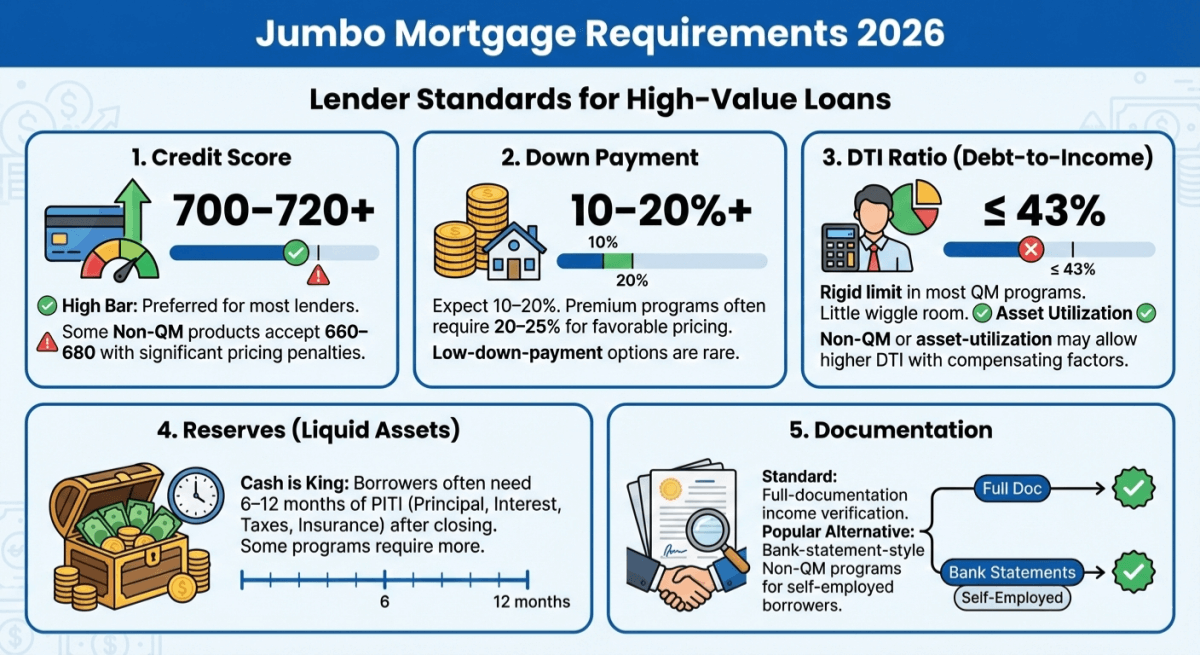
Jumbo Mortgage Requirements 2026
Every lender adds its own flavor, but the market has landed on some general expectations for 2026, and they're noticeably tighter than a few years back.
- Credit score. Expect a floor around 660–700 for standard jumbo programs, with the most competitive pricing reserved for scores of 740 and above. Super jumbo loans (roughly $1.5 million and up) often push that bar to 740–780.
- Down payment. Plan for 10–20% on most programs, and 20–25% for the best pricing. A handful of lenders will go as low as 5–10% down for borrowers with exceptional credit and strong reserves, though that's the exception rather than the rule.
- DTI ratio. Most qualified mortgage (QM) jumbo programs cap DTI at 43%. Non-QM and asset-utilization jumbo products sometimes stretch higher with strong compensating factors, and jumbo VA loans can allow DTI up to 50% on certain adjustable-rate products.
- Reserves. Lenders typically want 6–12 months of PITI (principal, interest, taxes, insurance) sitting in liquid assets after closing, and that number climbs for larger loan amounts.
- Documentation. Full income documentation is standard, but bank-statement and asset-based Non-QM programs remain a popular path for self-employed jumbo borrowers who don't fit a traditional W-2 file.
A couple of borrower groups worth a quick mention: veterans with full VA entitlement can technically access jumbo-sized loans with zero down, though individual lenders still layer their own credit and reserve overlays on top. Foreign national borrowers can qualify too, but they should expect larger down payments — often 30% or more — along with alternative documentation in place of a U.S. credit history.
How to Quickly Check Jumbo Mortgage Guidelines?
I used to check these requirements by logging into five separate lender portals and reading the fine print line by line. It ate up entire afternoons and left plenty of room for a costly mistake.
That's exactly the gap Zeitro Strata AI closes. It's an AI-powered mortgage guideline assistant built for loan officers, processors, and underwriters, indexing guidelines from more than 100 investors, including major names like AD Mortgage, AmWest, and CMG Financial.
Here's what makes it part of my daily workflow:
- Chat-based search. No need for exact keywords. Ask something like "Does AD Mortgage allow a 680 FICO on a jumbo loan with 15% down?" and get a direct answer in seconds — it handles specific eligibility questions and vague "what if" scenarios equally well.
- Cited answers. This is the feature that sold me. It doesn't guess — every answer links back to the exact page in the source guideline, so I can quote a client with confidence instead of crossing my fingers.
- Broad coverage. It's not limited to jumbo loans. The same tool covers QM and Non-QM programs, including DSCR, bank statement, ITIN, and foreign national files.
- Explain feature. When a clause reads like legal jargon, the Explain button breaks it down into plain language for you or your borrower.
- Accessible pricing. The Individual plan runs $8 a month for unlimited queries, and there's a free daily allowance on the Explorer tier if you want to try it before committing.

FAQs About Jumbo Mortgage Guidelines
Q1. What are the rules for a jumbo mortgage?
Rules vary by investor, but most jumbo programs require a loan amount above the local conforming limit, a credit score of 660 or higher (700+ for the best pricing), a DTI at or under 43%, and several months of post-closing reserves.
Q2. Do you have to put 20% down on a jumbo loan?
Not necessarily. Twenty percent is the traditional standard for avoiding mortgage insurance and securing the best rate, but plenty of lenders now offer jumbo programs with 10% or 15% down for borrowers with strong credit and reserves.
Q3. Are jumbo loans harder to get approved for?
Generally, yes. Since most jumbo loans aren't backed by Fannie Mae or Freddie Mac, they go through more manual underwriting, with closer scrutiny on income stability, asset sourcing, and credit history than a standard conforming loan sees.
Q4. What is the jumbo loan minimum in 2026?
It's any amount above your county's conforming loan limit. For most U.S. counties that's $832,750 for a one-unit property in 2026, rising to $1,249,125 in designated high-cost counties like parts of Northern Virginia, San Francisco, and New York.
Q5. Are jumbo loan closing costs higher?
Usually. Costs calculated as a percentage of the loan, like title insurance and origination fees, scale up with the loan amount. Add in the possibility of paying for two appraisals instead of one, and closing costs on a jumbo loan often run higher in dollar terms than on a conforming loan.
Q6. Can foreign nationals qualify for a jumbo loan?
Yes, though the path looks different. Foreign national borrowers typically need a larger down payment, often 30% or more, and provide alternative documentation such as international credit reports or verified asset statements in place of a U.S. credit score.
Q7. What is considered a super jumbo loan?
There's no single legal definition, but most lenders treat loans above roughly $1.5 million to $2 million as super or ultra jumbo, with correspondingly higher credit score, down payment, and reserve requirements than a standard jumbo loan.
Q8. How long does jumbo loan approval typically take?
Because jumbo files usually involve manual underwriting and sometimes two appraisals, expect the process to run longer than a conforming loan — often several weeks rather than several days. Timelines vary widely by lender and how complete the borrower's file is at submission.
Final Word
Jumbo mortgages don't have to feel like a maze. Whether you're structuring a deal for a picky underwriter or walking a high-net-worth borrower through a complex file, having verified guidelines at your fingertips is what separates a smooth closing from a last-minute scramble.
I'd genuinely recommend giving Zeitro Strata AI a try. It pairs the speed of AI with the accuracy of real lender guidelines, so you spend less time guessing and more time closing. Starting at $8 a month with a free daily allowance to test it out, it's a tool that can pay for itself on your very next deal.
Check your eligibility scenarios now at Zeitro.com.
People Also Read:
- What Are FHA Mortgage Guidelines? How to Verify FHA & Overlays Quickly?
- Conventional Mortgage Guidelines: What and How to Check Quickly?
- How to Get a DSCR Loan? Step-by-Step for Real Estate Investors
- 8 Best Non-QM Mortgage Lenders in 2026: Which to Choose?
- Mortgage Guidelines 2026: What Are They? How to Verify?

![[Tips for Loan Officers] How Can I Lower Borrower DTI?](https://cdn.prod.website-files.com/6731bc6e813a541b54c30b10/6aa3b89e281a639e7a5c6fca_lower-debt-to-income-ratio-banner.jpg)