[Proven] How to Generate Mortgage Leads for Free? 6 Methods

Blog

[Proven] How to Generate Mortgage Leads for Free? 6 Methods

If you're looking for the best way to generate mortgage leads for free, learn 6 proven methods here and get more leads now!
December 5, 2025
·
5 min read

Written by

Eric
Author from Zeitro

Share this article

Subscribe to updates

Thank you! Your submission has been received!
Oops! Something went wrong while submitting the form.

Are you tired of burning through your marketing budget on paid ads or buying mortgage leads that just don't convert? You are not alone. Whether you are a loan officer, mortgage broker, wholesaler, or part of a small lending team, the pressure to find quality borrowers without spending a fortune is real. We've all been there, staring at a pipeline that needs filling while trying to keep costs low.

The good news? Some of the highest-converting mortgage leads won't cost you a dime, but just your time and expertise.

In this guide, I'm sharing 6 proven, free methods to generate mortgage leads. These aren't theoretical concepts. They are actionable steps you can start today. By the end of this article, you will have a clear roadmap to build a sustainable flow of clients, from leveraging AI platforms to mastering local networking.

Let's dive into how you can stop chasing leads and start attracting them.

People Also Read:

Method 1. A Website to Showcase Yourself

In the digital age, if you aren't online, you don't exist. However, I've seen too many loan officers get stuck in the trap of building a custom website. Honestly, it's a headache. It requires expensive hosting, endless maintenance, and worst of all, you have to fight tooth and nail for SEO just to get a single visitor.

There is a smarter, zero-cost alternative.

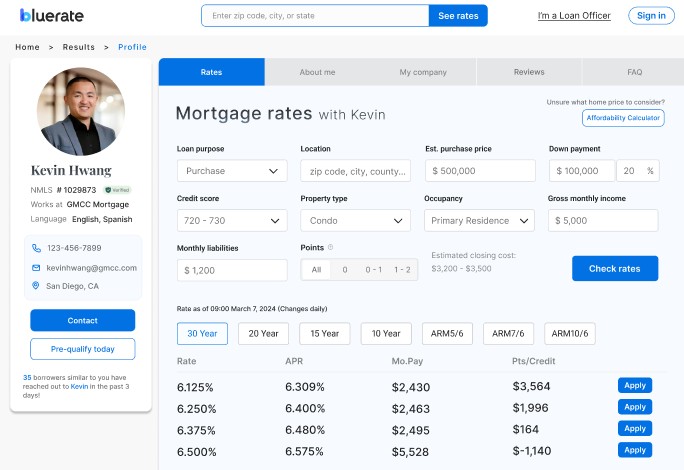
Instead of building a lonely island on the web, I highly recommend creating a free profile on an AI Mortgage Marketplace like Bluerate. Think of this as your professional storefront that comes pre-loaded with traffic. By joining a platform where borrowers are already searching for rates and lenders, you leverage their SEO and marketing efforts for your own benefit.

But Bluerate is more than just a digital business card. It's a powerhouse that integrates directly with the bets Loan Origination System (LOS). Here is why this is a game-changer for your workflow:

  • Total Transparency: From the initial Rate Quote to the final Close, everything is tracked in real-time.
  • AI Efficiency: The platform utilizes tools like GuidelineGPT and Scenario AI, which can reduce manual guideline research by 100%.
  • Speed Wins: With AI empowerment, professionals using Bluerate save 7+ hours per loan and see 20% faster loan closing speeds.

When you streamline the process, borrowers notice. In fact, the platform boasts a 90%+ application completion rate. You aren't just getting a lead. You're getting a borrower who experiences a seamless, transparent journey. That level of service helps you close 30% more loans naturally. Why pay for a website when you can join an ecosystem that actually helps you work?

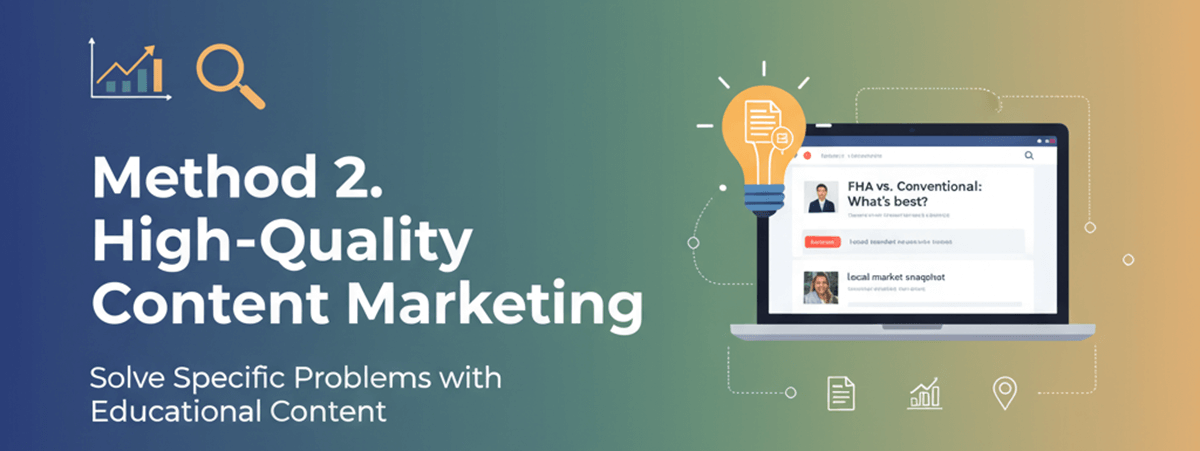
Method 2. High-Quality Content Marketing

You might be thinking, "I'm a lender, not a writer." But here is the truth: content is the only asset that works for you while you sleep. High-quality content builds trust before you ever pick up the phone.

The secret isn't to write generic updates, and it's to solve specific problems. Focus on educational content that answers the exact questions your clients ask. You can write blog posts like "How to get pre-approved in [Your City]" or "FHA vs. Conventional: What's best for first-time buyers?" Share a monthly local market snapshot. Use data from authoritative sources (like the Fed or local realtor boards) to show trends in your specific county.

Don't let them read and leave. Always include a "Lead Magnet." For example, offer a free eBook like "The Ultimate Closing Cost Guide" in exchange for their email. Place a sticky contact widget on your page so they can book a call instantly.

By consistently posting, say, one solid article every two weeks, you build a library of answers. Over time, this organic traffic becomes your most reliable source of free leads.
Method 2. High-Quality Content Marketing

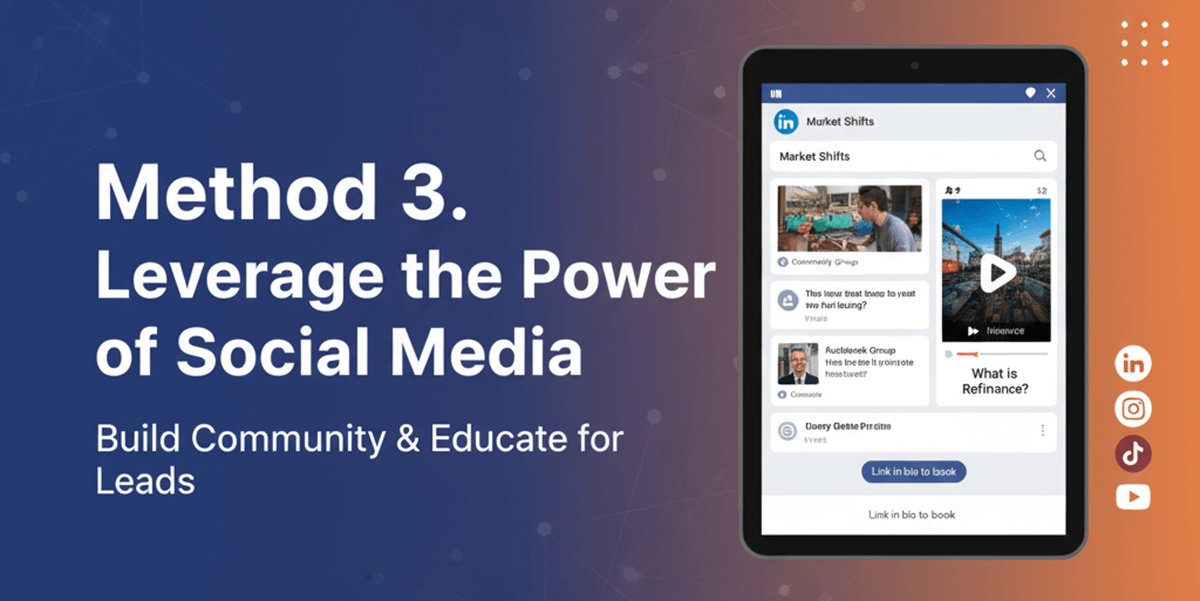
Method 3. Leverage the Power of Social Media

Social media is often misunderstood in our industry. It's not about broadcasting your daily rates to an empty room. It's about community and education. Each platform has a specific role in your lead generation strategy.

  • LinkedIn: This is your B2B powerhouse. Use it to connect with real estate agents and financial planners. Share case studies of tough deals you saved or professional insights on market shifts.
  • Facebook: Focus on hyper-local community groups. Don't spam, and be the helpful expert. When someone asks about housing in a local group, answer their question genuinely without a hard sell.
  • Instagram/TikTok YouTube: Video is king here. Create short, captioned videos explaining complex terms (e.g., "What is refinance?"). These "micro-lessons" build massive trust.

Consistency beats virality. Create a simple schedule: FAQs on Tuesday, Client Success Stories on Thursday, and Market Updates on Friday. Always include a clear Call to Action (CTA), such as "Link in bio to book a consultation."Show the human side. Share a photo of a closing day (with client permission) or a "behind-the-scenes" look at your underwriting process. This transparency proves you are a real person helping real families, not just a faceless bank.

Method 4. Word of Mouth with a Great Reputation

A referral is the "Holy Grail" of mortgage leads, because it's free, high-intent, and closes fast. But hoping for referrals isn't a strategy. You need a system to generate them.

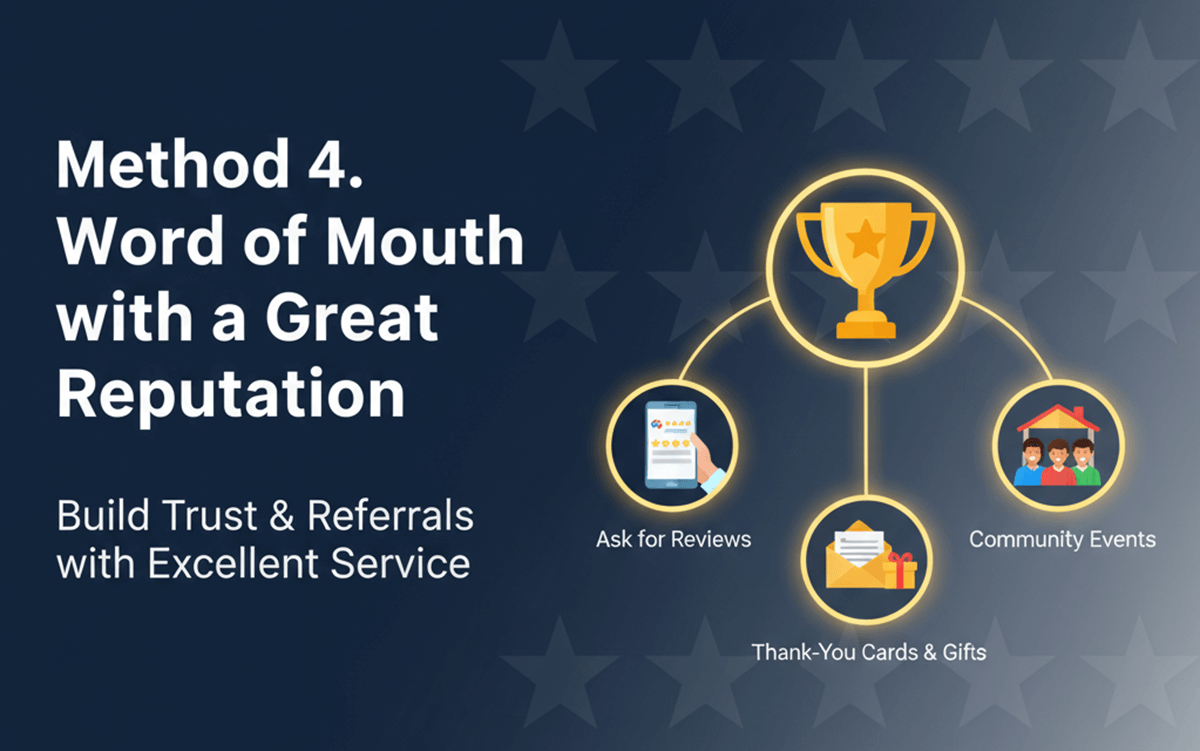
Reputation management starts with the client experience. If you use tools like Bluerate mentioned above to speed up closing, your clients are already happier. Capitalize on that joy. Don't know how to get reviews? Check out the ideas below:

  • Timing is Key: Ask for the review right when the loan funds. That is the moment of peak happiness.
  • Make it Easy: Send a text or email with a direct link to your Google Business Profile. Don't make them search for you.
  • The "Referral Tree": Create a simple program. Send handwritten thank-you cards or host small community appreciation events.

Note that you should always check your local regulations and RESPA guidelines regarding referral rewards to ensure you remain compliant. When future prospects search your name and see 50 five-star reviews mentioning your transparency and speed, the sale is already half-made.
Method 4. Word of Mouth with a Great Reputation

Method 5. Network with Local Real Estate Agents

This is the bread and butter for most top producers. Real estate agents control the buyer relationship, and they are desperate for a lender who won't kill their deal.

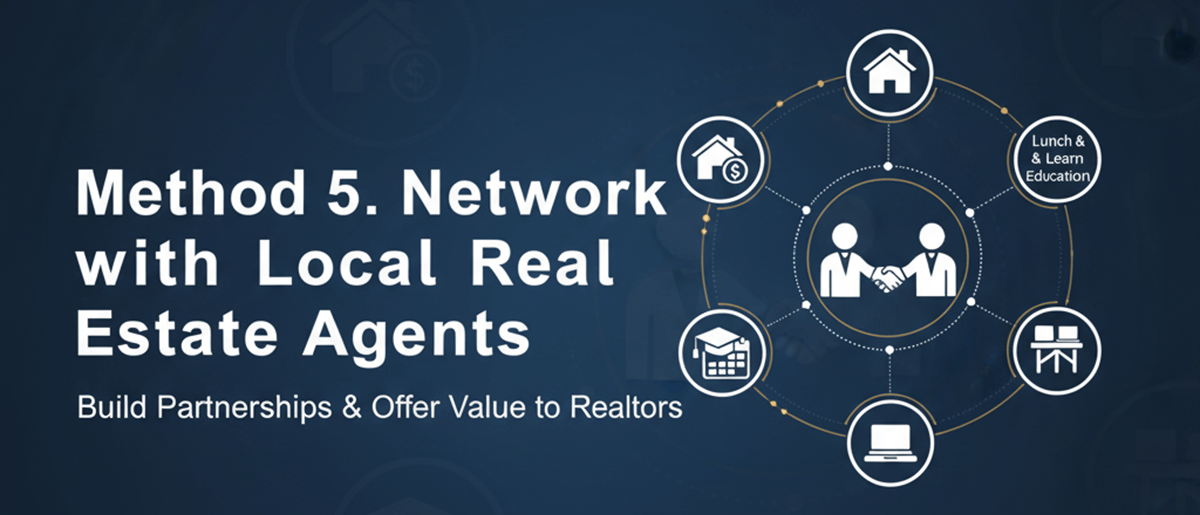
Don't just email them asking for coffee. You need to offer value first. Target high-volume local realtors and buy-side agents. Here are some partnership ideas:

  • Co-Marketing: Offer to create co-branded open house flyers using your marketing templates.
  • Education: Host a "Lunch & Learn" specifically on new loan products that help them sell hard-to-move properties like renovation loans or buydowns.
  • Open House Support: Offer to sit at their open house to pre-qualify buyers on the spot.

Show them you have a system. "I use an AI-driven process that ensures I never miss a closing date, and I update you every Tuesday on file status." When you prove you can make their life easier and protect their commission, the referrals will flow naturally.
Method 6. Connect with Other Professionals

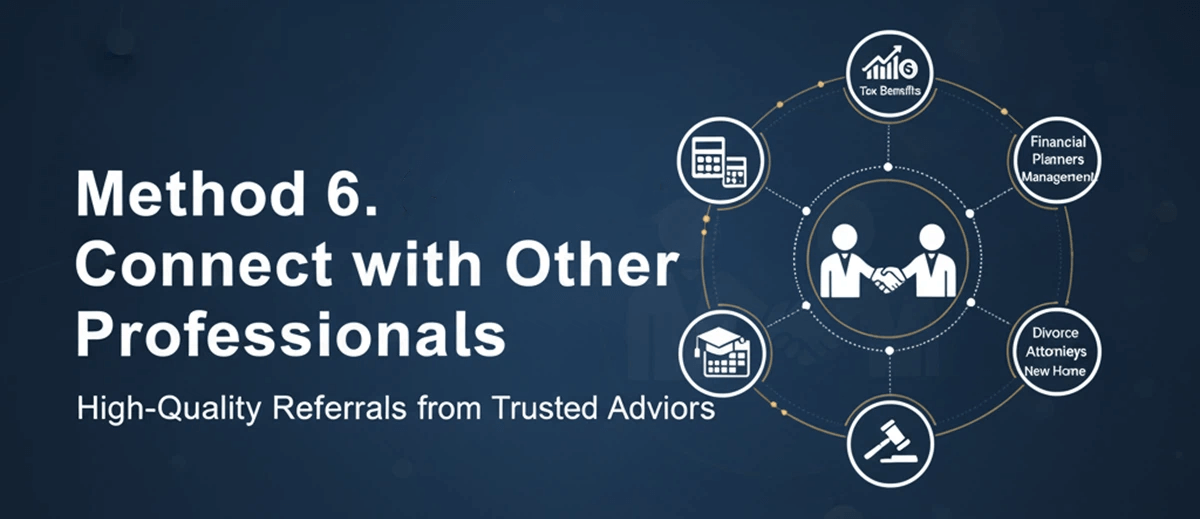
While everyone chases realtors, many overlook the "Other Professionals" who advise clients on major life financial decisions. These relationships can yield incredibly high-quality borrowers. Here are some professionals you can target:

  • CPAs: They know exactly who is buying a home for tax benefits or who has a self-employed income structure that needs a skilled lender.
  • Financial Planners: They handle clients looking to refinance for investment purposes or wealth management.
  • Divorce Attorneys: A niche, but these clients often need to refinance a spouse off a title or buy a new home quickly.

You can try to send a professional, personalized email. Focus on how you protect your client's interests. For example: "I specialize in helping self-employed clients navigate mortgage approvals without triggering audits. I'd love to be a resource for your tax clients."

Treat these partners with extreme professionalism. A referral from a CPA comes with a high level of trust transferred to you, and don't break it.
Conclusion

Generating free mortgage leads isn't about finding a "magic button". It's about building a presence where trust and value meet. Whether you are leveraging the AI power of Bluerate, creating educational content, or shaking hands with local realtors, the core principle is the same: Give value first.Don't try to do all six methods at once. First of all, you can create your free profile on Bluerate to handle your digital presence and streamline your workflow. Then, pick one distribution channel like Instagram or local Realtor networking, and commit to it for 90 days.

The leads are out there, and they are looking for a professional like you. Start building your pipeline today.

Keep reading

[2026 Update] 8 Highest-Rated Reverse Mortgage Companies for You

Blog

5 min read
Arrow icon on dark background
[2026 Update] 8 Highest-Rated Reverse Mortgage Companies for You
Protect your retirement with our 2026 guide to the 8 best reverse mortgage companies. Compare fees, pros, and cons to find the right lender for you.

When my parents first considered tapping into their home equity to fund their retirement, the sheer number of reverse mortgage lenders left us completely overwhelmed. If you're a homeowner over 62, you probably feel the same way—anxious about hidden fees, aggressive sales tactics, and making an irreversible mistake with your biggest asset. You want a trustworthy partner, not just a sales pitch. That's why I've done the heavy lifting to evaluate the top lenders for 2026.

However, if navigating through endless reviews feels like too much work, you can skip the guesswork. I highly recommend using Bluerate's free AI Chat. It instantly matches you with top-rated, local loan officers tailored to your specific financial situation, saving you time and stress.

How We Selected the Best Reverse Mortgage Companies

To give you the most accurate recommendations, I didn't just look at glossy marketing brochures. I dug into the hard data. My selection criteria focused heavily on trust and transparency. I cross-referenced Better Business Bureau (BBB) ratings, verified Trustpilot customer reviews, and checked the NMLS registry for compliance histories.

I also prioritized companies offering a wide variety of products, both government-backed HECMs and proprietary jumbo loans, so you have actual choices. Finally, I evaluated their fee transparency and whether they prioritize mandatory HUD counseling, ensuring these lenders meet strict E-E-A-T standards for your financial safety.

8 Best Reverse Mortgage Companies to Consider

Below is my curated list of the top eight reverse mortgage companies for 2026. Keep in mind that these aren't ranked from best to worst. Rather, each has its own unique strengths. Whether you need the lowest fees, face-to-face service, or a massive jumbo loan, you'll find a match here.

1. Finance of America

NMLS Number: 2285States: Available in most states (Not all 50)Verdict: Best overall for a wide variety of proprietary and HECM reverse mortgage options.

Finance of America Reverse (FAR) acquired American Advisors Group (AAG) in 2023, solidifying its position as a powerhouse in the reverse mortgage space. What I really like about FAR is its product flexibility. If your home is worth over the 2026 FHA limit of $1,249,125, their HomeSafe jumbo reverse mortgage allows you to access up to $4 million. They even have options that act as a second mortgage, letting you keep your current low-interest first mortgage intact.

Looking at online feedback, borrowers frequently praise their loan officers for being patient educators rather than pushy salespeople. On the BBB and Trustpilot, they maintain high marks for walking seniors through the complex math of reverse mortgages. While their interest rates might not always be the absolute rock-bottom lowest, their deep industry expertise makes them an incredibly safe bet for most families.

Finance of America

Pros:

  • Massive variety of proprietary products (like the HomeSafe loan).
  • Minimum age of 55 for certain non-FHA loans.

Cons:

  • Not licensed in every single U.S. state.
  • Interest rates are middle-of-the-road compared to discount brokers.

2. Longbridge Financial

NMLS Number: 957935States: All 50 states plus Washington, D.C.Verdict: Best for low upfront costs and innovative proprietary products.

Founded in 2012, Longbridge Financial has built a reputation around borrower education and low costs. They are one of the few lenders actively trying to modernize the industry. For example, their newly launched "Platinum Preserve" product is fantastic. It allows you to tap into your home equity now while keeping 10% to 40% of it safely tucked away for your kids or future medical emergencies.

From my research, Longbridge really shines in customer service. They boast a stellar rating on Trustpilot (around 4.8/5), with thousands of seniors highlighting how transparent their fee structure is from day one. They even have a solid mobile presence, which is surprisingly uncommon in this sector. If you want a lender that operates nationwide, keeps origination fees competitive, and actively encourages you to explore alternatives before signing, Longbridge is a top-tier choice.

Longbridge Financial

Pros:

  • Licensed in all 50 states for maximum accessibility.
  • Unique "Platinum Preserve" product lets you intentionally save equity for heirs.

Cons:

  • Some proprietary products require higher minimum property values.
  • The third-party appraisal process can occasionally be slow.

3. Fairway Independent Mortgage Corporation

NMLS Number: 2289States: All 50 states plus Washington, D.C.Verdict: Best for in-person customer service and speedy closings.Sometimes, you just want to sit across a desk from a real human being and shake their hand. If that sounds like you, Fairway Independent Mortgage is exactly what you need. With over 30 years in the business and physical branches scattered across the entire country, they bring a local, personalized touch to a very intimidating financial decision. Fairway is famous in the real estate world for its speed.

While a typical reverse mortgage can take 30 to 45 days to close due to counseling and appraisals, Fairway's dedicated reverse underwriting team often cuts that time down significantly. Customer reviews across the web consistently highlight the warmth and responsiveness of their local agents. They might not have the flashiest digital tools, but their hands-on, face-to-face guidance provides incredible peace of mind for older homeowners.

Fairway Independent Mortgage Corporation

Pros:

  • Exceptional A+ BBB rating and huge local branch network.
  • Known for closing loans significantly faster than the industry average.

Cons:

  • Lacks a dedicated mobile app for reverse mortgage management.
  • Rates can be slightly higher than online-only brokers.

4. Mutual of Omaha Mortgage

NMLS Number: 1025894States: 49 states (Excludes New York)Verdict: Best for brand trust and comprehensive retirement planning integration.

When it comes to financial products for seniors, name recognition matters. Mutual of Omaha has been a household name since 1909, and its mortgage division carries that same commitment to stability and trust. In recent years, they have been among the top HECM lenders in the United States by dollar volume, often ranking #1. What makes them stand out is how they view the reverse mortgage.

Their loan officers don't just sell you a loan. They look at how a HECM fits into your broader retirement portfolio, ensuring it won't negatively impact your Medicare or Social Security benefits. Online reviews frequently mention the relief of working with a legacy brand rather than a fly-by-night operation. They hold an A+ rating with the BBB. The only downside is that their conservative, careful approach means their underwriting process is rigorous.

Mutual of Omaha Mortgage

Pros:

  • Backed by a highly trusted, 100-year-old insurance and financial legacy.
  • Excellent at treating home equity as part of a holistic retirement plan.

Cons:

  • Underwriting guidelines can be quite strict.
  • Not licensed to operate in New York.

5. Liberty Reverse Mortgage

NMLS Number: 2726States: 50 states, Washington, D.C., and Puerto RicoVerdict: Best for deep educational resources and long-standing industry experience.

Liberty Reverse Mortgage has been a cornerstone of the industry for over 20 years, funding billions of dollars in loans for more than 60,000 older Americans. They are one of the most experienced lenders you can find, and it shows in their approach. Liberty is famous for its zero-pressure educational resources, breaking down complex FHA rules into plain English so you actually understand what you are signing.

Operating in all 50 states, they offer everything from standard HECMs to HECM for Purchase loans (which lets you buy a new home using reverse mortgage proceeds). While their parent company, PHH, is currently shifting its business model, which may impact long-term servicing, Liberty's historical track record remains solid. Customers on third-party sites frequently commend their agents for explaining the nitty-gritty details without rushing the sale.

Liberty Reverse Mortgage

Pros:

  • Over two decades of specialized reverse mortgage experience.
  • Excellent "Equity 101" educational materials for seniors.

Cons:

  • Parent company is currently transitioning its servicing portfolio.
  • No dedicated mobile application available.

6. CrossCountry Mortgage

NMLS Number: 3029States: All 50 statesVerdict: Best for borrowers looking for a massive, full-service retail lender.CrossCountry Mortgage is a giant in the traditional retail mortgage world, originating 1 in every 35 homes in the U.S. Recently, they have made a massive push into the reverse mortgage space, bringing over top-tier industry executives to build out a dedicated, highly trained reverse division. The main advantage of using CrossCountry is their sheer scale and resources.

They have access to over 170 investor outlets, meaning they can usually find a creative solution for unique property types or financial situations. Because they are so large, you can easily find a local branch in your town. The caveat, based on customer reviews, is that your personal experience will depend heavily on the specific loan officer you get. However, when you connect with one of their certified reverse specialists, the service is prompt and highly professional.

Pros:

  • Licensed nationwide with a huge network of over 3,500 loan officers.
  • Offers a true one-stop shop for both forward and reverse mortgages.

Cons:

  • Reverse mortgages are a newer core focus compared to their traditional loans.
  • Customer experience can vary widely depending on your specific local branch.

7. Northwest Reverse Mortgage

NMLS Number: 347051States: 28 statesVerdict: Best boutique broker for comparison shopping and localized expertise.

Unlike the direct lenders on this list, Northwest Reverse Mortgage operates primarily as a specialized niche broker. I absolutely love this model for borrowers who want to comparison shop without making a dozen phone calls. Because they aren't tied to a single bank's products, Northwest can pull quotes from places like Finance of America, Longbridge, and others to find you the absolute best deal. They are particularly strong in the Pacific Northwest but are licensed in 28 states.

They offer everything from standard FHA HECMs to highly specific products like second-lien reverse mortgages. Reviews for Northwest are overwhelmingly positive, with clients praising their transparent, consultative approach. They act more like financial advisors than mortgage brokers. If you live in their service area, they are a phenomenal choice.

Northwest Reverse Mortgage

Pros:

  • As a broker, they shop multiple lenders to find you the best rate.
  • Access to unique products like the HomeSafe Second loan.

Cons:

  • Limited geographic footprint (only available in 28 states).
  • They originate the loan but don't service it long-term.

8. South River Mortgage

NMLS Number: 1854524States: 28 statesVerdict: Best for HECM refinances and incredibly fast processing times.If you already have a reverse mortgage and are looking to refinance it to get a better rate or pull out more cash, South River Mortgage should be at the top of your list. They have carved out a very specific niche in HECM-to-HECM refinancing and have grown rapidly into the fourth-largest reverse lender in the country by volume.

South River is heavily technology-driven, which is how they manage to close loans in an average of just 26 days—lightning fast for this industry. While they only operate in about 28 states, their rates consistently rank among the lowest available. Looking at their Trustpilot feedback, homeowners are thrilled with the speed and the low fees. Once you start working with their team, the process is smooth, efficient, and highly professional.

South River Mortgage

Pros:

  • Highly competitive interest rates, especially for refinancing.
  • Extremely fast closing process (averaging around 26 days).

Cons:

  • Limited state availability.
  • Initial marketing outreach can feel a bit aggressive to some.

Considerations to Know in Advance

Before you sign any paperwork, I want to be completely honest with you: a reverse mortgage isn't free money. It's a loan against your home, and it comes with strict industry rules. Here is what you must consider before moving forward:

  • Mandatory Counseling: You cannot legally get a HECM without completing a session with an independent, HUD-approved counselor. This protects you from predatory lending.
  • Ongoing Responsibilities: You still own the house. This means you must continue paying your property taxes, homeowners insurance, and any HOA fees. If you default on these, the lender can foreclose on your home.
  • Upfront Costs: Closing costs can be high. Expect to pay origination fees, appraisal costs, and an initial FHA mortgage insurance premium. These are usually rolled into the loan, eating into your available cash.
  • Impact on Heirs: When you pass away or move out permanently, the loan becomes due. Your heirs will need to decide whether to sell the property to pay off the balance or refinance it to keep the family home.

FAQs About Top Reverse Mortgage Companies

Q1. What is the dark side of reverse mortgage?

The main downside is the high upfront costs and compounding interest. Because you aren't making monthly payments, the interest rolls into the loan balance, which grows larger every month. Additionally, if you fail to pay your property taxes or home insurance, you face the very real risk of losing your home to foreclosure.

Q2. How much can a 70-year-old borrow on a reverse mortgage?

There isn't a single flat number. It entirely depends on your home's appraised value, current interest rates, and the exact age of the youngest borrower. Generally speaking, the older you are, the more equity you can access. A 70-year-old might qualify for roughly 45% to 55% of their home's value in today's market.

Q3. What is better than a reverse mortgage?

It depends on your goals. If you have the income to make monthly payments, a Home Equity Loan or a Home Equity Line of Credit (HELOC) usually has much lower closing costs. Alternatively, simply downsizing, selling your large house and buying a smaller, cheaper one with cash, is often the cleanest financial move.

Q4. Is a reverse mortgage a good idea for seniors?

Yes, but only in the right circumstances. It's an excellent tool if you plan to "age in place" and stay in your current home for the rest of your life. However, if you plan to move into an assisted living facility or relocate closer to your grandkids in the next few years, the high upfront fees make it a poor short-term choice.

Q5. Can a 90-year-old get a reverse mortgage?

Absolutely, yes. In fact, because the loan amounts are calculated based on life expectancy, a 90-year-old will be able to access a significantly higher percentage of their home's equity compared to a 62-year-old. There is no maximum age limit for these FHA loans.

Q6. What disqualifies you from a reverse mortgage?

You will be disqualified if the youngest homeowner is under 62 (for FHA loans) or 55 (for some jumbo loans). You also won't qualify if you lack sufficient equity (usually you need at least 50%), fail the financial assessment proving you can pay ongoing property taxes, or have delinquent federal debt.

Q7. Why do banks not recommend reverse mortgages?

Traditional big banks like Chase or Wells Fargo largely exited the reverse mortgage market years ago. These loans are highly regulated, complex, and carry reputational risks if a senior faces foreclosure due to unpaid taxes. Traditional banks prefer to sell you a standard HELOC because the profit model is simpler and less risky for them.

Q8. What is the 95% rule on a reverse mortgage?

The 95% rule allows heirs to repay a reverse mortgage by paying the lesser of the full loan balance or 95% of the home's current appraised value if they want to keep the house. They simply have to pay 95% of the home's current appraised value, and the FHA insurance covers the remaining deficit.

Conclusion: What Company is Best for a Reverse Mortgage?

Deciding to take out a reverse mortgage is one of the most significant financial choices you will make in retirement. It's not just about getting cash. It's about securing your long-term comfort while fully understanding the costs involved.

If you want a quick recap, here is my Best For list of reverse mortgage companies:

  • Finance of America: Best overall options and jumbo loans.
  • Longbridge Financial: Best for keeping upfront costs low.
  • Fairway: Best if you want in-person, local customer service.
  • Mutual of Omaha: Best for brand trust and retirement planning.
  • Northwest: Best for having a broker compare rates for you.

Every homeowner's situation is entirely unique, and I always suggest talking to an independent financial advisor before signing anything. If you are ready to explore your exact numbers but don't want to deal with endless sales calls, try Bluerate AI Agent. It's the smartest way to safely connect with a vetted, local professional who actually understands your specific needs today.

People Also Read

Reverse Home Mortgage Explained: Meaning, Requirements, Example

Blog

5 min read
Arrow icon on dark background
Reverse Home Mortgage Explained: Meaning, Requirements, Example
Discover what a reverse mortgage is, how it works, and 2026 requirements. Explore real examples, pros, and cons to decide if tapping your home equity is right for you.

What is a reverse home mortgage, exactly? Basically, it lets homeowners 62 and older turn their house's equity into usable cash, without selling the place or taking on new monthly mortgage bills. After years in the lending industry, I constantly see seniors struggling with fixed incomes while sitting on a goldmine: their home. While the concept sounds simple, the actual 2026 rules can get pretty tangled.

For borrowers, knowing the basics is everything. For my fellow loan officers, leveraging AI tools like Zeitro helps us instantly verify reverse mortgage eligibility, so we can give clients the accurate, fast answers they desperately need.

What is a Reverse Mortgage?

Think of a traditional mortgage as you slowly buying your house from the bank. A reverse mortgage flips that script, the lender actually pays you based on the equity you've already built up. You skip the monthly principal and interest payments entirely.

This setup is exclusively for older homeowners. Whenever I sit down with clients, their first question is almost always, "Will the bank own my house?" Let me be crystal clear: you keep your title and ownership. You just live there like normal. The loan balance is only repaid when you permanently move out, sell the property, or pass away. It's simply a practical way to pad your retirement fund, cover unexpected medical bills, or afford basic home renovations without the heavy burden of a monthly payment hanging over your head.

What is a Reverse Mortgage?

Reverse Mortgage Example

Let's look at a realistic scenario. Take John, a 65-year-old retiree whose house is worth $500,000. He finally paid off his original mortgage years ago, but his current pension barely covers groceries and utilities.

By taking out a reverse mortgage, John taps into that $500,000 value. Since he has full equity, he qualifies for a tax-free line of credit. Instead of taking a massive lump sum, he sets up a $1,000 monthly payout to make life easier. Every month, his loan balance slowly grows because interest is added to what he borrows. But John still owns his home, lives comfortably, and never has to write a check to a lender.

Pros and Cons of a Reverse Mortgage

No financial product is perfect. I always insist my clients look closely at both sides of the coin before signing anything. Here is the honest breakdown:

Pros:

  • Zero monthly mortgage bills: You stop paying monthly principal and interest.
  • Tax-free money: The IRS treats the cash as loan proceeds, not taxable income.
  • You stay put: You remain the legal owner and can live there forever.
  • Payout choices: Pick a lump sum, monthly checks, or a standby line of credit.

Cons:

  • Your debt grows: Interest piles up, increasing your total loan balance over time.
  • Smaller inheritance: Your kids will inherit less equity.
  • Steep upfront costs: Closing fees and mandatory insurance premiums aren't cheap.
  • Ongoing property costs: You absolutely must keep paying property taxes and home insurance. Miss these, and you could face foreclosure.

What are the 3 Types of Reverse Mortgages?

If you decide this path makes sense, you'll need to pick the right program. Generally, the market offers three main types, depending on your home's worth and why you need the cash.

Home Equity Conversion Mortgages (HECMs)

HECMs are the industry standard. Because they are insured by the Federal Housing Administration (FHA), they offer great safety nets, like the guarantee that you'll never owe more than the home's market value.

However, the government sets strict boundaries. For 2026, the FHA capped the maximum claim amount at $1,249,125. So, if your house is worth $2 million, the lender still calculates your loan based on that $1.24 million ceiling. Also, to make sure older folks aren't being taken advantage of, the FHA forces every single applicant to complete a financial counseling session with an independent, HUD-approved advisor before the loan can move forward.

Proprietary Reverse Mortgages

Sometimes called jumbo reverse mortgages, these are private loans created by individual lending companies instead of the government. They are built specifically for borrowers sitting on multi-million dollar properties who want to borrow far past the FHA's limits.

Note for Mortgage Professionals: Handling proprietary products means dealing with messy, investor-specific Non-QM overlays. It used to take me hours to hunt down specific criteria. Now, top loan officers use Zeitro Strata AI to deep-search through 100+ investor guidelines. You can literally ask a vague scenario question and get a precise, fully-cited answer in seconds. It completely removes the guesswork when you are trying to structure a complex jumbo loan for a high-net-worth senior.

Single-Purpose Reverse Mortgages

These are the cheapest option out there, but they come with a major catch. Usually offered by local state agencies or non-profits, single-purpose loans restrict exactly how you spend the cash.

Just like the name says, the lender dictates the purpose. Typically, you can only use the funds for urgent home repairs, like fixing a collapsed roof, or catching up on past-due property taxes to avoid losing the house. While the fees and interest rates are rock-bottom compared to standard HECMs, you can't just use the money to pay for a vacation or daily groceries. Plus, these programs aren't available in every state, so you have to check with your local housing authority first.

How Does a Reverse Mortgage Work?

The mechanics of these loans often confuse people. Let me break down exactly what happens to the money once you are approved:

  • You Pick Your Cash Flow: Do you want a lump sum right at closing? Regular monthly checks? Or a line of credit you can tap into whenever you want? You get to choose the structure.
  • Interest Gets Capitalized: Since you aren't sending the bank a check every month, the lender just adds that month's interest directly to your loan balance. Slowly but surely, your debt grows while your remaining home equity shrinks.
  • The "Non-Recourse" Protection: This is huge. These are strictly non-recourse loans. If the housing market crashes and your loan balance eventually grows larger than what your house is worth, the lender eats the loss. Neither you nor your kids will ever have to pay the difference out of your own pockets.
How Does a Reverse Mortgage Work?

Reverse Mortgage Requirements in 2026

You can't just walk into a bank and demand a reverse mortgage. The 2026 rulebook has some pretty firm hurdles you have to clear first:

  • Age Limit: The youngest borrower on the property title must be at least 62 for a standard HECM. Some proprietary jumbo loans may allow 55, but confirm with the specific lender
  • Primary Residence: You actually have to live there for the majority of the year. Forget about using this on a beach house or a rental property.
  • Plenty of Equity: A good rule of thumb is having at least 50% equity. The new reverse loan must be big enough to completely wipe out any old mortgage you still have.
  • No Federal Debt: If you owe the IRS back taxes or defaulted on federal student loans, you're usually disqualified.
  • Upkeep: An FHA appraiser will check to ensure the house is structurally safe and sound.
Reverse Mortgage Requirements in 2026

How Do You Qualify for a Reverse Mortgage?

Beyond the basic age and equity rules, lenders need to know you won't default on your basic homeowner duties. The approval process starts with that mandatory HUD counseling I mentioned earlier, just to prove you understand what you're signing up for.

Then comes the Financial Assessment. There is no minimum credit score requirement. Lenders assess your overall financial patterns to confirm ability to pay property taxes, insurance, and HOA fees. We have to verify you bring in enough cash every month to easily cover your property taxes, homeowners insurance, and HOA fees.

Chasing down borrower documents for this assessment is notoriously slow. Smart brokerages are moving to POS systems like Zeitro's Digital 1003. It lets borrowers self-pre-qualify online in minutes while AI instantly crunches the Debt-to-Income (DTI) ratios. It delivers pre-qualifications 2.5x faster and literally saves loan officers over 7 hours of manual data entry per file.

HELOC vs. Reverse Mortgage

"Should I just get a HELOC instead?" I hear this question constantly. While both let you turn your home's value into cash, they are entirely different animals. A Home Equity Line of Credit (HELOC) works like a massive credit card secured by your house, and it expects you to pay the money back right away. A reverse mortgage is built for long-term retirement survival.

Here is how they stack up against each other:

HELOC vs. Reverse Mortgage

Basically, if you can afford another monthly bill, a HELOC is cheaper. If you need cash but cannot handle another payment, go with the reverse option.

FAQs About Reverse Home Mortgage

Q1. How to get out of a reverse mortgage?

By law, you get a three-day "Right of Rescission" to cancel the deal right after closing without any penalties. After that window closes, your only way out is to pay off the balance by selling the house or refinancing it into a traditional loan.

Q2. How do you pay back a reverse mortgage?

The debt typically comes due when the last borrower dies or permanently moves into a care facility. Heirs usually handle this by selling the house, paying off the lender, and keeping whatever profit is left over. Alternatively, they can use their own money to pay off the loan and keep the family home.

Q3. Is reverse mortgage interest deductible?

Not immediately. Because you aren't actually making monthly payments, you can't deduct the interest on your taxes every year. You only get to claim that mortgage interest deduction in the specific year the loan is entirely paid off.

Q4. How long does it take to get a reverse mortgage?

Expect the process to take roughly 30 to 45 days. It drags on a bit longer than a standard mortgage because you have to schedule the mandatory HUD counseling session and wait for a specialized FHA appraisal.

Q5. How much can I get from a reverse mortgage?

Your final number depends on your exact age, current interest rates, and the appraised value of your home. Generally, the older you are and the more your house is worth, the bigger your payout will be. You can pull personalized, instant rate quotes for clients using the Zeitro Pricing Engine, which grabs live pricing for both conventional and Non-QM products, so you can show borrowers real numbers in seconds.

Q6. How much equity do you need for a reverse mortgage?

Most lenders want to see that you own the home outright or have at least 50% equity. Since the new reverse loan has to pay off your old traditional mortgage first, you need a large cushion of equity to ensure you actually get cash in your pocket.

Conclusion: Is a Reverse Mortgage a Good Idea?

After guiding hundreds of families through this process, I firmly believe a reverse mortgage is a fantastic tool if used correctly. It's a lifesaver if you want to age in your own home, need to kill off your current mortgage bill, and want extra breathing room in your budget. But if you plan on moving soon, or if leaving a massive paid-off house to your kids is your top priority, skip it. Always sit down with a financial advisor first.

Handling these loans requires patience. By bringing AI solutions like Zeitro into your workflow, using DeepSearch for guidelines or setting up personal landing pages via GrowthHub, you can answer clients' questions instantly. It builds incredible trust and helps you close loans up to 20% faster when folks need your help the most.

People Also Read

WVOE Guidelines: What Is It and How to Verify Eligibility?

Blog

5 min read
Arrow icon on dark background
WVOE Guidelines: What Is It and How to Verify Eligibility?
Learn what WVOE guidelines are, the requirements for WVOE-only loans, and how mortgage professionals can use AI to verify eligibility in seconds.

As a mortgage professional, I know the drill. A borrower wants to buy a home, but their tax returns don't tell the whole story of their actual purchasing power. Enter the WVOE. But here's the problem: figuring out exactly which lender accepts what under their specific WVOE guidelines means wasting hours reading PDF matrices. If you're tired of that manual grind, you're not alone.

Later in this guide, I'll show you how I use Zeitro Scenario AI to verify eligibility across different lenders in seconds just by chatting with it. But first, let's break down the fundamentals.

What Does WVOE Mean in a Mortgage?

WVOE stands for Written Verification of Employment. In the industry, we usually just call it Fannie Mae Form 1005. As an underwriter or loan officer, I use this document to confirm a borrower's hire date, current title, detailed breakdown of compensation (base, bonus, overtime), and the likelihood of their continued employment.

For first mortgages, the lender must send Form 1005 directly to the employer, and the completed form must be returned directly to the lender without passing through the borrower. For second mortgages, the borrower may hand-carry the form to the employer, but the employer must mail it back directly to the lender. It's strictly designed this way to prevent fraud and give lenders a clear, verified picture of a borrower's stable income.

What is a WVOE Loan?

While a WVOE is just a piece of paper used in standard conventional loans, a "WVOE Loan" (or WVOE-Only Loan) is an entirely different beast. It's a specific Non-QM program tailored for traditionally employed wage-earners who want to skip the heavy paperwork.

With this product, you qualify the borrower using only the completed WVOE form. That means zero W-2s, no paystubs, and absolutely no tax returns. I find this program incredibly useful for clients who receive massive bonuses, heavy overtime, or have significant unreimbursed business expenses that ruin their debt-to-income (DTI) ratios on traditional tax filings. Lenders usually just require the Form 1005 paired with a couple of personal bank statements to prove the payroll deposits are real.

What is a WVOE Loan?

What are WVOE Mortgage Guidelines?

Guidelines exist because investors need to mitigate the risk of lending without traditional tax documents. While Fannie Mae has its standard rules, the real complexity lies in the Non-QM space. I've worked with dozens of lenders, and they all have their own unique "overlays" or extra restrictions for WVOE loans.

For instance, underwriters will rigorously vet the employer. The company must be an independently verifiable, legitimate entity. If your borrower works for a family business or holds any ownership shares in the company, they are instantly disqualified. Lenders also look at the consistency of income. If the WVOE shows a sudden, unexplained massive jump in commission right before closing, that's going to trigger conditions. Knowing these granular guidelines upfront is crucial so you don't waste time structuring a deal that will die in underwriting.

Key Requirements of a WVOE Loan

Every wholesale lender has slightly different matrices, but from my experience, the core requirements for a WVOE-only program usually follow a strict pattern to prevent fraud. Here is what you generally need to look out for:

  • Two-Year History: The borrower typically needs at least 24 months of employment history in the same line of work with the current employer, as verified by the WVOE. Changes in employer within the same field may be acceptable depending on the lender's overlays.
  • Authorized Signatures: Form 1005 must be signed by an official HR representative, a payroll officer, or a direct supervisor.
  • Non-Arm's Length Restrictions: The transaction must be arm's length. Working for a relative is a hard "no".
  • Credit & LTV Limits: FICO minimums for WVOE loans typically start at 620-680 depending on the lender and program, with LTV ratios often capped at 75%-80% for purchases (up to 95% in some cases with stronger profiles). These vary by specific Non-QM lender overlays.
  • Deposit Support: Lenders usually want to see 2 to 3 months of bank statements showing direct deposits that match the WVOE figures.
Key Requirements of a WVOE Loan

Bonus Tip: How to Efficiently Verify WVOE Guidelines?

If you're a Loan Officer or Broker, you already know the biggest pain point of Non-QM loans: comparing guidelines. Digging through a 100-page PDF from AD Mortgage or AmWest just to see if your borrower's specific scenario fits is a massive time sink.

That's why I rely on Zeitro Scenario AI. It's an AI-powered mortgage guideline assistant built specifically for our industry, and it completely changes the way I do my loan research. Instead of hitting Ctrl+F through outdated matrices, you just type your scenario into the chat, and it instantly searches the actual guidelines.

Bonus Tip: How to Efficiently Verify WVOE Guidelines?

Here's why it's a game-changer for my pipeline:

  • Massive & Updated Coverage: It pulls from nearly 300 guidelines, including 35+ specific WVOE programs, from top lenders like Freedom Mortgage, HomeXpress, MK Lending, and AAA Lending.
  • High Accuracy with Citations: It doesn't guess. It provides exact citations linking back to the source document, giving you hard proof for your underwriter.
  • Lightning-Fast Answers: Ask anything from broad eligibility questions to niche product rules, and get an answer in seconds.
  • Deep Explanation Function: If a lender's rule seems confusing, the "Explain" feature breaks it down further based on your selected documents.
  • Cost-Effective & Multi-Language: It supports both English and Chinese queries, lets you share results via link, and starts at just $8/month (plus, you get 3 free queries a day).

FAQs About WVOE Guidelines

Q1. How do you obtain a WVOE?

The borrower signs an authorization upfront. The lender then sends Fannie Mae Form 1005 directly to the employer's HR or payroll department. The employer fills out the income and history details, signs it, and sends it straight back to the lender.

Q2. Do I have to fill out the employment eligibility verification?

No. Borrowers are strictly prohibited from filling out any part of the WVOE form aside from the initial signature authorizing the release of information. If a borrower handles, types, or edits the form, the lender will reject the loan.

Q3. What is the difference between VVOE and WVOE?

A VVOE (Verbal Verification of Employment) is a phone call by the lender obtained within 10 business days prior to the note date (closing) to confirm the borrower remains employed. It supplements earlier written verifications like WVOE, which is used during underwriting. A WVOE (Written Verification) is a detailed physical form used early in underwriting to calculate your full income history.

Q4. What are acceptable alternative documents for employment verification?

If a WVOE isn't possible, lenders usually default to traditional full-doc verification using W-2s, 30 days of paystubs, and recent tax returns. Alternatively, many lenders now pull automated verification data directly from third-party databases like The Work Number.

Q5. What are common red flags on an employment background check?

Underwriters actively look for discrepancies. Red flags include white-out marks on the form, round-number income estimates, the employer's address matching a residential home or PO Box, or the HR contact number linking back to the borrower's personal cell phone.

Conclusion

WVOE loans are an incredible tool in the Non-QM space, offering a lifeline to borrowers whose tax returns don't reflect their true purchasing power. However, navigating the strict overlays and shifting requirements of dozens of different wholesale lenders can easily burn hours of your day.

As mortgage professionals, our time is better spent building relationships and closing deals, not acting as human encyclopedias for PDF matrices. If you're ready to speed up your conditions and stop second-guessing your approvals, I highly recommend ditching the manual search. Try Zeitro Scenario AI for free today. It's the fastest way to get exact, citable guideline answers in seconds and keep your pipeline moving.

People Also Read

Try Zeitro today and transform your loan origination workflow!

Get started free