Written by

Eric
Share this article

.svg)
Subscribe to updates
Last Checked and Updated on September, 2026
I still remember the sheer panic of opening my mail years ago and finding my first 1099 form. With gig work and freelancing everywhere now, millions of us get these tax slips every winter, and a lot of people still don't fully understand what they mean or how much power they actually hold, especially when it's time to buy a house. Qualifying for a mortgage without standard pay stubs can feel like an uphill climb. Fortunately, loan professionals now use tools like Zeitro Strata AI to verify eligibility in seconds instead of hours. Let's clear up the confusion around these forms.
What is a 1099 Form?
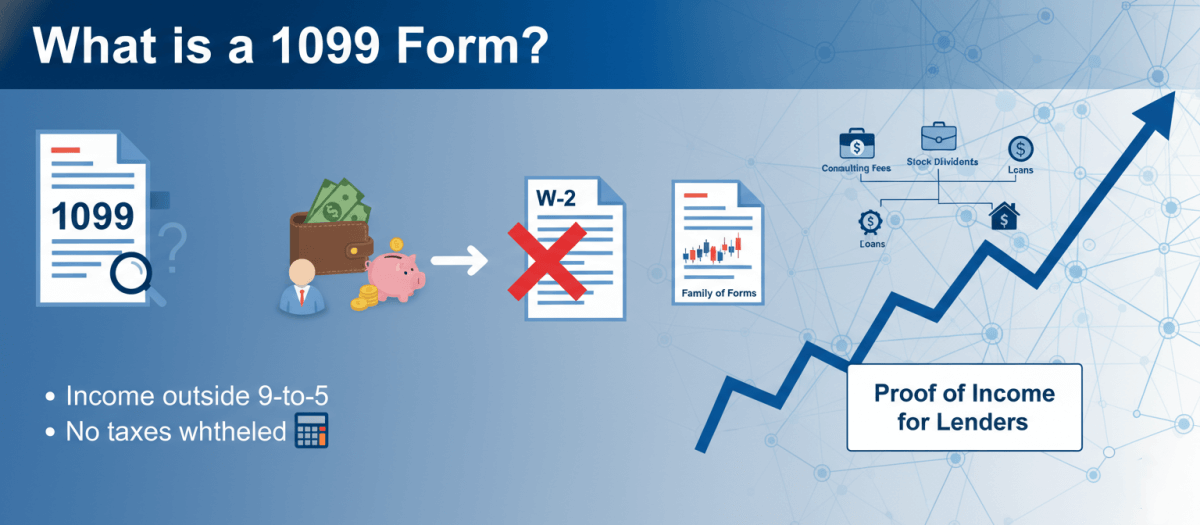
Think of a 1099 form as the IRS's way of keeping tabs on money you earn outside a standard 9-to-5 job. When I worked a corporate job, my employer handed me a W-2, which meant taxes were already pulled from every paycheck. A 1099 works the opposite way. It confirms you got paid, but nothing was withheld. You receive the full amount upfront, and the responsibility for paying income tax and self-employment tax falls entirely on you later.
It isn't just one document, either. It's an entire family of forms covering everything from consulting fees to stock dividends. While it's primarily a tax document, a 1099 is also a major piece of the puzzle when you're trying to prove income to a lender.
What are the Types of 1099 Forms?
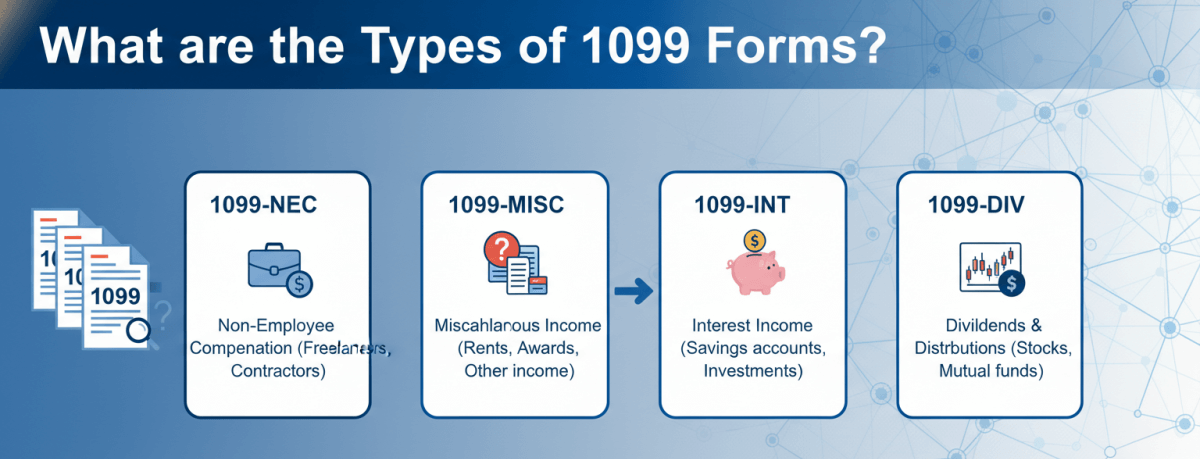
Since people earn money in so many different ways, the IRS created a version of this form for nearly every situation. Here's a breakdown of the ones you'll most likely run into, whether you freelance, rent out a room, or trade stocks.
Form 1099-NEC
If you do any freelance, contract, or gig work, the 1099-NEC (Nonemployee Compensation) is the one you'll see most. The IRS brought this form back a few years ago specifically to track freelance income. The rule is simple: if a client pays you $600 or more during the year, they're required to send you one.
Here's something worth knowing, though: that $600 threshold is about to shift. Starting with payments made in 2026 (the forms filed in early 2027), the reporting threshold for 1099-NEC rises to $2,000, thanks to the One Big Beautiful Bill Act. For anything you earned in 2025, the old $600 rule still applies.
I always tell my self-employed friends to watch their mailbox closely in late January for these. Beyond taxes, the 1099-NEC matters a lot if you're buying property. It shows underwriters exactly how much independent income you bring in. If you're going after a Non-QM (Non-Qualified Mortgage) loan without a stack of W-2s, this small piece of paper is basically your ticket to proving you can afford a mortgage.
Form 1099-MISC
Before the NEC form took over, freelancers used the 1099-MISC (Miscellaneous Information) for almost everything. Now it has a narrower job. You'll typically get one if you earned at least $600 from rent, prize winnings, or certain medical payments. Like the NEC, its $600 threshold is also set to rise to $2,000 for 2026 payments under the same new law.
I have a friend who rents out a condo through a property management company, and every winter that company sends him a 1099-MISC detailing his rental income. If you're building a real estate portfolio or leaning on rental income to qualify for a new mortgage, keeping these forms organized isn't optional. Lenders want to see a track record of steady, reliable cash flow, and your MISC forms are exactly the paper trail they're looking for.
Form 1099-K
Anyone selling on eBay, running an Etsy shop, or taking payments through PayPal or Venmo will probably cross paths with the 1099-K (Payment Card and Third-Party Network Transactions).
The reporting rules for this form have gone through quite a few changes over the past couple of years, so it's worth getting the current numbers right. For the 2025 tax year and going forward, the threshold sits at $20,000 in gross payments and more than 200 transactions. A much lower phase-in ($5,000, then $2,500, then eventually $600) was on the table for a while, but Congress reversed course when it passed the One Big Beautiful Bill Act in mid-2025, restoring the higher threshold. That means most casual sellers clearing out a closet on eBay won't trigger a 1099-K at all, though a few states still apply their own lower thresholds, and a platform can always choose to send one voluntarily.
One thing worth watching either way: this form reports your gross volume, including processing fees and refunds. Keep your bookkeeping tight so you're not accidentally paying taxes on money that never actually stayed in your pocket.
Form 1099-DIV & Form 1099-INT
Got a high-yield savings account or a brokerage account that pays dividends? Expect to see these two land in your mailbox. Form 1099-INT covers interest income of $10 or more from banks and brokerages. Form 1099-DIV handles dividends and capital gain distributions from your investments.
I rely on these every year to calculate my passive income at tax time. They might look like minor paperwork, but they carry real weight. Some loan officers can actually use consistent interest and dividend income to help you qualify for a home loan, since it shows an underwriter you have steady, passive cash flow working in the background.
Form 1099-B
For active investors and crypto traders, Form 1099-B (Proceeds from Broker and Barter Exchange Transactions) is the one to watch. Every time you sell a stock or swap cryptocurrency, your brokerage generates this form to log your gains and losses.
If you traded digital assets in 2025 or later, keep an eye out for a newer form too: 1099-DA, introduced specifically for cryptocurrency and other digital asset transactions. It works alongside 1099-B rather than replacing it, so don't be surprised if you receive both.
What I appreciate about 1099-B is how clearly it separates short-term trades from long-term holdings, since the IRS taxes those two very differently. It also provides your cost basis, so filling out Schedule D isn't a nightmare. If you plan to use asset dissipation to qualify for a larger mortgage, underwriters will look closely at your 1099-B history to confirm those gains are consistent, not a one-time event.
Form 1099-R
Tapping into a 401(k) or pension? You'll receive Form 1099-R. This one tracks distributions from retirement plans, annuities, IRAs, and even certain life insurance contracts. Fun fact: even a penalty-free rollover from one retirement account to another still generates a 1099-R logging the move.
I've seen plenty of retirees use the regular distributions on this form to qualify for a mortgage once they no longer collect a paycheck. Just pay close attention to the distribution code in Box 7 — it tells the IRS whether your withdrawal was a normal, taxable distribution or an early cash-out that could trigger a penalty.
Other Specific 1099 Forms
Beyond the major ones, the IRS has a whole alphabet of niche forms. You might see a 1099-G for unemployment benefits or a state tax refund, or a 1099-C if a lender canceled part of your debt (which, unfortunately, still counts as taxable income). There are also forms for real estate sales (1099-S) and 529 college savings withdrawals (1099-Q).
Quick clarification while we're on the subject: if you've come across people searching for a "1099-VLI" form, they actually mean Form 1098-VLI, a brand-new 2025 form for vehicle loan interest. Lenders send it when you've paid $600 or more in interest on a qualifying new-vehicle loan under the recent auto-loan-interest tax break. It belongs to the 1098 family, the same one your mortgage interest statement comes from, not the 1099 series, so don't let the similar name confuse you.
Will You Get a 1099 From Your Mortgage Company?
Here's an angle people rarely think about: your mortgage servicer might send you a 1099 too, depending on what happened with your loan that year. You could receive a 1099-INT if your escrow account earned $10 or more in interest, a 1099-A if your loan went through foreclosure or was treated as abandoned, a 1099-C if part of your debt was forgiven, such as through a loan modification, or a 1099-MISC if you received $600 or more in relocation assistance.
Don't confuse any of these with Form 1098, which simply reports the mortgage interest you paid during the year. That's a completely separate form with a completely different purpose, even though the numbers look similar on the page.
What Is a 1099 Form Used for?
After staring at these documents year after year, I've realized they really serve three main purposes:
- Reporting Income to the IRS: The government wants to make sure nobody's hiding off-the-books income. When you receive a 1099, the IRS gets a matching copy at the same time.
- Calculating Tax Liability: Since taxes haven't been paid on this money yet, you and your accountant need these figures to determine what you owe in federal, state, and self-employment tax.
- Mortgage Qualification: This one's huge. Without W-2s, these forms serve as solid proof of income, letting you qualify for loan programs built specifically for self-employed borrowers.
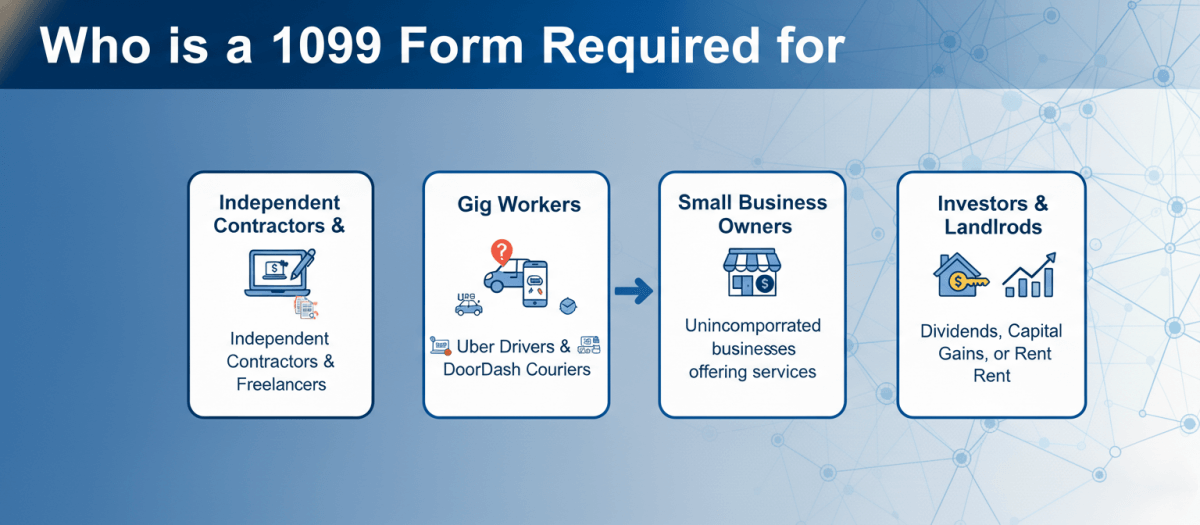
Who Is a 1099 Form Required for?
The list of people who receive these forms is massive. Essentially, if you earn money outside a traditional employer relationship, you're on it.
- Independent Contractors & Freelancers: Writers, designers, consultants.
- Gig Workers: Rideshare drivers and delivery couriers.
- Small Business Owners: Anyone running an unincorporated business that provides services.
- Investors & Landlords: Anyone earning dividends, capital gains, or rental income.
The rule of thumb is the $600 threshold (climbing to $2,000 for NEC and MISC payments made in 2026). If a company pays you more than that for services during the calendar year, the legal obligation falls on the payer to send you the paperwork.
How to Get a 1099 Form?
Good news: you don't have to apply for one. Whoever paid you is required to send it, usually a mailed copy or a secure download link early in the year. If something gets lost in transit, you can pull a Wage and Income Transcript directly from the IRS website.
Once you have your forms in hand, what's next? If you want to use that freelance income to buy a home, the process looks a bit different than a standard W-2 loan application. I'd recommend checking out Bluerate to connect with a local, professional loan officer for free. They know exactly how to put your 1099s to work and match you with a lender who fits your situation.
When are 1099s Issued?
Timing matters when you're trying to file on schedule. Payers are legally required to send out most forms, including the NEC and MISC, by January 31. If that date falls on a weekend, the deadline moves to the next business day.
Don't panic if your mailbox is empty on February 1, though. Investment-related forms, like the 1099-B from your broker, often get pushed to mid-February. My personal rule is to wait until late February before touching my tax return, just to make sure nothing's missing. You'll want everything in hand well ahead of the April 15 filing deadline.
1099 vs. W-2: What's the Real Difference?
People ask me this constantly, so let's put it side by side instead of dancing around it.
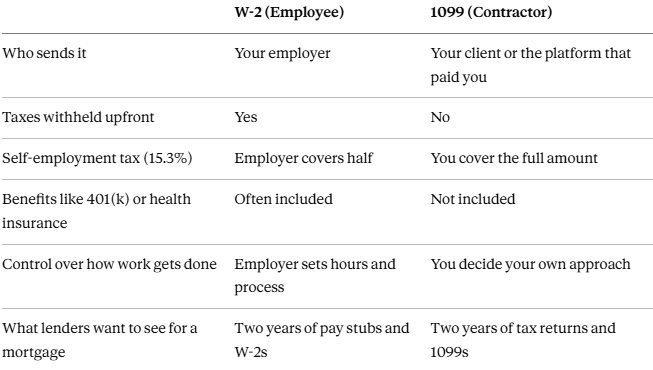
Neither one is automatically "better." A W-2 job trades flexibility for stability and built-in tax withholding. A 1099 arrangement trades that safety net for independence and often higher gross pay, with more tax responsibility landing on your shoulders come April.
Also Read: 1099 Form vs W2: What's the Difference? Details Here
Tip: How to Verify 1099 Form Eligibility?
If you're a loan officer, processor, or underwriter, you already know the headache of verifying a self-employed borrower's income. Digging through hundreds of pages of Non-QM guidelines to figure out whether a lender accepts a one-year or two-year 1099 history eats up time you don't have. That's exactly where Zeitro Strata AI comes in.
It's an AI-powered mortgage guideline assistant built for both QM and Non-QM loans, instantly searching 1,000+ guidelines from 100+ investors, including major names like AD Mortgage, CMG Financial, and Freedom Mortgage.

Here's why loan teams are leaning on it:
- Instant Citations: You get precise answers in seconds, backed by clickable source links so you can trust what you're reading.
- All-Scenario Support: Ask broad "what is" questions or run tight prequalification scenarios, in English or Chinese.
- DeepSearch & Explain: Filter by specific lender guidelines or ask for a plain-language breakdown of tricky underwriting details.
- Efficiency Boost: It cuts out manual reading, integrates with your LOS, and speeds up the entire loan process.
- Fair Pricing: Plans start at just $8 a month, with 3 free queries a day to try it out first.
FAQs About the 1099 Form
Q1. What is the difference between a 1099 and a W-2?
A W-2 is for regular employees, and taxes come out before you ever see your paycheck. A 1099 is for contractors, meaning you receive the full payment directly and are responsible for calculating and paying your own income and self-employment taxes later.
Q2. Does a 1099 mean I have to pay taxes?
Almost always, yes. Since nothing was withheld, you're required to report this income. Depending on your profit after business expenses, you'll owe regular income tax plus self-employment tax.
Q3. How much tax will I pay on a 1099?
It depends on your tax bracket and deductions. Generally, independent contractors pay a 15.3% self-employment tax for Medicare and Social Security, on top of their normal income tax rate. The upside is you can deduct legitimate business expenses, like internet, software, and mileage, to lower that bill.
Q4. What happens if I don't report a 1099 on my taxes?
I wouldn't risk it. The IRS already has a copy of the form on file. If your return doesn't match their records, it triggers an automatic CP2000 notice, which usually leads to penalties, added interest, or a full audit.
Q5. Do I need to file a 1099 form myself?
If you're the one who got paid, you use the numbers on the form to fill out your Schedule C; you don't mail in the form itself. If you're a business owner who paid a contractor $600 or more, then yes, you're responsible for filing it with the IRS and sending a copy to the contractor.
Q6. Is a W-2 or 1099 the same as my tax return?
No, and this trips people up constantly. A W-2 or 1099 is an informational document someone else sends you, reporting what they paid you. Form 1040 is the actual return you file yourself, where you report all your income, W-2 wages, 1099 earnings, and anything else, and calculate what you owe or get back.
Conclusion
At the end of the day, a 1099 form is more than just an annoying piece of tax-season paperwork. It's real proof of your income and your hustle. Whether you're calculating business deductions or using that cash flow to prove you can afford a new home, staying on top of these documents matters.
For mortgage professionals tired of digging through Non-QM guidelines by hand, give Zeitro Strata AI a try to speed up your approvals. And if you're a self-employed borrower figuring out how to buy a home with freelance income, you don't have to do it alone. Head over to Bluerate AI Agent to connect with a local loan officer who can make the whole process smooth and stress-free.
People Also Read
- Mortgage Guidelines: What Are They? How to Verify?
- What Does a Loan Officer Do? Duties, Pros, Cons, and Outlook
- Best DSCR Loan Lenders: Which to Choose from?
- 8 Best Non-QM Mortgage Lenders: Which to Choose?
- Refinance Meaning: What Refinancing a Mortgage Really Means
- Ultimate Guide: How to Get a 1099 Form Online?

![[Tips for Loan Officers] How Can I Lower Borrower DTI?](https://cdn.prod.website-files.com/6731bc6e813a541b54c30b10/6aa3b89e281a639e7a5c6fca_lower-debt-to-income-ratio-banner.jpg)