Written by

Eric
Share this article

.svg)
Subscribe to updates
Last checked and updated on July, 2026.
I recently saw a Reddit post from a first-time homebuyer experiencing severe sticker shock. They were borrowing $285,000 but faced a 1.36% origination fee (about $3,835) plus a $1,795 admin fee. That's over $5,600 just to get the loan started!
They panicked, asking if this was normal. If you've just received your Loan Estimate and are staring at similar numbers, don't worry. Let's break down exactly what this fee means and how you can save.
Key Takeaways
- A loan origination fee usually runs 0.5% to 1% of your loan amount, though refinances and smaller loan balances can push it closer to 1.5%.
- It pays for the lender's behind-the-scenes work: pulling credit, underwriting, processing paperwork, and preparing your closing documents.
- Government-backed loans play by different rules. FHA no longer caps the fee, but HECM reverse mortgages still have a hard federal ceiling.
- You pay it at closing, but a lender credit or a slightly higher rate can shrink it to zero.
- Getting Loan Estimates from at least three lenders remains the single most reliable way to bring the number down.
- Origination costs are highly negotiable. Shopping around and comparing Loan Estimates is the best way to lower them.
What is the Loan Origination Fee on a Mortgage?
Whenever clients ask me about the mortgage loan origination fee, I tell them to think of it like the service charge at a fancy restaurant. Essentially, it is the upfront price you pay a lender or broker for doing the heavy lifting to create, evaluate, and fund your mortgage.
Creating a home loan isn't automated magic. It takes human effort and technology. Lenders have to pull your credit, verify your income, assess the property's risk, and ensure everything complies with federal regulations. The origination fee compensates them for this labor.
Instead of hiding these operational costs entirely within your interest rate, lenders list them out so you know exactly what you're paying for the service itself. While seeing a massive charge on your paperwork is frustrating, understanding that you're paying for a specialized financial service makes it a bit easier to swallow.
Is Mortgage Loan Origination Fee Necessary?
Yes, it typically is necessary. Lenders are running a business, and this fee is one of the ways lenders recover the operational costs of processing your loan, alongside interest income and secondary market revenue.
However, while the cost exists, you don't always have to pay it out of pocket. As I'll explain later, savvy borrowers can use strategic negotiations or lender credits to effectively reduce their upfront cash requirement to zero.
What Does a Loan Origination Fee Cover?
"Origination fee" is really an umbrella term. After reviewing dozens of closing disclosures, I've found it typically bundles together:
- Application fee – the cost of opening and starting your file.
- Underwriting fee – the risk analysis that confirms you qualify for the loan.
- Processing fee – collecting, organizing, and verifying your documents.
- Document preparation fee – drafting the legal paperwork tied to your mortgage.
- Tax service fee – confirming your property taxes stay current over the life of the loan.
- Courier and wire fees – physically moving documents and funding the loan.
- General administrative costs – the miscellaneous overhead of running your file.
Not every lender bundles these the same way, and under CFPB rules, not all of them technically count as "origination charges." Tax service fees, courier costs, and wire fees are frequently broken out under a separate closing cost section instead of folded into Section A.

How Much is a Loan Origination Fee?
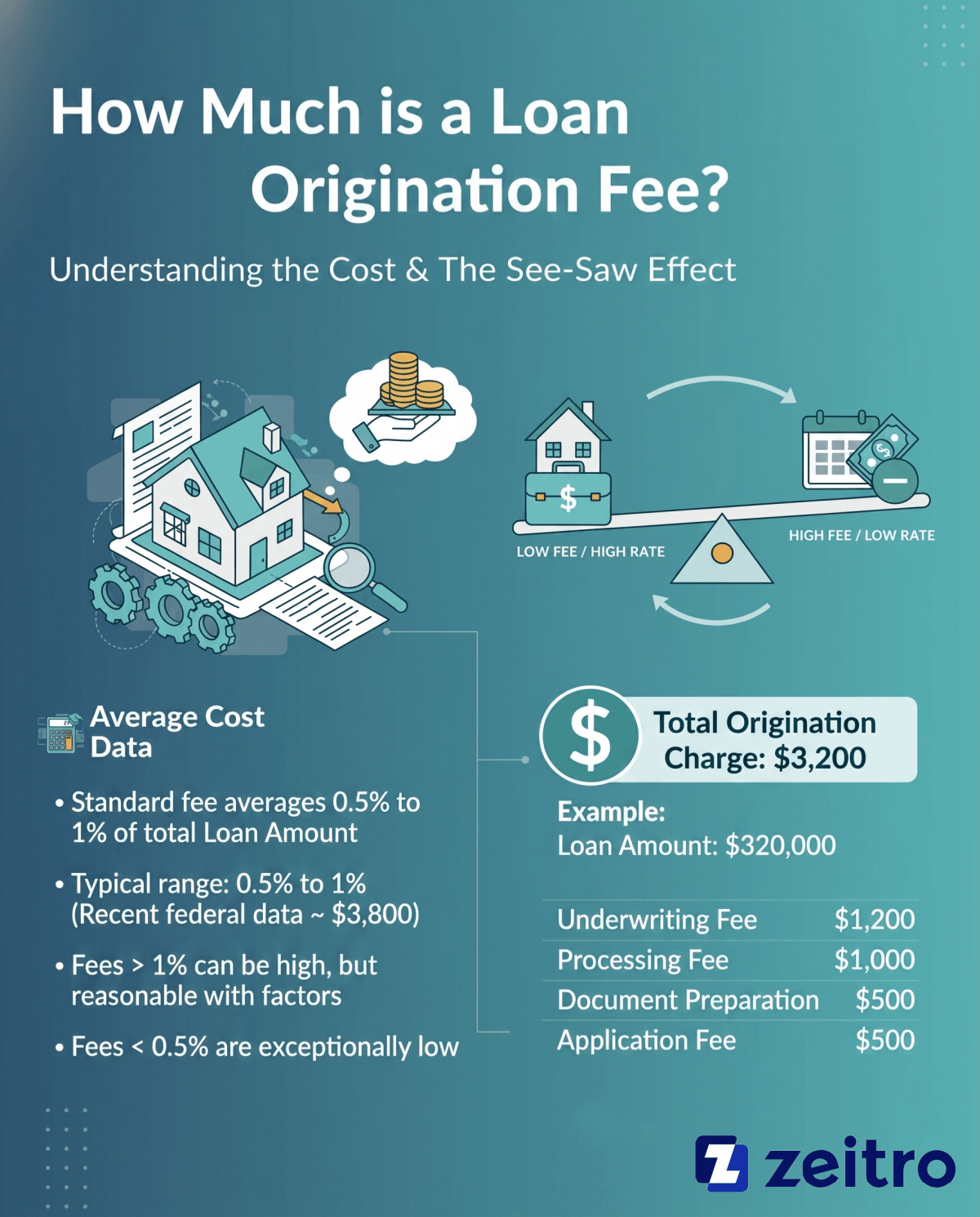
In the U.S. market, a standard loan origination fee averages between 0.5% and 1% of your total loan amount. For context, recent federal housing data shows average origination costs hovering around $3,800.
So, how do you know if you're getting ripped off? If we look back at that Reddit user facing a 1.36% charge plus nearly $1,800 in extra admin fees, that is undoubtedly on the high end. Fees above 1% are on the higher side, but they can be reasonable depending on factors like loan size, credit profile, or whether you're working with a broker. Conversely, anything below 0.5% is considered exceptionally low.
But here is the catch: mortgage pricing is a see-saw. A lender offering a 'low' or 'zero' origination fee isn't doing it out of charity. They are almost certainly charging you a higher interest rate to make their money on the back end. On the flip side, paying a standard 1% fee might secure you a much lower monthly payment. As a borrower, you have to decide if you'd rather pay cash upfront or interest over the next 30 years.
Also Read:
- [Solved] How Much Will My Monthly Payment Be?
- [Solved] How Much Interest Will I Pay on My Mortgage?
- Fixed vs Adjustable Rate Mortgage: Full Differences to Compare
- Must-Read Tips for Paying Off Mortgage Early
- Make Extra Payments on Mortgage: Is It Worth It?
Mortgage Origination Fees by Loan Type
Not every mortgage program follows the same 0.5%–1% rule of thumb. Here's how the major loan types compare.
- Conventional: No federal cap; typically 0.5%–1% of the loan amount, set by the lender.
- FHA (standard purchase): HUD removed its 1% federal cap on new FHA loans starting January 1, 2010. Lenders now set their own rate, usually still in the 0.5%–1% range, though the old "1% cap" you may read about elsewhere is outdated.
- FHA 203(k) rehabilitation: Can run up to 2% of the loan amount, given the added work of underwriting a renovation budget.
- VA: The VA doesn't cap the origination fee directly, but total lender compensation is effectively limited to about 1% of the loan amount for most transactions.
- USDA: Fees must be "reasonable" as determined by USDA guidelines, generally landing near 1% or below.
- HECM (reverse mortgage): Federally capped at the greater of $2,500 or 2% of the first $200,000 of home value plus 1% of the amount above that, with a hard ceiling of $6,000 regardless of home value.
If you're shopping a government-backed loan, ask your loan officer which of these rules applies before you compare Loan Estimates side by side; the caps above only limit the origination line, not your total closing costs.
How to Calculate a Loan Origination Fee?
The math is simpler than it looks. Multiply your loan amount, not your home's purchase price, by the fee percentage.
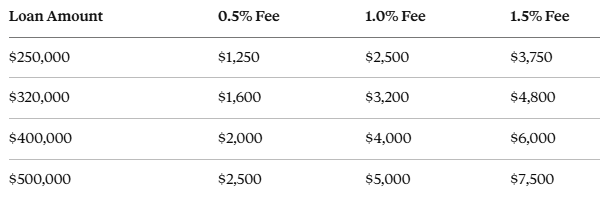
Down payment size matters here too, since it determines your loan amount. On a $400,000 home with 20% down, you're financing $320,000, so a 1% fee lands at $3,200, not $4,000. Mixing up purchase price and loan amount is the single most common mistake I see borrowers make when double-checking their own math.
Example of the Loan Origination Fee
Let's look at a realistic scenario so you can see the math in action. Imagine you are buying a $400,000 house and putting down 20% ($80,000). That leaves you with a mortgage loan amount of $320,000.
If your lender charges a typical 1% origination fee, you will owe $3,200. On your official paperwork, instead of one lump sum, you might see this broken down into a few line items like this:
- Underwriting Fee: $1,200
- Processing Fee: $1,000
- Document Preparation: $500
- Application Fee: $500
- Total Origination Charge: $3,200
Keep in mind, the fee percentage is always calculated based on the loan amount, never the total purchase price of the home.
When and How to Pay the Loan Origination Fee?
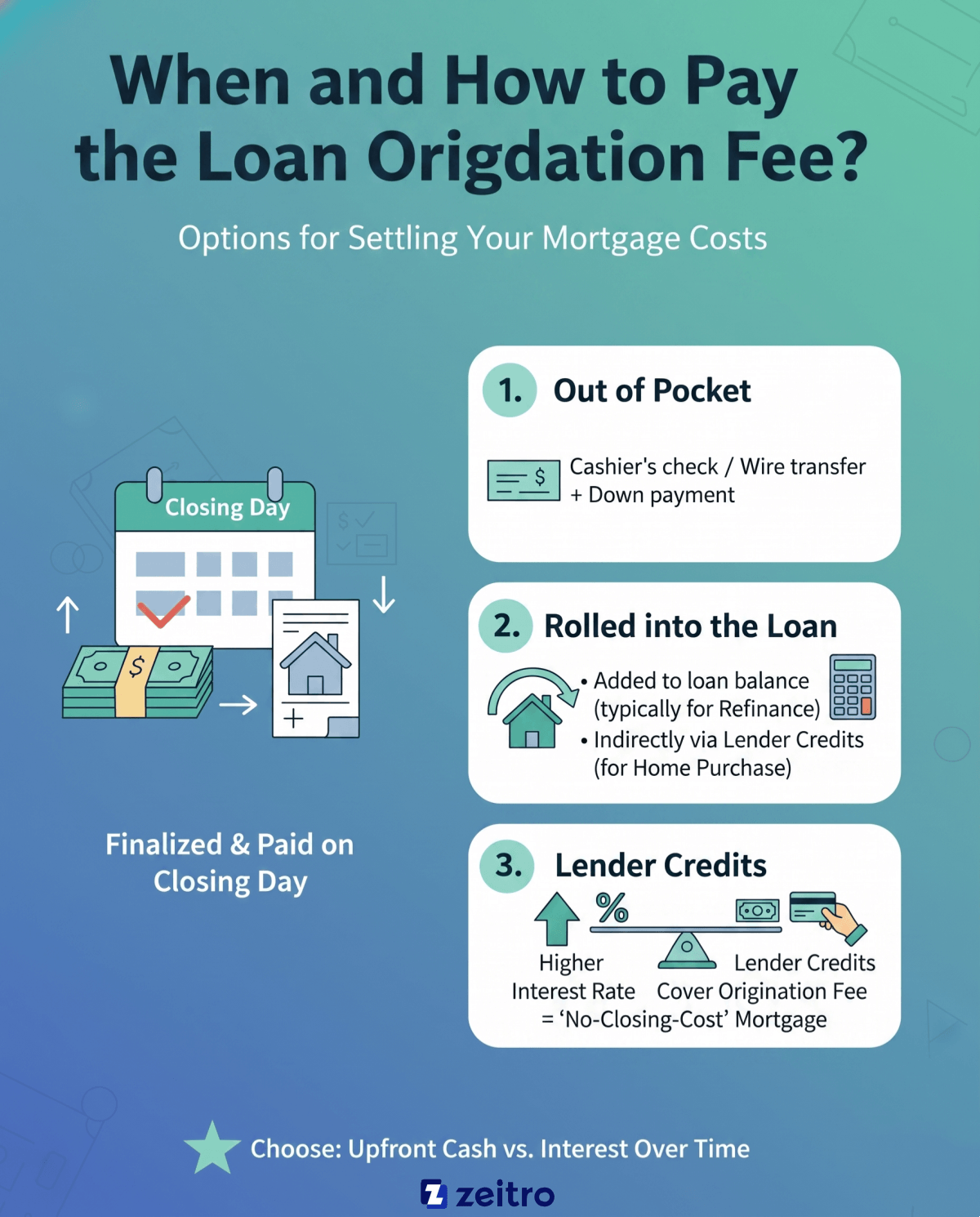
You won't have to hand over a credit card when you first apply. The origination fee is finalized and paid on your Closing Day as part of your overall closing costs.
When it comes time to settle up, you generally have three options:
- Out of pocket: You pay it directly using a cashier's check or wire transfer along with your down payment.
- Rolled into the loan: In some cases—more commonly with refinances, or if your loan-to-value ratio allows—you may be able to roll certain costs into the loan balance. For home purchases, this is often achieved indirectly through lender credits tied to a higher interest rate.
- Lender Credits: You can accept a slightly higher interest rate. In exchange, the lender gives you credits to cover the origination costs entirely, effectively making it a 'no-closing-cost' mortgage.
Crucial Things to Know About Mortgage Origination Fees
Before you sign anything, there are a few critical nuances I always urge homebuyers to understand to protect their wallets.
- First, know exactly where to spot these charges. Lenders are legally required by the Consumer Financial Protection Bureau (CFPB) to clearly itemize this under Section A ("Origination Charges") on Page 2 of your Loan Estimate and Closing Disclosure.
- Second, don't confuse origination points with discount points. This is a common trap. Origination points are the lender's mandatory service fees. Discount points, however, are completely optional prepaid interest. You can choose to buy discount points to permanently lower your interest rate, but they shouldn't be hidden as a mandatory origination fee.
- Finally, remember the power of negotiation. These fees are not set in stone! The absolute best strategy is to get Loan Estimates from at least three different lenders. If Lender A has great service but high fees, show them Lender B's cheaper paperwork and ask for a price match. Often, they'll drop their origination fee to win your business.
Why Do Lenders Charge This Fee at All?
It's fair to ask why lenders need a separate charge when they're already earning interest. The short answer: origination rarely breaks even on its own.
Industry research from the Mortgage Bankers Association puts the average cost to originate a single loan, once you count labor, technology, compliance, and overhead, at roughly $9,000. Compare that to a typical $2,000–$4,000 origination fee, and you can see the fee alone doesn't come close to covering the lender's actual expense. The rest gets recovered through your interest rate and, eventually, through selling the loan on the secondary market.
That gap is also a big reason your fee might look higher than a friend's. A small loan balance still requires the same underwriting labor as a large one, so lenders often charge a flat minimum fee regardless of size. A lower credit score can also add underwriting complexity, which sometimes shows up as a higher charge.
Do Origination Fees Vary by Lender Type?
Yes, and the pattern is fairly consistent across the industry, even though exact numbers shift constantly and are worth verifying on your own Loan Estimate rather than trusting any single article.
- National banks tend to have standardized, less flexible fee schedules, though their scale can mean competitive base pricing.
- Credit unions often post lower average fees, partly because they're member-owned and not chasing shareholder profit.
- Online and tech-driven lenders, including platforms built on tools like Zeitro, can run leaner operations, which sometimes translates into lower origination costs for borrowers.
- Mortgage brokers can shop your file across multiple wholesale lenders, giving you more room to negotiate, though you should watch for a separate broker compensation fee layered on top.
The safest approach is still the boring one: pull actual Loan Estimates from a few different lender types and compare Section A directly, rather than assuming any category is automatically cheaper.
Underwriting Fee vs. Origination Fee: What's the Difference?
This trips up a lot of borrowers, so it's worth a direct answer. The origination fee is the broader charge; underwriting is one of the services it's paying for, along with processing and document prep.
Some lenders list "underwriting fee" as its own separate line rather than folding it into the origination charge. If you see both on your Loan Estimate, ask your loan officer whether they're double-counting the same work; that's a fair question, and a transparent lender should be able to answer it in one sentence.
FAQs About Mortgage Loan Origination
Q1. Are loan origination fees tax deductible?
Generally, no. The IRS doesn't allow you to deduct standard service fees like underwriting or processing. However, if your 'origination charges' actually include discount points paid to secure a lower interest rate, those might be deductible as prepaid mortgage interest. Always consult your CPA for specifics.
Q2. Do you get your origination fee back?
No, you don't. Once your loan closes, this fee is non-refundable because the lender has already performed the work. Even if you refinance the house or pay off your mortgage entirely just six months later, that initial service charge will not be returned to you.
Q3. Can a loan origination fee be waived?
Yes, practically speaking. You can negotiate a 'no-closing-cost' mortgage where the lender waives or covers the origination fee. However, they aren't working for free. To compensate for dropping the upfront fee, the lender will simply charge you a higher monthly interest rate.
Q4. Why is my origination fee so high?
It could be high for a few reasons. If you have a small loan balance, lenders often charge a flat minimum fee. Alternatively, a low credit score might increase underwriting complexity, or your lender may have bundled optional discount points into the total origination charge.
Q5. How to negotiate the origination fee?
The secret is to shop around. Get official Loan Estimates from at least three different banks, credit unions, or brokers. Take the estimate with the lowest origination fee and present it to your preferred lender, asking them to match or beat their competitor's pricing.
Q6. How to finance a loan origination fee?
You can roll the fee into your loan balance so you don't pay cash upfront. However, this only works if your home's loan-to-value (LTV) ratio allows for the slightly larger loan size. Keep in mind, financing the fee means you'll pay interest on it for years.
Final Thoughts
Getting fixated on finding the lowest possible origination fee is a common rookie mistake. While saving money upfront feels great, a lender offering zero fees might be masking a terrible interest rate.
When comparing your mortgage options, my best advice is to focus heavily on the APR (Annual Percentage Rate). The APR gives you the honest, big-picture cost of borrowing because it blends both your interest rate and those upfront origination costs into one single number. Do your homework, gather multiple quotes, and don't be afraid to negotiate. You have more power in this transaction than you think.
People Also Read
- [Guide] Loan Origination Explained: Meaning, Process, Cost
- Fixed-Rate Mortgage Explained: What, Pros, Cons & FAQs
- Income Needed for Mortgage: Methods, Examples & Requirements
- [Solved] What Debt-to-Income Ratio is Needed for a Mortgage?
- Ultimate Guide to Biweekly Mortgage Payments: Is It Worth It?

![[Tips for Loan Officers] How Can I Lower Borrower DTI?](https://cdn.prod.website-files.com/6731bc6e813a541b54c30b10/6aa3b89e281a639e7a5c6fca_lower-debt-to-income-ratio-banner.jpg)