Written by

Eric
Share this article

.svg)
Subscribe to updates
Last Checked and Updated on August, 2026
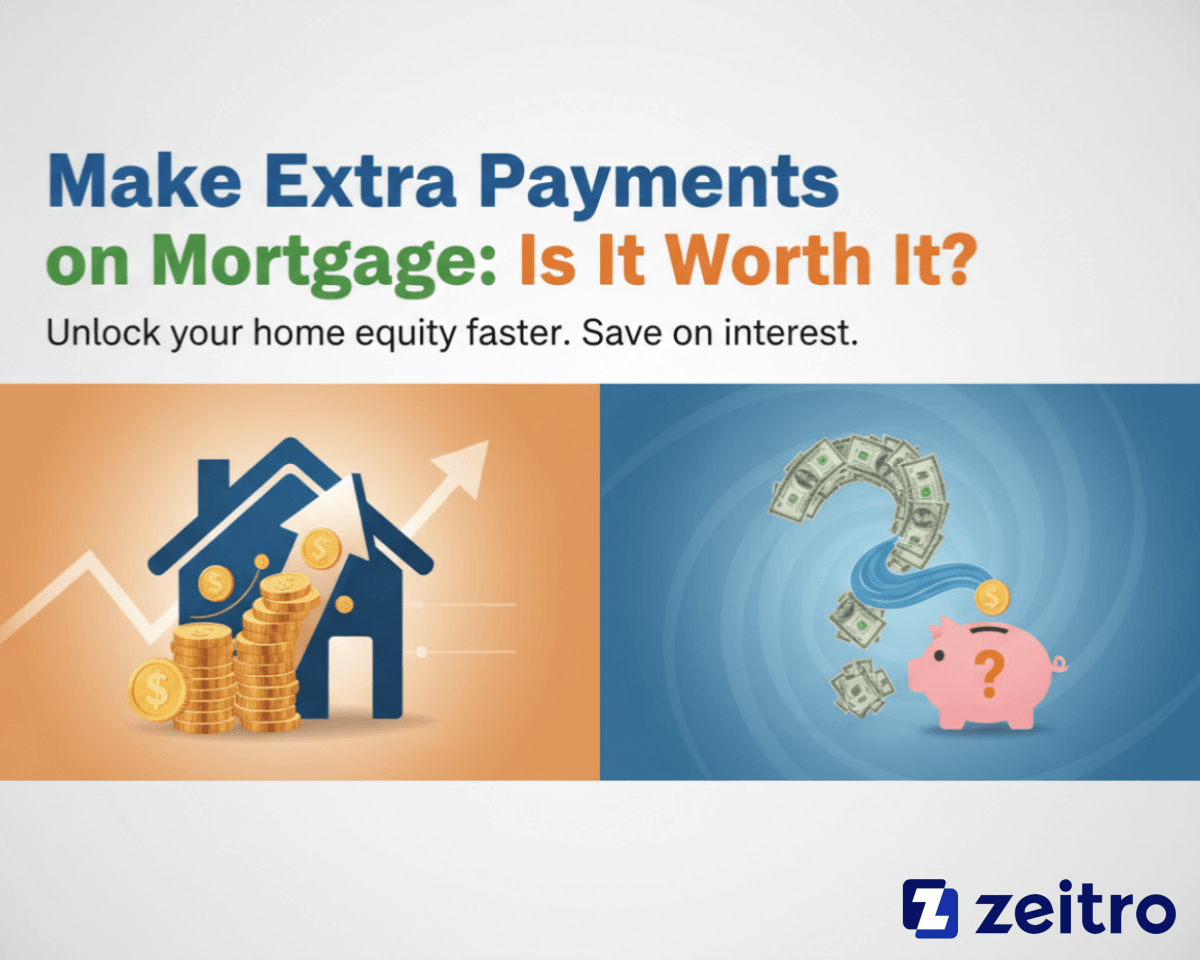
Staring down a 30-year home loan can be intimidating. I remember pulling up my first amortization schedule and realizing how much of that early payment was going to interest, not principal. So I started asking the obvious question: what actually happens if I make extra payments on my mortgage? Would tossing an extra couple hundred dollars a month really get me to "no more mortgage" faster, or was it just a nice idea that didn't move the needle much?
If you're asking the same thing, you're in the right place. Let's walk through what extra payments actually do to your loan, when they're worth it, and when your money might work harder somewhere else.
Key Takeaways
- Principal is everything. Make sure your servicer applies extra cash straight to your principal balance, not next month's bill.
- The long-term savings are real. Even modest extra payments can shave years off a 30-year loan and keep tens of thousands of dollars in your pocket.
- Watch your opportunity cost. Paying down a 6.5% mortgage isn't automatically smarter than paying off 24% credit card debt or keeping cash reserves on hand.
What's Included in Your Mortgage Payment?
Before you start sending extra money to your lender, it helps to know exactly what your regular payment is made of. Most monthly mortgage bills are made up of four pieces, often shortened to PITI:
- Principal: the amount you actually borrowed and still owe.
- Interest: what the lender charges you for the loan.
- Taxes: your share of local property taxes, usually collected monthly and held in escrow.
- Insurance: homeowners insurance, and private mortgage insurance (PMI) if your down payment was under 20%.
Here's why this matters for extra payments: your servicer only applies extra money to the principal piece. It has no effect on your escrow account, so your property tax and insurance costs will still rise or fall on their own schedule, separate from anything extra you send in.
Benefits of Making Extra Payments on a Mortgage
There's a lot to like about attacking your loan early, and the upside goes beyond simple math.
- Save real money on interest. Shrinking your principal early means compounding works less against you. Over a couple of decades, that can add up to tens of thousands of dollars.
- Shorten your loan term. You get to be mortgage-free years ahead of the original 30-year schedule.
- Build equity faster. More ownership stake gives you more options down the road, whether that's selling or doing a cash-out refinance.
- Peace of mind. There's a genuine stress-relief factor in watching that balance shrink faster than the bank expected.
Drawbacks of Making Additional Payments on Mortgage
That said, throwing every spare dollar at your house isn't automatically the smart move. A few things are worth weighing first.
- Your cash gets locked up. Once money goes toward your loan, you can't pull it back out to cover a car repair or a medical bill without refinancing or a home equity loan.
- Opportunity cost. If your rate is 6.5% but a diversified investment portfolio has historically returned closer to 8-10% over the long run, you may build more wealth by investing instead.
- Higher-interest debt should come first. It rarely makes sense to overpay a mortgage while carrying credit card balances at 20%+ APR.
- It can reduce your tax deduction. If you itemize, paying down principal faster means less mortgage interest to deduct in future years. That's rarely a reason to skip extra payments entirely, but it's worth running the numbers alongside your mortgage interest deduction.
- Prepayment penalties still exist on some loans. Federal rules limit how much lenders can charge and for how long, but the fine print varies by loan. We'll break this down in the FAQ below.

How to Make Extra Payments on a Mortgage?
You don't need to be rich to start doing this. I've mixed and matched a few different approaches over the years, depending on my cash flow.
- Switch to bi-weekly payments: Just split your normal monthly bill in half and pay it every two weeks. Biweekly payments equal 26 half-payments a year, which is equivalent to 13 monthly payments, and the extra principal payment each year helps reduce interest and shorten the loan term.
- Round up the bill: If your mortgage is $1,820, just send $2,000 every month. It's an easy habit to build.
- Use lump sums: Did you get a tax refund or a work bonus? Dump that windfall straight into the loan.
- Commit to one extra payment a year: Just pick a month and double up.
Once you've picked a method, here's how to actually get the money applied correctly:
- Log into your servicer's online portal and look for an option labeled "additional principal payment" or "principal-only payment." Most major servicers have this built in.
- If you're mailing a check, write "Apply to Principal Only" clearly in the memo line, and consider including a short note with the payment.
- Call your servicer to confirm the payment posted correctly. This one step catches most mistakes before they cost you months of wasted savings.
- Check your next statement. Your principal balance should be lower than a normal payment alone would explain. If it isn't, follow up. Some servicers default to holding extra funds as an advance on next month's bill instead of curtailing principal, which barely saves you anything.

How to Calculate Additional Payments on a Mortgage?
Amortization works like this: every extra dollar you put down lowers your principal. That means the interest calculated for the very next month is based on a smaller number. The savings snowball over time.
Trying to figure out the exact math on a notepad is a nightmare, though. To see the real impact on your timeline, I highly recommend using the online mortgage payment calculator at Zeitro. It lets you easily compare different scenarios without guessing. You just type in your loan info and see how a few extra bucks can shave years off your payoff date.

Examples of Making Extra Payments on Mortgage
Numbers make this a lot more concrete, so let's run a realistic scenario: a $300,000 loan on a 30-year fixed rate at 6.5%, which is close to where average rates have been sitting through much of 2026. Your regular principal-and-interest payment comes out to about $1,896 a month, and over the full 30 years you'd pay roughly $382,600 in interest if you never paid a cent extra.
What Happens If I Make 1 Extra Mortgage Payment a Year?
- Extra cash needed: About $1,896 a year, or roughly $158 extra a month.
- Interest saved: Around $87,000.
- Time saved: Close to 5 years and 10 months off your payoff date.
This is the smallest lift on the list, and it's essentially what you get automatically by switching to biweekly payments, which makes it a realistic starting point if a bigger monthly commitment doesn't fit your budget yet.
What Happens If I Pay 2 Extra Mortgage Payments a Year?
- Extra cash needed: About $3,792 a year, or roughly $316 extra a month.
- Interest saved: Around $139,000.
- Time saved: Close to 9.5 years off a 30-year term.
What Happens If I Pay 3 Extra Mortgage Payments a Year?
- Extra cash needed: About $5,688 a year, or roughly $474 a month.
- Interest saved: Around $175,000.
- Time saved: About 12 years, turning a 30-year loan into an 18-year one.
What Happens If I Pay 4 Extra Mortgage Payments a Year?
- Extra cash needed: About $7,584 a year, or roughly $632 a month.
- Interest saved: Around $201,000.
- Time saved: About 14 years, so a three-decade loan wraps up in under 16 years.
These figures assume every extra dollar is correctly applied to principal each month, starting from day one of the loan. Run your own loan amount and rate through the Zeitro mortgage calculator to see how your specific numbers compare.
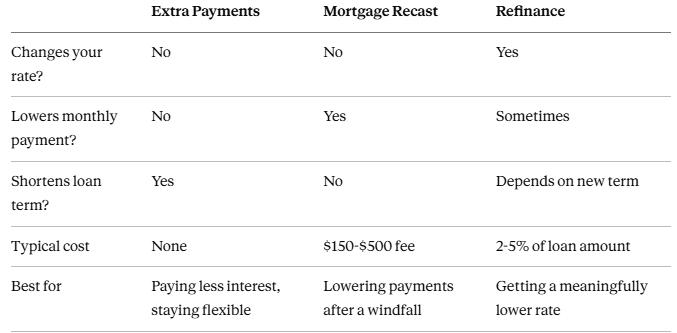
Extra Payments vs. Mortgage Recast vs. Refinance
If you're sitting on a lump sum, extra payments aren't your only option. Two other strategies are worth knowing before you decide.
A mortgage recast keeps your existing rate and term, but your lender re-amortizes what's left of the loan after you make a large lump-sum payment. That lowers your monthly bill without touching your interest rate. It's a good fit if you already locked in a low rate and mainly want breathing room in your monthly budget, not necessarily a faster payoff. Most servicers charge a small fee, typically in the $150-$500 range, and government-backed loans like FHA, VA, and USDA usually aren't eligible for recasting.
A refinance replaces your loan entirely, which resets your rate and often your term. It's the right move when today's rates are meaningfully below what you're currently paying, but it comes with full closing costs and new underwriting.
FAQs About Making Extra Payments on Mortgage
Q1. Do extra mortgage payments go to principal or interest?
You typically have to tell your servicer what to do with the money. Ask them to apply it to principal specifically; otherwise, it may be treated as an early payment of next month's bill instead of a true principal curtailment, which barely reduces the interest you owe over time.
Q2. Is there a penalty for paying off my mortgage early?
Sometimes, but it's less common than it used to be. Under federal rules that took effect in 2014, prepayment penalties are only allowed on certain fixed-rate loans, capped at 2% of your balance in the first two years and 1% in the third year, and banned entirely after that. FHA, VA, and USDA loans can't carry a prepayment penalty at all. Where you're most likely to still see one today is on investment-property loans or other non-conventional financing, so check your closing documents or call your servicer if you're not sure.
Q3. Should I pay off credit card debt or my mortgage first?
Credit card debt first, almost always. Card rates often sit north of 20%, far more expensive than a typical home loan. Clear out high-interest consumer debt before you put extra dollars toward the house.
Q4. Can I stop making extra mortgage payments at any time?
Yes. Unless you've gone through a formal recast or refinance, extra payments are entirely voluntary. If your budget gets tight, you can pause them and go right back to your regular payment with no penalty.
Q5. Does making extra payments lower my monthly bill?
No, your required monthly payment stays the same. What changes is how many payments are left. If your goal is a lower monthly bill instead of a shorter term, ask your servicer about a mortgage recast instead.
Q6. Does this work differently in Texas or other states?
No. The math behind extra payments, principal curtailment, and interest savings is the same nationwide; it doesn't vary by state law. The one exception is if you're pulling money from a home equity loan or HELOC to fund extra payments. Texas has unusually strict state constitutional rules around home equity lending, so it's worth a quick conversation with your lender if that's your plan.
Final Word: Is It Worth It?
So, should you actually do this? From my experience, it comes down to the rest of your financial picture. If you're free of high-interest debt, you've got a solid emergency fund set aside, and you don't have a clearly better use for the cash, extra principal payments give you a return that's roughly equal to your mortgage rate, guaranteed and risk-free.
Just don't push so hard that you end up house-rich and cash-poor. Run your own numbers through the Zeitro mortgage payment calculator, and pick a pace you can actually sustain.
People Also Read
- Zeitro Mortgage Affordability Calculator Free and Online
- [Solved] How Much Will My Monthly Payment Be?
- [Solved] How Much Interest Will I Pay on My Mortgage?
- Ultimate Guide: How to Calculate Monthly Mortgage Payment?
- How to Calculate Mortgage Interest: Manually & Automatically

![[Tips for Loan Officers] How Can I Lower Borrower DTI?](https://cdn.prod.website-files.com/6731bc6e813a541b54c30b10/6aa3b89e281a639e7a5c6fca_lower-debt-to-income-ratio-banner.jpg)