Written by

Eric
Share this article

.svg)
Subscribe to updates
Last checked and updated on July, 2026.
When I bought my first home, staring at the full 30-year amortization schedule genuinely rattled me. The total interest number looked bigger than the house itself. So I started digging: was there a way to pay less without refinancing or gutting my monthly budget? That's how I stumbled onto biweekly payments, and honestly, I wasted a few weeks confusing them with weekly and bimonthly schedules before I understood the real math.
If you're weighing a 30-year loan and wondering whether splitting your payment could quietly cut years off your mortgage, this guide breaks down exactly how each schedule works, where the hidden traps sit, and which option actually fits your paycheck.
Key Takeaways
- The core math: In a typical year, a biweekly plan turns into 26 half-payments, which equals 13 full monthly payments instead of 12.
- The payoff: Most borrowers shave roughly four to six years off a standard 30-year loan and keep tens of thousands of dollars that would otherwise go to interest.
- The warning: Never hand a third-party company money to "set this up" for you. Regulators have fined and shut down companies over exactly this practice, and I'll show you why below.
What Is a Biweekly Mortgage Payment?
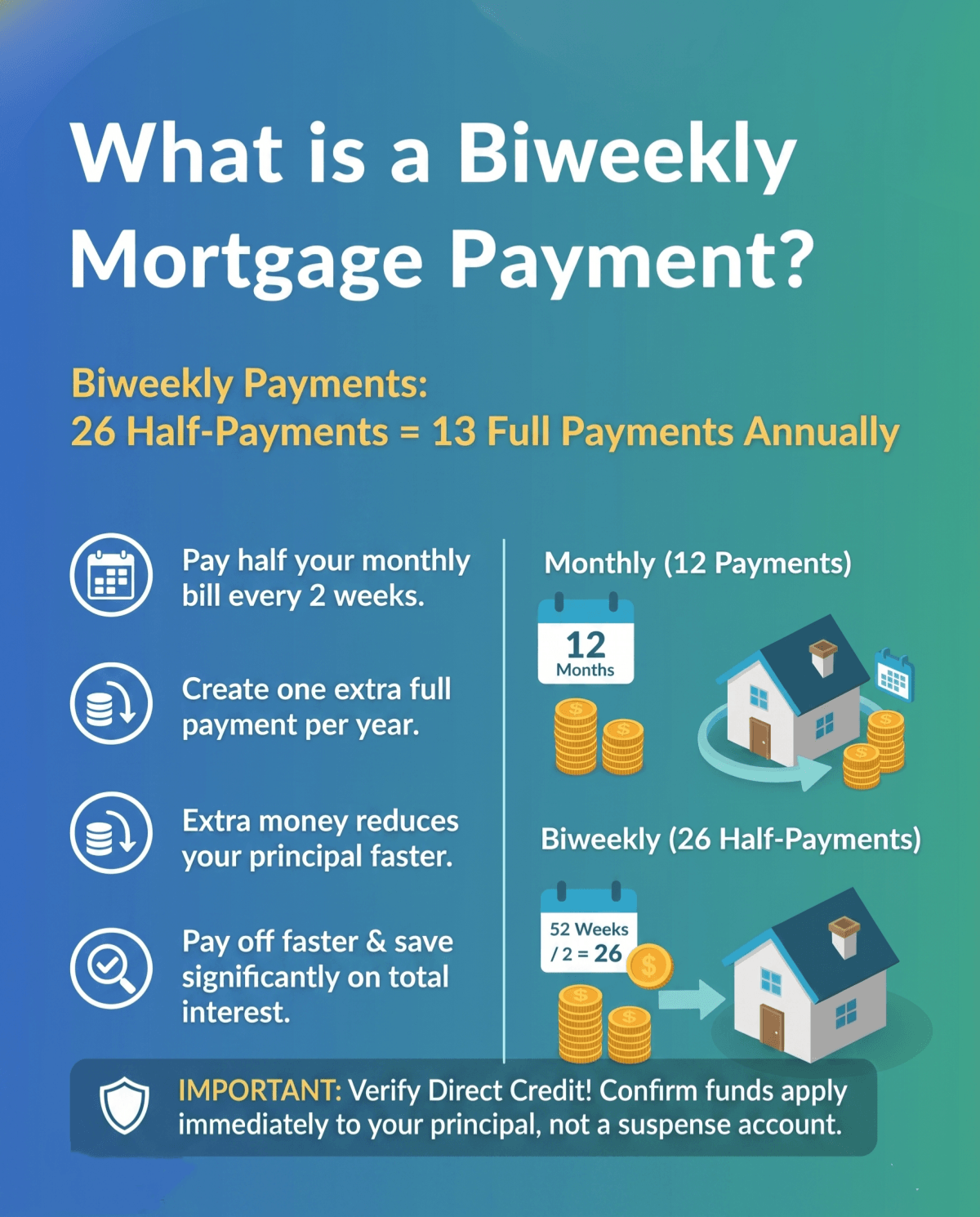
A biweekly mortgage payment means you split your normal monthly bill in half and send that smaller amount every two weeks instead of once a month. It sounds simple, but I mixed this up with a bimonthly schedule the first time I read about it, and I don't think I'm alone.
Here's the distinction that actually matters: bimonthly, also called semi-monthly, means paying twice a month, usually on the 1st and 15th. That works out to 24 half-payments a year, which is exactly 12 full payments. Nothing extra happens. Biweekly follows the calendar differently. Since a year has 52 weeks, paying every two weeks produces 26 half-payments, not 24. That's the equivalent of 13 full payments, and that 13th payment is where all the savings come from.
Can you set this up the moment you close on a loan? Sometimes. A handful of lenders let you pick a biweekly schedule right in your application. Most mortgages, though, are written as standard monthly contracts, so switching later usually means contacting your loan servicer and requesting a formal modification.
Weekly, Biweekly, Semi-Monthly, or Monthly: How the Math Actually Differs
People throw these four terms around like they're interchangeable, and they're not. I put together a quick comparison after getting tripped up myself:
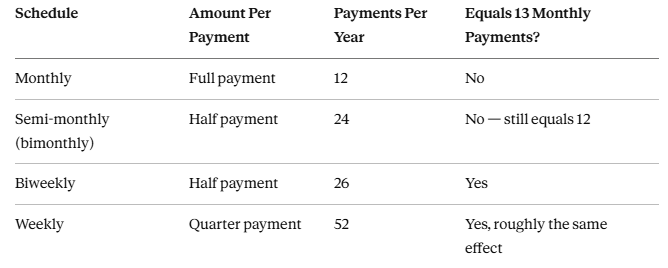
Weekly payment plans get searched a lot, and they do produce a similar acceleration effect to biweekly, since 52 weekly quarter-payments also add up to an extra payment each year. The catch is availability. Very few servicers actually offer a true weekly draft option, so most homeowners who like the idea end up choosing biweekly instead, or building their own weekly savings habit and depositing it toward principal manually.
If your goal is simply "pay twice a month," make sure you're clear on which one you're asking for. Semi-monthly won't accelerate your payoff at all on its own, while biweekly will.
How Do Biweekly Mortgage Payments Work?
The mechanism is almost accidental. Because 52 divided by 2 doesn't land on a clean 24, the calendar itself forces an extra half-payment into existence every year. Here's where that money actually goes:
- The 13th payment: Twenty-six half-payments naturally produce one full payment more than a standard monthly schedule delivers.
- Faster principal reduction: That extra payment gets applied straight to your loan balance, not to fees or interest that's already accrued.
- Compounding in reverse: Since your balance drops faster, the interest calculated on what's left shrinks along with it, which is why the savings snowball over the years instead of staying flat.
One thing worth knowing before you enroll: some servicers don't apply your half-payment the moment it arrives. Instead, they hold it in what's called a suspense account until the second half shows up to complete a full payment. Federal consumer protection rules require servicers to explain in writing how they handle partial payments, so it's worth asking directly whether your money gets credited to principal right away or sits parked for two weeks.
Pros and Cons of Biweekly Mortgage Payments
Like most money strategies, this one has a real upside and a real downside. Here's what I weighed before switching.
Benefits:
- Faster equity: You own your home free and clear years earlier than you would on a standard schedule.
- Real interest savings: Tens of thousands of dollars stay in your pocket instead of going to the bank over the life of the loan.
- Cash flow alignment: If your paycheck already arrives every two weeks, syncing your mortgage to that rhythm makes budgeting noticeably simpler.
Drawbacks:
- Less flexibility: Some programs expect you to stick with the schedule once you're enrolled, though many can be paused or canceled if your lender allows it.
- Third-party fees: This is the trap I'd urge every reader to avoid. Some outside companies charge steep enrollment and per-transfer fees to "manage" your biweekly payments for you. Regulators have gone after firms doing exactly this. One case involved a company charging roughly a $995 setup fee plus annual processing charges, and most customers who signed up never actually broke even, because it took years of fees before the interest savings caught up. That case eventually went all the way to the Supreme Court, which let the multimillion-dollar penalty against the company stand in early 2026. The takeaway is simple: your bank or servicer can almost always set this up for free, so there's rarely a reason to pay anyone for it.

Monthly vs. Biweekly: What the Numbers Look Like
To make this concrete, let's run a standard $300,000 loan over 30 years. Rates have moved around quite a bit lately (they've been sitting in the mid-6% range through mid-2026), so treat the number below as illustrative rather than exact.
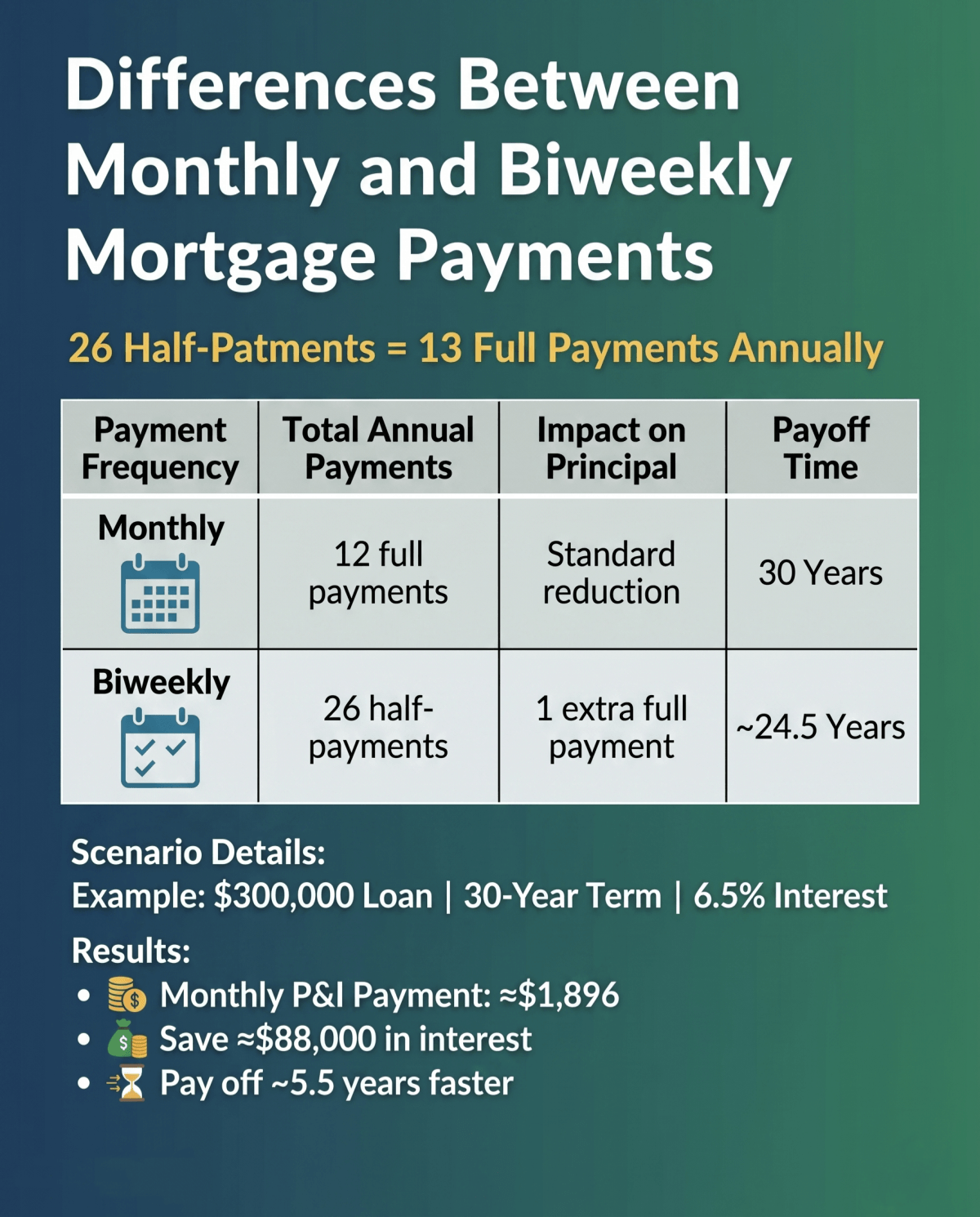
In this scenario, a standard monthly payment is about $1,896. Over 30 years, you would pay around $382,600 in interest alone. By switching to biweekly, you make the equivalent of 13 payments a year. This small tweak saves you roughly $88,000 in interest and shaves more than five years off your loan!
Every loan is slightly different due to taxes and escrow. I highly recommend using a free online mortgage calculator to plug in your exact rate and balance. It is the best way to see your personal math.
Also Read:
- Must-Read Tips for Paying Off Mortgage Early
- Ultimate Guide: How to Calculate Monthly Mortgage Payment?
- How to Calculate Mortgage Interest: Manually & Automatically
- [Solved] How Much Interest Will I Pay on My Mortgage?
Which Schedule Should You Actually Choose?
This isn't purely a math question. It's a lifestyle one too. Before switching, ask yourself:
- How am I paid? If your paycheck lands on the 1st and 15th, a biweekly draft can throw off your checking account balance since the dates won't line up neatly.
- How tight is my budget? An accelerated schedule leaves less room for a rough month if an unexpected bill shows up.
- Is it actually free? Ask your servicer directly. If there's a fee attached, that's a red flag worth walking away from.
- What's my opportunity cost? If you locked in a rate from a few years back that's well under 4%, you might come out ahead investing that extra cash instead of paying down cheap debt faster.
Alternatives to a Formal Biweekly Plan
If a locked-in biweekly contract feels too rigid, there are DIY options that get you the same result with more control. I actually use one of these myself.
- One extra payment a year: Stick to your normal monthly schedule, then send one additional lump sum toward principal whenever you have spare cash, ideally near year-end.
- The 1/12 rule: Take your monthly principal and interest amount, divide it by 12, and add that sliver to every payment. By December, you've mathematically made a 13th payment without ever touching a biweekly schedule.
- Refinancing: If rates have dropped since you closed, refinancing into a 15-year term guarantees a faster payoff without relying on any extra-payment discipline.
The nice part about DIY methods is that nothing is locked in. If your car breaks down in October, you simply skip the extra payment that month instead of scrambling to avoid a penalty.
FAQs About Biweekly Mortgage Payments
Q1. How much faster will I pay off my mortgage with biweekly payments?
Most borrowers cut four to six years off a standard 30-year loan. Higher starting interest rates actually see a bigger reduction in payoff time, because that extra principal payment eliminates more future compounding.
Q2. Does a biweekly mortgage actually save you money?
Yes. Your individual payments don't shrink, but your lifetime cost does. That extra annual payment chips away at your principal faster, so you're charged interest on a smaller balance for the rest of the loan, which typically adds up to tens of thousands in savings.
Q3. Can I switch to biweekly payments at any time?
Most lenders will let you switch mid-term, but you need to go through your loan servicer directly rather than assuming it happens automatically. It's also worth double-checking your contract for prepayment penalties, though these are uncommon on modern conventional loans.
Q4. Do I need a third-party company to set up biweekly payments?
No, and I'd actively steer you away from it. Third-party services often charge hundreds of dollars in setup and transaction fees for something your bank can typically arrange at no cost, or that you can replicate yourself with the 1/12 rule. Regulators have taken serious action against companies that profited off borrowers this way, so treat any paid "biweekly setup service" with skepticism.
Q5. Can I pay my mortgage weekly instead of biweekly?
In theory, yes; 52 quarter-payments a year produce a similar acceleration effect to biweekly. In practice, true weekly drafting is rare among mortgage servicers. Most people who like the idea of weekly payments end up choosing biweekly instead, since it's far more widely offered.
Q6. Does where I live affect how biweekly payments work?
The core math, 26 half-payments equaling 13 monthly payments, is the same no matter which state you're in, whether that's Texas, California, Florida, or Ohio. What does vary by state is your property tax timeline and how much of your monthly bill goes toward escrow. States with higher property taxes will naturally have a larger portion of each payment allocated there rather than toward principal.
Q7. Do all lenders offer free biweekly payment setup?
It depends on the lender, and policies change over time, so the best move is calling your specific servicer and asking directly rather than assuming based on what you've read online. Many major servicers offer it at no charge; some don't offer it formally at all, which is exactly why the DIY 1/12 rule exists as a fallback that works with any lender.
Q8. Does making biweekly payments build credit faster?
No. Credit bureaus care about your on-time payment history and credit utilization, not how often you pay. A biweekly schedule and a monthly one report to your credit file the same way, as long as your full payment lands on time each month.
Conclusion: Is Making Biweekly Mortgage Payments a Good Idea?
The short answer is yes, under the right conditions. If you're paid every two weeks, your budget has some breathing room, and your servicer offers a free automated biweekly draft, this is about as close to a pain-free way to save money as mortgages get.
If your lender charges a fee, or your income isn't perfectly steady, skip the formal enrollment and use the DIY 1/12 rule instead. You'll land on essentially the same savings without locking yourself into a rigid schedule, and without handing a percentage of your hard-earned interest savings to a third party that didn't need to be involved in the first place.
People Also Read
- Ultimate Guide: How to Buy a House for the First Time?
- [Tutorial] How to Estimate What Mortgage You Can Afford?
- Guide: How to Calculate Gross Income for a Mortgage?
- Mortgage Interest Deduction: Details, Limits & FAQs


![[Tips for Loan Officers] How Can I Lower Borrower DTI?](https://cdn.prod.website-files.com/6731bc6e813a541b54c30b10/6aa3b89e281a639e7a5c6fca_lower-debt-to-income-ratio-banner.jpg)