Written by

Eric
Share this article

.svg)
Subscribe to updates
Last Checked and Updated on August, 2026
Paying off a house is tough enough without leaving money on the table come tax season. If you're a homeowner trying to squeeze every dollar out of your 2026 return, you've probably wondered how the mortgage interest deduction actually works this year.
The One Big Beautiful Bill Act (OBBBA), signed into law in July 2025, ended years of uncertainty. Instead of letting the old TCJA rules expire and bounce back to looser limits, Congress locked most of them in for good. I went through the IRS guidance line by line so you don't have to, and I'll walk you through exactly what applies for the 2026 tax year.
Key Takeaways
- You can deduct interest on up to $750,000 of mortgage debt, or $1 million if your loan closed before December 16, 2017. Thanks to the OBBBA, this cap is now permanent — no more sunset date to plan around.
- You must itemize on Schedule A instead of taking the standard deduction to claim this benefit.
- Starting in 2026, private mortgage insurance (PMI) premiums are deductible again, though the break phases out once your income climbs past $100,000.
- The standard deduction rose to $32,200 for married couples filing jointly, $16,100 for single filers, and $24,150 for heads of household — meaning fewer people will benefit from itemizing at all.
What is the Mortgage Interest Deduction?
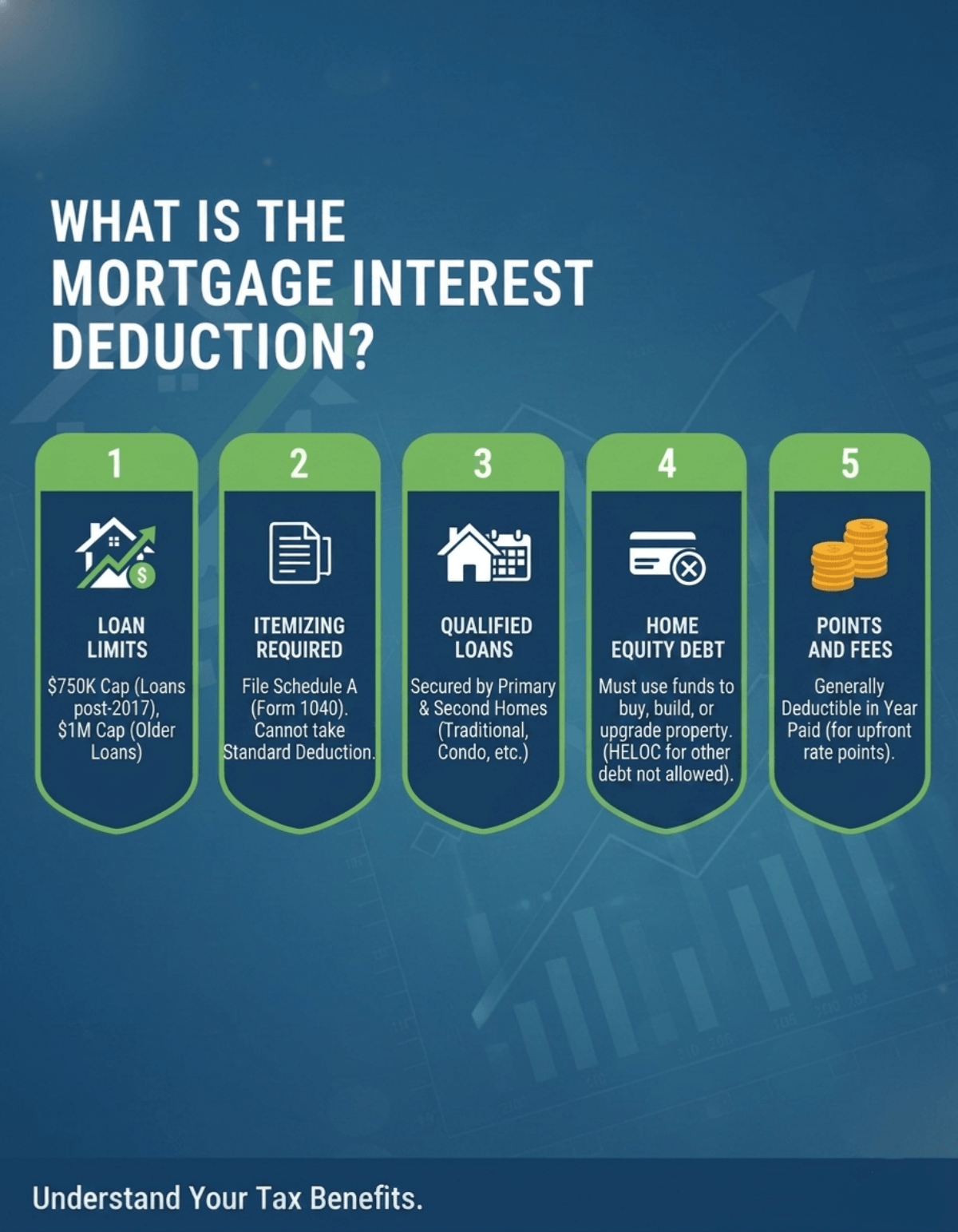
This deduction rewards you for buying a house by letting you subtract the interest on your home loan from your taxable income. The IRS spells out the rules in Publication 936, and it doesn't hand this out freely — there are real boundaries.
- Loan limits: Mortgages taken out after December 15, 2017 are capped at the first $750,000 of debt. Loans that closed before that date keep the older $1 million ceiling.
- You have to itemize: File Schedule A with your Form 1040. You can't claim the standard deduction and write off mortgage interest in the same year — it's one or the other.
- Qualified loans only: The property has to actually secure the loan. This covers your primary residence and one second home, whether it's a house, condo, or mobile home.
- Home equity debt: Pulled cash out through a HELOC to pay off credit cards? That interest doesn't qualify. The money has to go toward buying, building, or substantially improving the property that secures the loan.
- Points: Paid "points" to buy down your rate at closing? You can usually deduct those the same year you paid them.
PMI Premiums Are Deductible Again in 2026
This is the part most guides are still missing, so pay attention if your down payment was under 20%. The OBBBA permanently restored the deduction for private mortgage insurance, and it counts as qualified mortgage interest on Schedule A starting with the 2026 tax year.
There's a catch, though. The break phases out based on income. Once your adjusted gross income passes $100,000 ($50,000 if you're married filing separately), the deductible amount shrinks by 10% for every $1,000 you earn above that line. By the time your AGI hits $110,000 ($55,000 for separate filers), the deduction disappears entirely. If you're on the edge of that range, it's worth running the numbers before assuming this applies to you.
How Does Mortgage Interest Deduction Work?
Think of it as a math contest between two numbers: the standard deduction and your itemized expenses. Every filer gets a flat baseline. For 2026, that's $32,200 for married couples filing jointly, $16,100 for single filers and those married filing separately, and $24,150 for heads of household. You only come out ahead by itemizing if your actual expenses add up to more than that baseline.
Say you and your spouse paid $18,000 in mortgage interest last year. Add $8,000 in state and local taxes and $6,000 in charitable giving, and you're at $32,000 in itemized deductions. That's just under the 2026 joint standard deduction, so in this case the standard deduction still wins — a good reminder to add everything up before assuming itemizing pays off.
One number that changed the math for a lot of households: the state and local tax (SALT) deduction cap jumped from $10,000 to $40,000 starting in 2025, and it's set to grow another 1% each year through 2029. If your household income is high, though, that benefit shrinks fast — the write-off phases down once your modified AGI passes $500,000 and disappears down to the old $10,000 cap once you clear $600,000.
How Much Can You Deduct?
If your total mortgage balance stays under the applicable cap, you can generally deduct all the interest you paid for the year. Go over the limit, and you'll need to prorate it.
Here's the formula I use: divide $750,000 by your average mortgage balance for the year, then multiply that percentage by your total interest paid. Say your average balance was $900,000 and you paid $45,000 in interest. $750,000 divided by $900,000 comes out to about 83%, so you could deduct roughly $37,350 — not the full $45,000.
If you bought a home with a partner you're not legally married to, the IRS only lets each of you claim the portion of interest you personally paid, not half by default. Keep records that back up what you actually contributed. By January 31, 2027, your lender will send you Form 1098 for the 2026 tax year — Box 1 shows the exact interest figure you'll report.
What Qualifies as Mortgage Interest?
I often see folks assume any money sent to their lender counts as a write-off. Unfortunately, the IRS is pretty picky. Here is what actually qualifies:
- Primary loan interest: The actual interest charge on your main mortgage statement.
- Home equity loan interest: Only if you used the cash to put on a new roof, remodel a kitchen, or make another major property improvement.
- Late payment penalties: Late payment charges may be deductible as home mortgage interest if they are not for a specific service performed in connection with the mortgage loan.
- Prepayment penalties: Prepayment penalties may be deductible as home mortgage interest if the fee is not for a specific service performed or cost incurred in connection with the loan.
What Is NOT Deductible?
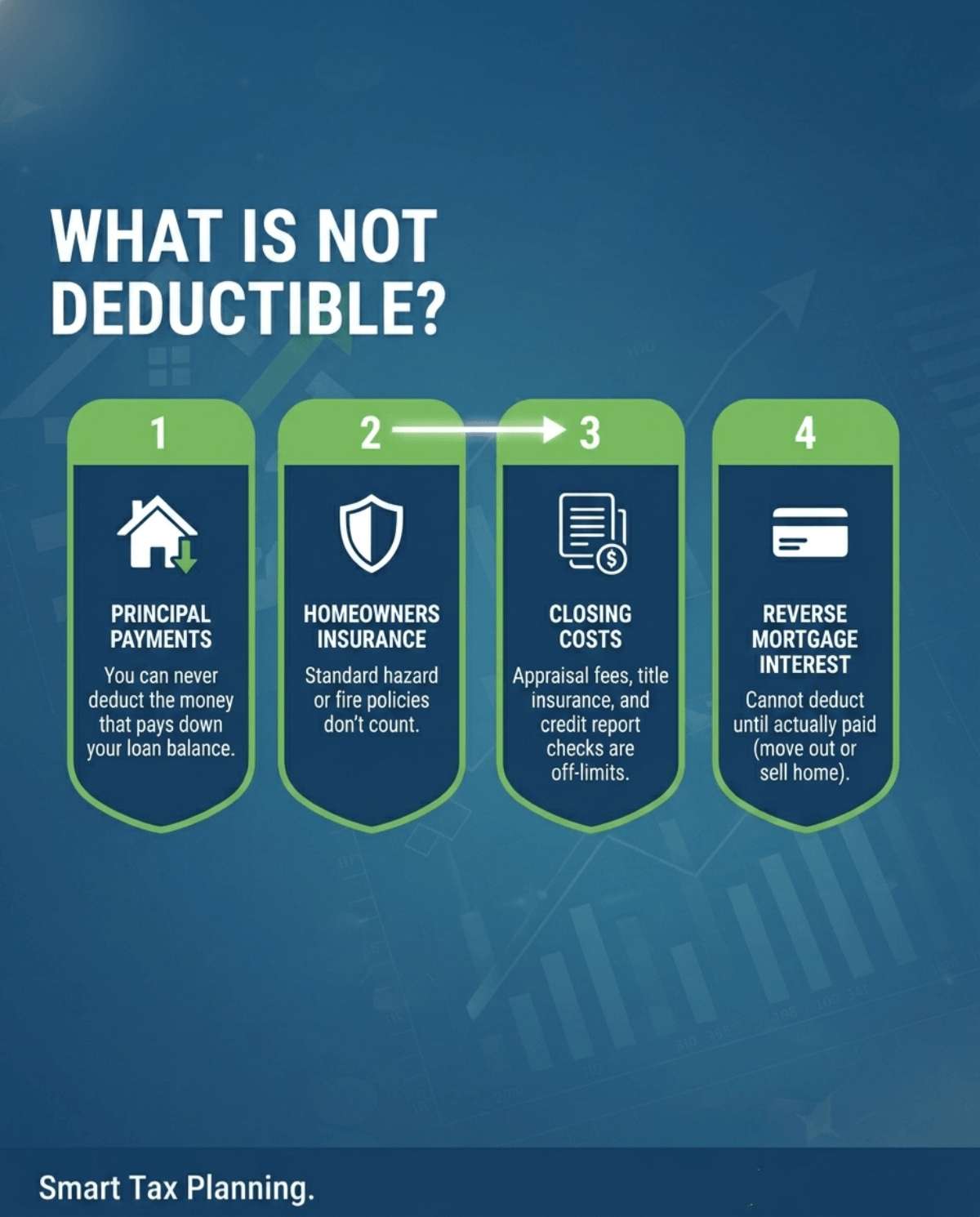
This is where people make the most expensive mistakes on their returns. The IRS will absolutely reject your deduction if you try to claim the wrong housing expenses. Here is what you cannot deduct:
- Principal payments: This is the big one. You can never deduct the money that actually pays down your loan balance. Only the interest.
- Homeowners insurance: Your standard hazard or fire policies don't count.
- Closing costs: Appraisal fees, title insurance, and credit report checks are strictly off-limits.
- Reverse mortgage interest: You can't deduct this until you actually pay it, which normally doesn't happen until you move out or sell the home.
Your State Rules Might Differ
Everything above covers your federal return, but state rules don't always match. California is a good example: the state never adopted the federal $750,000 cap, so residents can still deduct interest on up to $1 million of mortgage debt on their state return, even though the federal limit stays at $750,000. If you live somewhere other than California, check your state's conformity rules before assuming the federal cap is the only number that matters — some states follow federal law exactly, and others don't.
How to Claim the Mortgage Interest Deduction for the 2026 Tax Year
Ready to actually do the paperwork? The process isn't as scary as it sounds. Here is the step-by-step workflow I use when gathering my own tax documents:
- Track down your Form 1098: Keep an eye on your mail or your lender's online portal around late January. Look at Box 1—that's your official interest paid for 2026.
- Tally your other write-offs: Don't file yet. Dig up your receipts for significant medical bills, your state and local taxes (SALT, which is currently capped), and any charitable donations you made during the year.
- Run the numbers: Combine everything from Step 2 with your mortgage interest. Is that final number higher than the 2026 standard deduction for your filing status?
- Fill out Schedule A: If your itemized total won the math battle, ignore the standard deduction. Report your mortgage interest on Schedule A (Form 1040) and attach it to Form 1040.

Should You Claim the Mortgage Interest Deduction?
It comes down to your situation and where you live. My general rule of thumb:
- Lean toward yes if: You bought a pricier home recently (early payments are mostly interest), you give generously to charity, or you live in a high-tax state where SALT plus mortgage interest adds up fast.
- Lean toward no if: You're single with a modest loan balance, or you've owned your home long enough that you're mostly paying down principal instead of interest. The standard deduction is simpler and may leave you with a bigger refund anyway.
FAQs About Mortgage Interest Deduction
What loans qualify for a mortgage interest deduction?
Interest from a primary mortgage, a second mortgage, or a HELOC can all qualify, as long as the loan is legally secured by your primary or second home. Home equity funds specifically have to go toward structural improvements — not personal spending like debt consolidation or tuition.
Is home equity loan interest deductible in 2026?
Only in limited cases. If you used the loan proceeds to buy, build, or substantially improve the home securing the debt, the interest counts — but it still has to fit inside your overall $750,000 (or $375,000 if married filing separately) cap. Home equity loans used for anything else, like paying off credit cards or covering everyday expenses, aren't deductible at all under current rules.
What are the pros and cons of the mortgage interest deduction?
The upside is real: it can shrink your taxable income by thousands of dollars, especially in the early years of a mortgage when most of your payment goes toward interest. The downside is the paperwork — you need solid records to itemize, and the benefit naturally shrinks as your loan balance drops over time.
Is home mortgage interest 100% deductible?
Not necessarily. The IRS caps how much debt qualifies at $750,000. If your mortgage balance is $900,000, you can only claim a prorated share of the interest you paid, not the full amount.
What are the new rules for the mortgage interest deduction in 2026?
The biggest change is permanence: the OBBBA locked in the $750,000 cap for good instead of letting it expire. On top of that, PMI premiums are deductible again for the first time in years, and the SALT cap jumped from $10,000 to $40,000. Fewer taxpayers will itemize overall since the standard deduction is also higher, but homeowners in expensive markets will likely still come out ahead by itemizing.
What is the mortgage interest deduction limit for a single filer?
Single filers get the same $750,000 loan limit as married couples filing jointly. If you're married but file separately, though, your individual limit is cut in half to $375,000.
Final Word: Is a Mortgage Interest Deduction Worth It?
If your itemized expenses beat the standard deduction, claiming your mortgage interest is one of the smartest moves you can make on your return — it's a completely legal way to shield real money from taxes. Just be ready to do a bit of math and keep your paperwork organized.
Quick heads-up: this reflects my own understanding of current rules, but tax law is notoriously detailed and can vary based on where you live. Before filing your 2026 return, run your specific numbers by a licensed CPA or tax professional.
People Also Read
- Max DTI for Mortgage: Requirements By Loan Types
- Max LTV: Check Maximum Loan-to-Value Ratios By Loan Types
- 10 First-Time Home Buyer Tips: What to Know?
- [Solved] At What Income Level Do You Lose Mortgage Interest Deduction?


![[Tips for Loan Officers] How Can I Lower Borrower DTI?](https://cdn.prod.website-files.com/6731bc6e813a541b54c30b10/6aa3b89e281a639e7a5c6fca_lower-debt-to-income-ratio-banner.jpg)