Written by

Eric
Share this article

.svg)
Subscribe to updates
Last checked and updated on September, 2026
I still remember a client who finally found her dream downtown apartment, only to have that excitement crushed a few weeks later. Her mortgage fell apart because the building was labeled "non-warrantable." She lost her earnest money deposit, restarted her search from scratch, and missed out on a unit she'd already fallen in love with. It was an expensive lesson, and one I've seen play out more than once.
Whether a condo is warrantable decides one thing above all else: can you get a standard mortgage to buy it? If you're house hunting right now, this concept matters more than the countertops or the view. This guide walks through what a warrantable condo actually is, what changed under the 2026 Fannie Mae and Freddie Mac rules, and how to protect yourself before you sign anything.
Also Read:
- Warrantable vs Non-Warrantable Condo: What's the Difference?
- [Read First] What is a Non-Warrantable Condo Loan?
- Best Non-Warrantable Condo Lenders Near Me in 2026
- Non-Warrantable Condo Guidelines: Verify Eligibility in Seconds
Key Takeaways
- The definition: A warrantable condo meets the lending standards set by Fannie Mae and Freddie Mac, the two government-sponsored enterprises that buy most U.S. mortgages.
- Why it matters: Warrantability unlocks conventional financing, which usually means a lower rate and a smaller down payment than you'd get on a non-warrantable building.
- 2026 change to know: Fannie Mae and Freddie Mac dropped their old 50% investor-concentration cap in March 2026, but they're also retiring the fast-track review process — so more buildings now need a full financial review, not fewer.
- The biggest red flags: Condotels, one owner holding too many units, active lawsuits, and — increasingly common in 2026 — buildings that haven't completed a required structural inspection.
What is a Warrantable Condo?
In plain terms, a warrantable condo is a property that satisfies the financial and structural requirements set by Fannie Mae and Freddie Mac. If a building doesn't clear that bar, it's considered non-warrantable, and standard conventional loans simply aren't an option for anyone buying there.
Why does this term even exist? It comes down to risk. When you take out a conventional mortgage, your bank rarely holds onto that loan. Instead, it sells the loan to Fannie Mae or Freddie Mac to free up cash for the next borrower. But these agencies will only buy a loan if the entire building — not just your unit — looks financially sound. Warrantability has nothing to do with your kitchen finishes. It's purely a measure of how much risk the HOA is carrying.

What Makes a Condo Warrantable?
So what boxes does a building actually need to check? The rules are specific, and in 2026 several of them shifted. Here's where things stand right now:
- Owner-occupancy: For an investment property purchase, at least 50% of units must be owner-occupied (as a primary residence or second home). There's no minimum if you're buying to live there yourself.
- Single-entity ownership limits: No one buyer, investor group, or company can own more than 20% of the units in a project with 21 or more units. In smaller communities of 11 to 20 units, the cap drops to just two units total.
- Reserve funding: The HOA currently needs to set aside at least 10% of its annual budget for a replacement reserve fund. That threshold is rising to 15% for loan applications dated on or after January 4, 2027, and HOAs will no longer be allowed to use "baseline" funding models that let the reserve balance dip toward zero.
- Delinquency rate: No more than 15% of owners can be 60-plus days behind on HOA dues. Freddie Mac applies a stricter version of this rule, flagging delinquency at just 30 days past due.
- Commercial space: Ground-floor retail, restaurants, or other commercial use can't exceed 35% of the building's total square footage.
A quick note on terminology: you'll sometimes see this spelled "warrantiable" or "warrantyable" online — both are informal misspellings. The correct spelling is warrantable, and warrantability is the noun form lenders use when discussing whether a project qualifies.
What Changed in 2026: New Fannie Mae and Freddie Mac Condo Rules
This is the part most articles on this topic are missing, so it's worth spelling out clearly. On March 18, 2026, Fannie Mae issued Lender Letter LL-2026-03, and Freddie Mac released a matching bulletin the same day. Together, they made the biggest changes to condo lending standards since 2023.
Here's what actually shifted:
- The 50% investor-concentration limit is gone. Previously, a building with more units rented out than owner-occupied could lose access to conventional financing during a Full Review. That cap has been eliminated for established projects, which is genuinely good news for buyers eyeing downtown high-rises in cities like Miami, Chicago, or Las Vegas that lean heavily toward renters. Don't confuse this with the separate rule requiring 50% of units in a brand-new project to be presold before closing — that one is unchanged.
- Fast-track reviews are being retired. For loan applications dated on or after August 3, 2026, Fannie Mae's Limited Review and Freddie Mac's Streamlined Review both go away. That path used to let well-qualified buyers skip a deep dive into HOA finances. Going forward, most projects with more than a handful of units will need a Full Review, which means longer underwriting timelines and more paperwork requested from the association.
- Small buildings get a break. The Waiver of Project Review, previously limited to buildings with four units or fewer, now covers projects with up to 10 units, provided a 5-to-10-unit building isn't part of a larger master association.
- Insurance rules loosened in one area and tightened in another. HOAs can now insure roofs at actual cash value instead of full replacement cost, which should ease pressure in markets where roof coverage has become hard to find. At the same time, the maximum per-unit deductible on a master insurance policy is capped at $50,000 for applications dated on or after July 1, 2026.
- Florida got some relief. New or converted condo projects with attached units in Florida no longer have to go through Fannie Mae's Project Eligibility Review Service, a step that used to add significant time to the approval process.
One more detail worth knowing: lenders check a project's status in Fannie Mae's Condo Project Manager system before anything else. If a building shows up as "Unavailable" there, it's ineligible for conventional financing regardless of how strong your own income and credit look. I've seen well-qualified buyers get blindsided by this exact status check late in the process, which is why I always tell people to ask their agent to run it early.
A 2025 survey by the Community Associations Institute found that 42% of HOA board members and managers weren't sure whether their own building qualified for Fannie Mae or Freddie Mac financing — and among communities that turned out to be ineligible, 64% said it hurt their ability to sell units. If board members are this unsure, buyers shouldn't assume anything either.
Why Warrantability Matters When Buying a Condo
You might wonder why an HOA's budget should concern you when all you want is a nice place to live. It matters because warrantability touches nearly every part of the deal:
- More financing choices: A warrantable building opens the door to conventional and FHA loans, which together make up most of the mortgage market.
- Better pricing: Lower risk to the lender usually means a better rate and a friendlier down payment requirement for you.
- Easier resale: When it's time to sell, a warrantable unit attracts a much larger pool of buyers, because most people financing a purchase need conventional approval too. That keeps demand — and resale value — steadier over time.
What Makes a Condo Non-Warrantable?
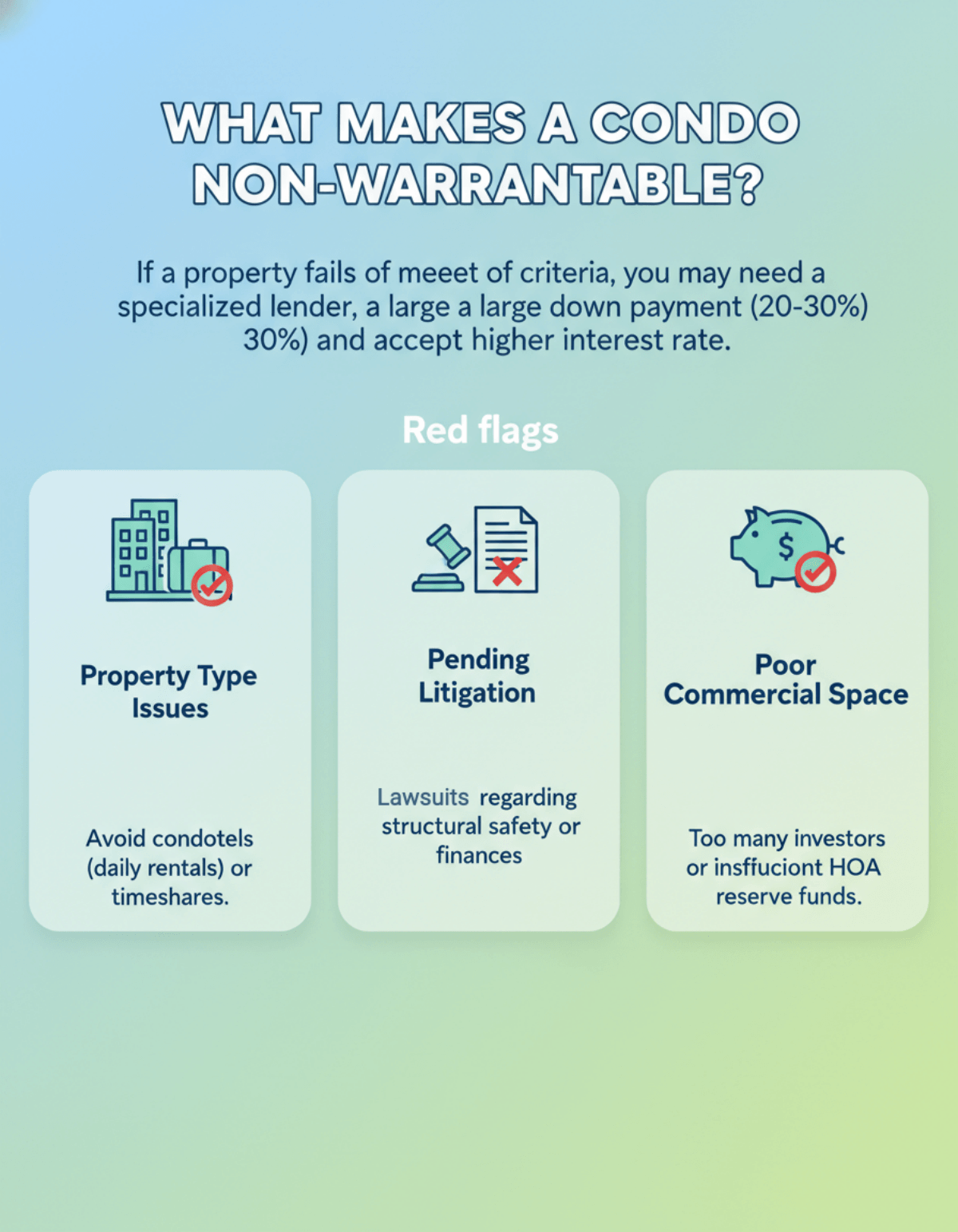
If a building fails any of the standards above, it falls into the non-warrantable category. You can still buy a unit there, but you'll likely need a specialized portfolio lender, a down payment closer to 20-30%, and a higher interest rate.
Watch for these red flags:
- Condotels and short-term rental setups: Buildings that operate like hotels, with daily rentals or rental-pooling requirements, are automatically disqualified. Lenders want long-term residents, not transient guests.
- Active or pending litigation: If the HOA is being sued over structural safety, habitability, or major financial damages, lenders will pause immediately until the matter resolves.
- Weak reserves or heavy investor concentration: A building with thin reserves and a flood of unpaid dues signals real bankruptcy risk to an underwriter.
- Failed or skipped structural inspections: This one is increasingly common, especially in Florida. Since the Surfside tragedy in 2021, buildings three stories or taller in Florida must complete a Milestone Inspection and a Structural Integrity Reserve Study covering major components like the roof, plumbing, and load-bearing structure. As of January 2026, HOAs can no longer vote to waive or underfund those reserves. Buildings that skip these requirements are increasingly labeled non-warrantable by Fannie Mae, Freddie Mac, and FHA alike — so if you're shopping in a coastal market, ask about this before you fall in love with a unit.
How to Check If a Condo Is Warrantable
You can't tell whether a building is warrantable just by touring a nice lobby. You need paperwork. Here's how I'd approach it, step by step:
- Ask your agent early. Before you tour, have your agent check MLS notes or call the listing agent to see whether recent buyers used conventional financing successfully.
- Lean on the Condo Questionnaire. This is the real deciding factor. Once you apply for a loan, your lender sends a detailed questionnaire to the HOA covering reserves, litigation, occupancy, and more. The HOA's answers make or break your approval — and slow or incomplete responses are one of the most common reasons closings get delayed.
- Check HUD's approved list if you're going FHA. Search HUD's condo lookup tool to see if a building has already been vetted. Even if it isn't listed, don't assume you're out of luck — see the FHA section below.
What About an FHA Warrantable Condo?
FHA financing works a little differently, and this trips people up often. A condo can qualify for an FHA loan in two ways. Either the entire project is already on HUD's approved list, or it qualifies for Single-Unit Approval, sometimes called spot approval, where the lender reviews just your unit and the HOA's finances rather than requiring the whole building to be pre-approved. HUD also streamlined how case numbers get assigned for Single-Unit Approval earlier in 2026, which should speed up processing for lenders working through the system.
If a building isn't on HUD's list, it's worth asking the HOA whether they'd be open to starting the FHA approval process. Boards sometimes just need someone to explain that approval benefits every future seller in the building, not only the one buyer asking about it.
FAQs About a Warrantable Condo
Q1. What is a warrantable condo, in simple terms?
It's a condo building that meets Fannie Mae and Freddie Mac's financial and structural standards, which means buyers can finance a unit there with a standard conventional mortgage instead of a specialty loan.
Q2. Can I get a mortgage on a non-warrantable condo?
Yes, but not through a standard Fannie Mae or FHA loan. You'll need a portfolio lender or a Non-QM loan program, both of which typically require a 20-30% down payment and come with a higher rate than conventional financing.
Q3. What is a condo questionnaire?
It's a detailed financial and operational survey your lender sends to the HOA. It covers reserve funds, the owner-to-renter ratio, commercial space, pending litigation, and other factors that determine whether the project is warrantable.
Q4. How does pending litigation affect a condo's warrantability?
If the HOA is facing a lawsuit tied to structural integrity, safety, or a major financial claim, lenders will flag the building as non-warrantable right away and won't approve conventional loans until the case is resolved.
Q5. Is "warrantable" spelled differently anywhere?
You might come across "warrantiable" or "warrantyable" in casual writing, but neither is correct. The standard spelling in lending documents and Fannie Mae's own guide is warrantable.
Q6. Is it hard to sell a non-warrantable condo?
Yes, noticeably. Your buyer pool shrinks to mostly cash buyers or those who can handle a large down payment, which tends to stretch out the time a unit sits on the market.
Conclusion
Warrantability is really a safety net — it protects the bank and it protects you from sinking your savings into a poorly managed building. The 2026 rule changes make this more relevant than ever: some buildings that were locked out of conventional financing over investor ratios can now qualify, while others that used to sail through a quick review will need to prove their finances in full.
My advice hasn't changed in years, though: never assume a beautiful building is a financially healthy one. Before you hand over earnest money, make sure your purchase contract includes a financing contingency. If your lender later discovers HOA issues and calls the condo non-warrantable, that clause lets you walk away and get your deposit back. It's one clause that can save you from a very expensive surprise.
People Also Read
- Bank Statement Mortgage Guidelines: What Is It? How to Verify?
- Non-QM Loan Guidelines: How to Check and Verify with AI Accuracy
- 8 Best Non-QM Mortgage Lenders: Which to Choose?

![[Tips for Loan Officers] How Can I Lower Borrower DTI?](https://cdn.prod.website-files.com/6731bc6e813a541b54c30b10/6aa3b89e281a639e7a5c6fca_lower-debt-to-income-ratio-banner.jpg)