![[2026 Read First] What is a Non-Warrantable Condo Loan?](https://cdn.prod.website-files.com/6731bc6e813a541b54c30b10/69d5b904f98358aa9156684d_non-warrantable-condo-loan-banner.png)
Written by

Eric
Share this article

.svg)
Subscribe to updates
Last Checked and Updated on September, 2026
You finally found the perfect condo, then the lender walks away because the building is "non-warrantable." It's a gut punch for any buyer, and it happens more than most people expect. Traditional banks usually pass on these units, leaving you to wonder if the deal is dead.
It isn't. You just need a different type of loan. And with Fannie Mae rewriting several of its condo rules earlier this year, some of what used to disqualify a building doesn't anymore. Here's what a non-warrantable condo loan actually is, what changed in 2026, and how to still get the keys to your new place.
Key Takeaway
- A non-warrantable condo fails one or more of Fannie Mae's or Freddie Mac's project standards, but a 2026 rule change actually made some buildings easier to finance, not harder.
- Expect a bigger down payment, strong credit, and extra cash reserves compared to a standard mortgage.
- Portfolio loans, Non-QM products, DSCR loans, and Bank Statement programs are your main paths forward.
- FHA's Single-Unit Approval program can sometimes work even when a condo fails conventional guidelines entirely.
- Talking to a mortgage pro who handles these deals regularly will save you weeks of back-and-forth.
What Is a Non-Warrantable Condo Loan?
A non-warrantable condo loan is a mortgage for a condo that Fannie Mae and Freddie Mac won't purchase on the secondary market. Standard mortgages require the whole building to pass a project review: a healthy HOA budget, adequate insurance, no major lawsuits, and a few other boxes checked. Miss any one of them, and every unit in the building gets labeled non-warrantable, not just yours.
Because these loans can't be sold off, the lender keeps them in-house or funds them with private capital. That means more of the risk sits on their books, so you'll usually see a somewhat higher rate. In exchange, underwriters lean harder on your personal finances than on the building itself.
One thing worth knowing before you assume the worst: a heavy investor presence in the building used to be an automatic disqualifier. As of this year, that's no longer always true for established buildings, which I'll explain below.
Also Read:
- Warrantable vs Non-Warrantable Condo: What's the Difference?
- [Explained] What is a Warrantable Condo for Homebuyers?
- 2026 Ultimate Guide: How to Buy a House for the First Time?

What Changed for Condo Buyers in 2026?
On March 18, 2026, Fannie Mae published Lender Letter LL-2026-03, and Freddie Mac followed with a matching bulletin. It's the biggest reshuffle of condo lending rules in years, and it cuts both ways: some buildings got a break, others got stricter oversight.
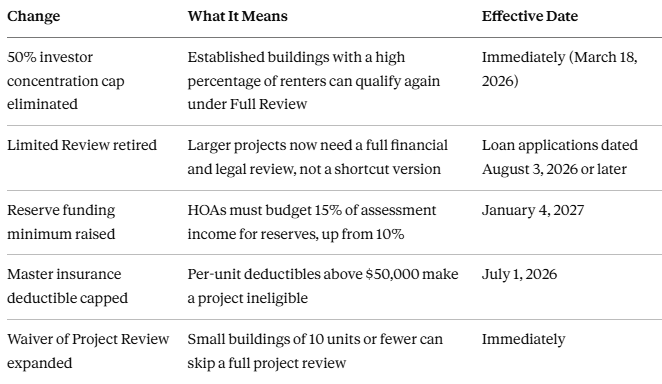
If you were told a year or two ago that a building was off-limits because too many units were rented out, it's worth asking your lender to check again. The old 50% cap on non-owner-occupied units is gone for existing buildings under Full Review, though new construction still has to meet a separate presale requirement.
The 6 Reasons a Condo Loses Its Warrantable Status
Lenders don't reject a building on a hunch. They're checking it against a specific list. Here's the current version:
- Delinquent HOA dues: 15% or more of units are 60+ days behind on assessments
- Excessive commercial space: Non-residential space exceeds 35% of total square footage
- Single-entity ownership: One owner holds more than 20% of units in a project of 21 or more
- Low reserve funding: Reserves fall below 10% of the annual budget (rising to 15% in 2027)
- Insufficient presale (new construction): Fewer than 50% of units are sold or under contract
- Active or unresolved litigation: Lawsuits affecting safety, structure, or the HOA's finances
I've seen buyers get blindsided by the litigation rule specifically. Even a seemingly minor lawsuit against the HOA, like a slip-and-fall claim, can be enough to freeze conventional financing for the entire complex until it's settled.
Requirements of a Non-Warrantable Condo Loan
Buying a condo outside the normal guidelines means you have to prove you're a safe bet. Lenders are taking a chance on the building, so they need you to look great on paper to balance things out. While every bank has its own playbook, here is what you generally need to bring to the table:
- A heavier down payment: Forget about 3% down. You'll usually need to put down 20% to 30% to get approved.
- Solid credit: Most lenders want to see a score of at least 680, but pushing that past 700 gets you much better terms.
- Plenty of reserves: Be ready to show you have enough cash left over to cover 3 to 6 months of mortgage payments.
- Low debt-to-income (DTI) ratio: Keeping your DTI under 43% shows you aren't biting off more than you can chew.
Also Read:
- Max DTI for Mortgage: Requirements By Loan Types
- [Guide] How to Calculate DTI Ratio for Mortgage?
- Non-Warrantable Condo Guidelines: Verify Eligibility in Seconds

How Much More Will You Pay?
This is the question most buyers actually want answered, so let's put real numbers on it. Non-warrantable condo rates typically run 0.5 to 1.5 percentage points above a comparable conventional loan. With conforming rates sitting in the mid-6% range through 2026, that puts most portfolio loans somewhere around 7% to 8%, and Non-QM pricing can climb a bit higher depending on your credit and documentation type.
Beyond the rate, some lenders tack on an origination fee of 1% to 2% of the loan amount. It adds up, but weigh it against the alternative: walking away from a building you actually want to live in.
Best Non-Warrantable Condo Programs to Choose
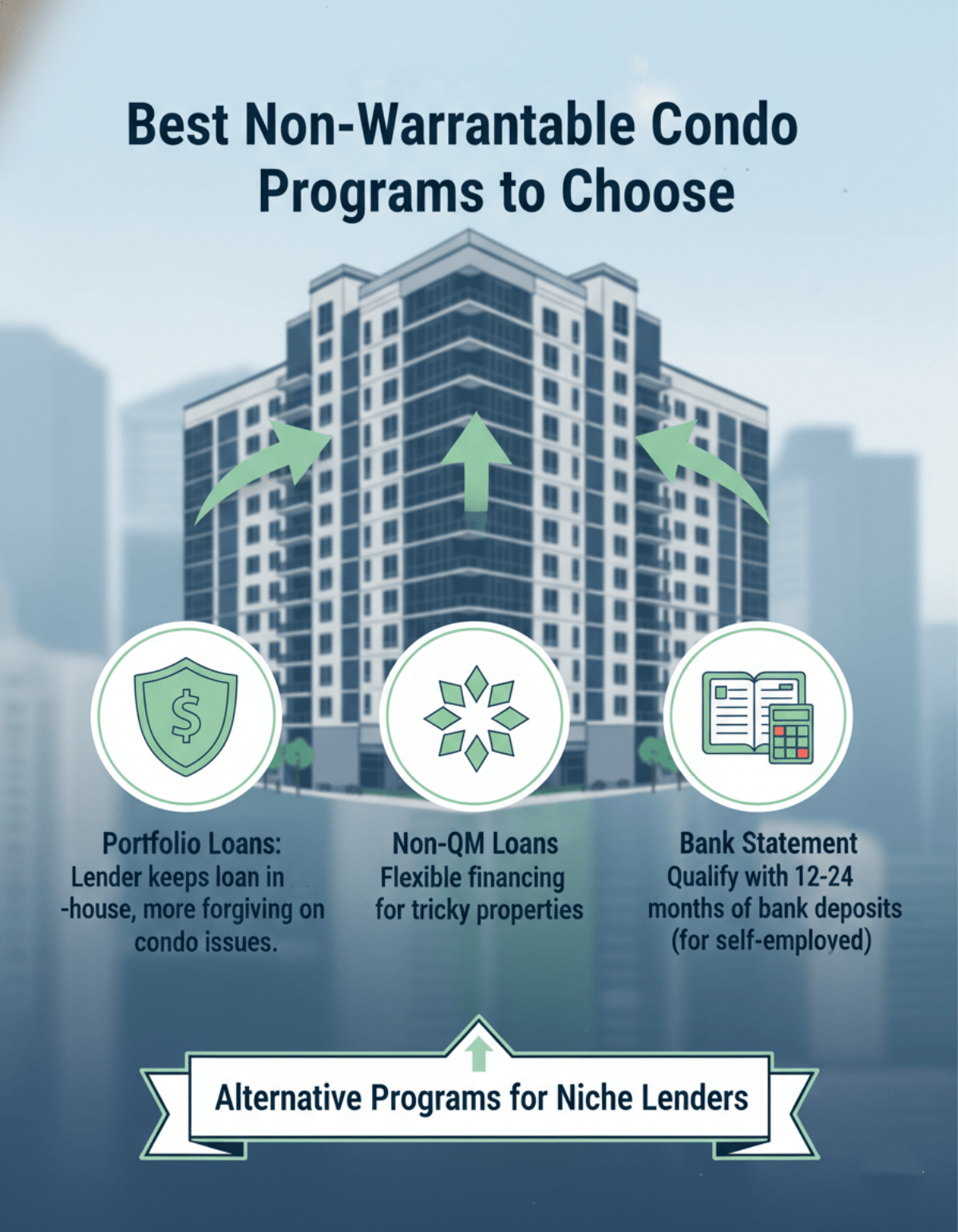
Since a standard mortgage is off the table, you'll need to look at lenders who specialize in exactly this kind of property. If you're shopping in 2026, these are the main routes worth exploring:
- Portfolio Loans: The non-warrantable condo lender keeps your loan rather than selling it, so they set their own rules and tend to be far more flexible about project-level issues.
- Non-QM Loans: These flexible products are built for tricky scenarios, including condotels (units that operate like short-term rentals with hotel-style amenities) and buildings dominated by investors.
- DSCR Loans: If you're buying the unit as a rental, some lenders will qualify you based on the property's own rental income instead of your personal tax returns, which sidesteps the DTI conversation entirely.
- Bank Statement Programs: Self-employed buyers whose tax returns understate their real income can qualify using 12 to 24 months of bank deposits instead.
Don't Rule Out FHA or VA
Fannie and Freddie aren't the only game in town. FHA offers a program called Single-Unit Approval (SUA), sometimes still called a spot approval, that lets a lender finance one unit in a building even though the whole complex isn't FHA-certified. The building still has to meet basic FHA standards and needs at least five units, but it's a path worth asking about, especially if you qualify for FHA's lower down payment. VA maintains its own separate condo approval list as well, so it's worth a quick check if you have VA eligibility.
How to Get a Non-Warrantable Condo Loan?
Getting a non-warrantable loan takes a bit more effort than a standard home purchase. Because the property falls into a weird category, you need to be prepared before you even start talking to sellers. Here is a realistic step-by-step approach to locking down the money:
- Get your finances in order: Gather your tax returns, bank statements, and proof of those cash reserves. A strong financial profile is your best leverage.
- Pull the condo documents early: Figure out why the building is non-warrantable. Grab the HOA budget, the master insurance policy, and the condo questionnaire so your lender knows what they are dealing with.
- Find a niche mortgage pro: Don't waste time at a big-box bank. Jump onto Bluerate to find and consult with a local loan officer for free. They know exactly which lenders actually fund these quirky properties and can guide you locally.
- Compare your options: Have your loan officer pull a few different scenarios so you can weigh the interest rates against the down payment requirements.
- Close the deal: Clear underwriting, sign the paperwork, and grab your keys.
What to Consider Before Applying for a Non-Warrantable Condo Loan?
Just because you can finance a non-warrantable condo doesn't mean you should ignore the trade-offs. These units can be great homes or investments, but go in with your eyes open.
- Smaller resale pool: Your future buyer will likely run into the same financing hurdle you did, which can slow down a sale later.
- Higher borrowing costs: Expect a somewhat higher rate and heftier closing costs, as covered above.
- HOA red flags: A thin reserve fund or a pending lawsuit isn't always the whole story. If you're looking at a building in Florida, ask specifically about its Structural Integrity Reserve Study (SIRS) status. Since January 1, 2026, Florida associations have been required to fully fund reserves for structural components like the roof, load-bearing walls, and plumbing, and a building that hasn't complied is increasingly likely to be flagged non-warrantable on top of facing insurance headaches.
- Less competition, better price: The upside is real. Since conventional buyers can't touch these units, you may land the property at a discount.
FAQs About a Non-Warrantable Condo Loan
Q1. What is the best non-warrantable condo loan?
A Portfolio loan or a Non-QM mortgage usually wins here. Since neither one follows Fannie Mae or Freddie Mac's rulebook, the lender can use judgment and approve you based on your actual financial strength rather than a rigid checklist.
Q2. What are non-warrantable condo guidelines?
They vary by lender, but most focus on why the building failed the standard test in the first place, along with your personal profile: credit score, cash reserves, and debt-to-income ratio. A lender will typically request the HOA's financials before finalizing terms.
Q3. What is the minimum down payment for a non-warrantable condo?
Some lenders will go as low as 10% to 15% for a strong borrower, but most programs ask for 20% to 30% to lock in a reasonable rate.
Q4. What is the minimum credit score for a non-warrantable condo?
Aim for 680 or higher. Scores in the low-to-mid 600s aren't automatically disqualifying, but you'll likely need a bigger down payment to bring a Non-QM lender to the table.
Q5. What are the red flags when buying a condo?
Watch for a nearly empty HOA reserve account, a pile of deferred maintenance, or a large share of owners behind on dues. Active lawsuits, upcoming special assessments, and (in Florida) an incomplete SIRS report are all signs to dig deeper before you write an offer.
Q6. Can a non-warrantable condo become warrantable again?
Yes. Warrantability isn't permanent in either direction. If the HOA resolves the issue, whether that's settling a lawsuit, rebuilding reserves, or clearing its delinquency rate, a lender can run a new project review and reclassify the building. It just takes time.
Q7. What is a condotel, and can I get a loan for one?
A condotel is a condo unit inside a building that operates more like a hotel: a rental front desk, mandatory or heavily encouraged short-term rental programs, and shared hotel-style amenities. Conventional lenders won't touch them, but Non-QM and some portfolio lenders finance condotels regularly, usually with a larger down payment.
Final Word
Financing a non-warrantable condo takes a bit more patience, but it's far from impossible, and the rules just shifted in favor of some buyers this year. You'll likely bring a bigger down payment, show cleaner credit, and accept a slightly higher rate. In return, you get access to buildings that conventional buyers simply can't touch.
Whether you land on a Portfolio loan, a DSCR loan, or a Non-QM product, the real key is working with a mortgage professional who understands this corner of the market. Pull the HOA's financials, get your own documents in order, and you'll be in a strong position to close on your condo in 2026, even if a traditional bank already said no.
People Also Read
- Bank Statement Mortgage Guidelines: What Is It? How to Verify?
- Non-QM Loan Guidelines: How to Check and Verify with AI Accuracy
- 8 Best Non-QM Mortgage Lenders: Which to Choose?

![[Tips for Loan Officers] How Can I Lower Borrower DTI?](https://cdn.prod.website-files.com/6731bc6e813a541b54c30b10/6aa3b89e281a639e7a5c6fca_lower-debt-to-income-ratio-banner.jpg)