Written by

Eric
Share this article

.svg)
Subscribe to updates
Last Checked and Updated on September, 2026
As a mortgage professional, I know exactly what happens when a condo project lands on my desk and something feels off. The moment I suspect it's non-warrantable, my stomach drops a little. For loan officers and underwriters, clearing these properties usually means digging through hundreds of pages of investor matrices just to see whether one specific non-QM lender will accept the deal.
Time is money in this business. We all want a fast, reliable way to verify eligibility so we can structure the file, get back to our borrowers, and close the loan without delay. The good news: checking non-warrantable condo guidelines doesn't have to eat up your afternoon anymore, and the rules themselves just shifted in some important ways.
Key Takeaways
- Non-warrantable condos don't meet Fannie Mae or Freddie Mac standards and require alternative financing.
- Non-QM and portfolio loans are the primary funding sources for these properties.
- Fannie Mae's Lender Letter LL-2026-03 retired several older rules in 2026, including the 50% investor-concentration limit and the Limited Review pathway, while raising reserve requirements for 2027.
- Manual guideline checks are tedious, often eating up 30 minutes or more per scenario.
- AI tools like Zeitro can now cross-reference hundreds of investor matrices, cutting that search time down to seconds.
What Is a Non-Warrantable Condo?
A non-warrantable condo is simply a unit inside a project that fails to meet the purchase standards set by Government-Sponsored Enterprises (GSEs) like Fannie Mae and Freddie Mac. That label doesn't mean the property is a bad investment. It just carries a different risk profile than a typical GSE-eligible building.
In my experience, a condo project usually ends up in this bucket for a handful of common reasons. Commercial space might exceed 35% of the building's total square footage. A single entity or developer might own more units than Fannie Mae's 20% limit or Freddie Mac's 25% limit allows. Other common deal-breakers include unresolved HOA litigation, deferred structural repairs, or a project that essentially operates as a hotel. Once any of these flags appear, standard conventional financing is off the table.
What Is a Non-Warrantable Condo Loan?
Since Fannie Mae and Freddie Mac won't purchase these mortgages, borrowers have to look elsewhere for capital. That's where a non-warrantable condo loan comes in. These specialized products are typically funded either by portfolio lenders, who keep the debt on their own books, or through the Non-QM (Non-Qualified Mortgage) market.
For originators, Non-QM loans offer real flexibility. They let borrowers finance condos that traditional banks would otherwise reject outright. Whether you're working with a first-time buyer or a seasoned investor, matching them with the right wholesale lender keeps the property financeable and your pipeline moving forward.
What Are Non-Warrantable Condo Guidelines?
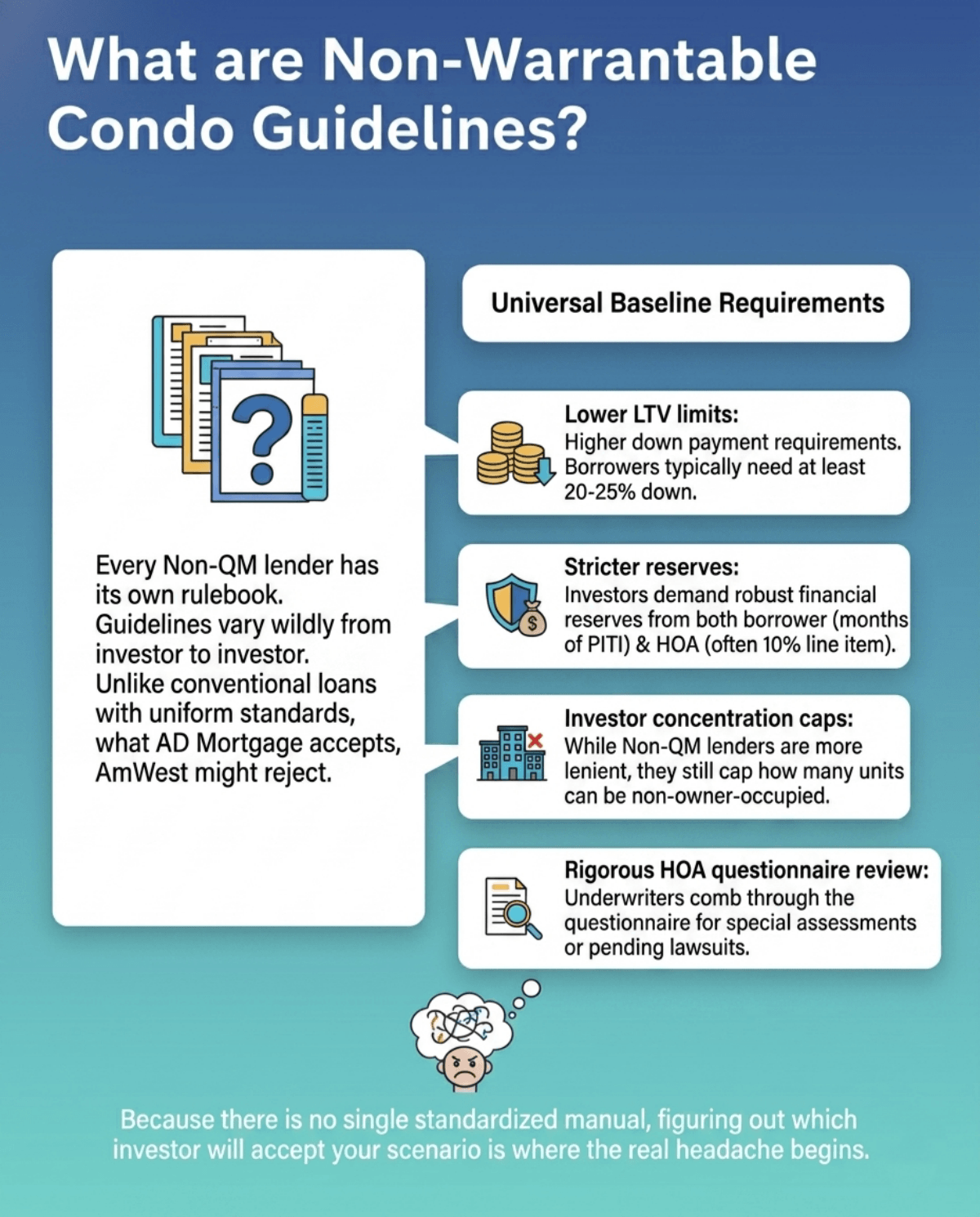
Every Non-QM lender writes its own rulebook. Unlike conventional loans, which follow one uniform GSE standard, non-warrantable condo guidelines vary widely from investor to investor. What AD Mortgage accepts, AmWest might reject outright.
Still, when I structure these deals, I typically run into a few baseline requirements that show up across most investors:
- Lower LTV limits: Expect a bigger down payment. Most Non-QM programs cap loan-to-value in the 70% to 80% range for non-warrantable buildings, meaning borrowers often need at least 20% to 25% down depending on the lender and the property's risk profile.
- Stricter reserves: Investors often want solid reserves from both the borrower (several months of PITI) and the HOA (commonly a 10% line item, though that floor is rising — more on that below).
- HOA delinquency limits: Under Fannie Mae's Selling Guide, a project becomes ineligible once 15% or more of units are 60 days or further behind on assessments, so lenders check this figure closely even outside conventional financing.
- Investor concentration caps: Non-QM lenders tend to be more forgiving than the GSEs, but most still cap how many units can go to non-owner-occupants.
- Rigorous HOA questionnaire review: Underwriters comb through the condo questionnaire looking for special assessments, pending lawsuits, or anything that hints at financial instability.
Because there's no single standardized manual across the industry, figuring out which investor will actually accept your borrower's scenario is where the real headache begins.
Fannie Mae's 2026 Rule Changes: What LL-2026-03 Means for Non-Warrantable Condo Guidelines
If you haven't revisited your condo checklist since early 2026, it's worth a second look. On March 18, 2026, Fannie Mae issued Lender Letter LL-2026-03, one of the biggest updates to condo project standards in years, developed alongside Freddie Mac and the Federal Housing Finance Agency. Several of its provisions are already in effect.
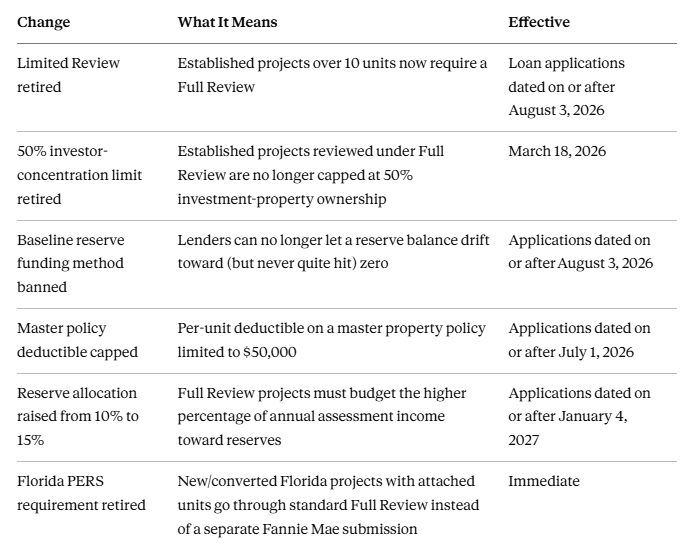
For our purposes as originators, two of these matter most day to day. First, the retirement of the 50% investor-concentration rule means a building that was previously non-warrantable purely because too many units were rented out may now qualify again under Full Review — worth a second look before you assume a project is a lost cause. Second, that 10%-to-15% reserve jump starting January 2027 is going to push more older buildings with thin reserve funding into non-warrantable territory, not fewer, so it's smart to start flagging this with clients now rather than after their application date has already passed the deadline.
Why Florida Condos Keep Showing Up on the Non-Warrantable List
If you originate in Florida, you've probably noticed non-warrantable flags popping up more often than they used to, and it isn't a coincidence. In the wake of the 2021 Champlain Towers South collapse in Surfside, Florida passed laws requiring older condo and co-op buildings three stories or taller to complete a Structural Integrity Reserve Study (SIRS) and, depending on age and coastal proximity, a milestone inspection.
Under House Bill 913, boards can no longer vote to waive or underfund the reserves tied to those structural items once their 2025 budget took effect. That's a meaningful shift from a few years ago, when many associations simply voted to defer the cost. Buildings that skip the study, or that fund it below the recommended level, are exactly the kind of project Fannie Mae flags for inadequate reserves or deferred maintenance — and right now, more than 1,400 Florida condo buildings sit on Fannie Mae's restricted project list as a result.
For anyone working Florida deals, this is worth building into your intake process. Ask for the SIRS report and the most recent milestone inspection alongside the standard condo questionnaire, and you'll catch a lot of non-warrantable buildings before you've burned hours structuring a file that was never going to close conventionally.
Fannie Mae vs. Freddie Mac: How the Baseline Rules Compare
Both GSEs are aiming at the same risks, but their exact thresholds don't always line up. Here's a quick side-by-side for the numbers that trip up projects most often:
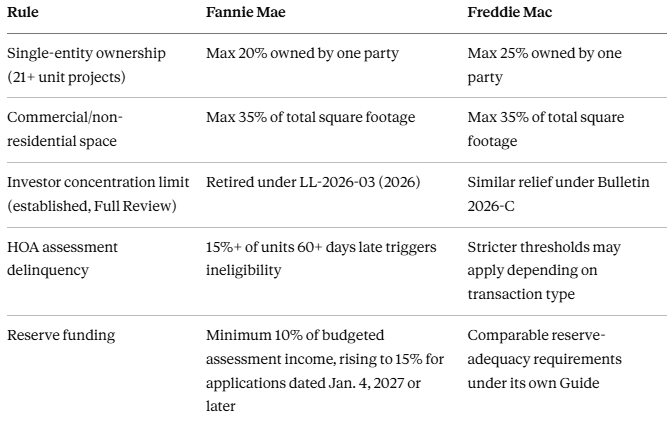
The takeaway for originators: a project that's non-warrantable under Fannie Mae isn't automatically non-warrantable under Freddie Mac, and vice versa. It's always worth checking both agencies' criteria — and, if neither works, moving straight to a Non-QM or portfolio option rather than assuming the deal is dead.
Why Is It Hard to Check Non-Warrantable Condo Guidelines?
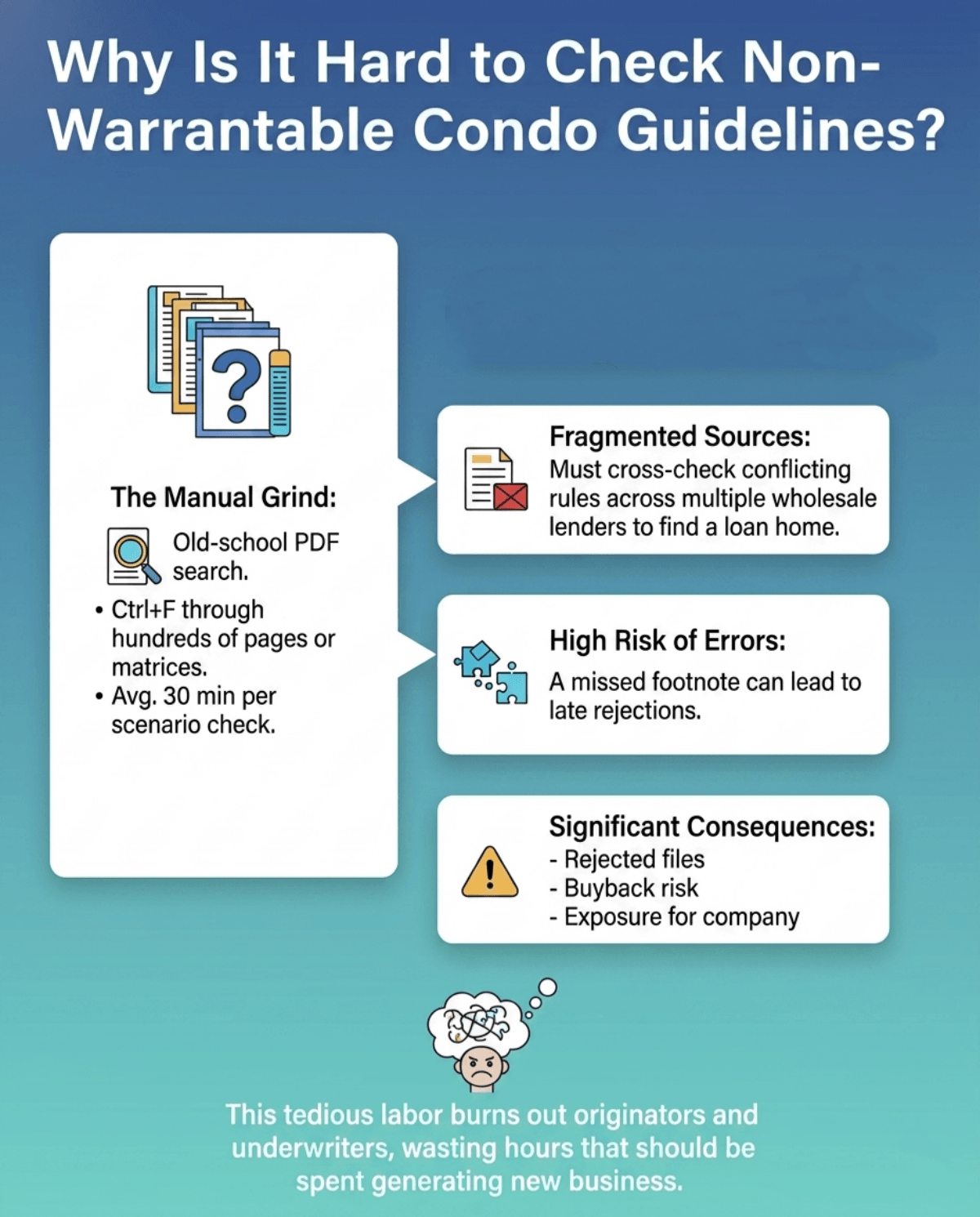
If you've ever hit Ctrl+F on a 40-page condo matrix looking for an LTV limit on a condo-hotel, you already know the pain. The process is frustrating for a few reasons:
- The manual grind: Most of us still rely on searching through hundreds of pages or dense matrices by hand. A single scenario check can easily eat up 30 minutes.
- Fragmented sources: You end up cross-checking conflicting rules across multiple wholesale lenders just to find a home for the loan.
- Confusing project status labels: Fannie Mae's own Condo Project Manager (CPM) system can mark a building as "Unavailable" — sometimes called the "Do Not Lend List" in the industry — and figuring out exactly why a project landed there isn't always obvious from the portal alone.
- High risk of errors: Missing a small footnote about HOA litigation can lead to a rejected file late in the process, or worse, put your company on the hook for buyback risk.
This kind of tedious labor burns out originators and underwriters alike, eating hours that would be far better spent generating new business.
Zeitro Strata: Check Non-Warrantable Condo Guidelines in Seconds
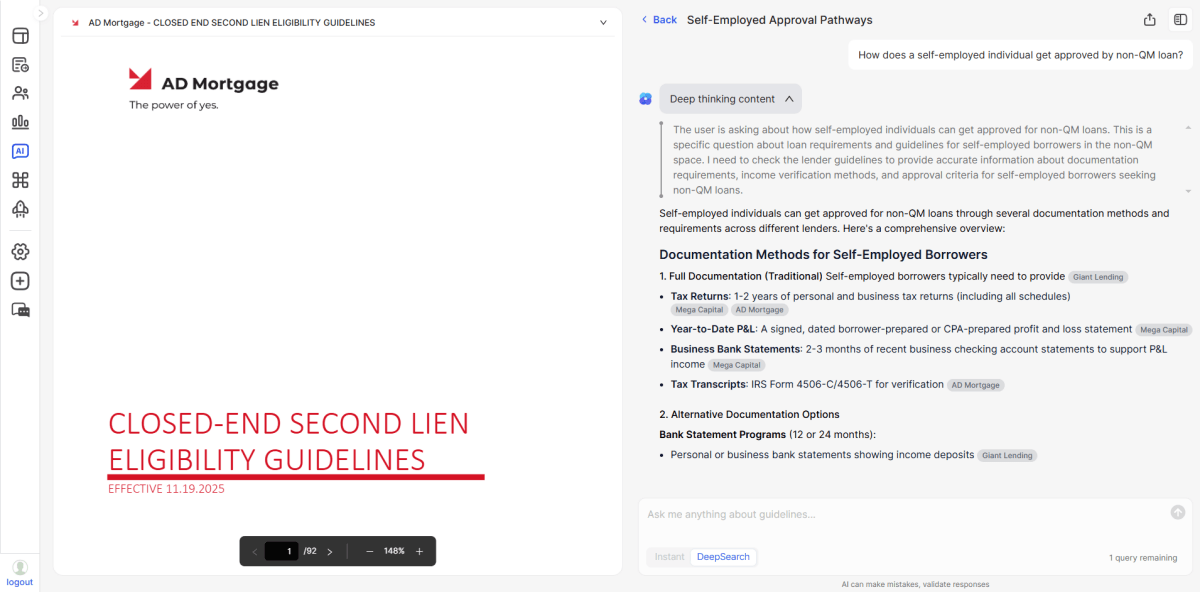
Instead of losing half an hour to PDFs, I now use Zeitro Strata, an AI SaaS tool built specifically for mortgage professionals. Its core feature, DeepSearch, instantly cross-references over 1,000 guidelines from 100+ investors, including AAA Lending, HomeXpress, and Luxury.
What sets Zeitro apart is how much I trust the output. As loan pros, we can't afford AI hallucinations on something this consequential. Zeitro provides 100% citation-backed answers, pointing directly to the source document so I can verify the rule myself before quoting a borrower or checking an LTV ceiling for a specific investor.
Pros:
- Cuts manual lookup time from around 30 minutes to seconds, saving users 18+ hours a month.
- Customizable tags let you filter by specific scenarios, like DSCR, ITIN, or Non-QM.
- The free Explorer plan gives you 3 AI queries a day to test it out with zero commitment.
Cons:
- The "Explain" feature, which clarifies a complex answer, technically counts as a new query and pulls from your daily limit.
Overall, it's a real productivity booster — one that speeds up pre-qualifications by roughly 2.5 times and keeps you current on changes like LL-2026-03 without having to comb through every lender letter yourself.
FAQs About Non-Warrantable Condo Underwriting Guidelines
Q1. Does Fannie Mae allow non-warrantable condos?
No. By definition, a non-warrantable condo fails to meet the eligibility requirements set by Fannie Mae and Freddie Mac. Because the GSEs won't purchase these loans, buyers need to secure financing through alternative routes, such as Non-QM products or portfolio lenders.
Q2. What is the minimum down payment for a non-warrantable condo?
Down payments run higher than on standard conventional loans. Borrowers should expect a minimum of 20% to 25% down, depending heavily on the specific Non-QM investor's guidelines, the borrower's credit profile, and the property's overall risk factors.
Q3. How do you finance a non-warrantable condo?
The most reliable path is working with a mortgage broker or wholesale lender who specializes in Non-QM lending. They have relationships with private investors and portfolio lenders who offer flexible programs built specifically for these harder-to-place condo projects.
Q4. Are mortgage rates higher for non-warrantable condos?
Yes. Because these loans can't easily be sold on the secondary market to government-sponsored enterprises, they carry less liquidity and more risk for the lender. To offset that exposure, private lenders and portfolio banks typically charge somewhat higher interest rates than on a standard warrantable condo loan.
Q5. Can a non-warrantable condo become warrantable again?
Absolutely, and it happens more often than people expect. If the underlying issue gets resolved — say, an HOA lawsuit settles, a reserve study brings funding up to the required level, or investor concentration drops to an acceptable range — the project can be reclassified and qualify for conventional financing again. In fact, Fannie Mae's 2026 retirement of its 50% investor-concentration rule already pushed a number of previously non-warrantable buildings back into eligible territory.
Q6. What is Fannie Mae's Condo Project Manager, and what does "Do Not Lend" mean?
Condo Project Manager (CPM) is the online system Fannie Mae's lenders use to check and certify a project's eligibility. When a building fails core requirements — inadequate reserves, unresolved critical repairs, or missing insurance documentation, for example — CPM marks it "Unavailable," which the industry often shorthands as being on the "Do Not Lend List." That status blocks conventional financing project-wide until the issue is resolved and the project is recertified.
Q7. What changed under Fannie Mae's LL-2026-03 update?
LL-2026-03 retired the Limited Review process, eliminated the 50% investor-concentration cap for established Full Review projects, capped master insurance deductibles at $50,000 per unit, and will raise the minimum reserve allocation from 10% to 15% of annual assessment income for applications dated on or after January 4, 2027. Together, these changes reshape which buildings qualify for conventional financing and which ones need a Non-QM or portfolio solution.
Conclusion
Navigating non-warrantable condo guidelines can feel like a moving target, especially with Fannie Mae's 2026 rule changes reshaping parts of the playbook. But it shouldn't stop you from closing deals. In fact, understanding how to place these loans — and staying current on updates like LL-2026-03 — makes you a more valuable loan officer or broker.
You don't need to spend hours on manual searches anymore. An AI-powered assistant handles the heavy lifting and delivers accurate, citation-backed answers instantly, even as the underlying rules keep shifting. Start with Zeitro's free Explorer plan today for 3 free AI queries a day. See what it's like verifying guidelines in seconds, and watch your productivity — and your mortgage pipeline — grow.
Also Read:
- Best Non-Warrantable Condo Lenders Near Me
- [Explained] What is a Warrantable Condo for Homebuyers?
- Warrantable vs Non-Warrantable Condo: What's the Difference?
- Best Mortgage Pipeline Management Software: Streamline Workflow
- Max DTI for Mortgage: Requirements By Loan Types

![[Tips for Loan Officers] How Can I Lower Borrower DTI?](https://cdn.prod.website-files.com/6731bc6e813a541b54c30b10/6aa3b89e281a639e7a5c6fca_lower-debt-to-income-ratio-banner.jpg)