Written by

Eric
Share this article

.svg)
Subscribe to updates
Last checked and updated on August, 2026.
Denied for a condo loan? The building itself might be the problem, not you. Here's what makes a condo non-warrantable, what changed in 2026, and how buyers still get financed.
As a loan officer, I've made this call more times than I'd like: a buyer with great credit and a solid income gets turned down, and it has nothing to do with them. The condo building failed the test. Welcome to the world of the non-warrantable condo.
It trips up buyers and lenders constantly, mostly because of strict Fannie Mae and Freddie Mac rules. But a rejection here isn't the end of the road. Let's walk through what this label actually means, why it happens, what changed this year, and how you can still get to closing.
Key Takeaways
- A non-warrantable condo fails one or more of Fannie Mae's or Freddie Mac's eligibility standards, so conventional lenders can't sell the loan on the secondary market.
- Common causes include HOA lawsuits, thin reserve funds, too much commercial space, or short-term rental activity.
- As of August 2026, Fannie Mae and Freddie Mac retired the fast-track Limited and Streamlined Review options, so far more condo projects now face full financial scrutiny regardless of the buyer's down payment.
- You'll need alternative financing such as portfolio loans, Non-QM mortgages, or DSCR loans instead of a standard conventional loan.
- Expect a bigger down payment and a higher rate to offset the lender's added risk.
Meaning: What is a Non-Warrantable Condo?
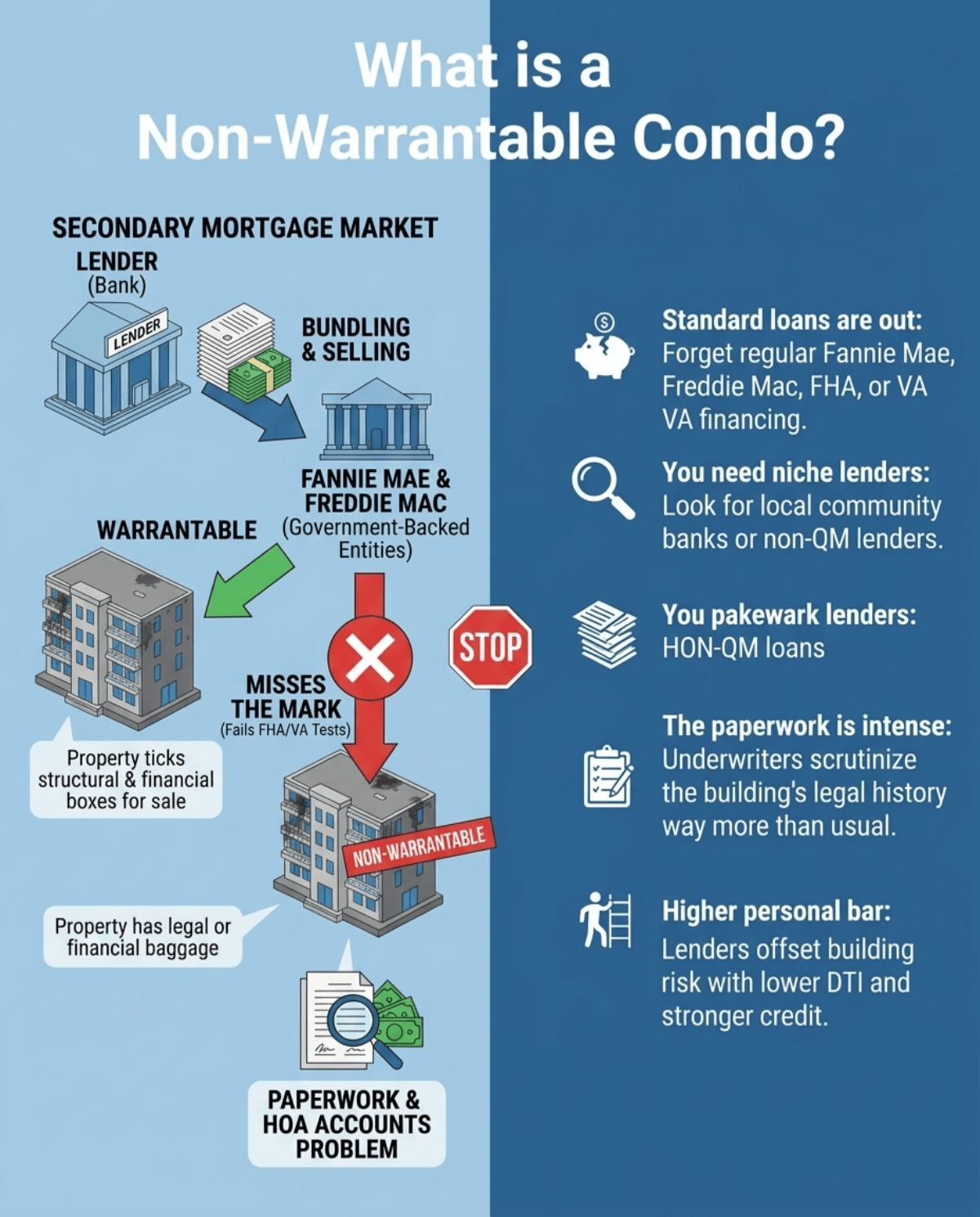
Picture how the secondary mortgage market actually works. When I close a conventional loan, my company almost never holds onto it. We package it up and sell it to Fannie Mae or Freddie Mac, who then resell it to investors as mortgage-backed securities. For that sale to happen, the condo project has to meet a checklist of financial and legal standards, a status the industry calls warrantability.
So what happens when a building doesn't clear that bar, or fails a parallel FHA or VA review? It gets labeled non-warrantable. That doesn't mean the building is unsafe or falling apart. In my experience, it almost always traces back to the HOA's paperwork, its bank account, or a legal dispute the board hasn't resolved yet.
Here's the short version of what that means for you:
- Conventional financing is off the table. Fannie Mae, Freddie Mac, FHA, and VA loans all require warrantable status.
- You'll need a specialty lender. Think local credit unions, portfolio banks, or Non-QM lenders.
- Underwriting gets deeper, not lighter. Your lender will dig into the building's legal and financial history far more than they would on a typical purchase.
- Your own numbers need to be stronger. Lenders usually ask for a lower debt-to-income ratio and better credit to offset the building's risk.
What are the Reasons a Condo is Considered Non-Warrantable?
I've read through more Condo Questionnaires than I can count, and Fannie Mae's rules leave very little wiggle room. One failed box on the checklist, and the entire project loses its warrantable status, not just one unit.
Here's what trips buildings up most often:
- Heavy single-entity ownership. One investor, company, or sponsor owns more than 20% of the units in a project with 21 or more units.
- Active litigation over safety or structure. The HOA is being sued over something tied to the building's soundness or habitability. Minor disputes, like a neighbor conflict or a case the HOA's insurer is already covering, usually don't count against you.
- Too much commercial space. Retail, office, or other non-residential use eats up more than 35% of the project's total square footage.
- Hotel-like operations. Nightly rentals, mandatory rental pools, or resort-style amenities push a project into condotel territory.
- Underfunded reserves. The HOA currently needs to keep at least 10% of its budgeted income in reserve for repairs and replacements. That threshold is scheduled to rise to 15% for loan applications dated on or after January 4, 2027, so buildings that are barely funded today may need to catch up soon.
- Critical, unresolved repairs. Unfunded repairs over $10,000 per unit, an active evacuation order, or a structural report flagging safety issues will all sink a project's eligibility.
One thing worth knowing: the old rule that flagged a project once investor-owned units passed 50% was retired for established buildings back in March 2026. That doesn't mean rental-heavy buildings are automatically fine now, since a separate rule still requires that at least half the units in newer projects be sold or under contract to owner-occupants, but it does mean a high renter count alone isn't the dealbreaker it used to be.

What Changed With Condo Rules in 2026
This is the part most articles on this topic still haven't caught up on, so it's worth slowing down for. In March 2026, Fannie Mae and Freddie Mac announced their biggest overhaul of condo lending standards in years, and the most disruptive piece of it just took effect.
For a long time, lenders had a shortcut called Limited Review (Fannie Mae) or Streamlined Review (Freddie Mac). If a buyer put down enough cash, typically 10% or more on a primary residence, the lender could skip most of the deep dive into the HOA's finances. As of August 3, 2026, that shortcut is gone for established condo projects with more than 10 units. Every one of those loans now goes through a Full Review, which means the underwriter pulls the budget, the reserve study, the delinquency rate, and any pending litigation regardless of how much the buyer is putting down or how clean their credit looks.
In practice, that means buildings that used to slide through on a big down payment alone can no longer count on that. A project with shaky finances that never got flagged before might get caught this time around, simply because more loans are now getting the full underwriting treatment. If you're house hunting in a building you're not fully sure about, this is exactly the kind of change that can turn a smooth closing into a scramble for alternative financing.
One more note for anyone shopping insurance-conscious buildings: HOA master policies now face a cap of $50,000 on the per-unit deductible for loan applications dated on or after July 1, 2026, which should help prevent surprise coverage gaps after a claim.
And a quick reality check from someone who does this daily: even when Fannie Mae or Freddie Mac says a project qualifies, individual lenders can still apply their own stricter internal rules, often called overlays. Passing the official checklist doesn't guarantee every lender will say yes.
Also Read: Biggest Condo Rule Change in a Decade: Guide for Mortgage Pros
Why Florida Condos Show Up on This List So Often
If you've searched around and noticed how many non-warrantable condo stories mention Florida, there's a clear reason. After the 2021 Surfside collapse, Florida passed laws requiring condo and co-op buildings three stories or taller to complete milestone structural inspections and a Structural Integrity Reserve Study, known as a SIRS, on a set schedule. Associations can no longer vote to waive or underfund the reserves those studies call for.
That's a good policy for building safety, but it's also pushed a wave of large special assessments and reserve shortfalls into the open, especially in older coastal buildings across Miami, Fort Lauderdale, and Tampa. Buildings that spent years underfunding their reserves are now catching up all at once, and that's precisely the kind of financial gap that can trip a Fannie Mae or Freddie Mac review. If you're shopping in Florida, ask for the building's most recent SIRS and milestone inspection report before you get attached to a unit.
Red Flags to Check Before You Fall in Love With a Unit
A little homework upfront can save you from a financing headache later. Before you write an offer, ask your agent or the HOA for:
- The most recent reserve study or SIRS, and whether the association is actually funding it or just talking about it.
- Board meeting minutes from the past year, which often mention lawsuits, special assessments, or maintenance disputes before they show up anywhere official.
- The delinquency rate, since a large share of owners behind on dues is a strong predictor of financial trouble ahead.
- Whether the building has hotel-style amenities like a rental desk, daily cleaning, or a concierge, all signs of condotel status.
- Any pending or planned special assessments, and what they're for.
Pros and Cons of a Non-Warrantable Condo
Taking on a non-warrantable property isn't automatically a bad move. Your perspective changes entirely depending on whether you're trying to buy a primary residence or you're an investor hunting for yield. Here's the reality of what you're walking into.
Benefits:
- Way less competition: Most buyers walk away when their traditional loan falls through. That leaves the door wide open for you.
- Solid price discounts: Sellers get desperate. They know their buyer pool is tiny, which gives you massive negotiation power.
- An investor's playground: If you're paying cash, these properties are often steals. A high renter ratio might scare off Fannie Mae, but it tells an investor the rental market is already proven.
Drawbacks:
- Heavy down payments: Lenders will ask for 20% to 30% upfront just to cover their perceived risk.
- Pricier money: Alternative financing simply costs more in interest and fees.
- A nightmare to resell: Eventually, you'll want to sell. And you'll be stuck dealing with the exact same financing hurdles the current owner is facing.
- Hidden HOA bombs: If the building was blacklisted for bad budgeting, you might get hit with a crippling special assessment down the line.
Types of Non-Warrantable Condo Loans
Hearing "no" from a conventional bank doesn't mean you're entirely locked out. Finding an experienced Mortgage Broker who knows their way around alternative financing is your best bet here.
If you want this condo, here are the loan types we typically look at:
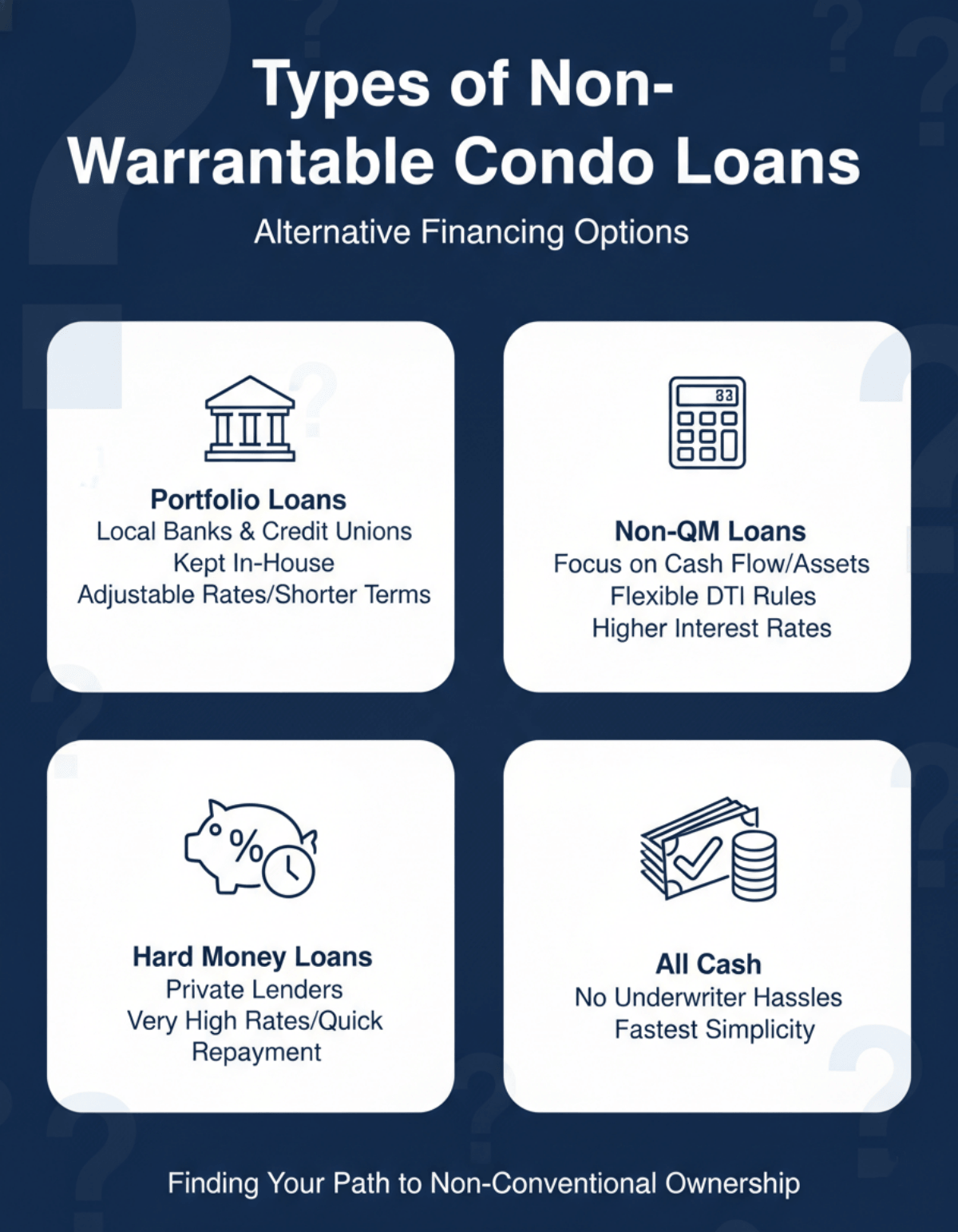
- Portfolio Loans: Local credit unions or banks keep these mortgages on their own books instead of selling them off. The catch? You'll likely see adjustable rates or shorter terms.
- Non-QM Loans: These non-qualified mortgages care less about standard DTI rules and more about your raw cash flow or assets. Expect a bump in the interest rate.
- DSCR loans. Built for investors, these size the loan around the property's expected rental income rather than your personal earnings, which makes them a natural fit for a non-warrantable condo you plan to rent out.
- Hard Money Loans: A favorite for house flippers needing fast cash. The rates are steep, and you have to pay them back quickly.
- All Cash: The ultimate cheat code. Skipping the underwriter entirely makes the problem disappear.
Non-Warrantable Condo vs Warrantable Condo
The easiest way to think about the difference between these two property types is looking at cash and headaches. Warrantable condos give you a smooth, boring, and predictable path to getting the keys. Non-warrantable properties, on the other hand, demand much more upfront capital and carry heavier borrowing costs. However, they can sometimes turn into incredible investments if you know how to navigate the extra friction.
Here is a quick snapshot of how they actually compare in the real world:
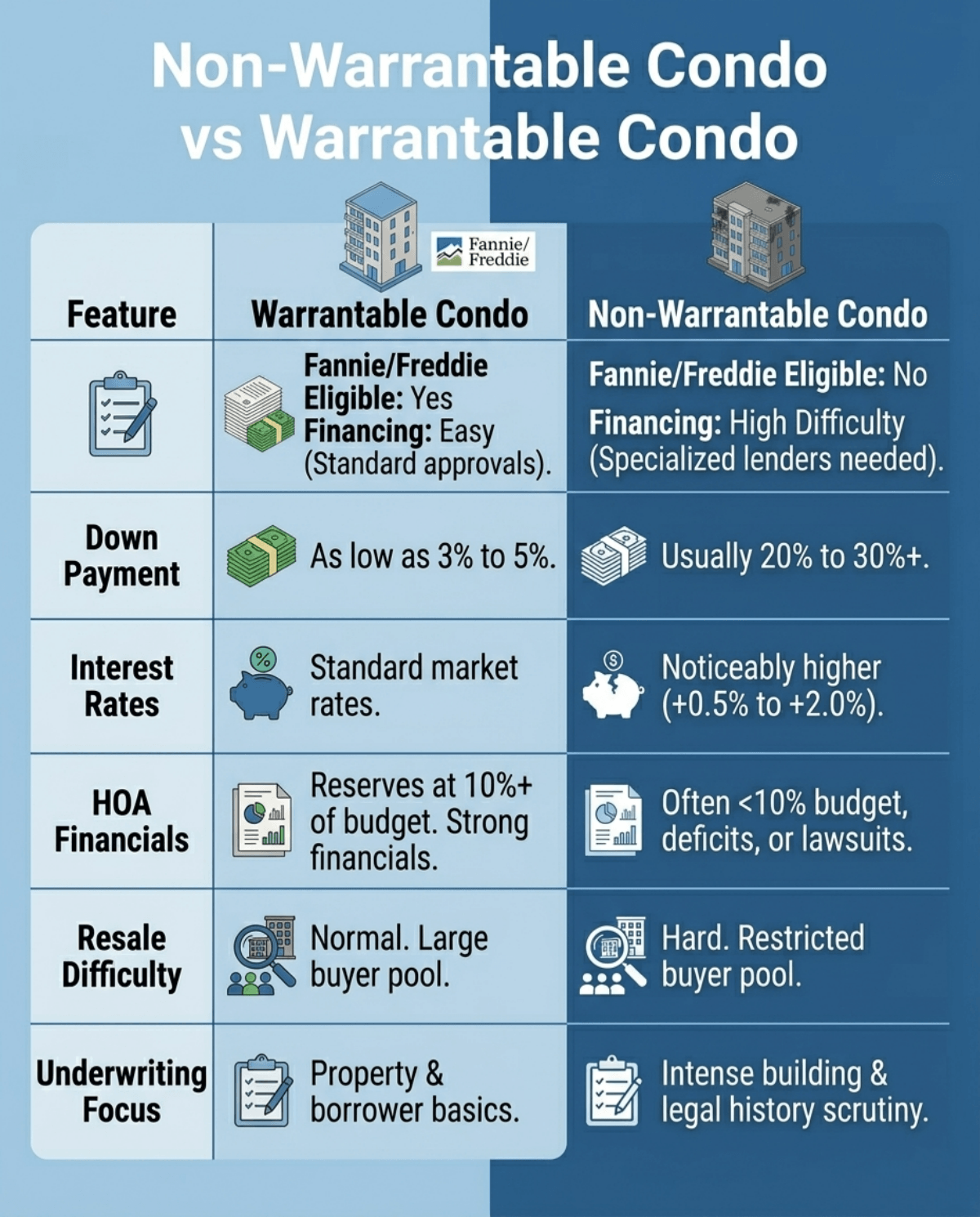
Paying attention to that massive gap in down payments and interest rates will quickly tell you if a slightly cheaper purchase price is actually worth the hassle.
FAQs About a Non-Warrantable Condo
Q1. Can a non-warrantable condo become warrantable?
Yes. This status isn't necessarily a permanent stain. If the HOA finally settles its pending lawsuits, boosts its reserve fund to meet Fannie Mae guidelines, or gets the investor ownership ratio back under control, the building can definitely earn back its warrantable title.
Q2. What are non-warrantable condo guidelines?
There isn't one universal rulebook for this. The term simply means the building failed the standard criteria set by Fannie Mae or Freddie Mac. From there, lenders offering portfolio or Non-QM loans will use their own private non-warrantable condo underwriting guidelines to figure out if they want the risk.
Also Read:
- What is Mortgage Eligibility Checker? Best Tool to Verify Guidelines
- Mortgage Guidelines: What Are They? How to Verify?
- How to Determine Mortgage Eligibility? Verify Guidelines in Seconds
- [Read First] What is a Non-Warrantable Condo Loan?
Q3. Do I need a larger down payment for a non-warrantable condo?
Yes. Since government-backed agencies refuse to guarantee these mortgages, your lender takes on all the risk. To make them comfortable lending you the money, you'll almost always need to bring at least 20% to 30% of the purchase price to the closing table.
Q4. Is it risky to buy a non-warrantable condo?
Yes, the risks are real. You are taking a gamble on the building's financial health. You could inherit a poorly managed HOA, get slapped with a massive special assessment to fix a leaking roof, or find yourself totally stuck when you try to sell later.
Also Read: Best Non-Warrantable Condo Lenders Near Me in 2026
Q5. Is it hard to sell a non-warrantable condo?
Yes. Whoever buys the place from you is going to face the exact same stressful financing hurdles you just went through. This shrinks your future buyer pool drastically, leaving you relying mostly on all-cash buyers or very experienced real estate investors.
Q6. How do I know if a condo is warrantable?
Start by asking your real estate agent or the HOA whether the project shows as approved in Fannie Mae's Condo Project Manager system. Your lender will also send the HOA a Condominium Project Questionnaire, known as Fannie Mae Form 1076 or Freddie Mac Form 476, which asks about the building's finances, legal status, and rental activity. If the project comes back listed as "Unavailable," that's your answer.
Q7. Who determines if a condo is warrantable?
Your mortgage underwriter makes the final call. Early in the process, they shoot a Condo Questionnaire over to the HOA to dig into the building's bank accounts, legal standing, and renter ratios. They compare those answers directly against Fannie Mae guidelines.
Q8. Are interest rates higher for a non-warrantable condo?
Yes. Because your local bank or lender cannot easily sell these loans on the secondary market, they are stuck holding the liability. To justify that exposure, they charge a risk premium, typically sitting about 0.5% to 2% above standard market interest rates.
Q9. Is a non-warrantable condo the same thing under FHA or HUD rules?
Not exactly, though the ideas are related. Fannie Mae and Freddie Mac maintain their own warrantability standards for conventional loans, while FHA keeps a separate list of HUD-approved condo projects for FHA-insured financing. A building can be off one list and still be on the other, so it's worth checking both if you're weighing loan options.
Q10. What changed with condo lending rules in 2026?
Fannie Mae and Freddie Mac eliminated their fast-track Limited and Streamlined Review options as of August 3, 2026, meaning most condo projects with more than 10 units now go through a full financial review no matter the buyer's down payment. They also retired the old 50% investor-ownership cap for established projects back in March 2026, and reserve funding requirements are set to rise from 10% to 15% starting in January 2027.
Conclusion: Should I buy a Non-Warrantable Condo?
So, is it worth it? I always tell clients it comes down to your endgame.
If you've got the cash on hand, you're buying a long-term rental, and you negotiated a real discount, this can turn into a genuinely smart investment. But if you're a first-time buyer stretching to cover the down payment, or you're planning to move again in a few years, I'd steer you toward a warrantable property instead. The higher rate and the resale friction just aren't worth it for a short hold.
Whatever you decide, don't skip the homework. Bring in a real estate attorney to read through the HOA's governing documents before you sign anything, and remember that even a building that clears Fannie Mae's checklist might still get a different answer from a specific lender.
If you're not sure whether you can finance a particular building, don't guess. Reach out to a Loan Officer today and we'll walk through your specific situation together.

![[Tips for Loan Officers] How Can I Lower Borrower DTI?](https://cdn.prod.website-files.com/6731bc6e813a541b54c30b10/6aa3b89e281a639e7a5c6fca_lower-debt-to-income-ratio-banner.jpg)