Written by

Eric
Share this article

.svg)
Subscribe to updates
Last Checked and Updated on August, 2026
I've seen it happen more times than I can count: a buyer falls in love with a gorgeous downtown condo, only to have their mortgage denied at the last minute. Or maybe you're a new loan officer staring at a rejected file, trying to figure out what went wrong. Buying a condo isn't just about the unit itself. You're also buying into the financial health of the whole community, whether you realize it or not.
That's where warrantable vs non-warrantable condos come into play. Fannie Mae and Freddie Mac, the two government-sponsored agencies that buy most U.S. mortgages, have strict rules about what they will and won't finance, and those rules got a significant update in 2026. Let me walk you through what actually separates the two, what changed this year, and how to avoid a financing surprise on your next deal.
Key Takeaways
- Warrantable condos meet Fannie Mae and Freddie Mac's project standards, so they qualify for standard, low-rate conventional financing.
- Non-warrantable condos fall short of those standards, which pushes buyers toward portfolio or Non-QM loans instead.
- Money is the biggest gap: non-warrantable properties usually require larger down payments (often 20% or more) and carry higher rates than warrantable ones.
- Fannie Mae overhauled its condo review rules in 2026, raising reserve requirements, retiring an entire review track, and loosening a few other restrictions at the same time.
What is a Warrantable Condo?
A warrantable condo is a property whose homeowners association (HOA) and building meet the lending standards set by Fannie Mae, Freddie Mac, the FHA, or the VA. When a condo project checks those boxes, a lender can approve your conventional mortgage with confidence, knowing it can later sell that loan on the secondary market instead of holding it on its own books.
For a buyer, that matters more than it sounds. A warrantable building is considered financially sound and low-risk, so the lender's exposure is smaller and your financing gets easier across the board. That usually means a lower interest rate, more flexible terms, and a down payment as low as 3% to 5% in many cases. In plain terms, warrantable status is the difference between a smooth closing and a stressful one.
What is a Non-Warrantable Condo?
By elimination, a non-warrantable condo is any project that doesn't meet those agency standards. But here's a misconception I run into constantly: non-warrantable doesn't automatically mean a bad property.
Some of the most desirable high-rises fall into this bucket. Common culprits include condotels (units that operate like hotel rooms), buildings still under construction, communities tangled up in a lawsuit, or a project with a thin HOA reserve account. It simply means the risk profile doesn't fit a standardized lending box, so Fannie Mae won't buy the loan and most banks won't touch it either. Financing one usually means paying cash or working with a lender who offers Non-QM or portfolio loans, like the specialized lenders who focus on exactly this niche.
Differences Between Warrantable and Non-Warrantable Condos
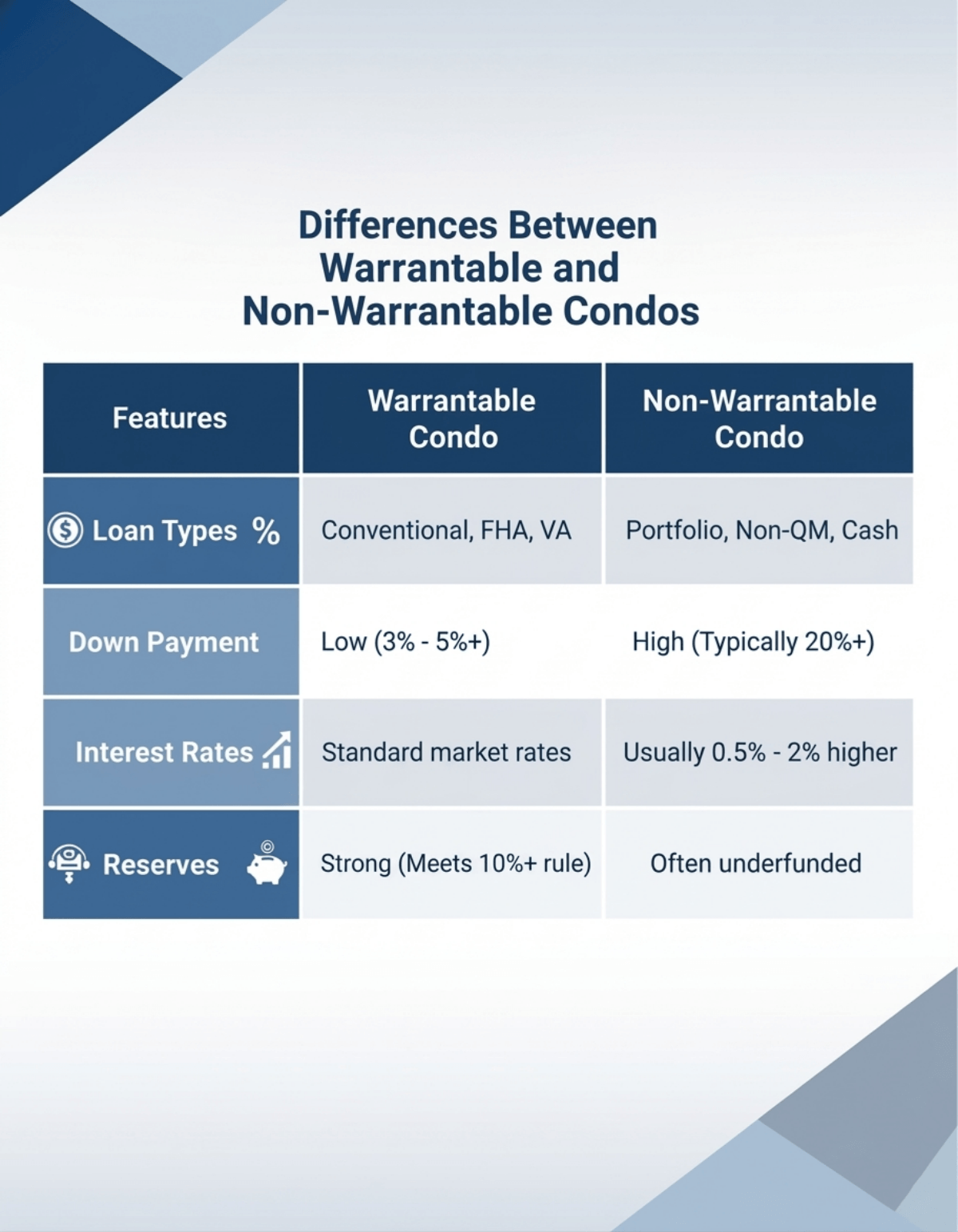
The gap between these two property types comes down to financial metrics and how the community operates. Here is a quick breakdown of what lenders look at when classifying a project, which I'll explain in detail below.
Financing
The type of mortgage you can use completely shifts depending on the property's status. Warrantable properties make standard conventional, FHA, and VA financing available, following Fannie Mae and Freddie Mac guidelines. These are the highly regulated, standardized products most buyers use.
If the building is non-warrantable, traditional lenders will issue a hard denial. Instead, you must pivot to alternative lenders offering portfolio loans or Non-QM products. These are mortgages that the bank or private lender intends to keep on their own balance sheet rather than sell to Fannie Mae. Because they make their own rules, they can accept the unique risks of the property, though it usually requires working with a specialized mortgage broker to find them.
Down Payment
Your initial cash outlay looks very different between the two. If you are purchasing a warrantable primary residence, standard loan programs might let you walk away with as little as a 3% to 5% down payment. It's highly accessible for first-time buyers.
Conversely, non-warrantable condos almost always require a much heavier upfront investment. Because the lender is taking on a non-traditional asset, they want more skin in the game from you. While a few niche programs might allow 10% down, the vast majority of portfolio and Non-QM lenders will ask for at least 20% to 30% down. If it's a severe case, like a condotel, expect the down payment demands to climb even higher.
Rates
Interest rates follow risk. Since warrantable units meet stringent federal guidelines, they represent the lowest possible risk to the mortgage industry. Consequently, you are rewarded with standard, competitive market interest rates.
When financing a non-warrantable unit, prepare for a rate bump. Lenders are retaining this loan on their own books (portfolio lending) and accepting a higher risk of default or property devaluation. To offset that exposure, they usually charge interest rates anywhere from 0.5% to 2% higher than what you'd get on a conventional mortgage. Over a 30-year term, that extra percentage point adds up significantly, making your monthly payments noticeably steeper compared to a standard property.
Owner Occupancy
Lenders closely examine who actually lives in the building. A community heavily populated by actual homeowners is considered much more financially stable. For a condo to remain warrantable, agencies require that no more than 50% of the units are investor‑owned rentals, meaning at least 50% must be owner‑occupied or used as second homes. This rule applies regardless of whether you are buying a primary residence or an investment unit.
When a building turns into an investor paradise, say, 60% or 70% of the units are rented out to tenants, the project quickly becomes non-warrantable. Lenders fear that transient renters don't maintain the property as well as owners, and out-of-state investors might be quicker to walk away from HOA dues during an economic downturn.
Litigation
Lawsuits are a massive red flag in the mortgage world. If the HOA is actively involved in major litigation, especially cases regarding structural soundness, safety, habitability, or significant financial disputes, Fannie Mae will immediately classify the entire project as non-warrantable. They won't risk lending on a building that might face a multi-million-dollar judgment.
However, a savvy loan officer knows that not all lawsuits kill a deal. Minor slip-and-fall claims covered by the association's insurance, or small disputes over neighborhood rules, usually won't affect the warrantability. The key is reviewing the exact nature of the lawsuit. But if it's a massive construction defect claim against the developer, conventional financing is completely off the table.
Reserves
A condo's reserve account is essentially its savings account for rainy days, like a roof replacement. Under Fannie Mae's "10% Rule", an HOA must allocate at least 10% of its annual budgeted assessment income to a replacement reserve fund. Projects that fall below this threshold are not eligible for warrantable status.
In practice, many lenders and boards aim for significantly higher reserve contributions, often 15% or more, to strengthen long‑term financial stability without triggering Fannie Mae disqualification.
As someone who reviews these files daily, I'll add a crucial update: agencies are getting even stricter post-Surfside. Lenders now demand fully funded reserve studies, and recent Fannie Mae guideline adjustments are pushing that reserve requirement closer to 15%. If an HOA has been keeping dues artificially low by neglecting their savings, buyers will be punished by losing access to normal financing until the community raises its assessments.
Insurance Requirements
Insurance rarely gets discussed in these conversations, but it can quietly sink a deal just as fast as a lawsuit. Fannie Mae's 2026 update set a maximum per-unit deductible of $50,000 on the HOA's master property insurance policy, mandatory for application dates on or after July 1, 2026. A building carrying a higher deductible, which is common in hurricane-prone coastal markets, can become a financing obstacle even if everything else checks out.
On the buyer's side, your individual HO-6 policy deductible can't exceed the greater of 5% of your coverage amount or $2,500. There's also some relief built in: roofs can now be insured on an actual cash value basis instead of full replacement cost, as long as the rest of the master policy still covers at least 100% of the project's estimated replacement cost. That single change is expected to bring a meaningful number of previously ineligible coastal and high-premium buildings back into conventional financing.
Commercial Space
Mixed-use buildings are incredibly popular in urban areas, who doesn't love having a coffee shop right in their lobby? But there is a strict limit. Fannie Mae guidelines mandate that no more than 35% of the total square footage of the building can be dedicated to commercial space.
If commercial space, like retail stores, restaurants, or offices, exceeds 35% of the building's total square footage, the project is generally classified as non‑warrantable under Fannie Mae guidelines. Agencies enforce this rule because they want to finance residential homes, not commercial enterprises. A heavy commercial footprint changes the traffic, noise, and overall risk profile of the building, meaning buyers there will have to rely on portfolio lenders to get the deal done.
Single Entity Ownership
A healthy condo association relies on diversified ownership. If a single individual, investor group, or corporation owns too large a piece of the pie, they gain oversized voting power and pose a concentrated financial risk.
Under current Fannie Mae rules, for projects with 21 or more units, a single entity generally cannot own more than 20% of the total units, and Fannie treats exceeding this threshold as a reason to classify the project as non‑warrantable. If a wealthy investor buys up 30% of the building to use as long-term rentals, the entire complex becomes non-warrantable. Lenders know that if this one major investor goes bankrupt and stops paying their HOA dues, the entire community's budget could collapse, dragging everyone else's property values down with it.
How Condo Projects Get Reviewed in 2026: Full Review, Limited Review, and Waivers
This is the part of the 2026 changes that most buyers never hear about until it slows down their closing, so it's worth understanding upfront.
For years, an established condo project (one that's been up and running for a while) could often qualify for a lighter, faster review called a Limited Review. That path required fewer documents and moved quickly. As of August 3, 2026, Limited Review is retired for good, and Freddie Mac's equivalent Streamlined Review is going away at the same time. From that date forward, almost every established project needs a Full Review unless it qualifies for a waiver, regardless of how much the buyer is putting down.
A Full Review digs much deeper: HOA budgets, financial statements, a reserve study, board meeting minutes, insurance documentation, and delinquency data all get examined. It's more paperwork and it takes longer, which is exactly why I'm telling clients to request these documents the moment they go under contract, not after the loan application is submitted.
There's genuinely good news buried in here too. Small condo projects, those with 10 or fewer units, now qualify for an expanded Waiver of Project Review, which is a much lighter path than Full Review. Projects with 5 to 10 units just need to avoid being part of a larger master association to use it. And one rule that hasn't budged: no more than 15% of units in a building can be 60 or more days delinquent on HOA dues, regardless of which review track applies.
Immediately (March 2026): Florida drops a separate FHA review requirement for new attached-unit projects; waiver eligibility expands to 10-unit and smaller projects; several insurance and deductible rules take effect
- July 1, 2026: The $50,000 master policy deductible cap and remaining HO-6 insurance rules become mandatory
- August 3, 2026: Limited Review is retired; established projects need a Full Review or a qualifying waiver
- January 1, 2027: Servicers must provide an annual insurance reminder
- January 4, 2027: The 15% reserve requirement becomes mandatory for Full Review files (with the reserve-study exception noted above)
FHA and VA Approval vs. Fannie Mae/Freddie Mac Warrantability
If you've ever filled out a condo certification form, you may have run into a line asking whether a project is "believed to be non-warrantable by conventional or HUD guidelines." That single sentence trips up a lot of buyers and even some newer loan officers, because it's actually referencing two completely separate approval systems.
"Conventional guidelines" refers to Fannie Mae and Freddie Mac, the standards this entire article is built around. "HUD guidelines" refers to the FHA's own approved condo list, which is maintained independently and searchable on HUD's website. A project can fail one system and still pass the other. I've worked deals where a building was non-warrantable for conventional purposes because of a reserve shortfall, but it still carried active FHA approval, which kept a buyer's 3.5%-down FHA loan alive. The VA runs its own separate approval list too, so a condo eligible for a VA loan isn't automatically warrantable under conventional rules, and vice versa.
One caveat worth knowing: FHA approval on an existing, established project can sometimes carry over for conventional lending purposes, but FHA approval for a new or newly converted project generally can't be used to satisfy conventional requirements. If you're weighing FHA versus conventional financing on a condo, it pays to check both lists rather than assuming one approval covers the other.
How to Tell If a Condo Is Warrantable
You can't eyeball warrantability from the lobby. It comes down to paperwork, and here's the process I walk buyers through:
- Request the Condo Questionnaire. Your loan officer or agent asks the HOA (or its management company) to fill this out. It's the single most reliable source of truth on reserves, occupancy, litigation, and insurance.
- Check the project's status in Fannie Mae's system. Lenders can look up whether a project shows as approved or unavailable in Fannie Mae's Condo Project Manager, which speeds up the review considerably if the project is already on file.
- Ask the management company direct questions. How much sits in reserves? What percentage of owners are behind on dues? Is there any active litigation? A good property manager will have these numbers ready.
- Check FHA and VA lists separately if you're using government financing. Conventional warrantability and government-backed approval aren't the same thing, so don't assume one covers the other.
Doing this homework before you write an offer, not after, is the single best way to avoid a financing surprise late in escrow.
Can a Non-Warrantable Condo Become Warrantable?
Yes, absolutely! A condo's classification isn't a permanent tattoo. It is dynamic and can change as the community evolves. A project that is unfinanceable today might be perfectly fine next year.
Here are the most common scenarios where a community regains its warrantable status:
- Litigation resolved: Once a major structural lawsuit is settled or dismissed, the red flag is removed.
- Reserves fixed: The HOA increases monthly dues to meet the mandatory 10% (or higher) reserve allocation.
- Construction finishes: A new development finally completes its last phase and turns control over to the homeowners.
- Ownership diversifies: A major investor sells off enough units to drop below the 20% single-entity threshold.
As a buyer or loan officer, your best tool is the Condo Questionnaire. You can ask the HOA to fill this out periodically to verify the community's most up-to-date financial and legal status before submitting an offer.

FAQs About Warrantable vs Non-Warrantable Condo
Q1. What does it mean when someone asks if a condo is warrantable?
It means someone wants to know whether the property meets Fannie Mae and Freddie Mac's lending standards. If it does, a buyer can finance it with a standard, lower-rate conventional mortgage. If it doesn't, they'll need to look at alternative financing instead.
Q2. What makes a condo warrantable?
At a glance, a project generally needs: at least 50% owner-occupancy (with some 2026 exceptions on investment loans for established projects), a reserve fund meeting the required allocation, no major structural or safety litigation, commercial space under 35% of total square footage, and no single entity owning more than 20% of units in larger projects. Meet all of these and the building typically qualifies for standard conventional financing.
Q3. What makes a condo non-warrantable?
A project becomes non-warrantable if it fails any one of the criteria above. The most common culprits I see are underfunded reserves, a building operating like a hotel (a condotel), active construction, unresolved litigation, or one owner holding too large a share of the units.
Q4. What is the minimum down payment for a non-warrantable condo?
A handful of Non-QM programs allow 10% down, but most borrowers should plan on at least 20%. Higher-risk properties, like condotels, often push that number to 25% or 30%.
Also Read: Non-Warrantable Condo Guidelines: Verify Eligibility in Seconds
Q5. How do I buy a non-warrantable condo?
A standard bank loan won't work here. You'll need a mortgage broker who specializes in portfolio or Non-QM loans, since these lenders look past Fannie Mae's standard rulebook. Paying entirely in cash is always an option too.
Also Read: Best Non-Warrantable Condo Lenders Near Me in 2026
Q6. Should I buy a non-warrantable condo?
It's not automatically a bad move. Because financing is harder to come by, you'll likely face less competition and may be able to negotiate a lower price. If the HOA eventually resolves whatever made it non-warrantable, whether that's a lawsuit, a reserve shortfall, or an insurance issue, the building's value could climb once conventional buyers are back in the pool.
Conclusion
At the end of the day, warrantable vs non-warrantable comes down to financing cost and ease, not the physical quality of the home. Non-warrantable status just means the community's finances or legal situation don't line up with federal guidelines right now, which pushes you toward higher rates and bigger down payments, at least until something changes.
And 2026 made this more important to check than ever. Between the retirement of Limited Review, the new 15% reserve threshold, and the insurance and investor-concentration updates, a project's status can shift faster than it used to. Before you fall for a property and write an earnest money check, have your loan officer pull the Condo Questionnaire first. Catching a red flag early saves everyone time and heartache. If you do run into a non-warrantable situation, don't panic, just be ready to work with a broker who knows how to navigate portfolio and Non-QM financing.
People Also Read
- Non-QM Loan Guidelines: How to Check and Verify with AI Accuracy
- Max LTV: Check Maximum Loan-to-Value Ratios By Loan Types
- Max DTI for Mortgage: Requirements By Loan Types
- AI Mortgage Underwriting Explained: Will You Be Replaced?
- Ultimate Guide: How to Calculate LTV Ratio for Mortgage?
- [Read First] What is a Non-Warrantable Condo Loan?

![[Tips for Loan Officers] How Can I Lower Borrower DTI?](https://cdn.prod.website-files.com/6731bc6e813a541b54c30b10/6aa3b89e281a639e7a5c6fca_lower-debt-to-income-ratio-banner.jpg)