Written by

Eric
Share this article

.svg)
Subscribe to updates
Last Checked and Updated on September, 2026
I've watched countless real estate deals rise or fall on one single number: the Loan-to-Value (LTV) ratio. Whether you're a homebuyer trying to figure out your down payment to dodge PMI, or a Loan Officer (LO) trying to match a borrower with the right QM or Non-QM product, getting this calculation right changes everything downstream.
It shapes your interest rate, your approval odds, and your insurance costs before you even get to the closing table. In this guide, I'll walk you through exactly how to calculate LTV — from the basic formula anyone can do in their head, to the AI-powered guideline checks that professionals rely on for anything more complicated than a standard purchase.
Key Takeaways
- LTV defines your risk: It compares your mortgage amount to the property's value, and that gap heavily influences your interest rate.
- The math is simple: You can run the formula by hand or use a free online calculator to get a quick estimate in seconds.
- Loan Officers need more than arithmetic: Professionals should lean on AI tools like Zeitro Strata to confirm whether a specific LTV actually clears a lender's guideline, not just the math.
- Limits vary by loan type and purpose: FHA tops out at 96.5%, Conventional purchases can reach 97%, and investment properties are capped much lower.
What Is the LTV Ratio?
The Loan-to-Value (LTV) ratio is how lenders measure the risk baked into your mortgage application. It tells you how much you're borrowing compared to what the home is actually worth. The higher that percentage climbs, the riskier your loan looks to an underwriter.
Here's something I picked up during my underwriting days that catches a lot of buyers off guard: lenders never just use the sale price. They calculate LTV off the lower of the purchase price or the appraised value. So if you agree to pay $400,000 for a house and the appraisal comes back at $380,000, your lender bases every calculation on that $380,000 figure — not the number you and the seller shook hands on.
It's also worth knowing that LTV and home equity are two sides of the same coin. Whatever percentage isn't tied up in your loan is equity you already own outright. An 80% LTV simply means you're sitting on 20% equity from day one.
Method 1: LTV Formula to Calculate Loan-to-Value
If you prefer crunching the numbers yourself, the math is actually quite simple.
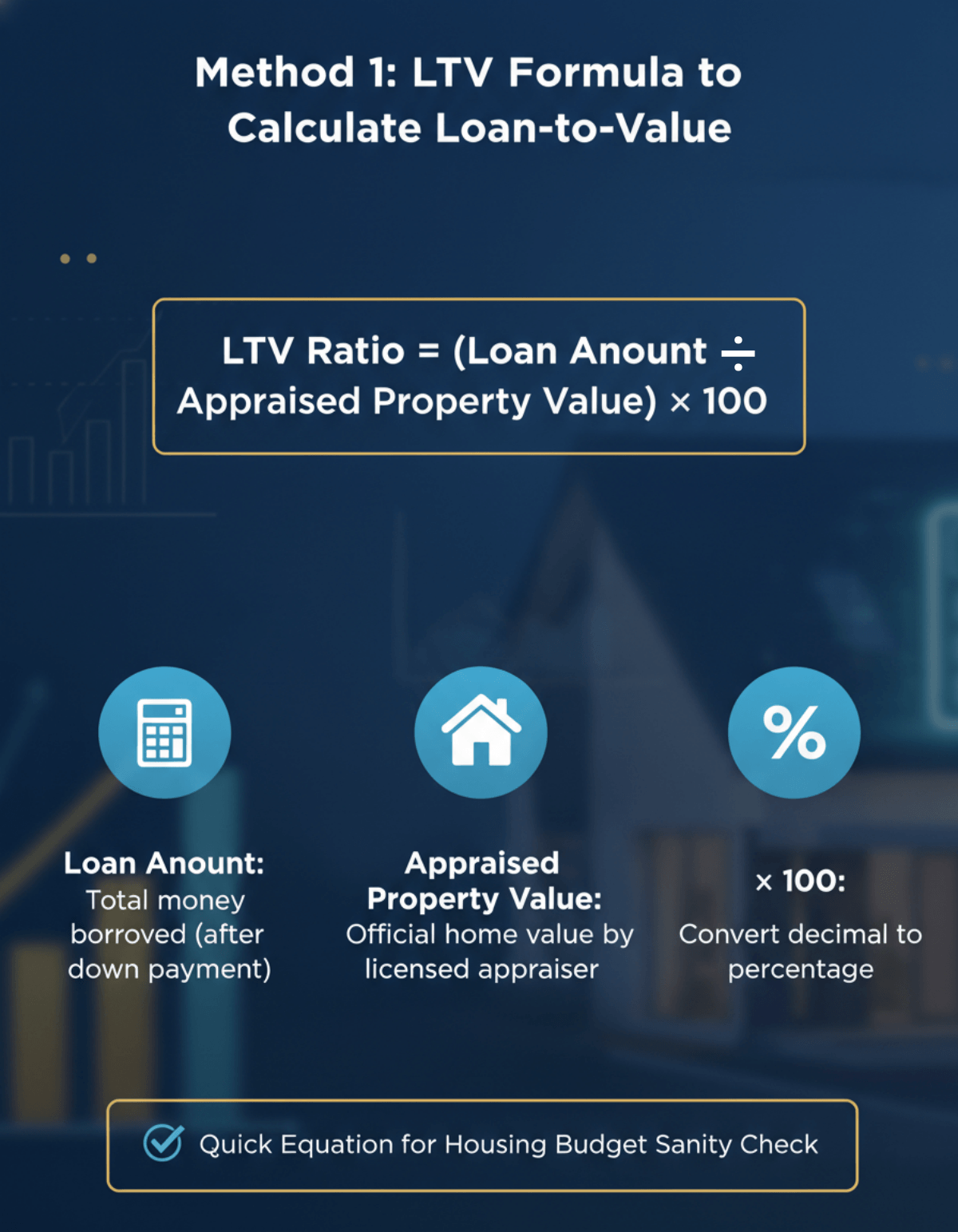
The universal LTV formula is: LTV Ratio = (Loan Amount ÷ Appraised Property Value) × 100.
Let's break down those variables. The "Loan Amount" is the total money you need to borrow after subtracting your down payment. The "Appraised Property Value" is what the home is officially worth, as determined by a licensed appraiser. To calculate, simply divide the mortgage amount by the property's value. Then, multiply that resulting decimal by 100 to get your percentage.
I always tell my clients to run this quick equation before we even start house hunting. It gives you a realistic baseline of your purchasing power. It is the most fundamental logic out there, perfect for buyers who want to grab a calculator and do a rapid sanity check on their housing budget.
Method 2: Use an Online LTV Calculator to Calculate LTV
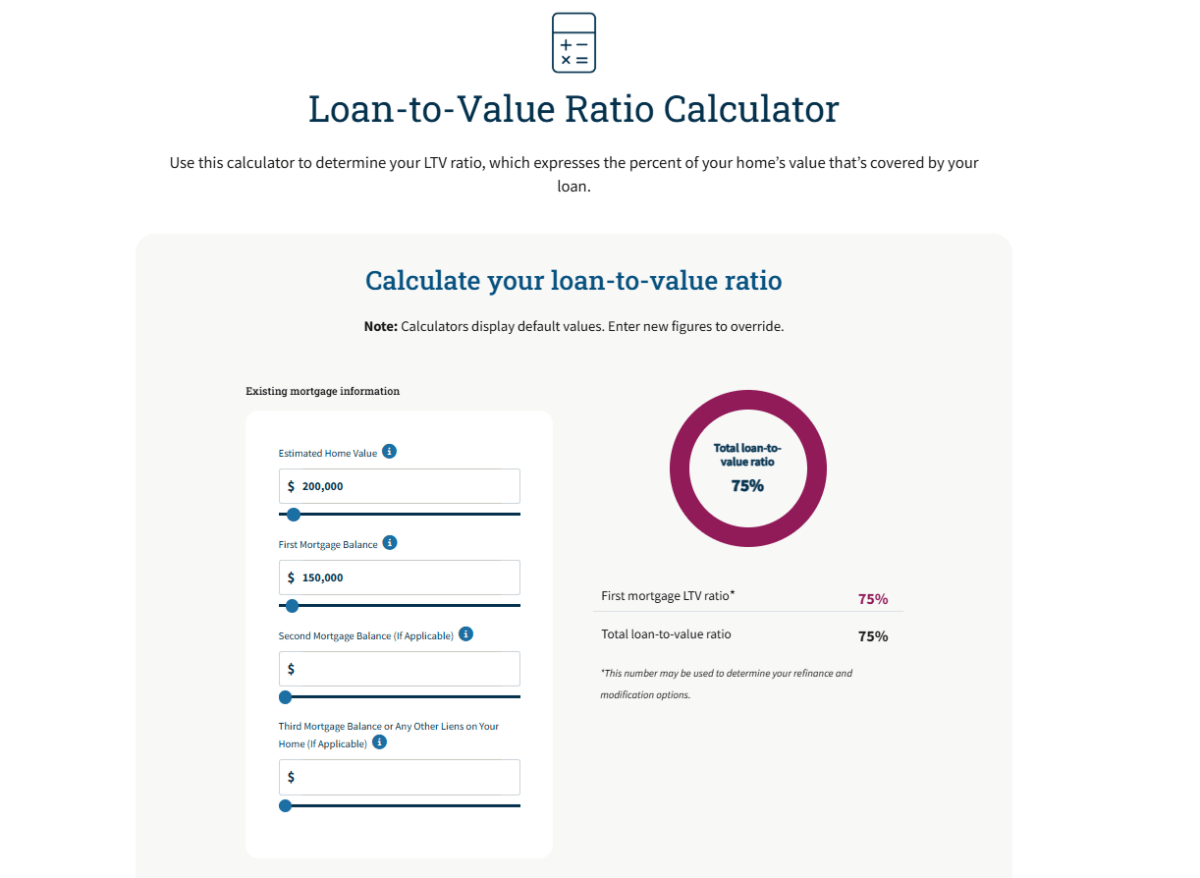
You don't have to do this math by hand. Plenty of solid calculators exist that handle it instantly. The Fannie Mae LTV Calculator is a favorite of mine because it comes straight from an authoritative government-sponsored enterprise, and the Bankrate LTV Calculator is another reliable option with interactive sliders that make it easy to test different down payment scenarios.
A common question I hear is which calculator is the "most accurate." Here's the honest answer: every legitimate LTV calculator uses the exact same formula, so the math itself doesn't vary from tool to tool. What actually determines accuracy is the number you plug in. If you enter your offer price instead of the appraised value, or round the figures, your result will be off no matter how polished the calculator looks. My advice is to stick with a calculator from a source you trust, and always update the inputs once your appraisal is in hand.
The real advantage of these tools is convenience. They're free, intuitive, and perfect for a fast estimate. Their limitation is that a basic calculator only spits out a raw percentage — it can't tell you whether an 85% LTV actually qualifies under a specific lender's current rulebook. That gap is where professionals need something more capable.
Method 3: Zeitro Strata to Calculate and Verify LTV Ratio
For Loan Officers and Brokers, landing on a raw percentage is only step one. The harder question is whether that number clears the hundreds of investor guidelines that change constantly. That's why I lean on Zeitro Strata, an AI-powered mortgage guideline assistant built to verify a scenario against real underwriting criteria, not just spit out a ratio.
Its DeepSearch feature cross-checks a given LTV against more than 1,000 guidelines spanning over 100 investors, covering everything from standard Conventional loans to trickier Non-QM products like DSCR and bank statement programs.
Every response comes back with a citation, so you can trace the answer directly to the source instead of taking an AI's word for it. You could ask something as specific as, "What's the max LTV for a DSCR loan with a 680 FICO?" in either English or Chinese, and if any part of the answer is confusing, the built-in "Explain" feature breaks it down further. The free Explorer tier gives you free queries a day at no cost, and full unlimited access runs just $8 a month.

LTV Calculation Example
Let's put the formula to work with a few real scenarios, since seeing the math applied tends to stick better than the formula alone.
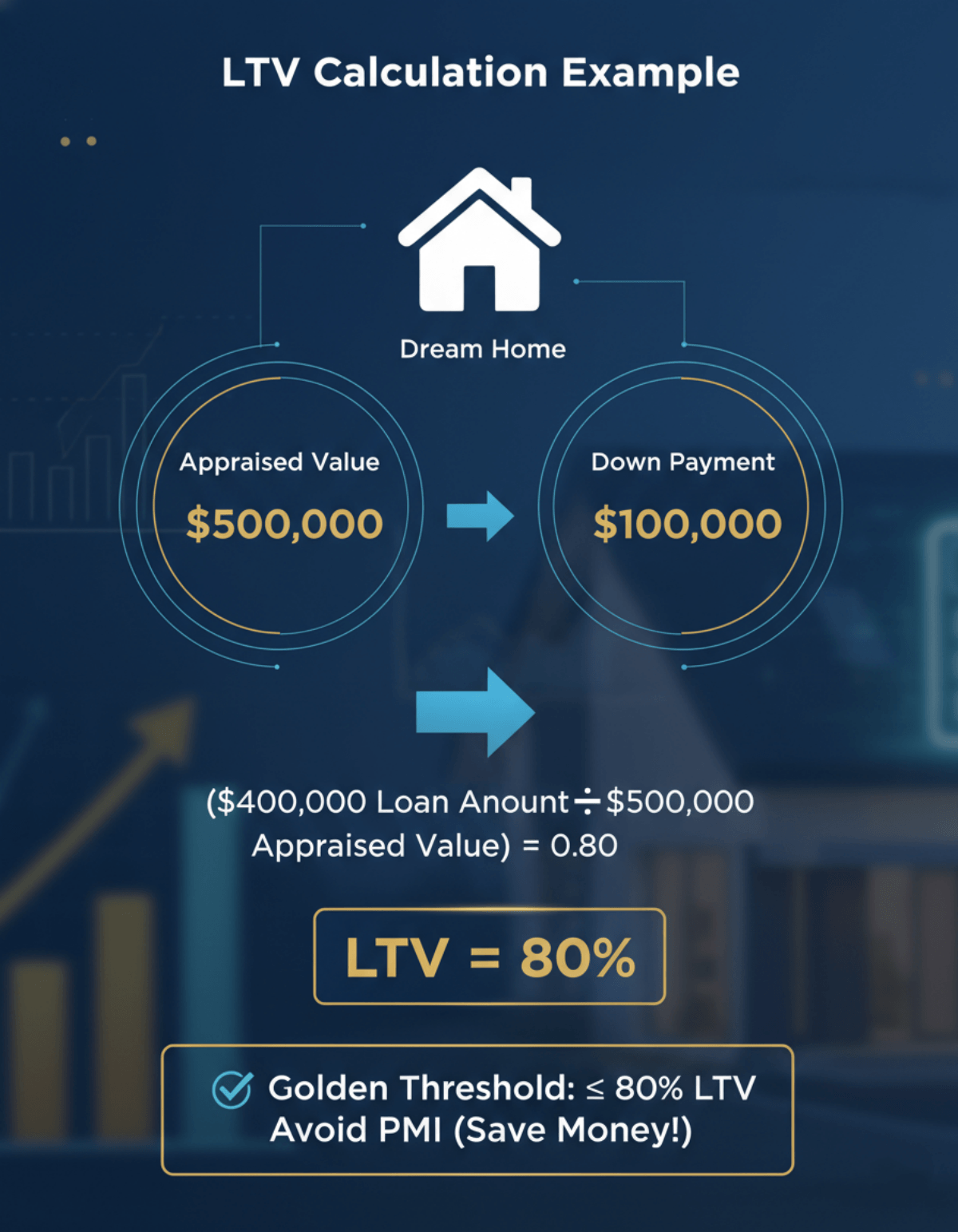
Example 1 — Standard purchase. Say your dream home appraises at $500,000, and you've saved a solid 20% down payment, or $100,000. That leaves $400,000 to borrow. Plug it into the formula: ($400,000 ÷ $500,000) = 0.80, multiplied by 100 gives you an LTV of exactly 80%. That 80% mark matters because it's the industry's unofficial line for avoiding Private Mortgage Insurance (PMI) altogether, which can save you hundreds of dollars every month.
Example 2 — Solving for the down payment. Suppose you want to buy a $400,000 home and you're targeting a 90% LTV. Since LTV represents the loan portion, your down payment needs to cover the remaining 10%, which comes to $40,000. Working backward from a target LTV like this is a handy trick when you know exactly what ratio you need to hit.
Example 3 — Solving for LTV from a down payment. Now flip it around: you're purchasing a $400,000 property and putting down $100,000. Your loan amount is $300,000, so your LTV is ($300,000 ÷ $400,000) × 100, which lands at 75%. Notice how a $100,000 down payment produces a lower LTV than the $40,000 example above — the bigger your down payment, the further your LTV drops.
LTV Reference Table: What Different Percentages Mean
Since so many buyers search for a specific number rather than the formula itself, here's a quick reference for what the most common LTV percentages actually represent in practice.
- 60–70%: Considered very low risk; often used for Non-QM and hard money underwriting caps
- 75–80%: The "golden zone" for Conventional loans; 80% or below generally avoids PMI
- 85%: Common ceiling for investment property purchases
- 90%: Standard cap for second-home purchases and reduced-down-payment FHA borrowers with credit under 580
- 95–97%: Conventional loans for qualified first-time or low-down-payment buyers
- 96.5%: Standard FHA maximum with a 580+ credit score
- 100%: Zero-down VA and USDA loans for eligible borrowers
Max LTV Requirements by Loan Types
Even when your math checks out, the loan still has to fit within industry limits, and those limits shift depending on the property's purpose. Here's a quick reference guide for maximum LTV allowances:
- Conventional Loans: Up to 97% for qualified first-time homebuyers who meet automated underwriting approval (like Desktop Underwriter) along with other eligibility criteria.
- FHA Loans: Up to 96.5% (3.5% minimum down payment) for buyers with credit scores of 580 or higher on homes priced at or below HUD limits. Scores under 580 cap out at 90%.
- VA and USDA Loans: Can reach a full 100%, meaning zero down payment, for eligible veterans or qualifying rural buyers.
- Non-QM Loans (such as DSCR or ITIN): Highly variable by investor, usually capped between 70% and 80%.
- Investment Property Purchases: Fannie Mae generally caps these at 85%, requiring at least 15% down, since rental properties carry more risk than a primary residence.
- Investment Property Cash-Out Refinances: Typically limited to 70–75% LTV, giving lenders a bigger equity cushion before releasing cash back to an investor.
- Second Home Purchases: Usually capped around 90%, with cash-out refinances on second homes falling closer to 75%.
Because Non-QM standards swing so widely between lenders like AAA Lending or AD Mortgage, LOs should use Zeitro Strata's customizable tags to instantly filter down to the exact guideline for a given investor rather than guessing.
One Exception Worth Knowing: FHA Streamline Refinances
Here's something that surprises a lot of homeowners: if you already have an FHA loan and qualify for an FHA Streamline Refinance, your lender typically doesn't order a new appraisal at all — which means there's effectively no LTV ceiling to calculate against. The new loan amount is based on your existing FHA balance rather than a fresh valuation of the home, so even homeowners with little equity or an underwater property can often still qualify. It's one of the few corners of the mortgage world where the LTV formula simply doesn't apply the way it does everywhere else.
Finding Your Optimal LTV, Not Just Your Lowest One
A lower LTV isn't automatically the smartest move for everyone. Before you dump every last dollar into a bigger down payment, it's worth weighing what that cash could do elsewhere. If skipping PMI by hitting 80% LTV saves you $150 a month, but draining your savings to get there leaves you without a cushion for repairs or an emergency, the lower LTV might cost you more peace of mind than it's worth. I generally tell clients to treat their target LTV as a balance between monthly savings, loan pricing, and how much liquidity they want to keep on hand — not just the smallest number they can technically reach.
FAQs About LTV Ratio Calculation
Q1. What is the difference between LTV and CLTV?
Standard LTV only accounts for your primary mortgage, while Combined Loan-to-Value (CLTV) adds in every other debt secured by the property, such as a HELOC or second mortgage. Lenders rely on CLTV when approving secondary financing, since it reflects the total amount borrowed against the home rather than just the first lien.
Q2. Does a higher LTV mean a higher mortgage rate?
Generally, yes. A higher percentage signals more risk to whoever is lending you the money. To offset that added exposure, lenders typically charge a higher interest rate and often require private mortgage insurance until your equity builds back up.
Q3. What is a good LTV ratio?
Landing at 80% or below is widely treated as the sweet spot in lending. Hitting that mark shows you've already built meaningful equity, which helps you sidestep costly mortgage insurance while unlocking more competitive rate offers.
Q4. What's the difference between PMI and LTV?
These two terms get mixed up constantly, but they're not the same thing. LTV is a ratio that measures risk — it's just math comparing your loan to the home's value. PMI, on the other hand, is an actual insurance product that your lender requires you to pay for once your LTV climbs above roughly 80% on a conventional loan. In short, your LTV is what determines whether you'll owe PMI in the first place, not the other way around.
Q5. Which online LTV calculator is most accurate?
Since every calculator runs the identical formula, accuracy comes down to the numbers you feed it rather than the tool itself. A calculator is only as reliable as the appraised value and loan amount you enter, so double-check those figures against your actual appraisal report rather than relying on an estimated home value.
Q6. Do I need to calculate LTV for an FHA Streamline Refinance?
Not usually. Since most FHA Streamline Refinances skip the appraisal entirely, there's no updated property value to calculate a new LTV against, and the program doesn't enforce a maximum LTV limit the way a standard refinance would.
Q7. Why do max LTV requirements change so often?
Limits shift because of broader economic conditions, the type of loan product involved (QM versus Non-QM), and each lender's internal risk appetite. Financial institutions routinely adjust their guidelines to protect their capital, especially when housing markets turn volatile.
Conclusion
Your Loan-to-Value ratio is far more than a homework problem — it's the foundation nearly every other number in your mortgage rests on. For everyday buyers, knowing this figure means you can budget realistically for your down payment and plan around potential insurance costs well before you make an offer. Free online calculators are more than enough to get you there.
If you're a mortgage professional, though, arithmetic alone won't cut it. Stop burning hours flipping through PDF guidelines to confirm whether a scenario actually qualifies. Sign up for the free Explorer tier on Zeitro Strata AI and let it verify complex scenarios instantly, so you can move faster and serve your clients with more confidence.
People Also Read
- Max DTI for Mortgage: Requirements By Loan Types
- How to Calculate DTI Ratio for Mortgage?
- AI Mortgage Underwriting Explained: Will You Be Replaced?
- What is Mortgage Eligibility Checker? Best Tool to Verify Guidelines
- Mortgage Guidelines: What Are They? How to Verify?
- [Tutorial] How to Estimate What Mortgage You Can Afford?

![[Tips for Loan Officers] How Can I Lower Borrower DTI?](https://cdn.prod.website-files.com/6731bc6e813a541b54c30b10/6aa3b89e281a639e7a5c6fca_lower-debt-to-income-ratio-banner.jpg)