Written by

Eric
Share this article

.svg)
Subscribe to updates
Last Checked and Updated on September, 2026
When I sit down with first-time homebuyers, they're usually overwhelmed by the alphabet soup of real estate terms. APR, DTI, PMI. It's exhausting. But there's one acronym you need to understand before applying for a mortgage: LTV, or Loan-to-Value ratio.
Here's why it matters so much: this single number shapes nearly every part of your loan. It affects whether you get approved, what rate you're offered, and whether you'll owe extra insurance on top of your monthly payment. Lenders lean on your LTV to gauge how risky your loan looks on paper. If this metric has ever confused you, let's walk through it together.
Key Takeaways
- Definition: LTV compares your mortgage amount to the property's value, expressed as a percentage.
- The 80% Rule: An LTV of 80% or lower is often called the "golden standard" because it typically lets you skip Private Mortgage Insurance (PMI).
- Risk Factor: A higher ratio signals more risk to lenders, which usually translates into a higher interest rate.
- It Shifts Over Time: Your ratio drops as you pay down principal, and it can drop further if your home gains value — though values can also flatten or fall.
LTV Meaning: What is Loan-to-Value in Mortgage?
Loan-to-Value is exactly what it sounds like: a percentage that compares the size of your loan against the home's actual value. I tell my clients to picture it as the bank's built-in risk gauge.
When a lender wires over hundreds of thousands of dollars, they want assurance that money is protected. Put down very little, and your LTV climbs — meaning the bank is shouldering most of the financial exposure. If the market dips and you fall behind on payments, a resale might not even cover what they lent you. A smaller loan relative to the home's value does the opposite: it shows the lender you have real skin in the game, which makes them far more comfortable extending the funds.

Why Your LTV Ratio Matters More Than You Think
That one percentage carries more weight than most borrowers expect, and it touches your wallet in three distinct ways.
- Loan approval. Every loan program sets a ceiling on LTV. Go above it, and a lender may decline you outright or ask for compensating factors — a stronger credit score, deeper cash reserves, or added fees.
- Mortgage insurance. Cross above 80% LTV on a conventional loan, and you'll almost certainly pay Private Mortgage Insurance. That's a real cost — often $100 to $300 a month depending on your loan size and credit — tacked onto your payment until you build enough equity.
- Interest rate. Lenders save their sharpest pricing for borrowers with lower ratios. Less risk on their end means a cheaper rate for you.
How to Calculate LTV Ratio?
The math here is refreshingly simple. Divide your loan amount by the property's value, then multiply by 100.
The LTV formula looks like this:
LTV Ratio = (Loan Amount ÷ Appraised Property Value) × 100
Here's a detail that trips up a lot of first-time buyers: lenders don't use the price you agreed to pay. They use the lesser of the purchase price or the appraised value.
Say you agree to pay $400,000 for a house, but the appraiser values it at $380,000. The bank runs its math on that lower $380,000 figure, not your contract price. This is exactly why a disappointing appraisal can throw an entire deal off track — it pushes your LTV higher than you planned for, sometimes overnight.

Example of LTV Ratio
Let's look at a realistic scenario so you can see how the math plays out in the real world.
Imagine you finally found the perfect house, and the accepted purchase price is $500,000. Thankfully, the home officially appraises for that exact same amount.
You've been saving up diligently and decide to put down $100,000, which is 20% of the purchase price. This means you need to borrow the remaining $400,000 from the bank.
Now, let's plug those numbers into our formula:
- Divide the loan amount ($400,000) by the property value ($500,000).
- $400,000 ÷ $500,000 = 0.80.
- Multiply by 100 to get the percentage.
Your LTV ratio is 80%. Because you hit that magic threshold, you'll secure a great interest rate and dodge monthly mortgage insurance entirely.
LTV Thresholds by Loan Type
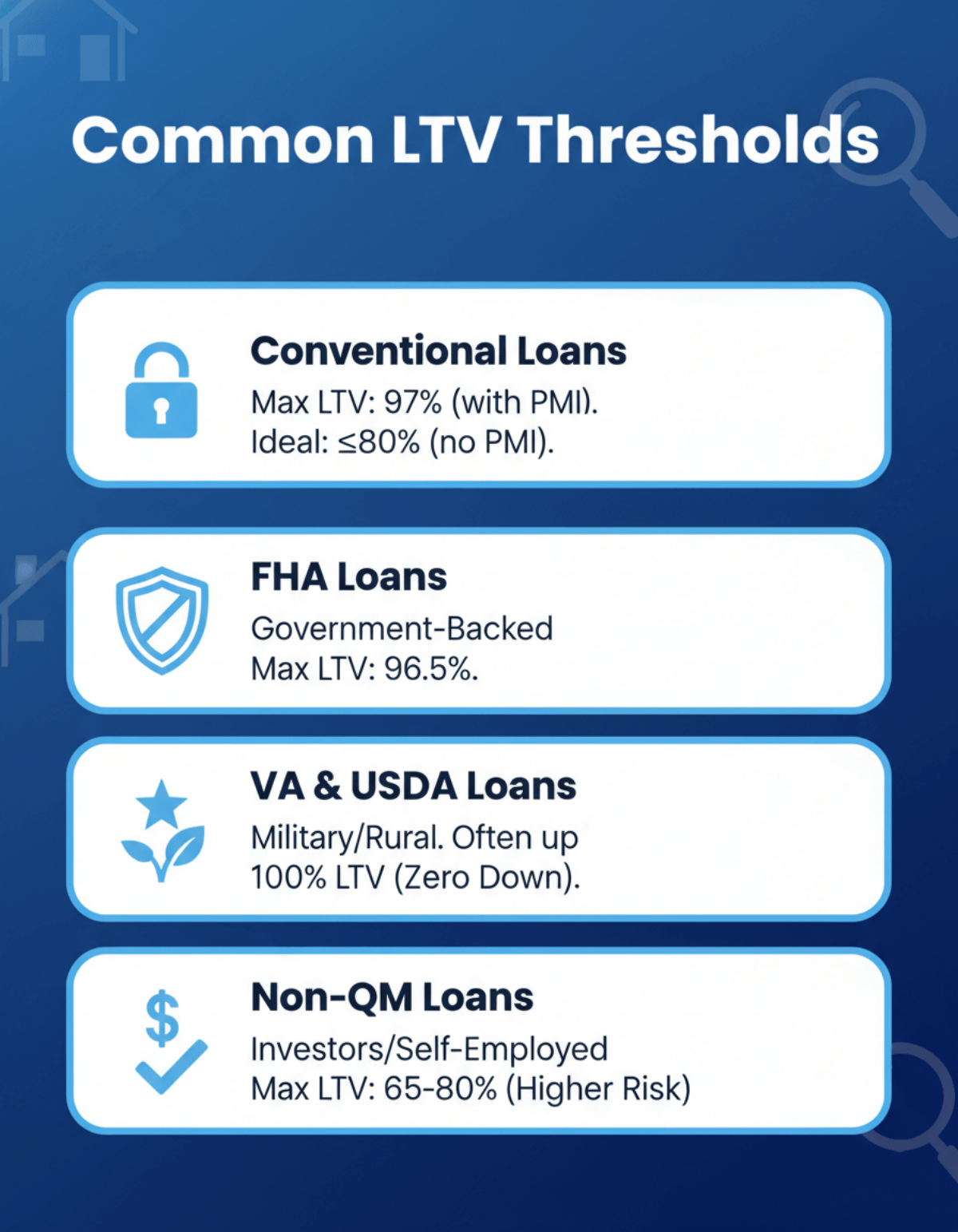
Every mortgage program sets its own boundaries. As a loan advisor, I look at these maximums daily. If you are shopping around for a mortgage right now, here are the standard caps you'll run into:
- Conventional Loans: The maximum LTV is generally 97% (a 3% down payment), but borrowers at that level almost always pay PMI. The ideal target is 80% or below, as this typically eliminates the need for mortgage insurance.
- FHA Loans: Backed by the government, these are great for first-time buyers and allow a maximum of 96.5% LTV.
- VA and USDA Loans: These specialized government programs are incredibly generous. If you qualify (based on military service or location in a designated rural area), they often allow up to 100% LTV, which typically means you can put down zero.
- Non‑QM Loans (Non‑Qualified Mortgages): These are alternative loans for real estate investors or self‑employed borrowers. Because they are inherently riskier, lenders typically cap LTV much lower than traditional loans, often in the range of about 65% to 80%, depending on the specific program and your credit profile.
Common LTV Percentages, Explained
Because "LTV" gets searched alongside almost every round number, here's a quick reference for what different percentages typically signal:
- 60% LTV: Considered very low risk. Common among cash-out refinance borrowers with substantial equity, or Non-QM investors targeting the most competitive pricing tier.
- 70–75% LTV: A frequent ceiling for investment-property cash-out refinances and many DSCR loan programs.
- 80% LTV: The benchmark for avoiding PMI on a conventional loan — the number most loan officers describe as the "sweet spot."
- 85% LTV: The standard ceiling for a conventional investment-property purchase.
- 90–95% LTV: Common territory for conventional loans with a smaller down payment; PMI applies, and pricing gets a bit more expensive as the ratio rises.
- 96.5% LTV: The FHA maximum, equal to a 3.5% down payment.
- 97% LTV: The conventional maximum for eligible first-time buyers, equal to 3% down.
- 100% LTV: Reserved for VA and USDA loans, where qualifying borrowers can finance the entire purchase price.
When Does LTV Affect Your PMI?
PMI is where LTV hits your monthly budget directly, and the rules around it trip up more borrowers than almost anything else in this article.
Once your loan balance reaches 80% of your home's original value, you can submit a written request to your servicer to cancel PMI. You don't have to wait around for it — federal law under the Homeowners Protection Act gives you that right as long as you're current on payments.
If you never bother to ask, your servicer is still required to automatically terminate PMI once your balance hits 78% of the original value — again, provided your payments are current. And even in the rare case where neither threshold gets hit on schedule, the law forces cancellation at the midpoint of your loan term (year 15 on a standard 30-year mortgage), no matter what your LTV looks like at that point.
One nuance that catches people off guard: these thresholds are based on your home's original value at closing, not today's market value. If you want PMI removed early because your home appreciated, you'll typically need to request a new appraisal rather than wait for automatic termination. Our guide to when PMI goes away walks through that process step by step.
Tips to Lower Your LTV
Whether you're buying or refinancing, nudging this ratio down is almost always worth the effort.
- Save a larger down payment. The most direct fix — every extra dollar you bring shrinks the loan amount.
- Shop below your max budget. Keep your savings steady and target a less expensive property, and your percentage improves on its own.
- Let equity build naturally. If you're refinancing, patience pays off as your local market appreciates and your balance shrinks.
- Challenge a disappointing appraisal. If a low valuation is blocking your refinance, a Reconsideration of Value (ROV) with stronger comparable sales can sometimes move the needle.
LTV vs. CLTV vs. TLTV vs. HCLTV: What's the Difference?
This is where most borrowers — and honestly, a few newer loan officers — start mixing up their acronyms.
- LTV only accounts for your primary mortgage. But add a second loan, like a Home Equity Line of Credit (HELOC), and the math needs to expand.
- CLTV (Combined Loan-to-Value) adds up every loan balance secured by the property — your first mortgage plus the drawn portion of any HELOC or second mortgage — divided by the home's value. Say you have a $300,000 first mortgage and you've drawn $50,000 on a HELOC against a $500,000 home. Your LTV is 60%, but your CLTV is 70%.
- TLTV (Total Loan-to-Value) is essentially the same concept as CLTV and the terms are often used interchangeably, particularly by Freddie Mac.
- HCLTV (Home Equity Combined LTV) — sometimes called HTLTV — goes a step further by counting your HELOC's full available credit limit, not just what you've actually drawn. Using the same example, if that HELOC has a $60,000 limit rather than a $50,000 balance, your HCLTV comes out to 72%. Lenders check this figure because it captures the worst-case scenario: what happens if you max out that credit line tomorrow.
Most HELOC and second-mortgage programs cap combined LTV somewhere between 80% and 90%, though the exact ceiling depends on your lender, credit profile, and whether the property is owner-occupied.
What Is an "LTV Target"?
This phrase gets searched often, and it means something slightly different from the "max LTV" we've covered so far.
An individual loan's max LTV is a hard ceiling set by a specific program — 97% for conventional, 96.5% for FHA, and so on. An LTV target, on the other hand, usually refers to a portfolio-level risk benchmark that a lender, investor, or servicer sets internally — the average LTV they're comfortable holding across an entire book of loans. A wholesale lender might aim for a portfolio target well below any single loan's maximum in order to manage overall risk exposure. As a borrower, this distinction mostly matters if you're working with an investor or private lender who talks about wanting to stay under a certain target rather than a hard regulatory cap.
A Quick Note on "LTV" Outside Real Estate
If you landed here from a search related to marketing or SaaS, you're likely thinking of a different LTV: Customer Lifetime Value, a completely separate metric measuring how much revenue a business expects from a customer over time. This article covers Loan-to-Value in the mortgage and real estate sense — same three letters, unrelated concept.
FAQs About LTV in Real Estate
Q1. What does 80% LTV mean?
It means you're borrowing 80% of the home's value and covering the remaining 20% yourself. This threshold matters because it's the point where conventional borrowers typically avoid paying PMI.
Q2. What is a good LTV?
Generally, 80% or lower is considered strong. Staying at or below that level keeps the lender's risk low, which usually earns you better pricing and lower long-term borrowing costs.
Q3. Is a 60% or 70% LTV good?
Yes — both are excellent. They signal substantial equity, which smooths out underwriting, unlocks the most competitive rates, and keeps you well clear of mortgage insurance requirements.
Q4. Is a high LTV good or bad?
It depends on context, but generally a high LTV is riskier for the lender and costlier for you. It often means a smaller down payment, a higher rate, and mandatory PMI. That said, a high LTV isn't automatically a bad decision — for many first-time buyers, it's simply the realistic path to homeownership sooner rather than later.
Q5. Is a 95% LTV bad?
Not at all. It's extremely common among first-time buyers using conventional or FHA financing. The tradeoff is a larger loan balance, which usually means a higher monthly payment and a PMI requirement until your equity grows.
Q6. What's the difference between PMI and LTV?
LTV is the ratio itself — a measurement of your loan size against your home's value. PMI is the insurance cost that kicks in because of that ratio, specifically when your LTV sits above 80% on a conventional loan. One is a metric; the other is a consequence of that metric.
Q7. Can your LTV ratio affect your mortgage interest rate?
Absolutely. Lenders price loans according to risk, and a lower ratio reads as lower risk. That typically translates into a more competitive rate and less interest paid over the life of the loan.
Q8. What's the maximum LTV for an investment property?
For a conventional purchase on a single-unit rental, most lenders cap financing at 85% LTV — a 15% down payment. Cash-out refinances on investment properties are more conservative, usually topping out around 70–75%.
Final Word
Your Loan-to-Value ratio isn't just banker jargon — it's a number that genuinely shapes your homebuying journey, from the rate you're offered to whether PMI shows up on your statement every month. Understanding how it works, and how it interacts with CLTV, PMI thresholds, and program-specific caps, can save you real money over the life of a loan.
Before you fall in love with a listing on Zillow, run your own numbers first. A free online mortgage calculator will show you how different down payments move your ratio. If you're a loan officer or broker who needs to verify LTV limits across dozens of investors and loan programs on the fly, Zeitro Strata AI cross-checks 100+ investors and 1,000+ guidelines in seconds, complete with citations back to the source — a lot faster than digging through PDFs. And if you're the borrower in this scenario, reach out to an experienced, licensed loan officer who can review your financial picture and help structure a loan around your actual goals.
People Also Read
- Max DTI for Mortgage: Requirements By Loan Types
- Mortgage Debt-to-Income Ratio Explained: Definition& Max DTI
- [Guide] How to Calculate DTI Ratio for Mortgage?
- 8 Best Non-QM Mortgage Lenders: Which to Choose?
- How to Determine Mortgage Eligibility? Verify Guidelines in Seconds

![[Tips for Loan Officers] How Can I Lower Borrower DTI?](https://cdn.prod.website-files.com/6731bc6e813a541b54c30b10/6aa3b89e281a639e7a5c6fca_lower-debt-to-income-ratio-banner.jpg)