Written by

Eric
Share this article

.svg)
Subscribe to updates
Last Checked and Updated on September, 2026
If you're a first-time homebuyer, or even a seasoned loan officer walking a client through their numbers, understanding Private Mortgage Insurance (PMI) matters more than most people expect. I still remember staring at my very first Loan Estimate years ago, genuinely confused about this extra line item nobody had warned me about.
Here's the short version: PMI is an added monthly cost when you put down less than 20%, but it's also the exact thing that lets many buyers stop renting years sooner than they would otherwise. In this guide, I'll walk through what the fee actually covers, what it typically costs in 2026, how to calculate it yourself, and the specific steps that get it removed for good.
Key Takeaways
- It protects the lender, not you. PMI shields the bank if you stop paying, not the other way around.
- Low down payments trigger it. Conventional loans require PMI once your down payment drops below 20%.
- It's temporary. Once you reach 20% equity, you can request cancellation.
- It cancels automatically, too. Federal law requires lenders to drop PMI automatically once your balance is first scheduled to hit 78% of the home's original value, as long as your payments are current.
What Does PMI Stand for in Real Estate?
PMI stands for Private Mortgage Insurance. When I bought my own first home, I assumed this policy protected me if I lost my job and couldn't keep up with payments. That's a common mix-up, and it's wrong. This coverage exists solely to protect the lender if you default on the loan.
Here's how it actually works: on a conventional loan, if your down payment lands below 20%, the lender views you as a higher-risk borrower, so they require this insurance as a condition of approval. FHA loans handle this differently, using a separate premium called MIP, and VA loans skip monthly mortgage insurance altogether in favor of a one-time funding fee. For conventional borrowers, the PMI premium gets folded directly into your monthly mortgage payment alongside principal, interest, and taxes. It can feel like a penalty at first, but without it, most buyers would need a far larger cash cushion just to qualify.
Is PMI the Same as Interest?
This trips up a lot of people, so it's worth clearing up directly: no, PMI is not interest, and it's not part of your principal balance either. It's a separate, third line item.
Your monthly mortgage payment is often described using the acronym PITI, which stands for Principal, Interest, Taxes, and Insurance. PMI falls under that final "I," alongside your homeowners insurance and property taxes, but it's tracked and billed separately from both. Unlike interest, PMI doesn't get calculated into your loan's APR in the same way, and unlike your principal payment, it does absolutely nothing to build equity in your home. Every dollar you send toward PMI is essentially a cost of admission for buying with a smaller down payment, not an investment in the house itself. That's exactly why lenders are legally required to remove it once you've built enough equity to no longer need it.

Types of PMI in Real Estate
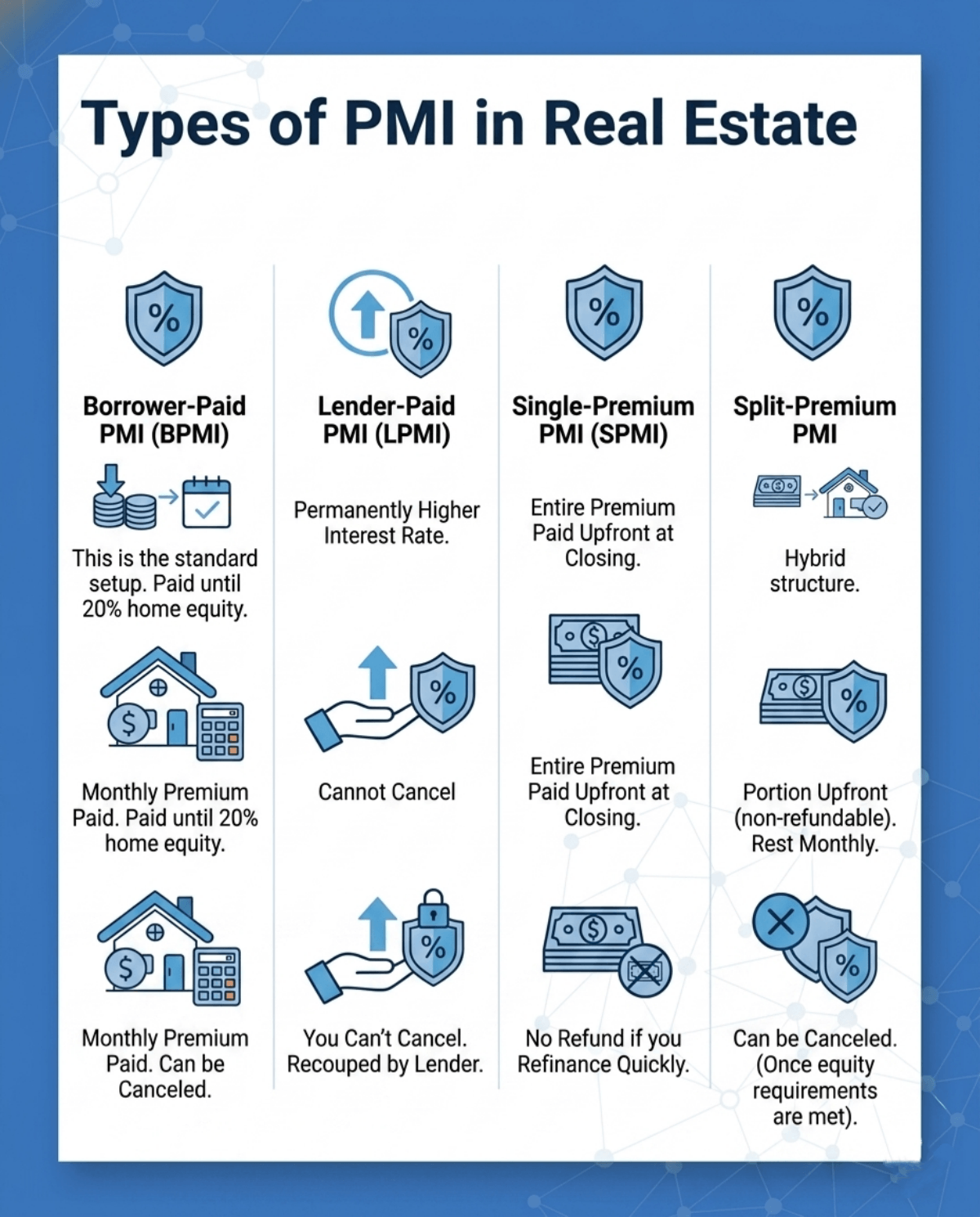
Most buyers assume there is only one way to handle this fee, but through my experience in the real estate market, I've seen four distinct structures. Knowing these can help you negotiate better terms:
- Borrower-Paid PMI (BPMI): This is the standard setup. You pay the premium monthly until you build enough home equity to cancel it.
- Lender-Paid PMI (LPMI): Your lender technically pays the premium upfront, but they recoup the cost by charging you a permanently higher interest rate. You can't cancel this later.
- Single-Premium PMI (SPMI): You pay the entire insurance bill upfront at closing. It lowers your monthly payment, but you won't get a refund if you refinance quickly.
- Split-Premium PMI: A hybrid where you pay a portion upfront at closing (non-refundable) and the rest monthly. It can be canceled like BPMI once equity requirements are met.
Average PMI Cost in 2026
Based on 2026 benchmarks from Freddie Mac, Bankrate, and Experian, you can generally expect annual PMI premiums to fall between 0.46% and 1.50% of your total loan amount. In dollar terms, Freddie Mac's own guidance puts that at roughly $30 to $70 per month for every $100,000 you borrow.
Your credit score is, by a wide margin, the single biggest factor in where you land on that scale, with your down payment size and loan term pulling second and third place. Here's a rough breakdown for a borrower putting 5% down on a conventional 30-year loan, based on typical rate cards from major mortgage insurers:
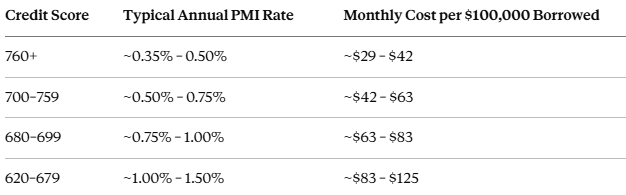
These are general industry ranges — your actual quote will depend on your specific lender, the mortgage insurer they use, and your full financial picture, so treat this table as a planning tool rather than a guarantee.
How to Calculate PMI in Mortgage?
To figure out your exact costs, you first need to understand your LTV (Loan-to-Value Ratio). This is simply the total loan amount divided by the property's appraised value.
Here is the general formula: (Total Loan Amount × Annual PMI Rate) ÷ 12 = Monthly Payment.
Let's look at a real-world Example:Imagine you are purchasing a $300,000 house in 2026. You put down 5% ($15,000), meaning you borrow $285,000.
If your lender assigns you an annual rate of 1%, the math looks like this: ($285,000 × 0.01) = $2,850 per year. $2,850 ÷ 12 = $237.50 per month.
Seeing the actual math helps my clients realize exactly how much non-equity-building cash leaves their pockets every month.
Also Try: Zeitro Private Mortgage Insurance (PMI) Calculator
How to Get PMI Removed?
Here's the good news: this insurance isn't permanent. Once your equity grows, you have several legal paths to get rid of it under the federal Homeowners Protection Act:
- Automatic Cancellation: By law, your lender must automatically drop coverage on the date your balance is first scheduled to reach 78% of the home's original value (the lower of the purchase price or the appraisal at origination), based on your original amortization schedule, provided you're current on payments.
- Request Cancellation: Once your balance reaches 80% of the home's current value, confirmed by a new appraisal, you can submit a written request to your servicer as long as your payments are current.
- New Appraisal: If your local market has heated up, your home may already be worth more than you paid. A fresh appraisal can prove your LTV has dropped below 80% through appreciation alone, potentially clearing the way for early removal.
- Refinance: Swapping into a new mortgage can wipe PMI out entirely, provided your new loan balance sits below 80% of the home's current value.
- Home Improvements: A finished basement, an added bedroom, or a renovated kitchen can boost your appraised value enough to push your equity percentage over the line early.

FAQs About PMI Mortgage
Q1. Is high PMI good or bad?
Technically, a high premium is a "bad" cost since it builds zero equity. That said, I'd encourage looking at the bigger picture: taking on this fee is often a smart trade-off that lets low-down-payment buyers get into the market and start building wealth years earlier than they otherwise could.
Q2. Is it better to put 20% down or pay PMI?
It really comes down to opportunity cost. If draining your savings to hit 20% down would leave you house-poor, or if that same cash could earn a better return elsewhere, paying the temporary premium is usually the smarter financial move.
Q3. How much is PMI on a $300,000 house?
With a 5% down payment and a typical 1% rate, expect roughly $237 a month. Your actual bill will shift depending on your credit score, your lender, and your overall loan-to-value ratio.
Q4. How long do you have to pay PMI for?
Most homeowners I work with carry this expense for somewhere between three and five years. You'll pay it until your balance drops to 80% of the home's original value, or until market appreciation pushes your equity there faster.
Q5. Is PMI tax-deductible in 2026?
Yes, with some limits. Congress reinstated this deduction starting with the 2026 tax year through the One Big Beautiful Bill Act, after it had expired back in 2021. If your adjusted gross income is under $100,000, you can generally deduct the full amount. Between roughly $100,000 and $109,000, the deduction phases out gradually, and above that range it disappears completely. It's worth running your specific numbers with a CPA, especially if you're a dual-income household near that threshold.
Q6. Does refinancing remove PMI?
Yes. If your home has appreciated meaningfully since you bought it, refinancing into a new mortgage can eliminate PMI immediately, as long as your new loan-to-value ratio comes in at 80% or below.
Q7. Does a VA loan have PMI?
No. VA loans skip monthly mortgage insurance entirely, regardless of your down payment. Instead, most VA borrowers pay a one-time VA Funding Fee at closing, which can be rolled into the loan balance. It's one of the few paths into homeownership that avoids an ongoing insurance line item altogether.
Final Word
Nobody enjoys an extra fee, but viewing Private Mortgage Insurance as a stepping stone rather than a penalty changes how it feels. It's the exact tool that let me, and plenty of clients I've worked with since, stop renting years ahead of schedule.
Before you start house hunting, sit down with a budget planner or an online mortgage calculator and get a realistic read on your numbers. And once you own the home, keep an eye on your local market. The moment your equity crosses that 20% line, reach out to your loan officer and get the cancellation process started so you can keep more of your paycheck.
People Also Read
- Max LTV: Check Maximum Loan-to-Value Ratios By Loan Types
- Ultimate Guide: How to Calculate LTV Ratio for Mortgage?
- Mortgage Debt-to-Income Ratio Explained: Definition& Max DTI
- Max DTI for Mortgage: Requirements By Loan Types
- Mortgage Rates Impact Affordability: The Lower, The Better
- [Tutorial] How to Estimate What Mortgage You Can Afford?

![[Tips for Loan Officers] How Can I Lower Borrower DTI?](https://cdn.prod.website-files.com/6731bc6e813a541b54c30b10/6aa3b89e281a639e7a5c6fca_lower-debt-to-income-ratio-banner.jpg)