Written by

Eric
Share this article


Subscribe to updates
Last Checked and Updated on September, 2026
When I bought my first house, I didn't understand why my monthly payment was higher than my lender's initial rate quote suggested. It took a phone call to figure out that my down payment fell just short of 20%, which meant I was on the hook for Private Mortgage Insurance. I ended up sitting down with a calculator to work out exactly what I was paying and why.
The good news? You don't need a finance background to run these numbers yourself. Here's the formula, broken down step by step.
Key Takeaways
- The core formula: Multiply your loan amount by your annual PMI rate, then divide by 12.
- Typical rates: Most borrowers pay between 0.46% and 1.50% a year, depending mainly on credit score and down payment.
- The finish line: PMI isn't permanent — you can remove it once you build enough equity, sometimes sooner than you'd expect.
What is Private Mortgage Insurance (PMI)?
Private Mortgage Insurance is a fee tacked onto conventional loans when your down payment is under 20%. Here's the part that catches people off guard: it protects the lender, not you. If you stop making payments, PMI is what makes the bank whole — you're simply the one footing the bill for that protection.
That's exactly why the 20% equity mark matters so much. Cross it, and you stop paying for a safety net that was never really yours to begin with. Think of PMI less as a punishment and more as the toll you pay for buying a home sooner rather than waiting years to save a full down payment.
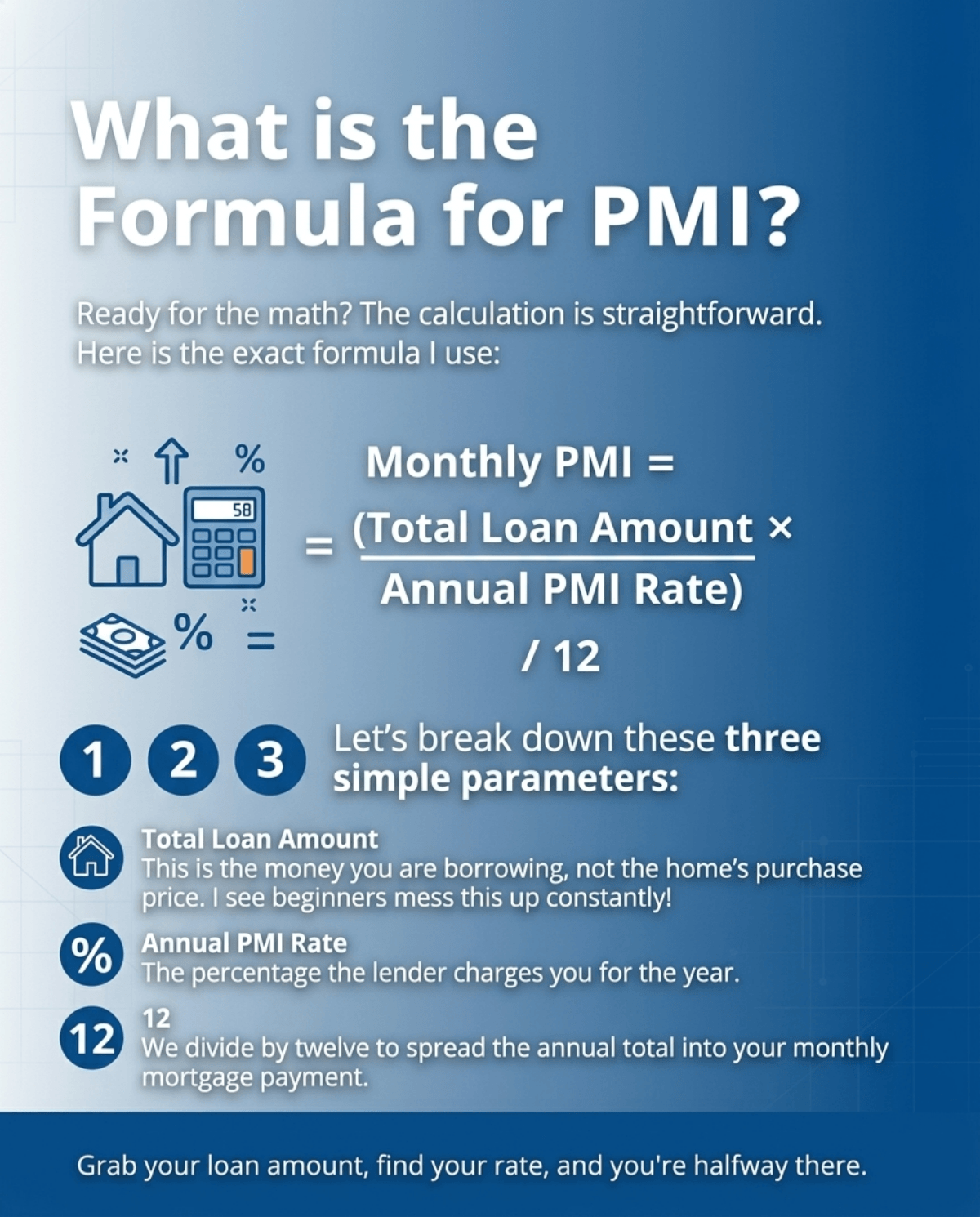
The Formula for Calculating PMI
Here's the math, in its simplest form:
Monthly PMI = (Loan Amount × Annual PMI Rate) ÷ 12
Three pieces make up this equation:
- Loan Amount: The amount you're borrowing — not your home's purchase price. Mixing these two up is the single most common mistake I see first-time buyers make.
- Annual PMI Rate: The yearly percentage your insurer charges, expressed as a number like 0.5% or 1%.
- 12: The divisor that spreads your annual premium across monthly payments.
Once you have those two inputs, the rest is basic arithmetic.
How to Find Your PMI Rate
Your PMI rate isn't a single fixed figure — it's assigned based on your specific financial profile. Here's where to track it down:
- Your Loan Estimate: This is the most reliable number you'll get, since lenders are legally required to disclose it before closing.
- National averages: As a rough starting point, rates generally land between 0.46% and 1.50% annually. When I'm doing quick napkin math, I usually plug in 0.5% or 1% as a conservative placeholder.
- A loan officer: A quick conversation with a mortgage professional will give you a number tailored to your actual credit and loan details, rather than a national average.
PMI Rates by Credit Score
Your credit score is the single biggest factor behind your rate, so here's what that typically looks like in practice:
- 760+: Around 0.46%
- 720–759: 0.50%–0.75%
- 680–719: 0.75%–1.00%
- 640–679: 1.00%–1.25%
- 620–639: Up to 1.50%
These figures come from national housing finance data and represent broad averages — your own quote will depend on your lender, your loan program, and your down payment size. Still, the pattern is consistent across the industry: every 40-point jump in your credit score tends to shave a noticeable chunk off your annual rate. If you're a few months out from applying, spending that time paying down credit card balances can genuinely move you into a cheaper bracket.
PMI Calculation Examples
Let's run a couple of real scenarios so you can see the formula in action.
Example 1: Say you take out a $300,000 loan and land a 0.5% rate thanks to a strong credit history.
- $300,000 × 0.005 = $1,500 per year
- $1,500 ÷ 12 = $125 per month
Example 2: Now picture a $500,000 loan with a steeper 1.0% rate.
- $500,000 × 0.01 = $5,000 per year
- $5,000 ÷ 12 = $416.67 per month
Notice the pattern? A higher rate on a larger loan compounds fast, which is exactly why shopping around for a better rate — or improving your credit before you apply — pays off in real dollars.
Also Try: Zeitro's Private Mortgage Insurance (PMI) Calculator
What Affects Your PMI Rate
Two borrowers with identical loan amounts can end up with very different premiums. Here's what lenders weigh when setting your rate:
- Credit Score: This is the biggest lever you control. A score above 760 typically unlocks the lowest premiums on the market.
- Down Payment and LTV Ratio: Putting down 15% signals far less risk than the bare 3% minimum, which translates directly into a lower rate.
- Loan Term: Thirty-year terms carry more long-run risk for lenders than fifteen-year terms, occasionally nudging your premium upward.
- DTI Ratio: If a large share of your income already goes toward existing debt, insurers may price that risk into your rate.
How to Reduce or Remove PMI
PMI has an expiration date built into federal law — you just need to know how to reach it. Here are four legitimate paths off the hook:
- Automatic termination at 78% LTV: Once your loan balance is scheduled to hit 78% of your home's original value — meaning your purchase price or appraised value at closing, whichever was lower — your lender is legally required to drop PMI, as long as you're current on payments. This happens automatically; you don't need to lift a finger.
- Borrower-requested cancellation at 80% LTV: You don't have to wait for the automatic date. Once your balance reaches 80% of that same original value, you can submit a written request to your servicer and often get PMI removed weeks ahead of schedule.
- Final termination at the loan's midpoint: Here's a rule most articles skip entirely — even if you haven't reached 78% LTV yet, federal law requires your lender to cancel PMI once you hit the halfway point of your loan term (year 15 on a 30-year mortgage), provided you're current on payments.
- A fresh appraisal or a refinance: If home values in your area have jumped, a new appraisal can prove you've crossed the 20% equity line early, based on current value rather than original value. Alternatively, if rates have dropped since you closed, refinancing into a new loan under 80% LTV wipes out PMI entirely — though it's only worth it once you run the numbers on closing costs versus savings.
Boosting your credit score before you even buy is the quietest way to win here: it won't remove PMI once it's in place, but it can land you a meaningfully cheaper rate from day one.

FAQs About Calculating PMI
Q1. Is PMI calculated on the purchase price or the loan amount?
Always the loan amount. If you buy a $400,000 house with $20,000 down, your PMI is based on the $380,000 you're actually borrowing, not the sale price.
Q2. Does PMI shrink as I pay down my mortgage?
Not usually. On most borrower-paid PMI policies, your monthly premium stays fixed to the original loan amount until you hit a cancellation or termination milestone — it doesn't quietly decrease month by month the way your principal balance does.
Q3. Do FHA loans charge PMI?
Not technically. FHA loans use a separate system called Mortgage Insurance Premium (MIP): a 1.75% upfront charge plus an ongoing annual premium, most commonly around 0.55% depending on your loan size and down payment. The bigger difference is timing — put down 10% or more and MIP drops off after 11 years, but below that threshold, it typically sticks around for the entire loan term unless you refinance into a conventional mortgage.
Q4. Should I still calculate PMI manually if calculators exist?
It's worth doing at least once. Online tools are faster, but running the math yourself builds a real feel for how your credit score, down payment, and loan size interact — knowledge that pays off the next time you're comparing loan offers.
Q5. Is PMI tax-deductible?
Starting with the 2026 tax year, yes — under the One Big Beautiful Bill Act signed in 2025, PMI is now treated as deductible mortgage interest. The deduction phases out gradually for adjusted gross income roughly between $100,000 and $109,000–$110,000, so higher earners may see a reduced benefit rather than losing it outright. Keep in mind this applies to income earned in 2026, meaning you'll claim it on the return you file in 2027, not on this year's taxes. Talk to a tax professional about how the phase-out applies to your specific income.
Conclusion
Calculating PMI really does boil down to one formula and a handful of variables — nothing about it requires a finance degree. The part that takes a bit more digging is nailing down your exact rate, but between your Loan Estimate and the credit-score ranges above, you should have a solid estimate in minutes.
My own advice, from having gone through this myself: build your credit score before you shop for a mortgage, and know your PMI removal dates the moment you close. Those two habits alone can save you thousands over the life of a loan. When you're ready to see your real numbers, reach out to a loan officer for an official Loan Estimate, or run your scenario through Zeitro's calculator above.
People Also Read
- Max LTV: Check Maximum Loan-to-Value Ratios By Loan Types
- Max DTI for Mortgage: Requirements By Loan Types
- [Guide] How to Calculate DTI Ratio for Mortgage?
- Mortgage Application Form 1003 (URLA): Everything You Need to Know
- Mortgage Rates Impact Affordability: The Lower, The Better