Written by

Eric
Share this article

.svg)
Subscribe to updates
Last checked and updated on August, 2026.
Buying a home is exciting, but let's be honest: paperwork can kill that excitement fast. I still remember staring at my very first Form 1003, completely lost in the acronyms and endless boxes.
Here's the good news: it's nowhere near as intimidating as it looks. The 1003 form, also called the URLA, is really just a structured way to tell your financial story. In this guide, I'll walk you through exactly what this document is, what's inside it, and how to get through it without losing your mind.
Key Takeaways
- The Foundation: Form 1003, officially the Uniform Residential Loan Application (URLA), is the standardized application nearly every U.S. residential lender uses to collect a borrower's personal, financial, and property information.
- The Purpose: Lenders use it to evaluate your financial health, determine loan eligibility, and calculate your debt-to-income (DTI) ratio.
- The Structure: The form spans nine numbered sections across two main components: a Borrower Information form you fill out and a Lender Loan Information form your lender completes.
- Accuracy Is Everything: Nearly every figure you enter has to match your supporting documents. Guessing, rounding, or leaving out a debt can delay closing or sink your approval entirely.
What is the 1003 Form? Uniform Residential Loan Application (URLA)
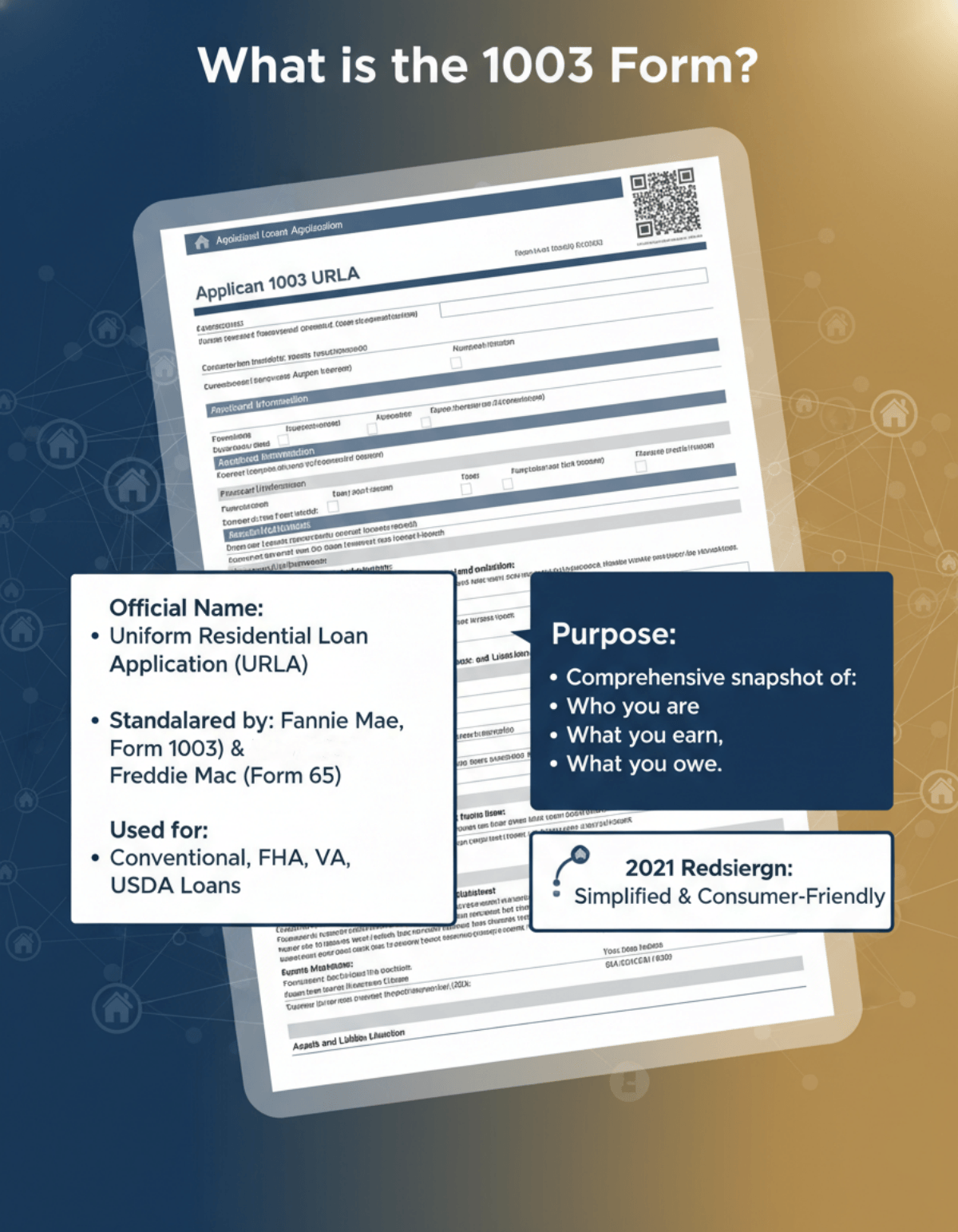
If you are applying for a home loan in the United States, you will cross paths with this document. Form 1003 is officially called the Uniform Residential Loan Application (URLA).
Created and standardized by government-sponsored enterprises (GSEs) Fannie Mae (who calls it Form 1003) and Freddie Mac (who refers to it as Form 65), it's the universal language of the mortgage industry. Whether you are applying for a Conventional, FHA, VA, or USDA loan, your lender will typically use this same standard application template as the starting point.
Back in 2021, when the redesigned URLA became the standard, with a mandatory effective date in early 2021, Fannie Mae and Freddie Mac modernized the layout, enlarged the fonts, and removed a lot of confusing jargon to make it more consumer‑friendly. Think of it as a comprehensive snapshot of who you are, what you earn, and what you owe.Form 1003, officially known as the Uniform Residential Loan Application (URLA), is the standardized form that Fannie Mae and Freddie Mac require nearly all U.S. mortgage lenders to use when they collect a borrower's personal, financial, and property information.
Fannie Mae calls it Form 1003. Freddie Mac calls the identical document Form 65. Whether you're going for a Conventional, FHA, VA, or USDA loan, your lender will almost always start with this same standard template.
The form got a major facelift in 2021, when the redesigned URLA became mandatory for all new loan applications sold to the two agencies. The goal was simple: bigger fonts, cleaner layout, less jargon, and a format that actually makes sense to a first-time borrower instead of just a loan processor. Since then, the biggest change has been on the compliance side rather than the form's design — in November 2024, the agencies revised the official URLA instructions to sharpen guidance around a couple of asset and declaration questions, and to clarify how a related consumer information form should be used.
Think of the URLA as a financial snapshot: who you are, what you earn, what you own, and what you owe, all in one standardized package.
The URLA Isn't Just One Document
Something a lot of borrowers don't realize: the URLA is actually built from two core components, plus a few optional add-ons depending on your situation.
- Borrower Information Form — this is the piece you fill out. It covers your personal details, income, assets, debts, and declarations.
- Lender Loan Information Form — your loan officer or processor completes this part. It documents the property, the loan terms, and transaction details.
Depending on your circumstances, you might also encounter:
- Additional Borrower Form, used when you're applying with a co-borrower.
- Unmarried Addendum, which a lender may use when a borrower selects "Unmarried" as their marital status and lives in (or is buying property in) a state that recognizes civil unions or domestic partnerships. It simply helps confirm whether anyone besides your legal spouse might hold property rights that could affect the title.
- Continuation Sheet, a blank page for extra information when a section runs out of room.
None of these extra pieces apply to every borrower. Most people applying solo, with a standard marital status, will only ever see the core Borrower Information form.
What is Form 1003 Used For?
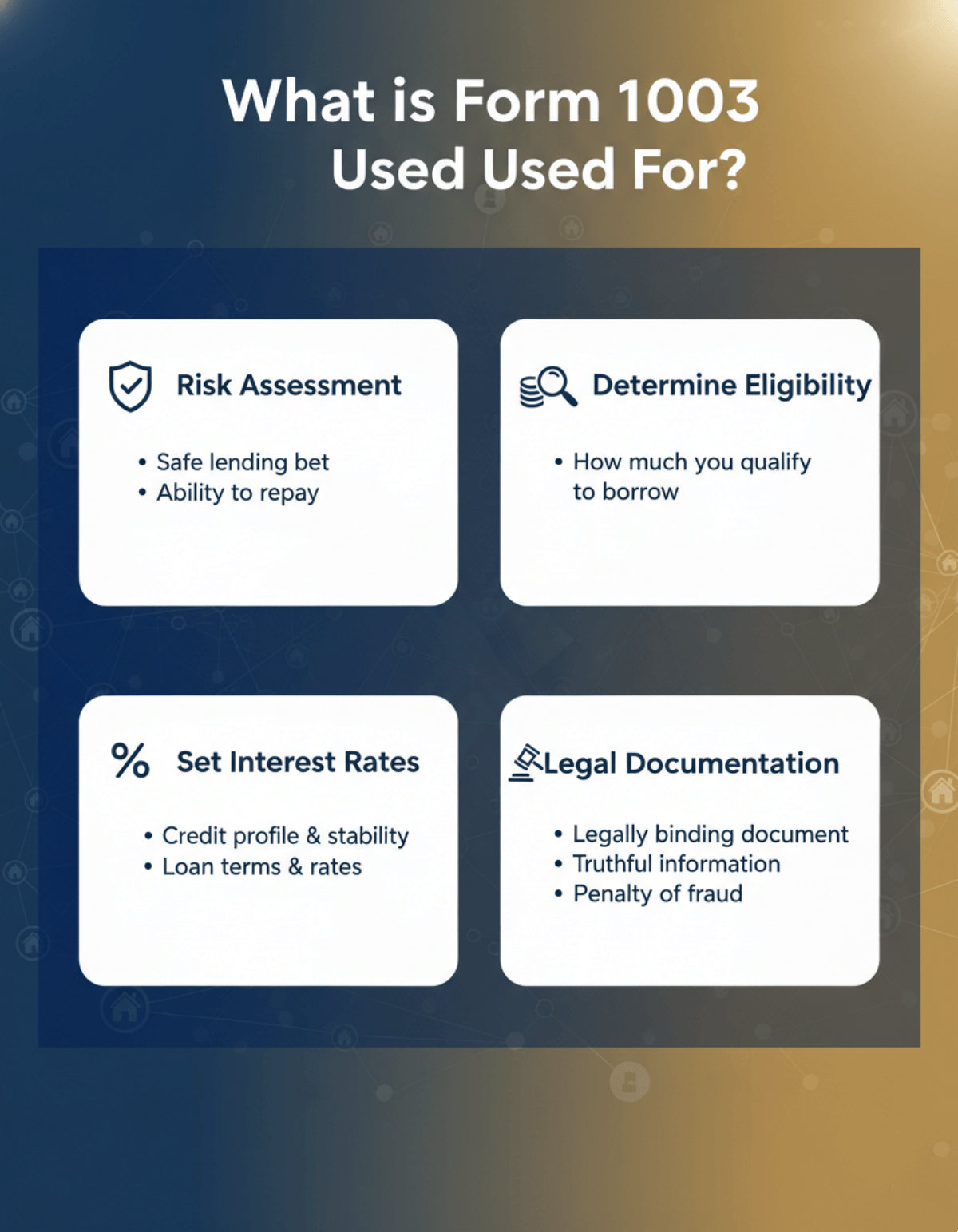
You might wonder why lenders need such a detailed breakdown of your life. Ultimately, the 1003 form serves a few critical purposes behind the scenes:
- Risk Assessment: Lenders need to know if lending you hundreds of thousands of dollars is a safe bet. This form highlights your ability to repay.
- Determine Eligibility: The data directly dictates how much money you actually qualify to borrow.
- Set Interest Rates: Your credit profile and financial stability, as outlined here, help underwriters decide your specific loan terms and interest rates.
- Legal Documentation: This isn't just a casual worksheet. It acts as a legally binding document. Signing it means you swear the information is truthful under penalty of fraud.
How Does the 1003 Form Work?
The URLA isn't just something you fill out once and forget. It travels with you throughout the entire homebuying journey. Here is how the typical process flows:
- Initiation: You'll complete the initial draft either online or sitting down with your loan officer. It gives them the baseline data to issue a pre-approval.
- Verification: Once you submit the form, your lender pulls your credit report. They will ask you for supporting documents, like pay stubs, to prove every claim made on the application.
- Underwriting: A human underwriter, or an automated system, reviews the verified 1003 alongside your credit history to make the final approval decision.
- Closing: At the closing table, you will see this form one last time. You'll be asked to sign the final, updated version to confirm your financial situation hasn't drastically changed since you first applied.
The 9 Sections of Form 1003 (2021 Redesign): A Full Breakdown
The redesigned Borrower Information form is organized into nine numbered sections. Having reviewed more of these files than I can count, I can tell you the new layout genuinely makes things easier to follow, once you know what belongs where. Here's the full breakdown.
Also Read: Tutorial: How to Generate a 1003 Form in 3 Ways?
Section 1: Borrower Information
This is the "get to know you" section. You'll provide your legal name, Social Security number, date of birth, and contact details. It goes deeper than the basics, too: you'll generally need to document your housing history and employment/income history for the past two full years, explaining any meaningful gaps along the way.
If your work history has a hole in it, don't panic. A short written explanation is usually all it takes, and lenders see this far more often than you'd think.
Section 2: Financial Information — Assets and Liabilities
This is where the numbers start piling up. Assets cover the cash and cash-equivalents you can draw on for your down payment and closing costs: checking and savings balances, retirement accounts, stock holdings, and similar. Liabilities cover your active debts, like credit card balances, auto loans, student loans, and child support obligations.
Lenders weigh your gross income against these monthly obligations to calculate your debt-to-income (DTI) ratio, which in my experience is often the single number that makes or breaks an approval. Precision matters here, especially with student loans right now. Federal data from early 2026 shows millions of borrowers falling behind on student debt after collections resumed, so if that applies to you, list the correct current balance and monthly payment rather than an outdated figure from before repayment restarted.
Section 3: Financial Information — Real Estate
If you're a first-time buyer, you get to skip this section entirely. If you already own a home, a rental property, or a vacation place, it all goes here. You'll list each property's current estimated value along with any mortgage balances tied to it.
Lenders use this to understand your existing equity and ongoing obligations, including taxes, insurance, and HOA dues. Keep your most recent mortgage statements handy so you can enter exact principal balances instead of rough estimates.
Section 4: Loan and Property Information
This section is easy to overlook, but it shapes how your loan gets priced and underwritten. It covers your loan purpose (purchase, refinance, or cash-out refinance), the type of property you're buying, and whether it's a manufactured home or a mixed-use property, meaning you plan to run a business like a daycare or salon out of part of it.
It also captures any gift funds or grants you're receiving toward your down payment or closing costs. If a family member is helping you out financially, this is where that gets documented, along with a gift letter your lender will likely request separately.
Section 5: Declarations
This section feels like a legal polygraph. It's a series of yes-or-no questions about your intentions and your financial past. Will you occupy the property, or is it an investment? Have you had a foreclosure or filed for bankruptcy in the last seven years? Are you currently a party to a lawsuit?
One question worth calling out specifically: are you currently delinquent or in default on any federal debt? This one matters more than it used to. With federal student loan delinquencies climbing sharply since collections resumed in 2025, more borrowers than in past years are running into this question honestly for the first time. If it applies to you, answer truthfully. A defaulted federal debt can affect your eligibility for certain loan programs, and your loan officer needs to know early so they can walk you through your options rather than discovering it later in underwriting.
Honesty really is the only workable strategy here. Background checks and credit pulls will surface a financial hiccup eventually, so trying to hide one rarely ends well. If your history is complicated, ask your loan officer about writing a letter of explanation.
Section 6: Acknowledgements and Agreements
This is where you formally sign off. By signing, you're certifying that everything on the application is accurate, authorizing your lender to verify the information, and agreeing that your loan terms could change if anything you disclosed turns out to be inaccurate. It's short, but it carries real legal weight, since it's the section that turns the rest of the form from a questionnaire into a binding statement.
Section 7: Military Service
This section simply asks whether you (or a deceased spouse) have ever served, or are currently serving, in the U.S. Armed Forces. It's a quick set of questions, but it matters: your answers here can open the door to VA loan eligibility and other benefits reserved for veterans and active-duty service members.
Section 8: Demographic Information
Federal fair-lending law requires lenders to ask about race, ethnicity, and sex for most mortgage applications, largely so regulators can monitor lending patterns and guard against discrimination. You're allowed to decline to answer, and doing so has zero effect on your approval odds. If you're filling out the form in person with a loan officer instead of online, they're required to note this information based on visual observation when you choose not to provide it, which is simply part of the compliance process rather than anything unusual.
Section 9: Loan Originator Information
The final section records who's handling your loan: the originating company's NMLS ID and the individual loan officer's NMLS number and state license, if applicable. This is your paper trail. If you ever want to verify that your loan officer is properly licensed, this section (plus a quick search on the NMLS Consumer Access website) is where you'd start.
1003 vs. Other Mortgage Forms: What's the Difference?
Once you start digging into mortgage paperwork, you'll bump into other numbered forms that sound similar but do completely different jobs. Here's a quick way to keep them straight:
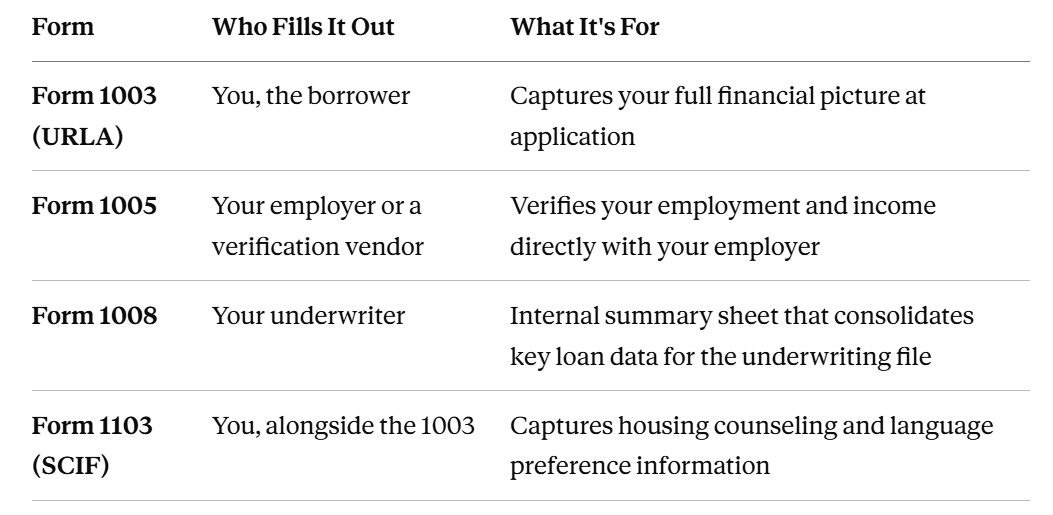
That last one, Form 1103, is worth a closer look since it's relatively new to a lot of borrowers.
The Supplemental Consumer Information Form (SCIF/Form 1103)
Since March 2023, lenders selling conventional loans to Fannie Mae or Freddie Mac have been required to use the Supplemental Consumer Information Form alongside the standard 1003. It asks about homeownership education you've completed, any housing counseling you've received, and your preferred language for communicating about the loan.
It's a short form, but it's not just paperwork for paperwork's sake. It's also available in Spanish, Vietnamese, Korean, Tagalog, and Traditional Chinese, which helps lenders better support borrowers who are more comfortable communicating in a language other than English.
Document Checklist: What You'll Need to Complete Form 1003
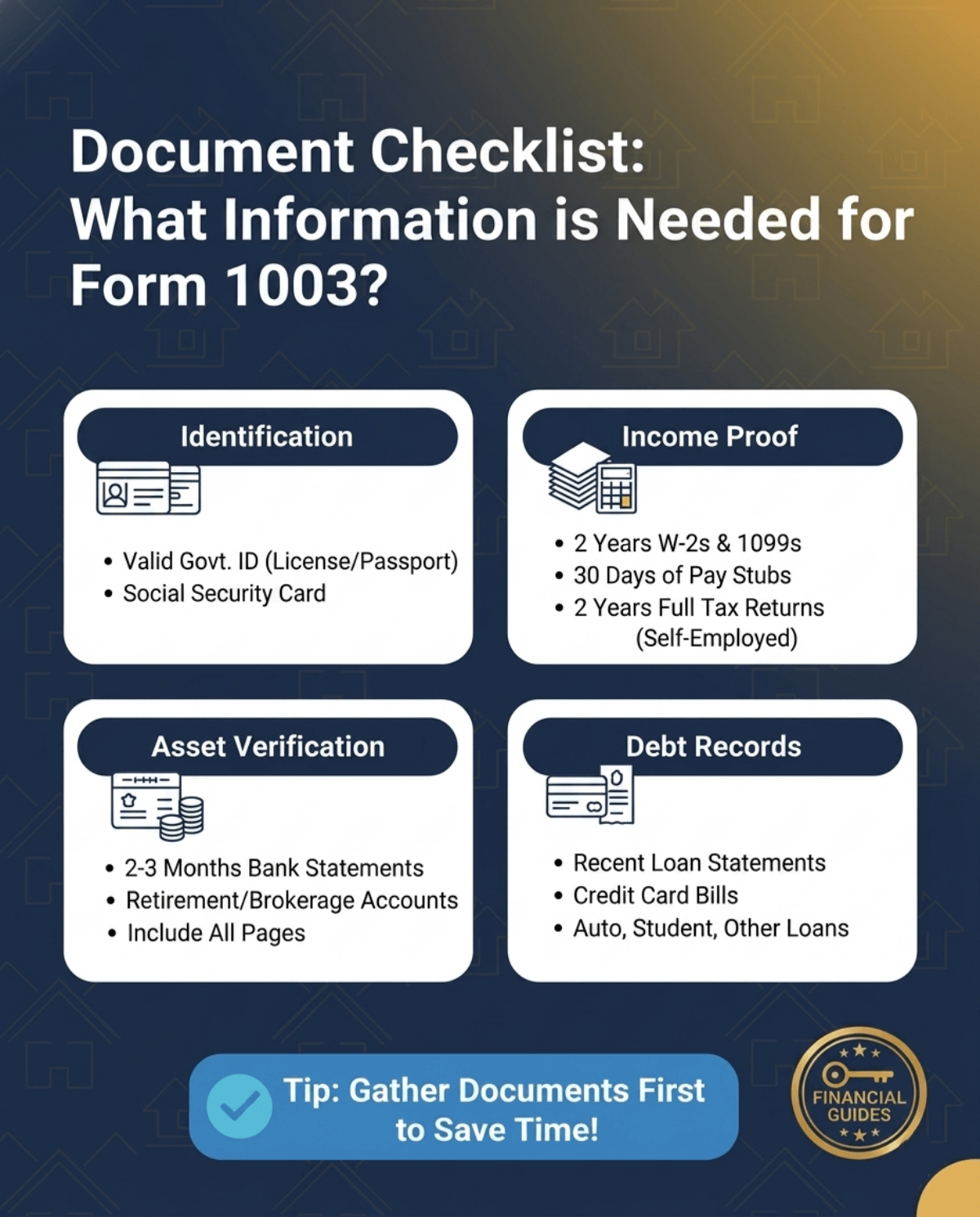
The application itself asks for a lot, but gathering your paperwork beforehand turns this from a stressful scramble into a straightforward task. Build a folder with the following before you sit down:
- Identification: A valid government-issued ID (driver's license or passport) and your Social Security card.
- Income Proof: W-2s and 1099s from the past two years, plus your most recent 30 days of pay stubs. Self-employed applicants should expect to provide two full years of tax returns.
- Asset Verification: Two to three months of statements for every bank, retirement, and brokerage account you're using to qualify. Include every page, even the blank ones.
- Debt Records: Recent statements for auto loans, student loans, and credit cards.
Having these ready in advance will save you hours of back-and-forth and keep your 1003 accurate from the start.
Common Mistakes to Avoid on Your 1003
After reviewing plenty of these applications, a few errors show up again and again. Watch out for these:
- Rounding or estimating numbers. Lenders cross-check everything against statements. A guessed figure that doesn't match creates unnecessary delays.
- Leaving out a debt because it feels minor. Small balances still count toward your DTI, and an undisclosed liability that surfaces later in underwriting looks worse than one you reported upfront.
- Skipping the explanation for an employment or address gap. A blank space raises more questions than a short, honest sentence would.
- Mismatched marital status and title information. If your marital status doesn't line up with how you plan to hold title, flag it with your loan officer early rather than letting underwriting catch it.
- Answering Declarations questions too quickly. These questions are specific. Read each one carefully rather than assuming you know what it's asking.
FAQs About Mortgage Application Form 1003
Q1. How many years of employment should you document on the 1003 for each borrower?
You'll generally need to document a two-year (24-month) employment and income history for each borrower, with an explanation for any significant gap along the way. Exactly how long a gap has to be before it needs a written explanation varies by loan program and lender, so don't rely on a single fixed number you read online; your loan officer will tell you what their specific guidelines require.
Recent college graduates can sometimes use transcripts to help satisfy this history requirement, particularly when paired with a solid job offer, though this depends on the lender and loan program. If you're self-employed or work as an independent contractor, expect closer scrutiny of those two years, usually backed up with tax transcripts.
Q2. What is another name for the Form 1003?
The most common alternative name is the URLA, short for Uniform Residential Loan Application. Fannie Mae brands it Form 1003, while Freddie Mac calls the identical document Form 65. They're entirely interchangeable across the mortgage industry.
Q3. Where can I get a blank 1003 form?
You typically won't need to track this down yourself; your mortgage broker or lender provides a digital portal or paper copy to complete. If you just want to preview a blank URLA PDF ahead of time, you can download one directly from the official Fannie Mae or Freddie Mac websites.
Q4. How can loan officers generate a 1003 form more efficiently?
If you're a loan officer, you already know that manually building a URLA is tedious and leaves room for costly errors. That's where a platform like Zeitro comes in. It automates the 1003 generation process, cuts down on manual data entry, speeds up the path to underwriting, and gives your borrowers a noticeably smoother digital experience.
Q5. Can I fill out the 1003 form online?
Yes, and it's now the norm rather than the exception. Most lenders use secure, encrypted online portals for the URLA today. Many will even text or email you a secure link so you can complete the form from your phone, and the digital experience typically skips sections that don't apply to you and lets you connect your bank accounts directly for instant asset verification.
Q6. Do both spouses need to fill out a 1003 form?
If you and your spouse are applying together and using both incomes to qualify, you'll complete a joint URLA, most likely with an Additional Borrower form, and both of you will need to sign. If only one spouse is applying for the loan, the other generally doesn't need to complete anything.
Q7. Is Form 1003 required for refinancing, too?
Yes. Whether you're purchasing a home or refinancing an existing mortgage, you'll complete the same standardized URLA. The main difference shows up in Section 4, where you'll select "Refinance" as your loan purpose instead of "Purchase," and you'll skip a few purchase-specific fields that don't apply.
Conclusion
Navigating the mortgage process can feel like learning a new language, but Form 1003 is really just the starting line of your homebuying journey. At its core, the URLA is a detailed, structured biography of your financial life, spread across nine sections and a couple of supporting forms.
The biggest piece of advice I can offer: honesty and accuracy will save you more time than any shortcut. Gather your documents early, read each Declarations question carefully, and don't hesitate to ask your loan officer questions when a section feels unclear.
For mortgage professionals and brokers looking to scale, don't let manual paperwork slow down your pipeline. Platforms like Zeitro automate 1003 generation end-to-end, cutting processing time and giving today's homebuyers the frictionless experience they expect.
People Also Read
- Max DTI for Mortgage: Requirements By Loan Types
- What is LTV (Loan-to-Value)? Meaning, Purpose & Thresholds
- Max LTV: Check Maximum Loan-to-Value Ratios By Loan Types
- Ultimate Guide: How to Calculate LTV Ratio for Mortgage?
- Refinance Meaning: What Refinancing a Mortgage Really Means

![[Tips for Loan Officers] How Can I Lower Borrower DTI?](https://cdn.prod.website-files.com/6731bc6e813a541b54c30b10/6aa3b89e281a639e7a5c6fca_lower-debt-to-income-ratio-banner.jpg)