Written by

Eric
Share this article

.svg)
Subscribe to updates
Last Checked and Updated on July, 2026
A mortgage underwriter is the person at a lender who reviews your income, credit, assets, and the property appraisal, then decides whether your loan gets approved, suspended for more information, or denied.
Let's be honest: waiting for a mortgage approval is stressful. You submit your paperwork, and then... silence. Behind that silence sits the underwriter, quietly working through your file. In this guide, I'll walk through what the job actually looks like day to day, how much it pays in 2026, and how people break into it.
I've spent enough time around lending operations to know that manual underwriting drags on forever and frustrates everyone involved — the borrower, the loan officer, and the underwriter themselves. That's part of why lenders are shifting to cost-effective LOS platforms like Zeitro to speed the process up. Let's start with who these decision-makers actually are.
What is a Home Loan Underwriter?
Picture a home loan underwriter as a risk analyst working on behalf of a bank or lender. Their job isn't to reject people for sport. It's to protect the lender from funding a loan that won't get repaid. They dig through your financial history to confirm you actually fit the risk profile the loan program requires.
Most underwriters work directly for retail banks, credit unions, or mortgage lenders. A question I get a lot: do you need a special license for this? In most cases, no individual license is required if you're employed by a licensed lender, since the company's license already covers your work. Independent contract underwriters are a different story. They typically need to register under the SAFE Act, which involves pre-licensing education, an exam, and a background check depending on the state.
One quick clarification, since people often lump these roles together: an underwriter isn't a separate business. They work inside the lender, or under contract to one. A mortgage broker, on the other hand, doesn't underwrite anything at all. Bbrokers shop your application around to different lenders, and each of those lenders runs it through their own underwriting.
Also Read:
- Mortgage Underwriter vs Loan Officer: Which Career Is Best?
- Best Mortgage Underwriter Training Online: Improve Your Expertise
- Best Mortgage Underwriter Certifications: Everything to Know Here
- 30 Mortgage Underwriter Interview Questions to Prepare First

What Does an Underwriter Do for a Home Loan?
Once your file lands on their desk, the underwriter starts a genuine deep dive into your finances. They have the authority to issue a "clear to close," suspend the file pending more documents, or deny it outright.
Here's what actually fills their day:
- Verify income and employment. Confirming the borrower has stable, documented income that can cover the mortgage payment long term.
- Review credit history and DTI. Looking at past payment behavior and calculating the debt-to-income ratio to see whether the borrower is stretched too thin.
- Assess the appraisal and LTV. Confirming the home is actually worth what's being paid for it, and that the loan-to-value ratio holds up.
- Check compliance against guidelines. Making sure every part of the file meets investor and agency guidelines set by Fannie Mae, Freddie Mac, or the FHA.
This is also where the classic "3 C's" of underwriting come in: Capacity (can you afford it), Credit (have you paid on time historically), and Collateral (is the property worth the loan amount). Nearly every underwriting decision comes back to weighing these three factors against each other.

Also Read: What is Mortgage Eligibility Checker? Best Tool to Verify Guidelines
Do Underwriters Use Software?
Yes, and this is one part of the job that's changed a lot even in the last few years. Nearly every conventional loan today first runs through an automated underwriting system (AUS) — most commonly Fannie Mae's Desktop Underwriter (DU) or Freddie Mac's Loan Product Advisor (LPA). Feed in the borrower's income, credit, and asset data, and the system returns an initial Approve or Refer finding within seconds.
That doesn't put human underwriters out of a job, though. Their role becomes verifying that the data going into the system was accurate, clearing the conditions the AUS flags, and making the final call on anything that doesn't fit neatly into the automated rules — self-employed borrowers, unusual income sources, or complex property types, for example. If you want a deeper breakdown of the tools underwriters and lenders rely on day to day, we've put together a full comparison of mortgage underwriter software.
Average Mortgage Underwriter Salary
Let's talk money, since this is usually the first question people actually want answered. Based on the latest 2026 job-posting data from Indeed, the average mortgage underwriter salary in the U.S. sits around $79,637 per year. Glassdoor's figure runs higher at roughly $117,659, but that number includes bonuses and total pay on top of base salary . A useful reminder that "salary" and "total compensation" aren't the same thing in this field, and per-file bonuses can meaningfully change your take-home pay.
Your actual number depends heavily on a few factors:
- Entry-Level / Underwriter : $55,000 – $65,000
- Mid-Level Underwriter: $65,000 – $86,000
- Senior Underwriter: $90,000 – $120,000+
- DE (Direct Endorsement) / FHA Underwriter: $95,000+
Location moves the needle too. Underwriters in high-cost markets like New York or Florida often clear $95,000 to $115,000+, while the same role in a lower-cost state like Michigan might average closer to $62,000. And most lenders layer a base salary with per-file bonuses tied to loan volume, so a strong closing month can bump your paycheck noticeably beyond the base number.
Also Read: Mortgage Underwriter Salary: How Much Does a Home Loan Underwriter Make?
How to Become an Underwriter for a Home Loan?
You don't need a specific college degree to break into this field, which is honestly one of the things I like about the mortgage industry. It rewards patience and an eye for detail more than any particular major. Here's the realistic path in:
- Start with the basics. A high school diploma is often enough, though a bachelor's degree in finance or accounting gives you a head start.
- Work your way in. Almost nobody walks in off the street straight into underwriting. Most people spend time as a loan processor or mortgage assistant first, learning how a file actually moves from application to closing.
- Consider a credential. Certifications like the Certified Mortgage Underwriter (CMU) or Certified Master Mortgage Underwriter (CMMU) from the National Association of Mortgage Underwriters (NAMU) can help your resume stand out, alongside general continuing-education courses required for licensed roles.
- Keep learning. Fannie Mae and FHA guidelines change often enough that staying current is basically part of the job description.
From there, a typical career path looks something like: Loan Processor → Junior/Underwriter I → Underwriter II or Senior Underwriter → Chief Underwriter or DE Underwriter, with each step usually bringing more file authority and a meaningfully higher paycheck.
Also Read: How to Become a Mortgage Underwriter With No Experience
Mortgage Underwriter vs Loan Officer
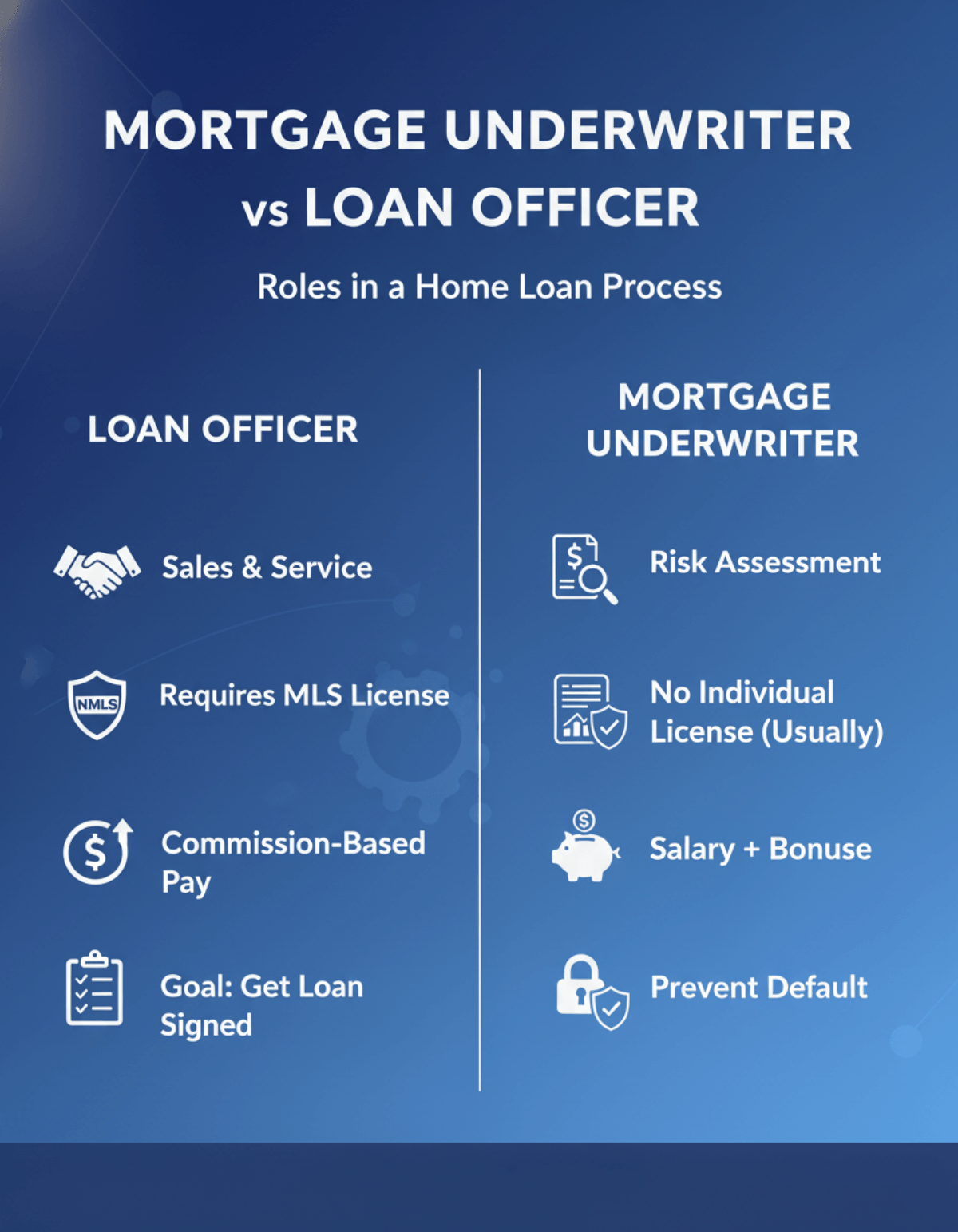
People mix these two up constantly. Both roles need each other to close a deal, but their day-to-day couldn't look more different. The loan officer — sometimes called a loan originator — is out front, meeting borrowers, explaining loan options, and bringing the deal in. The underwriter works behind the scenes, running the numbers and deciding whether the deal is actually safe to fund.
Here's a quick breakdown of how they compare:
Also Read: Must Read: What are the Duties and Responsibilities of Loan Officers
Loan Processor vs. Underwriter
This is another pairing that trips people up, partly because a processor's job often flows directly into underwriting. A loan processor gathers and organizes the borrower's paperwork — pulling pay stubs, ordering the appraisal, requesting title work — and hands off a complete file. The underwriter then makes the actual credit decision based on what's in that file. If it helps, think of the processor as the person who builds the case, and the underwriter as the one who rules on it.
FAQs About Home Loan Underwriters
Q1. What are the 3 C's of mortgage underwriting?
They stand for Capacity, Credit, and Collateral. Capacity means your income and DTI show you can handle the payments. Credit looks at your borrowing history. Collateral ensures the home's appraisal value is high enough to back up the loan amount.
Q2. Is it hard to become a mortgage underwriter?
It's challenging but very doable. The hard part isn't advanced math. It's memorizing hundreds of strict, ever-changing lending guidelines. You need a sharp eye for detail, strong logic skills, and the ability to handle high-pressure volume during busy housing seasons.
Q3. Can you work remotely as an underwriter?
Yes, absolutely. Since you're primarily reviewing digital documents and using cloud-based systems all day, it's a very remote-friendly job. Thanks to modern LOS software, many professionals now work entirely from home while securely accessing files and issuing their loan decisions.
Q4. How long does the mortgage underwriting process take?
An initial review usually takes about 3 to 10 business days. However, this timeline shifts constantly depending on how complicated your taxes are, the lender's current file backlog, and whether they use modern automated tools to speed up the workflow.
Also Read: [Solved] How Long Does Mortgage Underwriting Take?
Q5. Is a loan officer basically the same professional as an underwriter?
No. A loan officer (or loan originator) works directly with the borrower to originate and sell the loan, while the underwriter is a separate role that independently reviews the file and decides on the risk. The two functions are kept deliberately separate to comply with fair lending rules.
Q6. Can a loan officer influence the underwriter's decision?
Generally, no — and that's by design. Fair lending and conflict-of-interest rules mean loan officers aren't supposed to pressure or direct an underwriter's credit decision. A loan officer can advocate for a borrower by supplying extra documentation or context, but the final approve, suspend, or deny call rests with underwriting alone.
Conclusion
At the end of the day, the mortgage underwriter is the person keeping the housing market on solid ground, balancing risk for the lender while helping regular people get the keys to their homes. If you like detail-heavy work and want a stable, well-paying career without a sales quota hanging over your head, it's genuinely one of the better paths in the industry.
Now, if you're a mortgage broker or lender reading this, you already know that slow back-office operations hurt the client experience. If you want to cut operational costs and give your team better tools, take a look at Zeitro. As a cost-effective LOS built to speed up home loan underwriting, it gives your staff a smoother workflow and gets your borrowers into their homes faster. Win-win.
People Also Read
- Best Mortgage Companies for New Loan Officers
- How to Become a Loan Officer with No Experience?
- Best Mortgage CRM for Brokers, Lenders, MLOs
- [Tips] Where to Buy Mortgage Leads? Warm Leads for LOs
- Beginner's Guide: How to Get Leads for Mortgage Loans?
- Best Mortgage Underwriter Software: AI & Guideline Verification
![[Solved] Why is Loan Product Advisor (LPA) Rejecting Income?](https://cdn.prod.website-files.com/6731bc6e813a541b54c30b10/6aa11d2cb785a137b728997d_loan-product-advisor-reject-income-banner.jpg)

![[Solved] Why is Desktop Underwriter (DU) Rejecting Files?](https://cdn.prod.website-files.com/6731bc6e813a541b54c30b10/6aa11212d02666b337b8d2f4_desktop-underwriter-reject-file-banner.jpg)