
Written by

Eric
Author from Zeitro

Share this article

Subscribe to updates

Thank you! Your submission has been received!
Oops! Something went wrong while submitting the form.

When I first started looking into the mortgage industry, I was completely overwhelmed. Like many of you, I found myself staring at job boards, wondering: what actually is the difference between a mortgage underwriter and a loan officer? Which one makes more money? Which one has a better work-life balance? If you are stuck trying to figure out which path suits your personality, you are in the right place.

In this guide, I will break down both careers comprehensively so you can decide which role aligns perfectly with your skills and financial goals.

What is a Mortgage Underwriter?

Think of a mortgage underwriter as the ultimate gatekeeper of the lending world. From my experience, they are the analytical minds working tirelessly in the back office. Their primary job is to evaluate a borrower's financial risk—scrutinizing credit histories, assets, and debt-to-income (DTI) ratios—to decide if the bank should actually fund the loan.

While automation has slowed the overall job growth slightly, skilled underwriters who can navigate complex financial scenarios are still highly valued. If you love crunching numbers and prefer a quiet, analytical-driven environment, this is your zone.

What is a Mortgage Underwriter?

Also Read:

What is a Loan Officer? (MLO)

On the flip side, a Mortgage Loan Officer (MLO) is the frontline guide for homebuyers. They are the face of the company, actively hunting for leads, networking with real estate agents, and helping clients pick the right mortgage products. MLOs gather the initial paperwork to get the ball rolling.

According to the Bureau of Labor Statistics, employment of loan officers is projected to grow 2% from 2024 to 2034, which is slower than the average for all occupations. It is an intensely client-facing, sales-driven role. If you thrive on building relationships and closing deals, this career fits like a glove.

What is a Loan Officer? (MLO)

Also Read:

Quick Look at the Comparison Between Loan Officer vs Underwriter

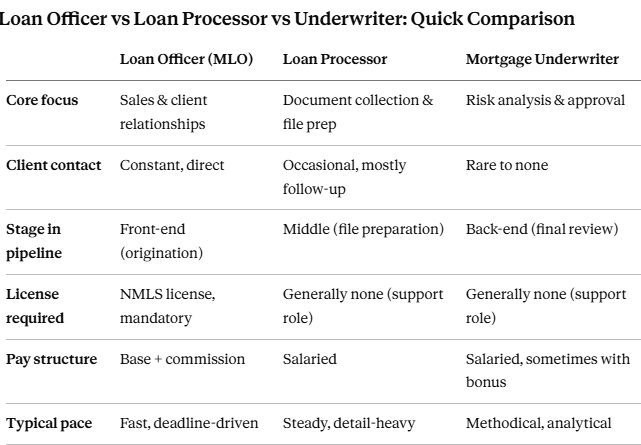
Before we dive into the nitty-gritty details, let me save you some time. Here is a quick snapshot I put together highlighting the core differences between these two mortgage professionals.

Quick Look at the Comparison Between Loan Officer vs Underwriter

This table covers the basics, but choosing your life's work requires a deeper understanding of the daily grind.

What is the Difference Between Loan Officer vs Underwriter?

Beyond that quick comparison, let's unpack exactly how these roles contrast on a day-to-day basis. I've broken down their differences across seven vital dimensions to give you a crystal-clear picture of what to expect.

Responsibilities

A loan officer's main responsibility revolves around origination. I always tell people that MLOs are the hunters. They bring the business through the door. Their day consists of cold calling, meeting with prospective buyers, explaining loan options, like fixed-rate vs. ARM, and taking the initial application.

Conversely, the underwriter handles the approval or denial phase. They are the risk managers protecting the lender's money. Once the MLO submits the file, the underwriter verifies that the borrower actually makes what they claim and that the property appraises correctly. They don't sell. They verify. While the loan officer wants every deal to close, the underwriter's duty is to ensure only the safe, qualified deals make it to the finish line.

Education, Skills & Certifications

When it comes to formal requirements, the paths diverge significantly. To legally work as a Loan Officer in the US, you absolutely must obtain your NMLS (Nationwide Multistate Licensing System) license. This requires passing a rigorous national exam, completing 20 hours of pre-licensing education, and undergoing background checks. You don't necessarily need a college degree, but sales charisma is non-negotiable.

Underwriters, however, rarely need a sales license. Instead, lenders look for extreme analytical prowess. A bachelor's degree in finance or accounting is highly preferred. Furthermore, to stand out or handle government loans, underwriters often pursue specific certifications, such as becoming an FHA Direct Endorsement (DE) underwriter or securing VA LAPP approval. Having these specialized designations proves your expertise in complex federal guidelines.

Also Read:

Salary

Let's talk money, because I know that is a huge deciding factor. Based on 2024 data from the Bureau of Labor Statistics, the median base salary for a loan officer sits around $74,180. However, MLOs are heavily commission-based. A top-producing loan officer in a busy real estate market can easily rake in well over $150,000 to $200,000 annually. The catch? If you don't close, you don't eat.

Mortgage underwriter average salaries range from about $65,000 to $95,000 annually, depending on experience, location, and source, often including bonuses but generally more stable than loan officers' commission-heavy structure.

Also Read:

Workflow

Understanding where each professional sits on the loan timeline is crucial. The loan officer lives entirely on the front-end. They represent the very beginning of the borrower's journey. An MLO initiates the application, locks in the interest rate, and passes the baton to the processing team to gather documents.

The underwriter operates strictly in the mid-to-back-end of the workflow. They only enter the picture once the loan processor has organized the file. The underwriter reviews the neatly packaged documents, issues conditions (asking for a missing bank statement, for example), and eventually grants the coveted "Clear to Close." They are the final checkpoint before the funds are actually wired to the title company.

Interaction

If you are an extreme extrovert, pay attention here. A loan officer's calendar is packed with social networking. I've seen successful MLOs spend their weekends hosting open houses with real estate agents, grabbing coffee with financial planners, and constantly texting anxious homebuyers. Your success depends directly on your external relationships.

An underwriter's social battery is drained very differently. They primarily engage in internal communication. Underwriters rarely, if ever, speak directly to the borrower. Their daily interactions are limited to emails and phone calls with loan officers and processors to clarify file discrepancies. It is a highly insulated, quiet role perfect for those who prefer analyzing spreadsheets over shaking hands.

Authority

Who really holds the power? I can answer that definitively: the underwriter has the final say. No matter how much a loan officer promises a client they will get approved, the MLO cannot override the underwriter.

Underwriters possess the ultimate authority to approve, suspend, or flat-out deny a mortgage. They are bound by strict investor guidelines, such as those set by Fannie Mae, Freddie Mac, or the FHA. If a borrower's file doesn't fit the matrix, the underwriter must reject it. While the loan officer can argue the case, escalate the issue to management, or provide compensating factors, they simply do not hold the pen that signs off on the company's millions of dollars.

Career Path

Both roles offer excellent upward mobility, just in different directions. An ambitious loan officer usually moves up the sales ladder. You might start as a junior MLO, become a top producer, and eventually transition into a Branch Manager or Regional VP of Sales. Some even open their own independent mortgage brokerages.

For an underwriter, the trajectory is firmly rooted in risk and operations. You typically start as a Junior Underwriter, advancing to a Senior Underwriter once you gain your government designations. From there, the path leads to Underwriting Manager, VP of Credit Operations, or even a Credit Risk Director. Both paths can lead to the executive suite, but one relies on sales volume while the other relies on technical expertise.

Suggestions on Picking Your Career

Still on the fence? Based on my time observing the mortgage industry, I've found that success comes down to matching your natural disposition with the job requirements. Here are a few practical suggestions to help you decide:

  • Choose the Loan Officer route if you are naturally outgoing, resilient, and thrive in social networking settings.
  • Opt for Underwriting if you are an introverted thinker who loves digging into data and scrutinizing details.
  • Pick Loan Officer if you want unlimited earning potential and don't mind the stress of fluctuating, commission-based income.
  • Go with Underwriting if a predictable 9-to-5 schedule, work-life balance, and a stable paycheck are your top priorities.
  • Choose Loan Officer if you possess a knack for persuasion and have a true sales mentality.
  • Select Underwriting if you have a strong sense of risk aversion and enjoy navigating complex regulatory frameworks.

FAQs About Mortgage Underwriter vs Loan Officer

Q1. Is a loan officer the same as an underwriter?

No, they are completely different roles. A loan officer is a sales professional who helps clients apply for a mortgage and selects the right loan product. An underwriter is a financial analyst who reviews the borrower's documents to assess risk and makes the final approval decision.

Q2. Who makes more, an underwriter or a loan officer?

It depends on performance. A top-tier loan officer earns significantly more due to uncapped commissions, sometimes exceeding $200,000 annually. However, an underwriter typically enjoys a much higher and more stable guaranteed base salary compared to an entry-level loan officer.

Q3. Will MLO be replaced by AI?

No. While AI and automated software are speeding up the initial processing and document sorting, buying a home is a massive, emotional financial decision. Borrowers will always need human loan officers for nuanced advice, empathy, and personalized problem-solving that AI simply cannot provide.

Q4. Can a loan officer override an underwriter?

No, a loan officer cannot override an underwriter's decision. The underwriter has the absolute final say on loan approval. However, if a loan is denied, the loan officer can submit an appeal or provide additional compensating factors to request a secondary review.

Q5. Is MLO in high demand?

Demand varies heavily with the economy. When interest rates drop, the demand for MLOs skyrockets due to a refinancing boom. While the overall long-term job growth is steady, the industry will always need skilled originators as long as people continue buying real estate.

Conclusion

Wrapping things up, deciding between these two paths really boils down to one fundamental question: do you want to drive the sales, or do you want to manage the risk? Loan officers are the extroverted engines of the mortgage industry, while underwriters are the meticulous brakes ensuring everything runs safely.

There is no absolute winner here. Choosing between a loan officer and mortgage underwriter career simply depends on your own personality traits, risk tolerance, and long-term financial goals. Take a moment to assess what makes you tick. If you found this breakdown helpful in clarifying your future career in real estate finance, please share it with others who might be weighing the exact same decision!

Keep reading

Manual Mortgage Underwriting Explained: An Ultimate Guide 2026

Blog

5 min read
Arrow icon on dark background
Manual Mortgage Underwriting Explained: An Ultimate Guide 2026
What is manual mortgage underwriting? Discover requirements for FHA & Non-QM loans, and learn to deliver 2.5x faster pre-qualifications with expert AI assistants.

In my years navigating the US mortgage landscape, I've seen countless borrowers get rejected by a computer algorithm simply because their lives don't fit into a tidy little box. That's where manual mortgage underwriting comes in.

If you've ever wondered what happens when the "automated system" says no, you're in the right place. In this guide, I'll break down exactly how this human-led process works, why it's a lifesaver for complex files in 2026, and how we as professionals can handle it without losing our minds.

What is Manual Mortgage Underwriting?

When I talk about manual underwriting, I'm referring to a process where a human underwriter, not a piece of software like Fannie Mae's DU or Freddie Mac's LP, personally reviews every line of a loan application. In the standard automated world, an algorithm decides your fate in seconds. But for manual underwriting, a professional digs deep into the borrower's "Three Cs": Credit, Capacity, and Collateral.

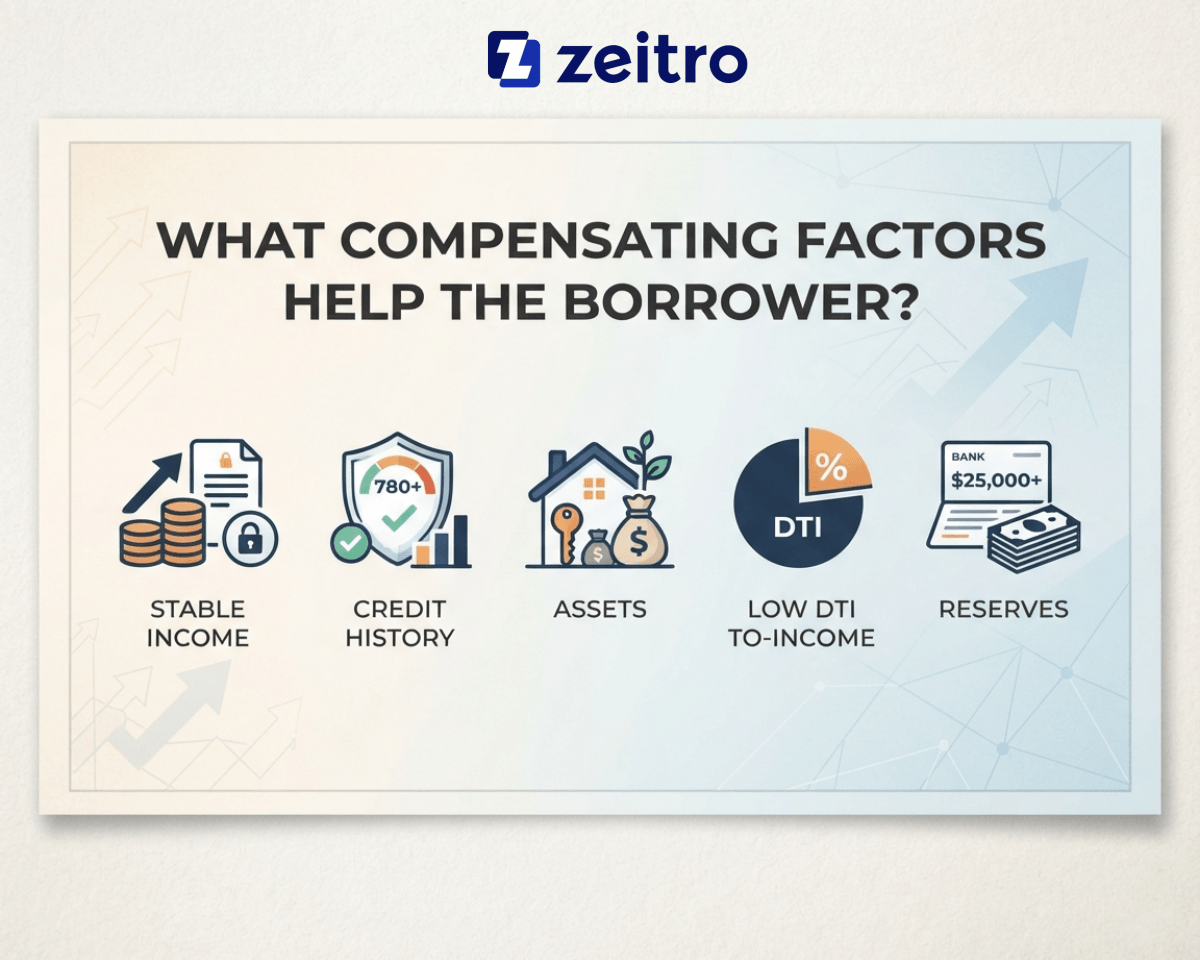
We need this because automation is rigid. If a borrower has a "thin" credit file or a recent life event like a bankruptcy, the computer often defaults to a "Refer" status. Manual underwriting is the secondary path that allows us to use common sense and "compensating factors" to approve a loan that a machine would otherwise ignore.

What is Manual Mortgage Underwriting?

Requirements for Manual Underwriting in Mortgage

Navigating the requirements for a manual file is definitely more demanding than an automated one. Through my experience, I've found that you have to be much more meticulous with the paper trail. Here is what is typically required:

  • Stricter DTI Limits: FHA manual underwriting guidelines set the maximum back-end DTI at 43% with no compensating factors, 47% with one compensating factor, and up to 50% with two or more. The front-end DTI follows similar tiers (31%, 37%, 40%). Automated FHA approvals via TOTAL Scorecard can allow higher DTIs up to 56.9% in some cases, so manual limits are not always stricter but more structured around compensating factors.
  • Verification of Non-Traditional Credit: If there's no FICO score, I have to document 12 months of on-time payments for things like rent, utilities, or even phone bills.
  • Cash Reserves: Lenders usually want to see 1-3 months of "PITI" (Principal, Interest, Taxes, and Insurance) sitting in the bank after closing.
  • Detailed LOX: A "Letter of Explanation" isn't optional here. It's a narrative tool to explain any credit dings or income gaps.
  • Asset Documentation: Every large deposit must be sourced and seasoned. There's no "skipping" the fine print.
Requirements for Manual Underwriting in Mortgage

Process of Manual Mortgage Underwriting

The process is a bit of a marathon, not a sprint. I usually describe it to my clients as a "forensic audit" of their financial life. Here is how it typically unfolds:

  • Initial Application & Trigger: We run the file through the AUS. If it returns a "Refer with Caution," we pivot to the manual path.
  • Comprehensive Data Gathering: I collect full tax returns, W-2s, and every page of bank statements. Nothing is left to chance.
  • The Human Review: The underwriter manually calculates the qualifying income and analyzes credit history patterns.
  • Compensating Factor Analysis: This is the "secret sauce" where the underwriter looks for reasons to say "yes," like a large down payment or significant savings.
  • Final Determination: The underwriter issues a manual approval, a counter-offer, or a denial based on their professional judgment.
Process of Manual Mortgage Underwriting

Pros and Cons of Manual Mortgage Underwriting

Every tool has its place, and manual underwriting is no different. I've seen it save deals, but it also tests everyone's patience.

Benefits:

  • Flexibility for "Non-QM" Borrowers: It's the best way to help self-employed individuals or those with unique income streams.
  • Human Empathy: A human can understand that a medical emergency caused a one-time credit dip. A computer can't.
  • Higher Approval Potential: It opens doors for borrowers who are creditworthy but don't meet "cookie-cutter" standards.

Drawbacks:

  • Slow Turnaround: Let's be real. It takes much longer. We're talking days or weeks instead of minutes.
  • Higher Scrutiny: The "condition list" can be miles long, which can frustrate borrowers.
  • Subjectivity: One underwriter might be more conservative than another, leading to less predictable outcomes.

When is Manual Mortgage Underwriting Done?

In my daily workflow, I don't choose manual underwriting unless I have to. It's typically triggered in specific scenarios that 2026's diverse economy often presents:

  • FHA "Refer" Status: When the automated system doesn't give an "Accept" on an FHA loan, manual is the only way forward.
  • Credit Challenges: This includes borrowers coming out of a Chapter 13 bankruptcy or those with recent foreclosures.
  • Non-Traditional Credit: For borrowers (often younger or new to the US) who simply don't have a credit score.
  • High DTI with Compensating Factors: When the debt ratio exceeds standard limits, but the borrower has massive cash reserves.
  • Complex Income: When a borrower has multiple businesses, and the AUS can't make sense of the 1040s.

Manual Underwriting vs. Automated Underwriting

Efficiency and Speed

The biggest divide is time. In the automated world, I can get a "Conditional Approval" in about the time it takes to brew a coffee. Manual underwriting, however, is notoriously labor-intensive. Traditionally, researching guidelines across different lenders could take me 30 minutes per query. This is why I've started relying on Zeitro Strata AI. It cuts that manual guideline lookup from half an hour down to seconds by cross-checking 100+ investors. It essentially gives manual underwriting the "speed" of an automated system.

Accuracy and Compliance

With automated systems, the "Black Box" does the math, but you don't always know why it rejected a file. In manual underwriting, the risk of human error is high. It's easy to miss a specific lender "overlay." Using tools like Zeitro has been a game-changer for me because it provides full citations. When I'm verifying a complex VA guideline or Non-QM guideline, I get an answer with a link to the source. This reduces manual work by 100% and ensures that when I submit a file, it actually meets the latest 2026 standards.

The "Human Factor" in Decision Making

Automated underwriting is binary—zero or one. Manual underwriting is a conversation. I've found that by using Zeitro, I can save over 7 hours per loan file. That's time I can spend actually talking to my underwriters and explaining the "why" behind a borrower's situation. Instead of getting buried in PDFs and guidelines from lenders like AAA Lending or Greenbox, I use AI to handle the "data" so I can handle the "human" side of the deal.

Zeitro

FAQs About Manual Mortgage Underwriting

Q1. Do lenders still do manual underwriting?

Absolutely. While many big retail banks prefer the ease of automation, many wholesale lenders and specialists, like those in the Non-QM space, rely on manual underwriting to capture the 20-30% of the market that doesn't fit standard criteria.

Q2. What are the benefits of manual underwriting mortgage?

The primary benefit is opportunity. It allows borrowers with high DTI, low credit scores, or complex income to achieve homeownership. It's about looking at the whole person, not just a score.

Q3. What are the disadvantages of manual underwriting?

The "paperwork fatigue" is real. It requires much more documentation, more time (often 20% slower closing times), and can sometimes result in higher interest rates due to the perceived risk.

Q4. What are the fees associated with manual underwriting mortgage?

Generally, the fees are similar to standard loans, but some lenders may charge a slightly higher "Underwriting Fee", ranging from $500 to $1,500, because of the extra man-hours required to review the file.

Conclusion

Manual mortgage underwriting remains a vital pillar of the industry in 2026. It is the bridge between a "no" from a machine and a "yes" for a family. However, as professionals, we can't afford to work the old-fashioned way. The "manual" part should refer to the decision, not the drudgery of searching through 300+ guidelines.

I've found that by integrating tools like Zeitro, I can deliver 2.5x faster pre-qualifications even on complex manual files. Whether you are a broker or a loan officer, your goal is to close loans faster and with more confidence. Don't let manual guidelines slow you down. If you want to see how I save 7+ hours per file while staying 100% compliant, I highly recommend checking it out. It's the smartest way to make "manual" feel "automatic."

People Also Read

Best Mortgage Underwriter Software in 2026: AI & Guideline Verification

Blog

5 min read
Arrow icon on dark background
Best Mortgage Underwriter Software in 2026: AI & Guideline Verification
Looking for the top mortgage underwriter software? Compare the top 6 AI tools of 2026, including Zeitro and DU, to streamline your loan origination process.

I've spent years in the mortgage industry, and if there's one thing that constantly drains our time, it's manual underwriting. You know the drill: cross-checking hundreds of pages of investor guidelines, verifying complex borrower data, and praying you didn't miss a tiny overlay. It is exhausting and highly prone to human error.

But in 2026, AI-powered software is changing the game. Tools like Zeitro are now essential. Not only do they instantly verify guidelines with precise citations, but they also streamline the entire loan origination process. Plus, with a highly cost-effective freemium plan, finding the best mortgage underwriter software is no longer a luxury—it's a necessity for survival.

What to Consider to Choose a Top Mortgage Underwriter Software?

Before jumping into the software sea, remember that not every platform will fit your specific business model. Based on my experience, choosing the right tool comes down to evaluating a few core metrics:

  • Guideline Coverage & Accuracy: Does the system support both QM and Non-QM loans? More importantly, can it provide exact source citations for its answers? You need to trust the data.
  • Integration & Workflow: A top-tier tool must talk to your existing LOS or POS. Look for features like seamless FNM 3.4 data exports.
  • Security & Compliance: We are handling sensitive financial data. Enterprise-grade security, specifically SOC 2 Type II certification, is non-negotiable.
  • Cost-Effectiveness: Is there a trial or a freemium model? For mid-sized brokerages or individual LOs, you want a platform that proves its ROI before requiring a massive upfront investment.

6 Top-Rated Software for Mortgage Underwriter in 2026

There are dozens of tools on the market, but after testing them for real-world efficiency, features, and actual ROI, I've narrowed it down. Here are the 6 best software options tailored for different mortgage underwriters' needs, from guideline AI and auto-decisioning to document processing.

#1 Zeitro - Best for Guideline Verification and Automated Process

Why Choose: The ultimate mortgage AI agent that turns hours of manual guideline research into seconds with exact citations.

Zeitro is a neutral, AI-native mortgage technology company founded in 2018, with a team that includes leaders from Google and Apple alongside mortgage industry veterans. It directly attacks our biggest daily headache: the endless search through loan manuals. Zeitro operates with total neutrality and boasts SOC 2 Type II certification, ensuring top-tier data security. I recommend it because it literally cuts research time from 30 minutes to a few seconds.

Zeitro - Best for Guideline Verification and Automated Process

Features:

  • AI Guideline Verification: It instantly cross-checks over 100 investors and 300+ guidelines (covering Non-QM, DSCR, ITIN, Jumbo, etc.). You can ask vague questions and get highly accurate answers backed by direct citations. There's even an "Explain" function for deeper clarity.
  • Automated Digital 1003 (POS): Borrowers can complete their application in 5 minutes. The AI accurately calculates DTI (85%+ accuracy), and you can seamlessly export the data in FNM 3.4 format.
  • Competitive Pricing Engine: Get rapid quotes for both conventional and Non-QM products, complete with flexible overlay adjustments.
  • High ROI: It saves professionals 7+ hours per loan file, speeds up pre-qualifications by 2.5x, and boosts closing rates by 30%.
  • Pricing: Zeitro offers an incredibly generous Freemium model. The free Explorer plan includes 3 daily AI queries and 10 lifetime FNM exports, while the premium tier is just $8/month.

#2 Fannie Mae Desktop Underwriter (DU) - Best for Conventional Automated Underwriting

Why Choose: The absolute industry standard for conventional loan automated decision-making.

You simply cannot talk about mortgage processing without mentioning Fannie Mae's Desktop Underwriter (DU). It is the official automated underwriting system (AUS) for conventional loans and practically a mandatory tool in our industry. DU analyzes a borrower's credit risk, income, and assets to deliver a comprehensive risk assessment. I always rely on DU when handling standard Agency loans because an "Approve/Eligible" finding is the gold standard for moving a file forward.

Fannie Mae Desktop Underwriter (DU) - Best for Conventional Automated Underwriting

Features:

  • Comprehensive Risk Assessment: Evaluates credit history, debt-to-income ratios, and loan-to-value metrics instantly to determine conventional eligibility.
  • Day 1 Certainty: This is a massive lifesaver. It provides rep and warrant relief by digitally validating borrower income, assets, and employment, drastically reducing buyback risks.
  • Deep Integrations: DU integrates seamlessly with virtually every major Loan Origination System (LOS) on the market, making data transfer completely frictionless.
  • Continuous Updates: Fannie Mae constantly updates its risk models to reflect current macroeconomic conditions and housing market trends, keeping your decisions compliant.

#3 FundMore.ai - Best for Automated Document Processing & Risk Assessment

Why Choose: Streamlines the underwriting process through AI-driven document recognition and automated conditions.

FundMore.ai is a cloud-based automated underwriting platform that leans heavily on machine learning to speed up the loan origination cycle. If your team is drowning in paperwork, this tool is a game-changer. It helps underwriters by automating the tedious task of reading and sorting through piles of borrower documents. It's highly effective at reducing the manual workload, which is why I consider it a top pick for risk assessment and document ingestion.

FundMore.ai - Best for Automated Document Processing & Risk Assessment

Features:

  • Advanced OCR Technology: Automatically captures, classifies, and extracts critical data from uploaded borrower documents, eliminating manual data entry.
  • Automated Stipulations: The system instantly generates loan conditions based on the extracted data and the lender's specific credit guidelines.
  • FundMore Score: Provides an intelligent decision recommendation, giving underwriters a clear visual cue on whether to approve, decline, or manually review a file based on predefined risk rules.
  • Secure POS Portal: Offers a modern, user-friendly portal for borrowers to easily upload their IDs and financial documents, keeping everyone on the same page.

#4 Freddie Mac Loan Product Advisor® (LPA) - Best for Streamlining Freddie Mac Loan Deliveries

Why Choose: The essential automated underwriting system for loans destined for Freddie Mac.

Just like DU is for Fannie Mae, Loan Product Advisor (LPA) is the proprietary AUS for Freddie Mac. If you plan on delivering loans to Freddie, using LPA is non-negotiable. It evaluates the risk of the loan against Freddie Mac's specific purchase standards. What I appreciate most about LPA is how it simplifies complex scenarios and gives underwriters a clear path to loan approval, running neck-and-neck with DU as an industry giant.

Freddie Mac Loan Product Advisor® (LPA) - Best for Streamlining Freddie Mac Loan Deliveries

Features:

  • Automated Collateral Evaluation (ACE): This feature can potentially waive the requirement for a traditional appraisal, saving borrowers time and hundreds of dollars.
  • Asset and Income Modeler (AIM): Automates the assessment of a borrower's income and assets, making it much easier to handle self-employed borrowers or complex tax returns.
  • Actionable Feedback: The system doesn't just give a yes or no. It provides incredibly detailed, easy-to-read feedback messages so you know exactly what conditions need to be cleared.
  • Broad System Compatibility: LPA works flawlessly within major LOS platforms, ensuring that your origination workflow remains uninterrupted.

#5 Ocrolus - Best for Financial Document Automation and Income Calculation

Why Choose: Extremely accurate AI and human-in-the-loop document processing for tricky income calculations.

Calculating income for non-traditional borrowers can be a nightmare. Ocrolus solves this by serving as a premier document automation and analysis tool. It is my go-to recommendation when dealing with messy bank statements, W-2s, and complex tax returns. It is especially useful for self-employed individuals or those applying for Non-QM loans. By blending AI with human verification, Ocrolus ensures your income numbers are spot-on.

Ocrolus - Best for Financial Document Automation and Income Calculation

Features:

  • Ultra-Accurate OCR: Captures data from almost any document type, regardless of quality, with over 99% accuracy.
  • Automated Income Calculation: Instantly calculates wages, rental income, and self-employed earnings using various methods (YTD, multi-year averages). Ocrolus provides accurate income analysis for GSE loans but does not integrate directly with Fannie Mae's Income Calculator. It supports workflows compatible with major LOS systems like Encompass.
  • Fraud Detection: Automatically flags tampered documents or suspicious inconsistencies, protecting lenders from fraudulent applications.
  • Income Summary Dashboard: Provides underwriters with a clean, consolidated view of all borrower income sources, making it easy to toggle between applicants and adjust values on the fly.

#6 Floify - Best for Point-of-Sale (POS) and Borrower Communication

Why Choose: A highly customizable POS that keeps borrowers, LOs, and underwriters perfectly synced.

Floify is a robust digital mortgage portal that acts as the bridge between the borrower and the underwriting team. While it doesn't make credit decisions itself, it dramatically improves the environment in which we work. By simplifying document collection and centralizing communication, Floify eliminates the back-and-forth emails that usually slow down the clear-to-close process.

 Floify - Best for Point-of-Sale (POS) and Borrower Communication

Features:

  • Automated Document Requests: Sends automatic reminders to borrowers when stipulations are missing, ensuring underwriters get what they need without having to chase people down.
  • Native eSignature Capabilities: Allows borrowers to legally sign disclosures and loan documents directly within their secure portal, speeding up compliance steps.
  • Milestone Updates: Automatically texts or emails borrowers and real estate agents when a file moves from "In Underwriting" to "Clear to Close".
  • Customizable Mobile App: Offers white-labeled mobile applications, giving your lending business a modern, branded feel while letting clients upload photos of documents straight from their phones.

Pros and Cons of Best Mortgage Underwriter Software

One size absolutely does not fit all in this business. The most effective strategy I've found is to combine foundational systems, like DU or LPA, with powerful AI efficiency tools like Zeitro. To help you visualize, here is a breakdown of the pros and cons of these top solutions:

Pros and Cons of Best Mortgage Underwriter Software

FAQs About Mortgage Underwriter Software

Q1. Do underwriters use Python?

Not usually. Most of us rely on ready-made automated systems like DU, LPA, or Zeitro rather than writing code ourselves. However, the backend engineers and data scientists who build these powerful AI mortgage platforms definitely use Python extensively to train their machine learning models.

Q2. What are the 4 types of underwriting?

The four main categories are mortgage, insurance, securities, and medical underwriting. In our specific field—mortgage—the process is further divided into manual underwriting (human analysis) and automated underwriting, using software to analyze risk based on algorithms.

Q3. What is the best CRM for mortgage?

Popular choices include Jungo, Total Expert, and BNTouch. However, the "best" mortgage CRM is one that seamlessly integrates with your other tools. An ideal setup allows your CRM to connect effortlessly with POS systems and pricing engines like Zeitro for a smooth workflow.

Q4. What is underwriting software?

It is a digital tool that helps lenders automatically analyze a borrower's credit, income, debt, and assets, like DTI and LTV. The software cross-checks this data against investor guidelines to quickly determine if a home loan should be approved or denied.

Q5. Are there any free mortgage underwriter software?

Yes! Zeitro offers a highly robust Freemium plan. Their Free Explorer Plan allows you to use the AI Guideline assistant 3 times a day and gives you 10 FNM exports. It is easily the most cost-effective entry point for industry professionals today.

Conclusion: Which One to Choose?

Wrapping things up, your choice heavily depends on your daily bottleneck.

  • If you are strictly processing conventional Agency loans, Fannie Mae DU and Freddie Mac LPA are your unavoidable baselines.
  • If messy tax returns and bank statements are slowing you down, Ocrolus is the way to go.
  • If you—whether a Loan Officer, Broker, or Underwriter—are exhausted by manually hunting through confusing QM and Non-QM guidelines, Zeitro is unequivocally the top choice. It is entirely neutral, SOC 2 certified, and designed to save you over 7 hours per file while boosting your closing rates.

People Also Read

Mortgage Underwriter Salary: How Much Does a Home Loan Underwriter Make?

Blog

5 min read
Arrow icon on dark background
Mortgage Underwriter Salary: How Much Does a Home Loan Underwriter Make?
How much does a mortgage underwriter make in 2026? Discover average salaries, real bonus structures, and if this stable, high-paying career is right for you.

People usually think real estate finance is all about aggressive sales quotas. But if you want the financial upside of the housing market without cold-calling strangers, mortgage underwriting is the sweet spot. As of 2026, a home loan underwriter makes a highly competitive average salary, generally between $65,000 and $85,000 to start.

I've seen senior underwriters easily clear six figures once they get some experience under their belts. Forget the fluff. In this breakdown, we are looking at hard data from major job boards, how the compensation structure actually works legally, and whether this desk job is the right career move for you.

Mortgage Underwriter Salary Breakdown

A national average only tells part of the story. From what I've seen, talking to hiring managers, your actual paycheck swings wildly based on three main factors.

  • Experience & Government Certifications: This is your golden ticket. Entry-level folks start on the lower end, but the moment you pass the tests for your FHA Direct Endorsement (DE) or VA Staff Appraisal Reviewer (SAR) credentials, your market value practically doubles.
  • Where You Live: Location matters. A firm in New York or San Francisco will naturally offer a higher base to offset the insane cost of living compared to a mid-market lender in Ohio.
  • Retail Banks vs. Wholesale Lenders: Big retail banks usually offer better baseline benefits and a steady base. Independent wholesale shops? They often lean heavier on lucrative per-file bonuses during rate-drop booms.
Mortgage Underwriter Salary Breakdown

Average Mortgage Underwriter Salary

Every job board uses a slightly different formula to calculate pay. Some rely entirely on self-reported employee surveys (which often include bonuses), while others scrape base salaries straight from active job postings. To give you a realistic picture, I've averaged out the latest 2026 data from the four biggest platforms. Expect a middle-ground baseline hovering right around $65,000 to $85,000.

Indeed

Let's look at Indeed. Based on thousands of recently aggregated job postings as of early 2026, their data shows an average base salary of around $76,839 a year for U.S. underwriters. What I find interesting about Indeed's numbers is the spread. The bottom 10%, mostly total beginners, sit closer to $55,000. Meanwhile, the top end stretches well past $115,000, especially in major metro markets. Since this data pulls directly from employer listings rather than employee memories, it's a highly accurate reflection of what companies are currently willing to pay a mid-level hire.

Salary.com

If you literally have zero experience, Salary.com is the best benchmark. They specifically track the "Mortgage Underwriter I" title. Right now, in 2026, they peg the median base pay at roughly $65,000. The typical range sits tight between $58,000 and $75,000. I always tell newcomers to look at this tier first so they don't get unrealistic expectations. The good news? Salary.com also shows that once you hit the Level III or IV tier a few years later, jumping into the $95,000 to $110,000 bracket is the standard progression.

Glassdoor

Over on Glassdoor, things look a little different. Because workers self-report their total take-home pay here, the average sits higher, pushing close to $95,000 annually. Of that total, about $75,000 represents the fixed base salary, while the remaining $20,000 comes from cash bonuses and extra compensation. I completely trust this breakdown. Anyone who has survived a busy mortgage season knows that those monthly production bonuses significantly pad your W-2. Glassdoor essentially reveals the "hidden" upside that standard job listings rarely advertise upfront.

ZipRecruiter

Finally, ZipRecruiter shows extreme real-time wage fluctuations. For 2026, they report an entry-level national average of about $62,000. However, their data shows a massive spread. The 25th percentile is scraping by at $41,000, while the 75th percentile is already hitting $72,000 for the exact same job title. To me, this proves that negotiating your starting offer is crucial. The huge variance means some lenders are trying to lowball new talent, while others are aggressively paying up for smart, analytical candidates. Don't settle for the bottom of that barrel.

How Does a Mortgage Underwriter Get Paid?

I constantly hear people assume underwriters get a cut of the loan they approve. They don't. In fact, doing so is highly illegal. Thanks to the Dodd-Frank Act's Loan Originator Compensation Rule, an underwriter's pay cannot be tied to the loan's interest rate or its size. This prevents conflicts of interest.

Instead, your money comes from three legitimate buckets.

  • First is your Base Salary, which is your guaranteed W-2 income and the bulk of your earnings.
  • Second is the Production or Quality Bonus. If your monthly quota is 40 files, your company might pay you a flat cash bonus for every file you clear beyond that, provided your error rate stays low.
  • Third is straight-up Overtime Pay. When interest rates drop and the housing market catches fire, mandatory overtime is common, resulting in massive spikes in your paycheck.

Loan Officer VS Underwriter Salary

A lot of folks debate whether to go into sales as a Loan Officer (LO) or stay behind the scenes as a Mortgage Underwriter. The money structures are night and day. LOs eat what they kill, and they hunt for borrowers and live off commissions. Underwriters get paid just for doing the math, whether the loan closes or not.

Loan Officer VS Underwriter Salary

An LO might make $300,000 during a refinance boom and then struggle to pay rent when rates spike. An underwriter's income is much more insulated from those wild market swings.

Also Read: Mortgage Underwriter vs Loan Officer: Which Career Is Best?

Home Loan Underwriter or Officer: Which to Choose?

Choosing between these two paths shouldn't just be about who makes more on paper. It boils down to how your brain is wired.

  • Become a Mortgage Underwriter if: You are naturally analytical, love diving into complex tax returns, and genuinely care about the tiny details. If the idea of a stable, predictable income lets you sleep at night, and you hate the thought of networking or managing angry clients, stay at the underwriting desk.
  • Become a Loan Officer if: You have thick skin, serious hustle, and are highly extroverted. If you don't mind sacrificing your weekends to take calls from real estate agents, and you are perfectly fine with an unpredictable paycheck in exchange for uncapped earning potential, sales is where you belong.

FAQs About Home Loan Underwriter Salary

Q1. Do mortgage underwriters make good money?

Yes. The median pay easily beats the national average. A mid-level underwriter typically earns around $75,000, while seasoned pros with specialized government credentials like DE or SAR regularly clear $100,000 or more a year when factoring in their volume bonuses.

Q2. Is being a mortgage underwriter stressful?

Yes, especially at the end of the month. While you don't have the stress of finding clients, you are strictly graded on your speed and accuracy. Trying to clear a heavy pipeline of loans before rate locks expire can definitely raise your blood pressure.

Q3. Do mortgage underwriters get a commission?

No. Federal regulations completely ban underwriters from earning commission based on loan amounts or interest rates. You are paid to assess risk objectively. However, lenders can and do reward underwriters with flat cash bonuses based on the sheer volume of files completed accurately.

Q4. Can mortgage underwriters work from home?

Yes. Remote work is massive in this industry right now. Most major lenders currently offer hybrid schedules, and many allow 100% remote underwriting. Honestly, skipping the daily commute is a huge financial perk that effectively increases your real take-home pay.

Q5. Is there a high demand for mortgage underwriters?

Yes, though it fluctuates. When interest rates drop, the surge in refinancing creates a desperate shortage of underwriting talent. But even during slower, higher-rate markets, experienced underwriters holding specialized FHA or VA sign-off authority remain incredibly hard for companies to replace.

Conclusion

Ultimately, mortgage underwriting is one of the best-kept secrets in the finance world. It offers a rare mix: a highly respectable, stable salary without the brutal hustle of commissioned sales. You get paid to analyze data, mitigate risk, and help people buy homes. The math is pretty clear. If you put your head down, learn the guidelines, and aggressively pursue those advanced DE and SAR certifications, six figures is a very realistic target.

If this sounds like your kind of career, don't just take my word for it. Open up Indeed or ZipRecruiter today and search for entry-level underwriting roles in your state. Look at the real numbers they are offering right now. The opportunity is definitely out there if you're willing to do the work.

People Also Read

Try Zeitro today and transform your loan origination workflow!

Get started free