Written by

Eric
Share this article

.svg)
Subscribe to updates
Last Checked and Updated on August, 2026
If you're anything like the borrowers I talk with every week, you're tired of asking the same question. For three years now, homebuyers have refreshed rate apps every morning, hoping for a sudden drop. Heading into 2026, I told my clients we were finally on a path toward relief. I have to be honest with you: that path got a lot bumpier than most of us expected.
I'm not going to pretend nothing changed since I first covered this topic. A few things happened this year that pushed rates higher instead of lower, and if you're planning a purchase or refinance, you need to understand them before you make a decision. Here's where things actually stand, based on the newest data from Fannie Mae, the MBA, Freddie Mac, and NAR.
Quick Answer: Where Rates Stand Right Now
The 30-year fixed mortgage rate is averaging 6.5% to 6.8% as of mid-August 2026, according to Freddie Mac's weekly survey and Bankrate's daily rate index. That's higher than where we stood at the end of 2025, not lower. Every major forecaster, including Fannie Mae, the Mortgage Bankers Association, and NAR, has revised its 2026 outlook upward this year. Nobody credible is projecting a return to 5% this year, let alone 4%.
Current Market Snapshot: What Changed Since December
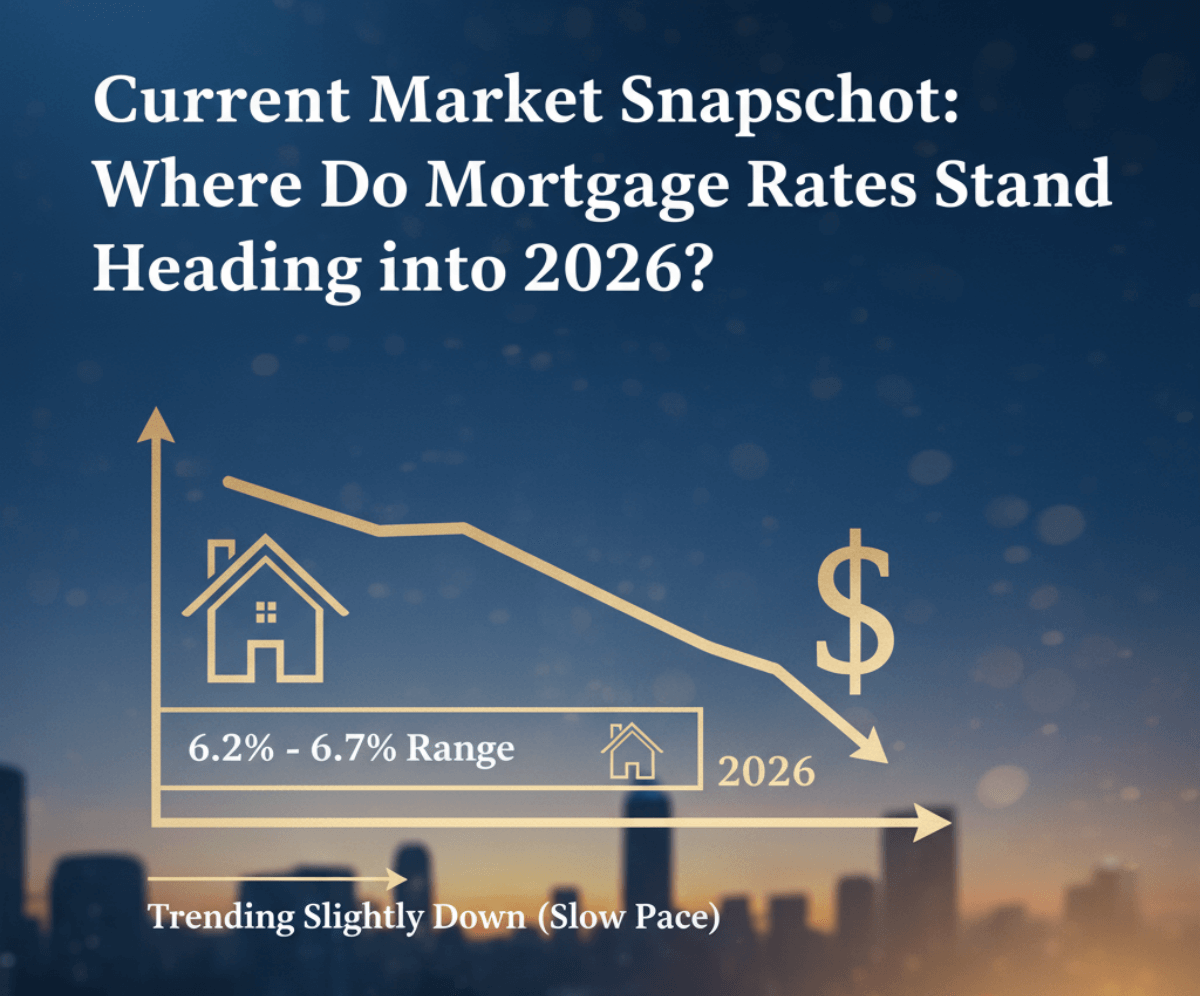
Back in December 2025, rates were hovering between 6.2% and 6.7%, and the general mood was cautious optimism. We expected a slow grind lower as the Fed kept cutting.
That grind never really started. As of mid-August 2026, Freddie Mac's Primary Mortgage Market Survey puts the 30-year fixed average at 6.67%, and daily rate trackers from Bankrate and Zillow show readings between 6.55% and 6.83% depending on the day. Century 21's CEO noted publicly that rates recently touched their highest point in a year, and weekly purchase applications have softened as a result.
So what pushed rates up instead of down? Three forces collided at once, and none of them were on anyone's radar a year ago.
Why Rates Stalled Out: The Real Story Behind 2026
I always tell clients that mortgage rates rarely move because of one single headline. This year is a textbook example. Here's what actually happened.
The Fed stopped cutting, and now some officials want to hike. After three rate cuts in late 2025, the Federal Reserve paused in January 2026 and hasn't budged since, holding its benchmark rate at 3.50% to 3.75% through five straight meetings. New Fed Chair Kevin Warsh, who took over from Jerome Powell mid-year, stripped the "leaning toward cuts" language out of the Fed's official statement entirely. A handful of regional Fed presidents have even pushed for a hike. Markets are now pricing in the possibility of one or two rate increases before year-end, a complete reversal from what forecasters expected in December.
Oil prices and renewed conflict pushed inflation back up. Escalating tension between the U.S. and Iran sent crude oil surging, with West Texas Intermediate futures spiking as high as $113 a barrel in April before settling lower. That spike rippled through the broader economy. Core PCE inflation, the Fed's preferred gauge, climbed from 3.0% in December to 3.4% by May, well above the Fed's 2% target.
New tariffs added fuel to the fire. A fresh round of import tariffs announced in early spring stoked additional inflation worries, pushing 10-year Treasury yields from around 4.2% to 4.6% in just a few weeks. Since mortgage rates track the 10-year Treasury far more closely than the Fed's overnight rate, that jump translated almost directly into higher rate quotes for borrowers.
Put simply: the "gradual, steady thaw" I described last winter got interrupted by geopolitics and inflation, not by anything happening inside the housing market itself.
Will Mortgage Rates Go Above 6.4% in 2026?
They already have. This was a genuinely open question at the end of 2025, when most forecasts clustered in the high 5s and low 6s. It isn't open anymore. Rates crossed 6.4% early in the year and have mostly stayed in the mid-to-high 6% range since, occasionally touching 6.8%. If you've been holding out for a rate below 6.4%, you've likely already missed several windows this year, and forecasters aren't expecting a lasting drop before 2027 at the earliest.
Expert Forecasts: What Leading Institutions Predict for 2026
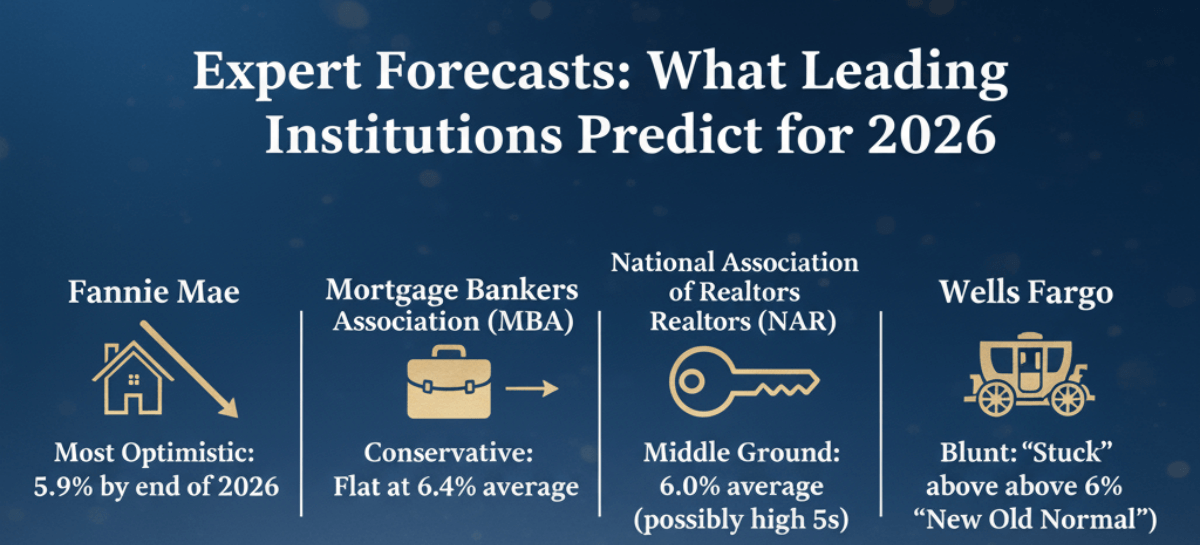
I always tell buyers not to lean on a single source. Here's the latest thinking from the institutions that matter most, along with when each forecast was published, since these numbers shift monthly.
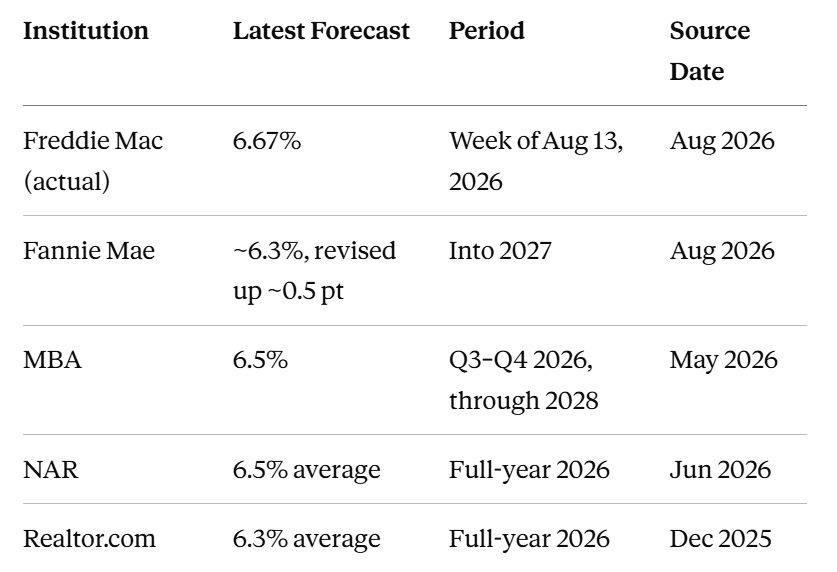
- Freddie Mac: Publishes the industry's benchmark weekly rate survey. Its most recent reading (August 13, 2026) put the 30-year fixed average at 6.67%, essentially flat week over week and slightly above where it stood a year earlier.
- Fannie Mae: Its Economic and Strategic Research Group had projected long-term rates would settle around 6.3% heading into 2027. Its August update revised that figure up by as much as half a percentage point, citing renewed inflation pressure and rising bond yields. Fannie Mae also trimmed its 2026 existing-home sales estimate slightly, to just under 4.11 million units.
- Mortgage Bankers Association (MBA): Its May 2026 Mortgage Finance Forecast projects 30-year rates averaging 6.5% in the third and fourth quarters of 2026, holding at that level through 2027 and 2028. The MBA's economists point to elevated CPI inflation, tied partly to the Middle East conflict and its effect on oil prices, as the reason rates aren't easing further.
- National Association of Realtors (NAR): Chief Economist Lawrence Yun's June 2026 outlook calls for mortgage rates averaging 6.5% this year, alongside a 4% rise in both existing-home sales and median home prices.
- Realtor.com: Its full-year 2026 forecast, published in December 2025, projected rates near 6.3% for the year, along with an 8.9% increase in existing-home inventory.
The consensus has clearly shifted higher since I last wrote about this. Where forecasters once clustered around 5.9% to 6.4%, the range now sits closer to 6.3% to 6.8%, and nobody with real credibility is projecting a dip below 6% before 2027.
2026–2027 Rate Forecast at a Glance
How Accurate Are Mortgage Rate Forecasts, Really?
This is worth addressing directly, because I think it matters more than any single number. Last December, Fannie Mae's own outlook had rates ending 2026 near 5.9%. By August, that projection had been revised upward multiple times, and actual rates were running nearly a full point higher than that original call.
I'm not pointing this out to criticize Fannie Mae's economists. Their job is genuinely difficult, and nobody predicted an Iran-driven oil spike or a new Fed chair rewriting the central bank's messaging within the same year. The lesson for you as a borrower is simpler: treat every forecast as a directional estimate, not a number to plan your finances around. When I talk with clients now, I tell them to budget for a range, not a point estimate, and to make peace with the idea that the "right" rate might arrive later than anyone currently expects.
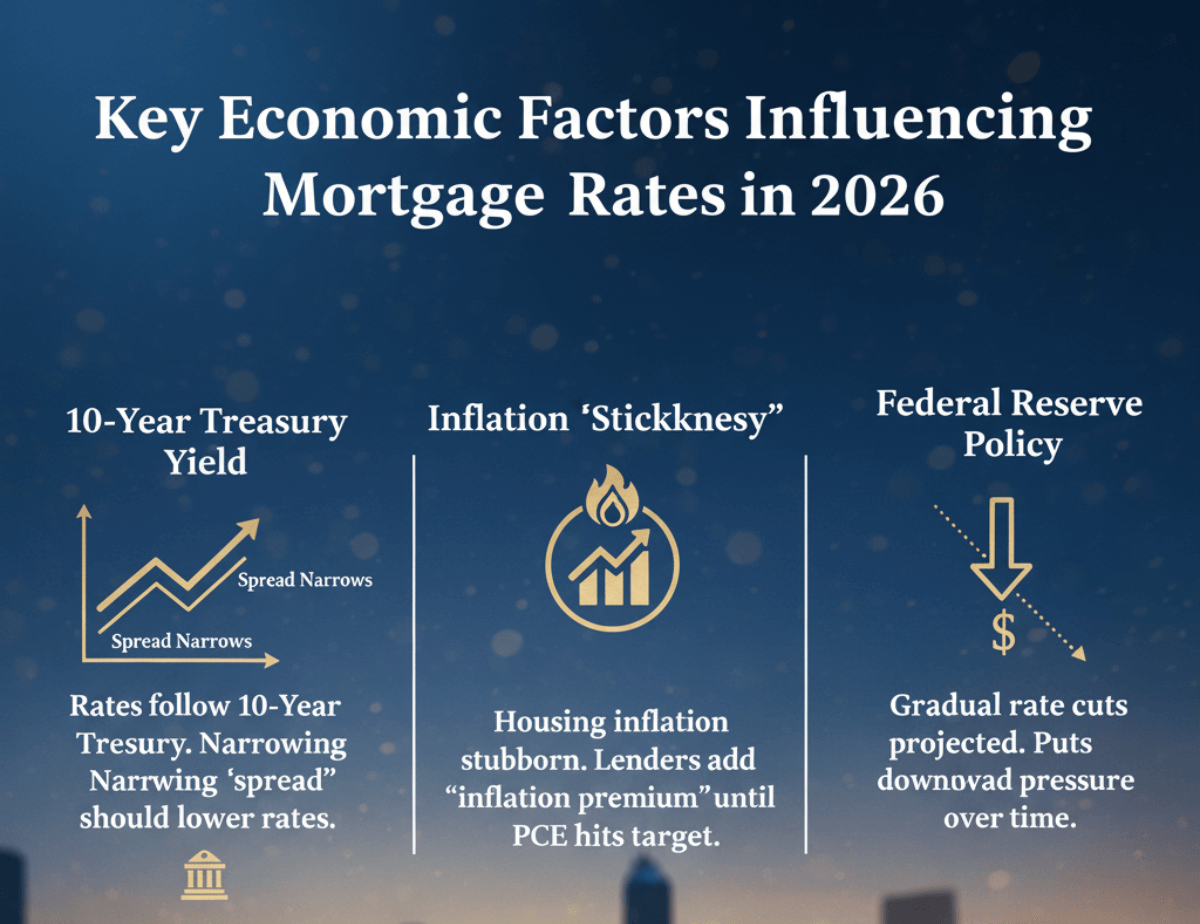
Key Economic Factors Influencing Mortgage Rates in 2026
To understand why are mortgage rates going down (even slowly), we have to look under the hood of the economy. It's not just about what the Fed says. It's about three specific levers:
- The 10-Year Treasury Yield: Mortgage rates don't follow the Fed Funds Rate directly. They follow the 10-year Treasury note. Right now, the "spread" (the difference between the Treasury yield and mortgage rates) is still historically high. As economic fear subsides in 2026, this spread should narrow, naturally lowering rates even if Treasury yields stay flat.
- Inflation "Stickiness": We have made progress, but inflation in the housing services sector remains stubborn. Until the Personal Consumption Expenditures (PCE) index hits the Fed's target consistently, lenders will bake an "inflation premium" into your rate.
- Federal Reserve Policy: The Fed is walking a tightrope. They are cutting rates to support the labor market, but they are moving slowly to avoid reigniting inflation. Their "dot plot" for 2026 suggests continued, gradual cuts, which puts downward pressure on mortgage rates over time.
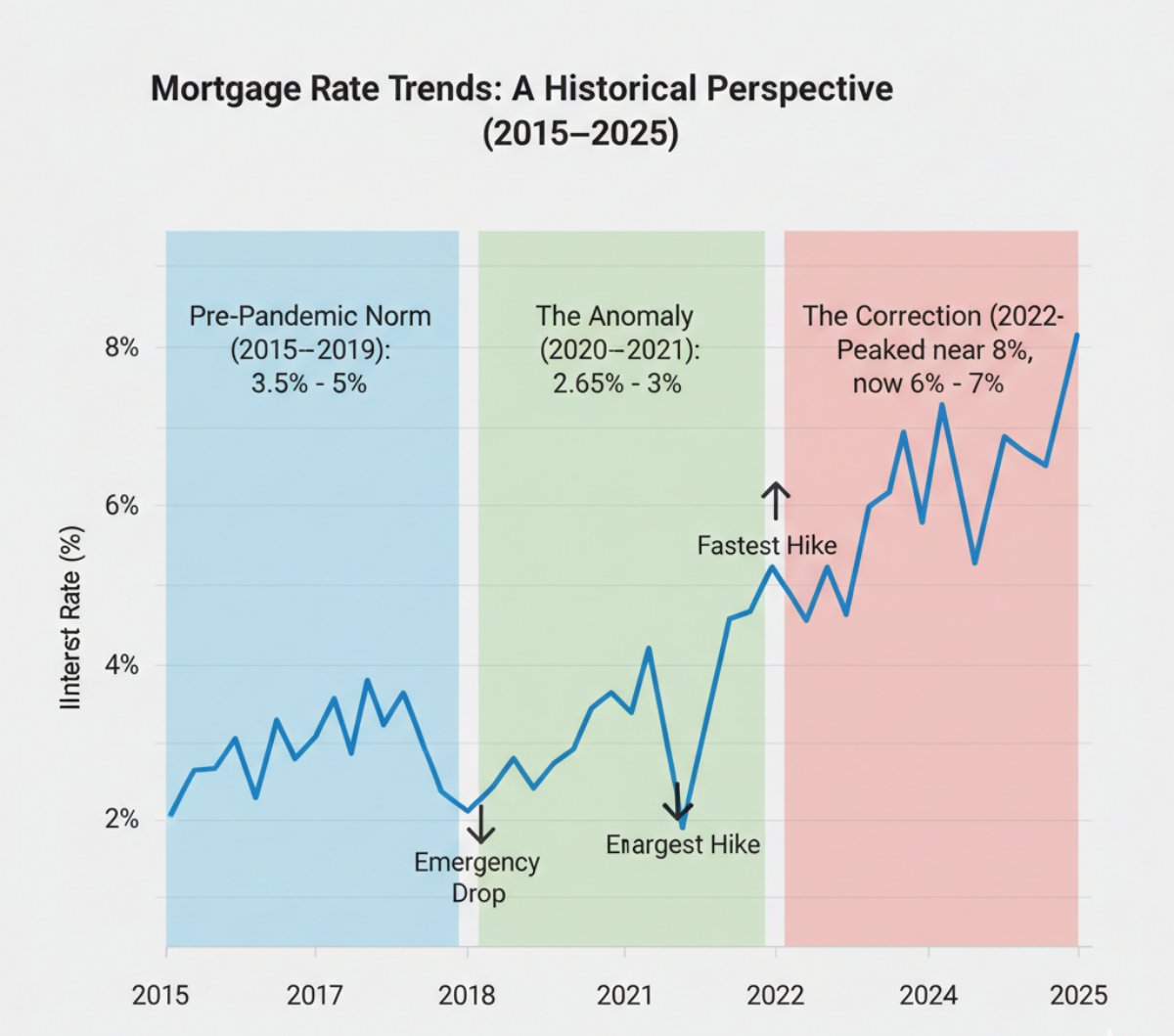
Mortgage Rate Trends: A Historical Perspective (2015–2026)
Context helps here. If you only look at the last five years, your sense of "normal" is probably skewed.
- Pre-pandemic norm (2015–2019): Rates moved between 3.5% and 5%, a healthy and fairly predictable range.
- The anomaly (2020–2021): Rates fell to 2.65% to 3%, an emergency response to a global crisis rather than a normal market condition.
- The correction (2022–2025): The fastest rate hike cycle in modern history pushed rates near 8% before they settled into the 6% to 7% range.
- 2026: Rates have stayed anchored in the mid-to-high 6% range for most of the year, occasionally testing 6.8%, as inflation and geopolitical risk offset the Fed's earlier cuts.
Zoomed out, 2026 looks a lot more like 2000 or 2007 than 2021. We're settling into something closer to a historical average, even if that's a hard adjustment for anyone who bought or refinanced during the 2020–2021 window.
Long-Term Outlook: What About 2027 Through 2030?
Looking past this year, most economists still expect a "new normal" rather than a return to pandemic-era rates. The structural forces that kept borrowing costs low for over a decade, cheap global labor and easy credit among them, have largely reversed.
For the next several years, the working baseline sits in the 6% to 6.5% corridor, a touch higher than what I projected last winter. The MBA currently expects 6.5% to hold through 2028. Fannie Mae's own models show a modest step down to roughly 6.3% by the second quarter of 2027, then flat from there. Demographics still matter too: Millennial and Gen Z buyers make up the largest home-buying cohort in U.S. history, and that sustained demand puts a natural floor under how low rates can realistically go. Barring a genuine recession, sub-5% rates look unlikely before the end of this decade.
The Lock-In Effect: Is Housing Inventory Finally Loosening Up?
The "lock-in effect" is still one of the biggest reasons home prices haven't cracked. As of early 2026, roughly four out of five mortgage holders carried a rate below 6%, and for the first time on record, the share of homeowners with a rate above 6% now outnumbers the share still locked in below 3%. That's a meaningful shift, even if it doesn't sound dramatic on the surface.
The picture isn't uniform across the country. In fast-growing regions like the South and Southwest, builders have kept adding new supply, and inventory has recovered noticeably faster. In older markets across the Northeast and Midwest, where resale homes dominate, the lock-in effect is still firmly in place, and sellers with 3% and 4% mortgages have little financial reason to list.
Nationally, Realtor.com's full-year 2026 forecast called for an 8.9% increase in existing-home inventory, continuing a third straight year of gains. That's not a flood of new listings, but it's a meaningful shift from the frozen market of 2022 and 2023. Life events (job relocations, growing families, divorces) are pushing more owners to sell despite giving up a lower rate, and that steady trickle is what's actually moving inventory, not a mass rush triggered by falling rates.
Should You Buy Now or Wait? Running the Real Numbers
This is the question every client eventually asks me, and I get it. Let's run the math on a $400,000 home using today's more realistic numbers instead of last winter's optimistic ones.
- Scenario A (Buy Now): You purchase at $400,000 with a 6.5% rate. Monthly principal and interest lands around $2,528.
- Scenario B (Wait One Year): Rates ease modestly to 6.3%, roughly in line with where MBA and Fannie Mae expect 2027 to open, but home prices climb another 3% to 4% (a conservative, historically grounded assumption). The home now costs about $415,000. Monthly principal and interest comes out to roughly $2,568.
The result: In this more realistic scenario, waiting doesn't actually save you money each month. It costs you slightly more, plus a full year of missed equity growth and amortization. Rate drops this modest rarely offset the price appreciation that tends to come with them. That doesn't mean waiting is never the right call. It just means the math needs to work for your specific situation, not a hoped-for rate that may not show up.
Two Common Situations, Worked Through
"I'm planning to retire and downsize in a couple of years. Should I wait for rates to return to pre-2022 levels?"Honestly, no. Rates in the 3% to 4% range were a pandemic-era anomaly, not a cycle we're likely to revisit anytime soon. For a retirement downsize, your monthly cash flow and how well the new home fits your life matter far more than chasing a rate that may never return. Run the numbers on today's rate and see if the payment works for your retirement budget.
"My lease ends in six months. Should I renew or buy now?"This one depends heavily on your local rental market and how long you plan to stay put. If you're set on staying in the same area for five-plus years, locking in a purchase price now and refinancing later if rates ease is often the stronger long-term play than renewing a lease and restarting your search next year at a similar or higher rate.
Smart Strategies for Buying in a High-Rate Market
If you decide to move forward in 2026, don't just accept the sticker rate you're quoted. A few tools can meaningfully soften the impact:
- 2-1 buydown: Ask the seller to fund a temporary rate reduction, typically 2 percentage points lower in year one and 1 point lower in year two. This buys you breathing room while you wait to refinance.
- Adjustable-rate mortgage (ARM): If you're confident you'll move or refinance within seven years, a 7/1 ARM often prices meaningfully lower than a 30-year fixed loan.
- "Marry the house, date the rate": Lock in today's purchase price now, then refinance later if and when rates ease. You can always change your loan terms down the road. You can't go back and change what you paid for the house.
FAQs: Mortgage Rates in 2026, Answered Honestly
Will interest rates realistically drop to 4% in 2026 or 2027?
No. There's no credible data supporting that outcome. Short of a genuine recession, which would bring its own set of problems like job losses, a 4% rate isn't realistic in this cycle. Plan around 6.5%, and treat anything below that as a pleasant surprise.
Will mortgage rates ever see 3% again?
"Never" is a strong word, but not in any timeframe you should plan around. That rate was a one-time response to a global pandemic, not a market feature you can count on returning. Building your financial plan around its comeback is a risky bet.
How does the Fed Funds Rate actually affect my mortgage rate?
Indirectly, and often with a lag. The Fed sets short-term rates that influence things like credit cards and HELOCs. Mortgage rates track long-term bond yields instead, mainly the 10-year Treasury. That's why the Fed can hold rates steady, or even signal a possible hike, and mortgage rates can still move independently based on inflation data and investor expectations.
Is 2026 shaping up to be a buyer's or seller's market?
It's landing somewhere in between, with a slight edge to sellers in many markets due to persistently tight supply. Inventory is improving (up close to 9% nationally per the latest full-year projections), but demand still outpaces the number of well-priced, move-in-ready homes in most areas. You'll have more choices than you did in 2024, but don't expect steep discounts.
The Bottom Line for 2026
So, are mortgage rates going down in 2026? Modestly, in some scenarios, but not the way most of us expected a year ago. The honest answer is that 2026 turned into a year of stability at a higher level than forecasters predicted, not the gradual decline we were promised.
My advice hasn't really changed, even though the numbers have. Stop trying to time the market perfectly. Even the best economists at Fannie Mae and the MBA have had to revise their calls multiple times this year. Look at your monthly budget with today's real rates, not a hoped-for future one. If the payment works comfortably at 6.5% and you plan to stay put for five or more years, buying still makes sense.
You can always refinance a rate later. You can't refinance the price you paid for the house today. Stay informed, stay realistic about the numbers, and focus on what's actually in your control.
People Also Read
- 8 Best Non-QM Mortgage Lenders in 2026: Which to Choose?
- Best CRM for Loan Officers 2026: Which One Suits You Most?
- Full Guide: What is a non-QM Loan? Everything to Learn

![[Solved] What Red Flags Would a Mortgage Underwriter See?](https://cdn.prod.website-files.com/6731bc6e813a541b54c30b10/6aa24ca70b95e62dd7bbeefd_red-flags-mortgage-underwriting-banner.png)