![[Solved] How Long Does Mortgage Underwriting Take?](https://cdn.prod.website-files.com/6731bc6e813a541b54c30b10/69ba6c72758bf721ac4f9f55_how-long-does-mortgage-underwriting-take-banner.png)
Written by

Eric
Share this article

.svg)
Subscribe to updates
I know that feeling of hitting "submit" on your mortgage application and then... waiting. It feels like your entire future is sitting in a black box. Having navigated the mortgage world for years, I can tell you that mortgage underwriting typically takes 1 to 3 weeks (5 to 15 business days), though it can be as short as 2-3 days for simple cases or longer for complex ones.
While some "clean" files can breeze through in 48 hours, others involving complex self-employment income or property issues might take longer. In this guide, I'll break down exactly what's happening behind the scenes during those days and, more importantly, how you can speed up the clock so you can finally get those keys.
How Long Does a Mortgage Take Once It Goes to Underwriting?
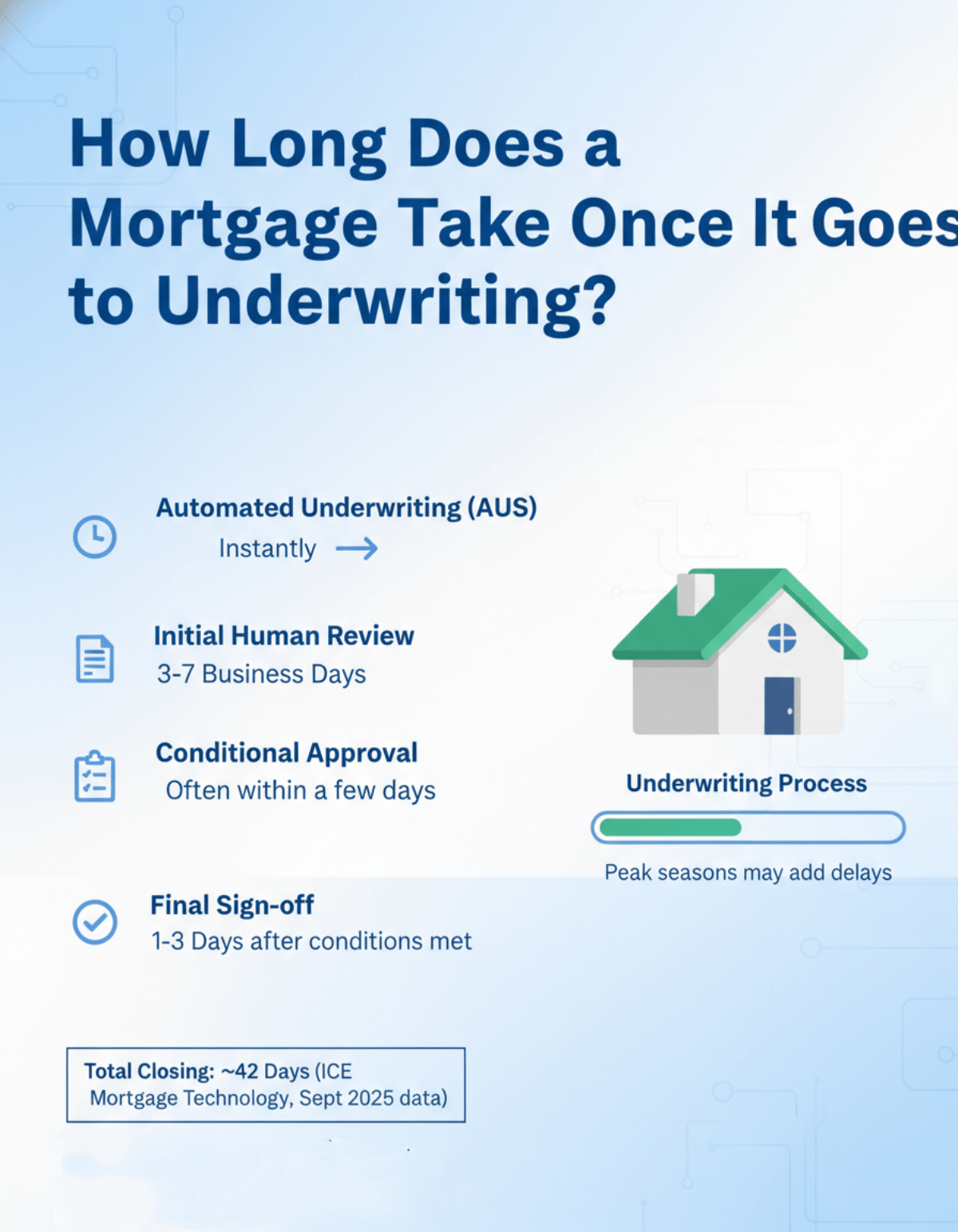
Once your loan file hits the underwriter's desk, the clock truly starts ticking. According to recent data from ICE Mortgage Technology (as of September 2025), the average time to close a purchase loan is about 42 days, of which underwriting comprises a significant portion (often 1-3 weeks). Here is a realistic timeline I've observed in the current US market:
- Automated Underwriting (AUS): This happens almost instantly. Systems like Fannie Mae's Desktop Underwriter (DU) flag major issues within minutes.
- Initial Human Review: 3 to 7 business days for document verification and initial assessment. This is where an underwriter manually verifies your debt-to-income ratio (DTI) and credit history.
- Conditional Approval: Issued after initial review, often within a few days if issues are flagged. Not necessarily within 24 hours.
- Final Sign-off: 1 to 3 days after conditions are met.
During peak seasons, high volumes can extend the total closing timeline, but specific underwriting delays vary and may add several days depending on lender backlog.
Initial Review vs. Final Underwriting: Two Different Clocks
Most borrowers lump the whole process into one blob called "underwriting," but it really runs in two stages, and mixing them up is what causes most of the confusion around timing.
- The initial review happens once your loan file first lands on an underwriter's desk. This usually takes 3 to 10 business days. During this stage, the underwriter checks your income, assets, credit, and debt-to-income ratio against the guidelines for your loan program.
- The final underwriting review happens after you've cleared your conditions and the appraisal has come back. This second pass is much shorter, often just 1 to 3 business days, because the underwriter is mainly confirming that nothing changed and that every condition was satisfied.
So when someone asks "how long is a loan in underwriting," the honest answer is: it depends on which clock you're asking about.
The 2026 Numbers: Underwriting Is Getting Faster
Here's something worth knowing if you last bought a home a few years ago: the whole process has sped up. Recent data from ICE Mortgage Technology shows the average purchase loan closed in about 36.8 days in March 2026, one of the fastest paces on record since the company started tracking this. That breaks down roughly into 11 days from application to rate lock, then another 26 days from rate lock to closing.
Compare that to just a year earlier, when the average sat closer to 42 days, and you can see the industry has genuinely trimmed the fat. A lot of that improvement comes down to lenders leaning harder on automated underwriting systems and digital document verification instead of manually chasing down paperwork.
I've noticed this shift firsthand. A few years back, a routine W-2 file with no red flags might still sit in a queue for a week before anyone touched it. Now, with automated underwriting engines doing the first pass in minutes, that same file can get eyes on it the same day it's submitted.
Underwriting Timelines by Loan Type
Not every loan moves at the same speed. The type of mortgage you're getting changes how long the underwriter needs, and why.
- Conventional loans are usually the fastest. With a clean file, expect underwriting to wrap up in roughly 3 to 7 business days, since there's no government agency layered on top of the lender's own guidelines.
- FHA loans tend to run 5 to 10 days longer than conventional. The extra time comes from stricter property condition standards and the added step of calculating mortgage insurance premiums, both of which conventional loans skip.
- VA loans follow a similar pattern to FHA. The automated system can return a decision in minutes, but the VA-assigned appraiser is often the real bottleneck, and appraisal turnaround alone can take 10 to 20 business days in busier markets. Once conditions and the appraisal are in, lender review usually takes 7 to 14 business days.
- Manual underwriting, where a human reviews the entire file line by line instead of relying on automated approval, is the slowest option. Expect it to take meaningfully longer than an automated approval, since it demands more documentation and more judgment calls from the underwriter. It's often the only path for self-employed borrowers or anyone whose income doesn't fit a standard W-2 mold.
- Refinances generally track close to purchase loans in underwriting time, though they can move a bit faster since there's no seller, no purchase contract deadline, and often a simpler appraisal.
List of Common Mortgage Underwriting Conditions
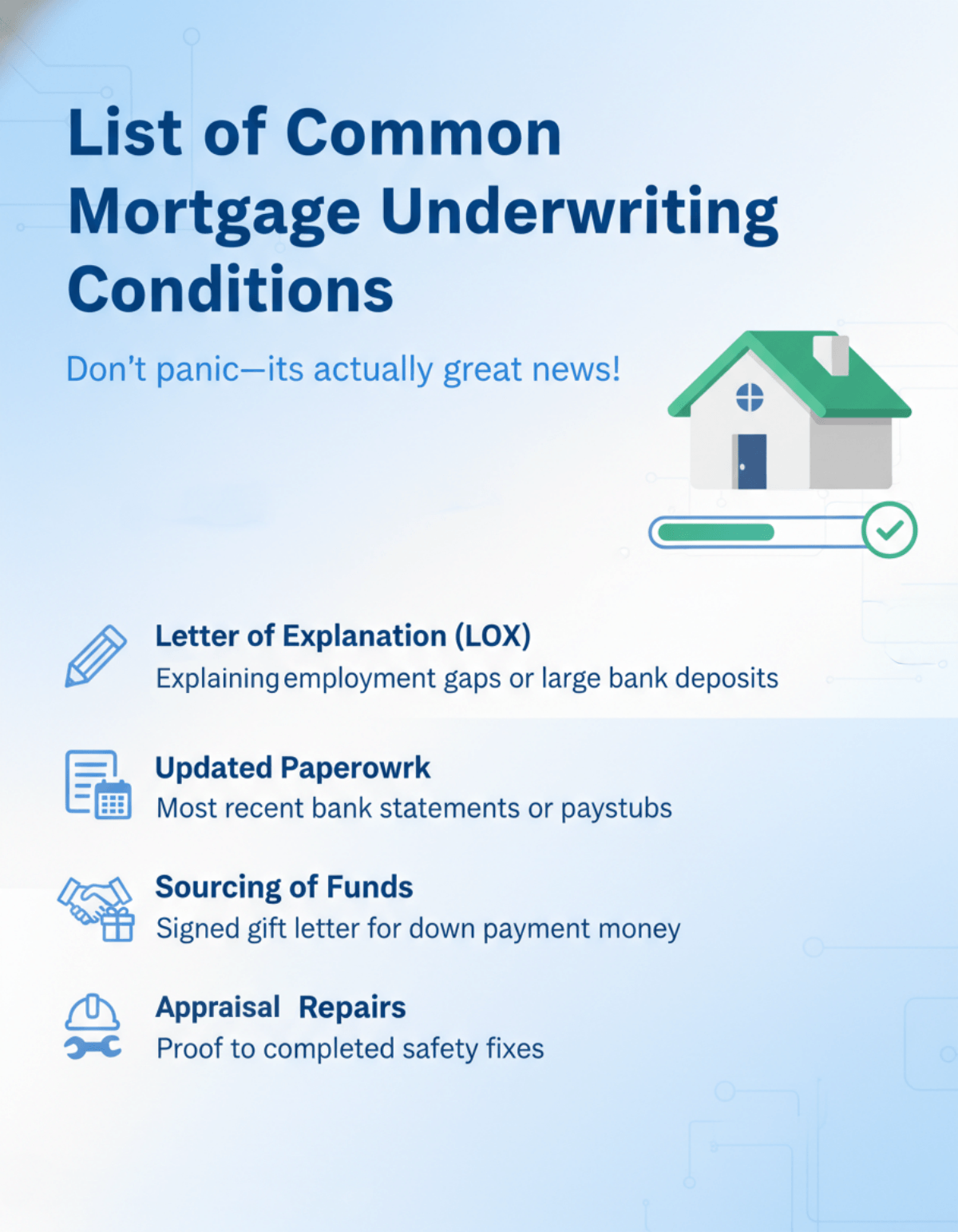
Don't panic if you get a "conditional approval"—it's actually great news. In my experience, it's rare to see a file go through without at least a few requests. These conditions are simply the underwriter's way of "double-checking the math." Common items include:
- Letter of Explanation (LOX): A brief note explaining a gap in employment or a recent large deposit in your bank account.
- Updated Paperwork: Since bank statements and paystubs expire, they might ask for the most recent month's version.
- Sourcing of Funds: If a family member gave you money for the down payment, you'll need a signed "gift letter."
- Appraisal Repairs: If the appraiser flagged a safety issue, the mortgage underwriter needs proof it has been fixed before funding.
Why Does Underwriting Take So Long?
This is the question I get asked the most, usually somewhere around day 10 of waiting. In my experience, delays almost never come from the underwriter being slow on purpose. They come from a handful of very avoidable snags:
- Incomplete documentation. This is, by far, the number one cause of delay. A missing signature page or an outdated bank statement can pause a file for days while the lender waits on a replacement.
- Third-party verification lag. Employers, banks, and landlords don't always respond the same day someone calls to verify your information, and the underwriter can't move forward without that confirmation.
- Appraisal scheduling. Especially with FHA and VA loans, if the appraiser flags a repair issue, the property needs a re-inspection before the file can close, which can add one to three weeks.
- Lender workload. If a lender is buried in a backlog of files, even a perfect application can sit in a queue longer than it should.
- Changes in your financial picture. A new credit card, a job change, or a large unexplained deposit mid-process can send the underwriter back to square one on a specific line item.
If your file feels stuck, the fastest fix is almost always the same: call your loan officer, ask exactly what's outstanding, and turn documents around within 24 hours instead of days.
What Factors Will Slow Down Mortgage Underwriting?
I've seen loans get stuck for weeks over things that could have been avoided. The biggest bottleneck is often incomplete documentation. If you send a bank statement but forget page 6 of 6 (even if it's blank), the underwriter has to stop and move on to the next file until you provide it.
Other major delays include:
- Credit Changes: Opening a new credit card or financing furniture mid-process is a huge mistake. It forces a total re-calculation of your DTI.
- Unresponsive Third Parties: Sometimes, the delay isn't the lender. It's waiting for a landlord to verify rent or an employer to return a phone call.
- Property Issues: Discovering a title cloud or an undisclosed tax lien on the property can halt the process for days while the legal team investigates.

Tips to Speed Up Mortgage Underwriting
If you want to move your file to the top of the pile, you need to be proactive. Here are my top two insider tips:
- For Underwriters and Lenders: Efficiency starts with the right tools. I highly recommend integrating Zeitro into your workflow. Zeitro connects directly to your Loan Origination System (LOS) and uses AI-powered tools to automate data extraction. By reducing manual entry, it allows underwriters to clear files significantly faster with fewer human errors.
- For Borrowers: Don't just settle for any lender. I suggest using Bluerate to connect with top-tier loan officers. Bluerate allows you to track your loan origination process in real-time. By having a clear view of the "milestone tracker," you can see exactly where the hold-up is and nudge the right person immediately.
- Be a "Document Ninja": Respond to all requests within 24 hours. Use a high-quality scanner—not a blurry phone photo—to ensure the underwriter can read every digit on your tax returns.
What Happens After Underwriting Approval?
Once you receive "Clear to Close" (CTC), underwriting is complete. The lender then issues the Closing Disclosure (CD) at least three business days before closing, per federal TRID rules, which outlines your final loan terms and closing costs. By federal law, you have a three-day "cooling-off" period to review this document before you can sign your final papers.
I always tell my clients to use this time to double-check their wire instructions and confirm their homeowners' insurance is active. After the three days, you'll attend the closing meeting, sign the stack of papers, and the house is yours.
FAQs About the Timeline of Mortgage Underwriting
Q1. What not to do during underwriting?
Do not quit your job, do not make large cash deposits that can't be sourced, and absolutely do not apply for any new credit. Any change in your financial profile can trigger a "denial" even at the last minute.
Q2. Do mortgages get declined at the underwriting stage?
Yes, they can. Most declines at this stage happen because the underwriter discovered undisclosed debt or the borrower's income couldn't be verified as originally claimed.
Q3. Does closing disclosure mean underwriting is done?
Yes, the Closing Disclosure is issued only after underwriting approval and Clear to Close, with a mandatory three-business-day review period before closing.
Q4. Should I be worried about underwriting?
Not if you've been honest. It's a standard verification process. Think of the underwriter as a "fact-checker" whose job is to ensure the loan is safe for both you and the bank.
Conclusion
Navigating the mortgage underwriting timeline can feel like a test of patience, but remember that the average window of 3 to 14 days is just a small step in your homeownership journey. The secret to a fast approval lies in the combination of your own preparation and the technology your lender uses.
- If you are a borrower looking for transparency and speed, head over to Bluerate to find a loan officer who keeps you in the loop every step of the way.
- If you are an underwriter or work for a lending firm, consider how Zeitro can transform your LOS with automation tools that eliminate the "paperwork lag."
By choosing the right partners and staying organized, you can turn a stressful waiting game into a smooth path to your new front door.
People Also Read
- Manual Mortgage Underwriting Explained: An Ultimate Guide
- What is Mortgage Eligibility Checker? Best Tool to Verify Guidelines
- Mortgage Guidelines: What Are They? How to Verify?
- Why is Underwriting Asking for More Documents in Mortgage?

![[Solved] What Red Flags Would a Mortgage Underwriter See?](https://cdn.prod.website-files.com/6731bc6e813a541b54c30b10/6aa24ca70b95e62dd7bbeefd_red-flags-mortgage-underwriting-banner.png)