![[Solved] What Red Flags Would a Mortgage Underwriter See?](https://cdn.prod.website-files.com/6731bc6e813a541b54c30b10/6aa24ca70b95e62dd7bbeefd_red-flags-mortgage-underwriting-banner.png)
Written by

Eric
Share this article

.svg)
Subscribe to updates
When I review your mortgage file, I am not looking for reasons to decline your application. My actual job is proving to investors like Fannie Mae and Freddie Mac that you can comfortably repay the debt. Still, specific patterns instantly halt my review. Learning how an underwriter spots risk helps you prevent costly closing delays. Here is what stands out on our desks and how to resolve each issue quickly.
Key Takeaways
- Paper trails protect down payments: Every dollar used for closing must be verified. Never deposit untraceable cash into your accounts.
- Keep credit in a holding pattern: Avoid opening new store cards, financing vehicles, or running credit checks before loan documents are signed.
- Stable employment is non-negotiable: Switching from a salaried role to independent contracting resets your required income verification window.
- Appraisal gaps need early contingency plans: Ensure you have contract protections or cash buffers if the property valuation falls short.
- Respond to conditions within 24 hours: Prompt documentation keeps your rate lock secure and moves you toward final approval.
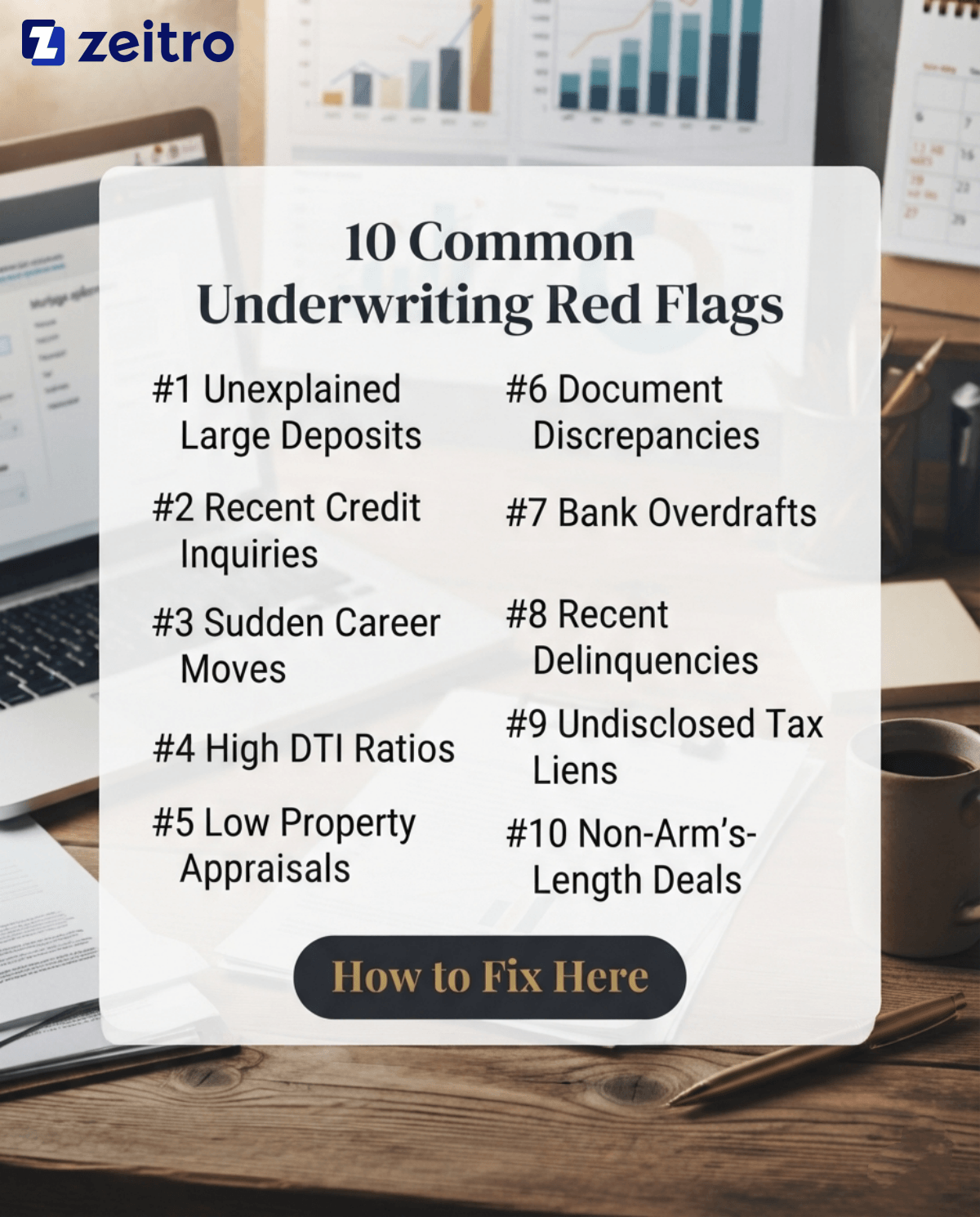
10 Common Underwriting Red Flags and Fixes
#1 Unexplained or Unsourced Large Deposits
Whenever I inspect your two-month bank statements, any single transfer or deposit exceeding 50% of your total monthly qualifying income triggers a manual review. Under federal anti-money laundering regulations, we cannot accept unverified cash, mattress money, or mystery deposits. We need absolute certainty that the money in your account is not an undisclosed personal loan requiring additional monthly payments.
How to fix it:
- Provide a clear paper trail, including copies of cancelled checks, settlement statements, or investment withdrawal slips.
- If the funds came from family, obtain an official gift letter alongside the donor's bank statement showing the outgoing transfer.
- Allow personal funds to sit in your account for at least 60 days so they appear as seasoned assets on normal statements.
#2 Recent Credit Inquiries and Undisclosed Debt
If you shop for appliances or finance a vehicle while your application is in review, an automated monitoring alert hits my computer. Even a simple hard credit inquiry can lower your credit score just enough to jeopardize automated underwriting approval. Worse, a new monthly installment payment can easily push your debt ratios beyond acceptable guidelines right before funding.
How to fix it:
- Put an absolute freeze on consumer borrowing. Do not apply for store cards or take out loans until your deed is recorded.
- Submit a signed Letter of Explanation (LOE) stating that specific inquiries resulted in no new credit lines or balances.
- If new debt was unavoidable, send the updated account agreement immediately so we can recalculate your numbers without unexpected surprises at closing.
#3 Sudden Career Moves or Switching to 1099 Work
Underwriting relies heavily on stable, predictable earnings with a continuous two-year track record. When an applicant leaves a predictable W-2 salary to become an independent 1099 contractor during processing, the loan stops dead in its tracks. Independent contractors generally require two full tax cycles of filed returns to prove verifiable income sustainability.
How to fix it:
- Postpone transitions to self-employment or commission-heavy structures until after you receive the keys to your home.
- If staying in the same field as a salaried employee, supply an unconditional offer letter along with your first 30-day pay stub.
- For corporate lateral moves, have your human resources department expedite a formal written verification of employment confirming permanent, full-time status.
#4 High or Spiking Debt-to-Income (DTI) Ratios
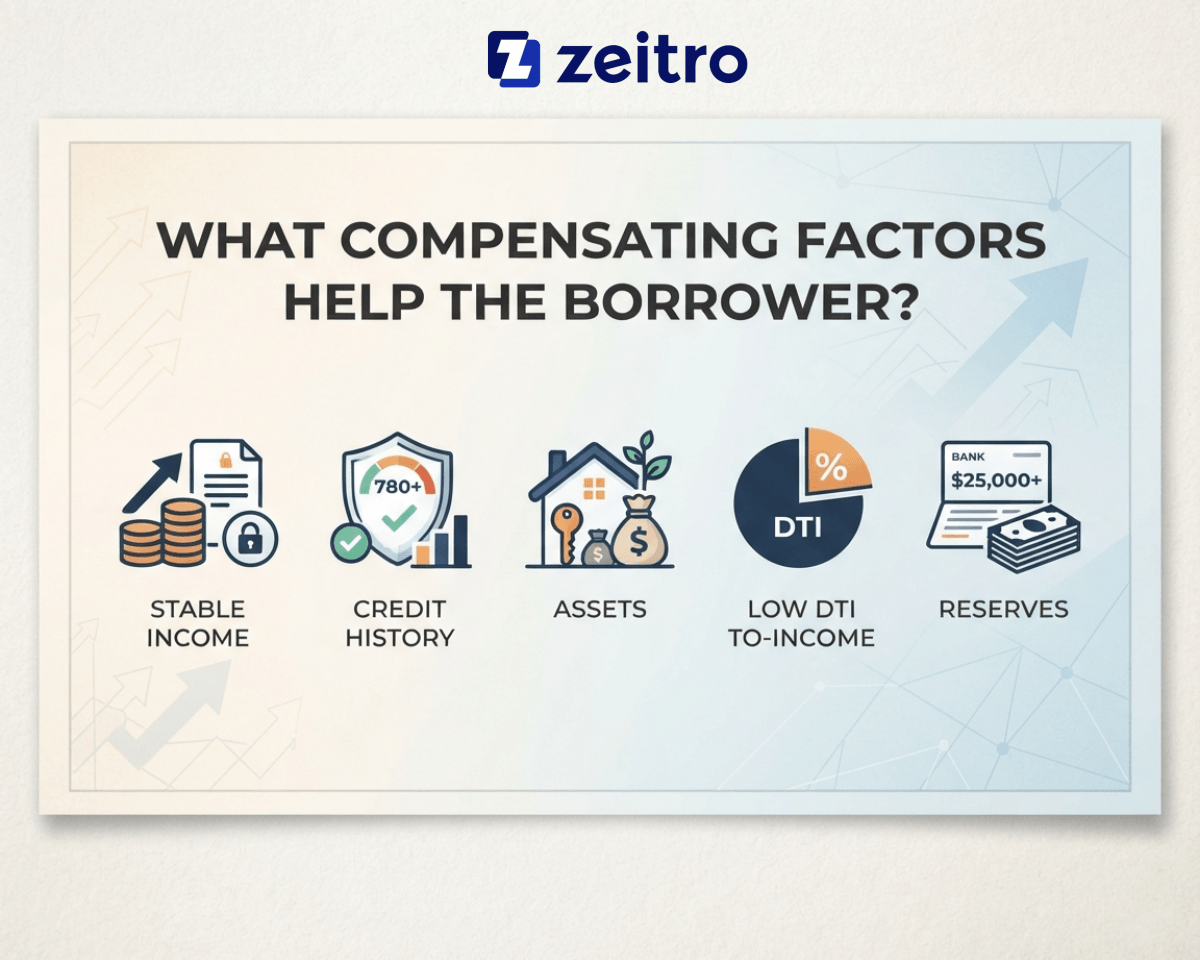
Most conventional loan files prefer a debt-to-income ratio beneath 45%, though strong files can occasionally stretch to 50% through automated systems. FHA loans may allow DTIs up to 57% with strong compensating factors.
When your recurring obligations absorb too much gross income, you leave zero margin for emergencies. A modest increase in local property taxes or homeowner insurance can push a marginal file straight into rejection territory.
How to fix it:
- Eliminate low-balance installment accounts or revolving credit balances that carry high minimum monthly payments.
- Add a creditworthy non-occupant co-borrower to the application to supply additional qualifying income.
- Revisit your loan structure by exploring lower-rate options, paying discount points, or switching to an FHA loan program with more forgiving ratio tolerances.
#5 Low Property Appraisals and Valuation Shortfalls
Lenders evaluate collateral just as closely as borrower finances. Our maximum financing percentage is always tied to the purchase price or the independent appraisal, whichever is lower. If an appraiser determines the house is worth $20,000 less than your contract price, the lender will not cover that difference, leaving a troublesome funding gap.
How to fix it:
- Ask your real estate agent to compile recent, hyper-local comparable sales and submit a formal appraisal rebuttal.
- Use your contract's appraisal contingency to negotiate the purchase price down to the newly determined market value.
- Cover the appraisal deficit out of pocket by contributing additional personal cash to preserve the required loan-to-value ratio.
#6 Personal Document Discrepancies and Address Conflicts
When our automated fraud software flags mismatches across your paperwork, I have to investigate for identity theft or occupancy misrepresentation. Red flags include variations in your Social Security number, different residential addresses across tax returns, or an employer using a personal post office box instead of a verified commercial location.
How to fix it:
- Verify that your full legal name, current residence, and Social Security details match across tax transcripts, pay stubs, and driver's licenses.
- Submit a brief Letter of Explanation clarifying legitimate address changes, recent relocations, or maiden names.
- Supply direct landline contacts or administrative credentials for your employer to facilitate smooth third-party employment verification.
#7 Bank Overdrafts and Chronic Non-Sufficient Funds
A single overdraft fee on a bank statement may seem trivial to a consumer, but to an underwriter, it signals cash-flow strain. Seeing multiple Non-Sufficient Funds (NSF) charges indicates you are juggling cash or spending past your limit. These items damage my confidence in your ability to manage higher monthly housing payments.
How to fix it:
- Maintain a financial cushion in your primary checking account for at least three months prior to loan origination.
- Provide written evidence from your banking institution showing the fee was an isolated administrative error that was fully refunded.
- Supply secondary reserve asset statements, such as retirement or brokerage accounts, showing liquid holdings to offset temporary cash-flow concerns.
#8 Recent Delinquencies and Late Housing Payments
Nothing worries an underwriter more than a 30-day late payment on rent or an existing mortgage within the prior twelve months. Credit scoring algorithms treat historical housing payments as the single most reliable predictor of future loan performance. A recent delinquency suggests that any financial bump could lead directly to default.
How to fix it:
- Collect twelve months of cancelled rent checks or electronic receipts verifying that your housing payments cleared on schedule.
- If a genuine medical emergency or temporary job interruption caused a past-due account, document it with a detailed hardship letter and receipts.
- Focus on building non-traditional credit references, such as on-time utility and insurance records, to demonstrate disciplined payment habits.
#9 Undisclosed Tax Liens or Ongoing Legal Battles
Federal tax obligations take automatic legal precedence over private mortgages. If a public records check reveals an unpaid IRS lien or a pending civil lawsuit where damages could impair your assets, the lender's first-lien security is compromised. We cannot issue final loan approval until these outstanding encumbrances are settled or formally subordinated.
How to fix it:
- Apply for a certificate of subordination or release of the federal tax lien using IRS Form 14134, and provide documentation showing the IRS has agreed to subordinate its lien position to the mortgage lender. A simple payment agreement alone is typically insufficient for loan approval.
- Provide court documentation confirming an active legal dispute is fully covered by liability insurance or has reached a settled dismissal.
- Obtain an official letter from the relevant tax authority confirming current account standing and the absence of any filed property liens.
#10 Non-Arm's-Length Deals and Rapid Property Flips
Buying a home from an immediate family member, close friend, or employer draws strict scrutiny. These non-arm's-length transactions present risks of artificial pricing, disguised gifts, or hidden kickbacks.
Similarly, properties bought and resold within ninety days at a substantial markup trigger rigorous anti-flipping reviews. FHA generally prohibits financing on properties sold within 90 days unless specific exceptions apply, while Fannie Mae and Freddie Mac allow such transactions with additional appraisal scrutiny.
How to fix it:
- Sign a formal non-arm's-length disclosure detailing personal or business relationships with the seller.
- Require the seller to provide paid contractor invoices, municipal building permits, and itemized receipts justifying any short-term price increase.
- Prepare for your lender to mandate an independent second appraisal to verify that the higher valuation matches neighborhood trends.
Tips for a Smooth Underwriting
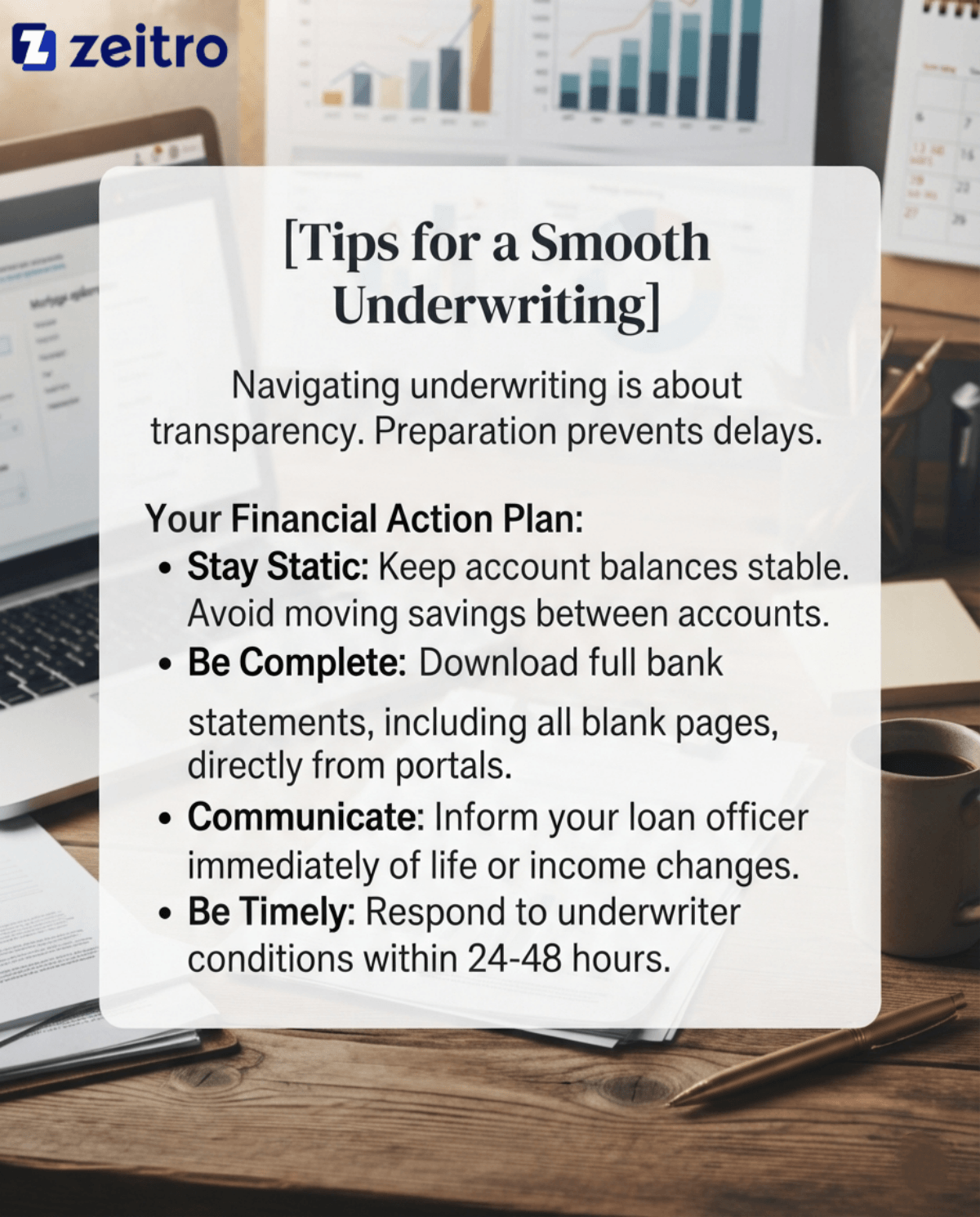
Navigating underwriting comes down to transparency and preparation. We run into problems when borrowers attempt to mask financial hiccups instead of addressing them upfront. Think of underwriting as an open-book review where every question has a reasonable answer as long as you maintain clear supporting documents.
- Keep your balances static: Postpone moving savings between multiple bank accounts during processing to avoid generating fresh verification requirements.
- Maintain complete paper trails: Download whole bank statement packages directly from your online portals, including every blank page.
- Communicate life changes early: Tell your loan officer immediately if your hourly schedule changes or if you receive unexpected funds.
- Return conditions promptly: Reply to underwriter stipulations within 24 to 48 hours to preserve your interest rate lock and meet closing schedules.
FAQs About Underwriting Red Flags
Q1. How common is it to get denied during underwriting?
Outright denials during the final underwriting stage are relatively uncommon once you hold a fully vetted pre-approval. Overall denial rates across the mortgage industry hover around 8% to 10%, primarily stemming from unresolvable credit blemishes or sudden income loss. In most cases, files encounter conditional approvals rather than rejections, meaning you simply need to supply missing documents to clear final milestones.
Q2. How far back does an underwriter look?
Underwriters typically audit the past two years of your financial life. We review two full years of W-2 statements, tax returns, and consecutive employment history. For liquid assets, our review standard covers your most recent 60 days of bank activity. On credit reports, we scrutinize the last 12 to 24 months closely, though severe items like bankruptcies or foreclosures remain visible for extended periods: Chapter 7 bankruptcies stay for up to 10 years, Chapter 13 bankruptcies for 7 years, and foreclosures for 7 years from the date of the first missed payment that led to the foreclosure.
Q3. What looks bad on bank statements for a mortgage?
Beyond overdraft fees and NSF penalties, red flags include recurring, untraceable peer-to-peer transfers, irregular cash deposits, and monthly debits tied to private lenders or payday loans. Undisclosed recurring payments suggest you took on unapproved loans that must be counted toward your total monthly liabilities.
Q4. Can an underwriter deny a loan after pre-approval?
Yes. A basic pre-approval is merely an initial estimate based on unverified credit and self-reported income. An underwriter can issue a denial if verified documents contradict your original application, if the home appraisal comes in deficient, or if you change jobs or open new credit lines before funding.
Final Words
Securing a mortgage is simply a step-by-step verification exercise. Remember that receiving an initial list of underwriter conditions is a routine part of the approval journey, not a denial.
By staying responsive, avoiding fresh financial commitments, and keeping an organized paper trail, you can clear every underwriting checkpoint and turn your conditional approval into a firm"clear to close" status.
People Also Read
- [Solved] Why is Desktop Underwriter (DU) Rejecting Files?
- [Solved] Why is Loan Product Advisor (LPA) Rejecting Income?
- Reasons: Why Is Income Not Qualifying for a Mortgage?

![[Solved] Why is Loan Product Advisor (LPA) Rejecting Income?](https://cdn.prod.website-files.com/6731bc6e813a541b54c30b10/6aa11d2cb785a137b728997d_loan-product-advisor-reject-income-banner.jpg)
![[Solved] Why is Desktop Underwriter (DU) Rejecting Files?](https://cdn.prod.website-files.com/6731bc6e813a541b54c30b10/6aa11212d02666b337b8d2f4_desktop-underwriter-reject-file-banner.jpg)