Written by

Eric
Share this article

.svg)
Subscribe to updates
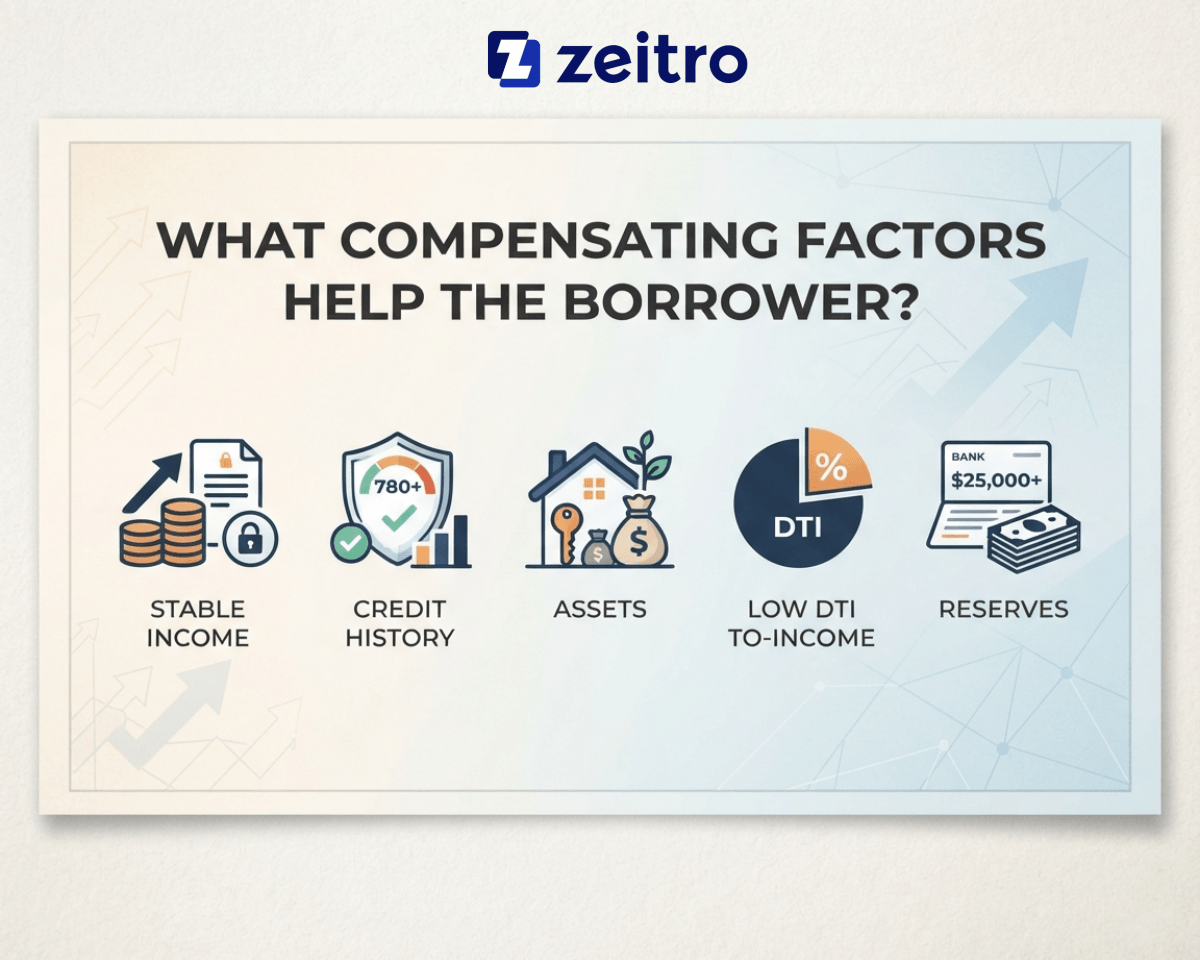
Whenever a loan file lands on my underwriting desk with a tight debt-to-income ratio or a borderline credit score, my immediate question is simple: what strengths can rescue this application? In everyday lending, rigid algorithms often trigger automated denials. That is where compensating factors step in. They provide the clear, documented leverage I need to push a tough mortgage file across the finish line.
Key Takeaways
- Compensating factors are verified financial strengths that exceed baseline guidelines to offset profile weaknesses like high debt ratios or thin credit.
- Underwriters require a "logical nexus," meaning the specific asset or metric must directly counterbalance the identified loan risk.
- Robust cash reserves, minimal payment shock, and generous residual income hold the greatest influence during manual underwriting.
- These elements resolve capacity and cash-flow concerns, but they will never excuse delinquent payment habits or poor credit character.
What are Compensating Factors for a Mortgage?
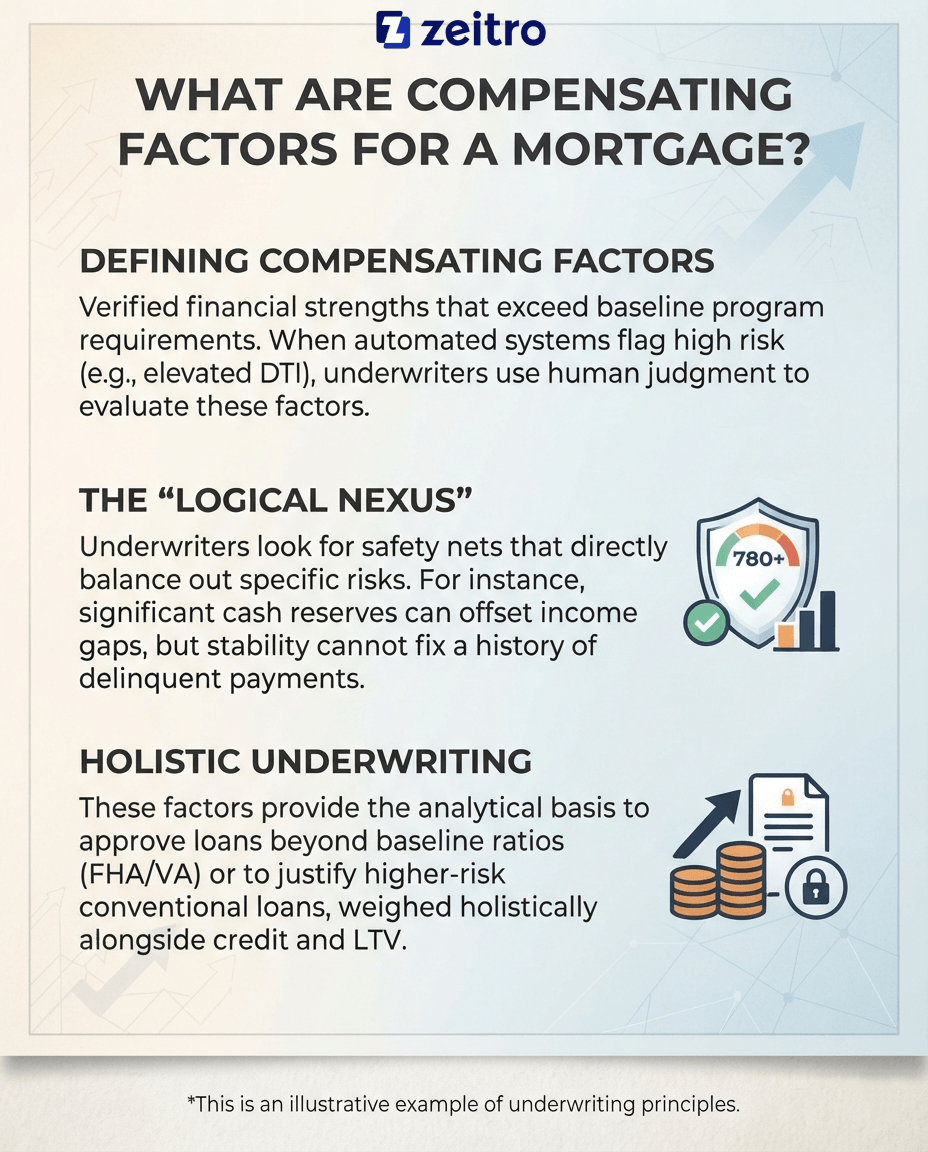
In my years structuring home loans, I define compensating factors as verified financial attributes that exceed baseline program requirements. When an automated system flags a borrower's file due to an elevated debt-to-income (DTI) ratio, we transition to manual underwriting. Here, human judgment takes over.
Crucially, standard compliance is not a compensating factor. Having just enough cash to cover closing costs will not qualify. Instead, underwriters look for distinct safety nets and what the industry calls a "logical nexus", meaning the financial strength must directly balance out the identified risk. For instance, holding significant liquid reserves can offset an income gap, but long job tenure cannot fix a history of delinquent payments.
Ultimately, these factors give underwriters the analytical basis to approve files that exceed baseline ratios on FHA and VA loans, and to justify higher-risk conventional loans within Fannie Mae and Freddie Mac guidelines, without materially increasing expected default risk. For FHA and VA, specific compensating factors map to defined DTI tiers. For conventional loans, they are weighed holistically alongside credit score, LTV, and automated underwriting findings.
What Compensating Factors Help the Borrower?
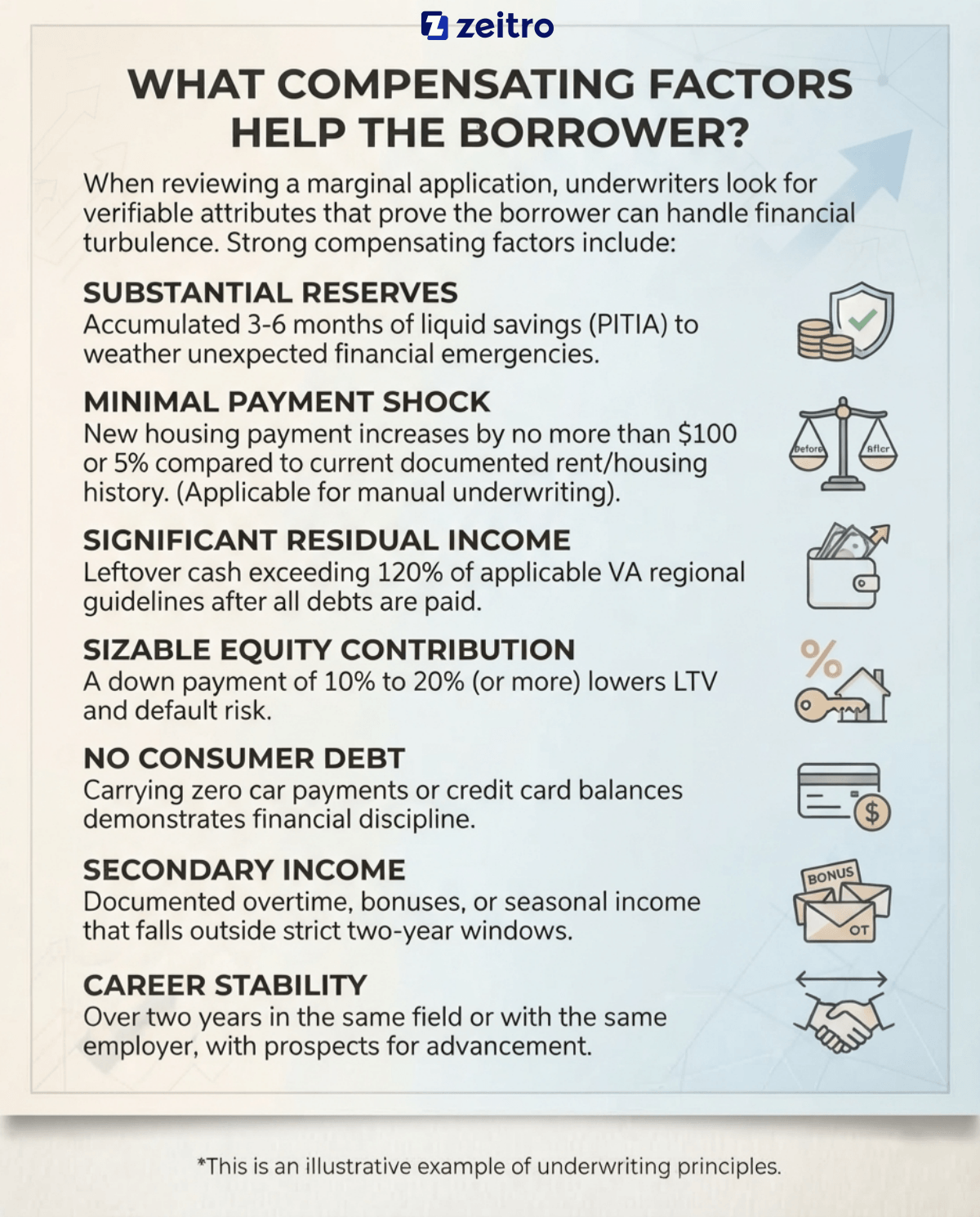
When I review a marginal application, I look for verifiable attributes that prove the borrower can handle financial turbulence. The strongest compensating factors include:
- Substantial Post-Closing Reserves: Accumulating three to six months of principal, interest, taxes, and insurance (PITIA) in liquid savings shows me that an unexpected emergency will not derail monthly mortgage payments.
- Minimal Payment Shock (FHA manual underwriting): If your proposed monthly housing payment increases by no more than $100 or 5% (whichever is less) compared to your verified 12-month rental or prior housing payment history, this can serve as a compensating factor under FHA manual-underwriting guidelines.
- Significant Residual Income: Having leftover cash that exceeds the applicable VA regional residual income guideline by 20% or more (i.e., at least 120% of the VA table amount) after paying all housing costs and debts is a recognized compensating factor, especially on higher-DTI files. FHA manual underwrites often use the VA residual income table as a benchmark, even though FHA itself does not publish its own regional residual income charts.
- Sizable Equity Contribution: Putting down 10% to 20% instead of program minimums lowers our loan-to-value ratio, giving you instant skin in the game and lowering default risk.
- Absence of Consumer Debt: Carrying zero credit card balances or car payments demonstrates disciplined money management, freeing up monthly cash flow exclusively for shelter costs.
- Documented Secondary Income: Regular overtime, performance bonuses, or seasonal earnings that miss strict two-year qualifying windows can still serve as qualitative proof of robust earning power.
- Extended Career Stability: Remaining in the same field or with the same employer for at least two years, with documented advancement prospects, provides confidence in sustained future earnings and can serve as a compensating factor in manual underwriting.
FAQs About Mortgage Compensating Factors
Q1. Can compensating factors overcome a bad credit history or recent bankruptcy?
Not for recent bankruptcies or recent serious delinquencies that violate program waiting-period rules. Compensating factors are intended to offset capacity or capital weaknesses, such as a high debt ratio, not to excuse open collections, recent mortgage late payments, or a demonstrated unwillingness to repay debts. However, for borderline credit scores or older credit issues that already meet program eligibility, strong compensating factors can help support approval.
Q2. How many compensating factors are needed for an FHA manual underwrite?
It depends on your debt ratios. Under HUD Handbook 4000.1, the baseline manual-underwriting limits are 31% front-end and 43% back-end with no compensating factors. With one documented compensating factor, the limits expand to 37% front-end and 47% back-end. With two or more strong compensating factors, they can reach 40% front-end and 50% back-end.
Q3. Can retirement funds like a 401(k) count toward cash reserves?
Yes, vested retirement assets can often be counted as reserves, but lenders usually apply a discount to reflect potential taxes and early-withdrawal penalties. The exact percentage varies by loan program and investor guidelines (FHA, VA, Fannie Mae, Freddie Mac) and by lender overlay, so the accessible balance used for underwriting may be less than the full vested amount.
Q4. Does a co-signer act as a compensating factor?
A non-occupant co-borrower adds qualifying income to lower the overall debt ratio, but they do not count as a compensating factor for your personal profile. The primary occupying borrower must still demonstrate individual stability.
Q5. How does residual income differ from standard debt-to-income ratio?
Debt-to-income measures percentages, whereas residual income calculates the exact dollar amount of discretionary cash remaining each month for food, medical care, and clothing after covering housing and revolving debts.
Conclusion
A borderline mortgage profile does not have to mean a dead end. In my daily underwriting work, compensating factors often turn an automated rejection into an approved loan by showcasing the complete financial picture.
If your debt ratio is high or your score is modest, sit down with your lender early. Highlighting your real-world cash reserves and spending discipline can easily tip the final decision in your favor.
People Also Read
- What Red Flags Would a Mortgage Underwriter See?
- Why is Loan Product Advisor (LPA) Rejecting Income?
- Why is Desktop Underwriter (DU) Rejecting Files?
- Mortgage Underwriting Condition: What and How to Clear?
![[Solved] What Red Flags Would a Mortgage Underwriter See?](https://cdn.prod.website-files.com/6731bc6e813a541b54c30b10/6aa24ca70b95e62dd7bbeefd_red-flags-mortgage-underwriting-banner.png)

![[Solved] Why is Loan Product Advisor (LPA) Rejecting Income?](https://cdn.prod.website-files.com/6731bc6e813a541b54c30b10/6aa11d2cb785a137b728997d_loan-product-advisor-reject-income-banner.jpg)
![[Solved] Why is Desktop Underwriter (DU) Rejecting Files?](https://cdn.prod.website-files.com/6731bc6e813a541b54c30b10/6aa11212d02666b337b8d2f4_desktop-underwriter-reject-file-banner.jpg)