Written by

Eric
Share this article

.svg)
Subscribe to updates
Last Checked and Updated on September, 2026
I still remember the days when "underwriting" meant sitting at a desk buried under piles of W-2s, bank statements, and tax returns, highlighting guidelines in thick physical binders. If you're a loan officer or a broker today, you already know those days are mostly behind us.
Whether you're an independent broker trying to scale or a lender chasing a shorter time-to-close, mortgage underwriting automation has quietly become the backbone of the industry. The Mortgage Bankers Association expects total U.S. residential originations to reach roughly $2.2 trillion in 2026, up about 8% from the year before, and there's no way loan teams handle that kind of volume without leaning on technology. In this guide, I'll walk through what this technology actually is, how it works, and which tools are genuinely worth your time.
What is Mortgage Underwriting Automation?
Mortgage underwriting automation is the use of software, algorithms, and increasingly AI, to check a borrower's file against lending guidelines without a person manually flipping through every page. While "Manual Underwriting" relies on a human to cross-check every detail of a 1003 application against a handbook, automation does that same comparison in seconds.
Think of it as the bridge between raw borrower data and a lending decision. In the U.S., this bridge usually takes the shape of an Automated Underwriting System, or AUS. An AUS pulls in credit, income, and asset data, then applies a rules engine and a risk model to decide whether the file fits an investor's appetite. This matters because today's borrowers expect an answer fast. If you can't hand someone a pre-approval in minutes, they'll simply call the next broker on their list.
So What Does "AUS" Actually Mean?
AUS stands for Automated Underwriting System. It's the umbrella term for any software that evaluates a loan file against a lender's or investor's rules and returns a finding, rather than waiting for a human to reach the same conclusion by hand. The concept isn't new; Fannie Mae introduced the first version of Desktop Underwriter back in 1995, and the industry has been layering smarter technology on top of that same idea ever since.
Three engines dominate U.S. residential lending today:
- Desktop Underwriter (DU) — Fannie Mae's system for conventional loans.
- Loan Product Advisor (LPA) — Freddie Mac's equivalent, sometimes still called by its old name, Loan Prospector.
- FHA TOTAL Scorecard — the engine that evaluates FHA-insured loans against HUD's guidelines.
Each one runs its own version of an AUS, but they're all answering the same basic question: does this borrower and this property fit the rules well enough to skip a full manual review?
Key Features often include:
- Data Integration: Pulling credit reports, income verification (VOE/VOI), and asset data automatically instead of asking a processor to key it in by hand.
- Rule-Based Engines: Instantly checking the file against Fannie Mae, Freddie Mac, FHA, or private investor guidelines.
- Risk Scoring: Calculating DTI (debt-to-income) and LTV (loan-to-value) ratios in real time.
- Conditional Approval Generation: Building a "needs list" for the borrower the moment a gap is found.
- Fraud Detection: Catching inconsistencies in a social security number, employment dates, or income that doesn't add up.
- Document Recognition (OCR): Reading uploaded pay stubs, tax returns, and bank statements, then pulling the numbers straight into the file instead of someone retyping them. Modern intelligent document processing can also flag a document that looks altered or a figure that doesn't match what a borrower reported, which is quietly becoming one of the more valuable pieces of the whole workflow.

Also Read:
- Should Mortgage Lender and Broker Build In-House AI Tools?
- AI Mortgage Underwriting Explained: Will You Be Replaced?
- What Conditions Will Underwriting Ask for? Get to Know
Benefits of Automated Mortgage Underwriting
In my experience, the real win isn't just speed. It's the peace of mind that comes with consistency. Here's why I think every mortgage professional should be leaning on these tools by now:
- Real Time Savings: Lenders running automation well are seeing per-file underwriting time drop by roughly 30-50%, simply by cutting out the manual "stare and compare" work.
- Fewer Costly Mistakes: Software doesn't get tired at 4 p.m. on a Friday. It checks DTI the same careful way every single time.
- Faster Pre-Qualifications: Tools built for this can deliver results up to 2.5x faster, which is often the difference between winning a deal and losing it to a competitor.
- Room to Scale: You can absorb a sudden spike in volume without doubling your headcount overnight.
- Better Transparency: The stronger platforms show their work, citing exactly why a borrower did or didn't qualify instead of handing back a black-box answer.
- Higher Conversion: When a borrower gets a five-minute application experience instead of a twenty-minute one, they're far more likely to actually hit submit.
Freddie Mac's own numbers back this up outside of any one vendor's marketing. The machine learning automations built into Loan Product Advisor can save originators up to $1,500 per loan by automatically verifying income, assets, and employment, and they've shortened the loan production cycle by about five days. That's not a small thing when rate locks are ticking down.
Limitations of Mortgage Underwriting Automation
I'd be lying if I said technology solved everything. We still need people in the loop, and for good reason:
- Complex Edge Cases: A borrower with five different self-employment income streams and an unusual legal situation can still trip up a standard AUS.
- Data Quality Issues: Garbage in, garbage out. If the initial entry is wrong, automation will confidently hand you the wrong answer.
- The Human Touch: Software can't sit across the table and explain a denial to a disappointed first-time buyer with any real empathy.
- Over-Reliance Risk: I've watched newer loan officers stop learning the actual guidelines because they trust the software blindly, which becomes a real problem the moment an audit rolls around.
- Regulatory Pressure: This one deserves more than a passing mention, so let's dig into it.
Is Automated Underwriting Compliant With Fair Lending Laws?
This is the question keeping a lot of compliance and risk teams up at night in 2026, and it's a fair one to ask. In May 2026, the CFPB issued guidance making clear that lenders using complex algorithms, including machine-learning underwriting models, are still fully responsible under the Equal Credit Opportunity Act and Regulation B for giving borrowers specific, accurate reasons when a loan is denied. A vague "the model said no" doesn't cut it.
The CFPB's amended fair lending rule also took effect on July 21, 2026, narrowing some of the broader enforcement theories the agency had leaned on before. Critics argue that pulling back on effects-based analysis could make it harder to catch unintended bias buried inside an automated decision, even when no one meant for it to be there. Whichever side of that debate you land on, the practical takeaway for lenders is the same: automated underwriting doesn't remove your fair lending obligations, it just changes where you need to document your reasoning.
The way I see it, AUS engines and the newer AI tools sitting on top of them aren't really a different category of risk than what the industry has managed for thirty years. They're an evolution of the same rules-based idea, just faster and a little less transparent by default, which is exactly why the documentation and human review piece still matters so much.
How Does Automated Mortgage Underwriting Work?
The process is more straightforward than it sounds. Once a borrower starts an application, the Digital 1003 acts as the intake valve.
- Data Harvesting: The system pulls credit, income, and asset data straight from bureaus and financial institutions through an API.
- The Check Phase: The engine compares that data against thousands of pages of guidelines — is the DTI under 43%, is the credit score above 620, and so on.
- The Feedback Loop: If something's missing, like a year of tax returns, the system flags it right away instead of letting the file sit.
- The Decision: Within seconds, the engine returns a finding.
What that finding actually says depends on which system ran it, and this is where a lot of people get confused:
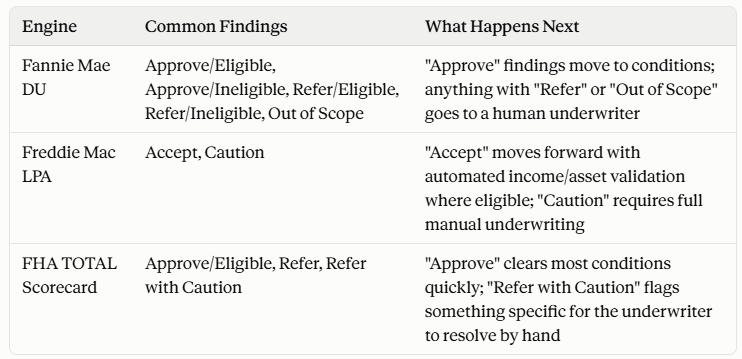
This is essentially the "clearance and triage" step of the whole system: it sorts files that are clean enough to fast-track from files that genuinely need a person's judgment. It's also why an automated "approval" was never meant to be the final word. It's a recommendation, not a closing document.
Tools that Provide Mortgage Underwriting Automation
Fannie Mae's Desktop Underwriter (DU)
Best for: Standard Conventional and High-Balance loans being sold to Fannie Mae.
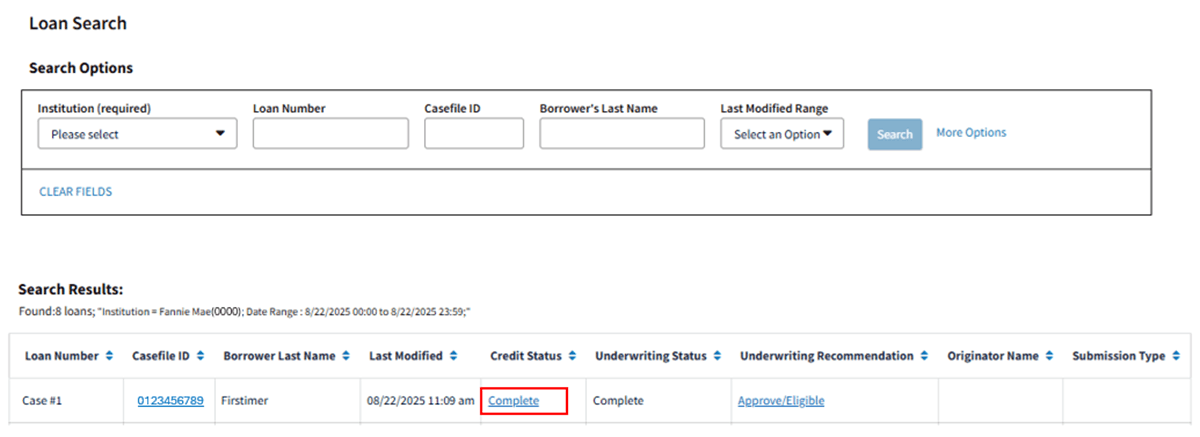
DU is essentially the reference point for the American mortgage industry. Since its 1995 launch, it's set the standard for what a digital approval should look like, and it keeps evolving. Fannie Mae's latest update, DU Version 12.1, expands eligibility rules for accessory dwelling unit income, adds HomeStyle Refresh capabilities, and broadens support for manufactured housing.
Features:
- Instant "Approve/Eligible" decisions.
- Direct integration with almost every Loan Origination System (LOS).
- Validated income, asset, and employment data through the Day 1 Certainty® program.
- Extensive support for 2-4 unit properties and manufactured homes.
- Comprehensive "Findings" report that outlines exactly what documentation is required.
Freddie Mac's Loan Product Advisor (LPA)
Best for: Lenders who want a second opinion or specifically target Freddie Mac's secondary market.
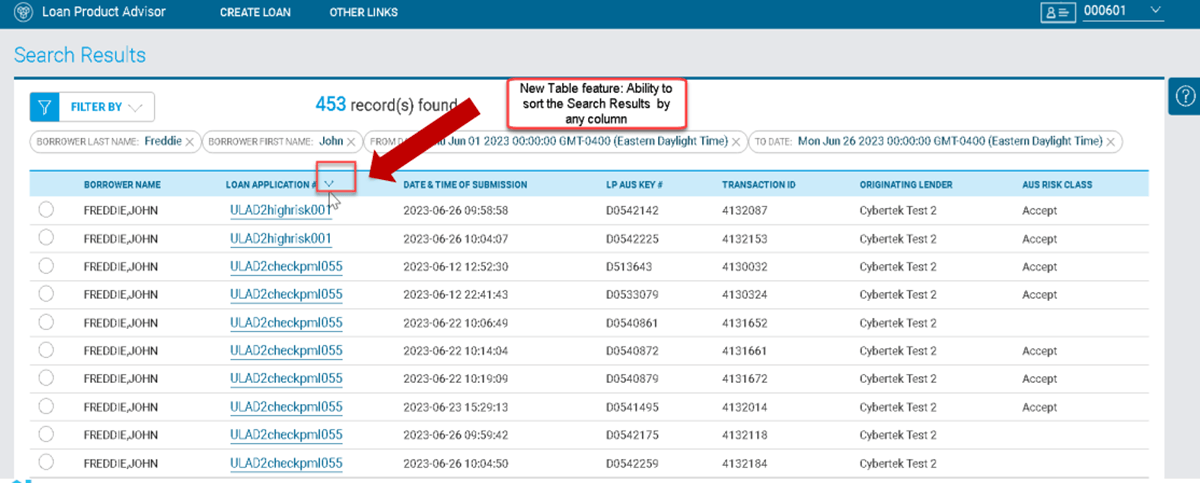
LPA is Freddie Mac's answer to DU. The two engines don't always agree, since their risk models weigh things a little differently, which is exactly why most brokers I know run a file through both before deciding how to package it. Freddie Mac updated LPA's rental income calculations for investment properties and 2-4 unit primary residences in its December 2025 specification release, which is worth knowing if you work with investor clients regularly.
Features:
- Streamlined "Asset and Income Modeler" (AIM) to reduce documentation.
- Integrated credit reporting from all three major bureaus.
- Real-time feedback on loan eligibility.
- Specific "ChoiceHome" features for affordable housing initiatives.
- Automated collateral evaluation (ACE) to potentially skip the appraisal.
Zeitro's AI Mortgage SaaS
Best for: Modern brokers and loan officers juggling complex Non-QM files who need a neutral AI assistant that isn't tied to any one lender's guidelines.
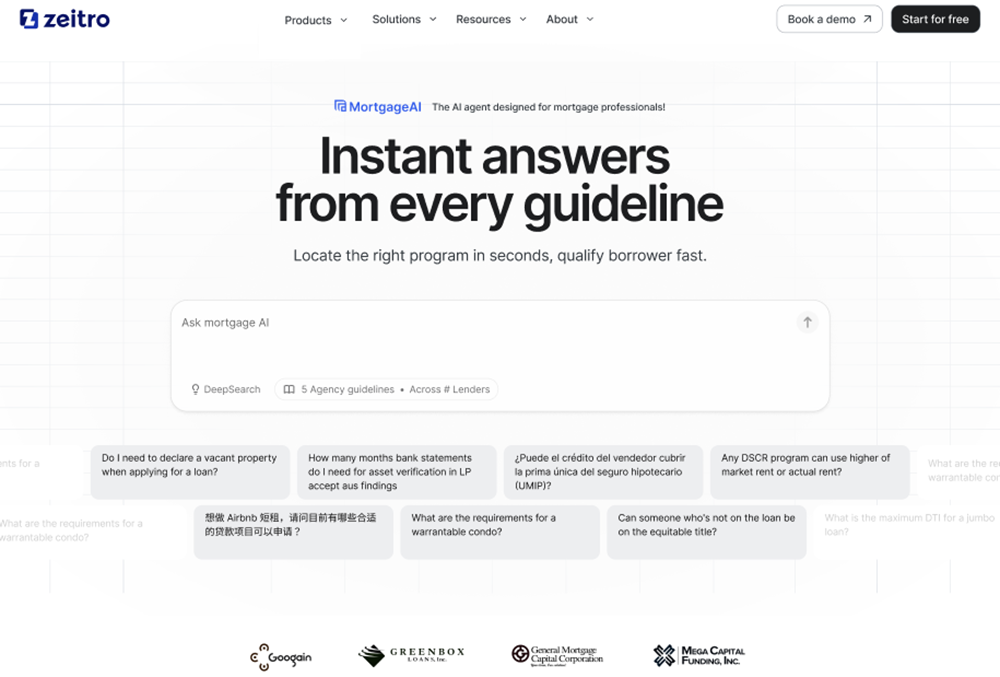
I've found Zeitro genuinely useful precisely because it isn't owned by a single investor. It behaves more like a senior underwriter sitting next to you, ready to answer questions across more than 1,000 continuously updated guidelines from over 100 investors, including names like AAA Lending, AD Mortgage, CMG Financial, and Freedom Mortgage.
Features:
- Zeitro Strata AI: A specialized assistant for querying complex QM and Non-QM guidelines — DSCR, ITIN, bank statement programs, and more — with answers that come back cited in seconds, not thirty minutes of manual lookup.
- Digital 1003 (POS): A borrower-facing portal built to hit 90%+ completion rates and export data in FNM 3.4 format.
- DeepSearch Technology: Cross-checks over 100 investors at once, which is exactly what you need when you're trying to answer a question like where a difficult, non-standard file might actually find a home on the secondary market.
- AI DTI and Income Calculator: Automates the qualifying income math using AI, which is one of the more error-prone parts of any pre-qual.
- Pricing Engine: Compares live rate sheets across investors so you're not eyeballing spreadsheets to figure out where a loan prices best, useful if you're the type who wants to compare pricing and underwriting fit side by side before running full numbers.
- GrowthHub & Personalized Microsites: Built on Bluerate, these give loan officers a branded page that functions a bit like a lightweight CRM front end, pulling in organic leads and showcasing live rate quotes.
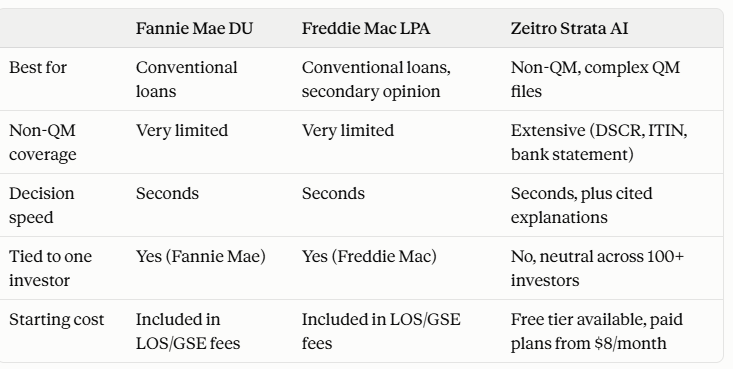
Here's how the three stack up at a glance:
FAQs about Mortgage Underwriting Automation
Q1. Will automation replace human underwriters?
No. It replaces the busy work. People are still needed for final sign-offs, genuinely complex problem-solving, and handling the nuances of high-net-worth or otherwise atypical borrowers.
Q2. Can I use these tools for Non-QM or DSCR loans?
Standard systems like DU and LPA weren't really built for Non-QM loans. That's exactly the gap tools like Zeitro Strata AI fill. They're built specifically to handle the outside-the-box guidelines that traditional GSE engines simply won't touch.
Q3. Is my borrower's data safe?
With the right vendor, yes. Zeitro, for example, is SOC 2 Type II certified, which is the standard financial services companies look for when they need proof a platform takes data security seriously.
Q4. How much does this technology cost?
It varies. GSE systems like DU and LPA come bundled into your existing LOS or transaction fees, while modern SaaS tools like Zeitro offer a free tier, with paid plans starting around $8 per month per user, which makes it accessible even for a one-person shop.
Q5. How accurate is AI-driven income calculation?
Top-tier tools are reaching over 85% accuracy on income calculation today, which cuts down significantly on the back-and-forth that used to eat up the processing stage.
Q6. What's the difference between an AUS finding and a final loan approval?
An AUS finding, like Approve/Eligible, is a recommendation based on the data submitted. It's not a closing document. A human underwriter still has to verify the actual documents, clear any outstanding conditions, and sign off before the loan can fund.
Final Word
Moving toward automation isn't just chasing a trend. In a margin-compressed market, it's closer to survival. By handing the repetitive guideline research and data entry over to AI, we free up time for the part of this job that actually pays: building relationships and getting deals closed.
My Recommendations:
- For Conventional Files: Get comfortable with Fannie Mae's DU. It's still the backbone of the industry for good reason.
- For Complex and Non-QM Deals: Use Zeitro Strata AI. It's the fastest way I've found to verify eligibility for DSCR, ITIN, or bank statement loans without reading through a 500-page guideline PDF.
- For Client Intake: Roll out Zeitro's Digital 1003. Borrowers appreciate the five-minute mobile experience, and you'll appreciate the auto-generated FNM 3.4 files landing straight in your LOS.
People Also Read
- What is Mortgage Eligibility Checker? Best Tool to Verify Guidelines
- Best Mortgage Underwriter Software: AI & Guideline Verification
- 6 Best Loan Origination Software for LOs/Brokers
- Best CRM for Loan Officers: Which One Suits You Most?
- [ Guide] How to Calculate DTI Ratio for Mortgage?
![[Tips for Loan Officers] How Can I Lower Borrower DTI?](https://cdn.prod.website-files.com/6731bc6e813a541b54c30b10/6aa3b89e281a639e7a5c6fca_lower-debt-to-income-ratio-banner.jpg)