Written by

Eric
Share this article

.svg)
Subscribe to updates
Last Checked and Updated on September, 2026
Whenever I talk to homebuyers or fellow loan professionals, one frustration comes up again and again: mortgage guidelines are dense, confusing, and always changing. If you're trying to figure out how to check mortgage eligibility in 2026, you're not alone. Working out whether a borrower actually qualifies used to mean hours of digging through PDF manuals from a dozen different investors.
That's changing fast. Everyday buyers still benefit from knowing the basic requirements before they even talk to a bank, but loan officers and brokers now have a faster path. Tools like Zeitro let mortgage professionals confirm eligibility against real guideline sources in seconds instead of hours, and you can try it with free daily queries.
What Is Mortgage Eligibility, in Plain English?
Mortgage eligibility is simply the checklist lenders use to decide whether you can safely repay a home loan. When I review a file, I'm weighing income history, existing debt, credit, and available down payment against a specific program's rules. Because limits get adjusted every year, here's where things stand for 2026:
- Conventional Loans: A minimum credit score of 620 and at least 3% down. The 2026 baseline conforming loan limit for most U.S. counties is $832,750 for a single-family home, rising to $1,249,125 in high-cost areas.
- FHA Loans: Built for buyers with thinner credit. You can qualify with a 580 score and 3.5% down.
- VA & USDA Loans: Both allow 0% down for eligible veterans or rural buyers, though most lenders still like to see a credit score in the 620-640 range.
- Non-QM Loans: These skip the standard W-2 paperwork entirely. Self-employed borrowers can qualify using bank statements or a DSCR (Debt Service Coverage Ratio) calculation for rental properties instead.

Also Read:
- What Are FHA Mortgage Guidelines? How to Verify FHA & Overlays Quickly?
- Conventional Mortgage Guidelines: What and How to Check Quickly?
- VA Mortgage Guidelines: What Are They and How to Check Them Quickly?
- Foreign National Mortgage Guidelines: Verify Eligibility Fast
- How to Determine Mortgage Eligibility? Verify Guidelines in Seconds
- Max DTI for Mortgage: Requirements By Loan Types
What Is a QM Loan, and Why Does It Matter?
You'll hear the term "QM loan" a lot once you start shopping, so it's worth unpacking. QM stands for Qualified Mortgage, a designation created under federal Ability-to-Repay rules. A loan that meets QM standards gives the lender legal "safe harbor" protection, which is part of why most mainstream loans on the market are structured as QM.
Here's the nuance most articles skip: the old rule requiring a hard 43% debt-to-income cap for QM status was replaced back in 2021. Today, general QM status is mainly determined by pricing — specifically, whether the loan's APR stays within 2.25 percentage points of the average prime offer rate. In practice, though, most lenders and automated underwriting systems (like Fannie Mae's Desktop Underwriter) still treat 43-45% DTI as a comfortable working ceiling, which is why you'll still see that range quoted constantly.
A Non-QM loan simply means the loan doesn't meet that federal safe-harbor definition, not that something is wrong with it. Non-QM programs exist precisely to serve borrowers — self-employed workers, real estate investors, foreign nationals — who don't fit neatly into agency guidelines.
Who Needs to Comply with Mortgage Eligibility Rules?
It's easy to assume these rules only apply to the person buying the house, but compliance runs both directions. Both sides of the transaction have to follow the guidelines closely for the deal to close cleanly.
- Borrowers: Whether you're a W-2 employee going conventional or an investor applying for a Non-QM loan, you need to demonstrate you meet the lender's financial thresholds.
- Lenders and Loan Professionals: Brokers, loan officers, and account executives have to cross-check every applicant against thick rulebooks. Approve a file that doesn't actually satisfy mortgage eligibility guidelines, and the lender risks steep penalties or gets stuck holding a loan nobody will buy.
The 4 C's Lenders Actually Look At
Behind every eligibility decision, underwriters are quietly scoring four core factors, often called the 4 C's of underwriting:
- Credit — your score and payment history, which signal how reliably you've handled debt in the past.
- Capacity — your income relative to your debts, expressed through your DTI ratio.
- Capital — the cash you bring to the table: down payment, closing costs, and reserves.
- Collateral — the property itself, confirmed through an appraisal to make sure it supports the loan amount.
Miss on one and you're not automatically disqualified — a strong credit score can offset a thinner reserve cushion, for instance — but understanding all four gives you a much clearer picture of where you actually stand.
Why Bother Checking Your Eligibility Early?
I always tell clients and colleagues to run their numbers before they even open a listings app. Checking early saves a surprising amount of heartbreak.
- Understand Your Purchasing Power: You get a realistic price range instead of falling for a home you can't actually finance.
- Catch Red Flags Early: A quick review surfaces credit errors or high debt loads while you still have time to fix them.
- Speed Up Pre-qualification: Having your numbers ready makes the formal pre-qualification step faster, so you can move quickly in a competitive market.
- Land on the Right Loan Program: If your tax returns don't reflect enough income, an early check might point you toward a Non-QM bank statement loan instead of a conventional one.
- Rent Payment History Can Help: If you're a first-time buyer with a thin credit file, a clean 12-month rent-payment record can matter more than people realize. Fannie Mae estimates roughly 17% of first-time buyers who were initially turned down get approved once positive rent history is factored in.

How to Check for Home Loan Eligibility?
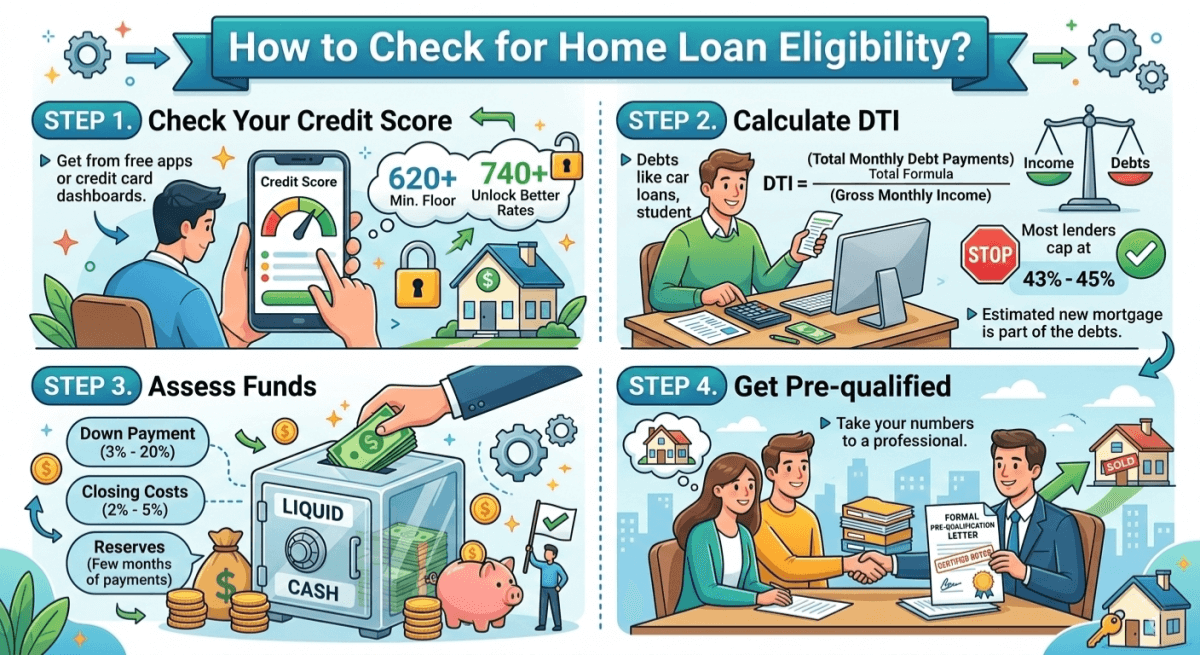
Doing a basic self-assessment is easier than most people expect. Here's the sequence I recommend before you ever pick up the phone to call a lender.
STEP 1. Pull Your Credit Score
Your credit shapes almost every other number in the process. Grab your score from a free app or your card issuer's dashboard. A 620 is generally the floor for conventional financing, but climbing above 740 unlocks meaningfully better rates and cheaper mortgage insurance.
STEP 2. Calculate Your DTI
Add up your monthly debt payments — car loans, minimum card payments, student loans — plus your estimated new mortgage payment, then divide that total by your gross monthly income. Most lenders using automated underwriting will comfortably approve files up to 43-45% DTI, and sometimes higher with strong compensating factors like reserves or a large down payment.
STEP 3. Verify Your Assets and Income
This is where a lot of first-time buyers get caught off guard. Lenders typically want two months of bank statements, and Fannie Mae's rule of thumb flags any single deposit larger than 50% of your monthly qualifying income as a "large deposit" that needs a paper trail — think a bonus, a gift, or a tax refund with documentation attached. On the income side, W-2 employees usually need recent paystubs plus a verbal or written verification of employment, while self-employed borrowers document income through tax returns or, increasingly, bank-statement programs. Budget in your down payment (3% to 20% depending on the loan) plus closing costs (roughly 2% to 5% of the loan amount), and try to keep a few months of reserves on hand.
STEP 4. Get Formally Pre-qualified
Once you've run your own numbers, bring them to a professional. A loan officer can run a soft credit pull and issue a formal pre-qualification letter, which signals to sellers that you're a serious, capable buyer.
Comparing Your Options for Checking Eligibility
Not every eligibility check is created equal. Here's how the three common paths stack up:
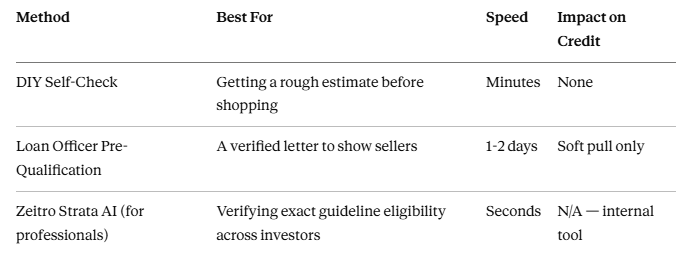
A DIY check gets you in the ballpark. A loan officer's pre-qualification carries real weight with sellers. And for the professionals working the file, a guideline-verification tool closes the gap between the two.
How Professionals Verify Mortgage Eligibility
Borrowers can do a rough self-check, but loan officers and brokers face a much harder version of the same task. We're cross-referencing borrower files against more than 1,000 guidelines from over 100 investors, and those guidelines shift constantly. That used to mean a lot of manual PDF reading. Now, I rely on Zeitro Strata AI.
Zeitro is an AI-native platform built specifically for the U.S. mortgage industry, and it changes how this part of the job actually works:
- Instant DeepSearch with Citations: Instead of spending 30 minutes hunting through a guideline PDF, you type your scenario and get a sourced answer in seconds, cross-checked against 100+ investors so you can always trace it back to the original document.
- Broad Non-QM and QM Coverage: It's not limited to Fannie Mae and FHA. Zeitro Strata AI also handles complex Non-QM scenarios — Asset Utilization, DSCR, ITIN, Foreign National — pulled straight from lender guidelines like AD Mortgage and Luxury Mortgage.
- Scenario-Specific Search: You can narrow results with custom tags for a loan type or lender, and the "Explain" feature acts as a follow-up review when an answer needs more context.
- Real Time Savings: Loan teams using Zeitro report saving over 7 hours per file and closing pre-qualifications about 2.5x faster. It's also worth noting for identifying qualified prospects early, before a full application eats up everyone's time. You can start with free queries a day.

FAQs About Checking Mortgage Eligibility
What does "mortgage eligibility" actually mean if I've never heard the term?
It just means whether you currently meet a lender's requirements to borrow money for a home — based on your credit, income, debt, and available cash. It's not a fixed score; it changes as your finances change.
What is a QM loan?
A Qualified Mortgage (QM) is a loan that meets federal Ability-to-Repay standards and gives the lender legal safe-harbor protection. Most standard conventional and government loans are structured as QM; Non-QM loans simply use different qualifying rules for borrowers who don't fit the standard mold.
Does checking my mortgage eligibility hurt my credit score?
Usually not. An initial pre-qualification check only requires a soft pull, which has zero impact on your score. A hard pull only happens once you move forward with a formal application.
Can I still get a mortgage with a high DTI ratio?
Yes. If your DTI runs above the typical 43-45% range, options include a larger down payment, paying down smaller debts first, or exploring Non-QM loans, which often allow more flexible debt-to-income underwriting.
What counts as verified assets for a mortgage?
Lenders generally want two months of bank statements showing your down payment and closing costs are already sitting in your account, plus reserves. Any single deposit over roughly 50% of your monthly qualifying income needs a documented source, whether that's a bonus, a gift letter, or a tax refund.
What is the difference between pre-qualification and pre-approval?
Pre-qualification is a quick estimate based on information you self-report. Pre-approval carries far more weight, since the lender has already verified your tax returns, bank statements, and credit report.
How do Non-QM loans affect eligibility?
Non-QM loans widen eligibility considerably for people who don't fit the standard mold. Instead of requiring W-2s, they let self-employed buyers or investors qualify through bank statements or rental income.
Also Read: Non-QM Loan Guidelines: How to Check and Verify with AI Accuracy
How long does a mortgage eligibility check actually take?
A DIY self-assessment takes just a few minutes. For professionals verifying complex, multi-investor guidelines with a tool like Zeitro, what used to take hours now takes seconds.
Conclusion
Understanding your borrowing power is the first real step in any home search. Whether you're headed toward a standard conventional loan or a more complex DSCR setup, knowing your 2026 limits and requirements up front saves everyone time.
- If you're a mortgage professional still digging through PDFs by hand, it's worth modernizing that workflow. I'd genuinely recommend trying Zeitro Strata AI — it gives fast, fully-cited answers, and you can start with 3 free queries a day.
- If you're a homebuyer ready to find out exactly what you qualify for, head over to Bluerate. You can connect directly with loan officers who use this same technology to get a free consultation and a personalized rate quote today.
People Also Read
- Reverse Mortgage Eligibility: Check Requirements and Criteria Here
- Best No Income Verification Mortgage Lenders
- Best DSCR Loan Lenders: Which to Choose from?
- 8 Best Non-QM Mortgage Lenders: Which to Choose?

![[Tips for Loan Officers] How Can I Lower Borrower DTI?](https://cdn.prod.website-files.com/6731bc6e813a541b54c30b10/6aa3b89e281a639e7a5c6fca_lower-debt-to-income-ratio-banner.jpg)