Written by

Eric
Share this article


Subscribe to updates
Last Checked and Updated on September, 2026
I talk to homebuyers every week who tense up the moment I mention "Private Mortgage Insurance." I get it. With the national median home price now sitting above $430,000, coming up with a full 20% down payment just isn't realistic for most people.
But from where I sit as a loan officer, PMI isn't a punishment. It's the thing that lets you buy years sooner instead of waiting to save up a giant cash cushion. Let's walk through what you'll actually pay this year, and how to get rid of it faster than you might think.
Key Takeaways
- 2026 rates: Most borrowers land somewhere between 0.2% and 2.25% of the loan amount per year, though the typical range for a solid credit profile is closer to 0.3%–1%.
- Who it protects: PMI protects the lender, not you, if you stop making payments.
- Cancellation: PMI drops off automatically at 78% LTV, you can request removal at 80%, and by law it must end at the midpoint of your loan's amortization schedule no matter what your LTV looks like.
- Tax break is back: Starting with the 2026 tax year, PMI premiums are deductible again for eligible homeowners who itemize.
Also Try: Zeitro Private Mortgage Insurance (PMI) Calculator
What Is Private Mortgage Insurance (PMI)?
Here's the honest version I give clients: Private Mortgage Insurance is required on a Conventional Loan whenever your down payment falls under 20%. It exists purely to reimburse the lender if you default. It does nothing for your equity or your investment.
Don't confuse it with homeowner's insurance, which covers fire, storms, or theft. And it's a different animal from an FHA loan's Mortgage Insurance Premium (MIP) or a USDA loan's guarantee fee — more on those below. Annoying as PMI feels, it's also the reason lenders are willing to approve low-down-payment loans at all.
How Much Does PMI Cost in 2026?
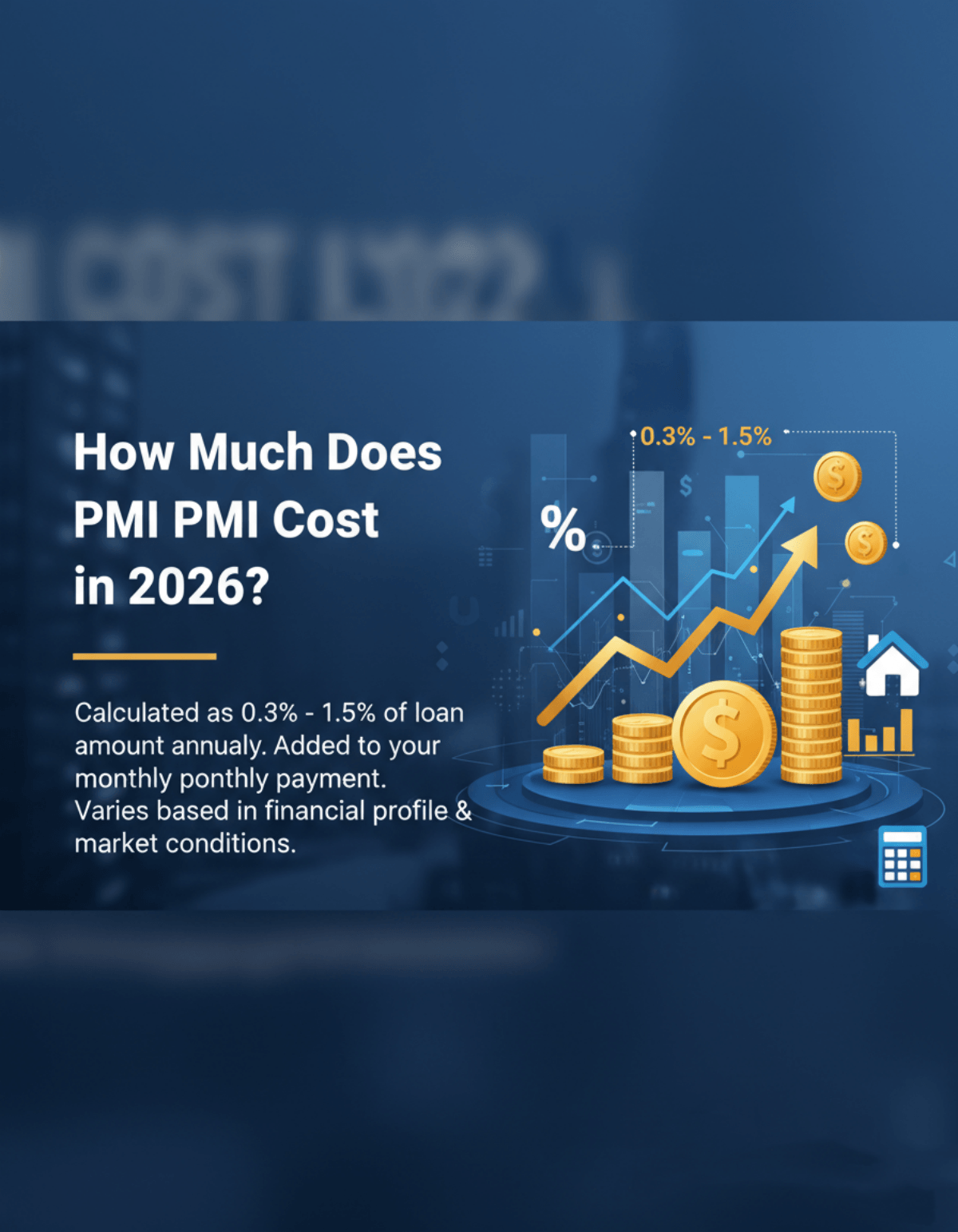
There's no single sticker price. Insurers price PMI as a percentage of your loan balance, and that percentage swings based on your risk profile. Across the industry, published rate cards from the major mortgage insurers put the full range at roughly 0.19% to 2.25% annually.
Most buyers with decent credit and a down payment of 5% or more land in a narrower band, around 0.3% to 1%. A rough shortcut I use with clients: figure on $30 to $70 a month for every $100,000 you borrow, depending on your credit and down payment.
Your lender takes the annual figure, splits it into 12 pieces, and folds it into your monthly mortgage bill. You never write a separate check for it.
PMI Rates by Credit Score and Down Payment
Credit score moves the needle more than almost anything else. Here's a representative snapshot of how annual PMI rates typically shake out across FICO tiers and down payment sizes:
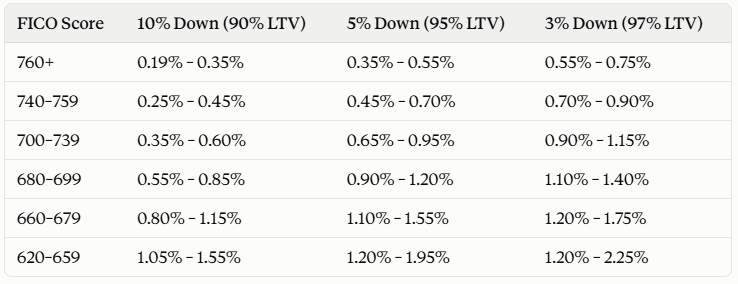
These are typical ranges, not guaranteed quotes. Your actual rate also depends on your debt-to-income ratio, occupancy type, and loan term, so two people with the same score can still see different numbers. For your exact figure, run your details through Zeitro's PMI calculator rather than guessing.
Average PMI Cost, in Real Dollars
Let's put actual numbers behind those percentages. The typical U.S. home now runs around $430,000. Bring a 5% down payment, and that's $21,500 out of pocket, leaving you with a $408,500 loan.
At an average rate of 0.8%, your annual premium comes out to $3,268. Split monthly, that's about $272 tacked onto your payment.
That's just a midpoint estimate, though. I've had clients paying under $100 a month and others well past $350. Your number depends entirely on your own financial picture.
Common PMI Cost Examples
To show how much these numbers swing, here are two real scenarios from my own client files. Both bought a $400,000 house, and their bills couldn't have looked more different:
- Example 1: Sarah had a 760 credit score and put 10% down. As a low-risk borrower, her rate came in at 0.35%. Her added monthly cost? Just $105.
- Example 2: Mark had a 650 credit score and only managed 3% down. The lender priced his loan at higher risk, landing him a 1.2% rate. His monthly bill was $388.
Same house, nearly four times the premium. That gap is entirely about risk pricing, not luck.
Factors That Affect PMI Cost
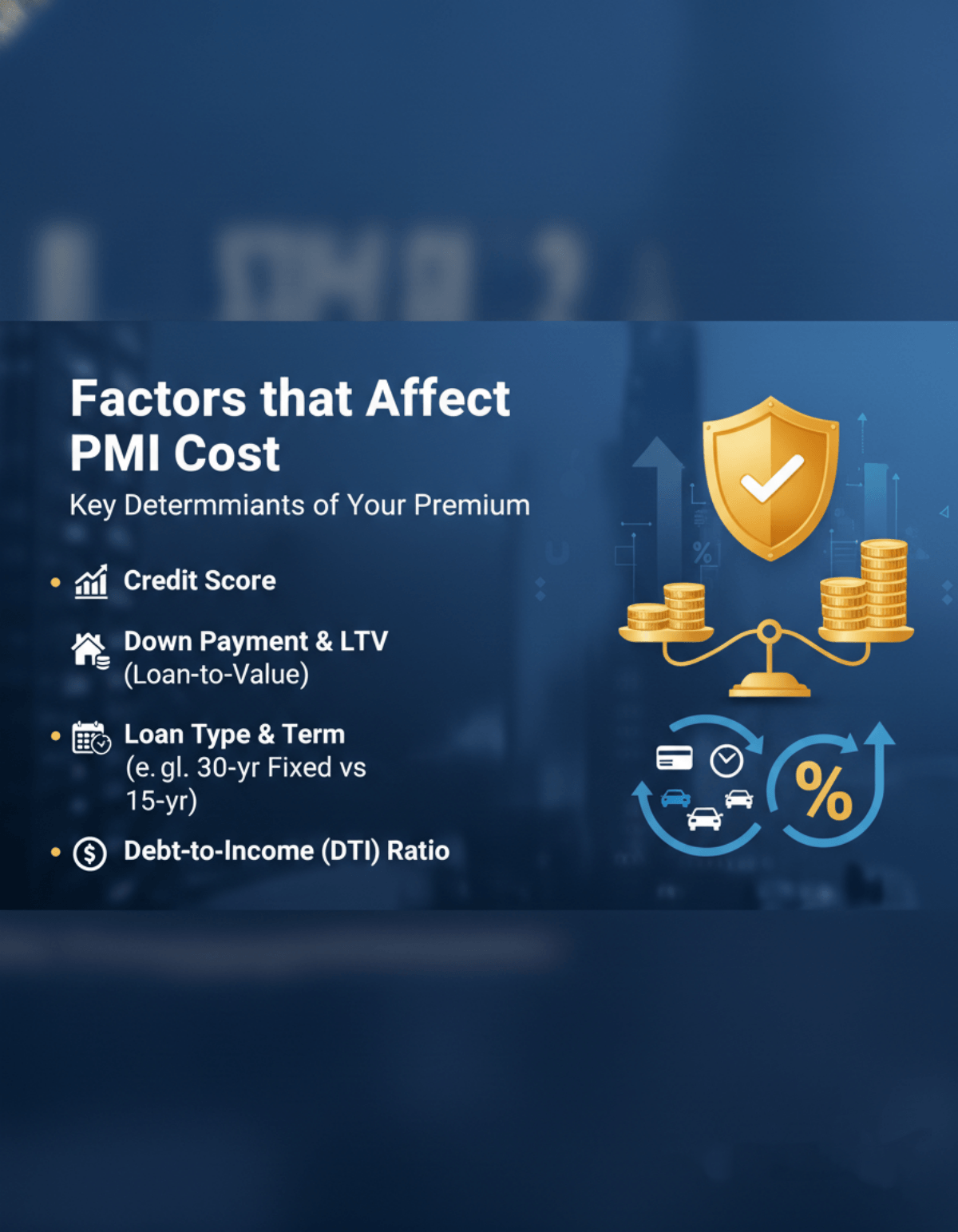
Before quoting a rate, insurers weigh a handful of specific inputs:
- Credit score: The single biggest lever. A stronger FICO score almost always means a cheaper premium.
- Down payment and LTV: Putting down 15% (85% LTV) gets you a noticeably better rate than scraping by with 3%.
- Loan type and term: A 30-year fixed loan usually carries a higher PMI rate than a 15-year term, since the insurer is exposed for longer. Adjustable-rate loans can push the rate up too.
- Debt-to-income ratio: If your paycheck is already stretched by car payments and credit cards, expect a higher premium.
- Occupancy and property type: A second home or investment property typically costs more to insure than a primary residence.
PMI vs. FHA MIP vs. USDA Guarantee Fee
Homebuyers mix these up constantly, so here's the quick breakdown:
- Conventional loan PMI applies only when you put down less than 20%. Once you build enough equity, it goes away.
- FHA loans charge a Mortgage Insurance Premium instead: a 1.75% upfront fee plus an annual charge of roughly 0.15% to 0.75%, depending on your loan term and down payment. On many FHA loans with less than 10% down, MIP sticks around for the entire loan term rather than canceling.
- USDA loans charge a 1% upfront guarantee fee plus a 0.35% annual fee, calculated on the remaining balance for the life of the loan.
- VA loans skip monthly mortgage insurance altogether, though most borrowers still pay a one-time VA funding fee at closing.
If your credit is strong, conventional PMI is usually the cheaper path. If your score needs work, FHA's flat MIP pricing can sometimes come out ahead. Worth running both numbers before you commit.
How to Reduce or Eliminate PMI Cost?
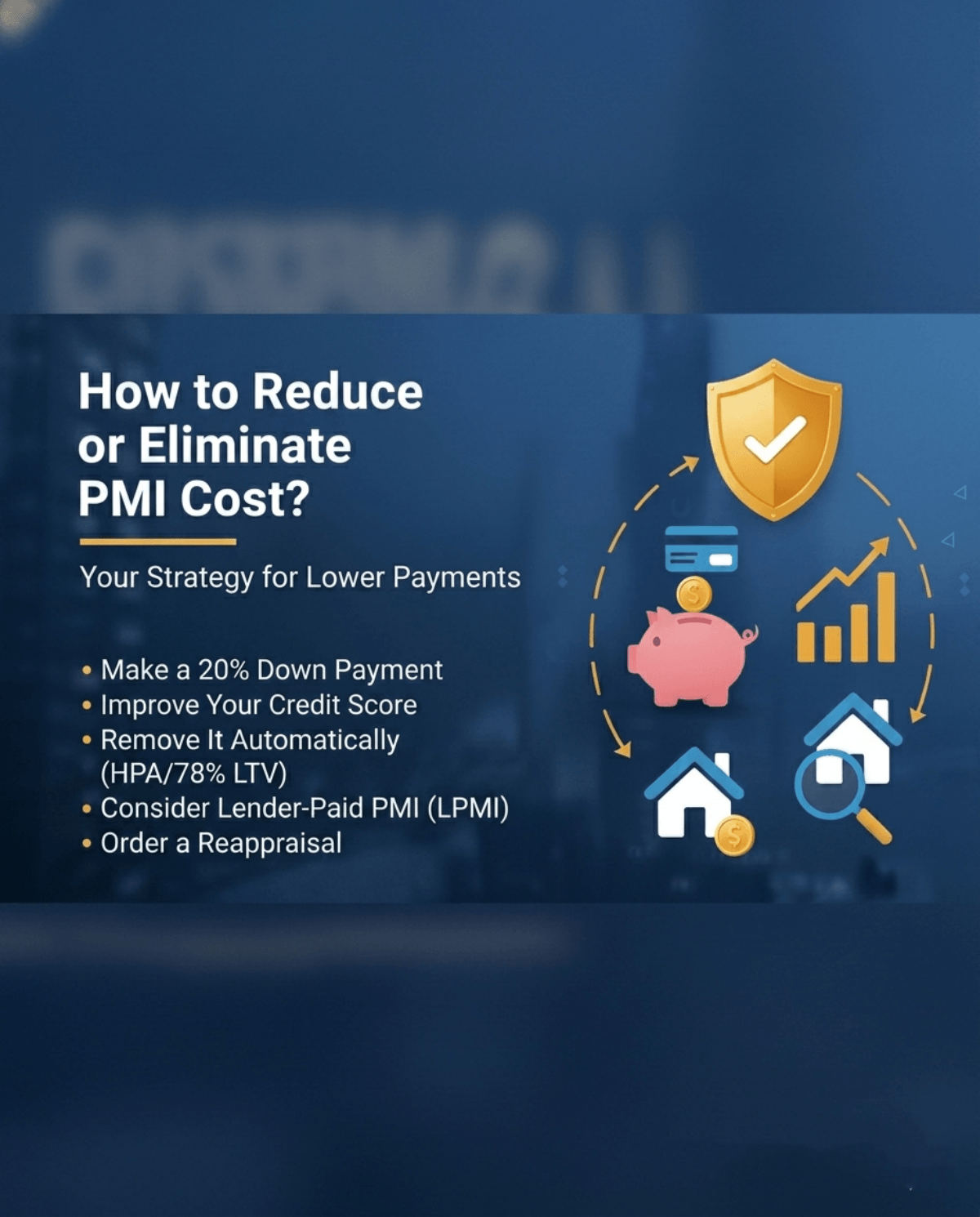
I tell every client the same thing: PMI is a temporary houseguest, not a permanent tenant. Here's how to shorten its stay or get rid of it entirely:
- Put 20% down from day one. Hit that mark, and you skip PMI entirely.
- Build your credit score before applying. Even a few months of paying down cards can move you into a cheaper tier.
- Let it terminate automatically. Under the Homeowners Protection Act, your lender must drop PMI once your LTV hits 78%. You can also request cancellation yourself at 80%.
- Know the midpoint rule. Even if your LTV hasn't reached 78% yet, the law requires PMI to terminate once you reach the midpoint of your loan's amortization schedule — the halfway point of a 30-year loan, for example — as long as you're current on payments.
- Consider Lender-Paid PMI (LPMI). Your lender covers the premium, but you accept a slightly higher interest rate in exchange. It can work well if you plan to refinance or sell within a few years.
- Ask for a new appraisal. If home values in your area have jumped, a fresh appraisal might already show you've crossed the 20% equity mark.
- Refinance if it makes sense. A refinance into a new loan with an LTV under 80% wipes out PMI on the spot.
Is PMI Tax Deductible in 2026?
For years, this deduction was in limbo. Congress let it lapse after 2021, and it sat unavailable through 2022, 2023, 2024, and 2025.
That changed with new legislation signed in 2025. Starting with the 2026 tax year, PMI and FHA MIP premiums are permanently treated as deductible mortgage interest for homeowners who itemize on Schedule A.
There's a catch: the deduction phases out at higher incomes. It starts shrinking once your adjusted gross income passes $100,000 and disappears completely around $110,000. Monthly premiums are deductible in full for the year you pay them; upfront premiums, like FHA's upfront MIP, get spread out over several years instead of claimed all at once.
If you pay PMI or MIP in 2026, keep your Form 1098 and talk to a tax preparer about whether itemizing makes sense for your situation. It's a real savings opportunity that a lot of homeowners still don't know exists.
FAQs About PMI Cost
Q1. Can I pay PMI upfront?
Yes. A Single-Premium option lets you pay the full amount at closing instead of monthly. It lowers your monthly payment, but you usually won't get a refund if you sell or refinance soon after.
Q2. Is PMI tax-deductible in 2026?
Yes, for eligible homeowners who itemize, though the deduction phases out for higher incomes. See the full breakdown above.
Q3. Do all mortgages require mortgage insurance?
No. Conventional loans require PMI only if you put down less than 20%. FHA loans use MIP regardless of down payment size. USDA loans charge a guarantee fee. VA loans skip monthly premiums but usually carry a one-time funding fee.
Q4. Does refinancing remove PMI?
It can. If your home's value has risen and your new LTV comes in below 80%, refinancing wipes out the PMI requirement on the new loan.
Q5. How long do you have to pay PMI?
It depends on how fast you build equity. Making standard payments alone usually takes 7 to 11 years to reach the 78% automatic cancellation point. Even if it takes longer, the law forces termination once you hit the midpoint of your loan term, regardless of your LTV at that point.
Final Word
PMI gets a lot of hate online, but it doesn't deserve it. I've watched it help plenty of families stop renting and start building equity years earlier than they'd planned.
Yes, it's an extra line on your monthly budget. But the cost is tied directly to your own financial health, and it's never permanent. Between paying down your balance, rising home values, the 78% cutoff, or the midpoint rule, you will eventually shake it off.
If you're planning to buy this year, talk with a licensed loan officer who can run your real numbers and tell you exactly what your 2026 PMI cost will look like.
People Also Read
- Max LTV: Check Maximum Loan-to-Value Ratios By Loan Types
- Max DTI for Mortgage: Requirements By Loan Types
- [Guide] How to Calculate DTI Ratio for Mortgage?
- Mortgage Application Form 1003 (URLA): Everything You Need to Know
- How to Calculate PMI? Do the Math On Your Own