Written by

Eric
Share this article

.svg)
Subscribe to updates
Last Checked and Updated on August, 2026
As a loan professional, I see it every week: homebuyers open their mortgage statement and wince at that extra Private Mortgage Insurance (PMI) line item. If you put down less than 20%, you already know the feeling. PMI got you into your home sooner, but it's a cost that protects your lender, not you, and it doesn't need to stick around forever.
The good news is that federal law spells out exactly when PMI must come off, and your loan type, payment history, and home value all affect how fast you can get there. Here's what actually determines your timeline, plus a few shortcuts most borrowers never hear about.
Key Takeaways
- You can request PMI cancellation once you reach 80% loan-to-value (LTV), meaning 20% equity.
- By law, your servicer must automatically drop PMI once your balance hits 78% LTV, which is the same as 22% equity.
- Even if you never hit 78% on schedule, federal law forces termination at the midpoint of your loan term, typically year 15 on a 30-year mortgage.
- A clean payment history is non-negotiable before any of this kicks in.
- Home renovations, extra principal payments, and refinancing can all shrink your timeline by years.
- Starting with the 2026 tax year, PMI premiums are deductible again if you itemize.
Also Try: Zeitro Private Mortgage Insurance (PMI) Calculator
Does PMI Go Away at 20%?
No, it doesn't vanish automatically at 20%. Under the Homeowners Protection Act (HPA), reaching 20% equity (or an 80% LTV) is merely the trigger point where you earn the right to request cancellation.
If you do nothing, your servicer isn't legally obligated to drop the premium until your balance naturally pays down to 78% of the original purchase price.
To stop paying as soon as you cross that 80% threshold, you must take the initiative and submit a formal, written request to your lender.
Ways to Get Rid of PMI from Mortgage
Fortunately, you have several legitimate paths to shake off this monthly burden. It all depends on your current financial situation and local housing market trends.
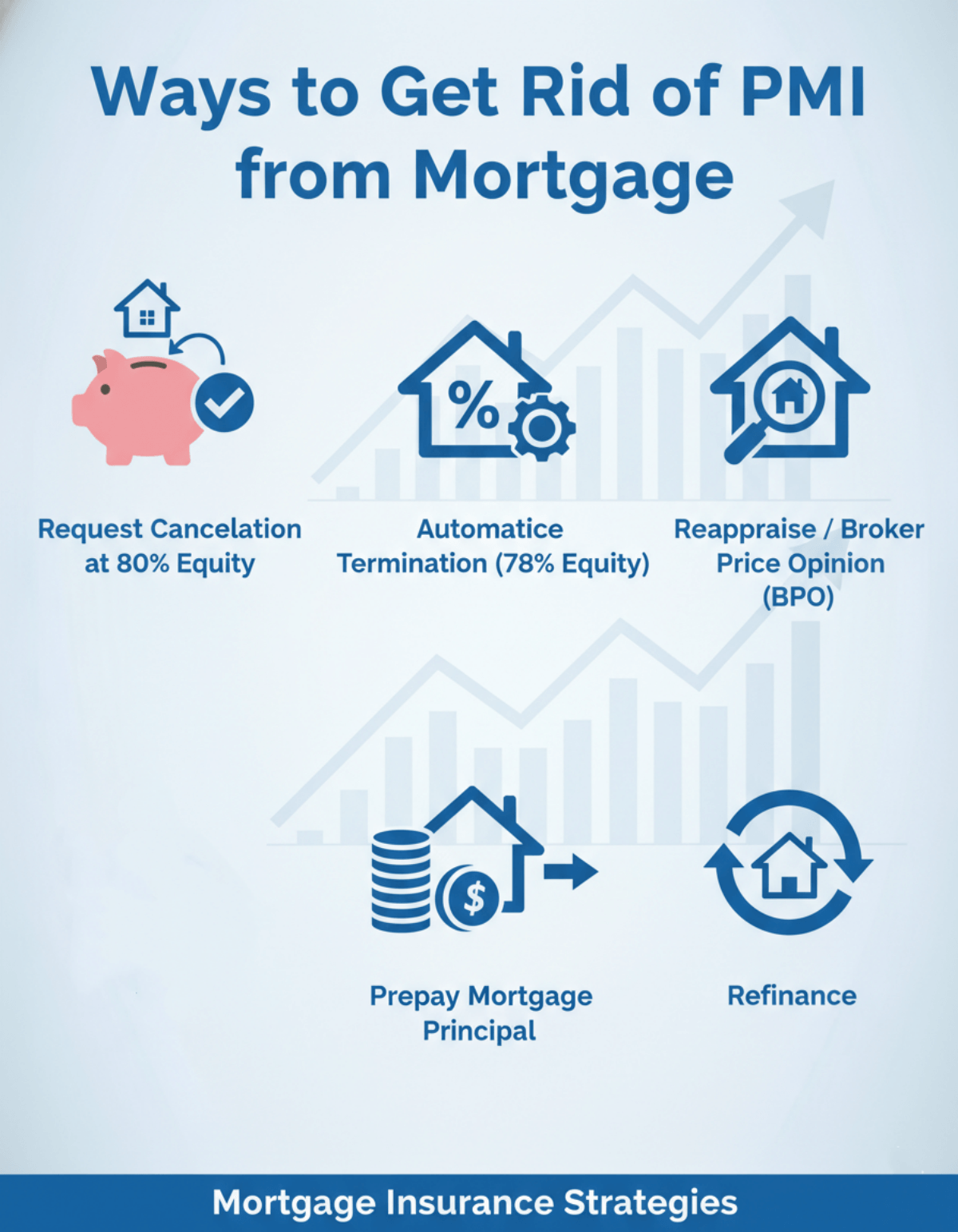
Request Cancellation at 80% Equity
Once your loan balance drops to 80% of your home's original purchase price (or the original appraised value, whichever was lower), you are in the driver's seat. Don't wait for your servicer to reach out. You need to write a formal letter requesting the removal of your private mortgage insurance.
Keep in mind that this 80% mark is calculated based strictly on your regular amortization schedule. The lender might require a basic certification to ensure the property hasn't declined in value and that no second mortgages or mechanics' liens are silently attached to your title.
Taking action at this exact moment saves you money before automatic termination kicks in months later.
Automatic Termination (78% Equity)
If writing letters isn't your style, you can simply rely on federal law. The Consumer Financial Protection Bureau (CFPB) enforces a rule stating that lenders must automatically cancel your PMI once your mortgage balance reaches 78% of the property's original value.
This happens naturally as you stick to your standard schedule. There is a catch, though: you must be completely current on your payments.
If you happen to be behind on your mortgage when the 78% milestone hits, the servicer will maintain the insurance coverage until you catch up and your account is back in good standing.
Final Termination at Your Loan's Midpoint
Here's a rule most articles on this topic skip entirely, and it's one of the strongest protections you have. Even if your home never appreciates and you only make minimum payments, federal law requires your servicer to end PMI once you reach the midpoint of your loan's original term, regardless of your LTV at that point.
On a standard 30-year mortgage, that midpoint lands at year 15. On a 15-year loan, it's the 7.5-year mark. This backstop exists specifically for borrowers who never formally request cancellation and whose homes don't gain value fast enough to hit 78% early. As long as you're current on payments when the date arrives, this one is automatic. No appraisal, no letter, no exceptions.
Reappraise/Broker Price Opinion (BPO)
What if your neighborhood has exploded in popularity, or you just completed a massive kitchen renovation? Your house is likely worth more now, meaning your Loan-to-Value ratio has naturally shrunk. In a hot market, you don't have to wait years to hit that magic equity number based on the old purchase price.
You can ask your lender to calculate your LTV using the current market value. Usually, this requires paying out of pocket for a professional appraisal or a Broker Price Opinion (BPO).
A crucial piece of advice from my experience: always contact your lender first. Hiring an outside expert without their blessing will just waste your money.
Prepay Mortgage Principal
For those who want to aggressively slash their debt, prepaying your mortgage principal is a fantastic strategy to remove PMI faster. By making extra principal payments each month or dropping a large lump sum, say, from a tax refund or a work bonus, you accelerate your timeline to hit that 80% LTV mark.
Even throwing an extra $100 toward the loan every billing cycle chops away at the balance significantly over time. Just make sure you specifically instruct your servicer to apply the extra funds directly to the "principal balance." Otherwise, they might hold the cash as a credit for future interest, defeating the purpose.
Refinance
When interest rates dip or your property value spikes, refinancing is a powerful move. By replacing your current mortgage with a brand new conventional loan, you bypass the old PMI completely, as long as your new loan sits at an 80% LTV or lower.
Refinancing also gives you a chance to secure a better interest rate or adjust your loan term. However, you need to run the numbers carefully. Refinancing comes with closing costs, which usually range from 2% to 5% of the loan amount. I always advise clients to calculate their break-even point: divide your total closing costs by your monthly savings.
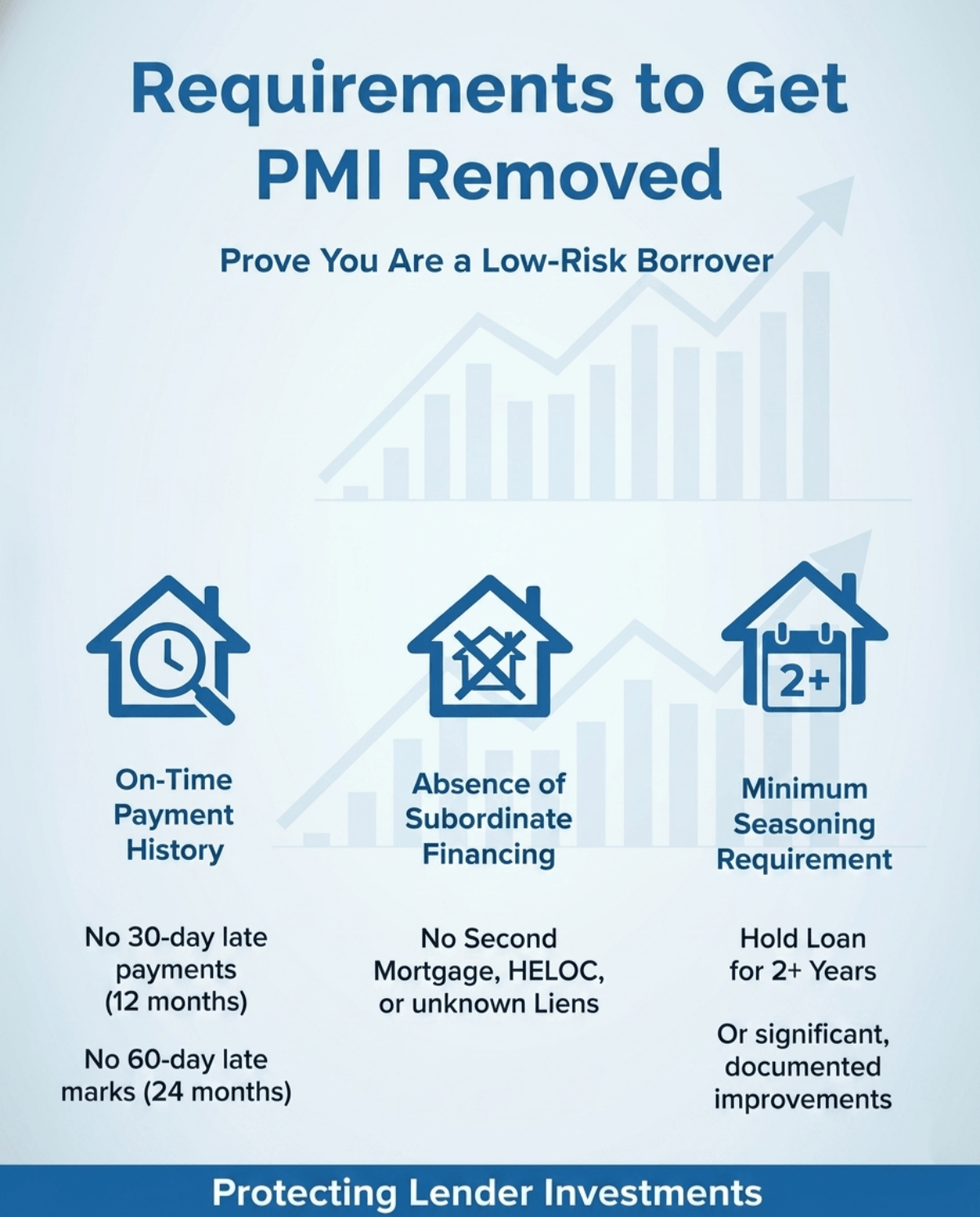
Requirements to Get PMI Removed
Before any servicer agrees to drop your mortgage insurance, you must prove you are a low-risk borrower. Meeting the equity threshold isn't enough. Lenders enforce strict rules to protect their investments. Here is what they look for:
- On-Time Payment History: Your track record must be spotless. Usually, this means zero payments that were 30 days late within the past 12 months, and no 60-day late marks in the last 24 months.
- Absence of Subordinate Financing: The bank wants to ensure no hidden debt is threatening their position. Having a second mortgage, a HELOC, or unknown liens can complicate or temporarily block your cancellation request.
- Minimum Seasoning Requirement: Lenders typically enforce a "seasoning period," meaning you must hold the loan for at least two years before requesting removal based on a new appraisal, unless you've made significant, documented structural improvements.
PMI Is Tax-Deductible Again Starting in 2026
Here's a piece of news that hasn't made it into most PMI guides yet: the mortgage insurance premium deduction is back. It expired at the end of 2021 and sat dormant through 2025, but the One Big Beautiful Bill Act reinstated it permanently, effective for premiums paid starting with the 2026 tax year.
To claim it, you'll need to itemize on Schedule A rather than take the standard deduction, and the benefit phases out for higher earners, generally between $100,000 and $110,000 in adjusted gross income. Your mortgage servicer reports the premiums you paid on Form 1098, so the number you need is already sitting in your year-end tax documents.
It's a modest win on its own, but combined with mortgage interest and property tax deductions, it can shift the math on whether itemizing beats the standard deduction for your household.
FAQs About Removing PMI from Mortgage
Q1. When does MIP go away on an FHA loan?
FHA loans don't technically carry PMI. They use a Mortgage Insurance Premium (MIP), and the rules for getting rid of it depend heavily on when you closed the loan.
If your FHA loan closed on or after June 3, 2013 and your down payment was under 10%, MIP sticks around for the life of the loan. The only real exit is refinancing into a conventional mortgage. If you put down 10% or more on that same timeline, MIP automatically ends after 11 years of payments.
Loans that closed before June 3, 2013 follow older, friendlier rules: MIP can be cancelled once your LTV reaches 78% and you've made at least five years of payments. A fair number of borrowers with these legacy loans are still paying MIP they technically qualify to drop, simply because nobody told them.
One more thing worth watching: as of 2026, lawmakers have floated a bipartisan proposal that would let newer FHA loans cancel MIP at 78% LTV instead of running for the full loan term. It hasn't passed, so don't count on it yet, but it's a policy shift worth tracking if you're carrying FHA insurance long-term.
Q2. Does PMI go away after reaching 20% equity automatically?
No. Reaching 20% equity, or 80% LTV, only gives you the legal right to submit a written cancellation request. It doesn't trigger removal on its own.
Skip that step, and federal law only forces automatic removal once your LTV reaches 78%, or at the midpoint of your loan term if you never get there first, assuming your payments stay current the whole time.
Q3. Can home improvements speed up PMI removal?
Yes. A finished basement, a new bedroom, or a full kitchen remodel can meaningfully raise your home's appraised value, which lowers your LTV without you paying down a single extra dollar of principal.
Major structural upgrades like these often let lenders waive the usual two-year seasoning period. You can request a fresh appraisal to prove you've crossed the equity threshold, but always clear the appraiser with your servicer first so the report actually counts.
Q4. Can you avoid PMI with just 10% down?
Yes, and there are a few legitimate ways to do it. Lender-Paid Mortgage Insurance (LPMI) has the bank cover the premium upfront in exchange for a slightly higher interest rate on your loan. An 80-10-10 piggyback structure is another option: an 80% first mortgage, a 10% second mortgage, and 10% cash down, none of which requires PMI. VA and USDA loans skip monthly mortgage insurance entirely for borrowers who qualify.
Q5. How much does PMI cost on a $300,000 loan?
Expect somewhere between $1,500 and $4,500 a year, or roughly $125 to $375 a month. Annual rates generally fall between 0.5% and 1.5% of your loan amount, with your exact number driven by credit score, down payment size, and debt-to-income ratio. Borrowers with strong credit tend to land near the bottom of that range.
Q6. Does my PMI payment decrease over time, even before it's removed?
Often, yes. Many PMI policies are priced against your current loan balance rather than a fixed number, so your monthly premium can drift down slightly each year as you pay down principal, well before you hit the 80% or 78% milestones. It's a gradual decline, not a dramatic one, but it's a different mechanism than the outright cancellation this guide focuses on.
Conclusion: Is It Better to Pay PMI or Put 20% Down?
Deciding whether to save up a full 20% down payment or bite the bullet on PMI is a highly personal financial decision. Waiting years to save 20% carries a massive opportunity cost. You might miss out on a great home, and rising property prices could price you out of the market entirely.
Conversely, paying PMI is an unrecoverable monthly expense, but it allows you to start building equity and lock in a property immediately. I always recommend sitting down with a trusted loan officer to review your specific assets. Run the numbers, evaluate your local housing market, and choose the path that best supports your long-term wealth.
People Also Read
- Max LTV: Check Maximum Loan-to-Value Ratios By Loan Types
- Max DTI for Mortgage: Requirements By Loan Types
- Mortgage Debt-to-Income Ratio Explained: Definition& Max DTI
- [Guide] How to Calculate DTI Ratio for Mortgage?
- Mortgage Application Form 1003 (URLA): Everything You Need to Know
- How to Calculate PMI? Do the Math On Your Own

![[Tips for Loan Officers] How Can I Lower Borrower DTI?](https://cdn.prod.website-files.com/6731bc6e813a541b54c30b10/6aa3b89e281a639e7a5c6fca_lower-debt-to-income-ratio-banner.jpg)